

Agency vs In-House Web Developer Salary: Which Pays More in 2026?
By Josh Ternyak

April 22, 2026
In-house developers earn 10-37% more than agency developers, with the gap widening at senior levels where equity becomes significant. This comprehensive guide covers salary by level, total compensation comparison, career development trade-offs, who each path suits best, agency structure types, the optimal agency-first-then-in-house strategy, successful transition tactics, and agency salary negotiation.
Agency vs. In-House Web Developer Salary: Which Pays More?
The agency vs. in-house decision is one of the most consequential career choices a web developer makes — affecting not just salary but skill development trajectory, daily work variety, career ceiling, and professional identity. Both paths produce well-compensated, successful developers; they just do it differently, and the "better" choice depends entirely on what you want your career to look like over the next 5–10 years.
In raw salary terms, in-house roles typically pay 10–20% more than equivalent agency roles. But the comparison is more nuanced than a salary table: agency developers build broad exposure that accelerates to senior in some specializations, while in-house developers build deep product knowledge and organizational context that creates different career opportunities. Understanding both dimensions — compensation and trajectory — is the foundation of a good agency vs. in-house decision.
Key Statistics: Agency vs. In-House Compensation
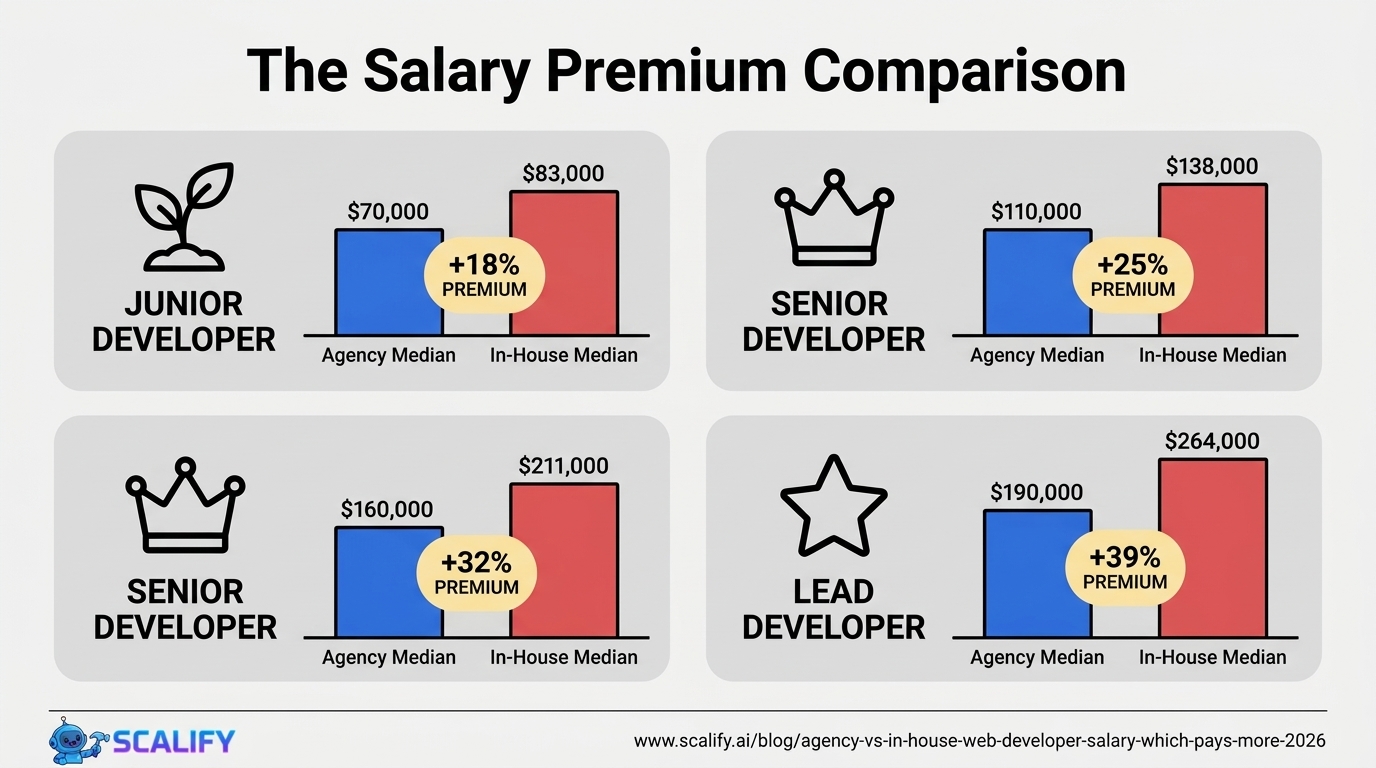
Salary Comparison by Level
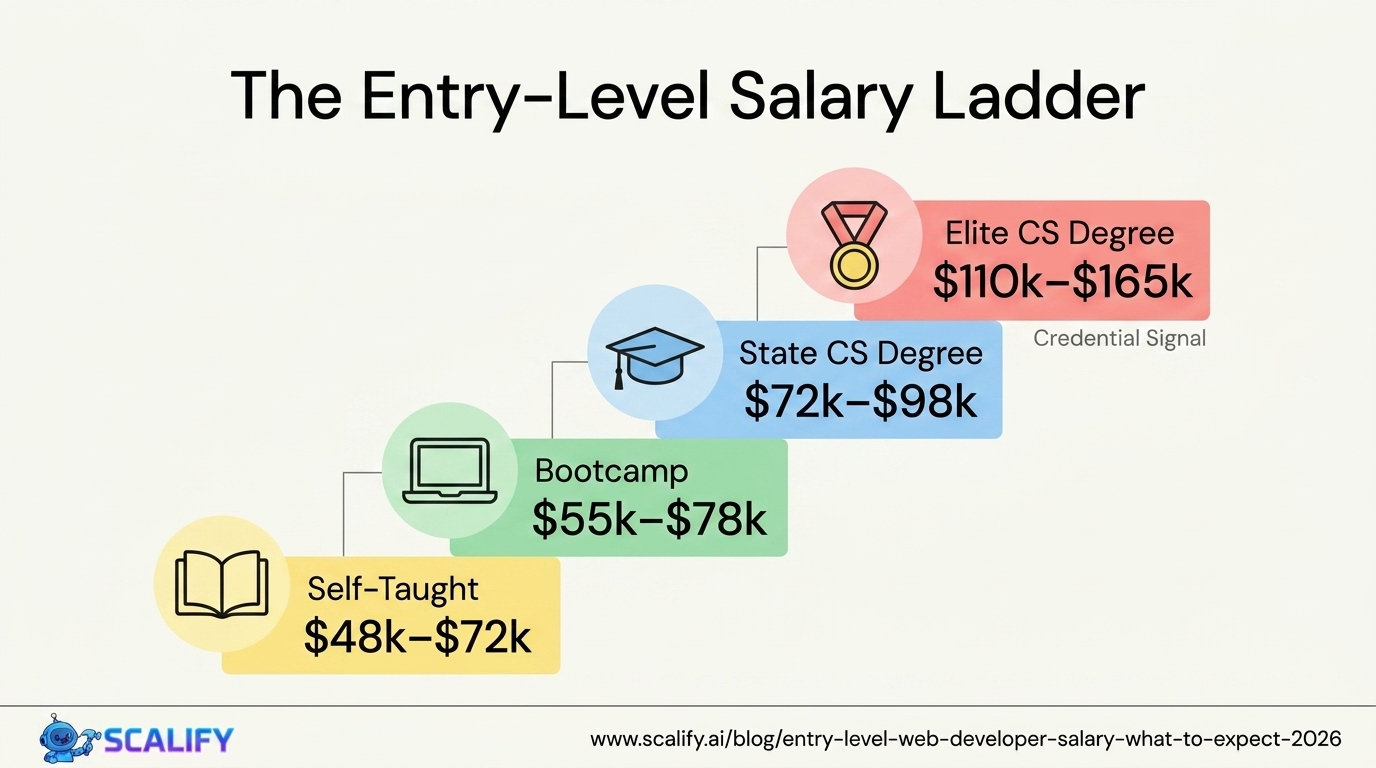
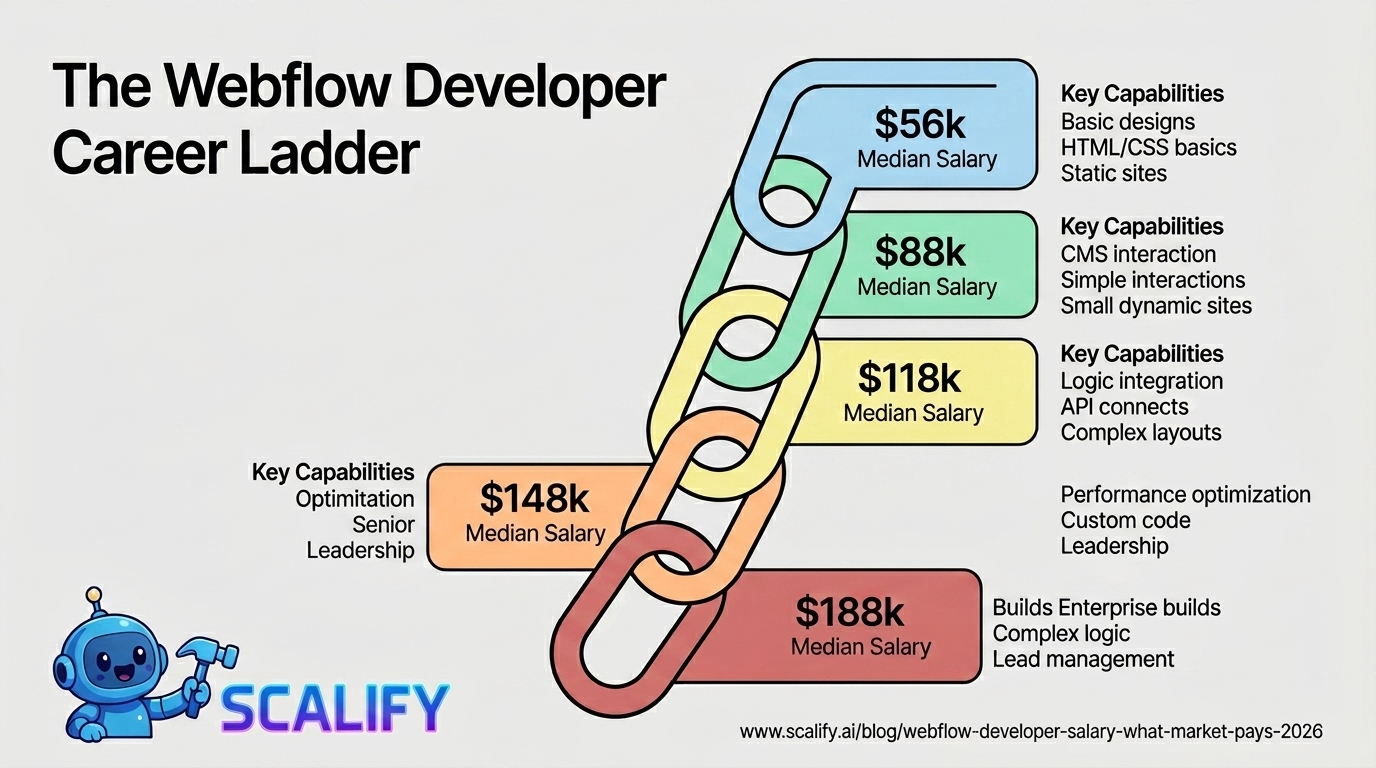
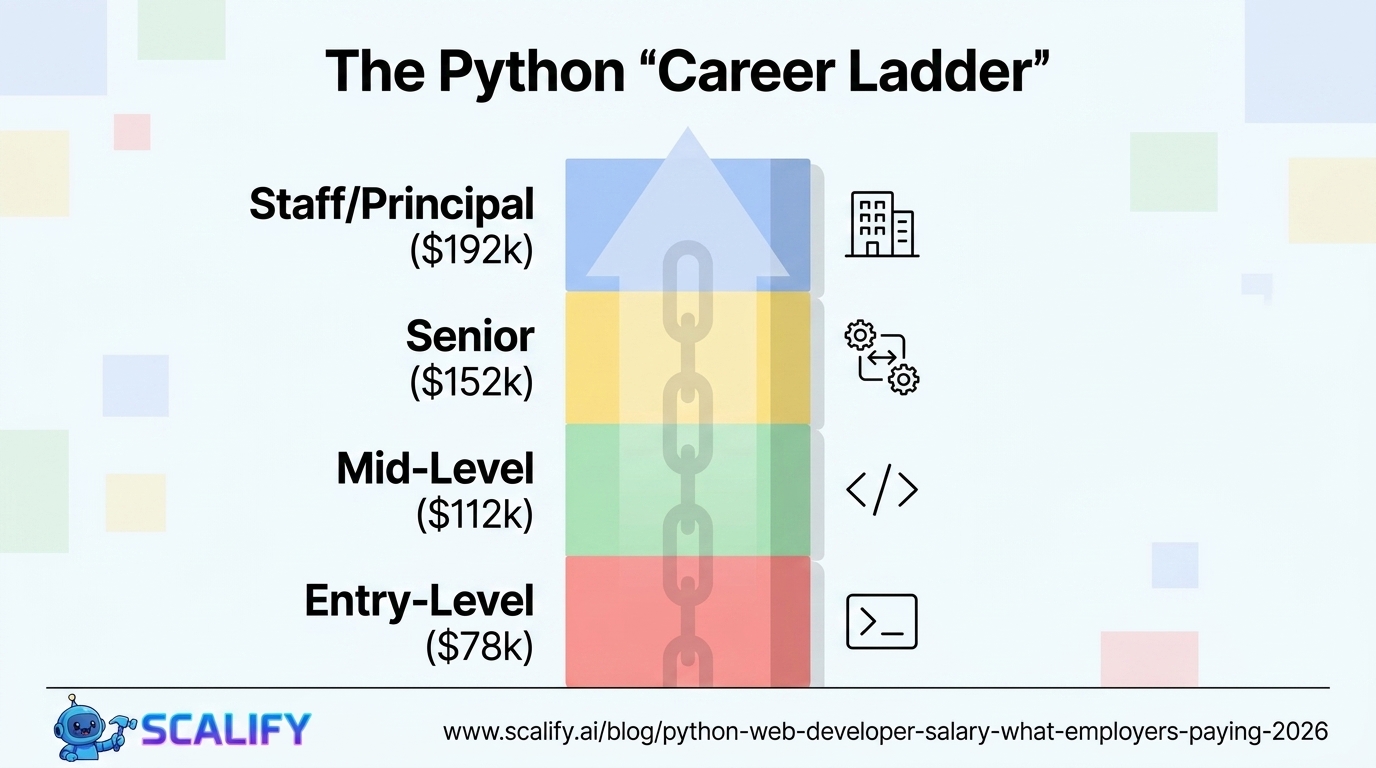
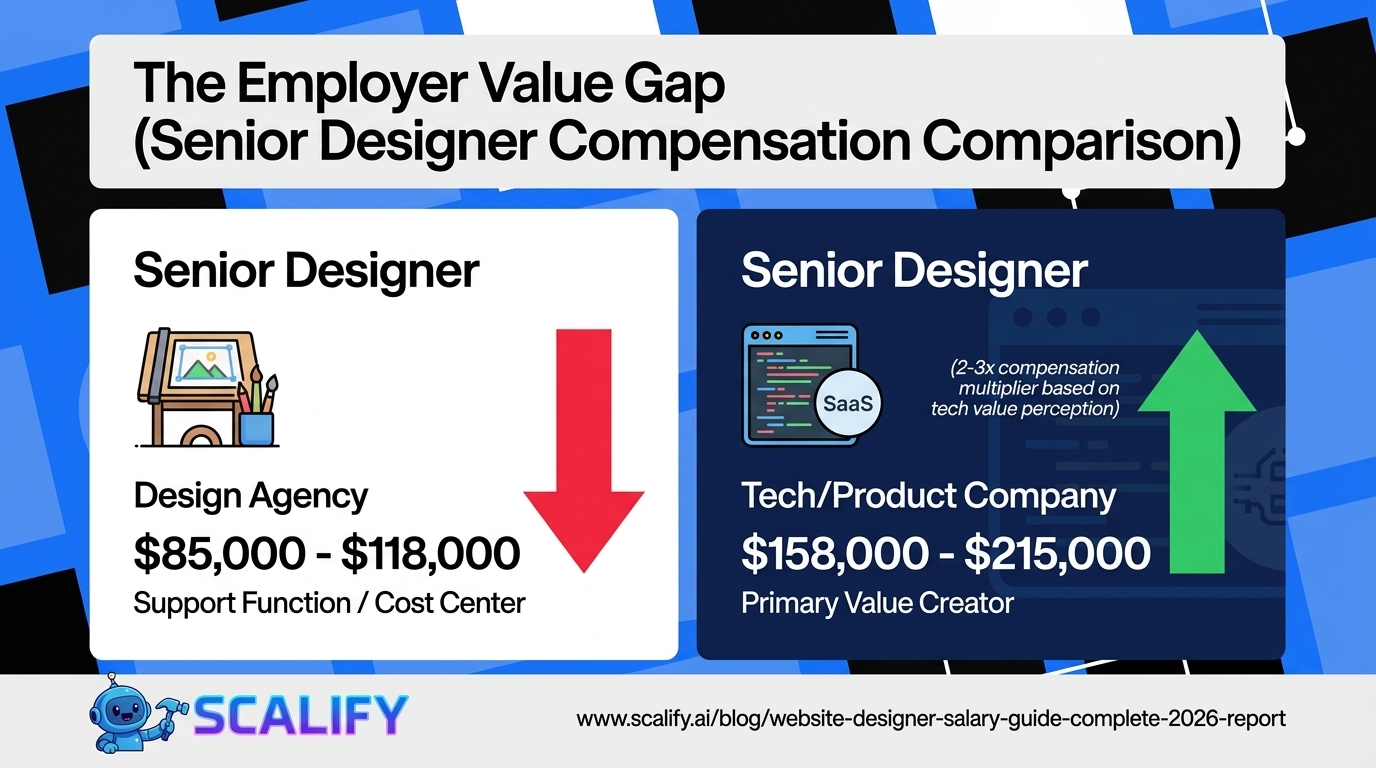
LevelAgency Salary RangeAgency MedianIn-House Salary RangeIn-House MedianIn-House PremiumJunior$45,000 – $65,000$54,000$55,000 – $78,000$64,000+18%Mid-Level$68,000 – $98,000$82,000$82,000 – $125,000$102,000+24%Senior$88,000 – $128,000$108,000$128,000 – $172,000$148,000+37%Lead / Principal$112,000 – $148,000$128,000$155,000 – $210,000$178,000+39%
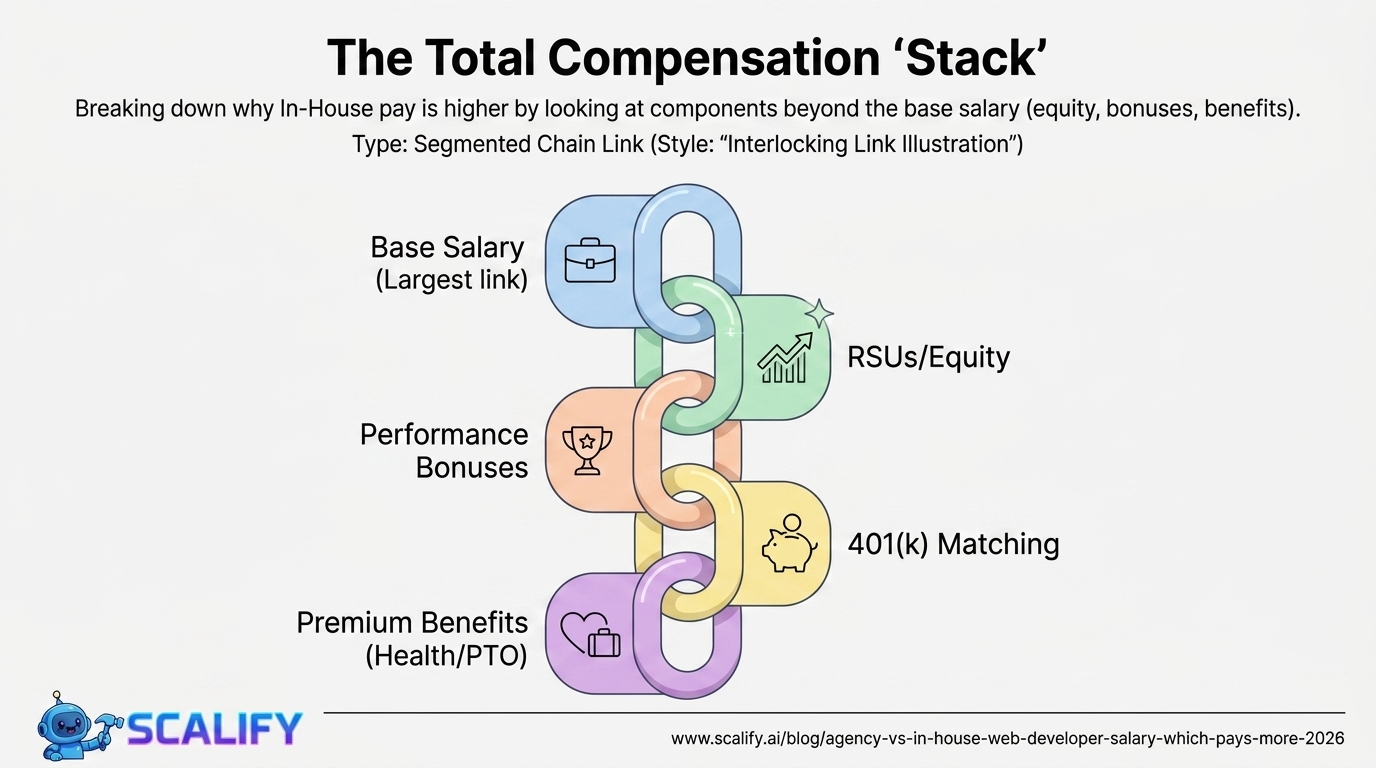
Total Compensation: The Full Picture
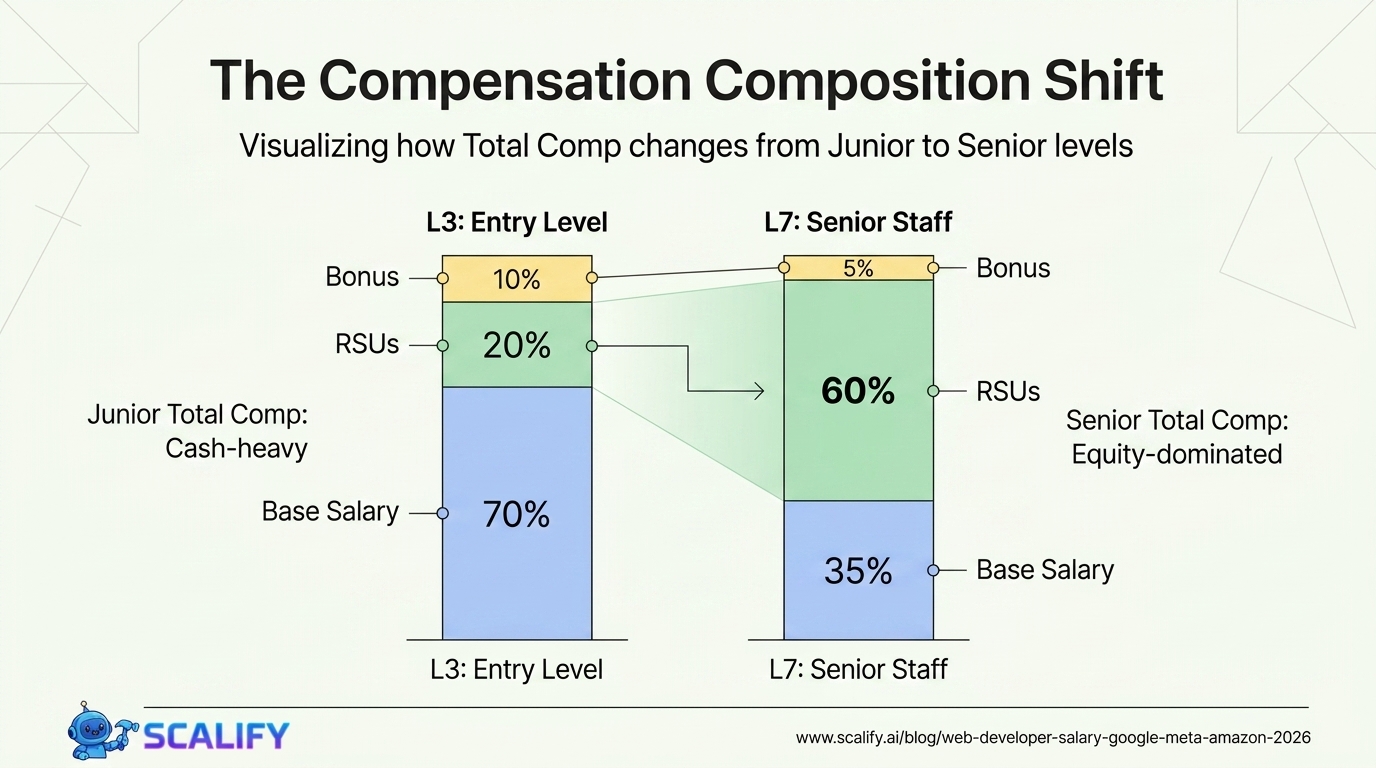
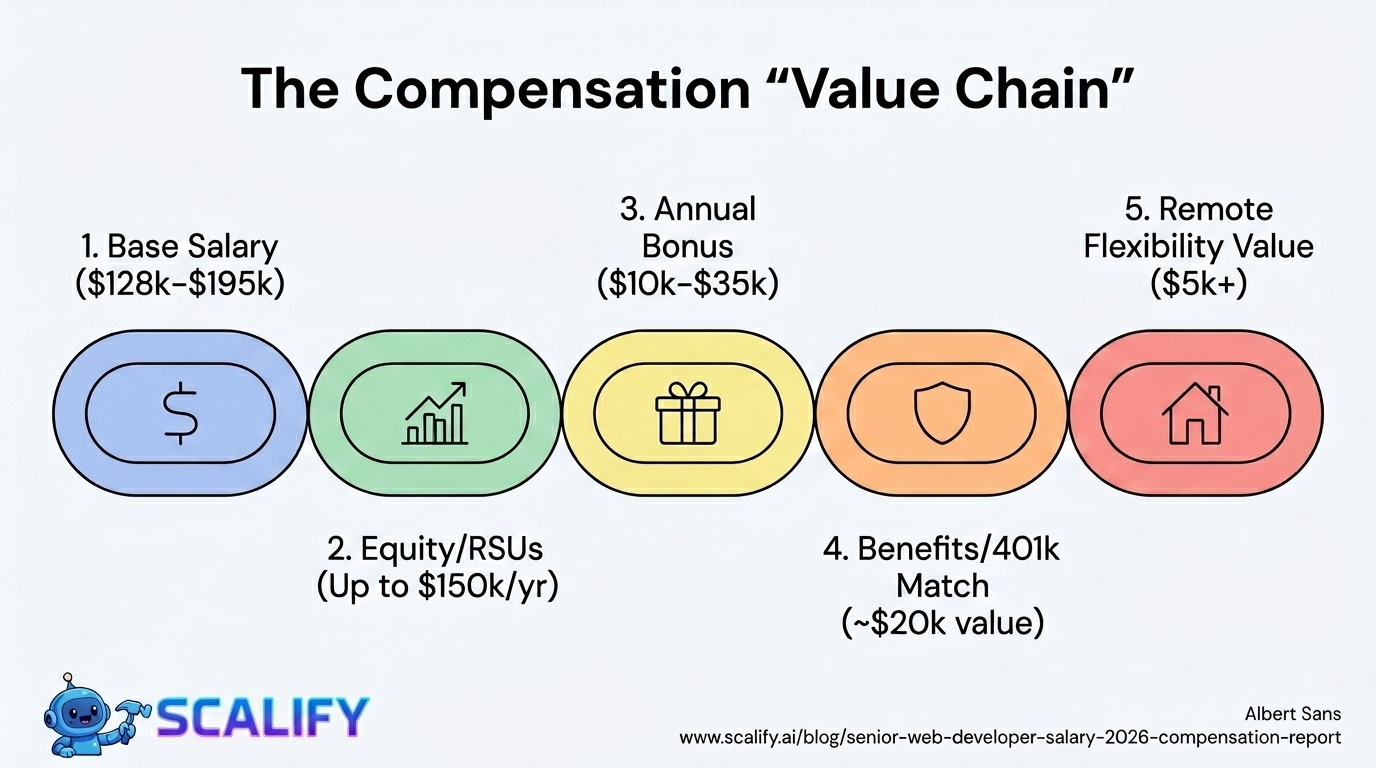
Compensation ComponentAgency (Typical)In-House Tech (Typical)In-House Enterprise (Typical)Base salary (senior)$88,000 – $128,000$128,000 – $172,000$118,000 – $155,000Performance bonus$2,000 – $8,000$10,000 – $30,000$8,000 – $18,000Equity / RSUsRare / $0$20,000 – $120,000/yr$5,000 – $25,000/yrHealth insurance qualityBasic – ModerateVery Good – ExcellentGood – Very Good401(k) match0–3%3–6%4–6%PTO days10–15 days15–25 days15–20 daysProfessional development budget$500 – $1,500$2,000 – $5,000$1,500 – $3,000Remote work flexibilityOften hybrid/in-officeOften fully flexibleStructured hybrid
The Career Development Trade-Off
Career FactorAgency AdvantageIn-House AdvantageTechnology breadth✅ Strong — new tech per client project❌ Narrower — depth in company stackIndustry knowledge depth❌ Surface-level — always moving on✅ Strong — years of domain expertisePortfolio development✅ Faster — many projects, many industries❌ Slower — fewer distinct projectsProduct ownership and long-term impact❌ Minimal — you ship and move on✅ Strong — see your work grow and evolveClient/stakeholder communication skills✅ Strong — constant client-facing work❌ More limited — internal stakeholders onlyDeep technical mastery❌ Harder — less time per technology✅ Strong — years on same stack/codebaseLeadership/management track access❌ Fewer rungs — smaller hierarchies✅ Strong — defined progression pathsEquity upside❌ Minimal — agencies rarely have equity✅ Significant at growth-stage companies
The Agency Path: Who It's Best For
Agency development is genuinely the better early-career choice for certain types of developers. Agencies typically expose junior and mid-level developers to more varied technical challenges in 2 years than in-house positions provide in 4–5 — because each new client project brings a different codebase, different tech stack decisions, different integration requirements, and different problem types. This variety accelerates both technical breadth and client communication skills that serve developers well throughout their careers.
Developers who thrive in agencies are those who genuinely enjoy variety and learning from context-switching, who want to build a diverse portfolio quickly, who are entrepreneurially minded (agency work is excellent preparation for starting a freelance business or an agency), and who value the client relationship skills that come from regular direct client communication. Agencies are a poor fit for developers who want deep product ownership, who find context-switching draining rather than energizing, or who are primarily motivated by equity upside.
The In-House Path: Who It's Best For
In-house development at a product company provides what agencies fundamentally can't: the experience of owning a product over time, seeing the code you write in production for years, making architectural decisions and then living with their consequences, and building deep domain expertise that makes you genuinely indispensable rather than just technically competent. The developers who value this depth — and who are motivated by the long-term equity upside that meaningful company success provides — consistently prefer in-house development after trying both paths.
In-house development at enterprise companies (financial services, healthcare, retail) provides strong base salaries, excellent benefits, and job stability, but typically lacks the equity upside and high-growth culture of product companies. Enterprise in-house development is well-suited for developers who prioritize stability, comprehensive benefits, and work-life balance over maximum compensation ceiling and startup intensity.
The Hybrid Strategy: Agency First, Then In-House
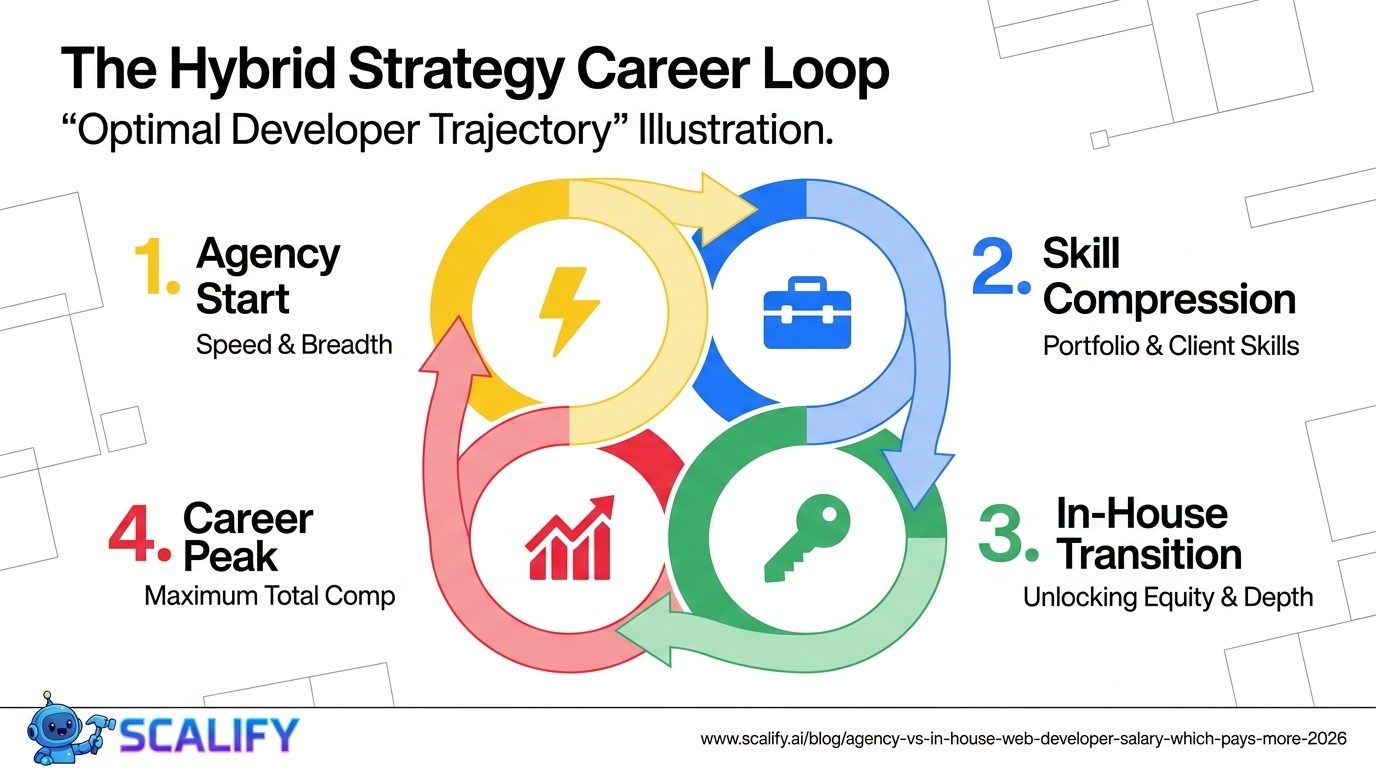
The career path that produces the best compensation outcomes for many developers is agency early, then in-house. Spending 2–3 years at an agency in the junior-to-mid transition phase builds the broad technical exposure, portfolio depth, and client communication skills that make a developer competitive for senior in-house roles at a level above where they would have entered without the agency experience. The agency alumni who move in-house typically earn 15–25% more than those who went directly in-house — because the agency's compressed learning environment produced capabilities that the direct-in-house path would have taken additional years to develop.
After the transition, the in-house path's compensation advantages — equity, better benefits, senior and staff engineering progression — compound over time in ways that agency salaries do not. The combination of agency breadth early and in-house depth later represents the best of both paths for developers who approach it intentionally.
Agency Developer Billing Rates vs. Salary: The Margin Question
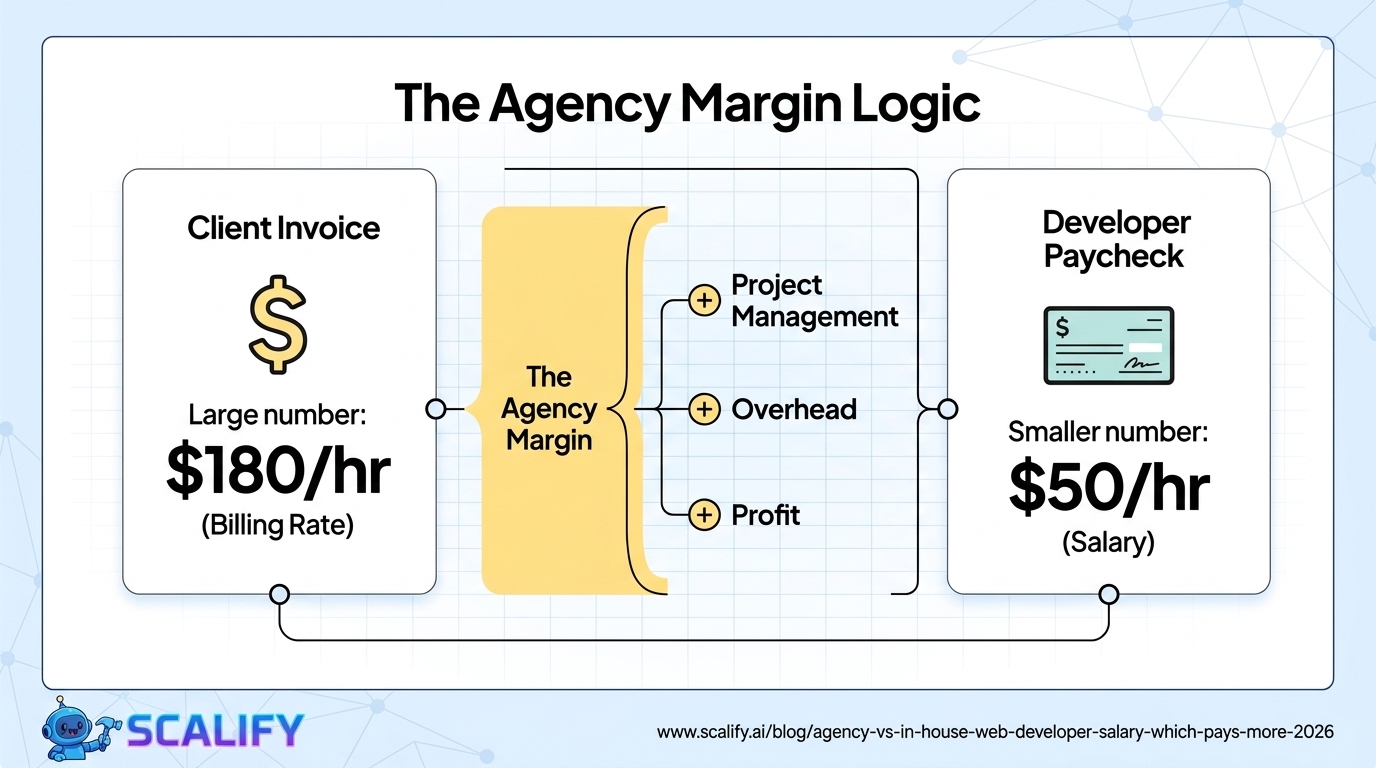
Understanding how agencies work financially is useful context for developers negotiating agency salaries. Agencies typically bill clients $100–$250/hour for developer time, while paying developers $40–$75/hour equivalent salary. The margin — sometimes 50–100% above the developer's cost — covers agency overhead (account management, business development, office, benefits, non-billable time) and profit. This structure is why agency developers who understand their billing rate consistently negotiate better salaries: knowing that you're billed at $180/hour while earning $62,000/year ($30/hr equivalent) provides concrete context for negotiating toward $80,000–$90,000 without exceeding the agency's typical developer margin.
The Bottom Line
In-house web developers earn 10–37% more than equivalent agency developers in both salary and total compensation — and the gap widens at senior and lead levels where equity and bonus structures diverge significantly. The agency path produces faster breadth development, richer portfolios, and stronger client communication skills. The optimal strategy for many developers is agency early (1–3 years) for skill breadth, then in-house for depth, ownership, and compensation ceiling. Both paths produce successful, well-compensated developers; the choice should be driven by what kind of work you actually enjoy, what you want your portfolio to look like in 5 years, and whether equity upside or compensation stability is more important to your financial goals.
At Scalify, we build professional websites for agencies, in-house development teams, and technology companies of all types in 10 business days.
Top 5 Sources
Agency Structures: How Different Agency Types Affect Developer Compensation
Not all agencies are equal in their compensation structures. Understanding the differences helps developers evaluate agency opportunities more effectively:
Large full-service agencies (100+ employees) typically pay the best agency salaries and offer the most structured benefit packages — closer to enterprise in-house than the image of a scrappy agency. Developers at these agencies often work on the largest, most technically complex client projects, building portfolio pieces that are competitive with in-house experience. The tradeoff is more bureaucracy, more account management overhead in the creative process, and sometimes less technical autonomy than smaller shops.
Boutique digital agencies (10–50 employees) are the archetype of agency developer experience: varied projects, direct client relationships, flexible technology choices, and significant individual responsibility. Compensation at boutique agencies is typically 10–20% below large agencies but the learning environment and portfolio development is often richer. These are the agencies where motivated junior and mid-level developers can advance fastest.
Staffing agencies / dev shops place developers at client sites on long-term contracts — more similar to contractor placement than traditional agency work. Compensation varies widely: staffing agencies markup developer day rates significantly, and negotiating directly for the client to pay the contractor rate minus agency fee produces better compensation than the standard staffing agency structure. Developers in staffing agency roles should always understand their billing rate and negotiate accordingly.
In-house agency teams — marketing departments or internal digital agencies within large non-tech companies — often pay at the lower end of the in-house range while offering the stability of a large employer. Healthcare systems, retail chains, and financial services firms all maintain internal web development teams that function like agencies but with a single internal client. These roles offer strong job stability and benefits but limited technical challenge and ceiling.
How to Transition from Agency to In-House Successfully
The agency-to-in-house transition is one of the most common and financially rewarding career moves in web development. Agency developers who execute it well position themselves at a salary level 15–25% above what they would have earned going in-house directly, because their agency experience demonstrates capabilities that in-house hiring managers value highly: the ability to work independently, manage client relationships, ship across diverse tech stacks, and handle ambiguous requirements without hand-holding.
The keys to a successful agency-to-in-house transition: build a portfolio that clearly demonstrates product-quality work (not just marketing sites), develop depth in one specific technology stack that target in-house employers use (React + TypeScript + Next.js is the most broadly applicable), contribute to open source projects in that stack to demonstrate passion beyond billable hours, and network specifically in the in-house product engineering community rather than the agency ecosystem. In-house employers hiring from agencies are primarily evaluating whether the candidate can shift from "deliver the client's brief" thinking to "solve the user's actual problem" thinking — demonstrating that shift explicitly in interviews is the most important part of the transition.
Negotiating Agency Salaries: What Works
Agency salary negotiations differ from in-house negotiations in important ways. Agencies have tighter salary bands because their business model depends on maintaining consistent developer margins — an agency paying one senior developer $140,000 while billing at the same rate as a developer they pay $108,000 is compressing margin without a clear business justification. The most effective agency negotiation levers: demonstrating that you're already performing at the next level's responsibilities (making the title and compensation adjustment a recognition of existing reality), presenting competing offers from other agencies or in-house companies (external offers create market-rate pressure that internal band arguments resist), and quantifying your contribution to specific client relationships or projects that have generated above-average revenue. Generic "I deserve more" arguments are least effective in agency negotiations; specific evidence of above-average commercial contribution is most effective.
The agency-to-in-house transition, when executed with the portfolio depth and technology focus described above, represents one of the clearest salary step-change opportunities in web development — and developers who manage it deliberately typically find themselves at the top of the in-house mid-level or entry-level senior band, rather than starting over at the bottom of the in-house pay scale.


.jpeg)
.jpeg)



78 SW 7th St, Miami, FL 33130