

Web Developer Salary: Computer Science Degree vs Bootcamp in 2026
By Josh Ternyak

April 20, 2026
CS graduates start $20-30k higher; bootcamps close most of the gap by year 5. Comprehensive comparison covering salary tables, 5-year trajectory, break-even analysis, FAANG access, algorithm interview barrier, bootcamp quality variation, hybrid path, and continuing education.
Web Developer Salary: Computer Science Degree vs. Bootcamp in 2026
The computer science degree vs. coding bootcamp debate is one of the most financially consequential education decisions in web development — with meaningfully different starting salaries, different ceiling trajectories, and different paths to senior-level compensation. Neither is universally superior: the right choice depends on how much time you have, how much money you can invest, which career paths you want access to, and how you learn best. This guide provides the data to make that decision clearly.
Key Salary Statistics: CS Degree vs. Bootcamp
First-Job Salary Comparison
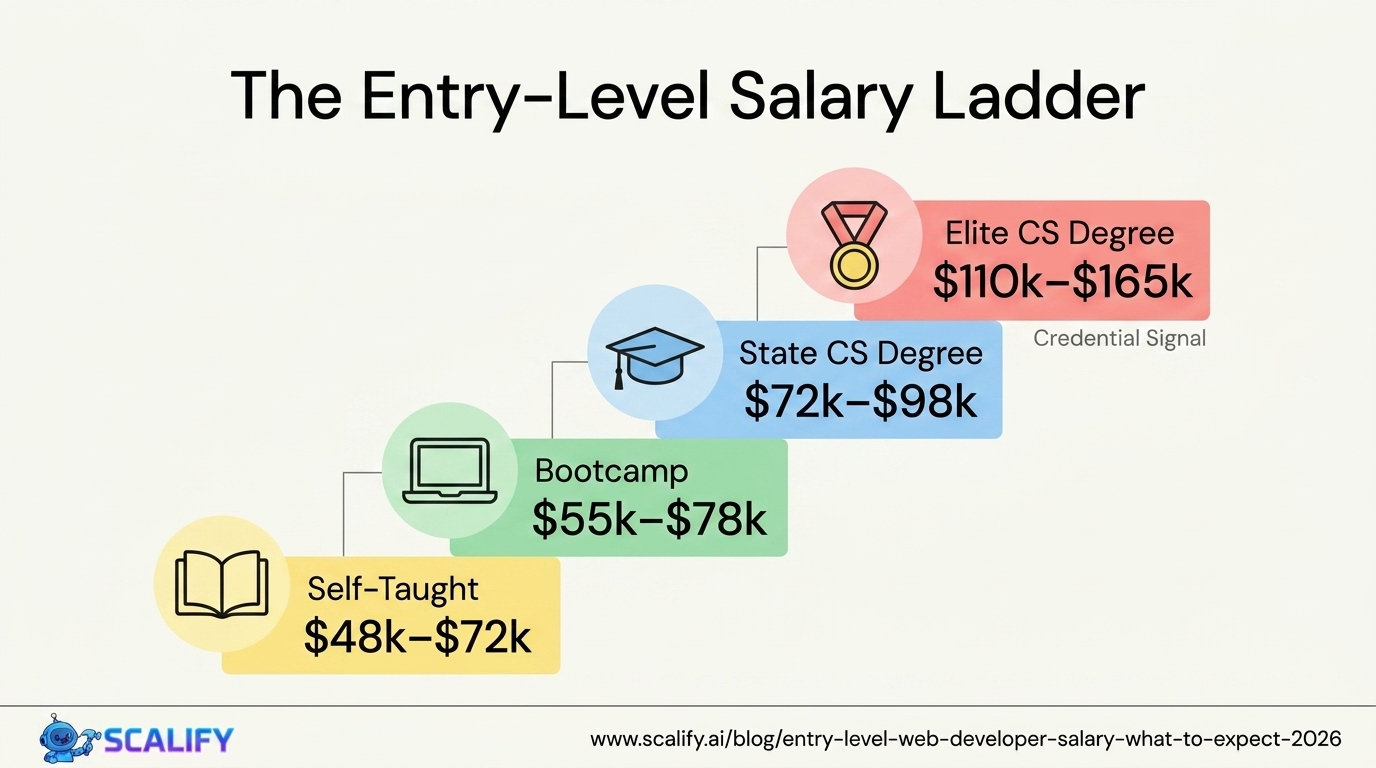
CredentialTypical First JobFirst Salary RangeFAANG AccessTimelineTop-20 CS degree (MIT, CMU, Stanford)FAANG, top startups$185,000 – $220,000 TCFull access4 years + $100k+ costState university CS degreeMid-size tech, startups, enterprise$72,000 – $98,000Limited — harder interviews4 years + $40–80k costCoding bootcamp (reputable)Agency, startup, mid-size company$58,000 – $75,000Very limited — algorithm barrier3–6 months + $13–18k costSelf-taught + strong portfolioAgency, freelance, small companies$48,000 – $68,000No — not a viable path12–24 months + $0 costCommunity college AS + portfolioLocal business, agency$52,000 – $72,000Very limited2 years + $8–15k cost
The 5-Year Trajectory: Where Each Path Leads
The first-job salary gap is significant, but the long-term trajectory matters more for lifetime earnings. The key divergence point is FAANG and top tech company access — which remains predominantly a CS degree path, particularly for the algorithm-heavy interviews that Google, Meta, and Amazon use.
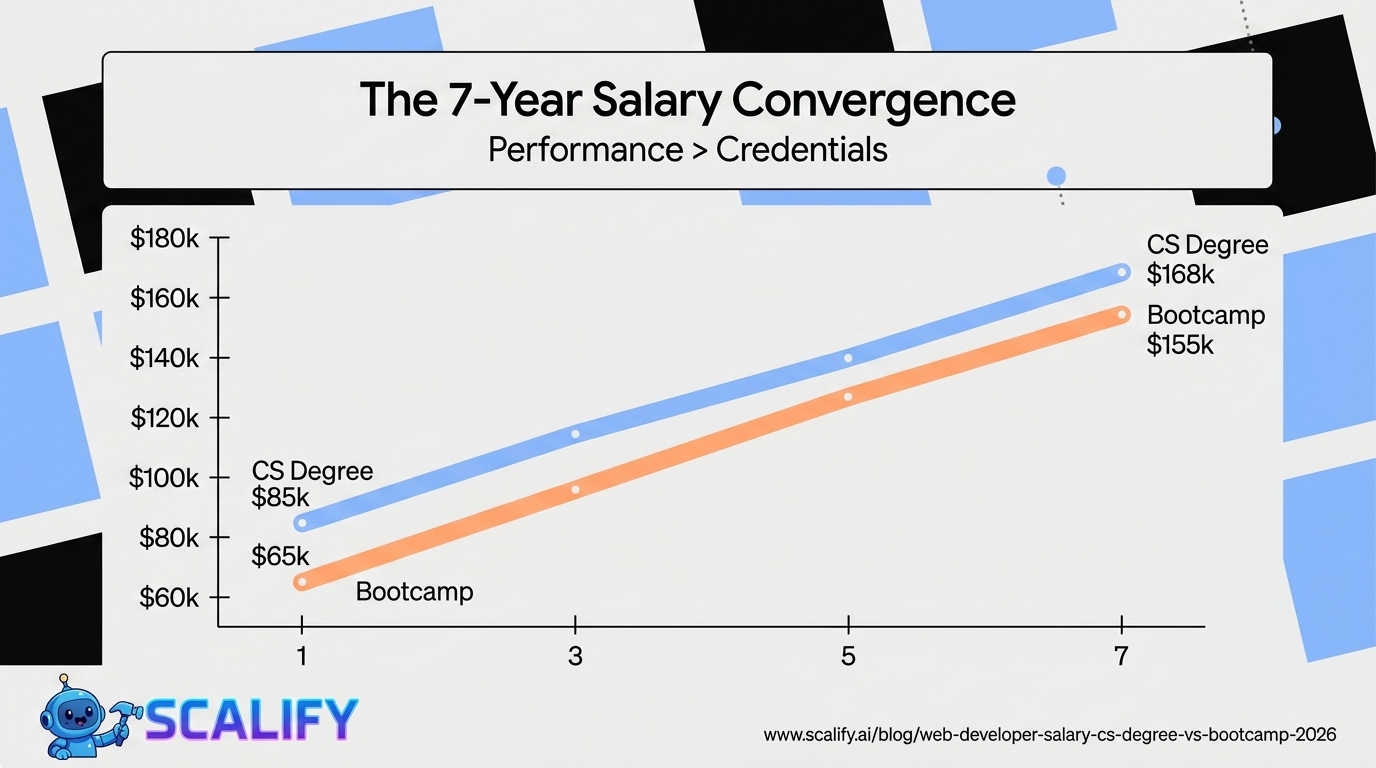
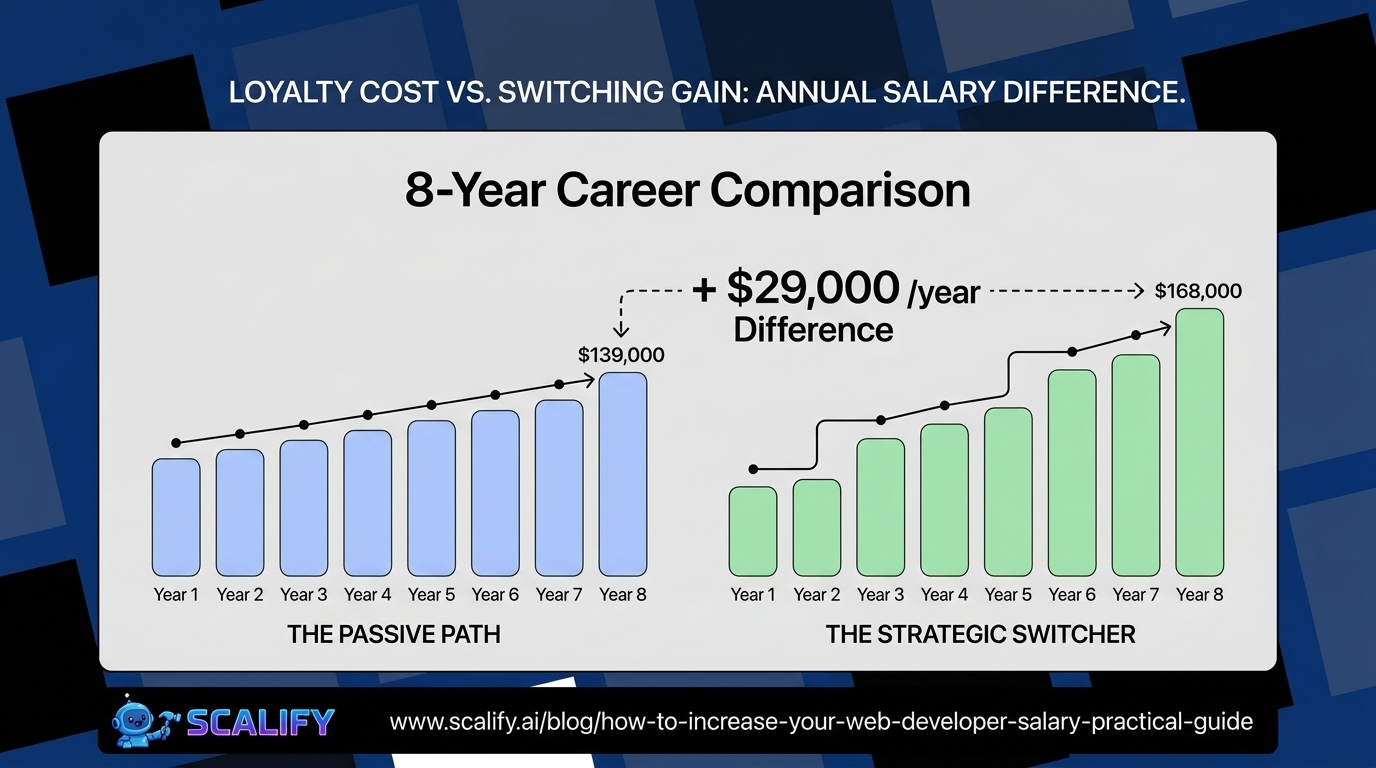
YearCS Degree (State Uni)Bootcamp GraduateGapYear 1 (first job)$85,000$65,000$20,000Year 2 (mid-level)$108,000$88,000$20,000Year 3 (mid-senior)$125,000$108,000$17,000Year 5 (senior)$152,000$138,000$14,000Year 7 (senior+)$168,000$155,000$13,000
The gap narrows significantly as bootcamp graduates who choose good learning environments, invest in skill development, and job-switch effectively close most of the initial credential gap through demonstrated performance. However, the gap at FAANG and top-tier tech never fully closes for most bootcamp graduates — the competitive coding interview remains the primary barrier, and CS degree programs provide better preparation for algorithmic problem-solving than bootcamps focused on practical application development.
The Financial Break-Even Analysis
Comparing total investment and expected returns:
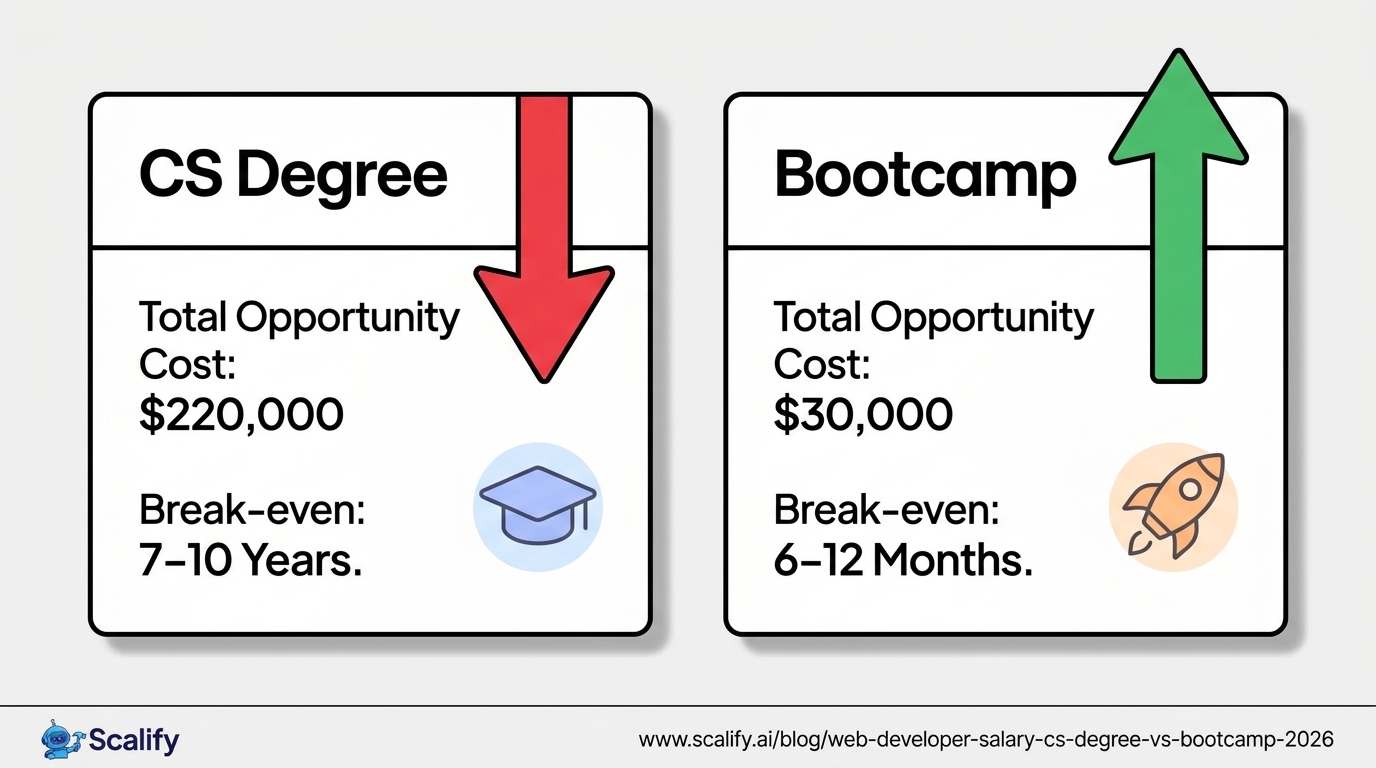
PathTotal CostIncome Lost During TrainingTotal Opportunity CostBreak-Even Timeline4-year state CS degree$60,000 tuition + fees~$160,000 (4 years at $40k opportunity)$220,0007–10 years from graduationCoding bootcamp (3 months)$15,000 tuition~$15,000 (3 months at $60k/yr)$30,0006–12 months from first jobSelf-taught (18 months)$2,000 courses/resources~$90,000 (18 months at $60k/yr)$92,0002–4 years from first job
The bootcamp financial break-even is dramatically faster — the lower investment and shorter timeline mean a bootcamp graduate starts earning years earlier than a CS degree candidate. However, the CS graduate's higher starting salary and better FAANG access mean the CS degree's long-term ROI can exceed the bootcamp's despite the longer break-even timeline. The answer to "which is better financially?" is: bootcamp if you need to earn sooner; CS degree if you can afford the 4-year investment and want FAANG access.
What CS Degrees Provide That Bootcamps Don't
The algorithmic foundation, data structures, operating systems, networking, computer architecture, and formal mathematical training that CS degrees provide matters primarily for roles that require this knowledge: systems programming, machine learning engineering, performance engineering, and the competitive algorithm interviews at FAANG companies. For web developers building business applications — the majority of web development work — this foundational knowledge rarely surfaces in day-to-day work, which is why bootcamp graduates can be effective at these roles without it.
CS degrees also provide: professional networking through university connections, alumni networks that facilitate job referrals, credentialing signal that opens doors at employers who screen by credential before evaluating skills, and the time and intellectual environment to develop intellectual depth that short, intensive programs rarely facilitate. The non-technical benefits of a university education — critical thinking development, academic writing, breadth of knowledge across disciplines — may or may not be valuable depending on individual goals.
What Bootcamps Provide That CS Degrees Don't
Bootcamps provide: fast time-to-market for employment (3–6 months vs. 4 years), practical, current technology skills (bootcamp curriculum is typically updated more frequently than university curriculum), collaborative learning environments optimized for adults with professional goals rather than 18-year-olds, job placement support that universities rarely provide in comparable depth, and dramatically lower cost. For career changers who already have professional experience and college degrees in other fields, bootcamps provide the web development skills needed to enter the field without repeating 4 years of undergraduate education.
The Best Choice for Your Situation
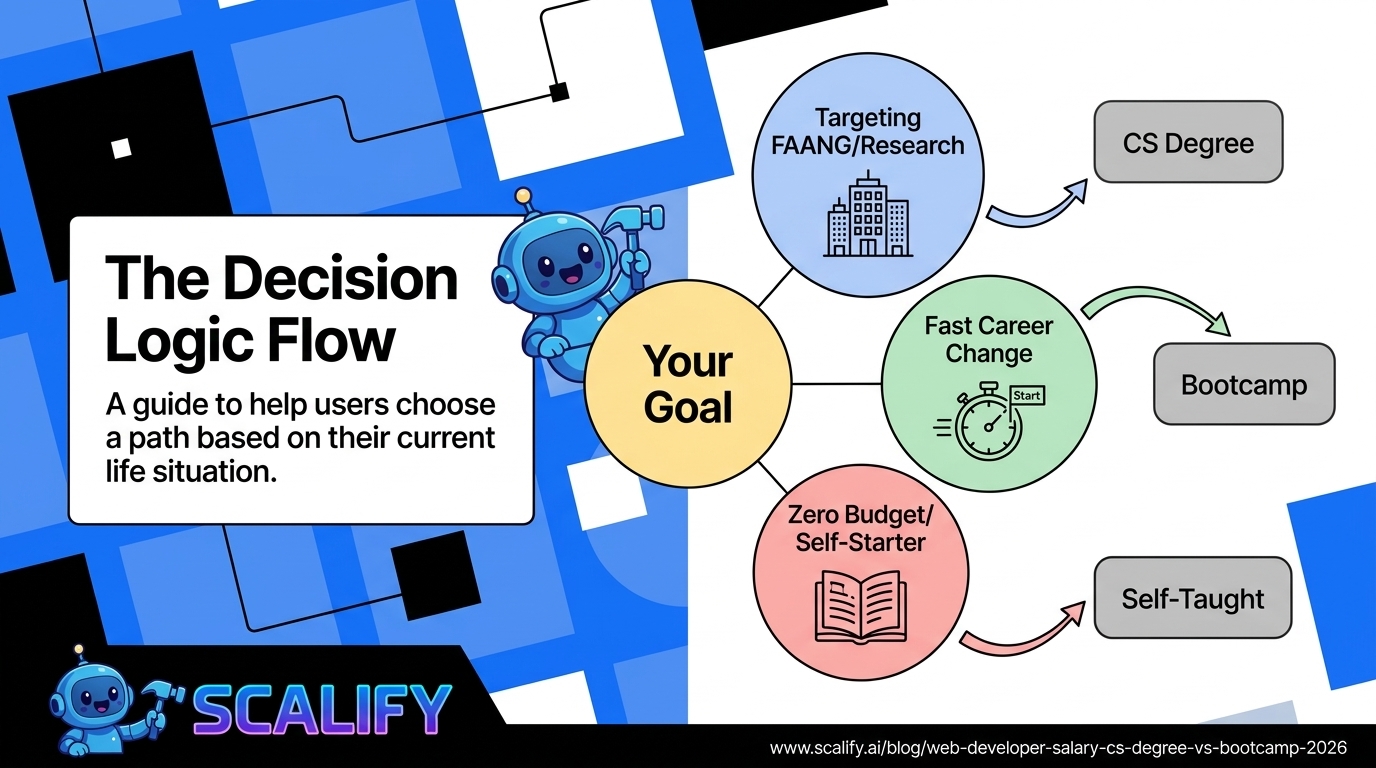
Your SituationRecommended PathWhyRecent high school graduate, time + financial aid availableCS degree (state university)Credential + FAANG access + lower effective cost with aidCareer changer, already have bachelor's degree, need income changeBootcampFast path to new field; CS degree redundant with existing credentialCareer changer, can afford 4-year investmentCS degree if FAANG is goal; bootcamp otherwiseOnly justified if algorithm-heavy roles are targetStrong self-directed learner with 18–24 months to investSelf-taught + strong portfolioLowest cost; most flexible; hardest path without structureAlready employed in tech (QA, IT, etc.)Bootcamp or self-taughtTransferable credential less important; skills are the gapTarget: FAANG entry-levelTop-20 CS degree strongly preferredAlgorithm interviews require CS preparation; bootcamp path very difficult
The Bottom Line
CS degree graduates start $20,000–$30,000 higher and have significantly better access to FAANG and algorithm-heavy roles. Bootcamp graduates start faster, invest less, and close most of the gap by year 5 in product-building roles. Neither is universally superior — the right choice depends on your timeline, financial situation, and target role type. For most career changers targeting web development roles at companies that hire on portfolio and skill demonstration rather than credential screening, the bootcamp path offers better ROI. For students who can access financial aid and want FAANG access, the CS degree remains the clearer path to the highest compensation available in web development.
At Scalify, we hire on skills and portfolio quality — demonstrated ability to build excellent websites matters more than the credential used to develop it.
Top 5 Sources
Bootcamp Quality: Why Not All Bootcamps Are Equal
The "bootcamp graduate" category encompasses enormous quality variation — from selective, rigorous programs with 85%+ job placement rates to low-quality programs that produce graduates who struggle to find employment at any salary. The specific bootcamp matters enormously, and treating all bootcamps as equivalent misrepresents the actual salary outcomes available to bootcamp graduates from well-regarded programs.
The indicators of a quality bootcamp: job placement rates published with specific salary data (not just "placement rates" without defining what constitutes placement), alumni who can speak specifically to the technical rigor of the curriculum, curriculum that includes TypeScript rather than just JavaScript, React rather than just HTML/CSS, and computer science fundamentals alongside practical application building. Programs that teach outdated stacks (jQuery, basic PHP, no TypeScript) prepare graduates for a shrinking market of legacy codebases rather than the growing market of modern web development.
The most reputable bootcamps in 2026 — those with demonstrated job placement outcomes and alumni willing to recommend them without hesitation — consistently charge more ($15,000–$25,000) and are more selective than the commodity end of the bootcamp market. The salary outcomes from these programs are substantially better than averages that include lower-quality programs, and the comparison with CS degrees becomes much narrower when only high-quality bootcamp outcomes are included.
The Algorithm Interview Problem: The Hardest Bootcamp Barrier
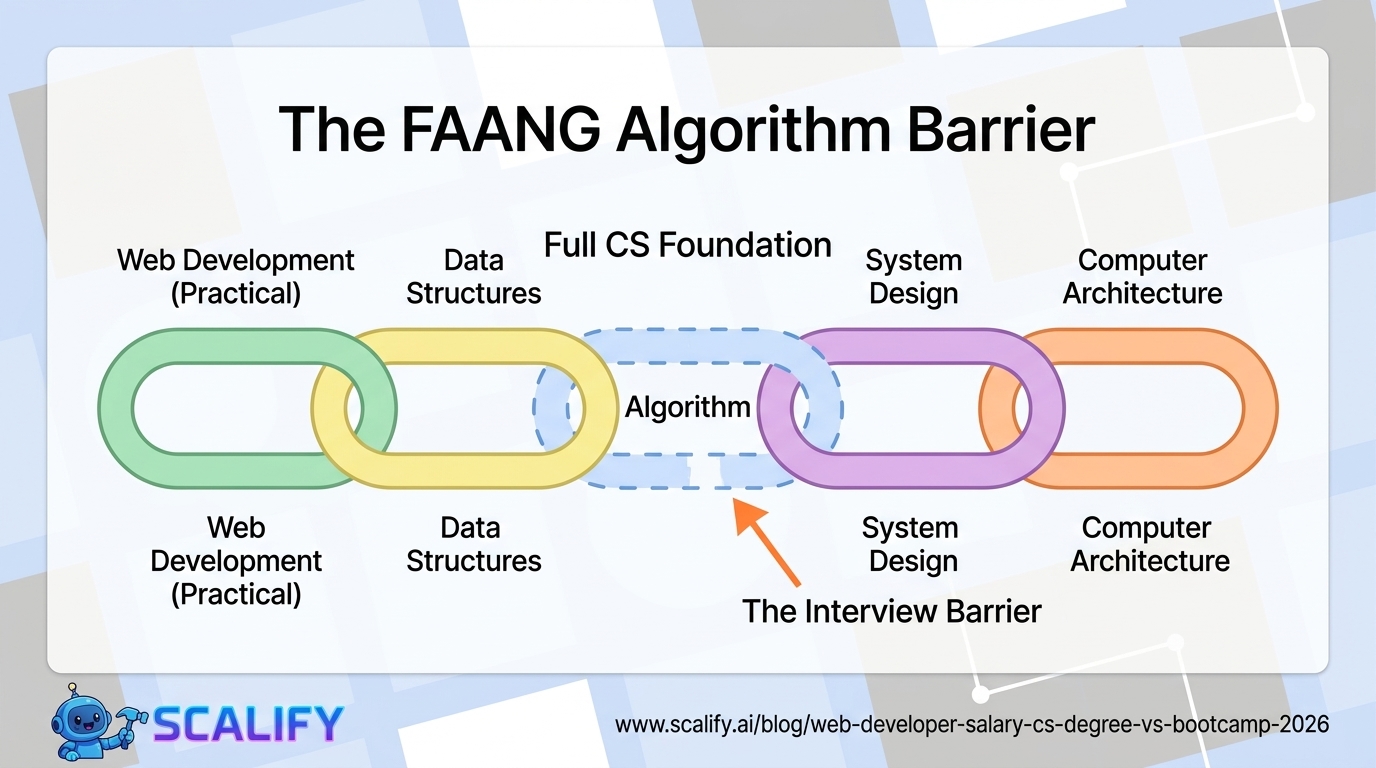
The primary reason bootcamp graduates struggle to access FAANG and top-tier tech companies is not knowledge of web development — it's the competitive algorithm interview process that these companies use to screen candidates. Google, Meta, Amazon, and their peers use 4–6 rounds of algorithm and data structure problem-solving interviews (LeetCode-style) that test computer science fundamentals — time and space complexity analysis, graph algorithms, dynamic programming, tree traversals — that are rarely covered comprehensively in bootcamp curricula focused on practical web development.
Bootcamp graduates who target FAANG typically spend 3–6 months of additional dedicated preparation on algorithmic problem-solving after completing the bootcamp — essentially self-teaching the CS fundamentals that degree programs cover over 4 years. A small percentage succeed through this path; the majority find their skills are better rewarded at companies that evaluate through practical work samples, take-home projects, or portfolio review rather than whiteboard algorithm assessments.
The Hybrid Path: Bootcamp + Online CS Supplement
An increasingly popular approach combines bootcamp speed with CS depth: complete a quality bootcamp to develop practical web development skills and secure initial employment, then systematically fill CS knowledge gaps through online resources (Coursera's CS specializations, MIT OpenCourseware, CS50, Algorithm courses) while employed. This hybrid path produces developers with practical experience AND CS depth, on a timeline faster than a 4-year degree, at a lower cost than either option alone. Developers who follow this path for 18–24 months post-bootcamp often achieve competitive algorithm interview performance while maintaining the practical application development skills from their bootcamp and first job, positioning them for FAANG interviews that would have been inaccessible from the bootcamp alone.
Continuing Education: Staying Competitive After Either Path
Whether CS degree or bootcamp, the web development field requires continuous learning investment that doesn't end at credential completion. Technology stacks evolve rapidly — a developer who graduated with React 16 skills in 2018 and hasn't kept pace with React 18, Next.js App Router, TypeScript, and AI integration trends is increasingly uncompetitive in 2026 regardless of their initial credential. The developers who maintain salary growth over a 15–20 year career are those who invest systematically in skill currency: dedicating 5–10% of their working time to learning new tools, attending conferences or watching conference talks online, following technical blogs and newsletters, and building side projects in emerging technologies before the market prices them in fully. The credential starts the career; continuous learning sustains and advances it.
The Degree Premium Beyond First Job: What Happens at Mid-Career
The salary gap between CS degree and bootcamp graduates that starts at $20,000–$30,000 narrows over time for developers who invest in skill development and job mobility. However, there's a persistent ceiling effect for bootcamp graduates without CS fundamentals at companies that internally promote based on algorithm interview performance — meaning promotions to staff engineer levels at FAANG companies require passing the same algorithm interviews that are barriers to entry, and bootcamp graduates who never developed that skill set may plateau at senior engineer rather than reaching staff level. For developers who don't have FAANG ambitions, this ceiling is irrelevant; for those who do, the CS degree's ongoing advantage at mid-career is real and compounds into significantly higher lifetime earnings at the top tier of the compensation scale.
Regardless of the path chosen, the web development career ultimately rewards demonstrated skill and continuous learning more than the credential used to enter the field — with the significant exception of FAANG algorithm interviews where CS preparation remains a meaningful advantage that bootcamp graduates must deliberately supplement to overcome.


.jpeg)
.jpeg)

78 SW 7th St, Miami, FL 33130