

Should You Use a Website Builder or Hire a Developer? (2026 Guide)
By Josh Ternyak

April 18, 2026
Website builders cost 60-80% less than custom development. This honest guide covers when builders win (standard requirements, limited budget, content independence) vs when developers win (unique functionality, commercial differentiation, foreseeable custom features), platform comparison table, 3-year total cost analysis, 5-question decision framework, the AI factor changing both options, hybrid approaches, and developer selection criteria.
Should You Use a Website Builder or Hire a Developer?
The website builder vs. hire a developer decision is one that thousands of business owners face every year — and the "right" answer is not universal. It depends on the complexity of what you need, your budget, your timeline, your technical comfort level, and how important your website is as a revenue driver vs. a basic business card. Getting this decision wrong in either direction has real costs: using a website builder when you need a developer produces a limited website that can't grow with your business; hiring a developer when a builder would have served you well wastes budget on unnecessary complexity.
Key Statistics
Website Builders: What They Are and Who They're For
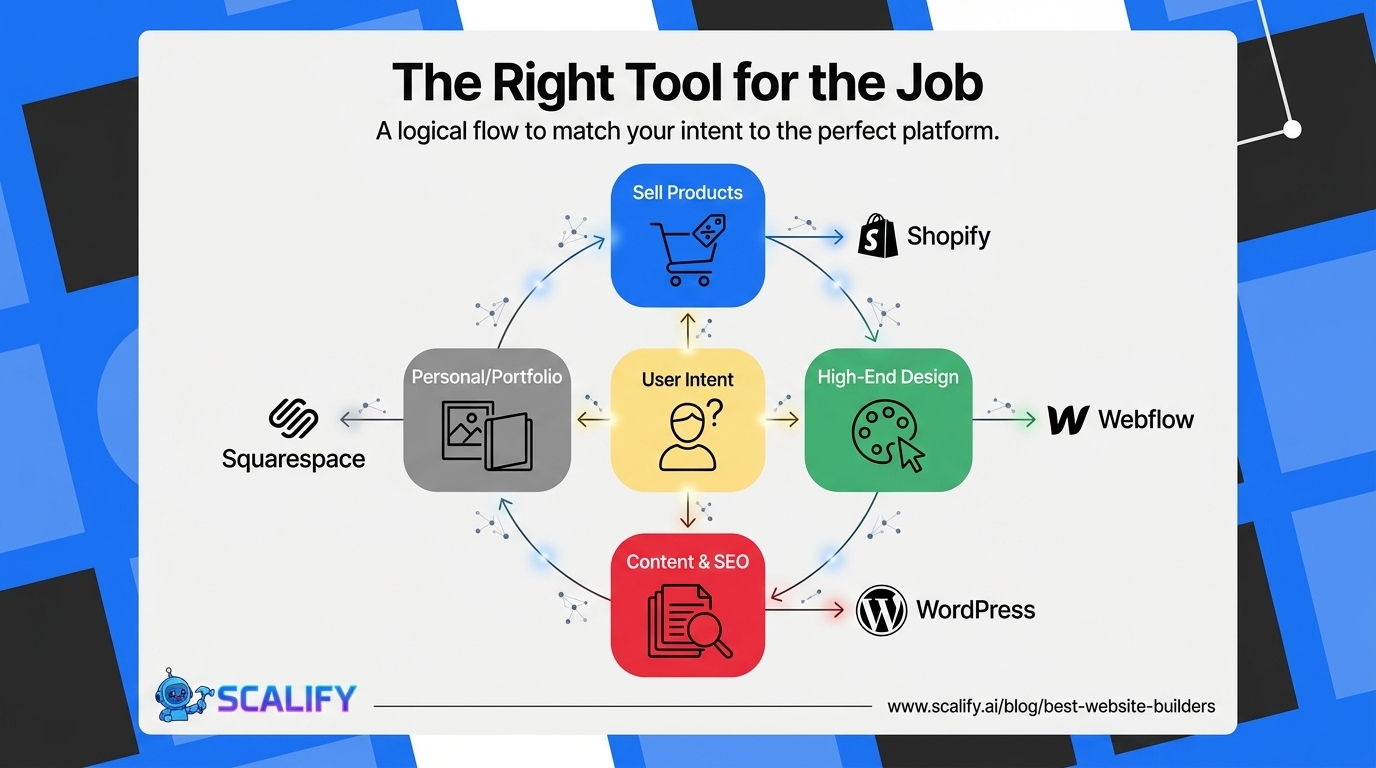
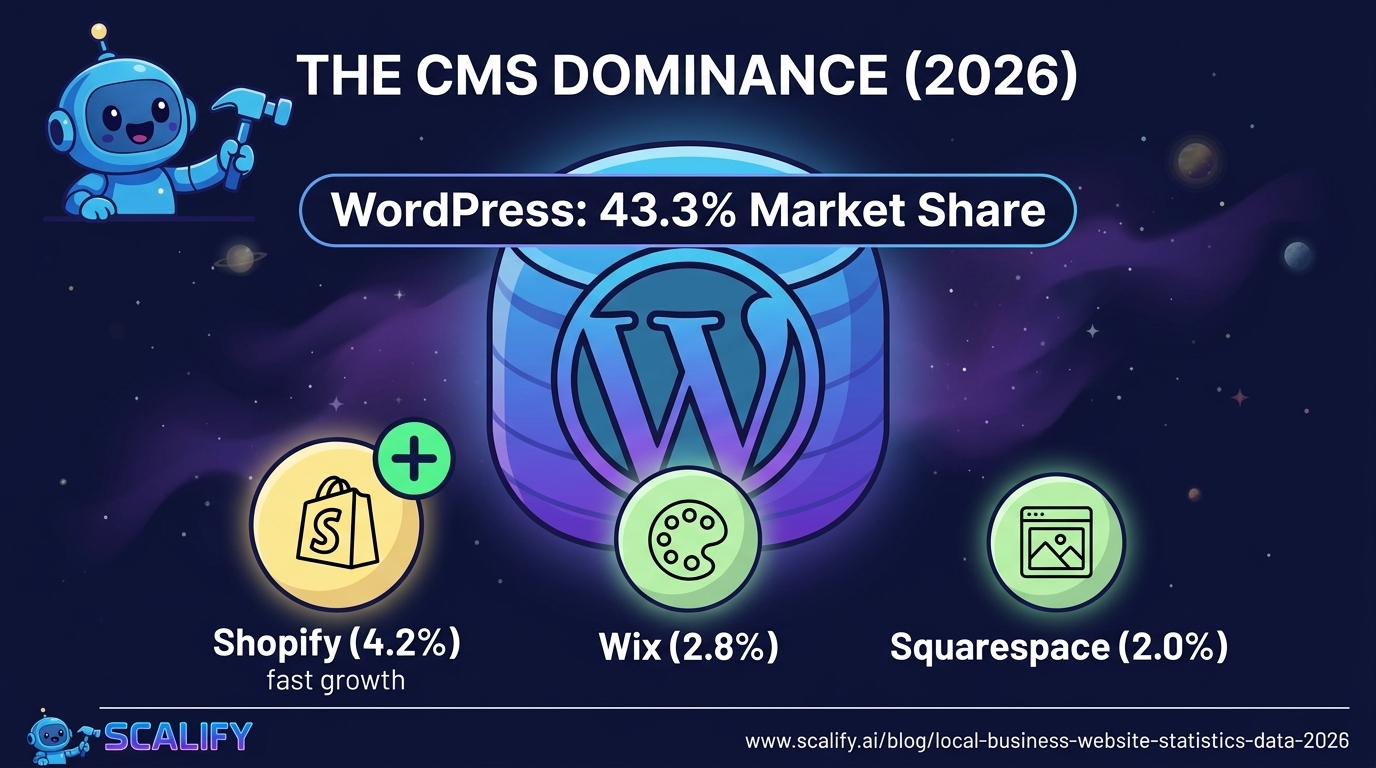
Website builders (Wix, Squarespace, Webflow, Shopify, Weebly) are cloud-hosted platforms that provide drag-and-drop interfaces for building websites without coding knowledge. They handle hosting, security updates, SSL certificates, and technical maintenance — allowing business owners to focus on content and design rather than technical infrastructure.
BuilderBest ForPriceEase of UseDesign QualityWixSmall businesses, flexibility-focused builders$17–$159/moVery EasyGood — many templatesSquarespaceCreatives, service businesses, portfolios$23–$65/moEasyVery Good — design-forwardWebflowDesign-focused, agencies, complex layouts$14–$42/moModerate (learning curve)Excellent — professional qualityShopifyE-commerce (primary use case)$29–$299/moEasy for e-commerceGood with themesWordPress.comBlogs, content-heavy sites$4–$45/moModerateGood — many themes
When to Use a Website Builder
When you're starting out and testing an idea. If you're launching a new business concept and aren't sure whether it will succeed, investing $15,000 in a custom website before validating market demand is premature. A Squarespace or Webflow site at $30–$50/month lets you test the concept, refine your messaging, and build initial customer relationships before committing to a higher-cost custom build.
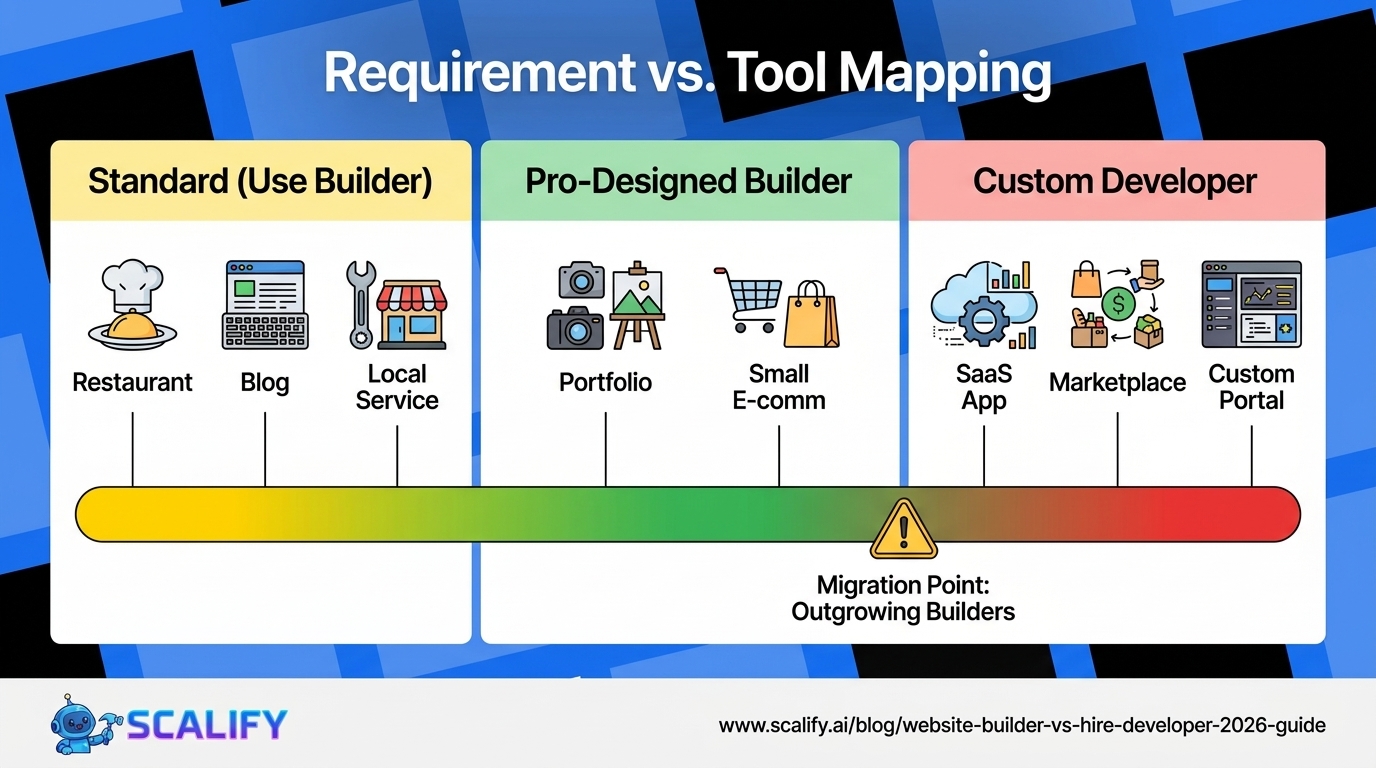
When your requirements are standard. Most small service businesses, consultants, restaurants, local businesses, and portfolio websites have standard requirements — homepage, about page, services, contact, and a simple blog. These requirements are served excellently by website builders, and no custom development capability is needed or would provide proportional value.
When you want to update content yourself. Website builders' content management interfaces are designed for non-technical users — you can update text, swap images, and add new pages without touching code. If being independent of a developer for content updates is important (and it often is for small businesses), a builder provides this independence at low cost.
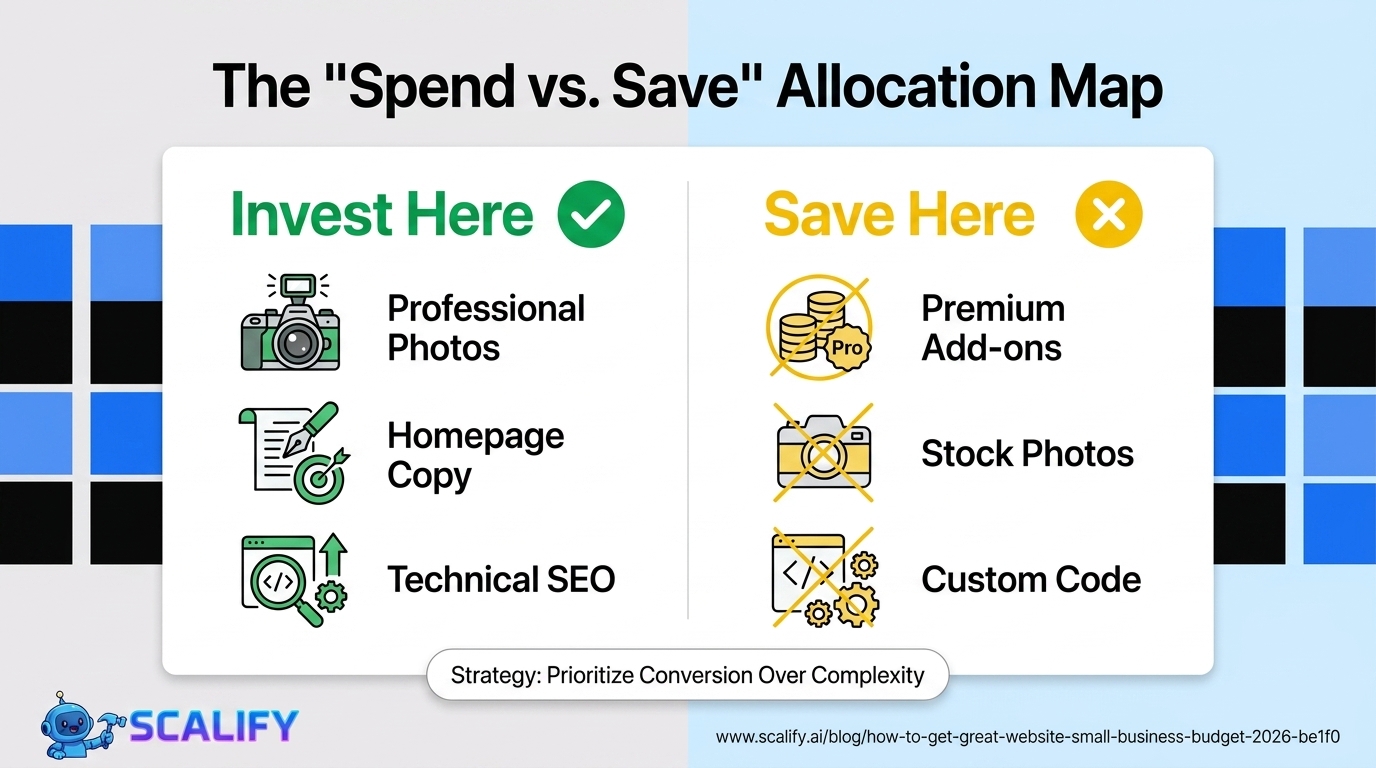
When budget is genuinely limited. A well-built Squarespace or Webflow site at $3,000–$5,000 (using a professional designer) produces a significantly better website than a hastily built custom site at the same budget. The builder handles infrastructure and maintenance, allowing the design budget to go entirely toward visual quality and content rather than being split with technical implementation.
When to Hire a Developer
When you have unique functional requirements. Complex product configurators, custom booking systems with sophisticated logic, multi-vendor marketplaces, SaaS applications, or integrations with proprietary internal systems — these require custom development. Website builders have limits, and pushing them into territory they're not designed for produces brittle, maintenance-intensive solutions that would have been better built custom from the start.
When visual differentiation is commercially critical. Businesses in competitive markets where first impression determines whether prospects stay or leave — premium B2B services, design-forward consumer brands, agencies — need websites that look genuinely distinctive. A custom design built by an experienced designer and developer can achieve visual outcomes that no template provides, and for businesses where the website's perception of quality directly affects sale probability, this differentiation has measurable commercial value.
When you'll need ongoing custom feature development. If your website will grow in complexity over time — new features, integrations, automation, user portals — starting on a builder platform creates a point at which you'll need to migrate everything to a custom build anyway. If that migration is foreseeable within 2–3 years, building custom from the start (even at higher initial cost) avoids the disruption and cost of mid-stream migration.
When your website is a primary revenue driver. E-commerce sites doing $500,000+/year, SaaS products, and any website where conversion rate optimization through custom A/B testing, personalization, or complex funnel logic is critical deserve the flexibility and control that custom development provides. At these revenue levels, even a 2% conversion rate improvement from better UX or more sophisticated A/B testing pays for significant custom development investment.
The Middle Path: Professional Template-Based Design
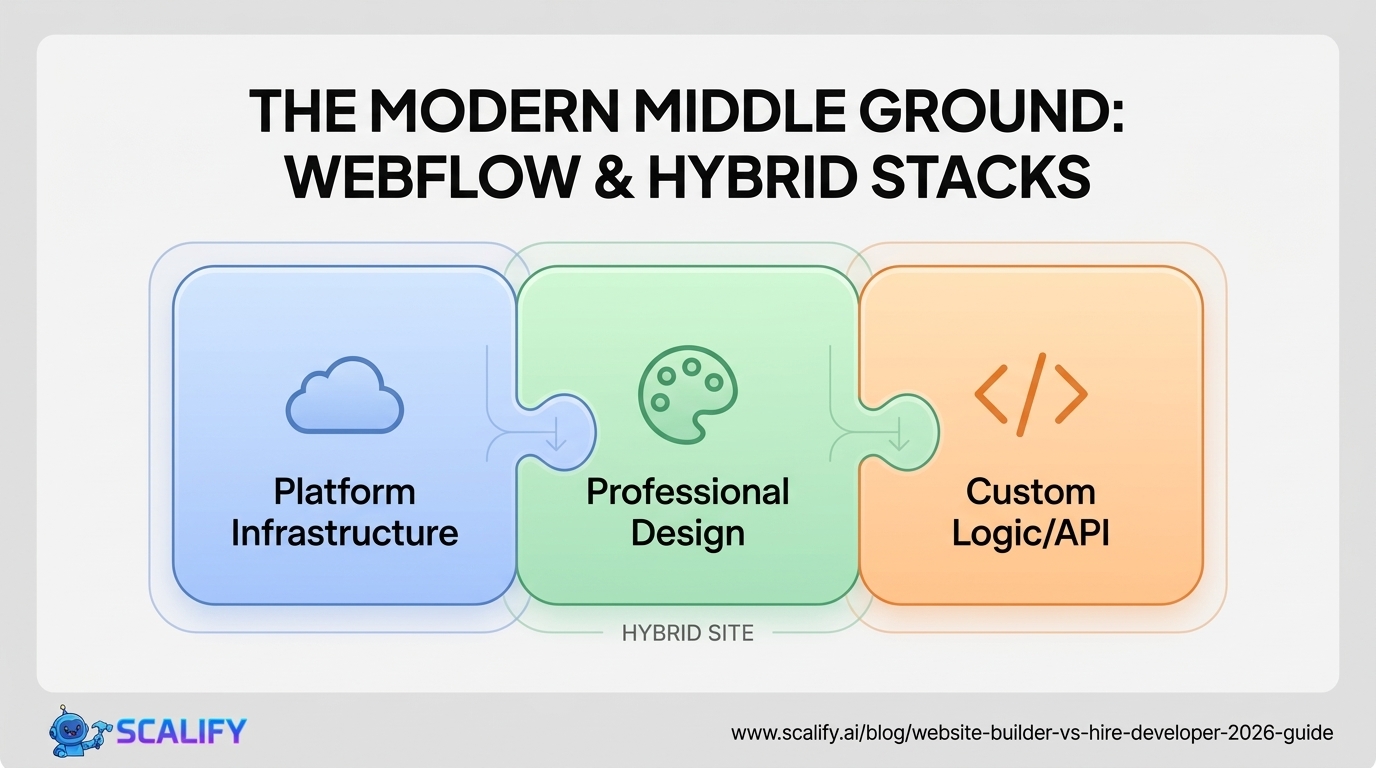
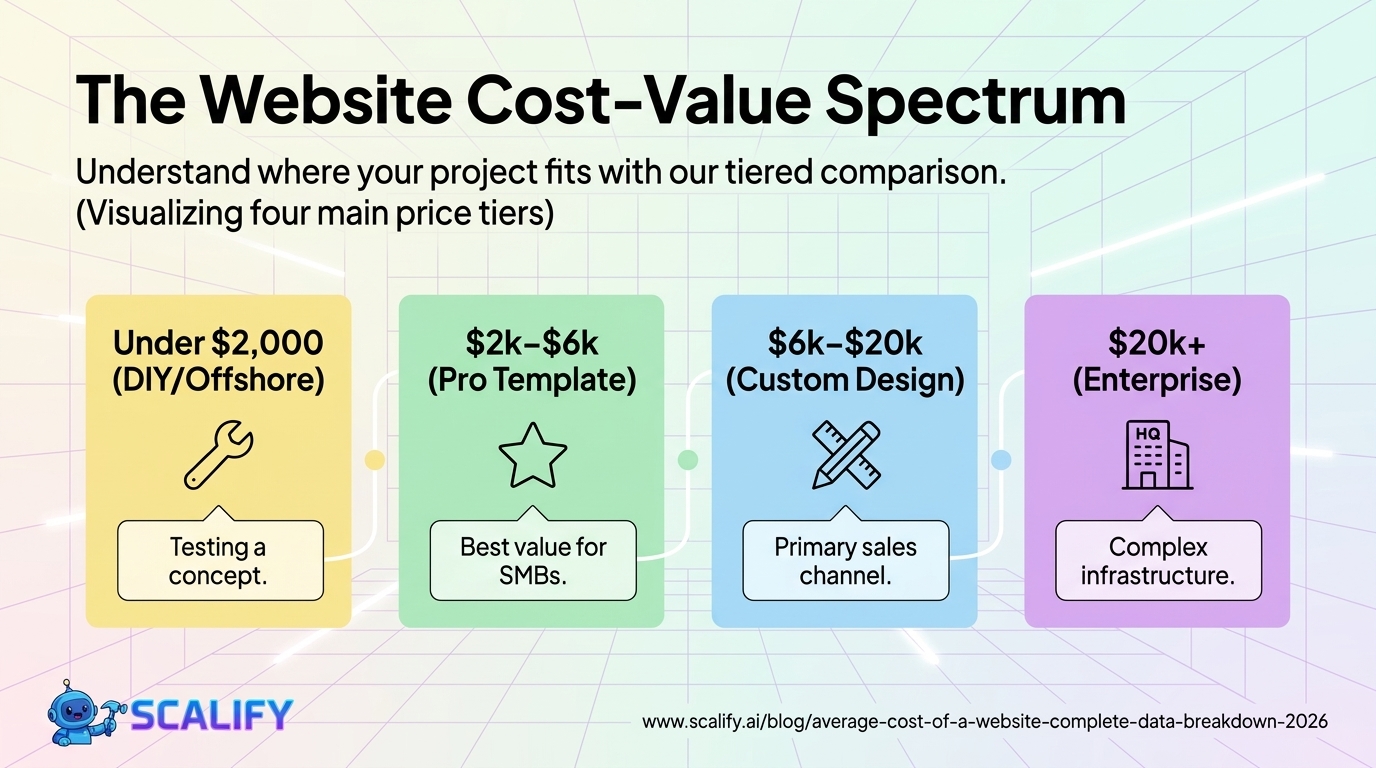
The most common choice for businesses that need professional results without enterprise custom development budgets is professional template-based design — having an experienced web designer or agency build a website using a platform (Webflow, WordPress, Shopify) without using a commercial template directly. This approach delivers: professional design quality (the designer creates something unique to the brand), platform maintenance benefits (security updates, hosting handled by the platform), and content management independence (the client updates content through the platform's CMS). Cost: $3,000–$12,000 for a professionally built Webflow or WordPress site vs. $12,000–$50,000+ for a fully custom build.
Cost Comparison: 3-Year Total Cost of Ownership
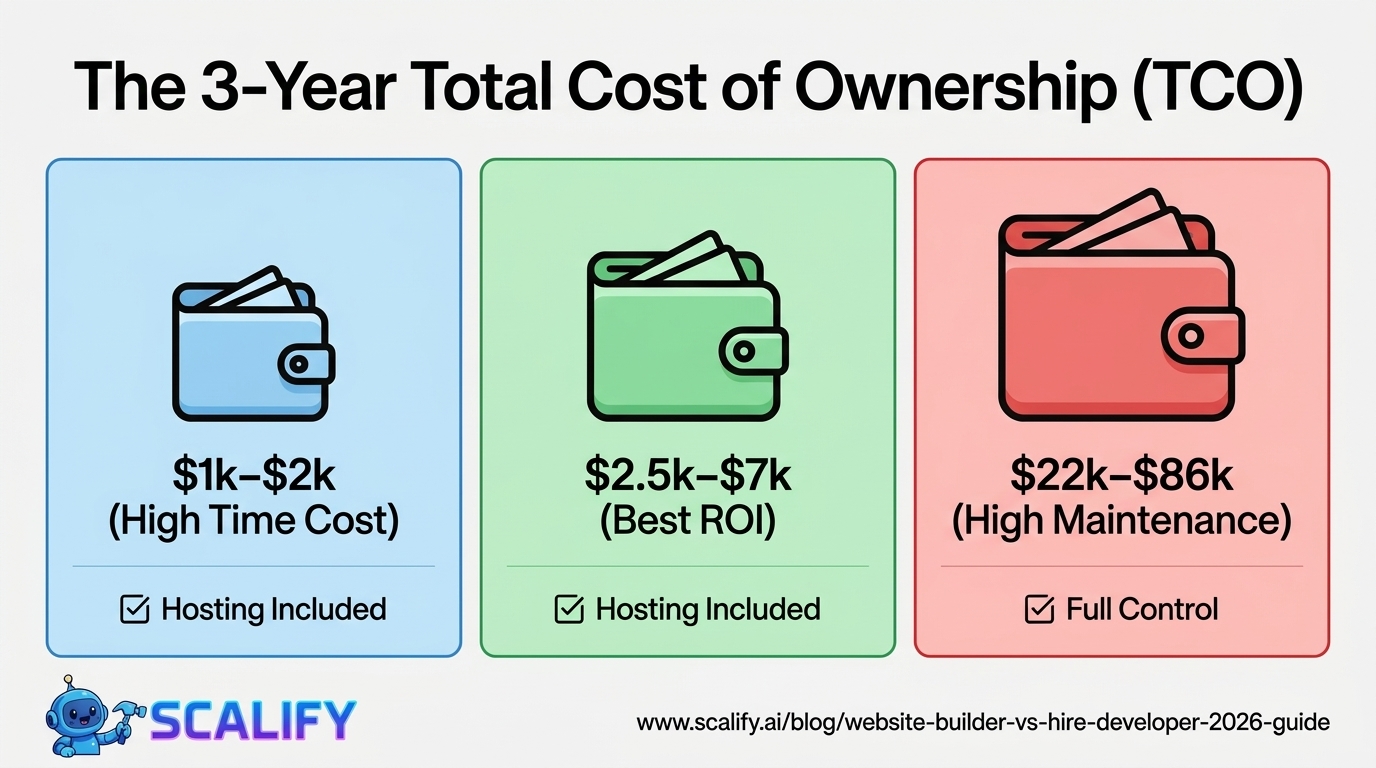
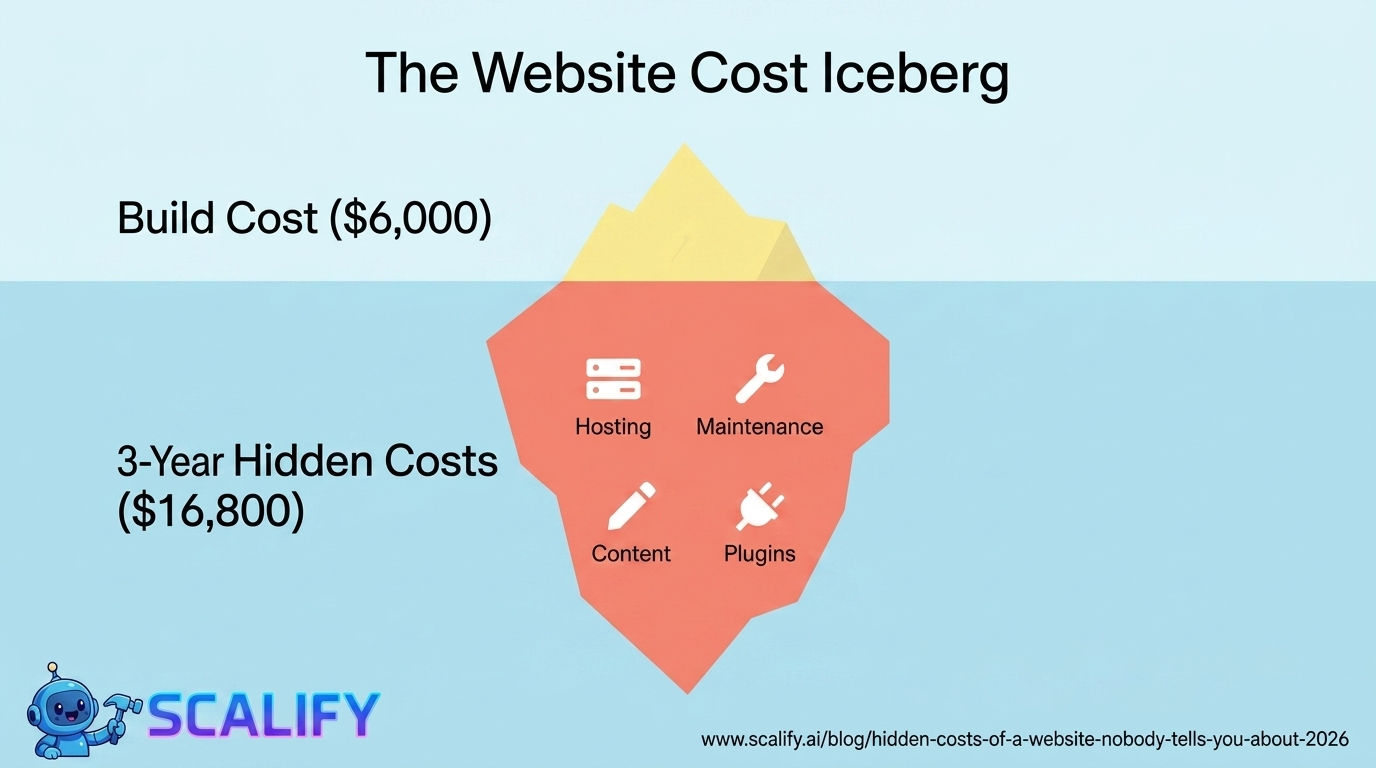
ApproachInitial BuildMonthly Ongoing3-Year TotalWhat It Gets YouDIY Website Builder$0 (your time)$30–$60 + your maintenance time$1,080–$2,160Basic website; lower quality ceiling; your time investmentBuilder + Designer$1,500–$5,000$30–$60$2,580–$7,160Professional quality; independence for content; builder simplicityWebflow/WP Custom$4,000–$12,000$50–$150 (hosting + platform)$5,800–$17,400High quality; CMS flexibility; some developer dependencyFully Custom Build$15,000–$50,000+$200–$1,000 (hosting + maintenance)$22,200–$86,000Maximum flexibility; unique design; requires ongoing developer
Making the Decision: 5 Questions
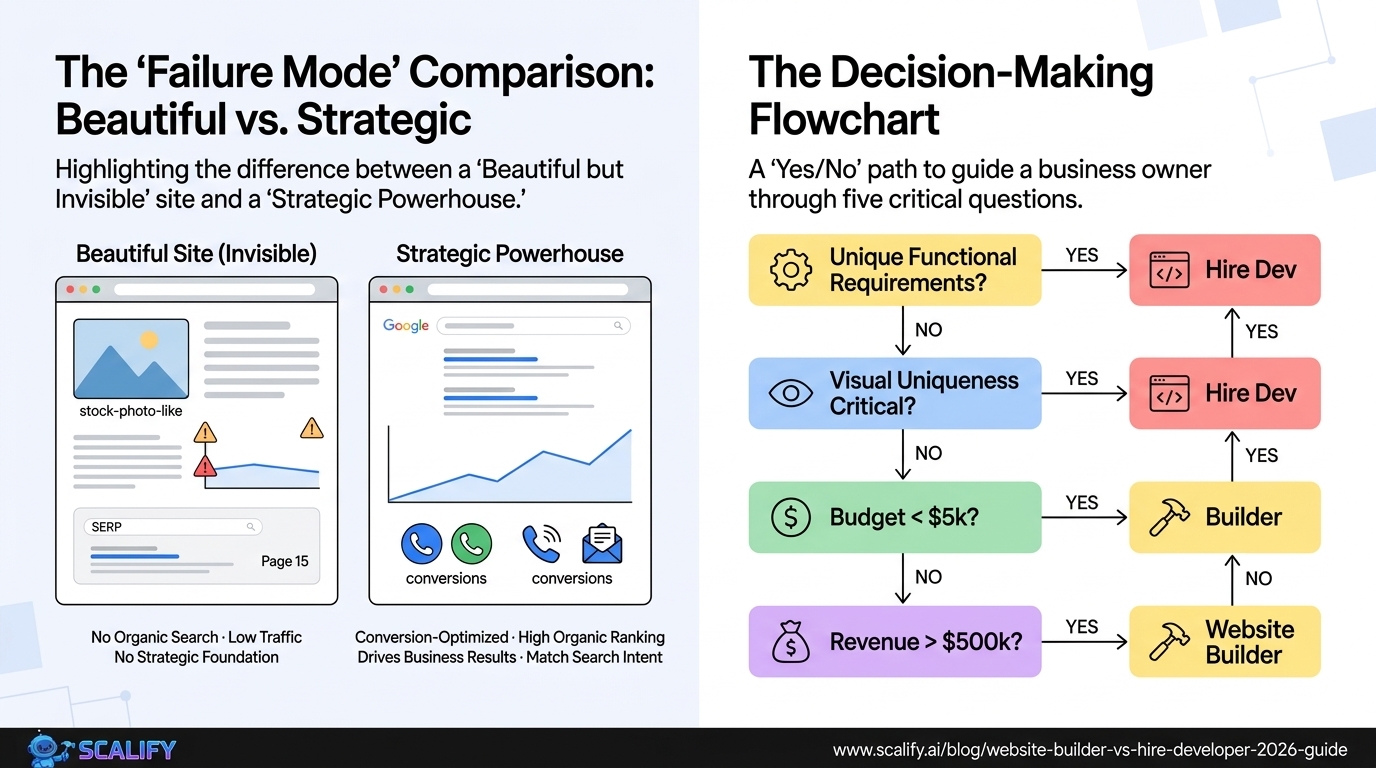
1. Do I have unique functional requirements no platform provides? If yes → hire a developer. If no → a builder is viable.
2. What is my total 3-year budget including maintenance? Calculate actual total cost for each option before deciding based on initial cost.
3. How important is content independence vs. developer relationship? High independence priority → builder. Complex ongoing feature needs → developer relationship is natural.
4. Will I outgrow a platform within 2–3 years? If yes → build custom now and avoid the migration cost. If no → platform is efficient.
5. Is visual uniqueness commercially significant for my business? Premium brand where website quality affects sale decisions → invest in custom design. Standard business with standard requirements → builder is sufficient.
The Bottom Line
Website builders are the right choice for most small businesses, solopreneurs, and businesses with standard requirements and limited budgets — they provide professional results at a fraction of custom development cost and eliminate ongoing technical maintenance overhead. Hiring a developer is the right choice when unique functional requirements, commercial-grade visual differentiation, or foreseeable custom feature development make the investment worthwhile. The most common wrong decision is spending $20,000 on custom development when a $5,000 professionally designed Webflow site would have served the business equally well for 3 years — or building a DIY Wix site for a business where the website's quality directly determines whether prospects become clients.
At Scalify, we deliver professional websites in 10 business days using Webflow — professional-quality design and development without the 6-month custom build timeline or the DIY builder quality ceiling.
Top 5 Sources
The AI Factor: How AI Tools Are Changing Both Options
AI-powered website building tools are significantly changing the landscape of the website builder vs. developer decision. Major platforms have integrated AI design assistance that dramatically reduces the expertise required to produce professional-looking results: Wix ADI (Artificial Design Intelligence) generates a complete website from answers to a few questions, Squarespace Blueprint creates initial site structures from brand information, and Webflow's AI tools assist with layout and copy generation. These AI tools narrow the gap between DIY builder quality and professionally built builder sites, but don't eliminate it — AI-generated layouts still benefit significantly from human design judgment and brand-specific customization that the AI can't apply without careful human direction.
On the developer side, AI coding assistants (GitHub Copilot, Claude, ChatGPT) have made custom web development significantly faster — reducing the time required to build standard features and allowing developers to focus more time on the genuinely complex, custom aspects of a project. This has modestly reduced the cost premium of custom development for straightforward sites while maintaining the premium for genuinely complex requirements that require architectural judgment that AI tools don't provide.
Hybrid Approaches: The Middle Ground
Several hybrid approaches combine elements of both builder and developer approaches in ways that weren't practical before modern platforms:
Webflow + Custom Components: Webflow's Component API and custom code embed features allow developers to build custom interactive components or integrations while keeping the rest of the site manageable in Webflow's visual editor. A business can have 90% of its website fully editable in Webflow's CMS while having a complex interactive pricing calculator or custom booking system built by a developer as an embedded component.
Headless CMS + Custom Front-End: Systems like Contentful, Sanity, or WordPress as a headless CMS provide content management through a friendly editor interface while allowing a React or Next.js front-end to be built by developers with complete design freedom. This approach delivers content independence (non-technical users update through the CMS) with custom front-end flexibility (developers can build any experience the front-end framework supports).
Shopify + Custom Theme: Shopify provides e-commerce infrastructure (payments, shipping, inventory) while a custom Shopify theme built by a developer provides unique visual design and layout. This hybrid gives businesses the proven e-commerce infrastructure of Shopify with the design differentiation of custom development — popular among direct-to-consumer brands that need both e-commerce reliability and visual uniqueness.
The Developer Selection Question: Once You've Decided to Hire
If the decision goes toward hiring a developer, the selection process matters as much as the initial build-vs-build decision. Key criteria for evaluating web development agencies or freelancers:
Portfolio quality and relevance. Review work for businesses similar to yours in size and industry. A portfolio of beautiful restaurant websites doesn't demonstrate the capability for a complex B2B SaaS interface. Ask specifically for examples in your category.
Communication quality and responsiveness. Web development is a collaborative process that requires clear communication about requirements, scope changes, and delivery expectations. A developer or agency that responds slowly to inquiries before being hired is likely to respond slowly to questions and issues during the project.
References and case studies. Ask for and contact references from recent clients. Ask specifically about: whether the project was delivered on time and on budget, how the developer handled scope changes, how responsive they were to requests during and after the project, and whether the client would hire them again.
Contract clarity. Ensure the contract specifies deliverables, timeline milestones, intellectual property ownership of the final code, payment schedule, and what constitutes project completion. Ambiguity in any of these areas creates disputes during or after delivery.
The website builder vs. developer decision ultimately comes down to a clear-eyed assessment of your specific situation — not a general principle about which approach is superior. Builders win for businesses with standard requirements, limited budgets, and independence needs; developers win for businesses with unique functionality needs, commercial-grade differentiation needs, or foreseeable custom feature development. Getting this initial decision right saves significant money and avoids the disruption of premature platform migrations.


.jpeg)
.jpeg)

78 SW 7th St, Miami, FL 33130