

Static vs Dynamic Websites: Which Do You Need?
By Josh Ternyak

April 17, 2026
Static or dynamic — the choice affects your website's speed, cost, security, and flexibility. This guide breaks down the real differences and helps you make the right call for your specific situation.
A Distinction That Sounds Technical But Has Very Practical Consequences
Static versus dynamic. If you've spent any time researching how to build a website, you've seen these terms. Maybe someone told you "you should go static for performance" or "you need a dynamic site if you want to do X." Maybe you nodded along while privately having no idea what they were actually describing.
This distinction matters more than it might seem. It affects how fast your site loads, how much it costs to build and run, how secure it is, how easy it is to update, and what it's capable of doing. Choosing the wrong type for your use case means either paying for complexity you don't need or building something fundamentally incapable of doing what you require.
The good news: once you understand what each one actually means and why the technical difference produces these practical outcomes, the right choice for your situation usually becomes obvious. Let's get into it.
What Is a Static Website?
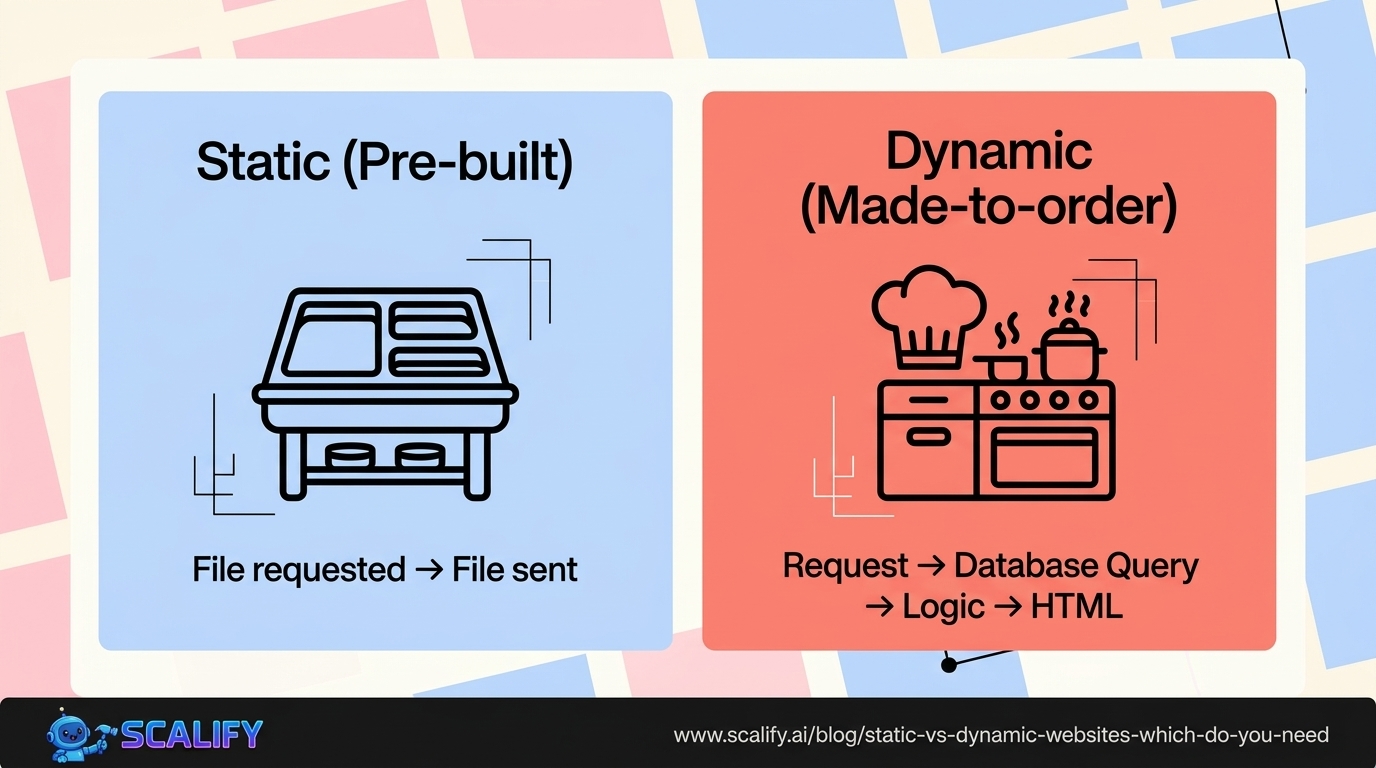
A static website is one where every page exists as a pre-built file — typically an HTML file with its CSS and JavaScript — stored on the server exactly as it will be delivered to the visitor. When someone requests a page, the server finds the file and sends it. No processing. No database query. No assembly of content from multiple sources. Just: file requested, file sent.
The word "static" refers to the server-side behavior, not the visual experience. A static website can have animations, interactive elements, JavaScript-powered features, even real-time data fetched from external APIs — all of that can exist on a static site. What makes it static is that the server itself isn't generating the page dynamically at the moment of the request.
Think of it like a printed book. The pages exist already. When you open to page 47, you see whatever was printed there. The book doesn't generate a new page 47 based on who's reading it or when.
Static websites are typically built in one of two ways:
Manually crafted HTML/CSS/JS files — a developer writes the code directly. Fine for simple sites but doesn't scale well when you have dozens of pages or need to update content regularly.
Static Site Generators (SSGs) — tools like Next.js (in static export mode), Gatsby, Astro, Hugo, and Eleventy that take source files (often Markdown content and template files) and compile them into a complete set of static HTML pages at build time. Content updates involve editing source files, running the build, and redeploying. Many modern SSGs also support pulling content from headless CMS platforms, giving non-technical editors a friendly interface while still producing a static output.
What Is a Dynamic Website?
A dynamic website generates pages on the fly at the moment someone requests them. When a visitor hits a URL, the server runs code — often querying a database, applying business logic, personalizing the content — and assembles the HTML response specifically for that request before sending it.
The same URL can produce different content depending on who's asking, when they're asking, what they've done before, what's in the database at that moment, and any number of other variables. Log into Netflix and you see your recommendations. Log into your bank and you see your accounts. Open Amazon and you see products tailored to your browsing history. All dynamic.
Dynamic websites are built on web application frameworks: WordPress, Django, Ruby on Rails, Laravel, Express.js, Next.js in server-rendering mode. These frameworks handle the routing, database connections, session management, and HTML generation that makes dynamic behavior possible.
Think of a dynamic website like a restaurant that cooks your food after you order it, versus a buffet of pre-prepared dishes. The restaurant can make anything on the menu customized to your preferences. The buffet serves what's already made — fast and consistently.

The Performance Difference: Why Static Is Faster (Usually)
Performance is where the static vs. dynamic distinction has the most immediate, measurable impact.
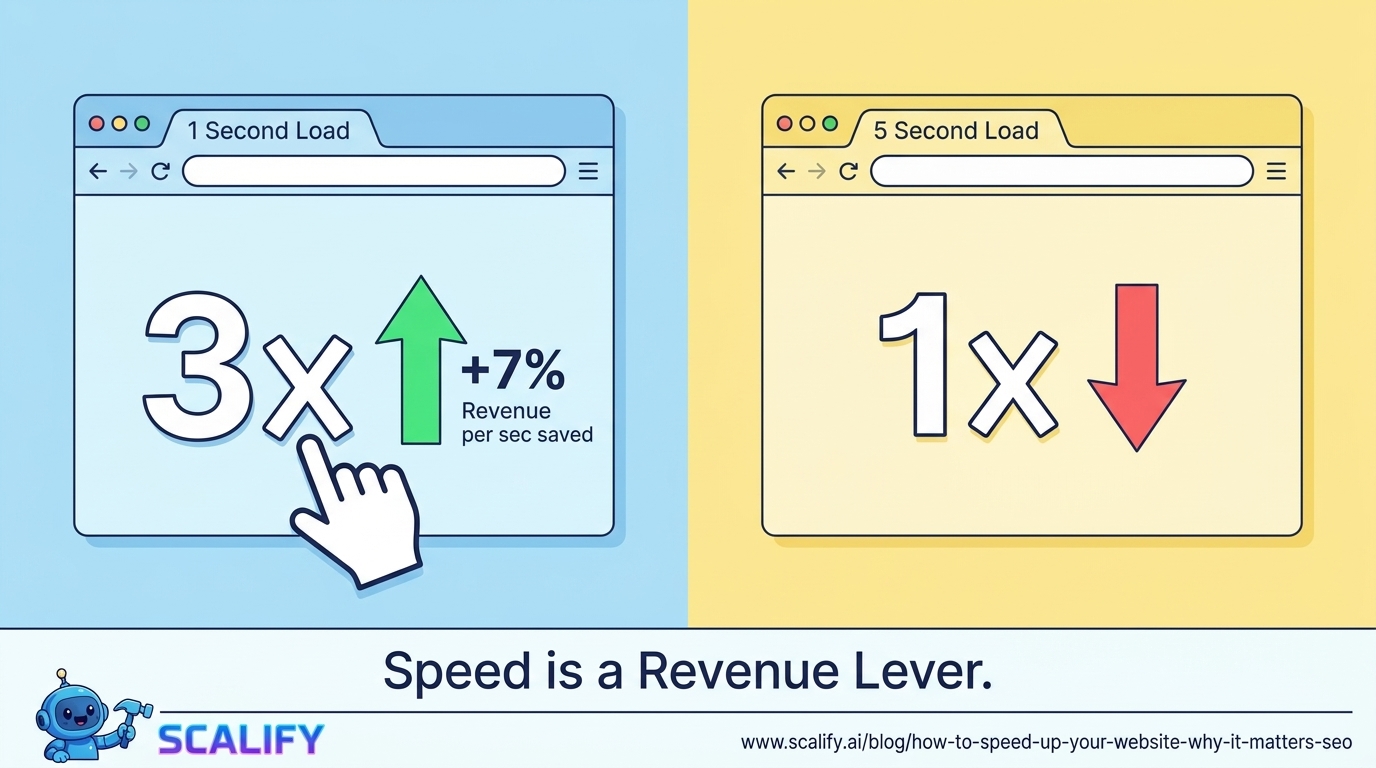
A static page request is fundamentally simple: locate file, transmit file. The server does minimal work. Response times can be in the single-digit milliseconds at the server level. Combine that with a CDN that caches those static files on edge servers around the world, and you have a setup that can deliver pages to visitors in under 100 milliseconds regardless of where they are.
A dynamic page request involves more steps: receive request, authenticate user (maybe), query database (possibly multiple queries), run application logic, assemble template with retrieved data, generate HTML, transmit response. Each step adds time. A well-optimized dynamic site handles this in 100–300 milliseconds. A poorly optimized one takes seconds — and that's before the browser has even started loading CSS, JavaScript, and images.
The performance gap between a well-built static site and a well-built dynamic site is narrower than it used to be, thanks to improvements in server hardware, caching strategies, and CDN sophistication. But all else being equal, static is faster because there's simply less work to do.
This matters enormously for SEO and user experience. Google's Core Web Vitals — the performance metrics it uses as ranking factors — reward fast sites and penalize slow ones. A static site hosted on a CDN can achieve near-perfect Core Web Vitals scores with relatively little optimization effort. Getting the same scores from a dynamic site requires careful, deliberate performance engineering.
Security: Static Sites Have a Structural Advantage
Security is an underappreciated advantage of static sites that becomes more meaningful the more you think about it.
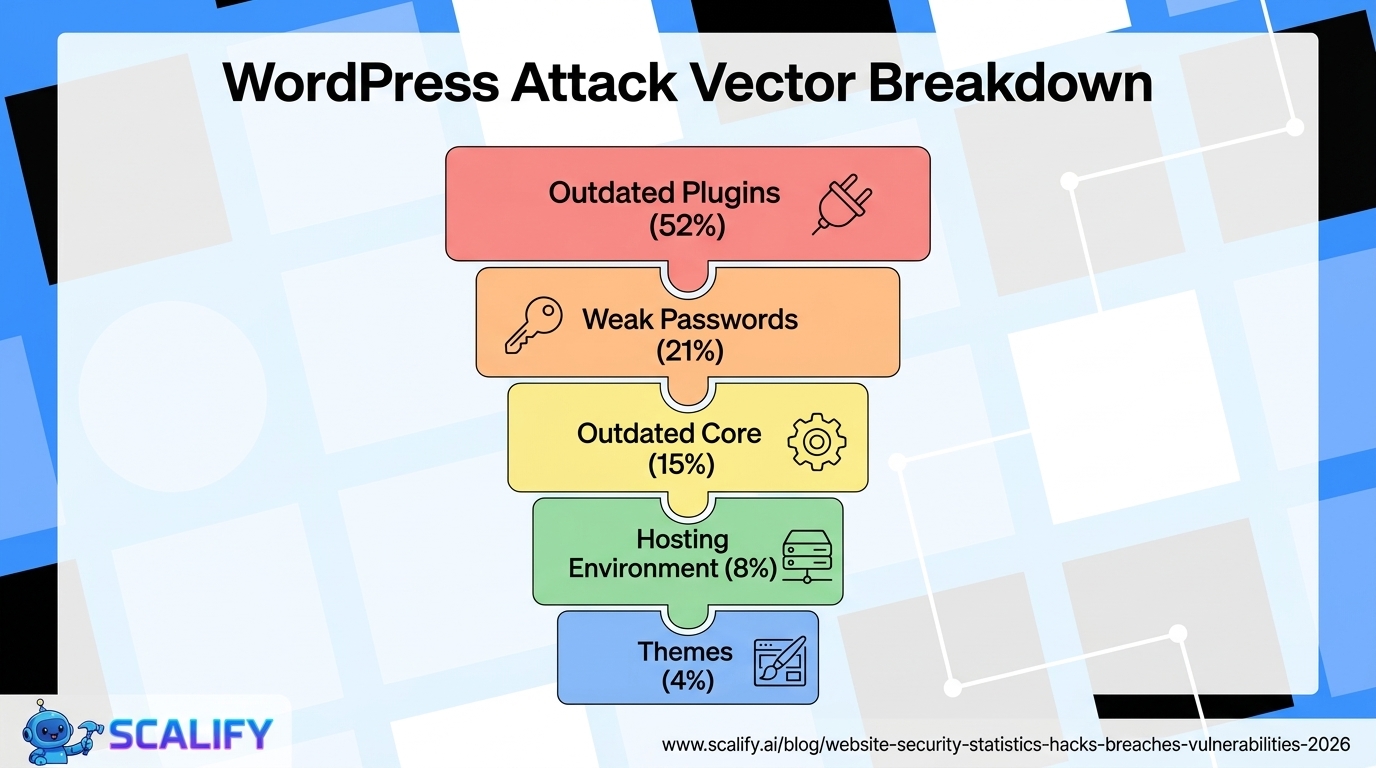
Dynamic websites have a large attack surface. They run server-side code. They connect to databases. They have admin interfaces. They use plugins and dependencies that may have vulnerabilities. They accept user inputs that, if handled poorly, can be exploited through SQL injection, cross-site scripting, or command injection attacks. WordPress sites are among the most frequently hacked things on the internet, largely because they're dynamic, plugin-heavy, often misconfigured, and extremely numerous — making them high-value targets for automated scanning attacks.
A static website has none of these attack surfaces. There's no server-side code to exploit. There's no database to inject malicious queries into. There's no admin login page to brute-force. The worst a successful attack on a static site can do is deface the content (if the attacker gains access to your deployment pipeline) — a serious problem, but not a data breach, not a backdoor, not a compromised database of customer records.
For any website handling sensitive data — customer information, payment details, personal health or financial records — the dynamic nature of the site makes security more complex and the stakes of getting it wrong higher. Static sites sidestep much of this complexity entirely.

Scalability: Static Wins Again, But Differently
Scalability refers to how well a system handles increasing load — specifically, what happens when traffic spikes from the normal baseline to 100x or 1000x the normal baseline.
Static files hosted on a CDN scale essentially infinitely at near-zero marginal cost. A CDN distributes cached copies of your pages across dozens of edge locations globally. Each request is served from the nearest edge node without touching your origin server. If a million people hit your static site simultaneously, the CDN handles it. Your costs go up proportionally with traffic, but the performance stays constant.
Dynamic websites must scale their server infrastructure to handle increased load. More traffic means more database queries, more application processing, more server resources consumed. Handling a traffic spike requires either pre-provisioned capacity (expensive) or auto-scaling infrastructure (more complex to set up). Done well, dynamic sites can scale to massive traffic — but it requires engineering investment that static sites don't need.
For most small businesses, this is a moot point — your traffic isn't in a range where either architecture would struggle. But for businesses with viral potential, big launch moments, or seasonal traffic patterns, static architecture gives you one less thing to worry about.
The Content Management Question: Static's Biggest Limitation
If static sites are faster, more secure, and easier to scale, why doesn't everyone use them?
The answer is primarily about content management — specifically, who can update the site and how easily.
On a traditional static site, updating content means editing source files, running a build process, and deploying the new files. This is completely fine for a developer doing it from their terminal. It's not acceptable for a marketing manager who wants to publish a blog post, update a product description, or change a headline without filing a ticket with the engineering team.
Dynamic CMSs like WordPress solved this with a friendly admin interface that anyone can use. Log in, click New Post, write your content, click Publish. No code, no build process, no deployment. This democratization of content publishing was one of the defining developments of the web's evolution.
The modern answer to this tension is the headless CMS: a content management system that provides a user-friendly editorial interface but doesn't control the front-end presentation. Editors create and publish content in the CMS (Contentful, Sanity, Prismic, Storyblok, Webflow CMS). That content gets pulled via API into a static site generator at build time, producing fast, static pages. New content triggers a new build automatically — the whole process can run in under a minute, and the published result is a static site with all its performance and security advantages.
This headless/static approach has become the dominant architecture for serious content sites that care about both editorial workflow and performance.

When Dynamic Capabilities Are Non-Negotiable
For all the advantages of static sites, there are use cases that genuinely require dynamic server-side processing. No amount of clever CDN configuration changes these requirements.
User authentication and personalized accounts. If users need to log in and have access to their own data — their orders, their profile, their saved preferences — you need a dynamic backend. Static sites can authenticate users through third-party services (Auth0, Clerk) but the underlying user data management is always dynamic.
Real-time data. Stock prices, live sports scores, inventory levels that need to reflect actual current availability, real-time collaboration features — these require server-side processing that produces different results moment to moment.
Complex forms and data processing. A contact form that sends an email is easily handled by a static site with a serverless function or a form service. A multi-step intake form that creates a record in your CRM, sends a customized email sequence, triggers an internal notification, and schedules a follow-up call requires application logic that lives on a server.
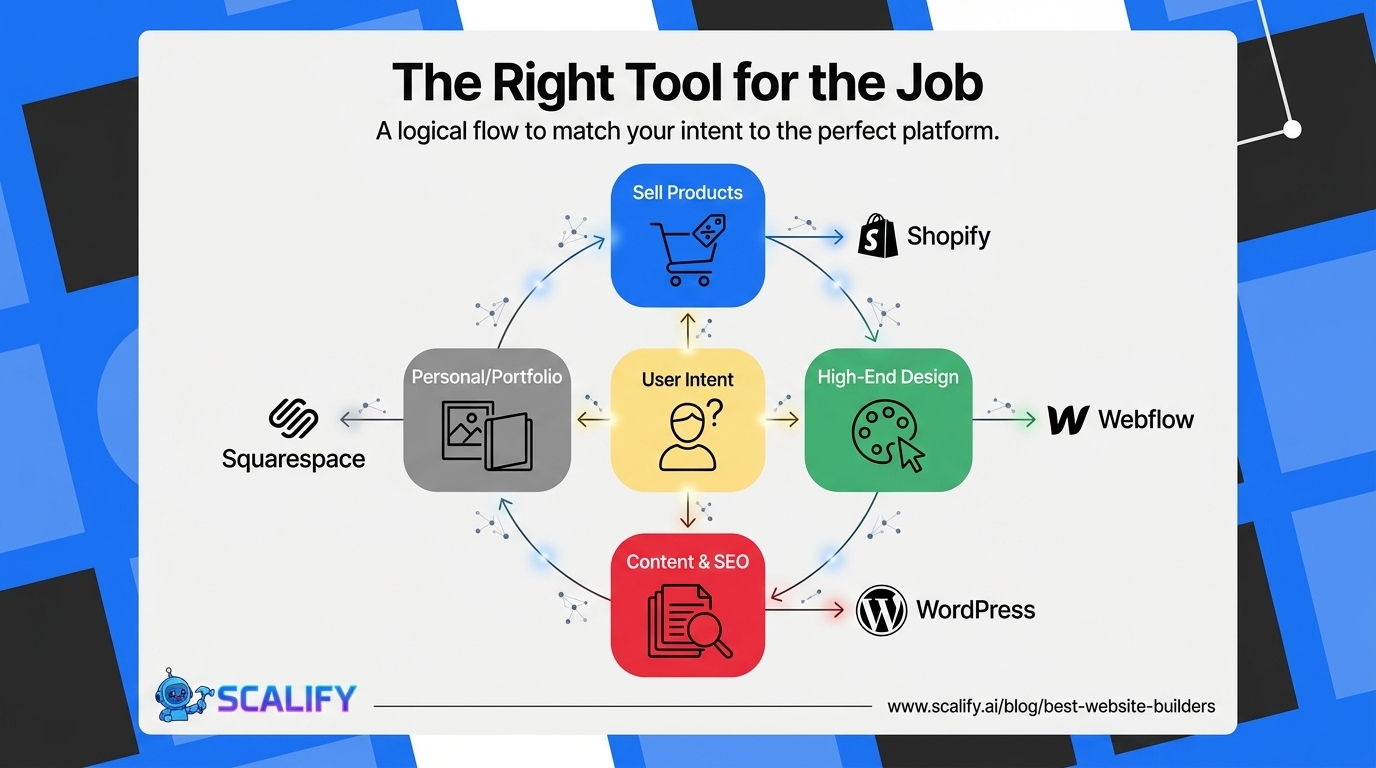
E-commerce with inventory and pricing logic. Simple product listings can be static. But carts, checkout, inventory management, discount codes, tax calculation, and order processing require real-time dynamic processing. Shopify handles this by being a dynamic platform entirely dedicated to e-commerce — you're not building that logic yourself.
Search functionality at scale. Basic static site search is possible (Algolia and similar services provide this). But complex search with filtering, faceting, and real-time results across large content libraries typically requires a dynamic search service.
The Hybrid: Serverless Functions and the JAMstack
Modern web development has blurred the strict static/dynamic divide with an architecture called JAMstack (JavaScript, APIs, Markup) and serverless functions.
The idea: build your site statically for performance, but handle specific dynamic requirements with targeted serverless functions — small pieces of server-side code that run on-demand (in AWS Lambda, Cloudflare Workers, Vercel Functions, etc.) and shut down when they're done, rather than requiring a continuously running server.
Need to process a form submission? Serverless function. Need to fetch private data that can't be exposed in the frontend? Serverless function. Need to send an email, process a payment, or call an external API with secret credentials? Serverless function.
This hybrid approach captures the performance and security benefits of static architecture while enabling the specific dynamic capabilities a site actually needs, without requiring a full dynamic backend. It's become the dominant architecture for high-performance marketing sites and content platforms built by teams that take web performance seriously.
Cost Comparison: What Each Actually Costs to Run
The cost differential between static and dynamic hosting is significant and often underappreciated.
Static site hosting: Platforms like Netlify, Vercel, and Cloudflare Pages offer free tiers that are genuinely production-ready for most small businesses. You can host a static site with excellent global performance for $0–20/month. Even at enterprise scale, static hosting costs are minimal because CDN delivery is extremely cost-efficient.
Dynamic site hosting: Running a server that's always on, always processing requests, always connected to a database, costs more. Quality shared WordPress hosting starts around $15–30/month. Managed WordPress hosting (WP Engine, Kinsta) runs $25–100+/month. Custom dynamic applications on cloud infrastructure require more DevOps attention and typically cost $50–500+/month depending on traffic and complexity.
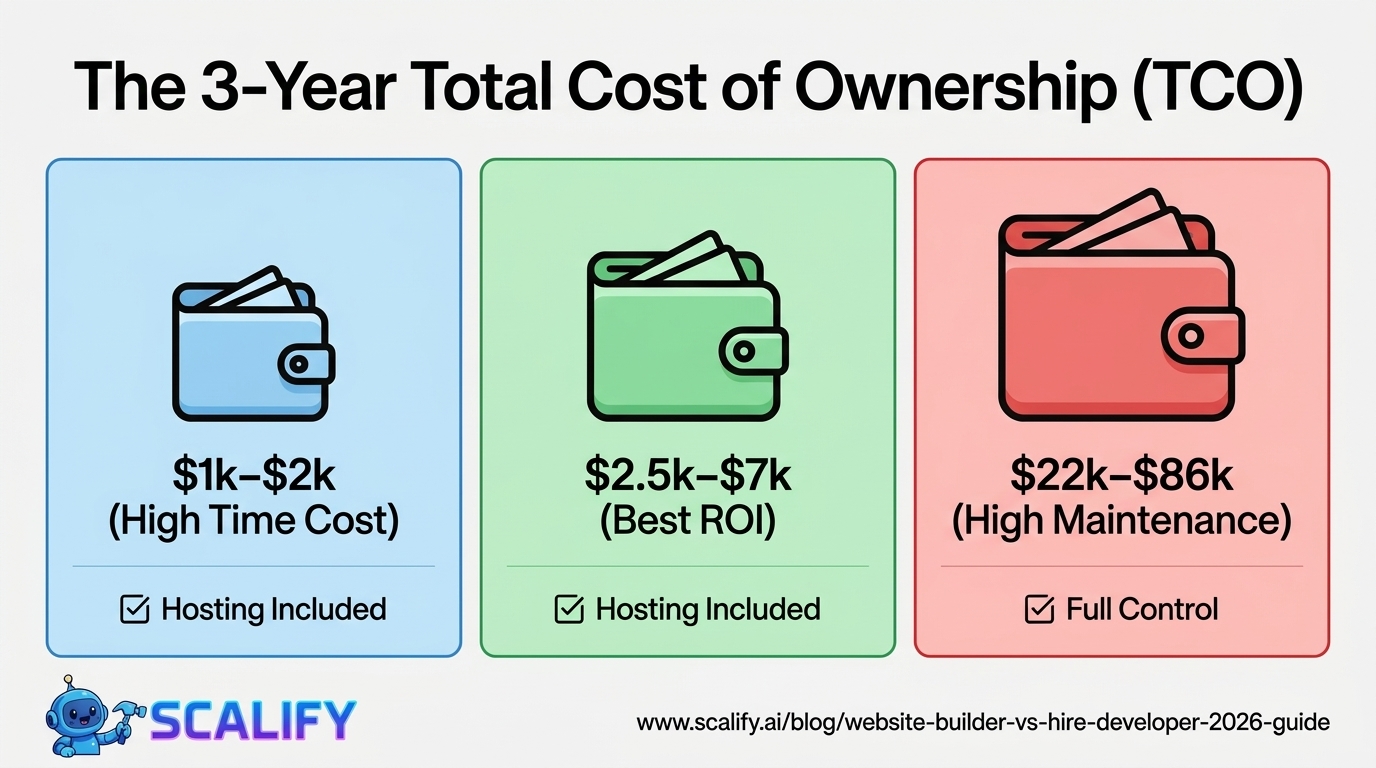
Beyond raw hosting costs, dynamic sites accumulate more ongoing maintenance costs: security patches, plugin updates, dependency management, database optimization, server monitoring. These aren't optional — letting a dynamic site go unmaintained is how sites get hacked. Factor this into the total cost of ownership comparison.
Which One Do You Actually Need?
Here's the decision framework, stripped down to the essentials.
Choose a static approach if: Your website is primarily informational — telling people who you are, what you offer, and how to contact you. Content is updated by a small team and can go through a build process. You want maximum performance and security without engineering overhead. You're running a marketing site, portfolio, documentation site, or content blog.
Choose a dynamic approach if: You need user accounts and personalization. You're building an e-commerce store with complex catalog, cart, and checkout requirements. You need real-time data integration. You need a large non-technical team to publish and update content without any technical friction. You're building an application, not just a site.
Consider a hybrid (JAMstack) approach if: You want the performance and security of static with specific dynamic capabilities for forms, search, or data processing. You're working with developers who are comfortable with modern tooling. You want the best of both worlds and are willing to invest in the slightly more complex architecture.
For most small business websites — service companies, professionals, local businesses, startups with marketing sites — a static site or a platform like Webflow (which abstracts away the technical distinction entirely and handles both the CMS and the publishing pipeline) delivers everything you need at lower cost and with better performance than a WordPress-style dynamic CMS.
For businesses that genuinely need the capabilities of a dynamic system — e-commerce, memberships, user-generated content — the investment in dynamic infrastructure is justified by those requirements.
The Bottom Line
Static sites are faster, cheaper, more secure, and easier to scale. Dynamic sites are more capable and more flexible, enabling functionality that static architecture simply can't support. The right choice depends entirely on what your website actually needs to do.
If you're building a marketing or informational site, the default today should be static or a platform that handles this distinction for you. Add dynamic complexity only when you have specific requirements that demand it — not because "dynamic" sounds more sophisticated or because that's what you've always done.
Whatever architecture is right for your situation, Scalify builds websites that are architected properly from the start — fast, secure, and built to perform. No over-engineering. No under-building. Just the right solution for what your business actually needs.











.jpeg)

.jpeg)




78 SW 7th St, Miami, FL 33130