

Web Developer Salary Trends: 5-Year Growth Chart (2021–2026)
By Josh Ternyak

April 22, 2026
Web developer salaries grew 28% from 2021 to 2026, with the AI integration premium now worth $20,000–$40,000 and the specialization gap widening every year. This comprehensive guide covers year-by-year salary data, the 2022–2023 tech correction and recovery, technology-specific salary changes, remote work's geographic impact, and the outlook through 2030.
Web Developer Salary Trends: The 5-Year Growth Story (2021–2026)
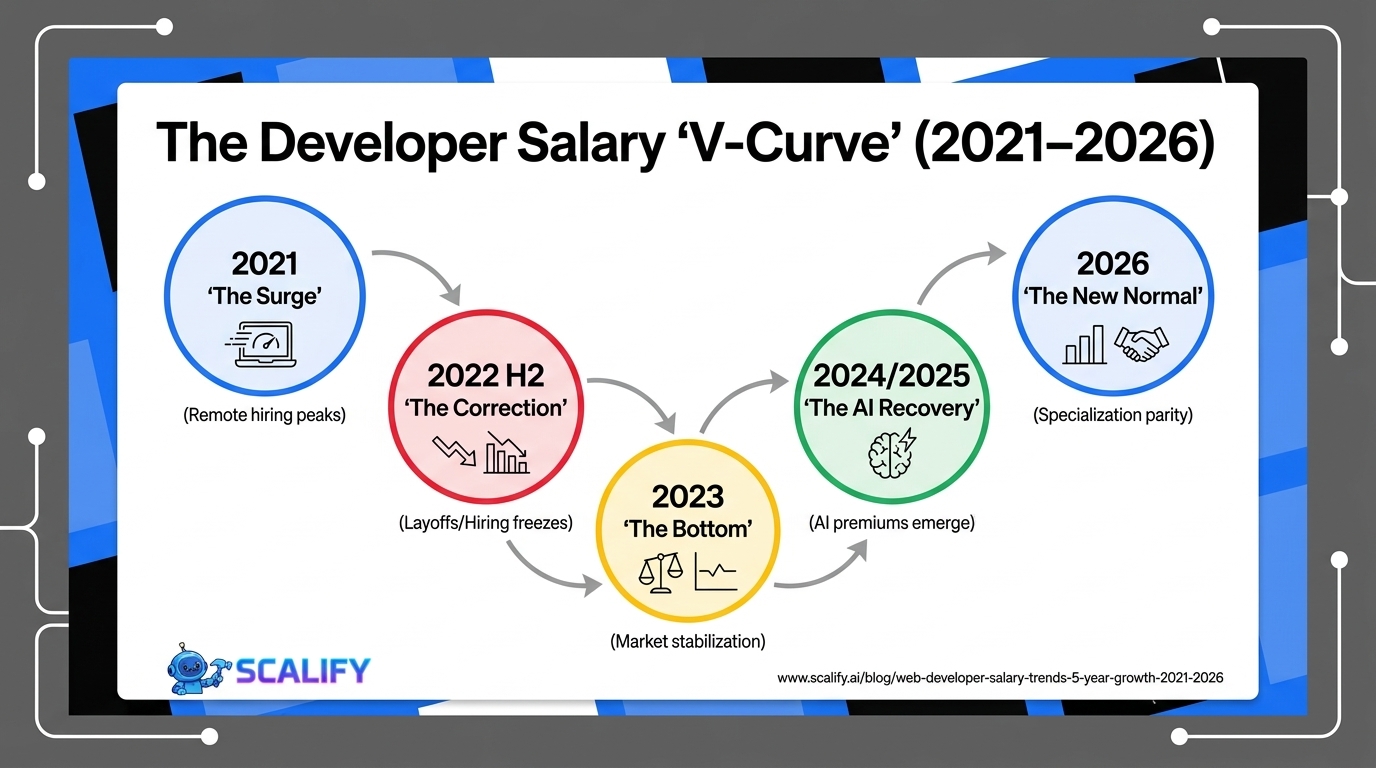
Web developer salaries have followed a dramatic arc over the past five years — a surge driven by pandemic-era digital transformation demand, a correction as the tech hiring bubble deflated in 2022–2023, and a recovery driven by AI tooling demand and the continued digitization of every business sector. Understanding this trajectory gives developers the context to benchmark their compensation accurately and negotiate from a position of market knowledge rather than guesswork.
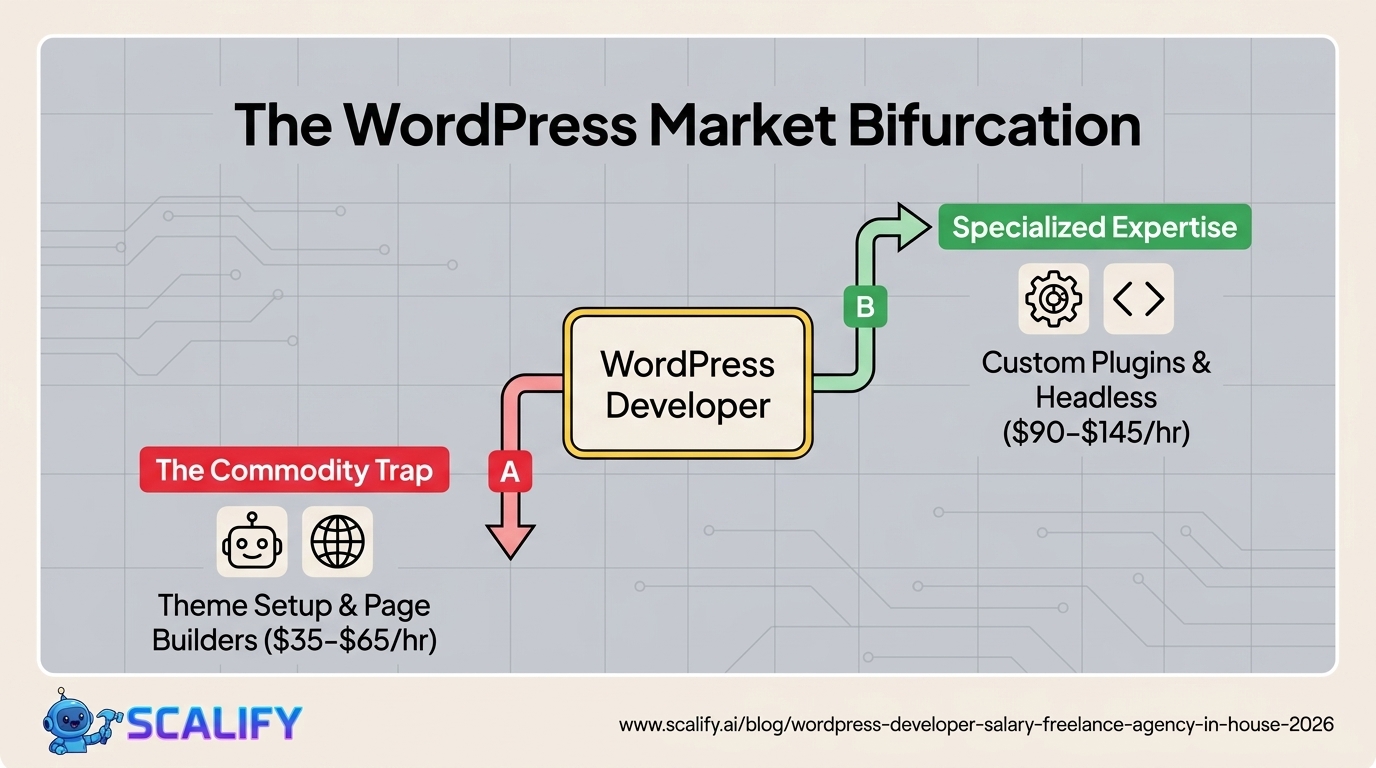
From 2021 to 2026, median web developer compensation in the United States increased approximately 28–35% across experience levels. The most significant gains occurred in specialized roles — AI-adjacent development, platform engineering, senior full-stack — while the most significant compression occurred in commoditized roles like junior generalist front-end and basic WordPress development. The net picture is a market that pays significantly more for differentiated expertise than it did five years ago, while paying proportionally less for undifferentiated skills that have become easier to produce through bootcamps and self-study programs.
Key Web Developer Salary Trend Statistics (2021–2026)
Year-by-Year Salary Data: 2021–2026
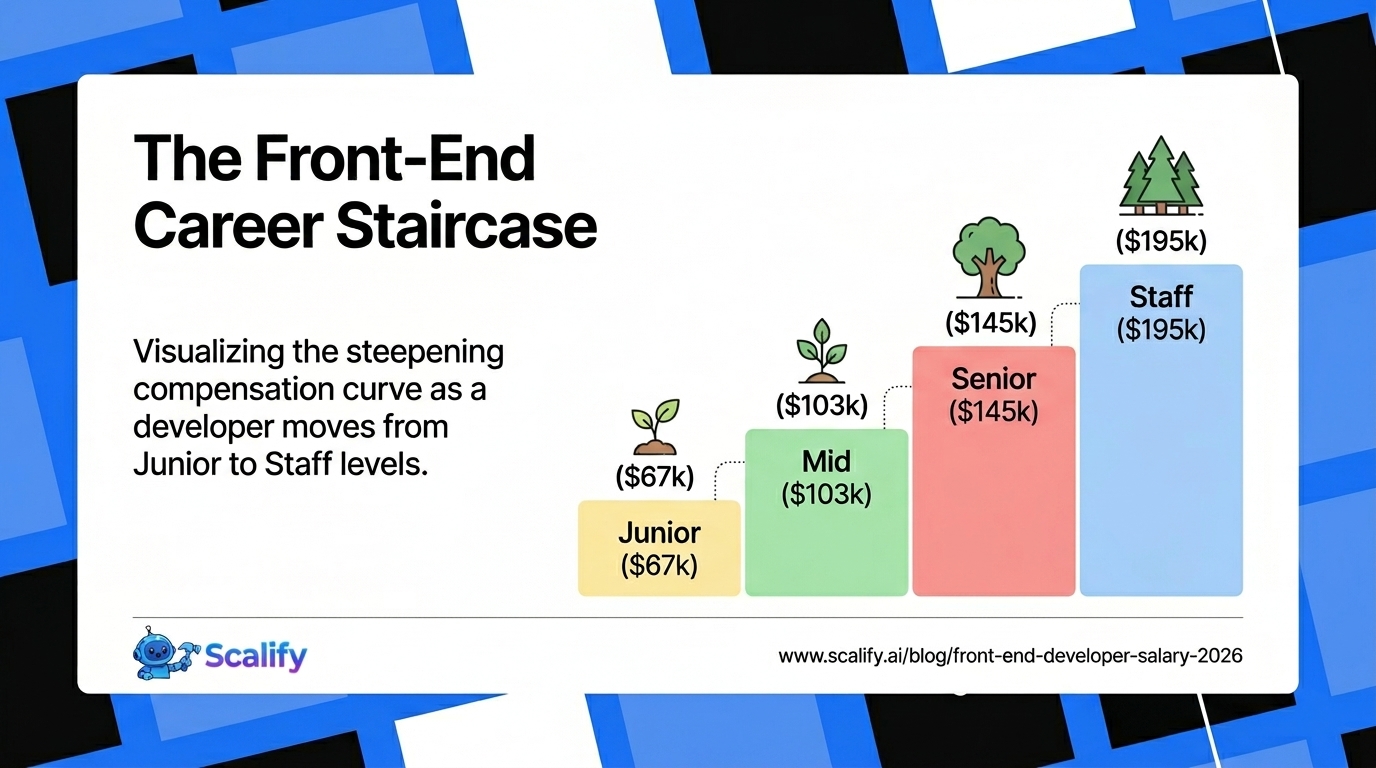
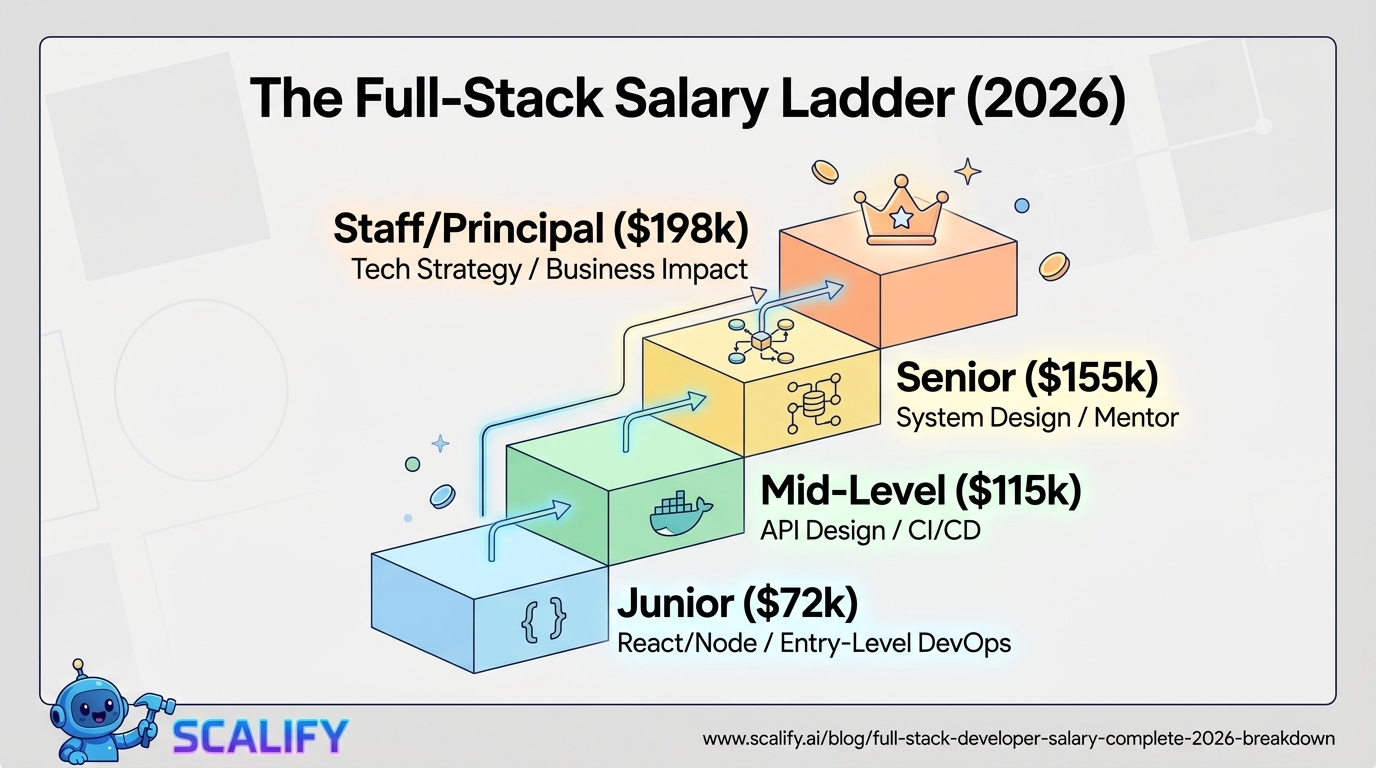
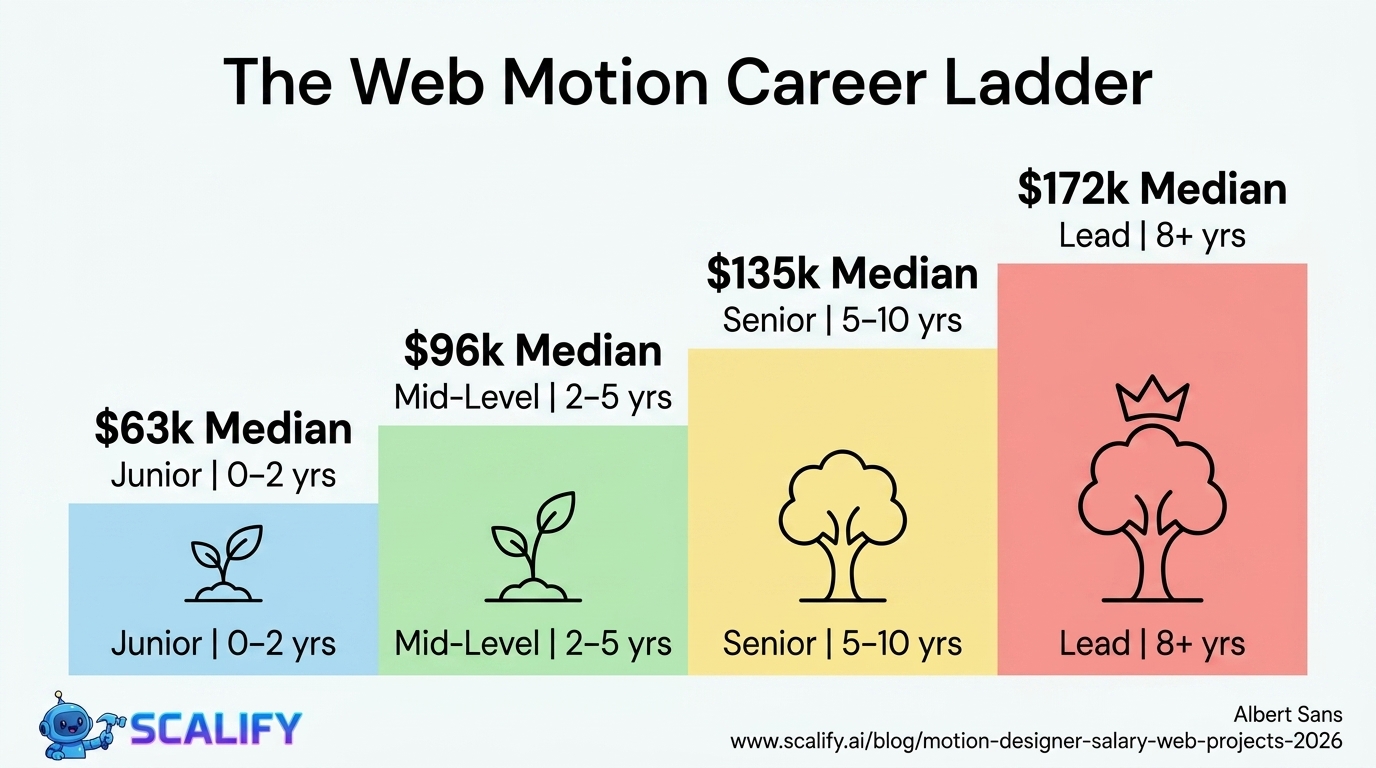
YearJunior MedianMid-Level MedianSenior MedianKey Market Driver2021$62,000$88,000$128,000Peak pandemic digital transformation; remote hiring normalized globally2022 H1$66,000$95,000$140,000Peak of tech hiring bubble; FAANG competing aggressively for talent2022 H2$62,000$90,000$132,000First major tech layoffs begin; Meta, Twitter, Stripe hiring freezes2023$59,000$86,000$125,000Continued layoffs; market correction; increased candidate supply2024$62,000$92,000$135,000Recovery begins; AI integration demand emerges; market stabilizes2025$66,000$100,000$148,000Strong recovery; AI-adjacent premiums emerge; React/TypeScript standard2026$68,000$108,000$158,000Stable growth; specialization premiums widening; remote parity mature
The 2022–2023 Tech Correction: What Happened and Why
The 2022–2023 tech layoff cycle was the most significant salary disruption in web development in over a decade. Following the historically unusual demand surge of 2020–2021 — when every organization urgently needed digital capabilities and competed frantically for engineering talent — the market overcorrected. Rising interest rates made growth-stage tech investment more expensive, companies that had over-hired during the growth phase reduced headcount, and the resulting candidate surplus temporarily suppressed salaries by 8–12% from peak levels.
The companies most affected were growth-stage tech companies and consumer internet businesses — Meta, Twitter/X, Snap, Lyft, Stripe — that had grown headcount aggressively during the low-interest-rate era. Established enterprise software companies, consulting firms, and non-tech industries experienced much smaller disruption — a pattern that accelerated the movement of web development talent out of pure tech and into every-industry technology roles, contributing to what has become a more geographically and sector-diverse web developer job market in 2026 than existed in 2021.
The recovery that began in late 2023 was driven by two converging forces: the natural normalization of supply and demand after the correction, and the emergence of AI integration as a new category of web development work that created fresh, urgent demand for engineers who could build AI-powered applications. By 2024, companies that had been laying off engineers were actively hiring for AI-adjacent roles — often at premium compensation — and the market recovery was well underway.
The AI Effect on Web Developer Salaries: 2023–2026
AI Skill Category2023 Premium2024 Premium2026 PremiumTrendLLM API integration (OpenAI, Anthropic)+$15,000+$22,000+$28,000Growing steadilyAI-powered feature development+$18,000+$25,000+$32,000Strongly growingRAG / vector database integration+$20,000+$28,000+$35,000Strongly growingPrompt engineering for production apps+$12,000+$18,000+$22,000Growing, stabilizingAI-assisted development (Copilot, Cursor)NeutralNeutralExpected baselineBecoming table stakes
The distinction between AI as a productivity tool and AI as a domain of expertise is critical for understanding salary impact. Using GitHub Copilot or Cursor has become expected of most developers — it produces productivity gains but not salary premiums because it's not a differentiating skill. Building AI-powered features — integrating LLM APIs into production applications, designing RAG systems, building conversational interfaces with streaming responses — is a genuine specialization that commands significant and growing premiums. Developers who treat AI tooling as a crutch without building AI integration expertise are missing the biggest compensation opportunity in the current market.
Technology-Specific Salary Trends: What's Rising and What's Falling
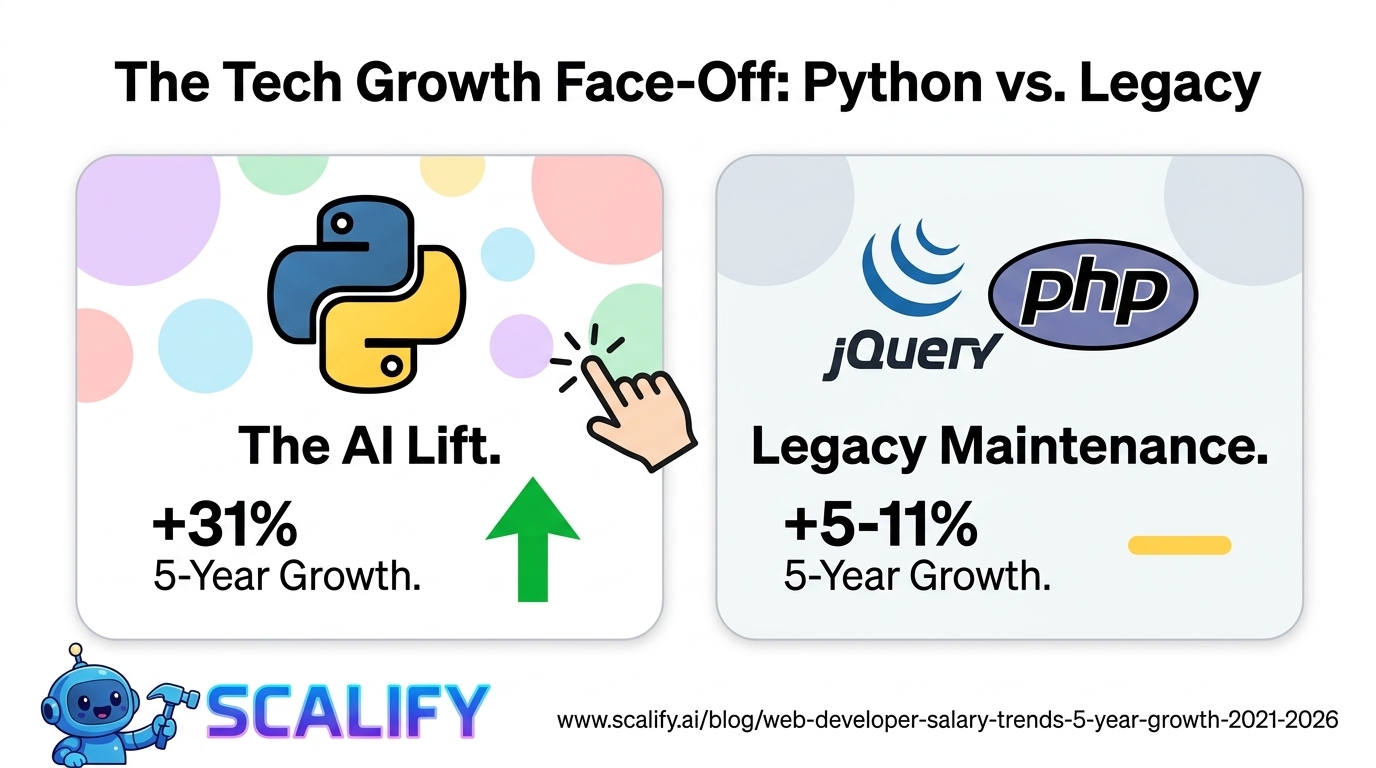
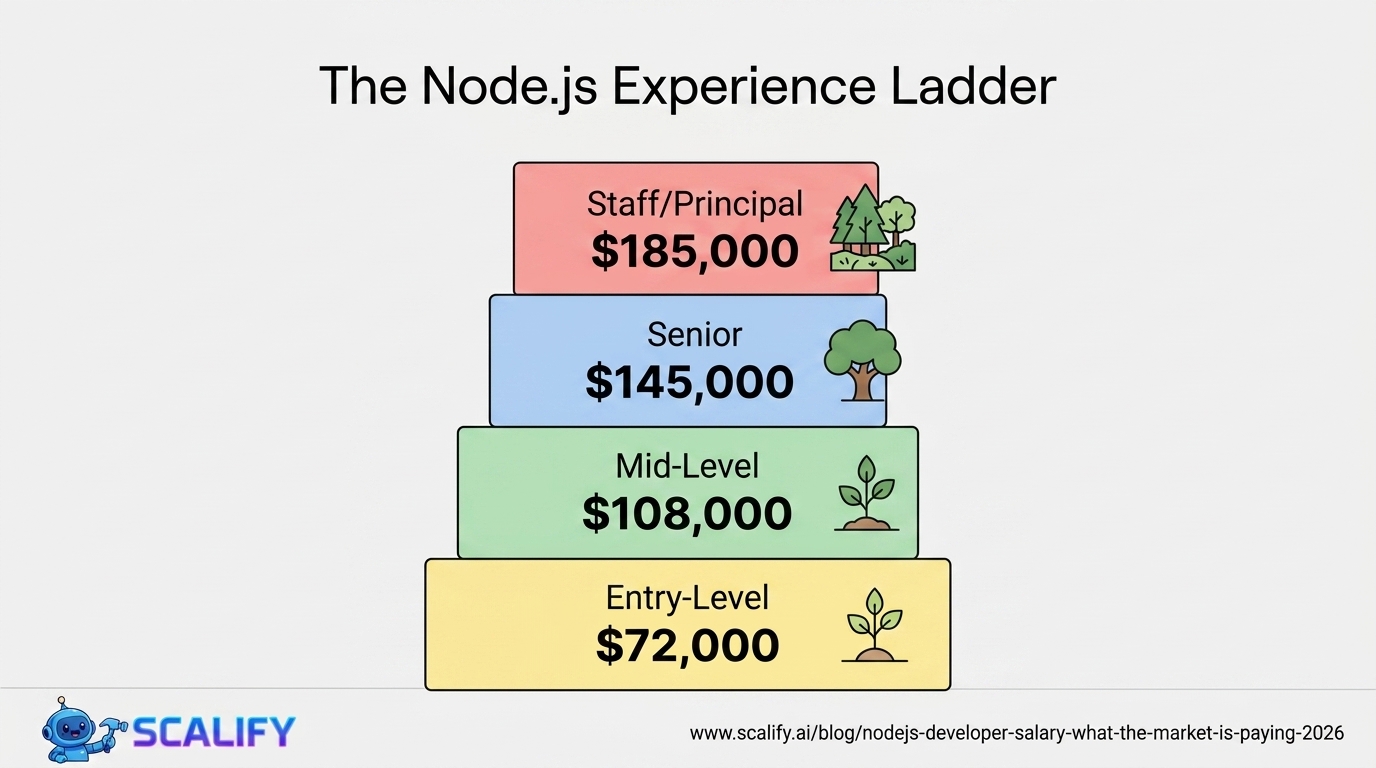
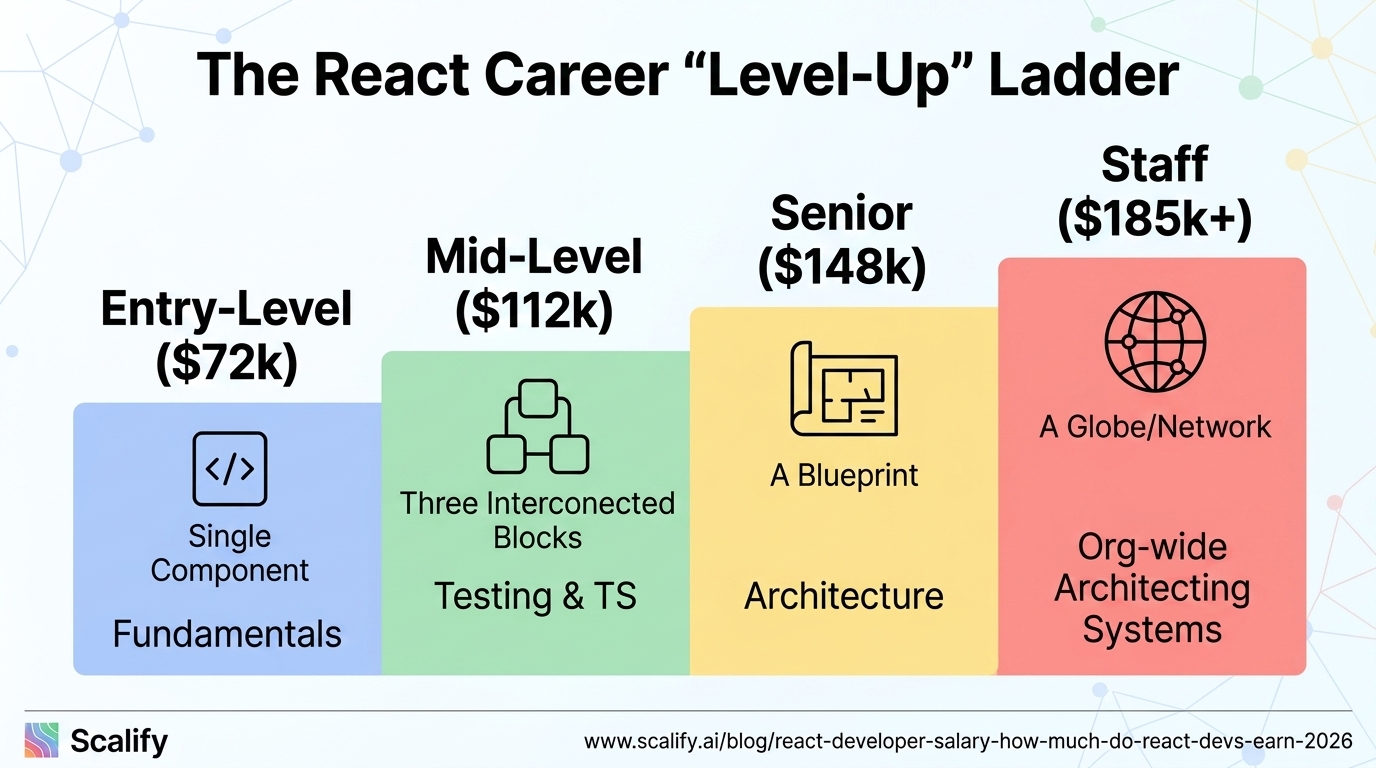
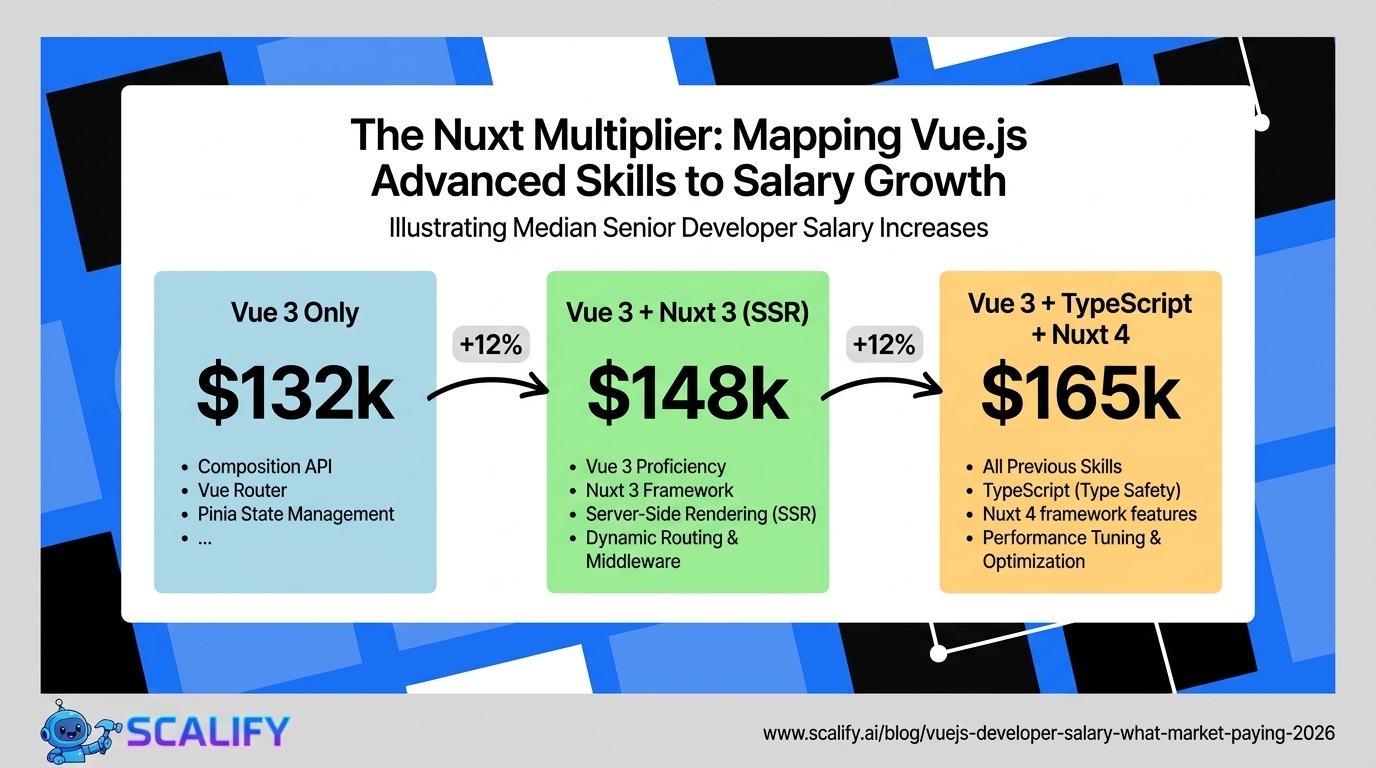
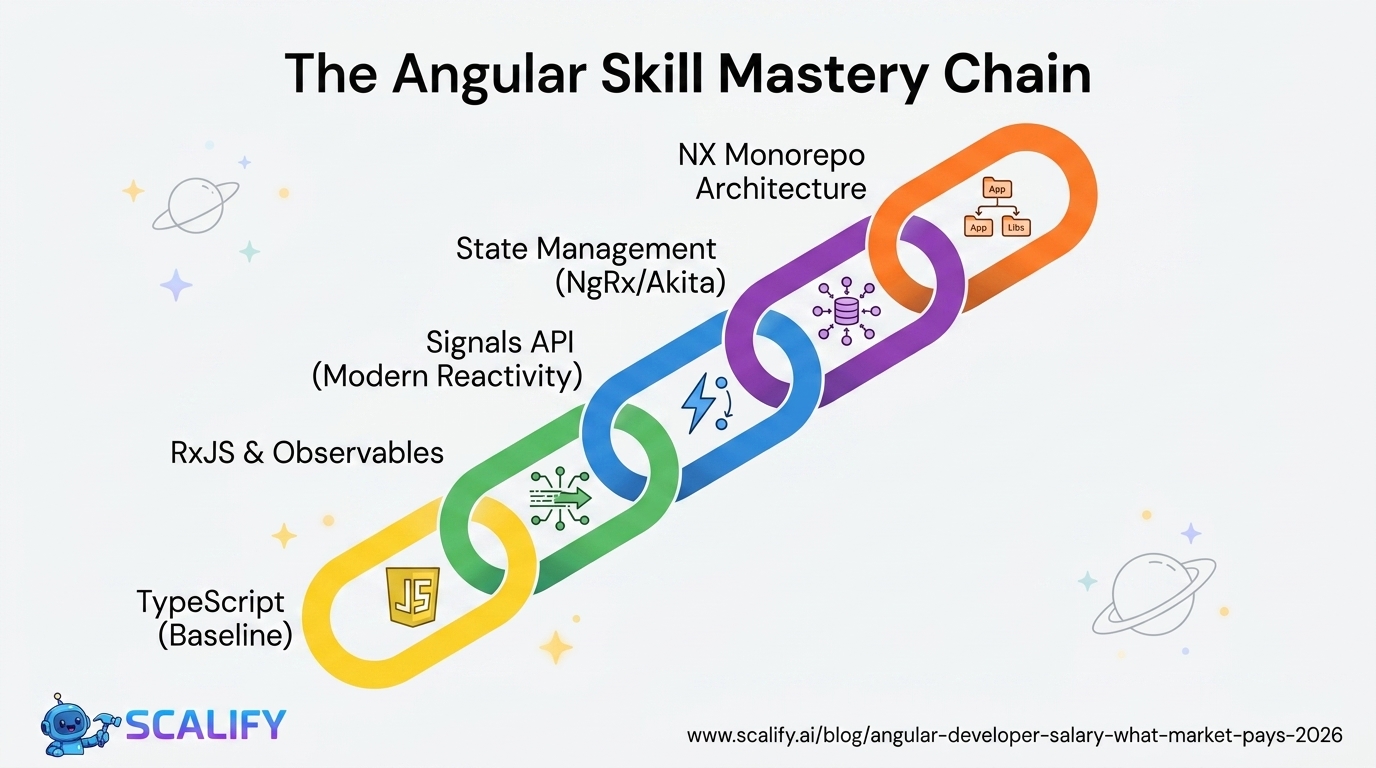
Technology2021 Mid-Level Median2026 Mid-Level Median5-Year ChangeDemand DirectionReact$92,000$112,000+22%Dominant — stableTypeScript$95,000$118,000+24%Strongly growing — becoming the standardNext.js$94,000$115,000+22%Growing — React meta-framework standardNode.js$88,000$108,000+23%Stable — ubiquitousPython (web + AI)$90,000$118,000+31%Strongly growing — biggest AI/ML liftGo (Golang)$105,000$128,000+22%Growing — cloud-native premiumVue.js$85,000$100,000+18%Stable — smaller but loyal ecosystemAngular$88,000$102,000+16%Stable — enterprise focusPHP / WordPress$72,000$80,000+11%Declining for new developmentjQuery$65,000$68,000+5%Declining — legacy maintenance only
Python's 31% five-year salary growth — the strongest of any major web development technology — directly reflects the AI/ML lift effect. Python was already a strong web development language before the AI boom; the explosion of Python's dominance in AI/ML tooling has made Python web developers indispensable at any company building AI-powered applications, which is essentially every technology company in 2026. The Python salary trajectory is likely to continue outpacing other languages as long as Python maintains its AI/ML ecosystem dominance.
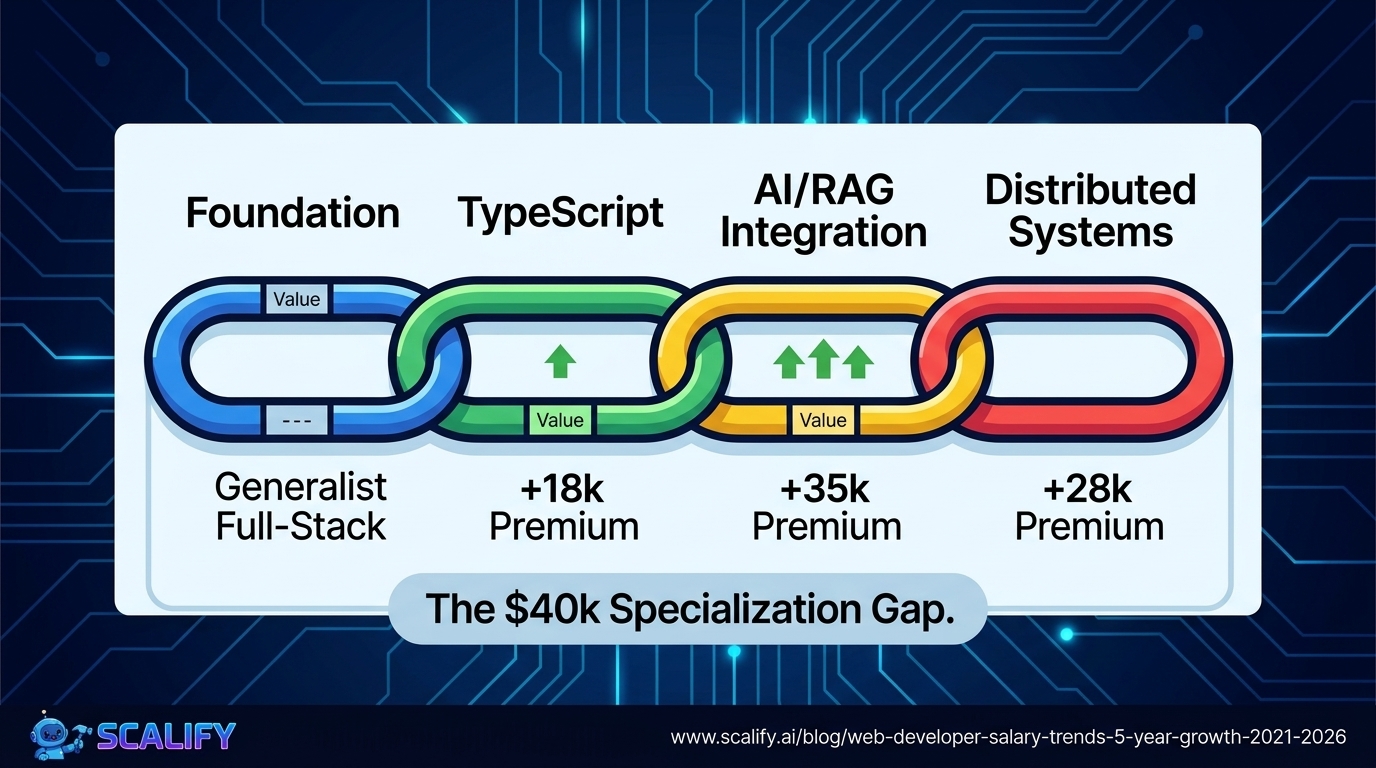
TypeScript's ascent is the other major five-year story. In 2021, TypeScript was a premium skill. In 2026, it's increasingly an expectation for mid-level and senior front-end and full-stack roles at companies with any engineering maturity. The $10,000–$18,000 TypeScript premium over JavaScript-only developers reflects a market that has concluded that untyped JavaScript codebases are a technical debt liability, and that developers who resist TypeScript adoption are accepting a permanent compensation disadvantage relative to peers who have adopted it.
Remote Work's Impact on Web Developer Salary Trends
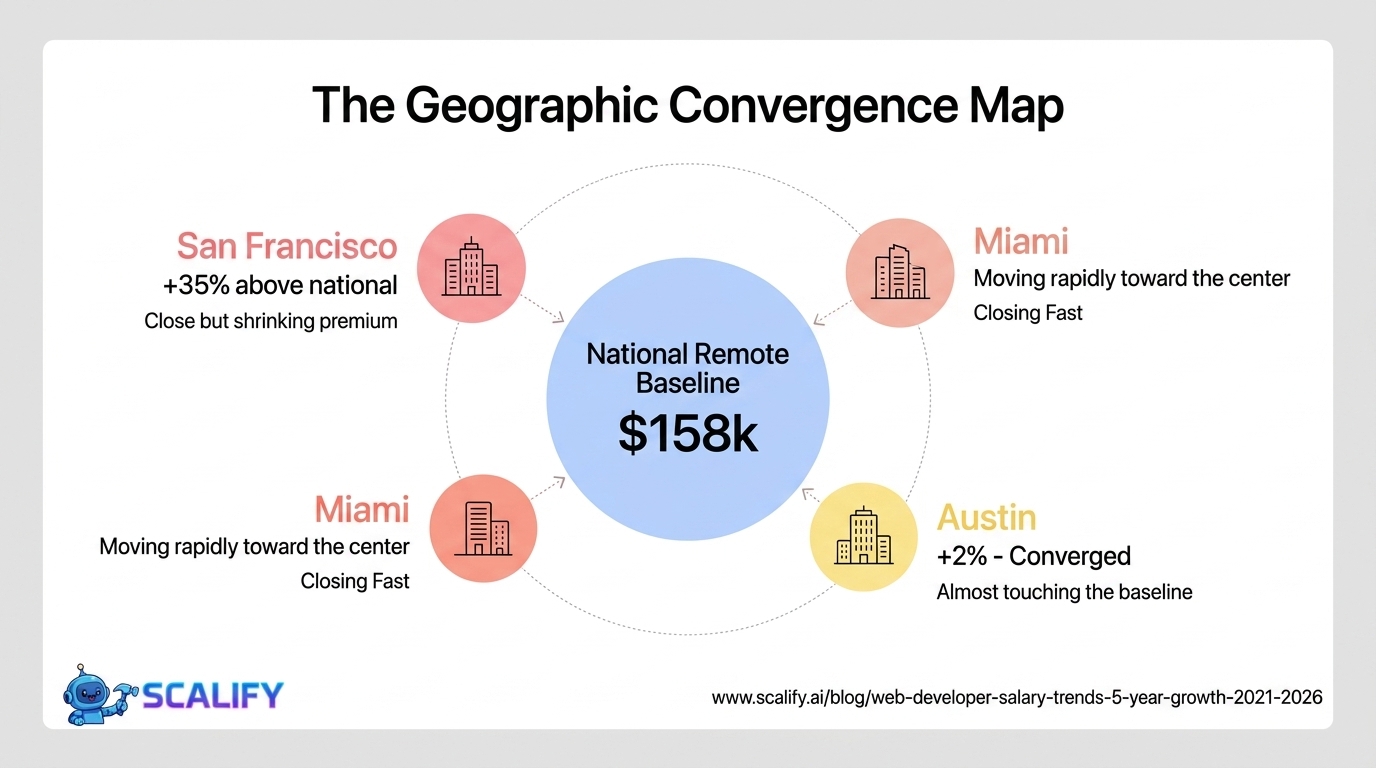
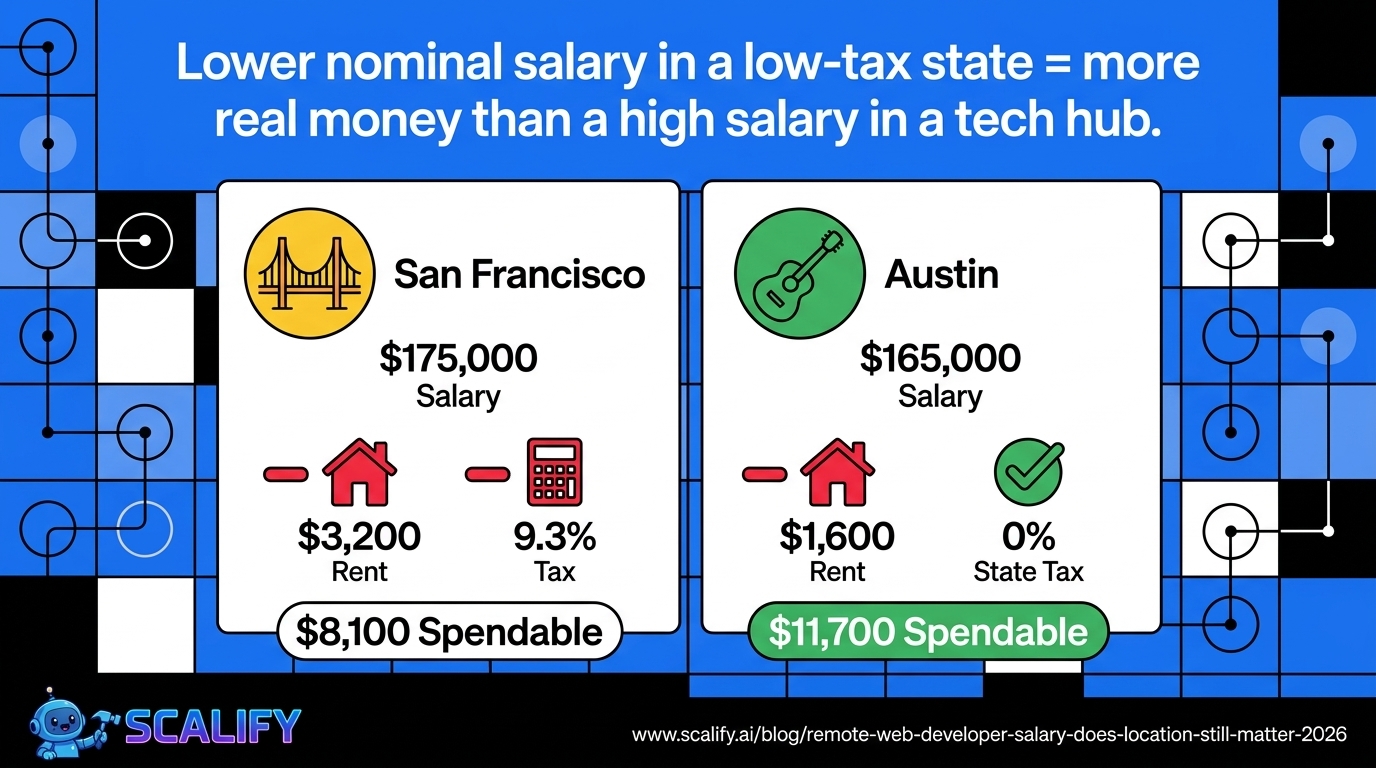
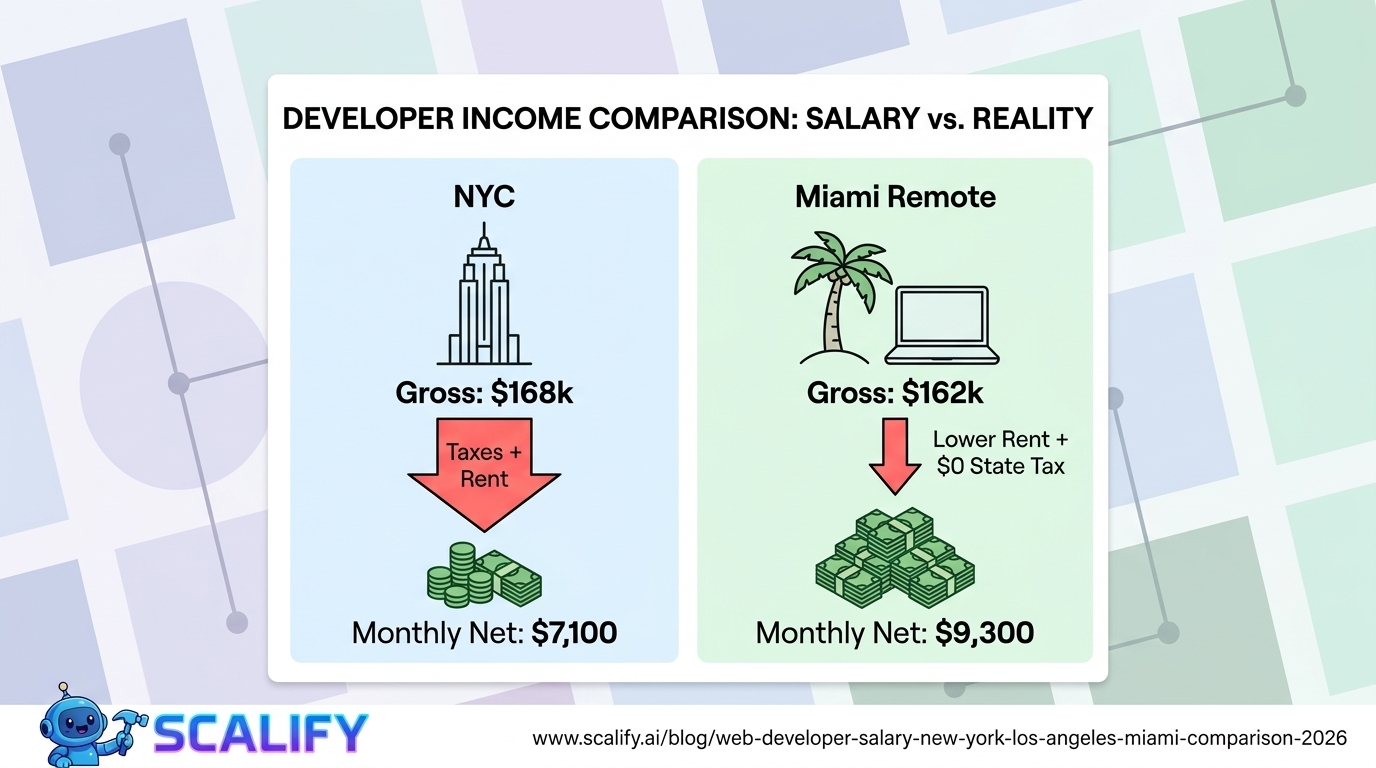
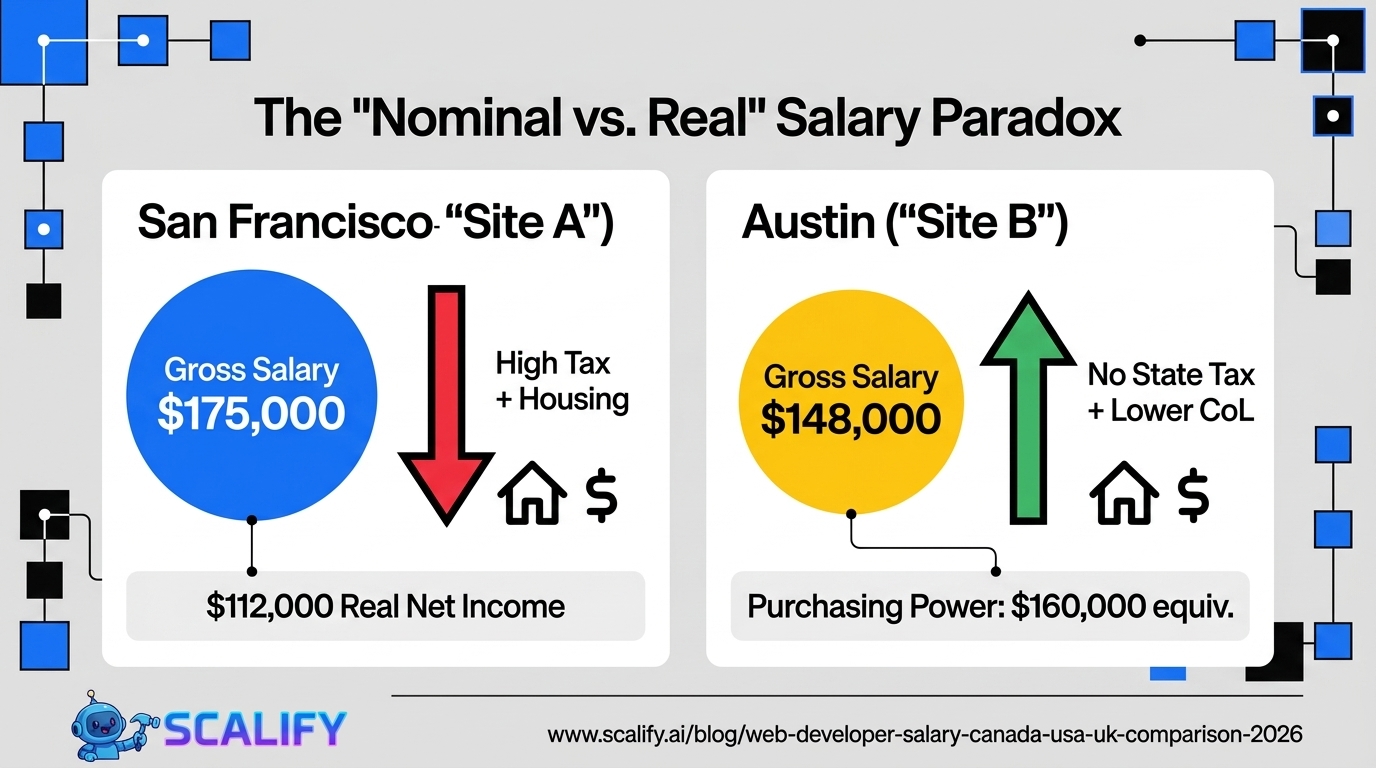
The normalization of remote work has been the single most structurally significant change in web developer compensation geography over the past five years. Before 2020, web developer salaries were heavily geography-dependent — a senior developer in San Francisco earned 60–80% more than an equivalent developer in Nashville. After 2020, as remote work became standard practice, the geographic premium compressed significantly.
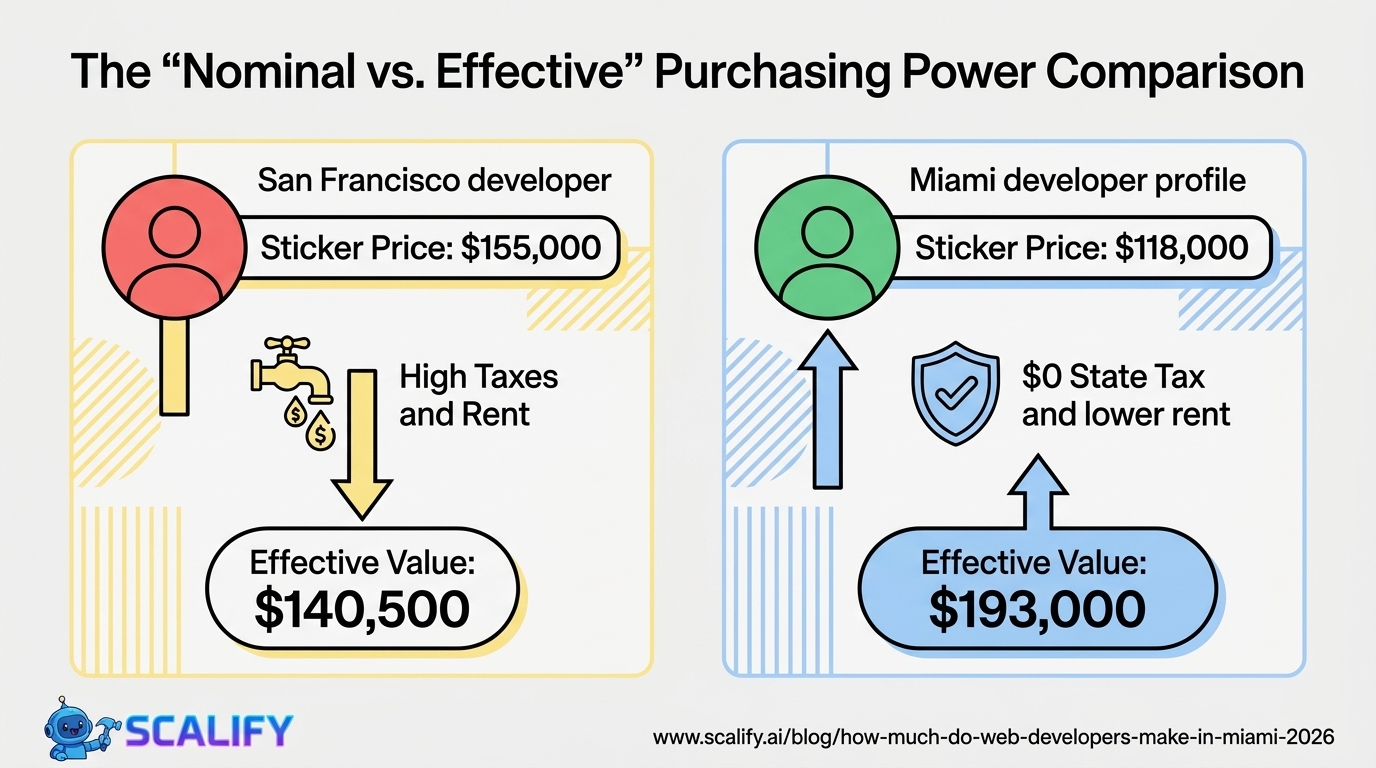
CitySenior Salary 2021Senior Salary 20265-Year ChangeGeographic Premium vs. National AverageSan Francisco$162,000$195,000+20%+35% above national (down from +55% in 2019)New York City$148,000$178,000+20%+23% above nationalSeattle$155,000$185,000+19%+28% above nationalAustin$118,000$148,000+25%+2% above national — nearly convergedMiami$102,000$132,000+29%-9% below national — closing fastNational Remote$128,000$158,000+23%Baseline
Secondary and tertiary markets like Austin, Denver, Miami, and Atlanta have seen the strongest percentage salary growth over the past five years — growing 25–30% compared to San Francisco's 19–20%. This convergence reflects both the migration of high-compensation tech workers to lower cost-of-living cities (bidding up local salaries) and the normalization of remote work allowing local companies to offer nationally competitive rates to compete for talent that could otherwise work anywhere.
The Specialization Premium: Five Years of Widening
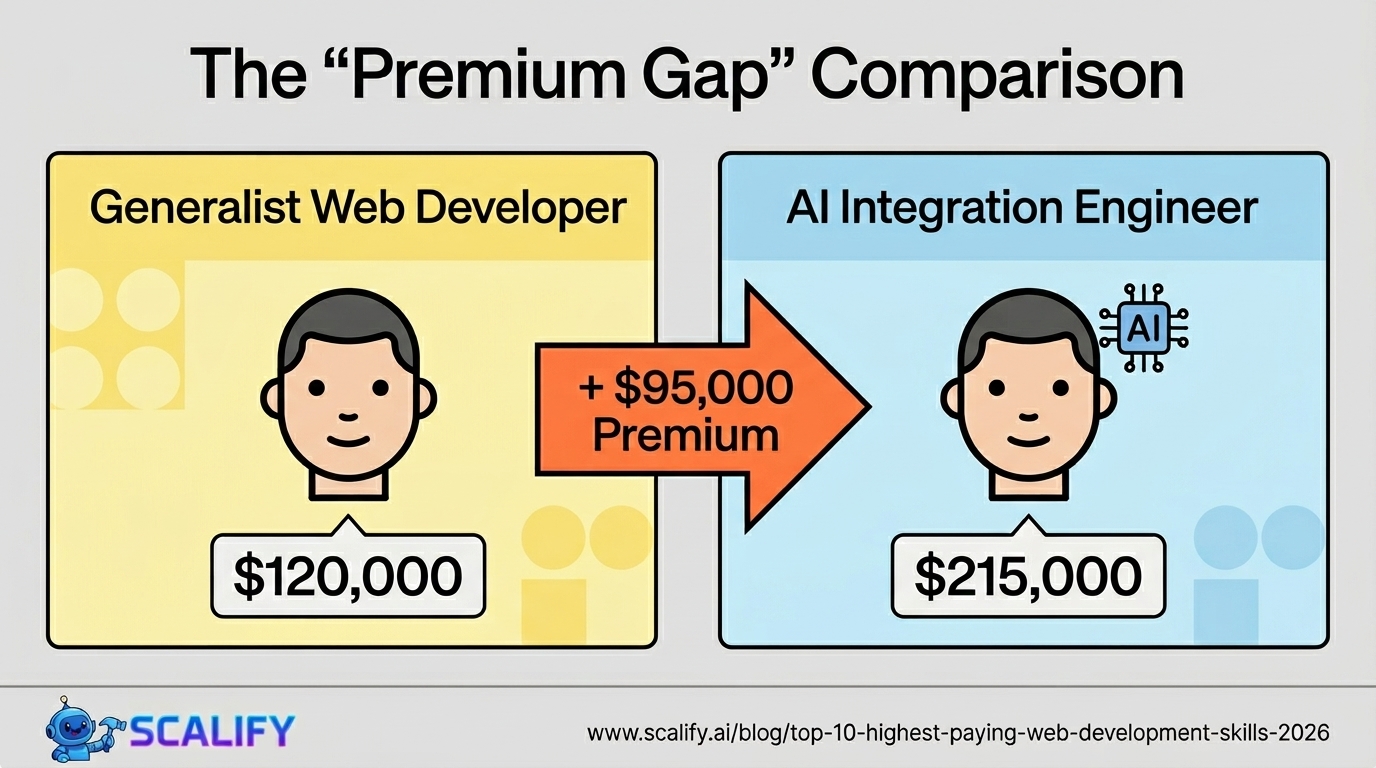
One of the most consistent and important trends in web developer compensation over the past five years is the widening premium between specialized expertise and general proficiency. In 2021, the gap between a generalist mid-level developer and a specialized mid-level developer in the same experience bracket was approximately $12,000–$18,000. In 2026, that gap has widened to $20,000–$40,000 depending on the specialization.
Role Comparison2021 Gap2026 GapTrendSenior generalist vs. senior AI integration specialist$15,000$38,000Widening fastMid front-end generalist vs. mid React/TypeScript specialist$10,000$18,000WideningSenior back-end generalist vs. senior distributed systems engineer$18,000$28,000WideningWordPress developer vs. Webflow specialist$5,000$12,000Widening moderately
This widening specialization premium is the strongest argument for deliberate career planning over passive skill accumulation. Developers who let their skills drift wherever their work takes them tend toward generalism — which was a fine strategy in 2015 but produces below-average salary growth in 2026. Developers who identify high-value specializations early and invest deliberately in building genuine depth in those areas are capturing the premium that the market increasingly reserves for demonstrable expertise.
Web Developer Salary Outlook: 2026–2030
TrendExpected Salary ImpactMost Affected RolesAI tool adoption becoming baseline expectationNeutral — becomes table stakes, not premiumAll rolesAI application development demand growingStrong positive — $20,000–$40,000 premiumFull-stack, back-end, specialized developersNo-code/low-code platform growthNegative for basic site building; neutral for complex devJunior generalists most affectedEnterprise digital transformation continuingPositive — sustained demand from non-tech sectorsAll mid-level and senior rolesCybersecurity integration requirementPositive for devs who add security knowledgeBack-end, full-stack, DevOps-adjacentGlobal remote talent competitionNegative for commodity roles; neutral for senior specialistsJunior and mid-level generalists most at risk
The headline outlook for web developer salaries through 2030: continued strong growth for specialists, compressed growth for generalists. The market for developers who can build AI-powered applications, design distributed systems, optimize web performance to measurable business outcomes, and integrate complex third-party ecosystems is growing faster than the supply of people who can do those things well. The market for developers who build standard websites and applications using well-documented patterns and widely understood tools is growing slower — facing both increased developer supply from training programs and increasing automation of routine tasks through AI coding tools.
The strategic implication is clear: invest in specialization, continuously. The web developer who peaks their skill development at mid-level generalism in 2026 is accepting a salary trajectory that will underperform the market through 2030. The web developer who identifies a high-value specialization and pursues genuine expertise in it — not surface familiarity but the depth that produces independently valuable work — is positioned for above-market salary growth regardless of what the broader tech market does.
What the 5-Year Trend Means for Your Salary Negotiation Today
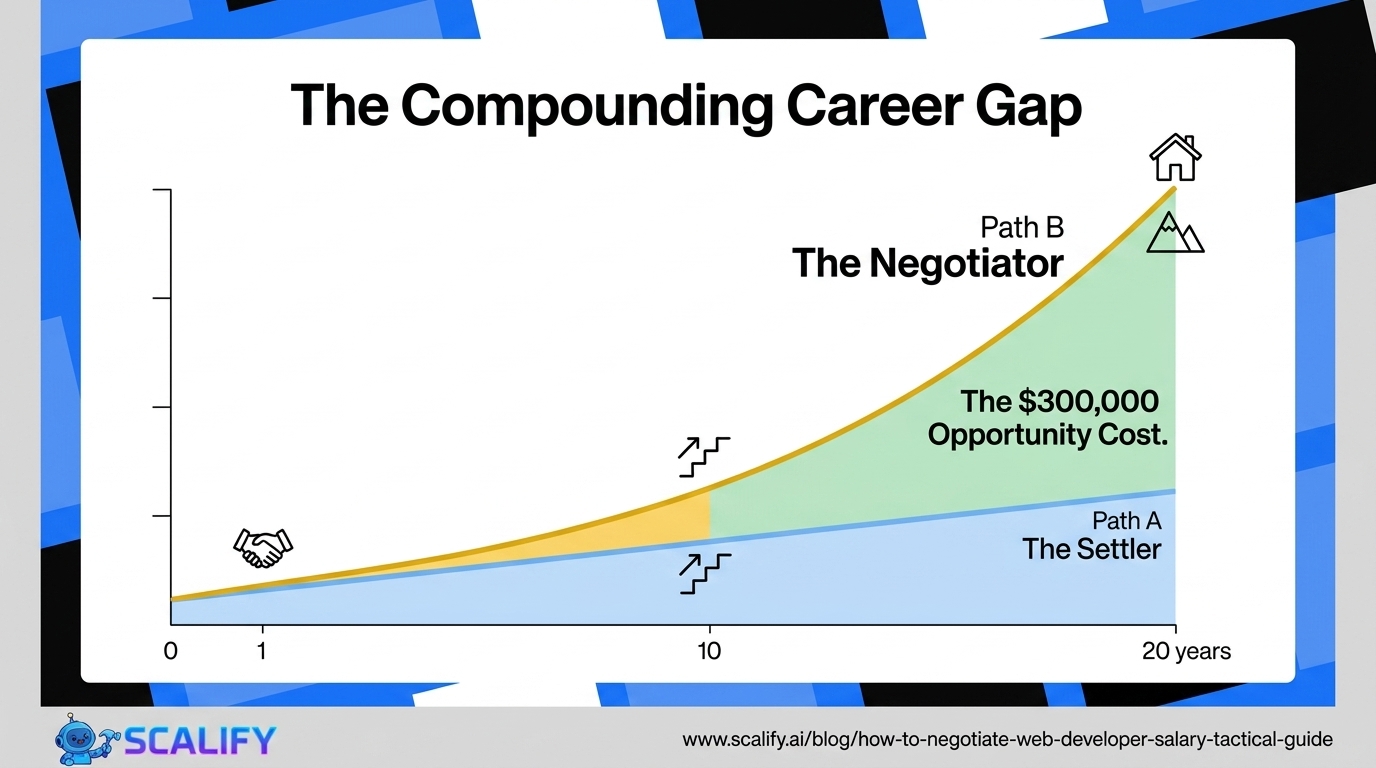
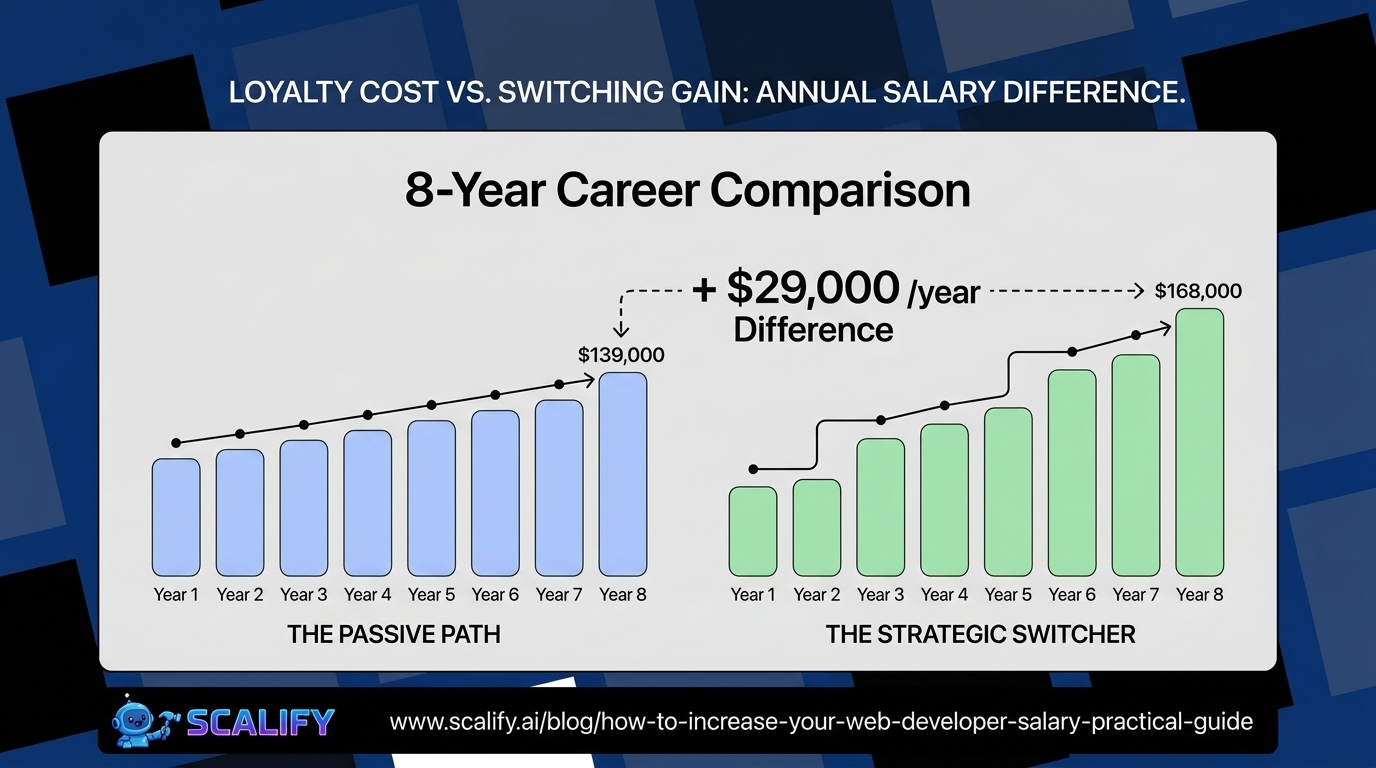
The most actionable insight from five years of web developer salary data is the timing of negotiation relative to market conditions. The developers who negotiated salaries in early 2022 — at the peak of the bubble — locked in compensation levels that many spent 2023 trying to maintain as the market corrected. The developers who negotiated in 2024–2025, during the recovery, often secured compensation that exceeded pre-correction levels with the additional leverage of AI skill premiums.
In 2026's stable market, the best negotiation leverage comes from specialization depth and demonstrable impact rather than market conditions alone. Developers who can quantify their contributions — "I led the migration to TypeScript that reduced our bug rate by 35%," "I built the AI integration layer that reduced customer support tickets by 40%," "I optimized our API response times from 800ms to 120ms, enabling us to onboard enterprise clients with strict SLA requirements" — negotiate from a position of demonstrated ROI rather than market comparison. This approach consistently produces better outcomes than salary surveys alone, regardless of where the broader market cycle is.
The Bottom Line
Web developer salaries grew approximately 28–35% from 2021 to 2026, with the 2022–2023 correction being a temporary disruption rather than a structural reversal. The most consistent and important trend across the full five-year period is the widening premium for differentiated specialization over general proficiency — AI integration, TypeScript, cloud architecture, and platform engineering have all moved from premium skills to premium-commanding requirements, and the gap between specialists and generalists continues to widen. Developers who invest in building genuine expertise in high-demand specializations are positioned for the strongest compensation trajectory through 2030, while those who remain generalists will see continued compression of their relative compensation position in an increasingly specialized market.
At Scalify, we build professional websites for technology companies and growing businesses in 10 business days — helping teams establish the digital presence their engineering expertise deserves.
Top 5 Sources



.jpeg)
.jpeg)

78 SW 7th St, Miami, FL 33130