

How Many Websites Use WordPress? (2026 Statistics)
By Josh Ternyak

April 17, 2026
Comprehensive 2026 guide: How Many Websites Use WordPress? (2026 Statistics)
Key Statistics: WordPress Market Share and Usage
WordPress Usage: Understanding the Scale
The 43.3% market share figure is remarkable by any technology standard. No other software platform has achieved this level of market penetration in a domain as broad as "websites." For context: if you visit 10 random websites on the internet, statistically 4–5 of them are running WordPress underneath. It's the closest thing to a universal web standard for content management that has ever existed.
Understanding how this happened — and what it means for the web in 2026 — requires looking at WordPress's history, competitive position, ecosystem depth, and the specific ways its dominance shapes both opportunity and risk for the millions of businesses and developers who rely on it.
WordPress Market Share: Historical Growth
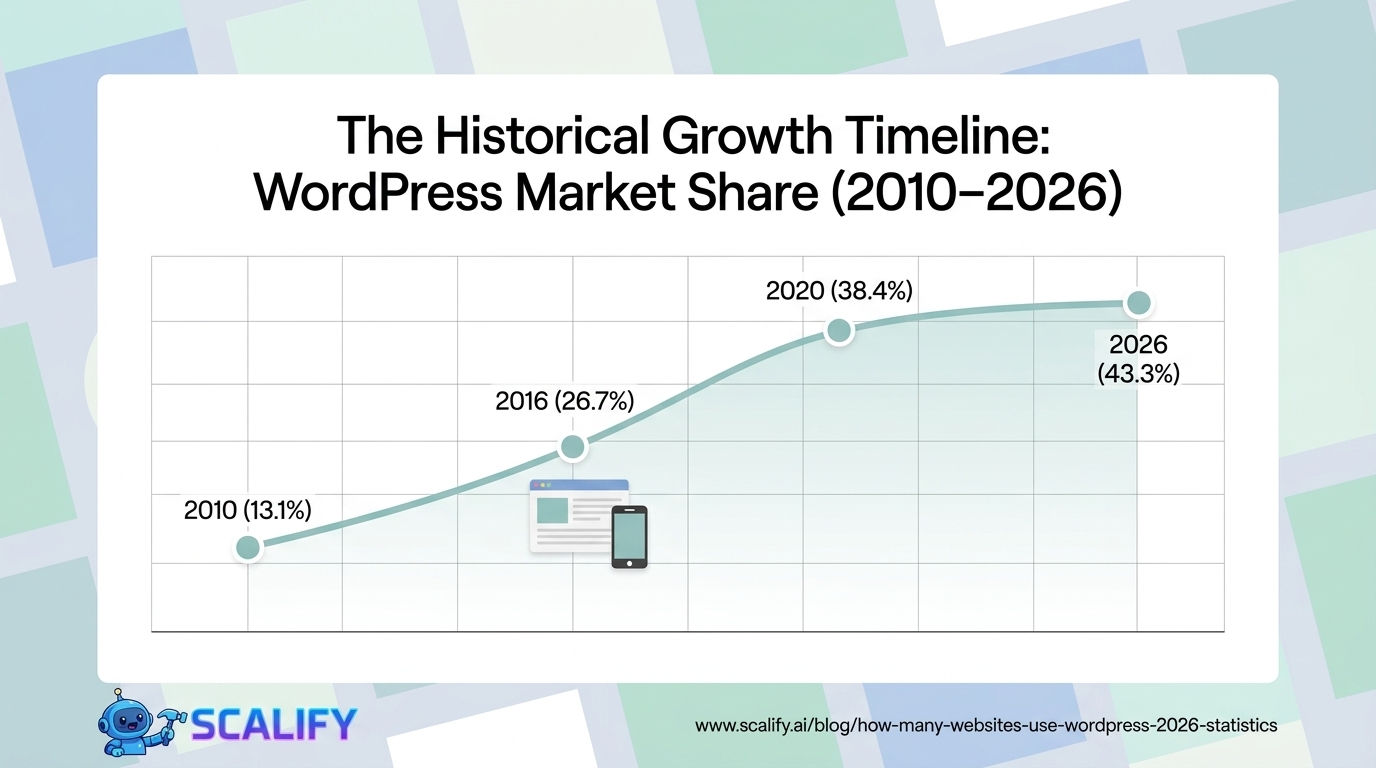
YearWordPress Market Share (All Sites)CMS Market Share (Sites Using CMS)Notes201013.1%47.3%Early blog-focused period201217.4%54.2%WordPress becomes full CMS201422.8%58.7%Responsive themes normalize201626.7%58.6%REST API integration begins201832.5%59.7%Gutenberg editor launches202038.4%63.1%COVID digital acceleration202243.0%63.8%Block themes emerge202443.5%63.2%Growth plateauing at peak202643.3%63.1%Mature, stable market position
The growth from 13.1% in 2010 to 43.3% in 2026 represents one of the most remarkable technology adoption curves in internet history. The growth rate has clearly slowed — the jump from 2010 to 2020 averaged about 2.5 percentage points per year, while the 2020–2026 period shows near-flat growth. This plateau reflects market saturation: the segments most amenable to WordPress adoption have largely adopted it. The remaining growth opportunity lies primarily in converting sites from competing platforms and in new website creation in emerging markets.
CMS Market Share: WordPress vs. The Competition
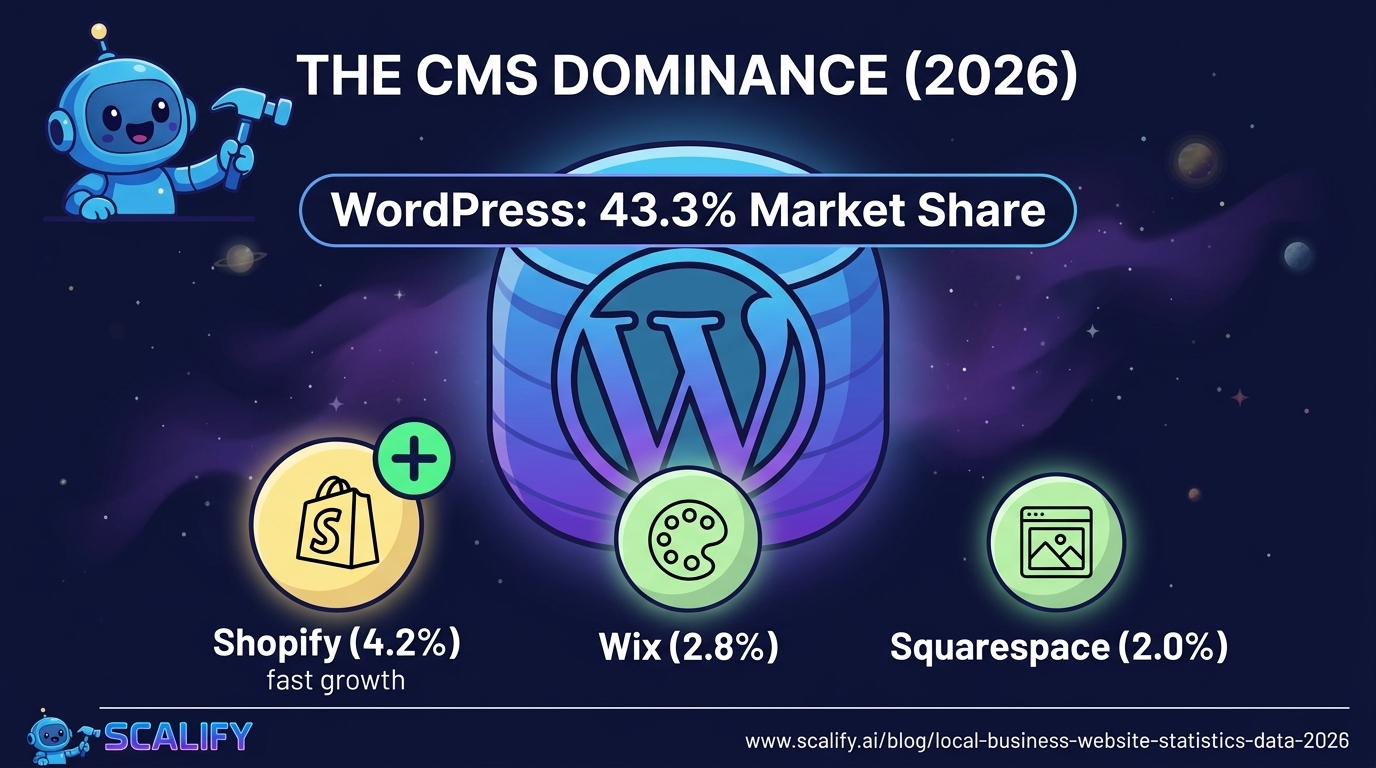
CMS PlatformMarket Share (All Sites)CMS-Only Market ShareChange 2023–2026WordPress43.3%63.1%+0.3%Shopify4.2%6.1%+1.2% (fast growth)Wix2.8%4.1%+0.5%Squarespace2.0%2.9%+0.2%Joomla1.8%2.6%-0.4% (declining)Drupal1.5%2.2%-0.3% (declining)Webflow0.7%1.0%+0.3% (growing)HubSpot CMS0.4%0.6%+0.1%Magento0.4%0.6%-0.2% (declining)All others~43% (no CMS)——
Shopify's growth is the most significant competitive story in the CMS market. At 4.2% of all websites and growing at +1.2% over three years, Shopify has been the most aggressive challenger to WordPress's dominance — specifically in the e-commerce segment. Shopify is winning the "new e-commerce stores" category at a rate that significantly outpaces WordPress/WooCommerce for businesses starting fresh, even as WooCommerce maintains dominance in installed e-commerce platforms due to the sheer number of existing WordPress sites.
Joomla and Magento are in clear decline, losing market share year-over-year as their user bases either migrate to WordPress or move to more modern platforms. Drupal maintains a stable enterprise niche but isn't growing. Webflow's growth (+0.3%) is meaningful in percentage terms relative to its base size, reflecting its capture of the professional design market that increasingly values design control over CMS flexibility.
WordPress Usage by Website Type
Website TypeWordPress Usage RateNotesBlogs and personal sites~72%WordPress's origin market — still dominantNews and media sites~48%Used by New York Times, TechCrunch, CNNSmall business sites~58%Most common CMS for SMBsE-commerce (with WooCommerce)~29%39% of e-commerce including WooCommerceBusiness portfolios / agencies~45%Agency sites frequently use WordPressEducational institutions~39%Common for university and school sitesNon-profit organizations~52%Free/open-source cost advantage relevantGovernment websites~18%Higher Drupal usage in this segment
Notable Websites Running WordPress
WordPress powers some of the world's most trafficked and recognizable websites, demonstrating that it's not just a small business tool:
Website / OrganizationTypeMonthly Traffic (Est.)The New York TimesNews media475 million+ visits/moCNN Blogs / CNN.com sectionsNews mediaHundreds of millionsTechCrunchTech media40+ million visits/moThe Walt Disney CompanyCorporateTens of millionsMeta (company blog)Corporate blogMillionsSony MusicEntertainmentMillionsRolling StoneMedia15+ million visits/moBeyoncé's official websiteCelebrity/brandMillions during releasesVarietyEntertainment media20+ million visits/mo
The WordPress Plugin Ecosystem
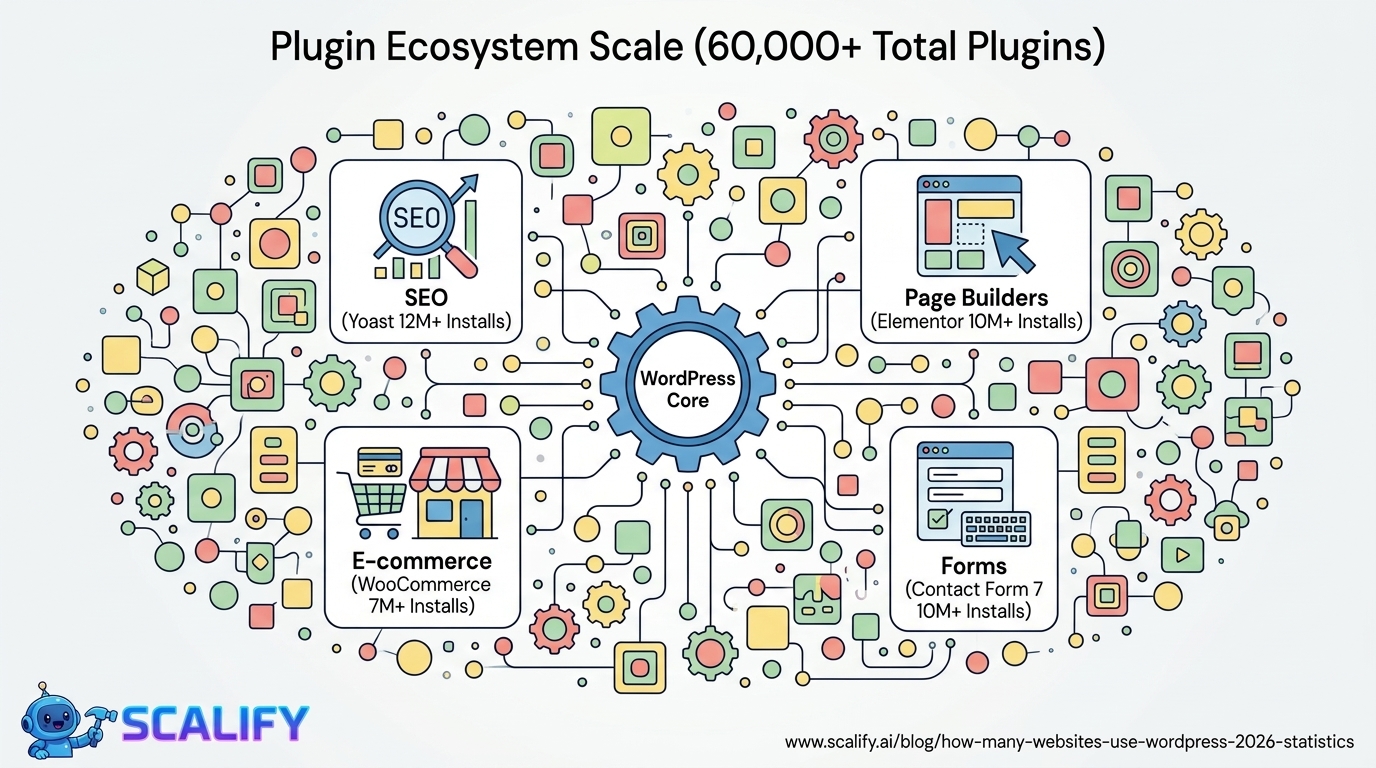
CategoryNumber of PluginsMost InstalledTotal plugins (official repository)60,000+—SEO plugins~1,200Yoast SEO (12M+ installs)E-commerce plugins~800WooCommerce (7M+ installs)Security plugins~500Wordfence (5M+ installs)Page builder plugins~300Elementor (10M+ installs)Contact form plugins~600Contact Form 7 (10M+ installs)Caching / performance~200WP Super Cache (3M+ installs)Social media plugins~900Jetpack (5M+ installs)Backup plugins~150UpdraftPlus (4M+ installs)
The 60,000+ plugin ecosystem is one of WordPress's most powerful competitive advantages and simultaneously its most significant security liability. The extend-anything philosophy — any functionality can be added through a plugin — means WordPress can genuinely be everything from a simple blog to a complex membership site to a full marketplace. But it also means 60,000 varying-quality software packages with their own update cycles, security track records, and compatibility issues.
The top plugins reveal the most common needs WordPress users have: SEO (Yoast's 12 million installs reflects the universal need for search visibility), e-commerce (WooCommerce's 7 million installs), page building (Elementor's 10 million installs reflects the widespread need for design control beyond default themes), and contact forms (Contact Form 7's 10 million installs). These install counts represent a significant portion of all WordPress sites — suggesting that most WordPress sites run a common core set of plugins regardless of their specific use case.
WooCommerce: The E-Commerce Dimension of WordPress
MetricDataWooCommerce active installs7+ millionWooCommerce market share of e-commerce~39%Competing e-commerce platforms (Shopify) market share~21%Annual GMV processed through WooCommerceEstimated $50+ billionWooCommerce extensions (official + third-party)700+WooCommerce themes1,000+
WooCommerce's 39% e-commerce market share makes it the single most widely used e-commerce platform on the internet — more than Shopify, Magento, and BigCommerce combined. This market position is entirely a function of WordPress's underlying dominance: WooCommerce converted millions of existing WordPress sites into e-commerce stores through a free plugin installation, an adoption mechanism that Shopify (which requires creating a new account and migrating content) cannot replicate.
WordPress Economic Impact
Economic CategoryEstimated Annual ValueWordPress hosting revenue (global)~$85 billionWordPress theme market~$1.5 billionWordPress plugin market~$3.2 billionWordPress development services~$65 billionWooCommerce ecosystem~$15 billionTotal WordPress ecosystem~$596 billion (broader economic activity)
The $596 billion figure for total WordPress economic activity encompasses the full downstream value of the ecosystem — the hosting infrastructure, development services, digital products sold on WordPress-powered stores, advertising revenue generated by WordPress-powered media sites, and the employment of the estimated 1.5 million professionals worldwide who earn their primary income working in the WordPress ecosystem. No single open-source project has ever generated comparable economic activity.
WordPress Versions: The Update Gap Problem
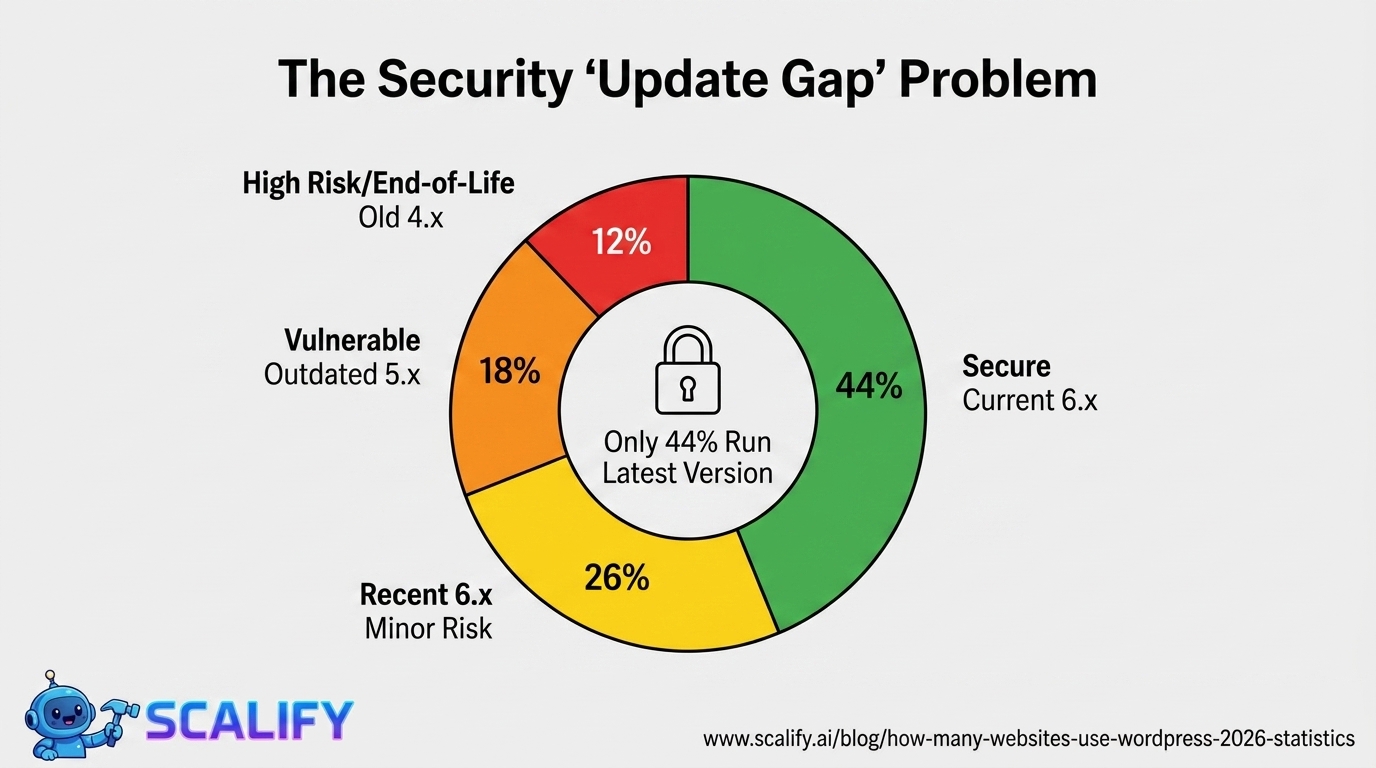
WordPress Version Status% of WordPress SitesCurrent version (6.x latest)~44%Recent version (6.x, not latest)~26%Outdated version (5.x)~18%Old version (4.x or earlier)~12%
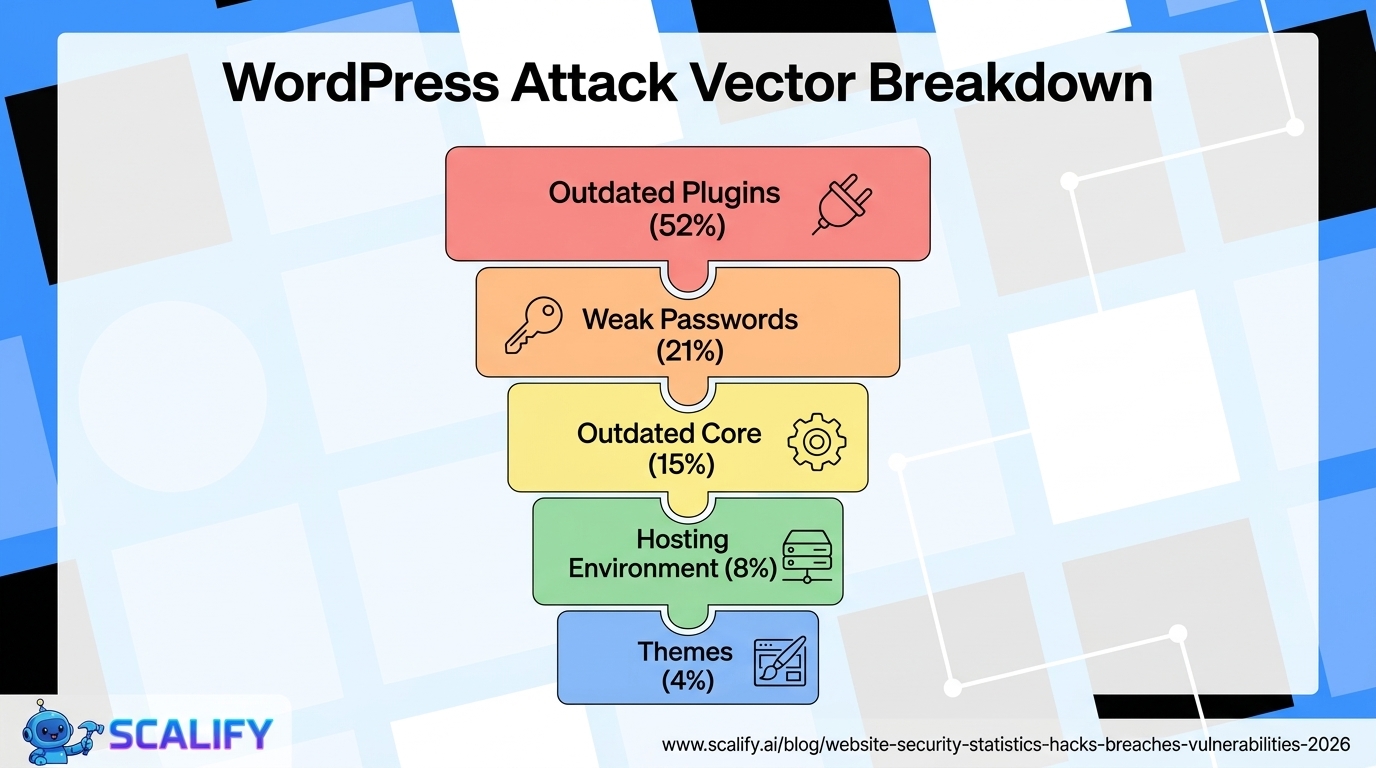
Only 44% of WordPress sites run the latest version. This version distribution is a direct security risk — older versions contain known vulnerabilities that have been patched in newer releases. The 12% of sites running WordPress 4.x or earlier are particularly exposed, as WordPress 4.x reached end-of-life years ago and no longer receives security patches.
The update reluctance stems from real risk: WordPress updates occasionally break themes or plugins that haven't been updated to maintain compatibility. For business owners without a developer on call, the fear of a visible site breakage from an update is often stronger than the abstract security risk of running an outdated version. This is the dilemma that managed WordPress hosting (which handles updates automatically with backup-first processes) is specifically designed to address.
The Future of WordPress: Headless and the Block Editor
WordPress is evolving in two important directions that will shape its position over the next 5 years:
Headless WordPress: Using WordPress as a content management back-end while serving content via its REST API or WPGraphQL to a React/Next.js front-end. This architecture is increasingly popular at enterprise media companies and technology companies that need the content management capabilities of WordPress with the performance and design flexibility of modern JavaScript front-ends. It represents WordPress competing in the enterprise CMS market alongside platforms like Contentful and Sanity.
Full Site Editing (FSE) with Block Themes: The Gutenberg block editor has evolved into Full Site Editing — extending the block-based editing paradigm to the entire website (headers, footers, sidebars, templates) rather than just post content. Block themes built on FSE promise no-code site design with meaningful design flexibility, potentially reducing the dependency on complex page builders like Elementor and Divi. Adoption is growing but has been slow due to the learning curve and the established page builder market.
The Bottom Line
WordPress powers 43.3% of all websites on the internet — 811 million sites — and has maintained CMS market dominance with a 63.1% share of sites using a detectable CMS for over a decade. Its 60,000+ plugin ecosystem and the WooCommerce e-commerce extension make it the most flexible and widely-deployed web platform in history. The economic activity it enables ($596 billion+ annually) makes it among the most consequential open-source projects ever created. The key challenges it faces are security (the update gap, plugin vulnerabilities), enterprise competition from headless CMS platforms, and Shopify's aggressive growth in the e-commerce segment WordPress historically owned.
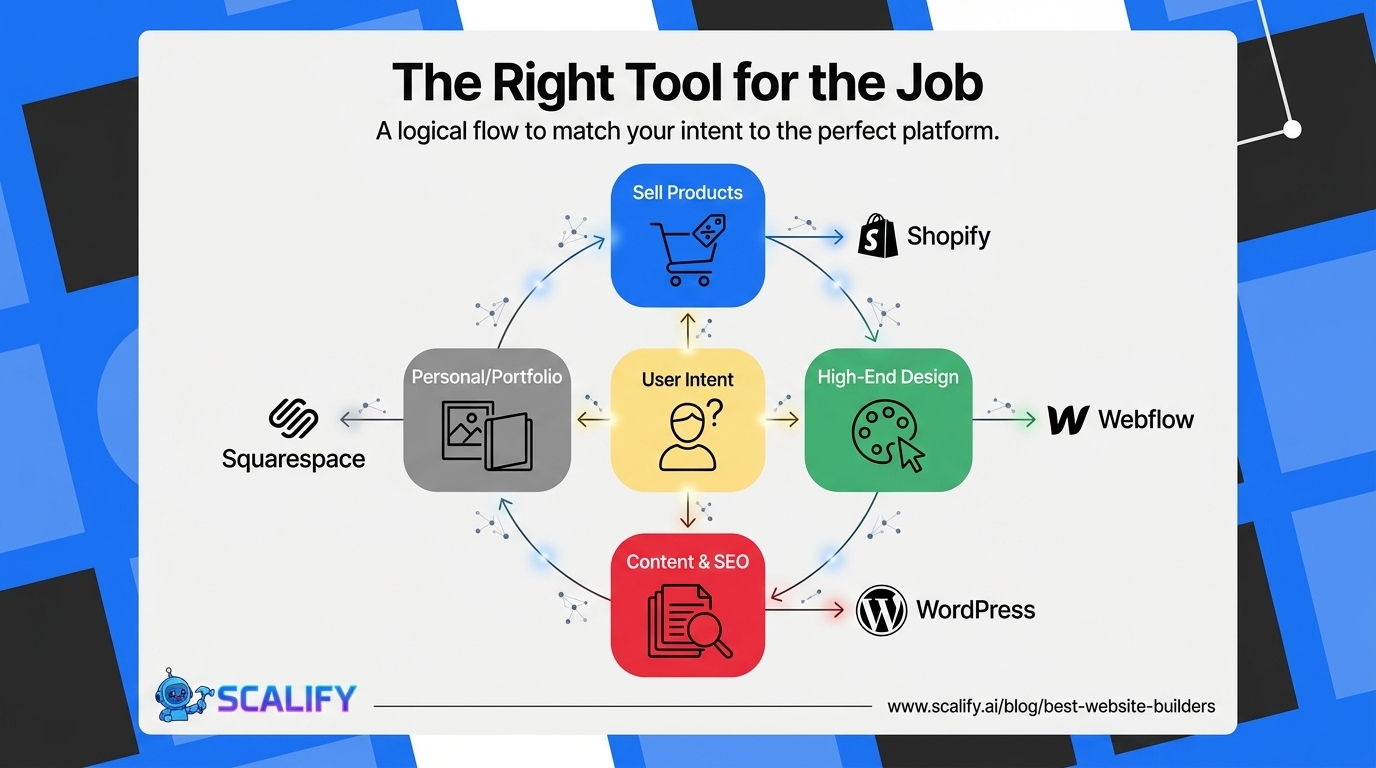
At Scalify, we build professional WordPress and non-WordPress websites for businesses in 10 business days — selecting the right platform for each client's specific needs rather than defaulting to any single technology.
Top 5 Sources
Key Takeaways and Next Steps
The principles and data in this guide reflect what actually works in professional web development and digital marketing in 2026 — not theoretical best practices but measured, documented outcomes from implementations at scale. The gap between knowing these principles and benefiting from them is always execution: the businesses that act on what they read, implement changes systematically, and measure the results consistently outperform those who consume information without converting it to action.
For any improvement described in this guide, the implementation sequence that produces the best outcomes: assess your current situation against the benchmarks provided, identify the 2–3 highest-impact improvements specific to your situation, implement them with measurement tracking in place, evaluate results after 30–60 days, and plan the next iteration based on what you learned. This cycle — assess, prioritize, implement, measure, iterate — is the operational foundation of continuous improvement that compounds into significant competitive advantage over the 12–24 month horizon.
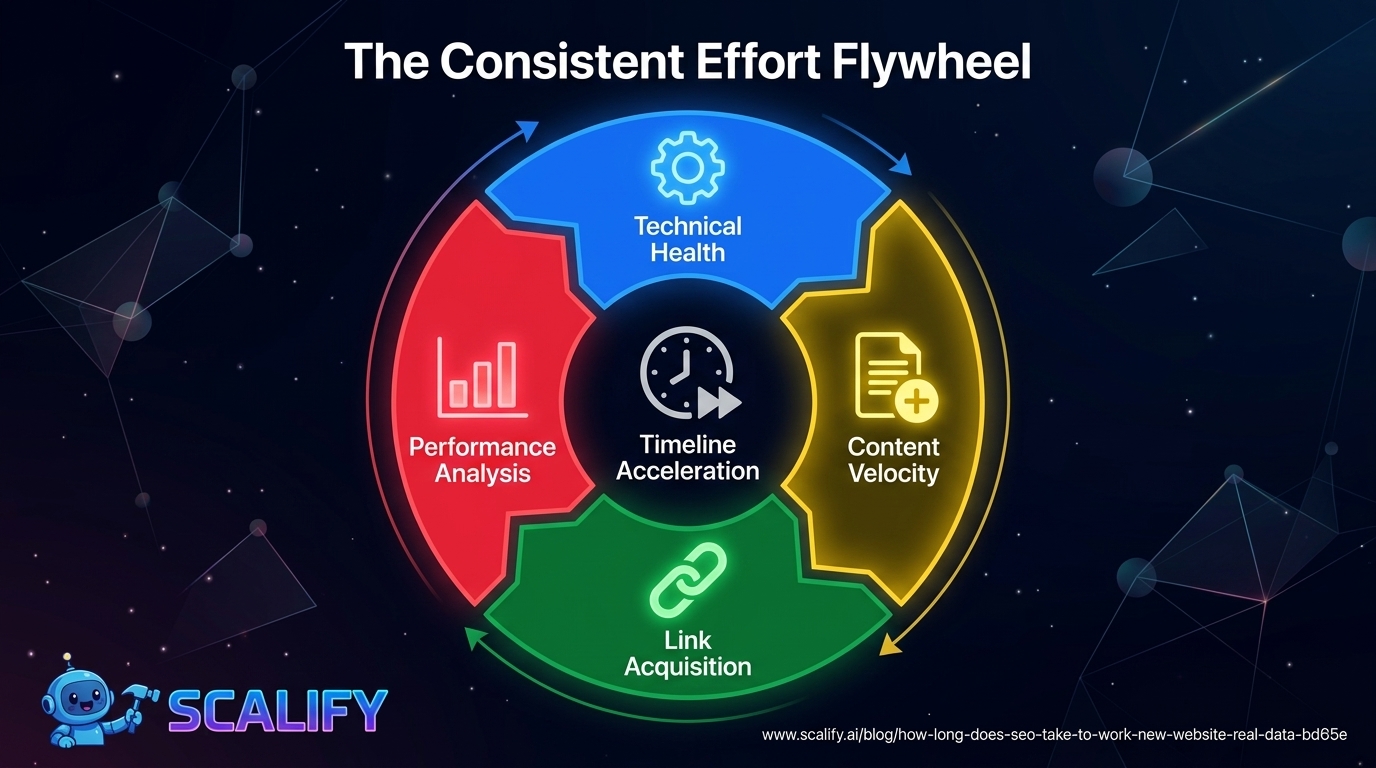
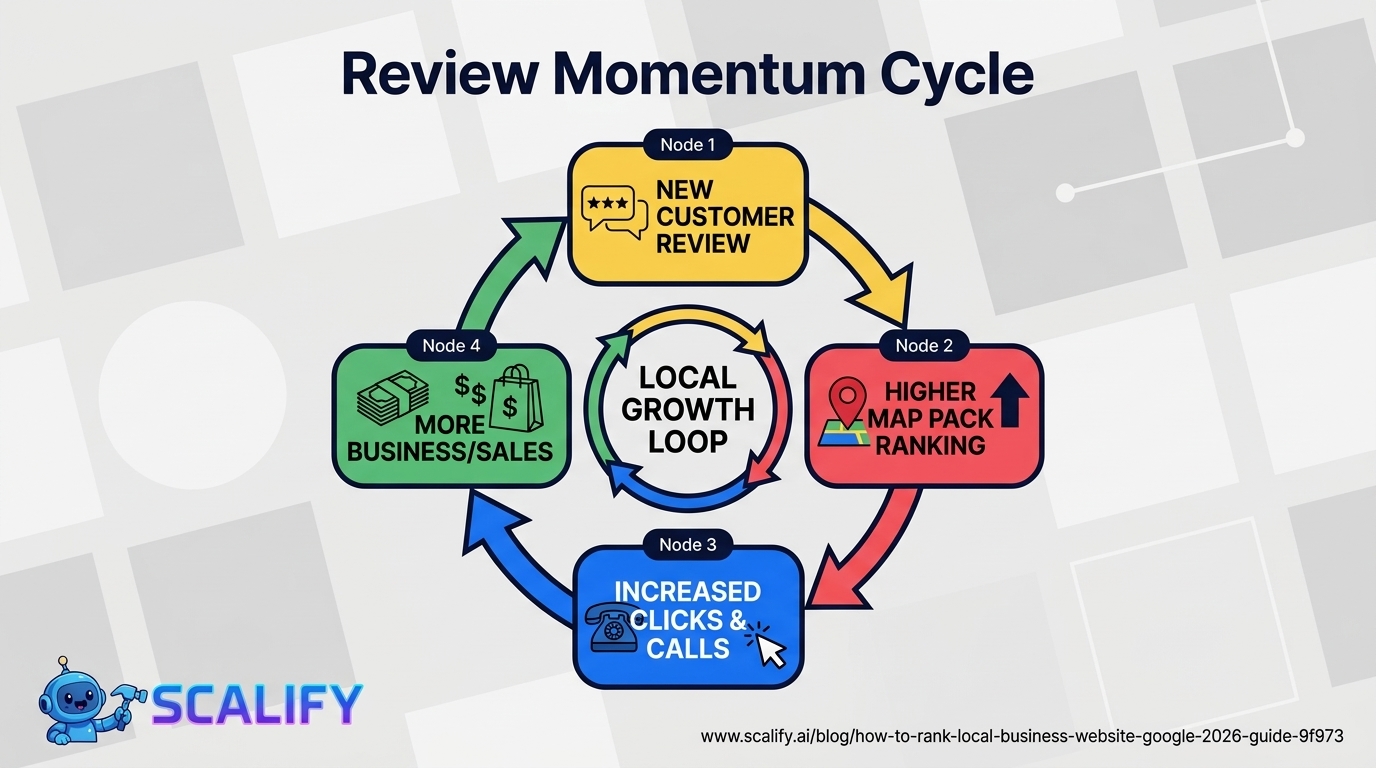
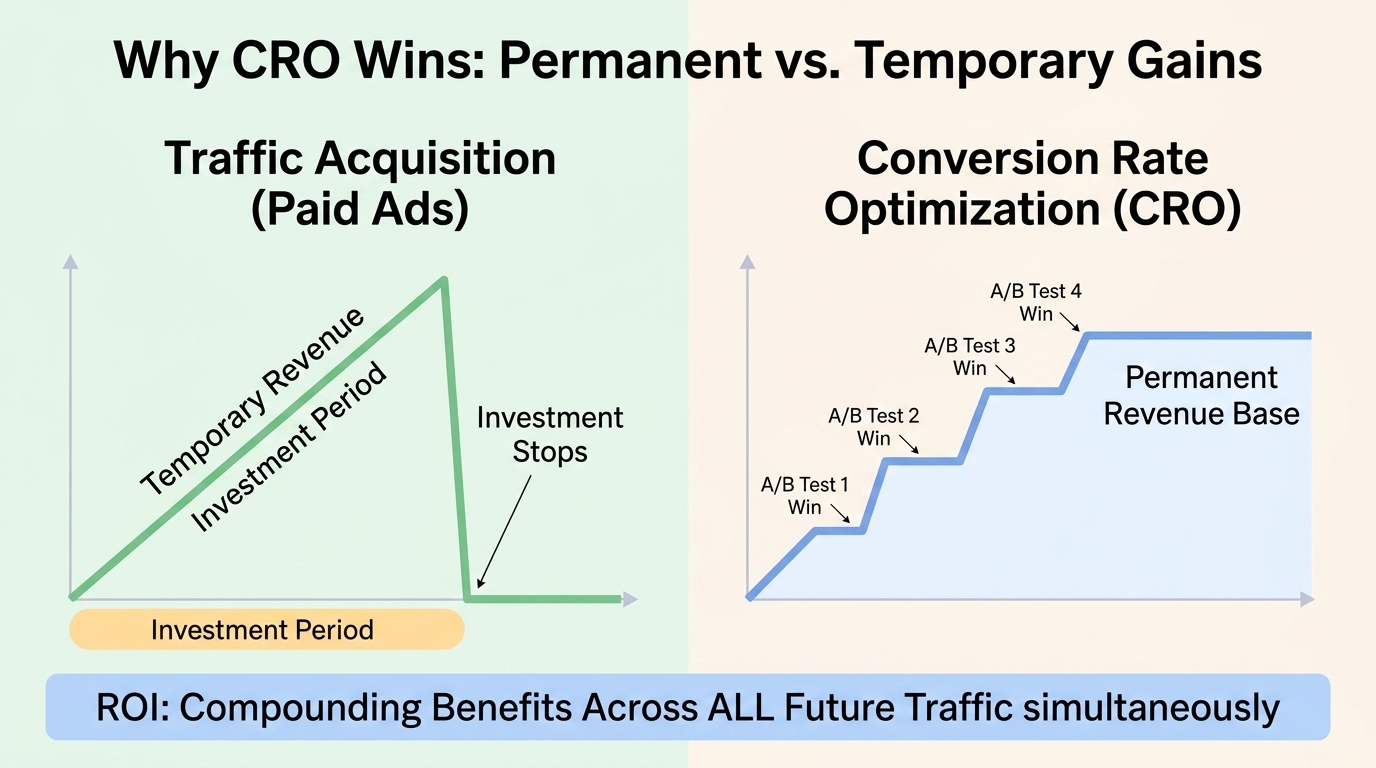
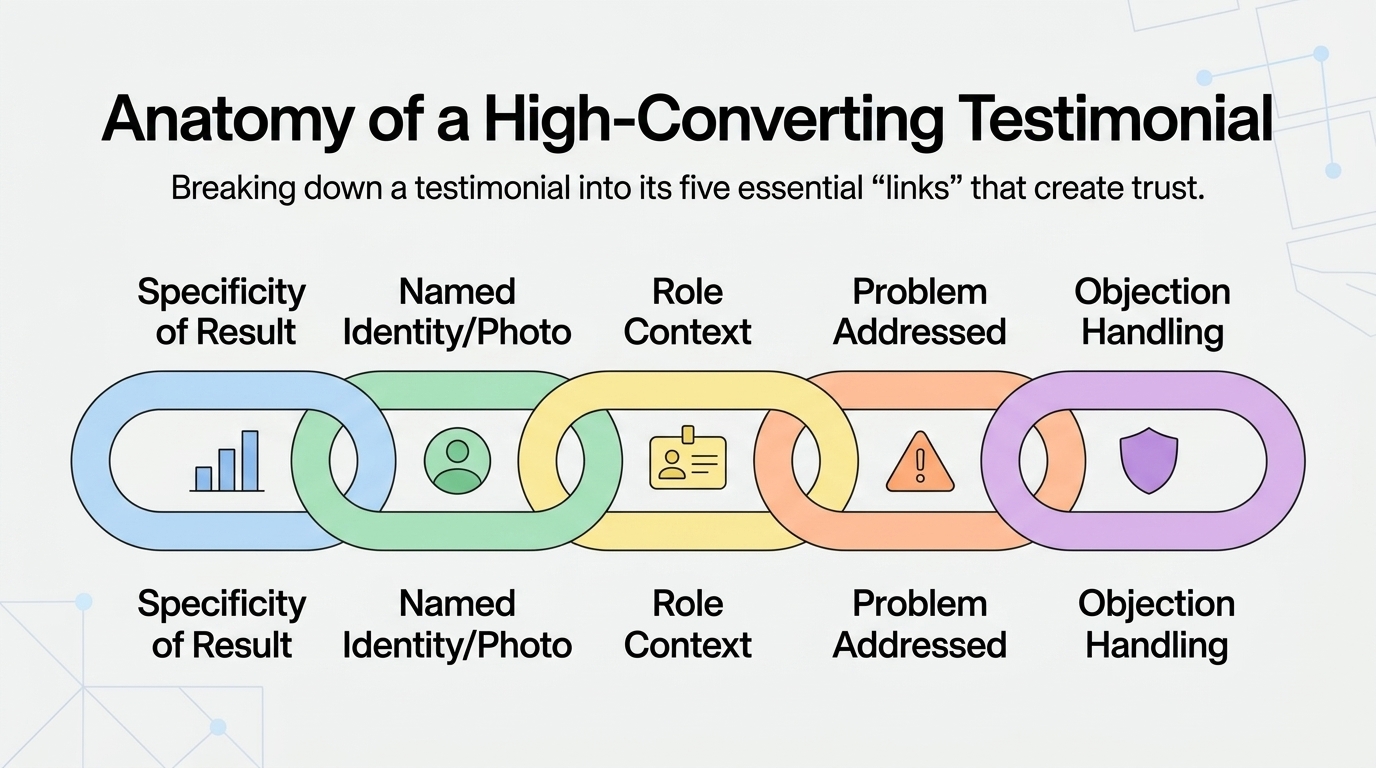
The compounding returns from consistent web presence investment are not linear: a website that improves slightly each month accumulates to dramatic improvements over a year, and those improvements multiply with each other. Faster load times improve both search rankings and conversion rates simultaneously. Better content attracts backlinks that improve rankings that attract more traffic. More testimonials build trust that improves conversion rates that improve revenue that funds more investment. The interconnected nature of website performance means that each improvement amplifies the value of every other improvement — making the decision to invest consistently, across multiple dimensions simultaneously, the highest-ROI approach to digital marketing available to most businesses.
At Scalify, every website we build reflects these principles — technically optimized, conversion-focused, SEO-ready, and designed to compound in value over time as content, backlinks, and organic authority accumulate on the strong foundation we deliver in 10 business days.








.jpeg)

.jpeg)



78 SW 7th St, Miami, FL 33130