

How Much Does a DevOps Engineer Make for Web in 2026?
By Josh Ternyak

April 20, 2026
DevOps engineers who specialize in web application infrastructure earn $85,000–$275,000+ in 2026. This comprehensive guide covers salary by experience level, cloud platform specialization, city-by-city breakdowns, certification ROI, the full skill stack employers want, FAANG compensation data, freelance rates, and the web developer-to-DevOps transition pathway.
DevOps Engineer Salary for Web in 2026: What You Need to Know
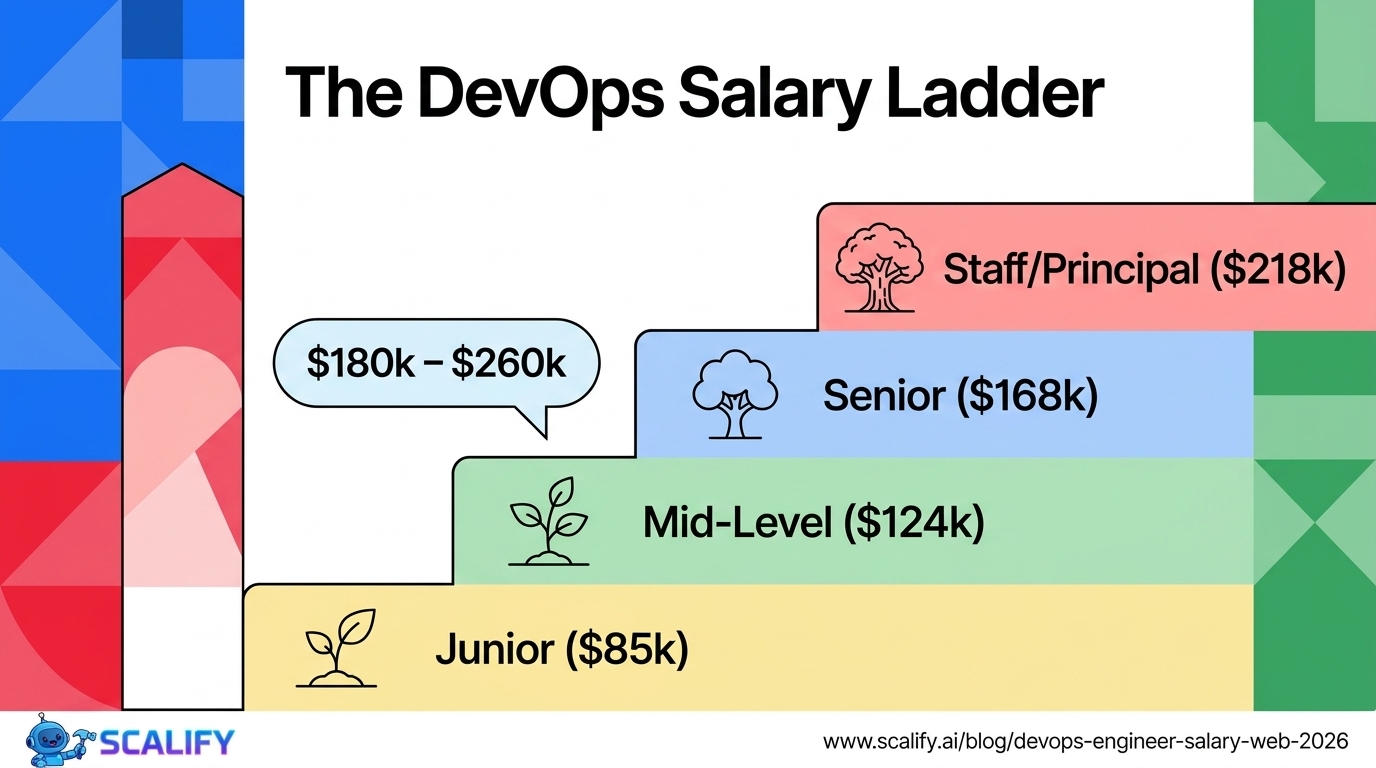
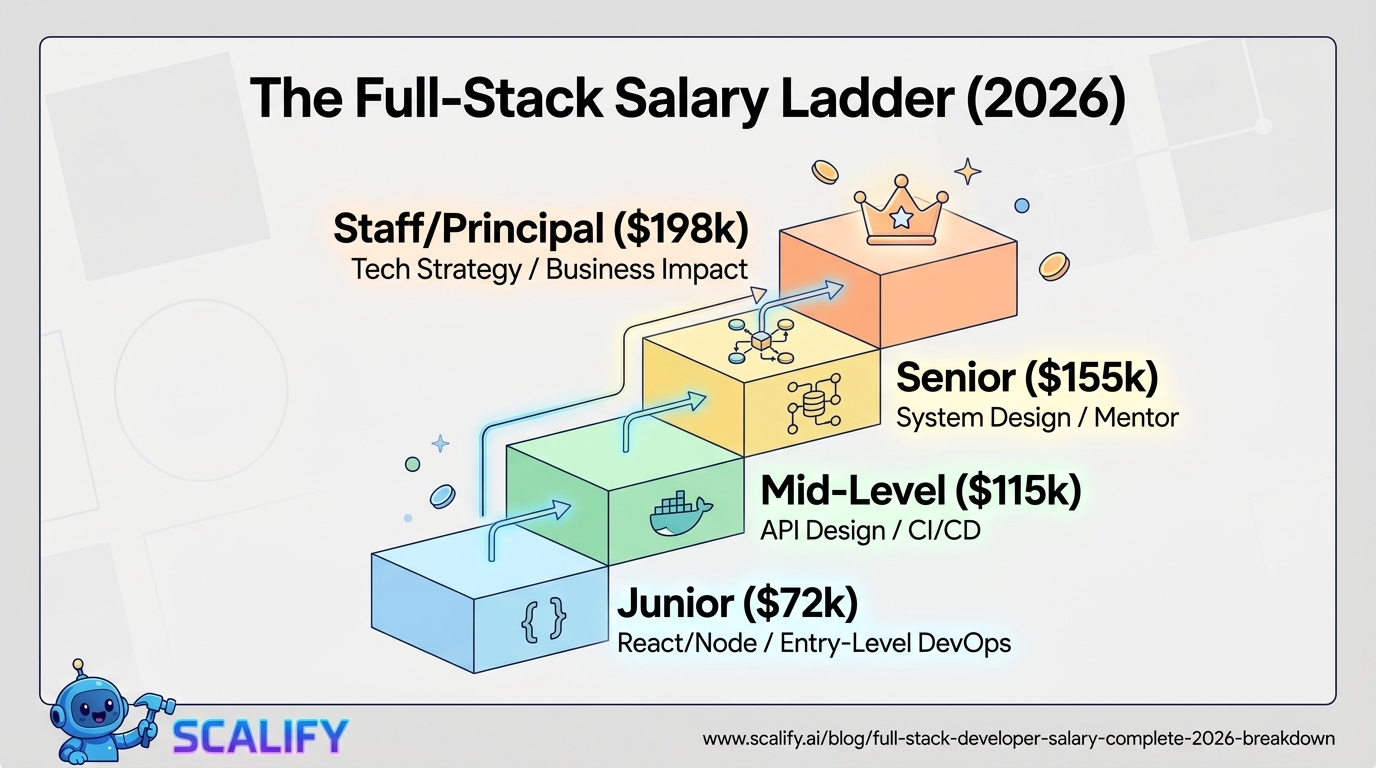
DevOps engineers who specialize in web application infrastructure are among the highest-compensated roles in the entire technology ecosystem — consistently earning more than front-end developers, more than most back-end engineers, and approaching the compensation levels of senior software architects at major tech companies. In 2026, the median DevOps engineer salary in the United States sits at approximately $124,000 at the mid-level, climbing to $168,000–$218,000 at senior and staff levels.
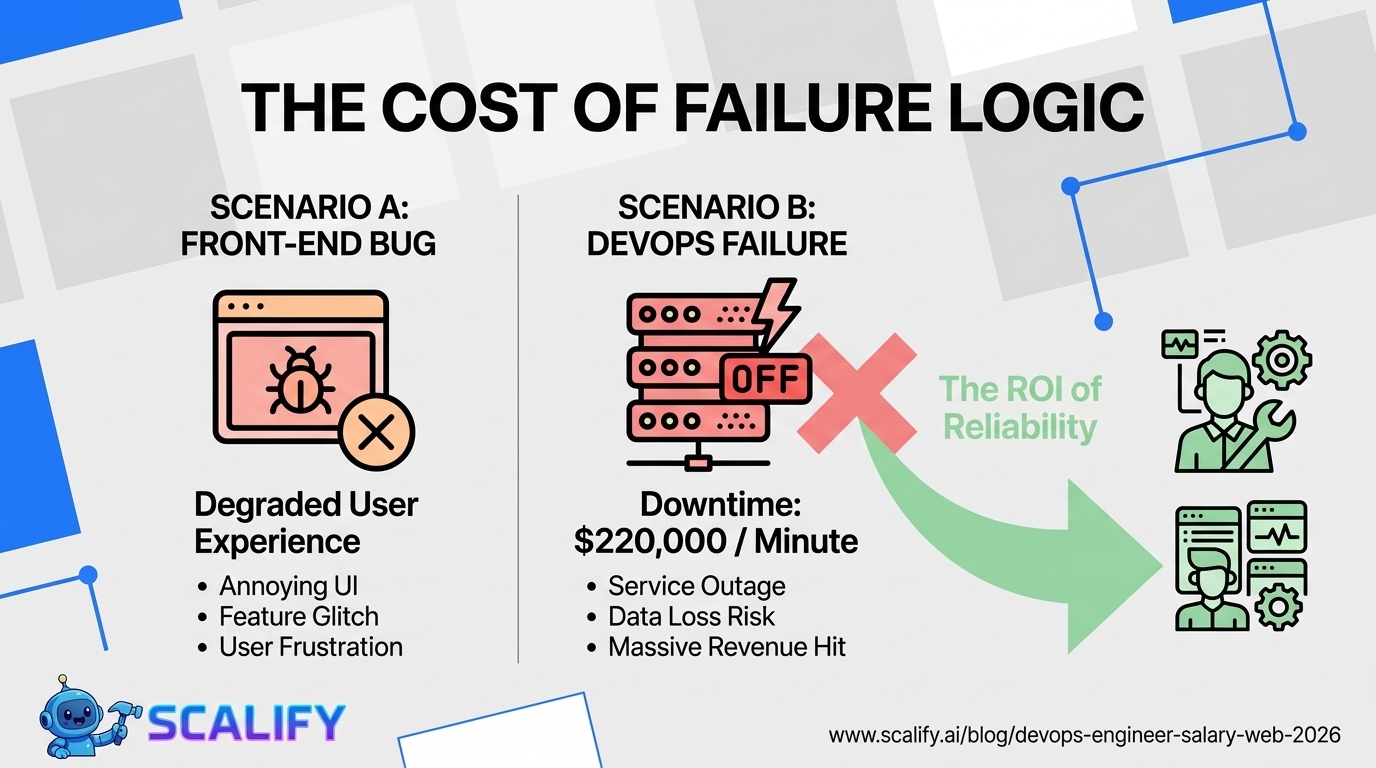
Why is DevOps paid so well? Because the cost of getting it wrong is catastrophic and visible. A front-end bug degrades user experience. A DevOps failure takes the entire website or application offline — and every minute of downtime costs real money. Amazon famously calculated that each minute of downtime costs approximately $220,000. At that scale, a skilled DevOps engineer who prevents even a single major outage per year pays for themselves many times over. The scarcity of engineers who deeply understand cloud infrastructure, containerization, CI/CD pipeline architecture, security posture, and observability — combined with the high operational stakes — is what drives DevOps compensation to its current premium levels.
This guide covers everything you need to understand about DevOps engineer salaries in 2026: experience level breakdowns, cloud platform specialization premiums, geographic differentials, certification ROI, skill stack analysis, the web developer-to-DevOps transition pathway, and how to position yourself for maximum compensation whether you're entering the field or negotiating your next role.
Key Salary Statistics: DevOps Engineers in 2026
DevOps Engineer Salary by Experience Level
Experience level is the single strongest predictor of DevOps compensation — more than geography, more than certifications, and more than specific technology stack. The jump from junior to senior DevOps is particularly dramatic because senior engineers can independently architect and maintain entire deployment infrastructure, while junior engineers require significant oversight and are limited to defined, well-scoped tasks.
Experience LevelYears in RoleSalary RangeMedian SalaryTotal Comp (with equity/bonus)Junior DevOps / Cloud Engineer0–2 years$72,000 – $102,000$85,000$88,000 – $115,000Mid-Level DevOps Engineer2–5 years$105,000 – $148,000$124,000$130,000 – $175,000Senior DevOps / Platform Engineer5–10 years$145,000 – $205,000$168,000$180,000 – $260,000Staff / Principal SRE8–15 years$185,000 – $275,000+$218,000$250,000 – $400,000+DevOps Engineering Manager8+ years (management track)$175,000 – $260,000$208,000$230,000 – $350,000+VP of Infrastructure / Engineering12+ years$220,000 – $350,000+$270,000$350,000 – $600,000+
The trajectory from junior to senior is steeper in DevOps than in most other engineering disciplines. A junior DevOps engineer at $85,000 who spends 5–7 years building genuine expertise in cloud architecture, Kubernetes orchestration, infrastructure as code, and observability engineering can reach senior compensation of $168,000–$205,000 — a 97–141% salary increase. This growth rate is exceptional compared to most careers and reflects how disproportionately the market values deep, demonstrated DevOps expertise over general technology skills.
The jump to staff-level SRE ($218,000+ median) requires not just technical depth but the ability to set technical direction across engineering teams, design systems that handle massive scale, and mentor other engineers. At this level, DevOps compensation begins to approach and sometimes exceed senior engineering managers — a recognition that technical leadership and people management are separate career tracks with comparable market value.
DevOps Engineer Salary by Cloud Platform Specialization
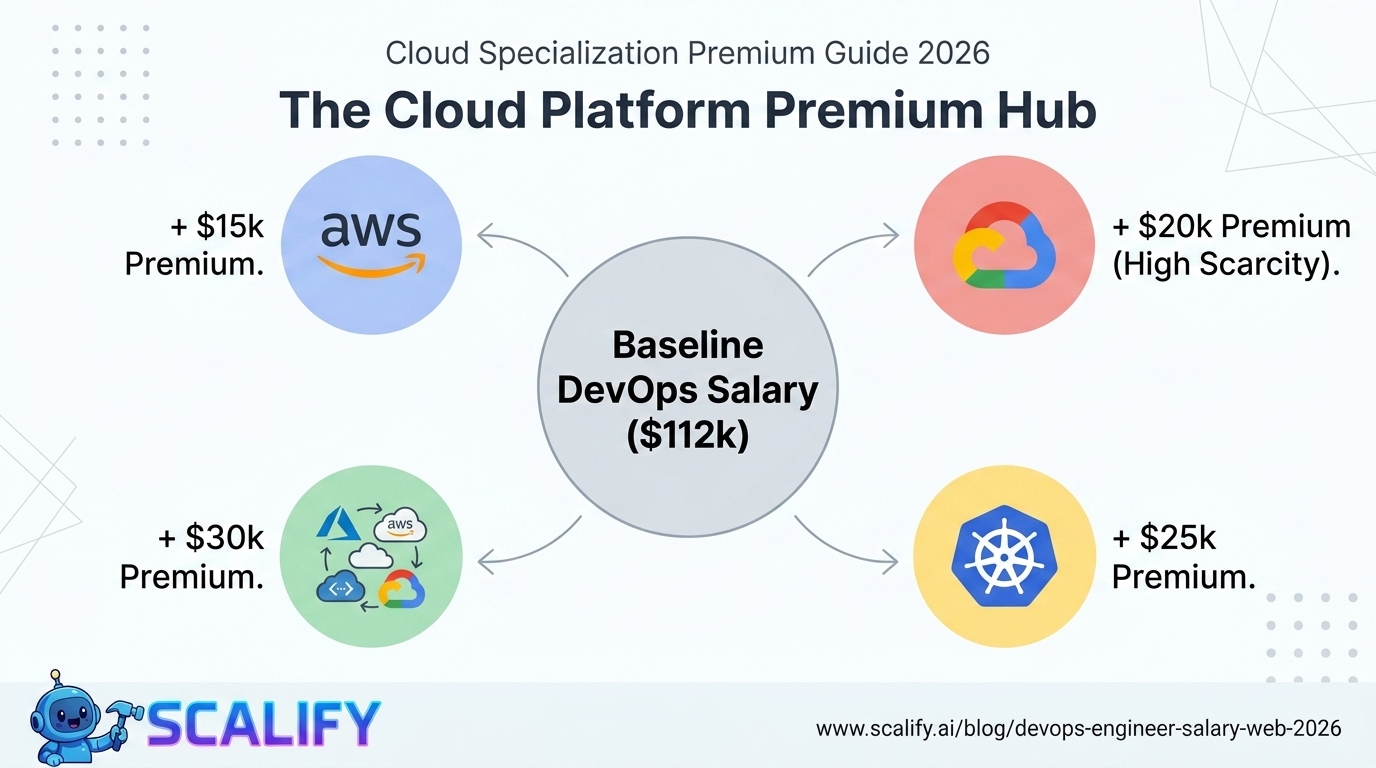
Cloud platform expertise is one of the clearest salary differentiators within DevOps. The three major cloud providers — AWS, Azure, and GCP — all pay differently and attract different types of companies. AWS dominates market share and therefore job volume; GCP pays a slight premium due to scarcity of certified engineers relative to demand; Azure is dominant in enterprise and government contexts where Microsoft ecosystem integration is required.
Cloud PlatformMid-Level MedianSenior MedianMarket ShareJob VolumeSalary Premium vs. No SpecializationAWS (Amazon Web Services)$128,000$172,000~31%Highest+$8,000–$15,000GCP (Google Cloud Platform)$132,000$178,000~12%Moderate+$12,000–$20,000Azure (Microsoft)$125,000$168,000~25%High (enterprise)+$6,000–$12,000Multi-Cloud (AWS + Azure or AWS + GCP)$138,000$185,000Growing rapidlyHigh and growing+$18,000–$30,000Kubernetes (platform-agnostic)$135,000$180,000Container standardVery High+$15,000–$25,000No specific cloud specialization$112,000$152,000N/ADecreasingBaseline
The multi-cloud premium is real and growing. As enterprises increasingly spread workloads across multiple cloud providers for redundancy, cost optimization, and vendor risk management, DevOps engineers who can operate effectively across AWS and Azure — or AWS and GCP — are commanding premiums of $18,000–$30,000 over single-cloud specialists. If you're early in your DevOps career, becoming proficient in one cloud deeply (AWS is the highest-volume choice) and developing working knowledge of a second is the highest-ROI technical investment you can make.
GCP's slight salary premium despite lower market share reflects a classic supply-demand imbalance: Google Cloud's share is growing rapidly as Google wins enterprise contracts, but the pool of certified GCP engineers is smaller than AWS or Azure. Engineers who certify in GCP Professional Cloud DevOps Engineering can access a less competitive hiring pool while commanding higher compensation — particularly at companies that have standardized on Google Cloud infrastructure.
DevOps vs. Web Developer Salary: The Full Comparison
DevOps and web development are closely related disciplines — many DevOps engineers started as web developers — but the salary premium for DevOps is consistent and significant at every experience level. Understanding this premium is useful both for DevOps engineers benchmarking their compensation and for web developers considering a career transition.
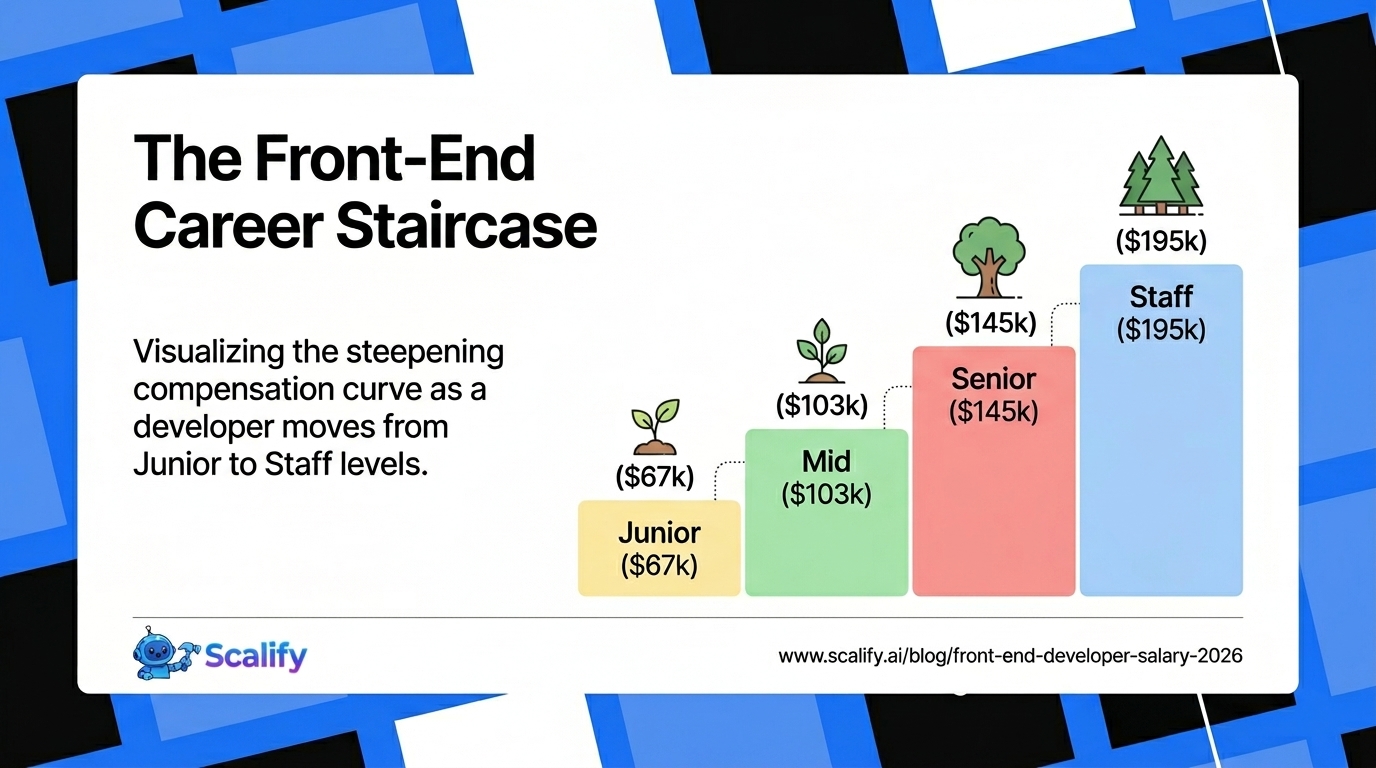
RoleJunior MedianMid-Level MedianSenior MedianPremium vs. Front-End DevStaff / Principal SREN/AN/A$218,000+50–55%Senior DevOps / Platform EngineerN/AN/A$168,000+16–20%Site Reliability Engineer (SRE)$88,000$128,000$172,000+18–24%DevOps Engineer$85,000$124,000$168,000+15–20%Back-End Developer$78,000$110,000$155,000+7–10%Full-Stack Developer$75,000$108,000$152,000+5–8%Front-End Developer$68,000$103,000$145,000Baseline
The consistent 15–25% premium that DevOps earns over equivalent front-end developers is one of the most stable compensation differentials in technology. It hasn't compressed significantly over the past decade, suggesting it reflects a genuine and durable scarcity premium rather than a temporary market imbalance. The skills required for senior DevOps — deep cloud architecture knowledge, Kubernetes mastery, infrastructure-as-code proficiency, production systems experience, security awareness, and observability engineering — take years to build and are not easily replaced by AI tooling or offshore resources.
DevOps Engineer Salary by City and Location
Geography remains a significant DevOps salary variable despite the widespread normalization of remote work since 2020. Companies in high-cost markets still pay location-adjusted salaries for in-office roles, and many remote roles anchor compensation to the hiring company's headquarters market. However, DevOps has one of the strongest remote compensation parity rates of any engineering discipline — primarily because DevOps work is inherently distributed (managing cloud infrastructure requires no physical presence) and because the talent pool is genuinely global.
LocationJunior DevOpsMid-Level DevOpsSenior DevOpsCost of Living IndexEffective Purchasing Power (Senior)San Francisco Bay Area$98,000 – $125,000$142,000 – $178,000$188,000 – $250,000+Very High (100)ModerateSeattle$92,000 – $118,000$135,000 – $168,000$178,000 – $235,000High (82)GoodNew York City$88,000 – $115,000$130,000 – $162,000$172,000 – $225,000High (88)ModerateBoston$85,000 – $112,000$125,000 – $158,000$165,000 – $215,000High (78)GoodAustin / Denver$78,000 – $102,000$112,000 – $145,000$148,000 – $195,000Moderate (62)Very GoodChicago$75,000 – $98,000$110,000 – $140,000$145,000 – $188,000Moderate (65)Very GoodMiami$68,000 – $92,000$95,000 – $130,000$128,000 – $172,000Moderate (60)GoodPhoenix / Atlanta / Dallas$72,000 – $95,000$105,000 – $135,000$138,000 – $178,000Moderate (55–60)ExcellentRemote (major US company)$80,000 – $108,000$120,000 – $155,000$158,000 – $212,000VariableExcellent (in lower COL areas)
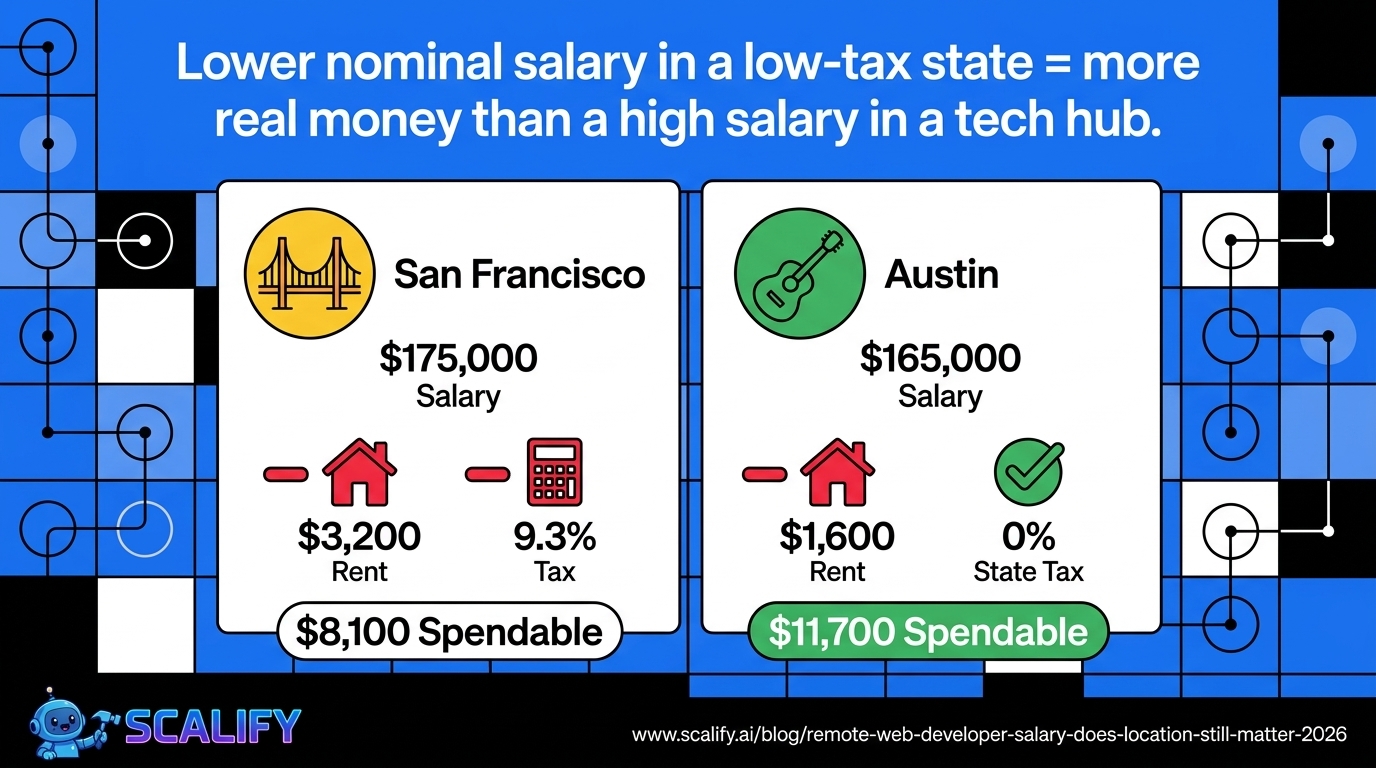
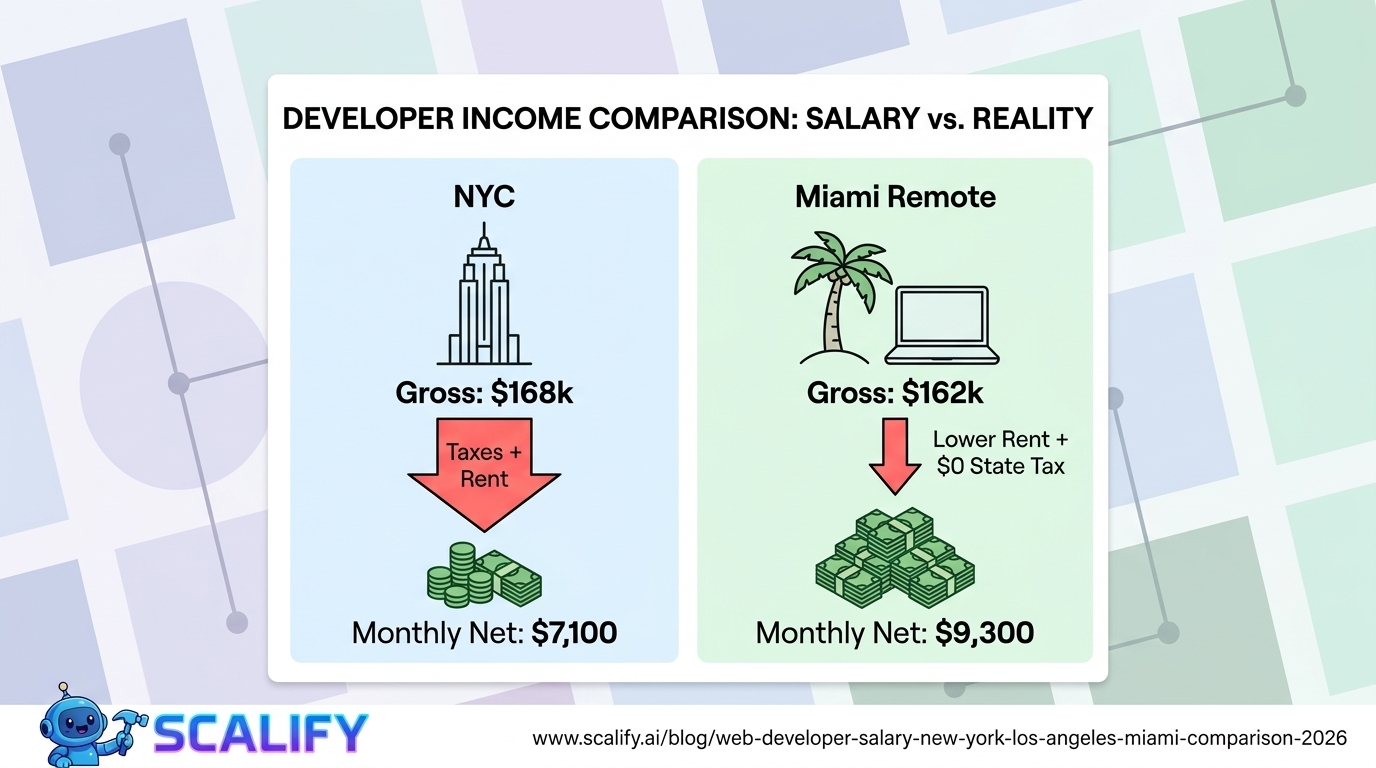
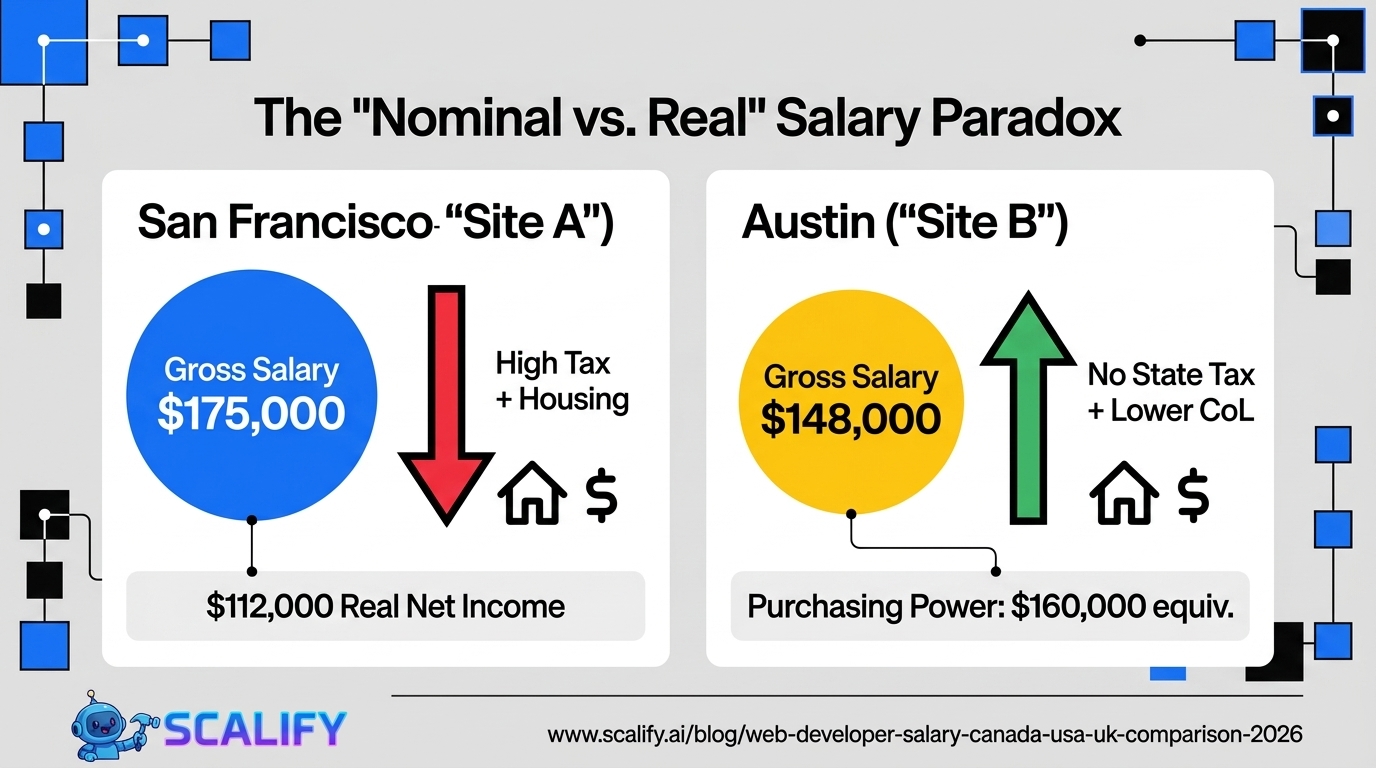
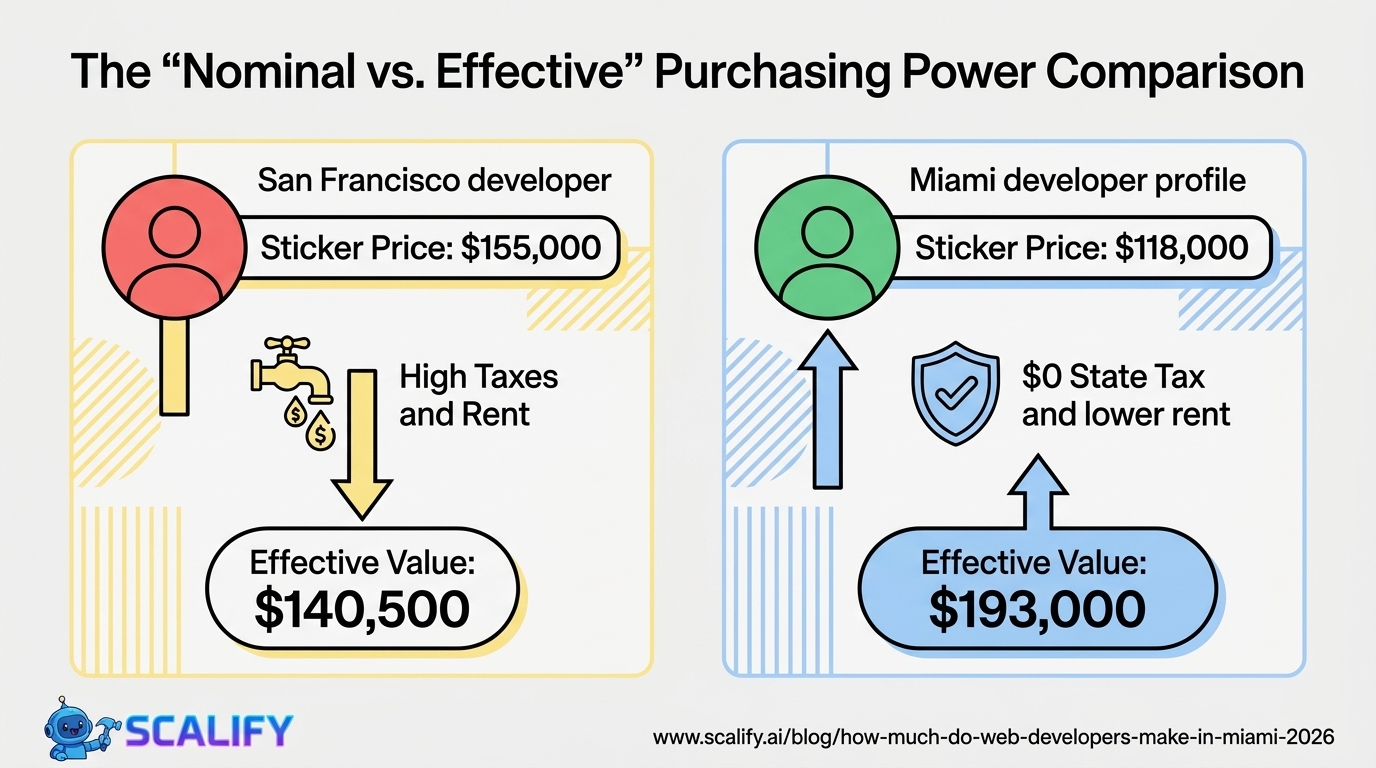
The Austin/Denver and Phoenix/Atlanta/Dallas markets represent some of the best purchasing-power-adjusted DevOps compensation in the country. A senior DevOps engineer earning $168,000 in Austin lives comfortably in a market with a cost of living index of 62 — compared to the San Francisco engineer earning $220,000 in a market with an index of 100. In real terms, the Austin salary often provides higher quality of life despite being nominally lower. This dynamic is driving significant migration of tech talent to Sun Belt markets, which in turn is gradually pushing local DevOps salaries higher.
Remote work has meaningfully compressed geographic salary differences at the top of the market. Engineers at FAANG companies working remotely frequently receive San Francisco or Seattle anchor salaries regardless of where they live. Startups and mid-size companies vary widely — some pay flat national rates, some apply geographic multipliers. Always negotiate remote compensation on the company's highest-market rate, not a locally-adjusted rate, when the role is fully remote and you're delivering equivalent value.
DevOps Certifications and Their Real Salary Impact
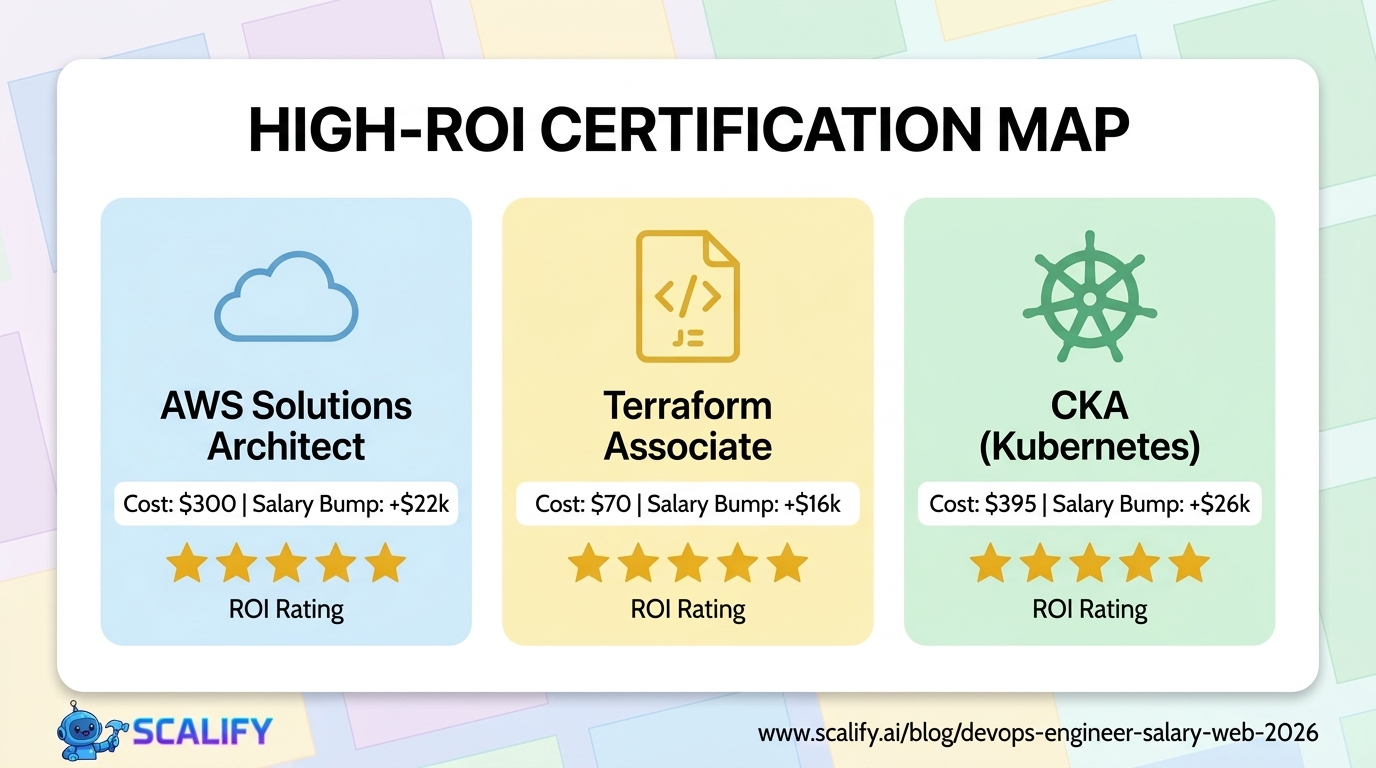
Certifications are one of the most directly actionable salary levers available to DevOps engineers — particularly at the junior and mid-level, where demonstrated credentials can substitute for the years of production experience that employers ideally want but can't always find. The ROI on the right certification is exceptional: a $300 exam fee and 6–8 weeks of study can add $10,000–$25,000 in annual salary — a 3,000–8,000% annual return on the investment.
CertificationIssuerAvg Salary BumpExam CostStudy TimeDifficultyROI RatingAWS Solutions Architect — AssociateAmazon+$10,000 – $22,000$3004–8 weeksModerate★★★★★AWS Solutions Architect — ProfessionalAmazon+$18,000 – $32,000$3008–16 weeksHard★★★★★Certified Kubernetes Administrator (CKA)CNCF / Linux Foundation+$12,000 – $26,000$3954–8 weeksModerate-Hard★★★★★AWS DevOps Engineer — ProfessionalAmazon+$15,000 – $28,000$3008–14 weeksHard★★★★☆Google Cloud Professional DevOps EngineerGoogle+$12,000 – $24,000$2004–8 weeksModerate-Hard★★★★☆HashiCorp Certified: Terraform AssociateHashiCorp+$8,000 – $16,000$702–4 weeksModerate★★★★★Azure DevOps Solutions ExpertMicrosoft+$10,000 – $20,000$165 × 2 exams6–10 weeksModerate-Hard★★★★☆Certified Kubernetes Security Specialist (CKS)CNCF+$14,000 – $28,000$3956–10 weeksHard★★★★☆Prometheus Certified AssociateCNCF+$5,000 – $10,000$2502–4 weeksModerate★★★☆☆
AWS Solutions Architect Associate is consistently ranked as the single highest-ROI technical certification in IT for career-stage engineers. The combination of market recognition (every hiring manager knows what it represents), broad applicability (AWS dominates cloud market share), and attainability (4–8 weeks of focused study for someone with development background) makes it the obvious first certification choice for anyone transitioning into or advancing within DevOps.
The Certified Kubernetes Administrator (CKA) deserves special mention because it's performance-based — candidates must complete hands-on tasks in a live Kubernetes environment within a time limit, rather than answering multiple-choice questions. This makes it significantly harder to credential-farm and therefore more credible to experienced hiring managers who discount exam-only certifications. Engineers with CKA certification consistently report faster hiring processes and stronger salary negotiating positions because the certification carries genuine signal about capability.
The Terraform Associate certification's exceptional ROI ($70 exam cost, 2–4 weeks study, $8,000–$16,000 salary bump) is partly a function of how universally Terraform is used across cloud providers. Unlike AWS or GCP certifications that are provider-specific, Terraform expertise applies everywhere — making it an ideal complement to any cloud certification stack.
Core DevOps Skill Stack for Web Engineers: What Employers Actually Want
DevOps job descriptions in 2026 cluster around a consistent core skill set. Understanding which skills are universal requirements versus differentiators helps prioritize learning investments. The skills below are organized by how commonly they appear in senior DevOps job postings and how strongly they correlate with compensation.
Skill CategorySpecific TechnologiesRequired AtSalary ImpactLearning DifficultyContainer OrchestrationKubernetes, Helm, DockerMid-Level and above+$15,000–$25,000HighInfrastructure as CodeTerraform, Pulumi, AWS CDKMid-Level and above+$10,000–$18,000ModerateCI/CD PipelinesGitHub Actions, GitLab CI, Jenkins, CircleCIJunior and above+$6,000–$12,000ModerateCloud Platform ExpertiseAWS, GCP, or Azure (deep)Junior and above+$8,000–$20,000Moderate-HighMonitoring and ObservabilityPrometheus, Grafana, Datadog, OpenTelemetryMid-Level and above+$8,000–$15,000ModerateScripting and AutomationPython, Bash, GoAll levels+$5,000–$12,000ModerateLinux / Unix SystemsShell, systemd, networking, permissionsAll levels (essential)Foundation skillModerateService Mesh / NetworkingIstio, Envoy, CiliumSenior and above+$12,000–$22,000HighCloud SecurityIAM, Vault, SAST/DAST, CSPMMid-Level and above+$10,000–$20,000HighGitOpsArgoCD, FluxSenior and above+$8,000–$16,000Moderate
The emergence of platform engineering as a distinct discipline — distinguished from traditional DevOps by its focus on building internal developer platforms (IDPs) that abstract cloud complexity from application teams — is creating a new premium tier within the DevOps market. Platform engineers who can design and maintain self-service developer tooling (Backstage, internal portals, automated environment provisioning) are commanding $180,000–$240,000 at senior levels, reflecting the strategic value of multiplying developer productivity across an entire engineering organization.
Cloud security is the fastest-growing specialization within DevOps. As compliance requirements expand (SOC 2, HIPAA, GDPR, PCI-DSS) and cloud misconfigurations continue to be the leading cause of data breaches, engineers who combine DevOps operational expertise with deep cloud security knowledge — Cloud Security Posture Management (CSPM), secrets management with HashiCorp Vault, automated vulnerability scanning in CI/CD pipelines — are accessing a highly differentiated market with limited supply and strong salary premiums.
DevOps at FAANG and Top-Tier Tech Companies
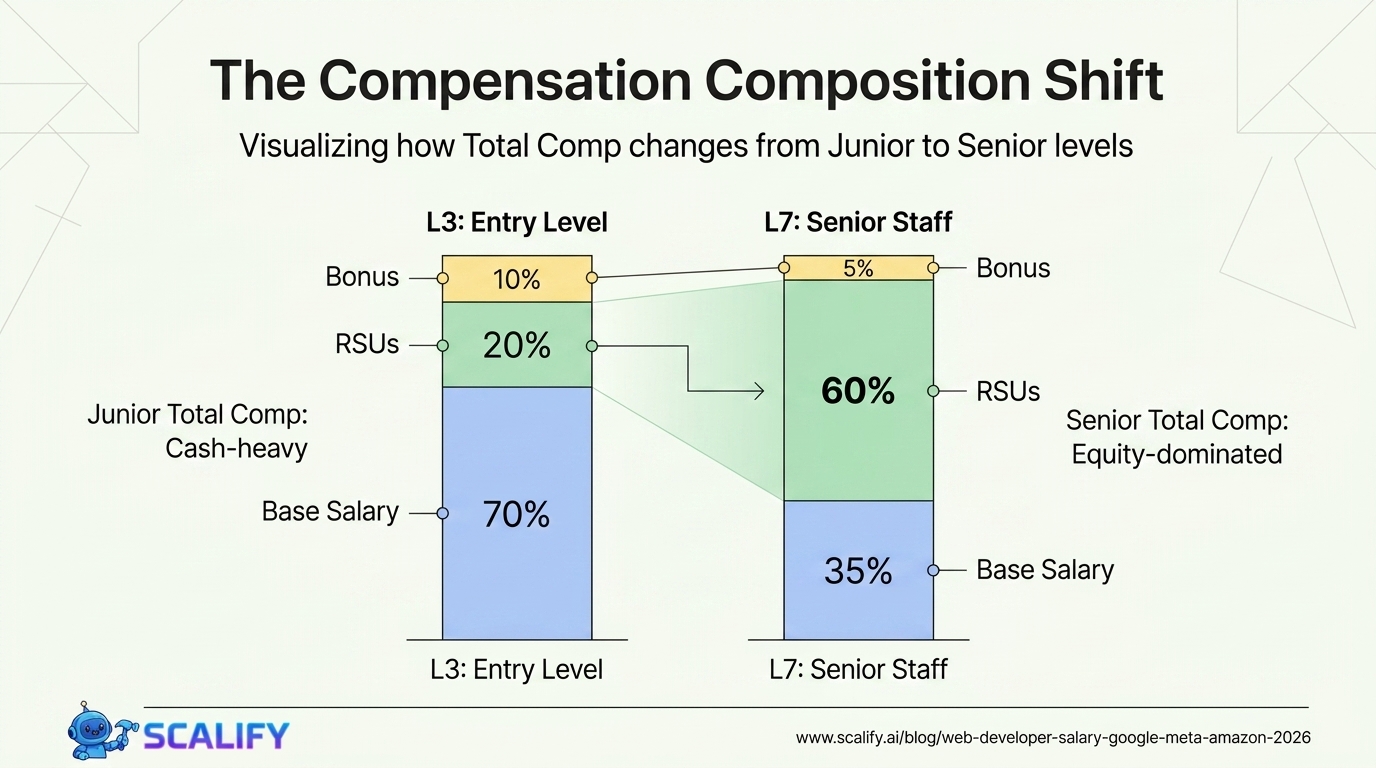
Compensation at FAANG companies (Facebook/Meta, Amazon, Apple, Netflix, Google) operates in a completely different tier than the general market. Total compensation (base salary plus stock plus bonus) at these companies can reach $300,000–$500,000+ for senior and staff-level DevOps engineers, with a substantial portion of that compensation coming from equity that appreciates with company performance.
CompanySenior DevOps / SRE BaseTarget Annual BonusEquity (Annual Value)Estimated Total CompGoogle (L5 SRE)$185,000 – $215,00015–20% of base$120,000 – $200,000+$340,000 – $460,000Meta (E5 Production Engineer)$178,000 – $210,00010–15% of base$130,000 – $210,000+$340,000 – $460,000Amazon (SDE II / DevOps L5)$165,000 – $200,000Variable (sign-on heavy)$100,000 – $180,000+$290,000 – $420,000Netflix (Senior SRE)$250,000 – $350,000Included in cash compSeparate grants$280,000 – $420,000Apple (Senior DevOps)$175,000 – $210,00010–15% of base$80,000 – $150,000+$280,000 – $390,000Microsoft (Senior SRE / L63)$165,000 – $198,00010–15% of base$80,000 – $140,000+$270,000 – $370,000
Netflix's famously high base salary (which includes no explicit equity refresh program but pays significantly higher cash than peers) reflects their philosophy of compensating for market value directly rather than through retention-focused equity vesting. A senior SRE at Netflix earning $280,000–$350,000 in base salary has maximum flexibility — they can invest that cash in whatever assets they choose rather than being locked into company stock vesting schedules.
Getting into FAANG DevOps roles typically requires 5–8 years of strong experience, specific exposure to operating systems at enormous scale (millions of requests per second, multi-region deployments, complex distributed systems), and a rigorous interview process that tests both systems design and hands-on operational knowledge. The interview process for Google SRE roles in particular is notoriously thorough — often 5–7 rounds covering distributed systems theory, Linux internals, network troubleshooting, and incident response scenarios.
Freelance and Contract DevOps Rates in 2026
DevOps freelancing and contracting has become substantially more viable since 2020, as companies became comfortable with remote infrastructure management. Contract DevOps engineers command premium hourly rates because they provide flexible capacity without the overhead of full-time employment — particularly valuable for companies doing cloud migrations, Kubernetes adoptions, or CI/CD pipeline buildouts that have defined scopes rather than ongoing staffing needs.
Contract DevOps Engagement TypeTypical Hourly RateTypical DurationAnnual Equivalent (Full Utilization)Junior DevOps Contractor$75 – $110/hr3–12 months$156,000 – $228,000Mid-Level DevOps Contractor$110 – $160/hr3–12 months$228,000 – $332,000Senior DevOps / Cloud Architect$150 – $225/hr2–9 months$312,000 – $468,000Cloud Migration Specialist$160 – $240/hr3–9 months$332,000 – $499,000Kubernetes Implementation$140 – $210/hr1–6 months$291,000 – $436,000DevSecOps / Cloud Security Specialist$165 – $250/hr2–9 months$343,000 – $520,000
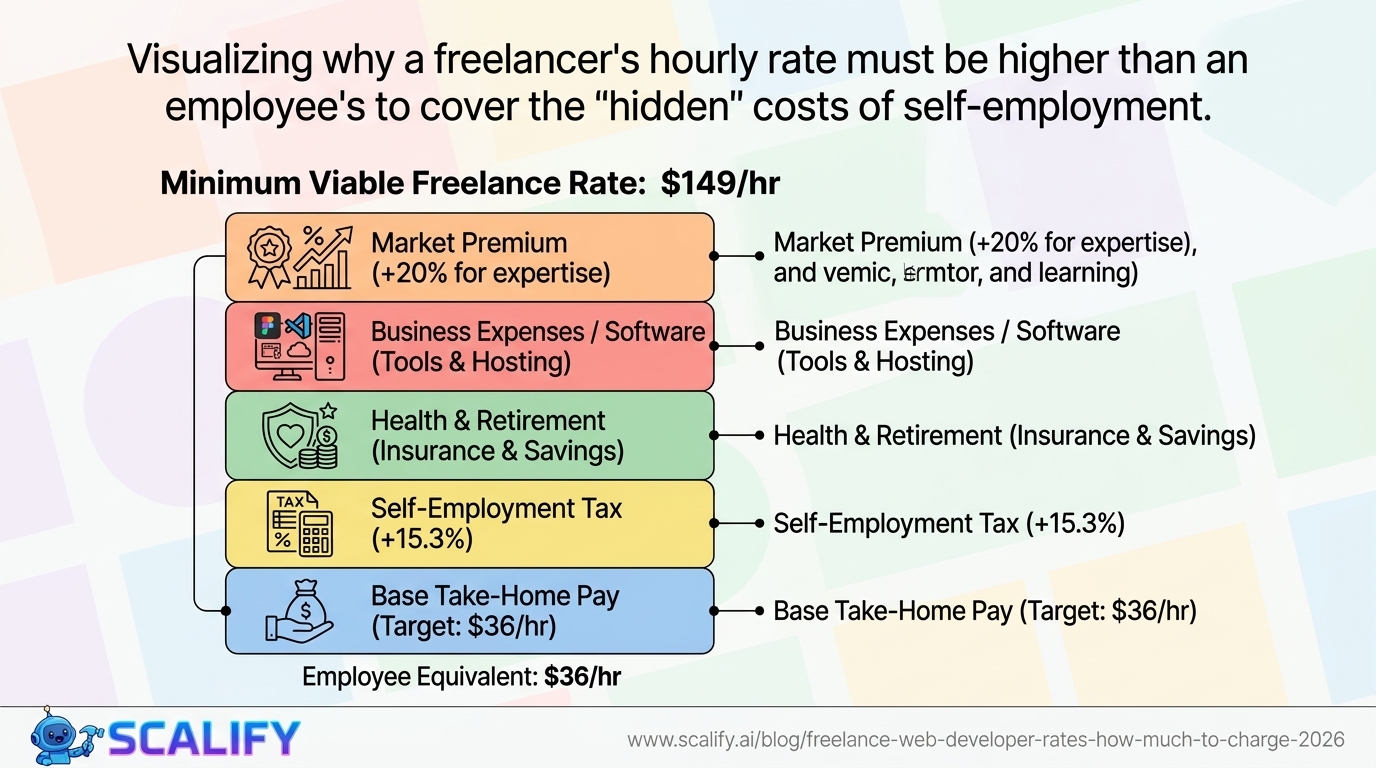
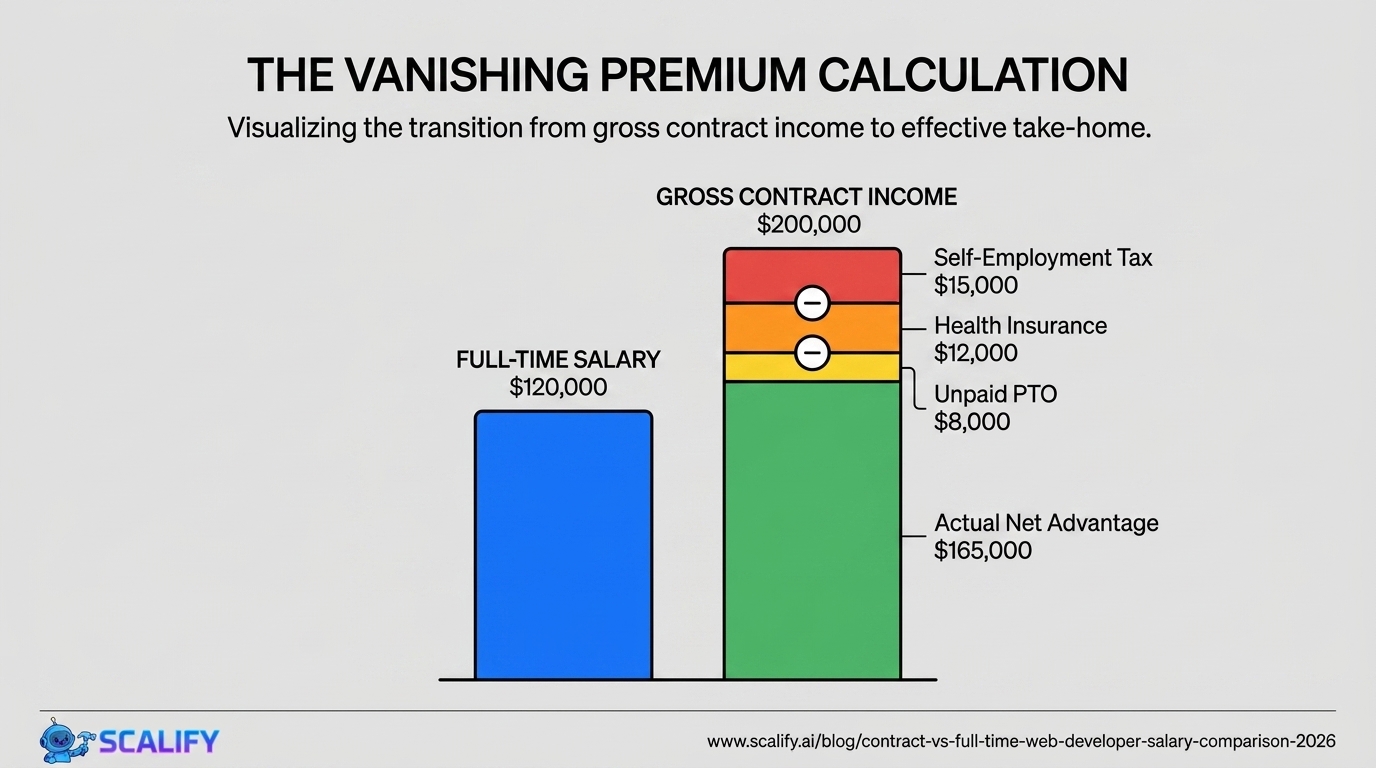
The significant premium for contract work over full-time employment (contract rates often represent 30–50% higher effective hourly compensation) reflects several factors: contractors don't receive benefits, carry their own self-employment tax burden (15.3%), must fund their own retirement contributions, and manage gaps between engagements. When these costs are accounted for, the effective premium over equivalent full-time compensation is typically 15–25% — still meaningful, but not as dramatic as the gross rate comparison suggests.
The Web Developer-to-DevOps Transition: The Path and the Salary Upside
Many of the highest-earning DevOps engineers started their careers as web developers — building application code before becoming curious about the infrastructure that ran it. The transition is well-trodden, typically takes 12–24 months of deliberate effort, and produces one of the most reliable salary jumps available to experienced web developers without returning to school or changing industries.
Transition StageTimeframeFocusTypical Salary During StageStage 1: Foundation buildingMonths 1–4Linux fundamentals, Docker basics, basic AWS services (EC2, S3, VPC, IAM), Python scriptingCurrent web dev salaryStage 2: Hands-on applicationMonths 3–8Deploy personal projects on AWS, set up CI/CD with GitHub Actions, containerize applications, pursue AWS SAA certificationCurrent web dev salary + readying for transitionStage 3: DevOps responsibilities at current employerMonths 6–14Volunteer for deployment pipeline improvements, infrastructure work, monitoring setup at current jobPossible internal promotion or raiseStage 4: First DevOps roleMonths 12–20Junior or DevOps-adjacent role at new employer; focus on Kubernetes, Terraform, monitoring$85,000–$105,000 (junior DevOps)Stage 5: Mid-level DevOpsMonths 24–48Full DevOps engineer with production responsibility; expanding cloud, security, observability expertise$120,000–$148,000
The most successful transitions combine self-directed study with practical application at the current employer before making the jump. Web developers who can say "I rebuilt our deployment pipeline from manual FTP uploads to automated GitHub Actions CI/CD with staging environments" in their first DevOps job interview have demonstrated operational judgment that no certification alone can convey. Employers know that DevOps skills transfer from real production experience — showing that you've already done some of the work, even informally, is worth more than any credential.
How to Negotiate Your DevOps Salary
DevOps engineers are negotiating from a position of structural strength — demand consistently outpaces supply, the skills are difficult to offshore or automate, and the cost of losing a good DevOps engineer (in recruitment time, institutional knowledge, and operational risk during the gap) is very high for employers. This market dynamic means that DevOps engineers who negotiate effectively can typically improve initial offers by $10,000–$25,000 with relatively low risk of losing the offer.
Key negotiation principles specific to DevOps roles:
DevOps Salary Outlook: 2026–2030
Several trends will shape DevOps compensation over the next four years:
AI and automation will change the role but not eliminate it. AI tooling is already beginning to automate aspects of DevOps work — infrastructure provisioning, log analysis, incident triage. However, the judgment required to architect complex systems, make cost-reliability tradeoffs, design incident response procedures, and mentor engineering teams cannot be automated. The role will evolve toward higher-level architecture and platform engineering as the more mechanical tasks are automated — if anything, this will increase the premium for senior DevOps expertise.
Platform engineering will become a distinct discipline with premium compensation. The Internal Developer Platform (IDP) movement — building self-service tooling that allows application engineers to deploy and manage infrastructure without deep DevOps knowledge — is creating a new specialization category. Platform engineers who can design these systems are accessing premium compensation above traditional DevOps rates.
DevSecOps integration will continue driving security skill premiums. As security requirements expand and security breaches continue to dominate headlines, the integration of security into DevOps workflows (DevSecOps) is becoming a baseline expectation rather than a specialization. Engineers who build security competency on top of strong DevOps foundations are well-positioned for the highest-premium roles in the next four years.
The Bottom Line
DevOps engineers focused on web infrastructure earn $85,000–$275,000+ in 2026 depending on experience, location, cloud specialization, and employer type. The median mid-level salary of $124,000 represents a 20–25% premium over equivalent front-end web developers — a premium that has held stable for a decade and shows no signs of compression. The highest-ROI investment for career-stage DevOps engineers is certification (AWS Solutions Architect Associate and CKA offer exceptional salary-per-study-hour returns) combined with hands-on Kubernetes and Terraform experience in production environments. Web developers with 3+ years of experience looking to significantly increase their compensation should give serious consideration to the DevOps transition pathway — 12–24 months of deliberate effort producing a 30–50% salary increase is one of the best career ROI calculations in technology.
At Scalify, we work with DevOps engineers, platform teams, and technology companies across the country — building professional websites in 10 business days that represent the technical expertise and professionalism that high-performing teams deserve.
Top 5 Sources






.jpeg)

.jpeg)





78 SW 7th St, Miami, FL 33130