

Web Developer Salary in New York vs Los Angeles vs Miami: 2026 Comparison
By Josh Ternyak

April 22, 2026
New York leads in nominal salary, LA is close behind, but Miami with remote SF-rate work produces 40% more after-tax income. This comprehensive guide covers salary by role and level in all three cities, the after-tax reality, industry specializations, job market size, cost of living comparison, networking and career development, remote work culture differences, and a 5-year financial model comparing all three scenarios.
Web Developer Salary in New York vs. Los Angeles vs. Miami: 2026 Comparison
New York, Los Angeles, and Miami represent three of the most significant tech markets in the eastern and southern United States — each with distinct compensation characteristics, cost-of-living profiles, tax structures, and industry specializations that produce very different effective financial outcomes for web developers. This comparison goes beyond nominal salary to examine what each market actually pays, what it costs to live there, and which city produces the best financial outcomes for web developers at different career stages.
Key Statistics
Salary by Role and Experience Level
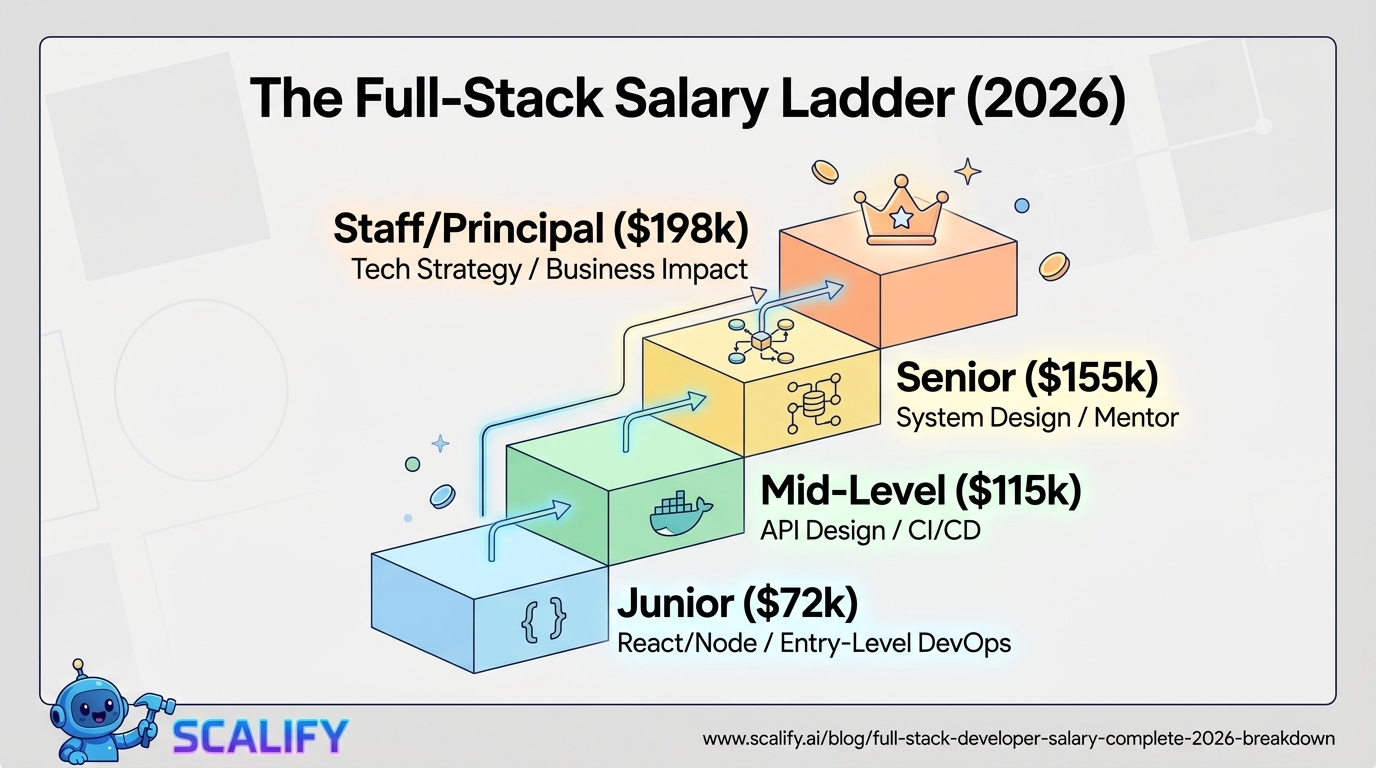
Role / LevelNew York CityLos AngelesMiamiJunior Front-End Developer$72,000 – $92,000$68,000 – $88,000$55,000 – $75,000Junior Full-Stack Developer$75,000 – $95,000$70,000 – $90,000$58,000 – $78,000Mid-Level React Developer$118,000 – $148,000$112,000 – $142,000$88,000 – $118,000Mid-Level Full-Stack (React+Node)$122,000 – $152,000$115,000 – $145,000$90,000 – $120,000Senior React / TypeScript$158,000 – $195,000$148,000 – $182,000$118,000 – $152,000Senior Full-Stack$162,000 – $198,000$152,000 – $185,000$122,000 – $155,000Senior DevOps / Platform$172,000 – $215,000$162,000 – $205,000$130,000 – $168,000Staff / Principal Engineer$205,000 – $265,000$195,000 – $252,000$155,000 – $200,000
The After-Tax Reality: What You Actually Keep
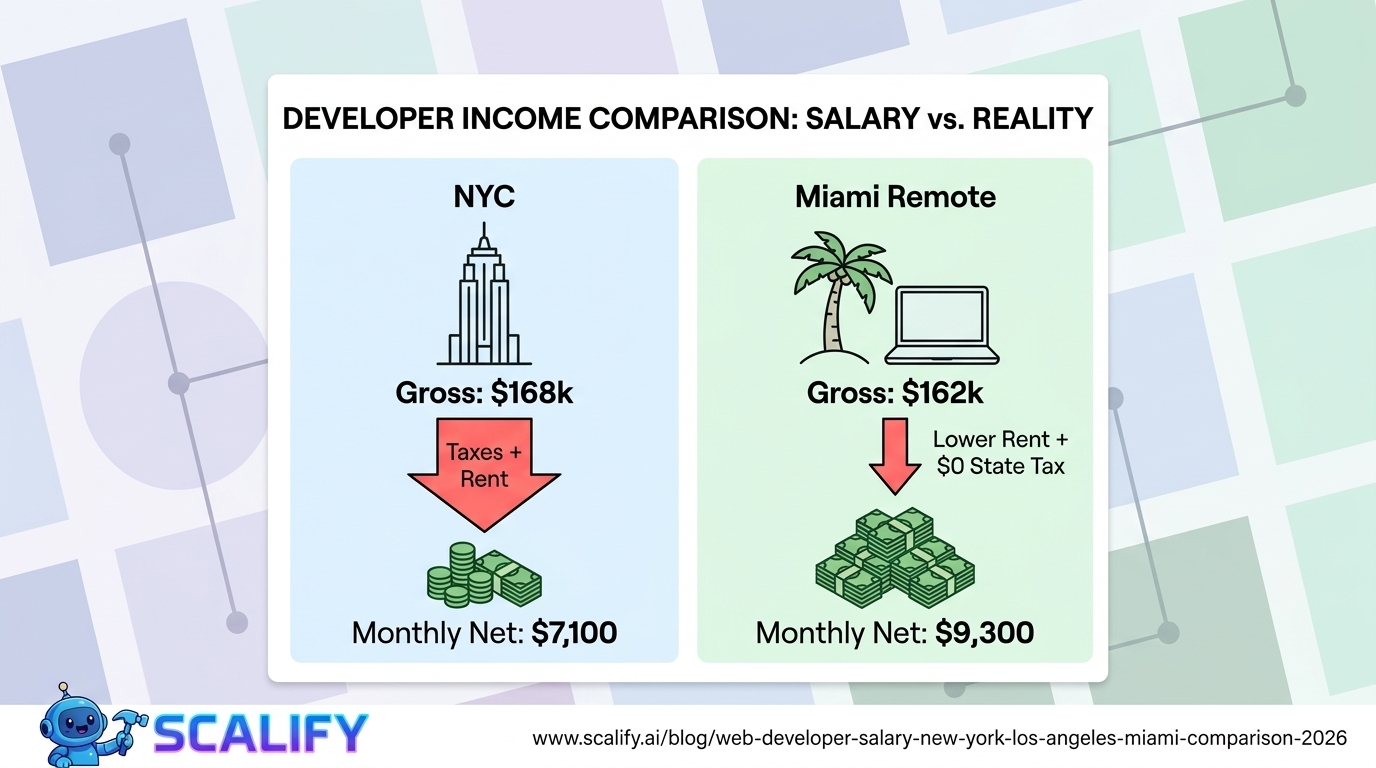
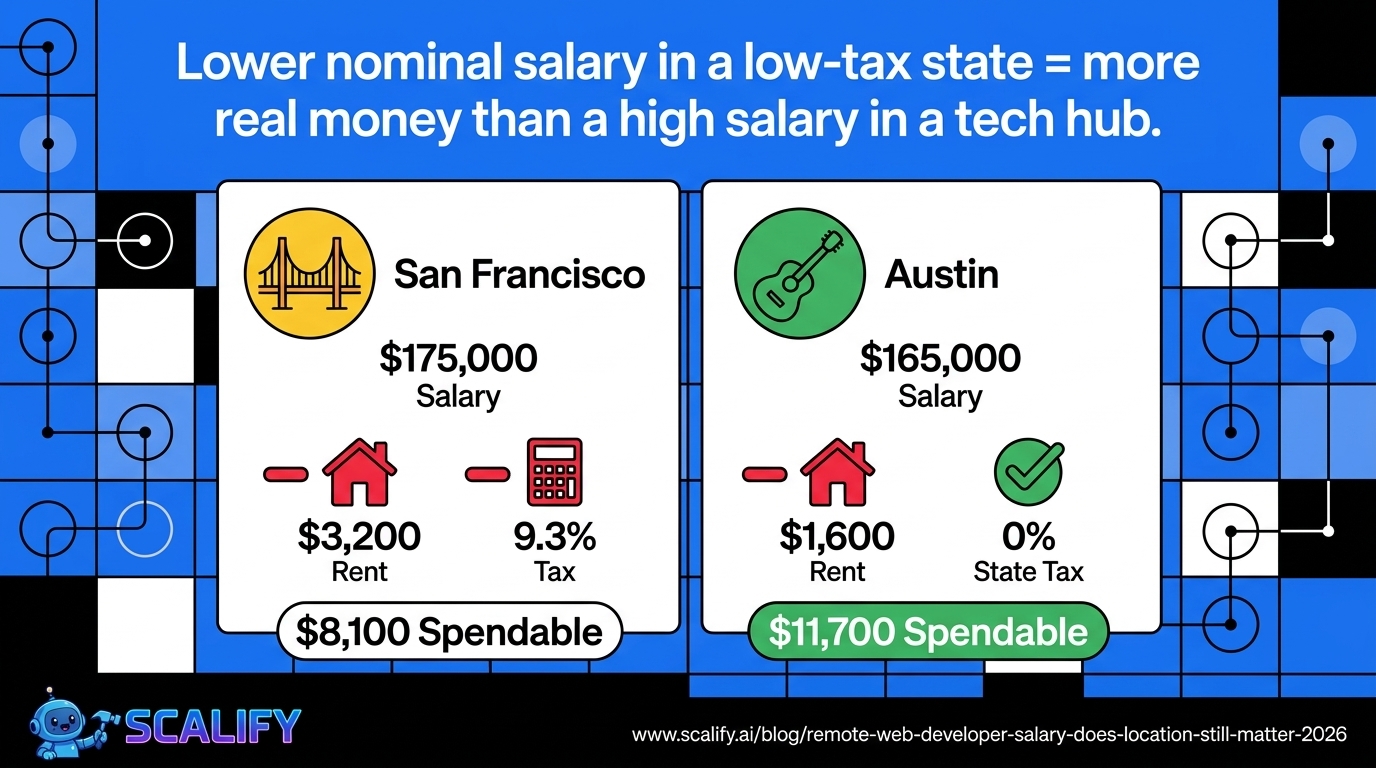
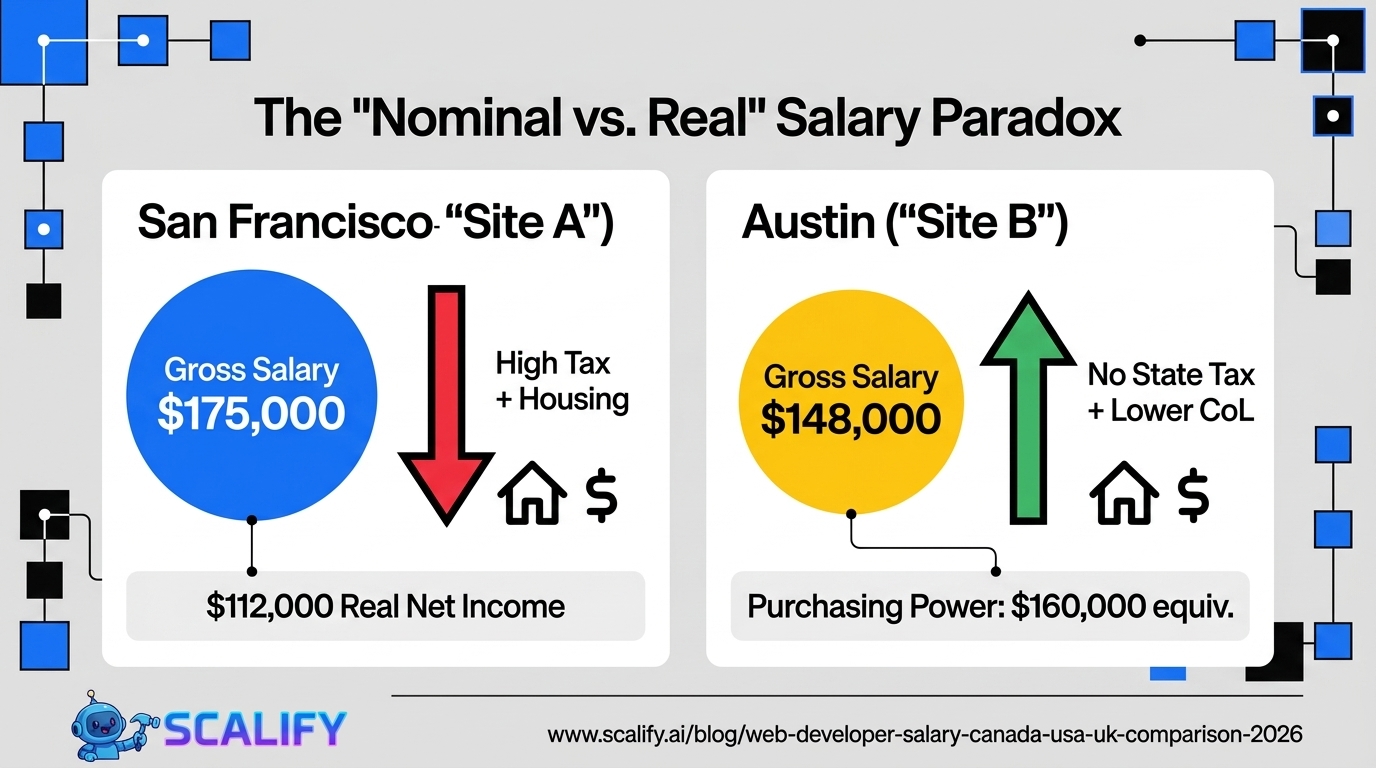
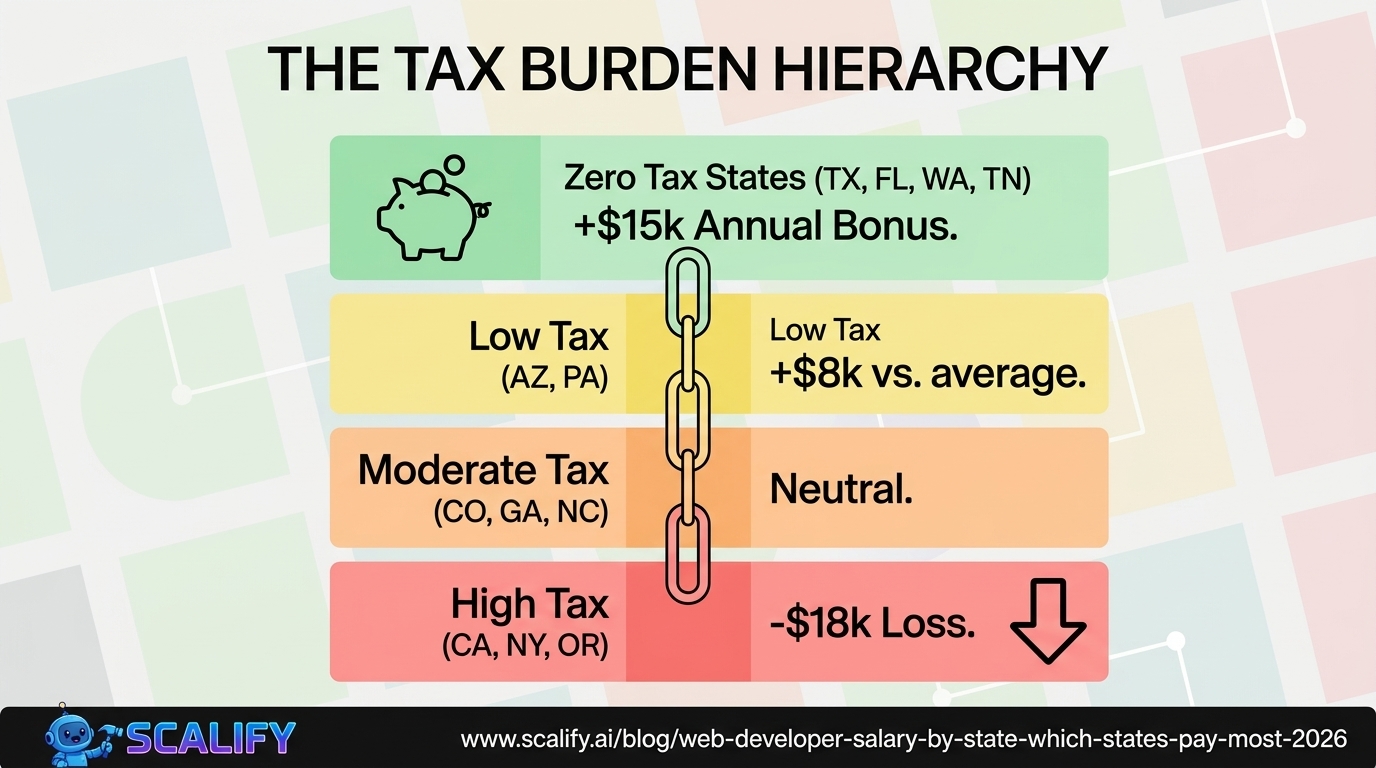
ScenarioGross SalaryState + Local Tax (est.)Federal Tax (est.)Monthly Rent (1BR)Monthly Net After RentNYC Senior Developer$168,000~$18,000 (NY + NYC local)~$35,000$3,500~$7,100LA Senior Developer$158,000~$13,800 (CA state 9.3%)~$33,000$2,600~$7,300Miami Senior Developer$132,000$0 (FL no income tax)~$26,500$2,100~$6,900Miami (remote SF-rate)$162,000$0 (FL no income tax)~$34,000$2,100~$9,300
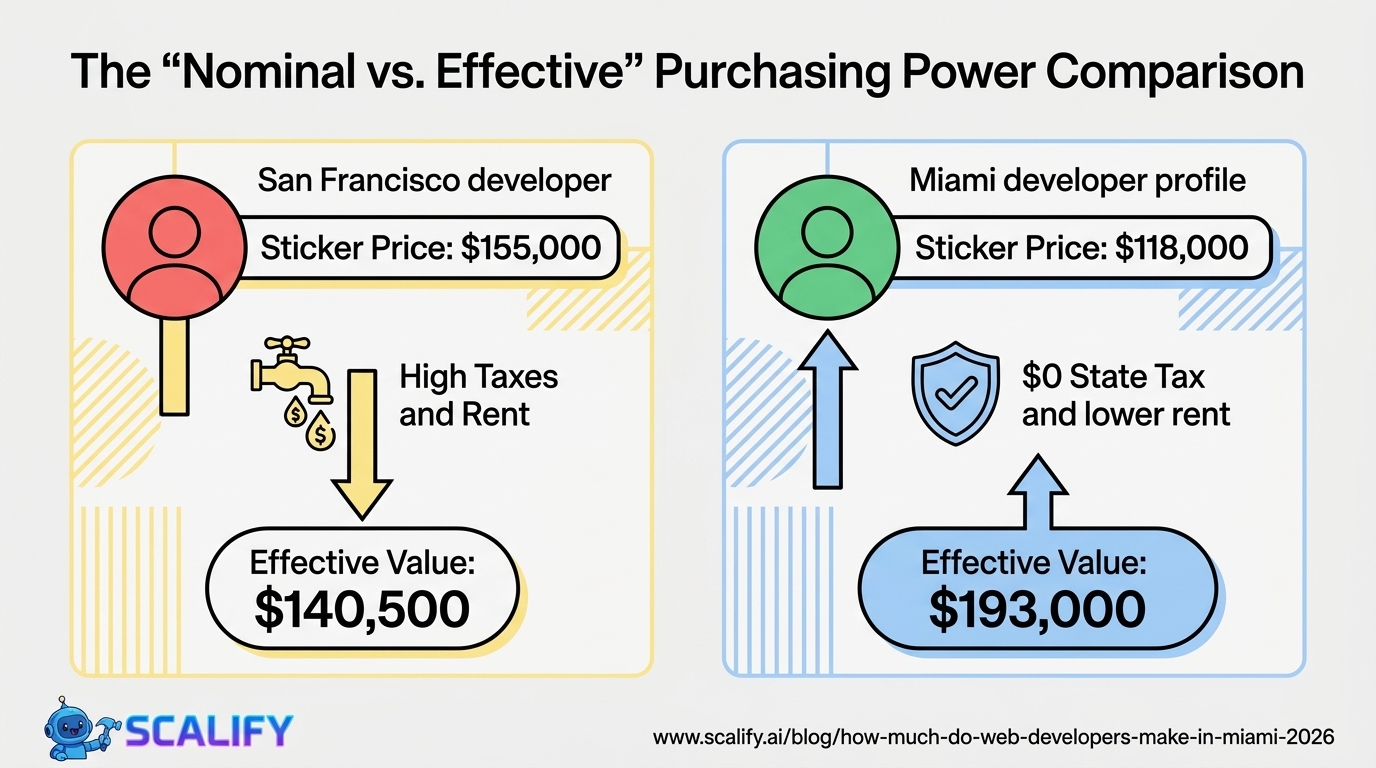
The striking finding: a Miami developer earning a remote San Francisco-anchored salary of $162,000 with no state income tax and Miami's cost of living produces $9,300/month in after-rent, after-tax income — significantly more than the NYC developer nominally earning $168,000 who produces only $7,100/month after NYC's local income tax and dramatically higher rent. The remote work scenario completely inverts the apparent advantage of New York's nominal salary lead.
Industry Specializations: Where Each City Has a Premium
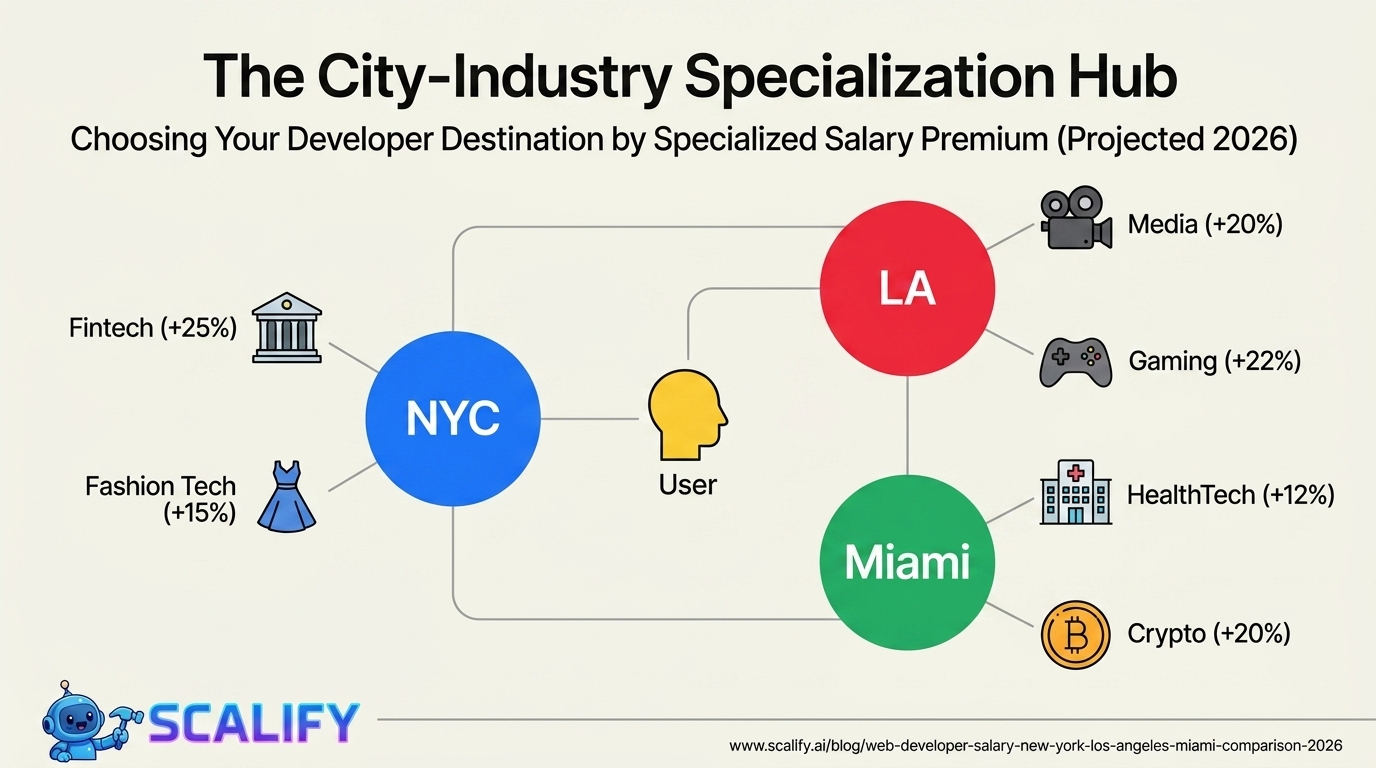
Industry / SpecialtyBest CitySalary Premium vs. General MarketWhyFinancial technology (fintech)New York City+15–25%Wall Street, major banks, largest fintech clusterMedia / entertainment technologyLos Angeles+10–20%Netflix, Disney, Warner Bros., gaming studiosFashion and e-commerce techNew York City+8–15%Major fashion brands, direct-to-consumer companiesGaming developmentLos Angeles+12–22%Activision, EA, Riot Games, dozens of studiosHealthcare technologyMiami+8–12%Large healthcare systems serving diverse populationLatin American market techMiami+5–15%Gateway to Latin America; bilingual premiumReal estate technologyMiami / NYC+8–15%Large real estate markets in both citiesCrypto / blockchainMiami+10–20%Miami has become a crypto-friendly hub
Job Market Size and Opportunity
MetricNew York CityLos AngelesMiamiTotal web developer job postings (monthly est.)~4,500~3,200~1,800Senior developer postings~1,800~1,200~650FAANG / top-tier tech company presenceVery Strong — all major companiesStrong — major presenceLimited — mostly growing companiesStartup ecosystem vitalityVery Strong — global top 5Strong — global top 10Growing — regional top 3Developer competition per postingHighHighModerate — less competition5-year salary growth trend+22%+20%+35%
Cost of Living: The Full Picture
Expense CategoryNew York CityLos AngelesMiami1BR apartment (median rent)$3,400–$4,500$2,400–$3,200$1,900–$2,500Monthly groceries (single person)$400–$600$350–$500$350–$450Monthly transportation$127 (subway) or $0–$200 (no car needed)$200–$600 (car required)$150–$400 (car helpful)Health insurance (employer-subsidized)$200–$400/mo personal contribution$200–$400/mo$150–$350/moOverall COL index (NYC=100)1007665

Which City Is Best for Different Developer Profiles?
Early-career developer (0–3 years): New York offers the best combination of high nominal salary, career acceleration (density of senior developers to learn from), and access to top-tier companies. The high cost of living is challenging but manageable on junior salaries when shared housing is used. The career capital built in NYC's demanding, competitive environment has long-term value that partially justifies the financial sacrifice.
Mid-career developer targeting maximum compensation: Remote work from Miami working for a San Francisco or New York company. Zero state income tax, lower housing costs, and national-market remote salary combined with Miami's quality of life and growing local tech ecosystem is the highest-financial-outcome scenario for developers who have established expertise and can compete for remote roles at national rates.
Senior developer with fintech specialization: New York is the clear choice — the fintech premium (15–25% above general market) is only available in New York at scale, and the combination of that premium with senior base salaries means NYC fintech senior developers often earn $185,000–$220,000 base salary, putting them ahead of equivalent Los Angeles or Miami developers despite New York's higher taxes and living costs.
Developer in entertainment/gaming: Los Angeles is the clear choice — the concentration of major entertainment companies and gaming studios creates a specialized market that doesn't exist at the same scale anywhere else. LA game developers typically earn $145,000–$195,000 for senior roles at major studios.
The Bottom Line
In nominal salary terms, New York leads, Los Angeles is close behind, and Miami lags significantly. In after-tax, after-cost purchasing power terms, the ranking depends heavily on whether the developer is working locally or remotely: local workers in all three cities achieve roughly similar financial outcomes, with New York slightly ahead; remote workers living in Miami while earning coastal rates achieve dramatically better financial outcomes than in-person workers in either New York or LA. For developers choosing between these markets today, the remote work opportunity is the most important variable — Miami's zero income tax and lower cost of living make it the financially optimal choice for any developer who can secure national-rate remote employment.
At Scalify, we build professional websites for technology companies and startups across New York, Los Angeles, Miami, and every other market — delivering in 10 business days wherever our clients are.
Top 5 Sources
Networking and Career Development in Each City
The value of living in a major tech market extends beyond the local salary premium to the networking density that accelerates career development. New York's developer community is one of the most active in the world — hundreds of meetups, conferences, and professional events monthly create constant opportunities for career connections, freelance leads, and exposure to companies and technologies that small markets don't provide. The NYC tech ecosystem is particularly strong for developers interested in fintech, fashion tech, ad tech, and media technology, where the density of relevant companies creates both formal job opportunities and informal networks.
Los Angeles's developer community is strong but more fragmented than New York — the city's geographic sprawl (35+ miles from Santa Monica to Pasadena) means the "LA tech scene" is actually several distinct regional scenes centered around different areas and industries. Santa Monica hosts many consumer tech and e-commerce companies, Culver City has entertainment tech, Hollywood has media and content tech, and the Valley has traditional tech companies. Developers in LA need to be more intentional about which submarket they're networking in to get the career development benefit of the local ecosystem.
Miami's developer community is smaller but significantly less competitive than New York or LA — early participants in the growing Miami tech ecosystem report being able to build meaningful relationships with founders, CTOs, and hiring managers more quickly than in more mature, competitive markets. For developers at the beginning of their career or those trying to establish themselves in a new specialization, Miami's accessibility premium has genuine career value alongside its financial advantages.
Office vs. Hybrid vs. Remote in Each City
The prevalence of office requirements varies by city. New York has the most established return-to-office culture of the three markets — many major New York financial services and media employers have pushed 3–4 day in-office requirements that reduce the practical advantage of nominally remote jobs at these companies. Developers at pure tech companies in NY often maintain hybrid or remote arrangements, but those in banking and traditional media may find in-person requirements more common than the remote flexibility they'd expect based on the national trend.
Los Angeles has the highest remote work penetration of the three markets due partly to the city's commuting infrastructure challenges — LA's freeway-dependent transit system makes 5-day in-office work genuinely painful in a way that NYC's subway-accessible Manhattan does not. Tech companies in LA have been among the most flexible on remote and hybrid arrangements, and the geographic spread of the metro area means in-person requirements often apply only to specific office locations that many employees would commute 45–60+ minutes to reach.
Miami has the most remote-friendly developer culture of the three markets. The city's tech scene was largely built by remote workers and digital nomads who relocated during and after the pandemic, and the culture of remote or hybrid work is deeply embedded in the Miami tech ecosystem. Local Miami companies generally offer more flexible arrangements than equivalent roles in New York or Los Angeles, and the growing number of remote roles at national companies whose employees choose to live in Miami means that remote work flexibility is increasingly the norm rather than the exception in Miami's developer market.
Long-Term Financial Modeling: 5-Year Outcomes
A 5-year financial model of a mid-level developer's career in each city, assuming the developer starts at the same career stage with equivalent skills, illustrates how the geographic differences compound:
Metric (5-year cumulative)NYC (in-person)LA (in-person)Miami (local)Miami (remote SF rate)Total gross income~$620,000~$580,000~$480,000~$600,000Total taxes (state + fed + local)~$185,000~$168,000~$120,000~$155,000Total rent paid~$210,000~$168,000~$132,000~$132,000Net after tax and rent~$225,000~$244,000~$228,000~$313,000Estimated home equity (if purchased)High but high priceHigh but high priceStrong — lower pricesStrong — lower prices
The 5-year model confirms that Miami with remote SF-rate compensation produces $313,000 in after-tax, after-rent income — 40% more than equivalent NYC in-person employment and 28% more than LA in-person employment despite nominally lower gross income in the Miami local scenario. The financial case for Miami + remote work is compelling when modeled over a multi-year period rather than evaluated on first-year salary alone.
Making the Decision: A Framework
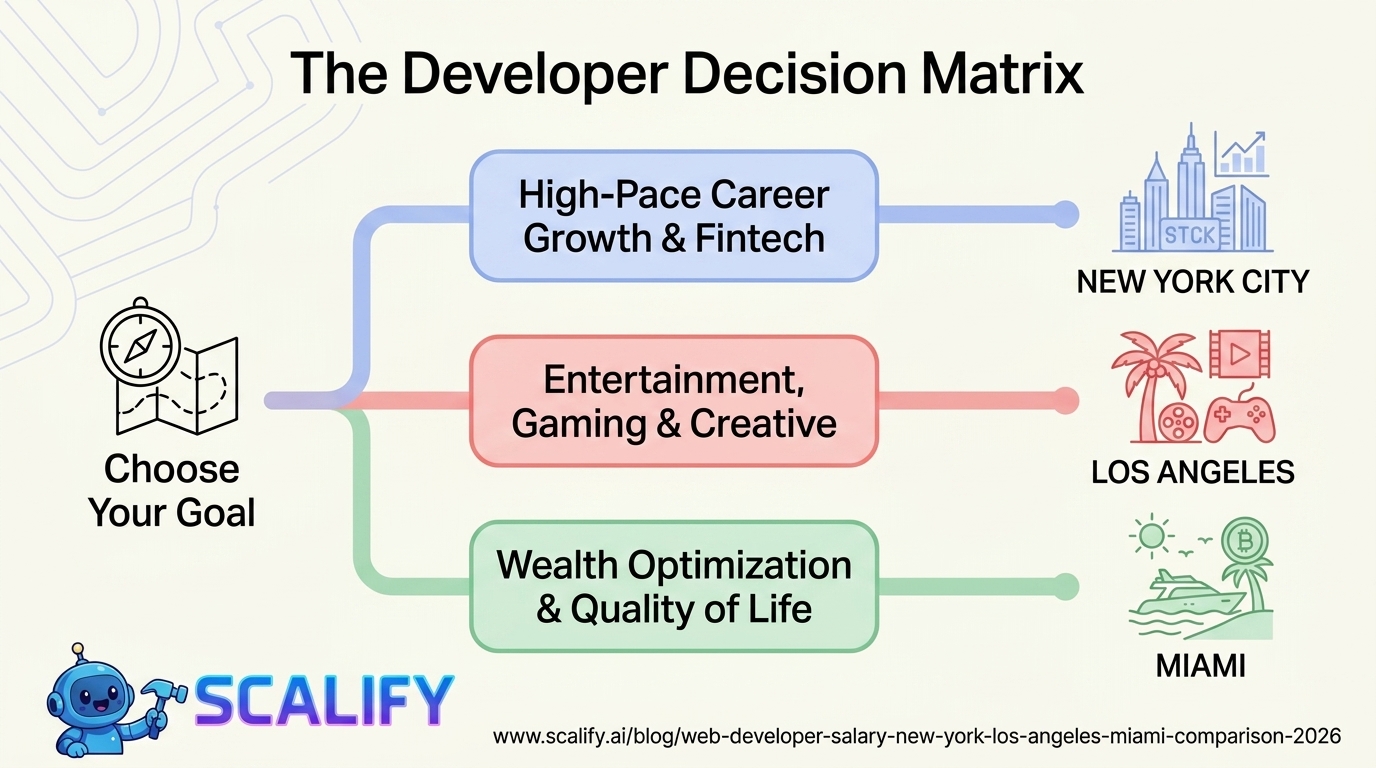
For web developers actively choosing between New York, Los Angeles, and Miami, the decision framework should weigh three categories: financial outcomes (after-tax, after-cost income and wealth accumulation potential), career development (industry access, networking density, promotion opportunities, specific tech sector alignment), and lifestyle preferences (urban density, weather, culture, outdoor access, social scene). The financially optimal choice — Miami with remote work — is not the right choice for every developer. A developer who wants to work in fintech and be surrounded by the world's most talented financial technology engineers should be in New York. A developer who wants to work in gaming or entertainment technology and build a career at a major studio should be in Los Angeles. Miami is the right choice for developers who prioritize financial optimization and quality of life, who can secure remote work or can build their career in Miami's growing tech ecosystem, and who value the city's specific lifestyle advantages — weather, Latin American cultural richness, proximity to international markets, and zero state income tax — over the established career ecosystems of NYC or LA.





.jpeg)
.jpeg)




78 SW 7th St, Miami, FL 33130