

Web Developer Salary by State: Which States Pay the Most in 2026
By Josh Ternyak

April 22, 2026
Web developer salaries vary 65% across US states. Washington has the best after-tax pay; Texas and Florida combine competitive salaries with zero income tax. This guide covers the top 20 states by salary, purchasing power comparisons, remote work state tax rules including NY's controversial rule, emerging tech hubs, and a framework for making geographic career decisions.
Web Developer Salary by State: Which States Pay the Most in 2026
Web developer salaries vary by as much as 65% across US states — driven by differences in cost of living, tech industry concentration, state income tax structures, and local demand for technical talent. Understanding these geographic salary differences helps developers make informed decisions about where to live, how to negotiate with employers in different markets, and whether the nominal salary difference between high-pay and low-pay states actually translates to better financial outcomes after taxes and cost of living.
Key Statistics: Web Developer Salary Geographic Variation
Web Developer Salary by State: Top 20
StateMid-Level MedianSenior MedianState Income TaxEffective Senior Pay*California$125,000$172,000~9.3% (top bracket)~$155,000Washington$122,000$168,000$0~$168,000New York$118,000$162,000~6.5–10.8% (NYC)~$145,000Massachusetts$115,000$158,0005%~$150,000Colorado$108,000$148,0004.4%~$141,000Texas$108,000$148,000$0~$148,000Virginia$105,000$145,0005.75%~$136,000Illinois$102,000$140,0004.95%~$133,000Georgia$98,000$135,0005.49%~$127,000Florida$95,000$132,000$0~$132,000Pennsylvania$95,000$130,0003.07%~$126,000Oregon$98,000$132,0009.9%~$119,000Tennessee$88,000$122,000$0~$122,000Nevada$88,000$120,000$0~$120,000Arizona$90,000$122,0002.5%~$119,000North Carolina$88,000$120,0004.75%~$114,000Minnesota$90,000$122,0009.85%~$110,000Michigan$82,000$112,0004.25%~$107,000Ohio$80,000$108,0003.99%~$104,000Missouri$75,000$102,0004.95%~$97,000
*After estimated state income tax only — does not include federal tax or local taxes. Based on a simplified state tax calculation for illustration.
The Real Question: Which States Have the Best Purchasing Power?
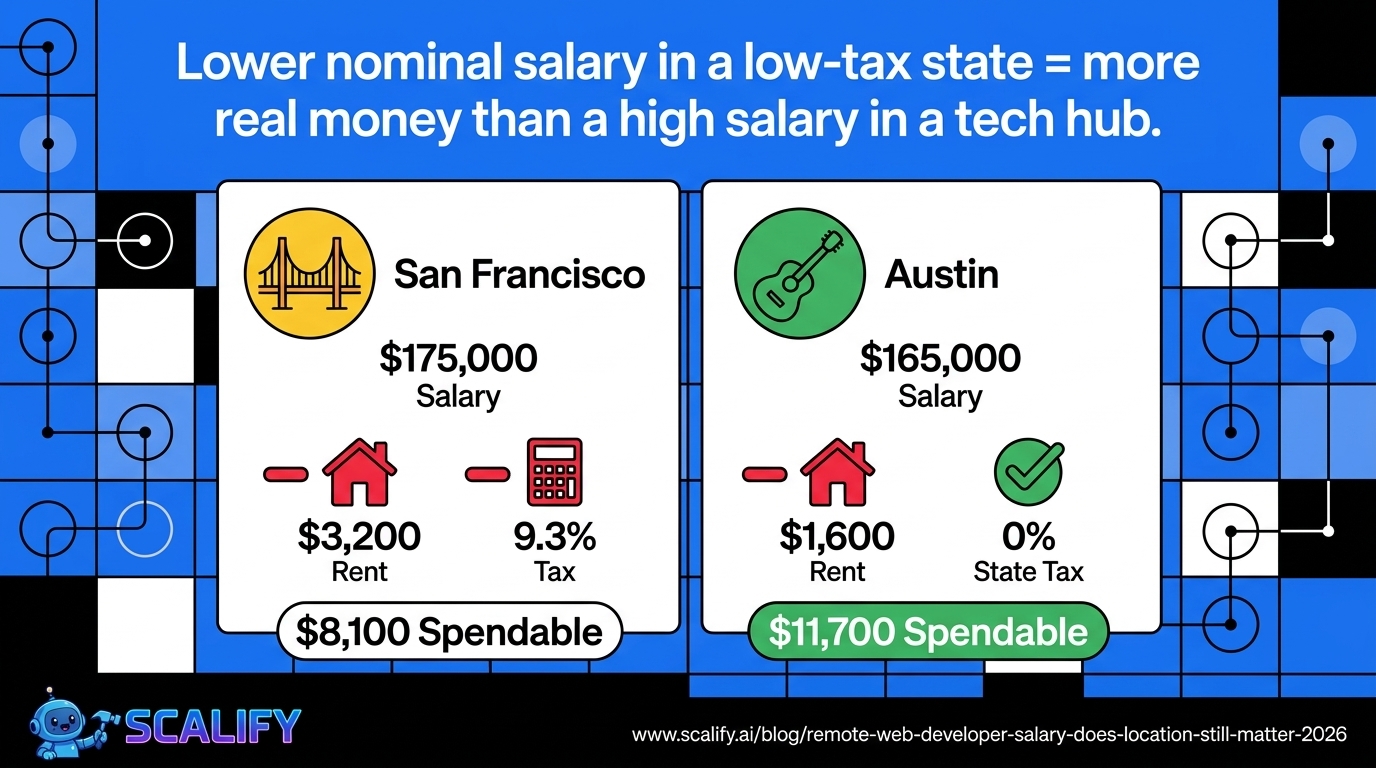
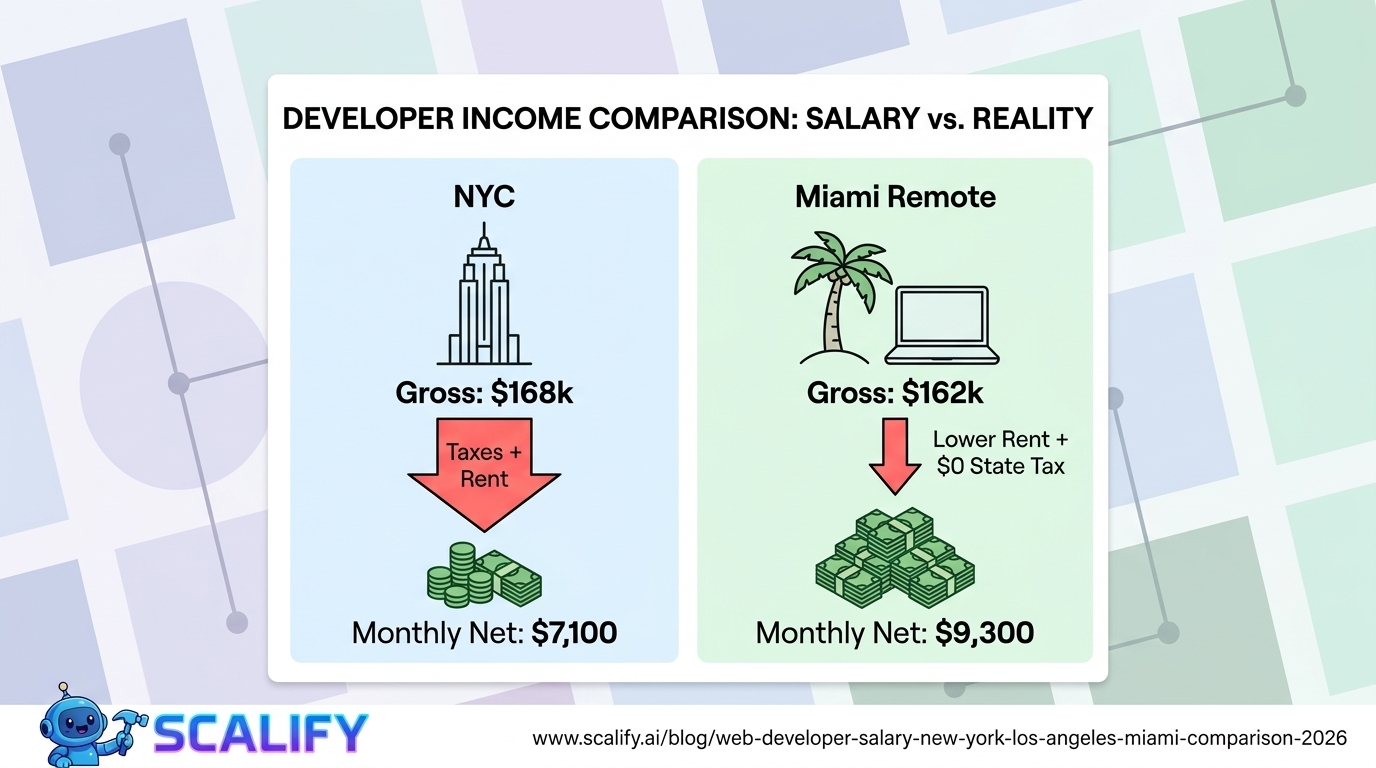
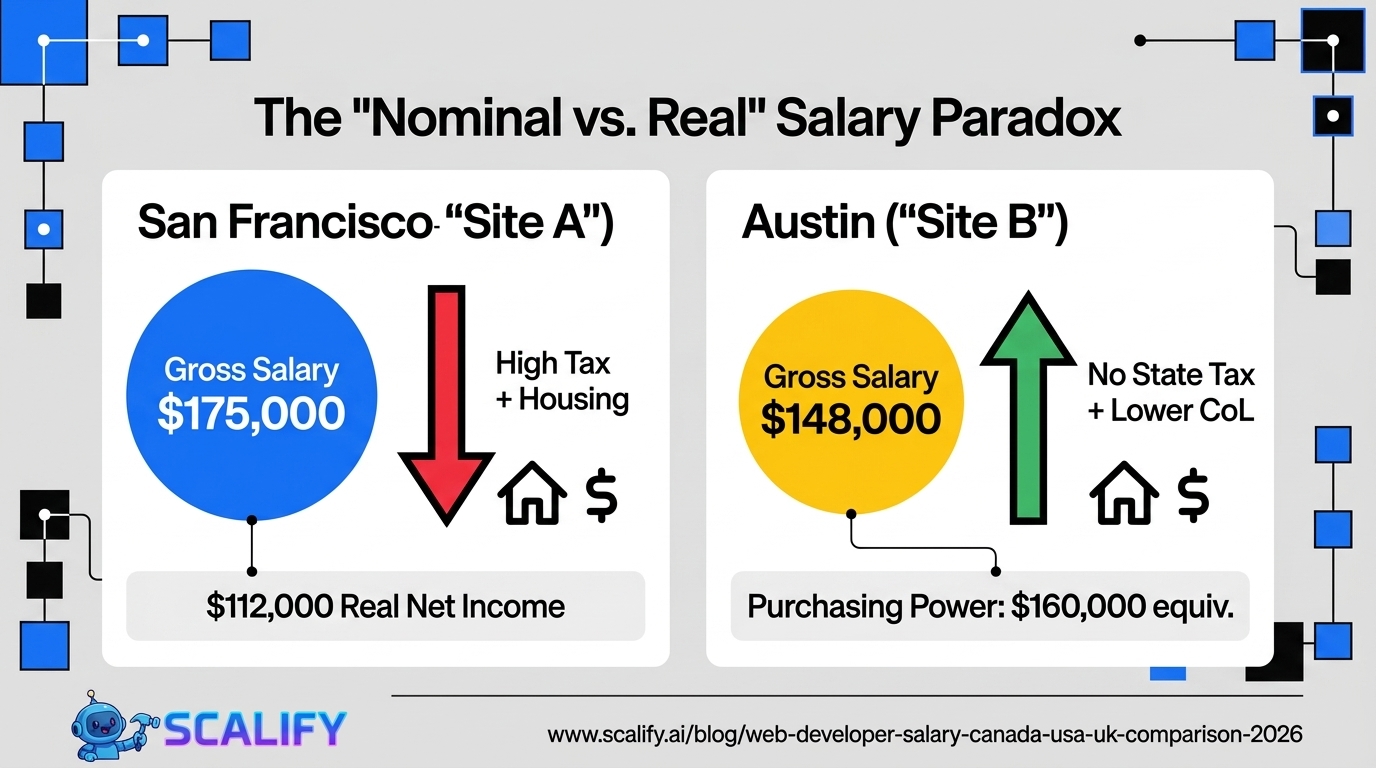
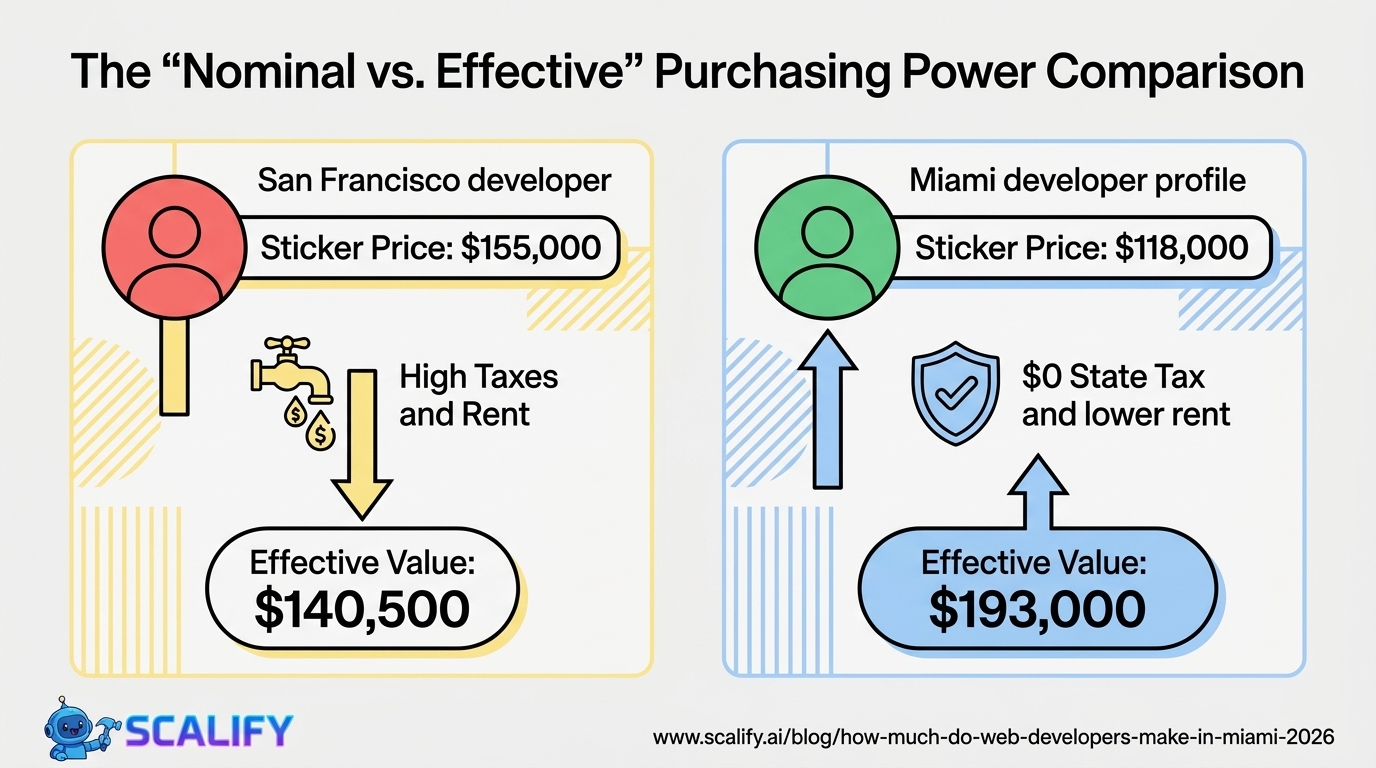
State / CitySenior SalaryAfter-Tax (est.)Avg. 1BR RentMonthly DiscretionaryOverall RankAustin, TX$148,000~$108,000$1,600~$7,400🥇 Top TierRaleigh/Durham, NC$120,000~$114,000$1,400~$8,000🥇 Top TierNashville, TN$122,000~$89,000$1,400~$6,000🥈 StrongSeattle, WA$168,000~$118,000$2,200~$7,600🥇 Top TierSan Francisco, CA$182,000~$120,000$3,200~$6,800🥈 Strong (high cost)Miami, FL$132,000~$96,000$2,100~$5,900🥈 Strong (lifestyle premium)Denver, CO$148,000~$110,000$1,700~$7,100🥇 Top TierNew York City, NY$162,000~$110,000$3,500~$5,300🥉 Adequate
Why Washington State Wins the After-Tax Competition
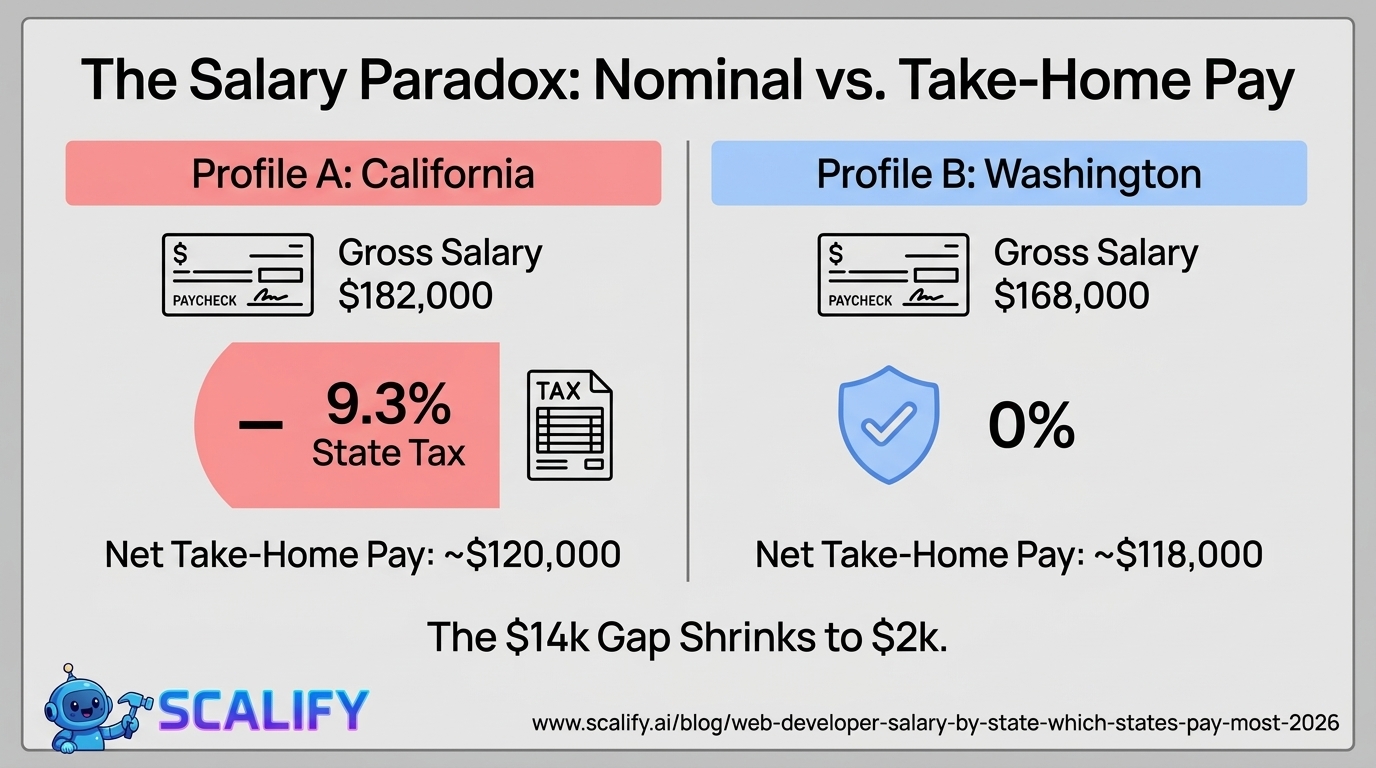
Washington State combines the highest nominal tech salaries in the nation (driven by Amazon and Microsoft headquarters in Seattle, and the downstream effect on all tech salaries in the region) with zero state income tax. A senior web developer earning $168,000 in Seattle keeps approximately $118,000 after federal taxes — compared to a comparable California developer earning $182,000 who keeps approximately $120,000 after California's top-bracket state income tax. The difference in take-home income between Seattle and San Francisco is now only $2,000 annually despite a $14,000 difference in gross salary. When Seattle's lower housing costs vs. San Francisco's are factored in, Seattle's developer market provides genuinely better financial outcomes for most senior developers despite nominally lower salaries.
The No-Income-Tax State Advantage: The Numbers
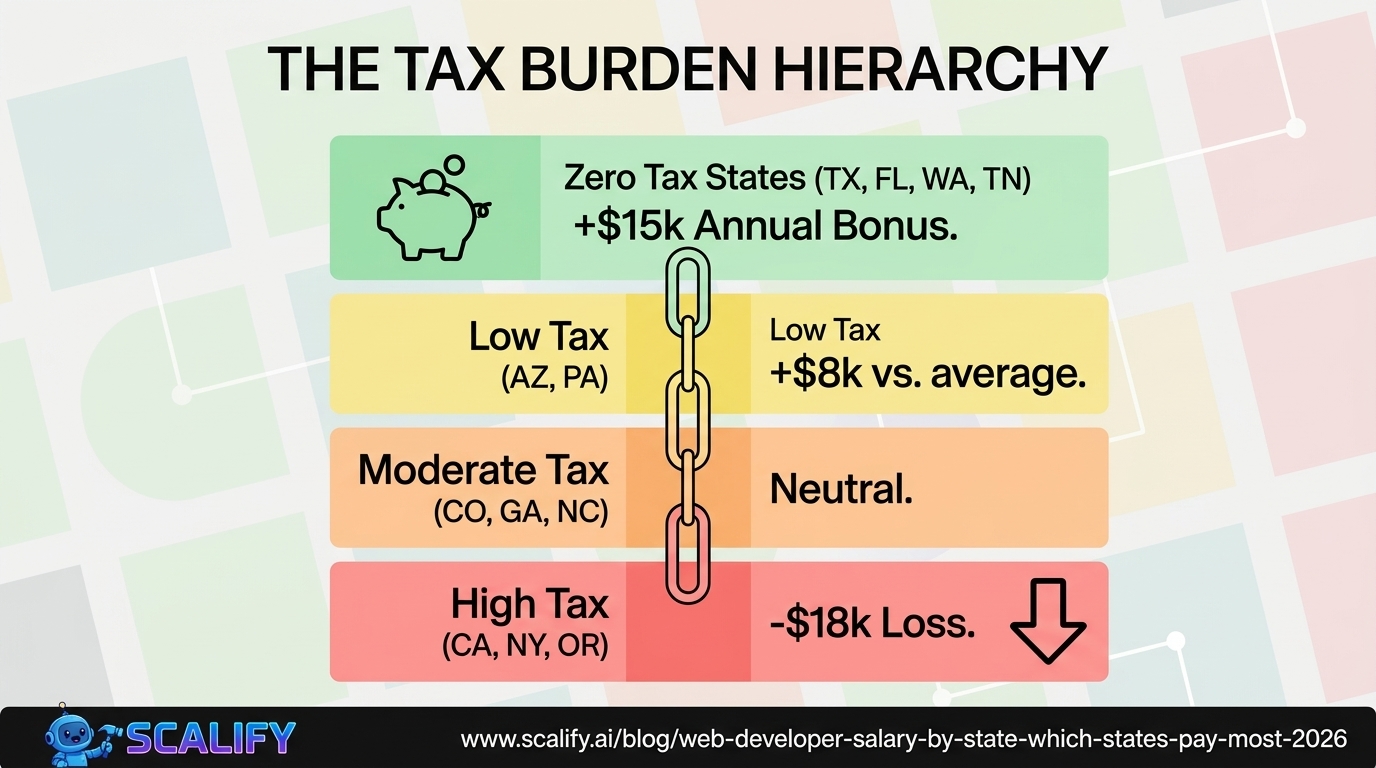
State Tax StatusStatesEffective Annual Bonus vs. 5% State Tax StateNo income taxTX, FL, WA, TN, NV, WY, SD, AK, NH (dividends only)+$5,000–$15,000 at senior salary levelsLow income tax (under 3%)AZ (2.5%), PA (3.07%), IN (3.05%)+$3,000–$8,000 vs. 5% statesModerate income tax (3–6%)CO, GA, NC, MI, OH, MONear neutral vs. averageHigh income tax (6%+)CA, NY, OR, MN, NJ-$8,000–$18,000 vs. no-tax states
States With the Fastest Growing Tech Markets
Texas (Austin, Dallas, Houston): Texas's tech market has grown faster than any other major state since 2020, driven by corporate relocations from California (Tesla, Oracle, HP Enterprise, Charles Schwab), the established University of Texas pipeline into Austin's growing startup ecosystem, and zero state income tax that attracts engineers relocating from California. Austin's developer salaries grew 39% from 2020 to 2026 and continue rising as demand outpaces local supply.
Florida (Miami, Tampa, Orlando): Florida's tech sector has grown rapidly since 2020 driven by migration from the Northeast and West Coast, a business-friendly regulatory environment, and zero state income tax. Miami in particular has attracted fintech companies (Pipe, Relay, Nuvei), real estate technology firms, and a growing startup ecosystem. Developer salaries have grown 35% since 2020.
Colorado (Denver, Boulder): Denver has emerged as one of the strongest secondary tech markets in the US, with a growing presence of cybersecurity companies, aerospace technology, and cloud computing firms. Boulder's startup ecosystem (driven by CU Boulder's engineering program) continues producing both companies and talent. Developer salaries grew 28% from 2020 to 2026.
North Carolina (Research Triangle): The Research Triangle — Raleigh, Durham, and Chapel Hill — has one of the most rapidly growing tech job markets in the US, driven by university talent (Duke, UNC, NC State), healthcare technology concentration, and affordable housing relative to coastal markets. Remote developers in Research Triangle working for coastal companies at coastal rates effectively earn 25–30% more in purchasing power than equivalent developers in San Francisco.
The Bottom Line
California pays the highest nominal web developer salaries but also has the highest state income tax and cost of living. Washington State (Seattle) provides the best combination of high salaries and zero income tax. Texas and Florida offer competitive salaries with zero income tax and lower cost of living than major tech hubs — producing top-tier purchasing power. For developers prioritizing financial outcomes, the optimal strategy is working for a location-agnostic US company at national rates while living in a zero-income-tax state with below-average cost of living — the combination produces financial quality of life that exceeds any single high-salary market.
At Scalify, we build professional websites for technology companies and developers across every US state — delivering in 10 business days wherever our clients are located.
Top 5 Sources
Remote Work and State Tax: The Critical Rules Every Developer Must Know
Remote work has created complex multi-state tax situations that many developers don't fully understand. The most important rules:
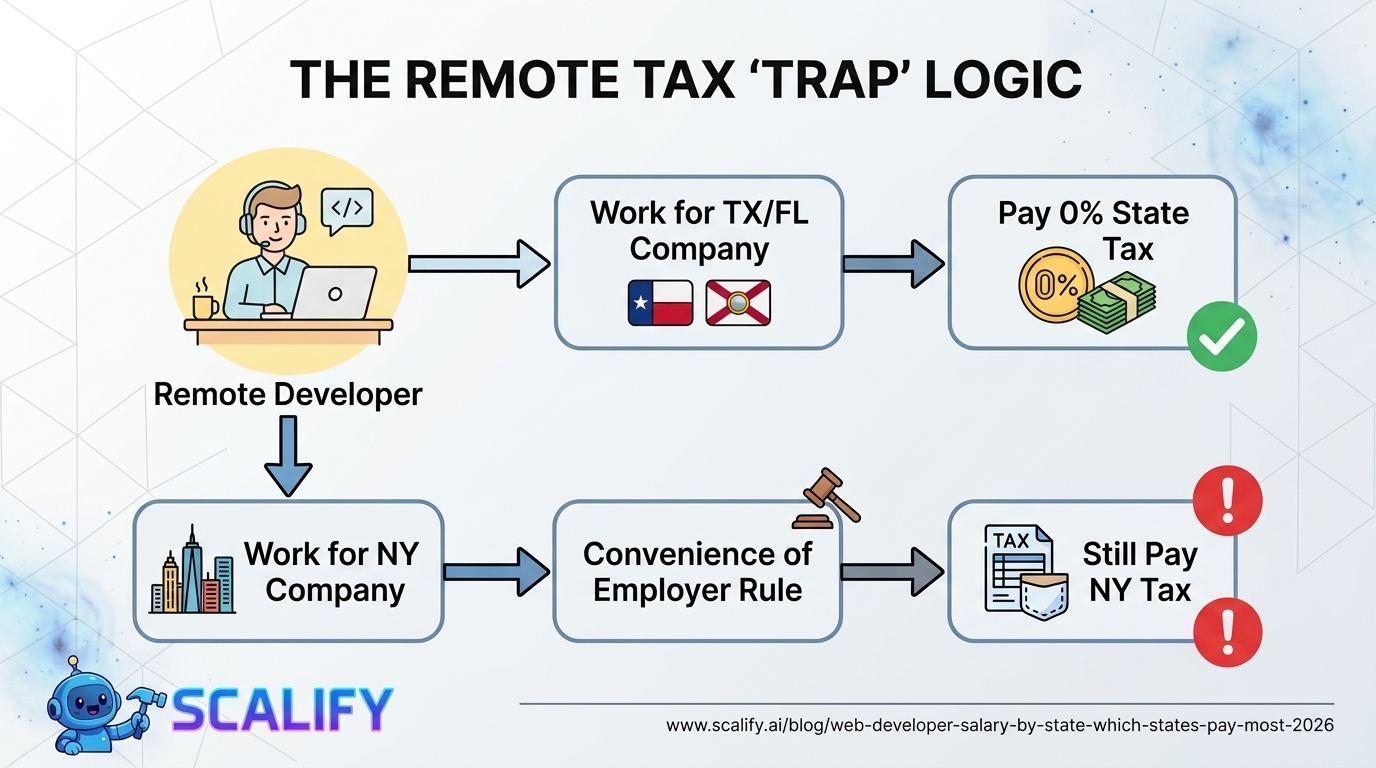
You pay income tax where you live, not where your employer is headquartered. If you live in Texas and work remotely for a California company, you pay zero state income tax — not California's 9.3%. California can only tax income earned while physically in California.
Exception: New York's "Convenience of Employer" rule. New York State taxes all income of non-NY residents working for NY-based employers if the employee works remotely for their own convenience rather than because the employer requires it. This rule has been upheld in court and means that a developer living in Florida working remotely for a Manhattan company may still owe New York state income tax on their full salary — wiping out Florida's tax advantage entirely. If your employer is based in New York and you're working remotely, consult a tax professional about whether the convenience rule applies to your situation.
Temporary presence rules. Most states have a threshold — typically 30 days — before requiring income tax filing for non-residents working in the state. Developers who travel to their employer's office occasionally generally don't create a tax obligation below this threshold, but exceeding it can trigger multi-state filing requirements.
Cost of Living Adjusted Salary: What Your Pay Actually Buys
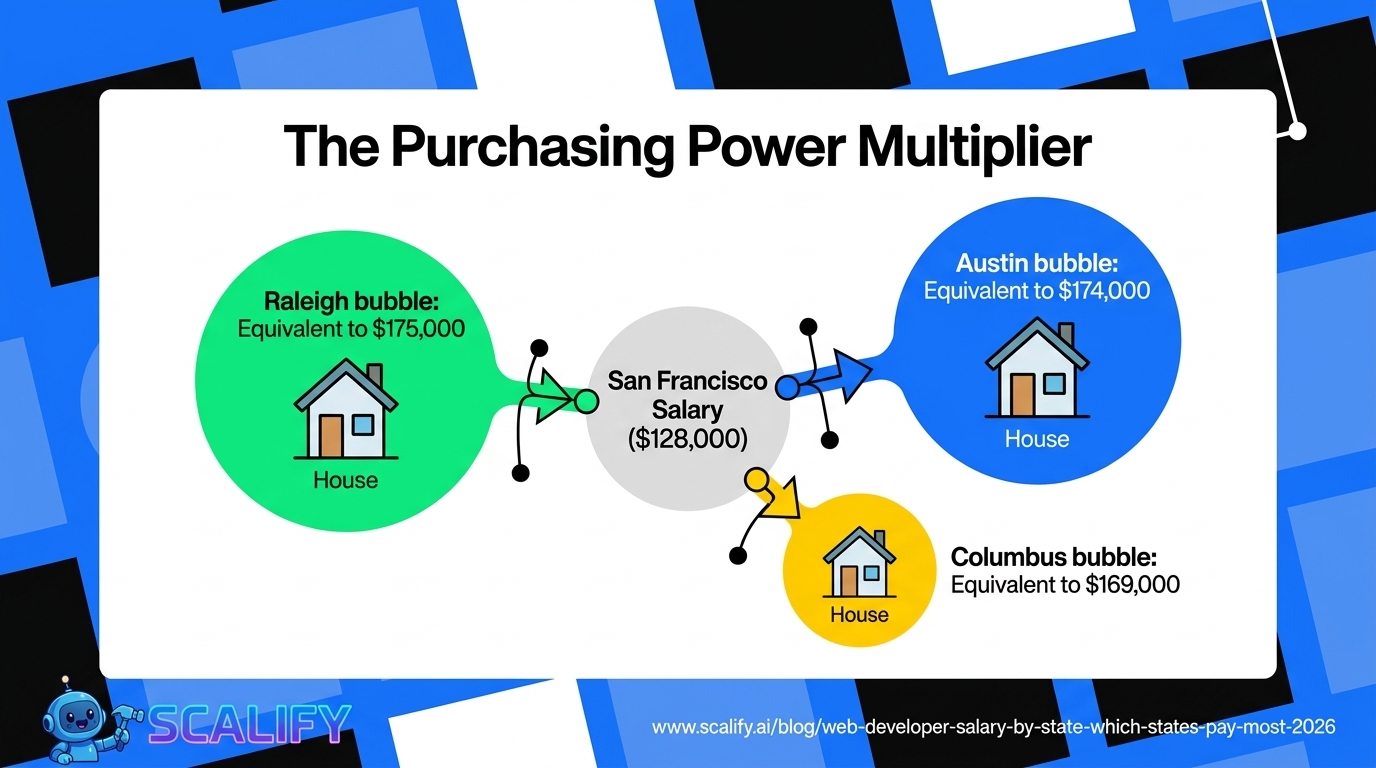
The MIT Living Wage Calculator and Numbeo's cost of living data make it possible to compare what equivalent salaries buy in different states. A mid-level developer salary of $95,000 in Columbus, Ohio buys roughly the same standard of living as $145,000 in San Francisco — because housing, transportation, food, and services cost approximately 53% less. This cost-of-living adjustment is why many developers who leave high-cost coastal markets for secondary markets report feeling meaningfully wealthier despite nominal salary reductions.
CityMid-Level Dev SalaryCOL Index (SF=100)Purchasing Power EquivalentSan Francisco$128,000100$128,000 baselineSeattle$122,00078~$156,000 SF equivalentAustin$108,00062~$174,000 SF equivalentDenver$108,00068~$159,000 SF equivalentRaleigh$98,00056~$175,000 SF equivalentColumbus$88,00052~$169,000 SF equivalentMiami$95,00061~$156,000 SF equivalent
The purchasing power analysis reveals that Raleigh and Columbus — despite nominal salaries 23–31% below San Francisco — provide equivalent or better financial quality of life due to dramatically lower cost of living. These markets have become increasingly attractive to web developers making geographic career decisions, and their tech sectors are growing as a result of that attractiveness.
How State Tax Affects Freelance Developers
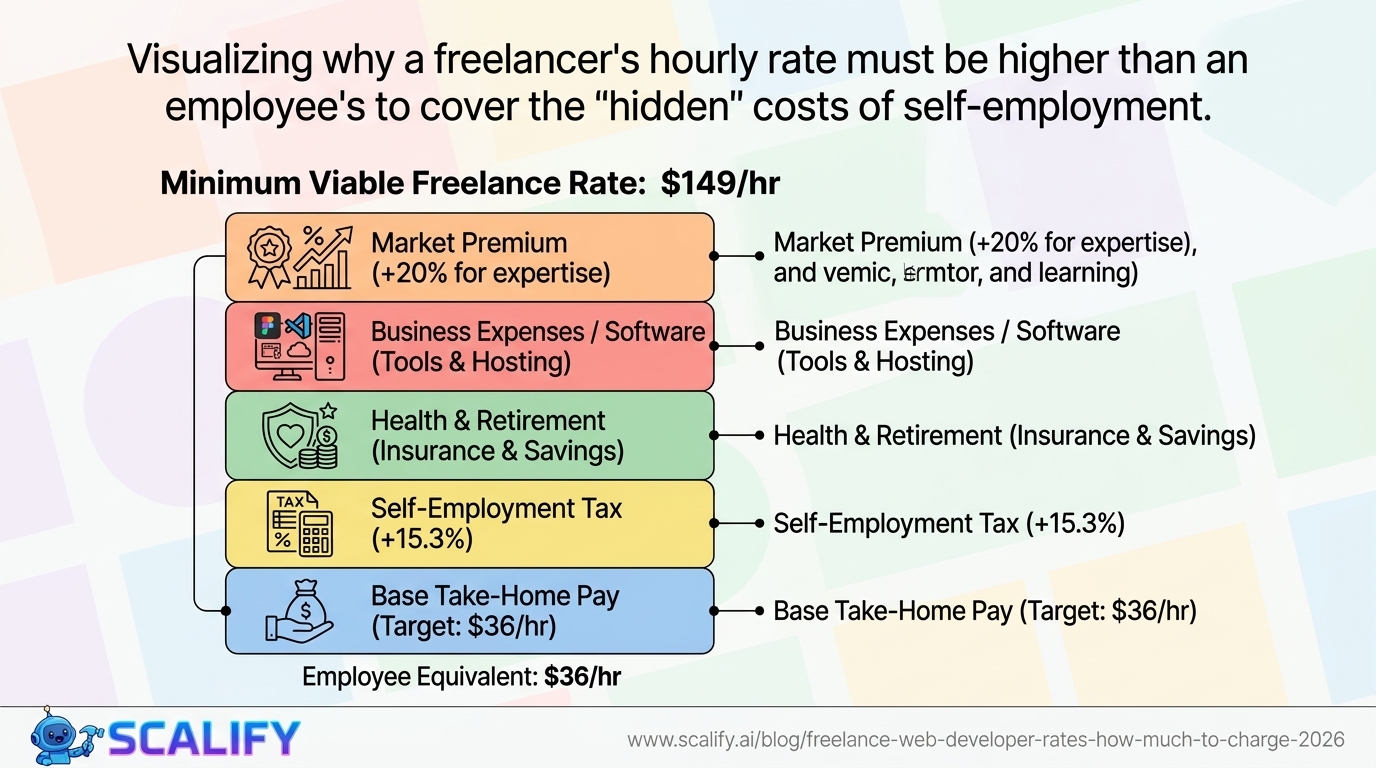
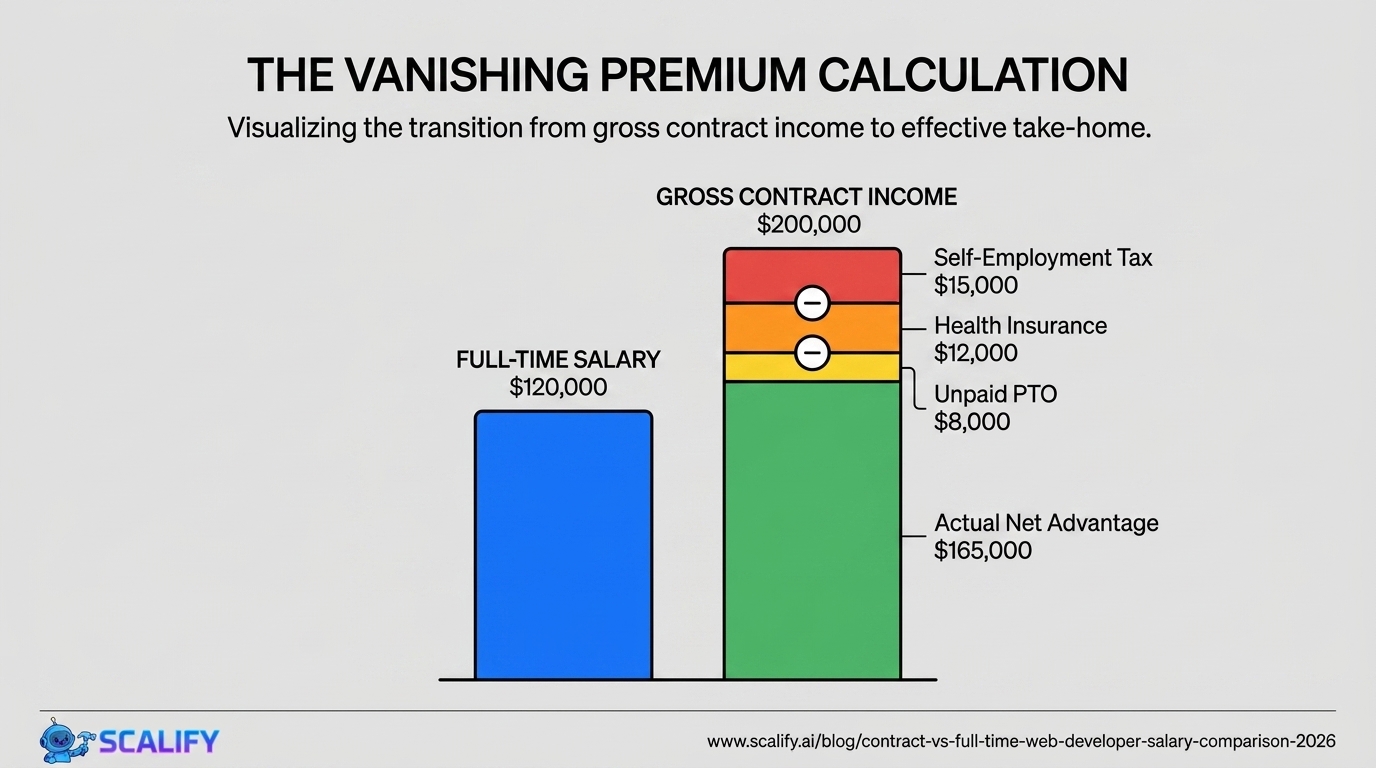
Freelance web developers are generally free to live in any state they choose — and for freelancers, living in a no-income-tax state is a straightforward financial optimization. A freelance developer billing $150/hour who works 1,500 billable hours per year earns $225,000 in gross income. In California, that developer pays approximately $17,000–$21,000 in state income tax. In Texas or Florida, that developer pays zero state income tax — a direct annual savings of $17,000–$21,000 with no trade-off other than geography. For freelancers who are location-independent, the no-income-tax state advantage is one of the most straightforward financial optimizations available.
Emerging Tech Hubs: Where Salaries Are Growing Fastest
Beyond the established major tech markets, several secondary cities have emerged as high-growth opportunities for web developers who want above-average salaries without the extreme cost-of-living of San Francisco or New York:
Salt Lake City, Utah has quietly become one of the strongest tech markets in the western US — nicknamed "Silicon Slopes." Major employers include Pluralsight, Qualtrics, Adobe's large engineering office, and a growing startup ecosystem. State income tax is 4.65% (moderate), housing costs are significantly below coastal markets, and the outdoor recreation culture attracts quality-of-life-conscious engineers. Senior developer salaries average $132,000–$155,000 — strong for the cost of living.
Pittsburgh, Pennsylvania has leveraged Carnegie Mellon University's world-class computer science program into a growing robotics and AI tech cluster. Google, Uber (autonomous vehicles), and Amazon all have significant engineering presence. Developer salaries average $95,000–$130,000 for senior roles with housing costs among the lowest of any major tech market in the US.
Kansas City, Missouri/Kansas is an emerging market for financial technology and healthcare technology, with a cost of living that makes even relatively modest developer salaries ($85,000–$115,000) stretch further than equivalent purchasing power in coastal markets.
For developers willing to trade coastal prestige for financial quality of life, these emerging markets offer something increasingly rare: competitive developer salaries with affordable housing, reasonable commutes, and established communities — without the extreme competition for talent that makes career development harder in already-saturated major tech hubs.
Making the Geographic Decision: A Framework
When evaluating whether a geographic move makes financial sense, use this framework: calculate the after-tax, after-housing-cost monthly income in each location (not just gross salary), factor in career development quality (some markets have richer ecosystems for certain specializations), consider lifestyle preferences honestly (some people thrive in dense urban environments; others prefer space and outdoor access), and model the 5-year financial outcome rather than just the first year. A move that looks neutral in year one often looks significantly positive in year five as the geographic compound effects — lower housing costs building equity faster, lower taxes compounding in investment accounts, lower cost of living enabling higher savings rates — accumulate.











.jpeg)

.jpeg)







78 SW 7th St, Miami, FL 33130