

Top 10 Highest-Paying Web Development Skills in 2026
By Josh Ternyak

April 20, 2026
The top 10 highest-paying web dev skills in 2026 command $20,000-55,000 premiums. This comprehensive guide covers each skill in depth: AI/LLM integration ($165-215k), DevOps/Platform ($148-195k), TypeScript expert, application security, WebAssembly, performance engineering, real-time systems, accessibility, Web3, and Rust. Includes salary table, learning paths, portfolio evidence strategies, and certification guide.
Top 10 Highest-Paying Web Development Skills in 2026
Web development skills are not valued equally — the difference between a developer with commodity skills and one with in-demand specializations can be $40,000–$80,000 in annual salary at equivalent experience levels. In 2026, certain skills command extraordinary premiums because they address problems that are either technically complex, commercially critical, or both. Understanding which skills drive the highest compensation — and investing deliberately in developing them — is one of the highest-ROI career investments available to web developers at any level.
The Top 10 Highest-Paying Web Development Skills
1. AI/LLM Integration Engineering
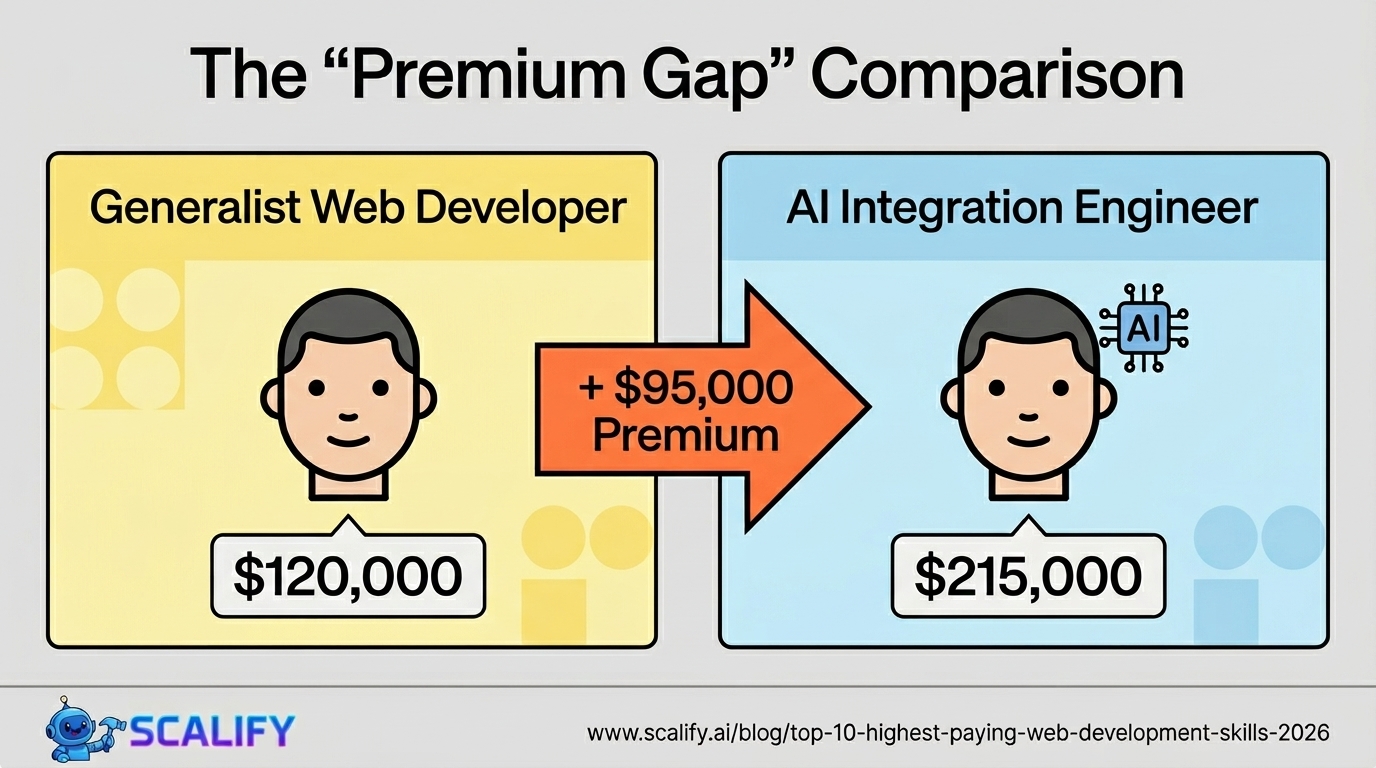
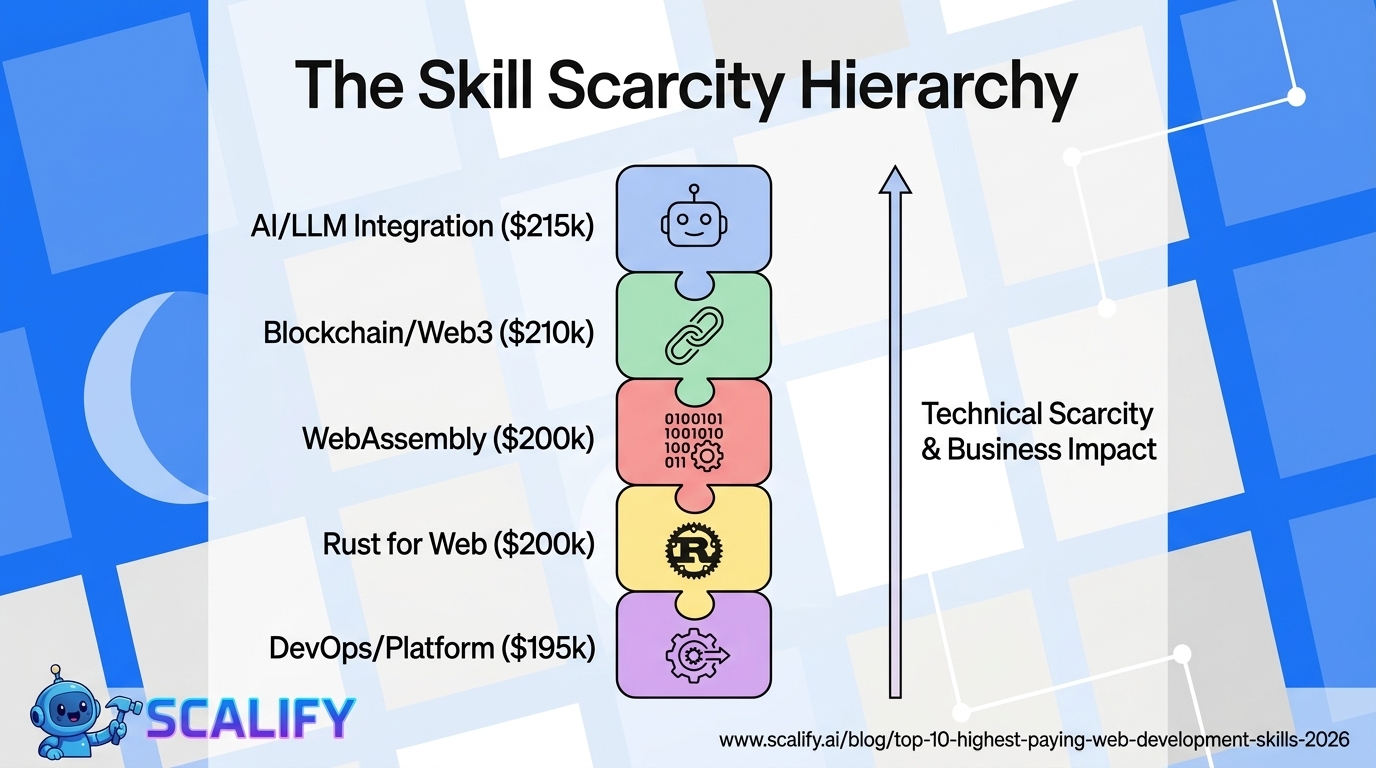
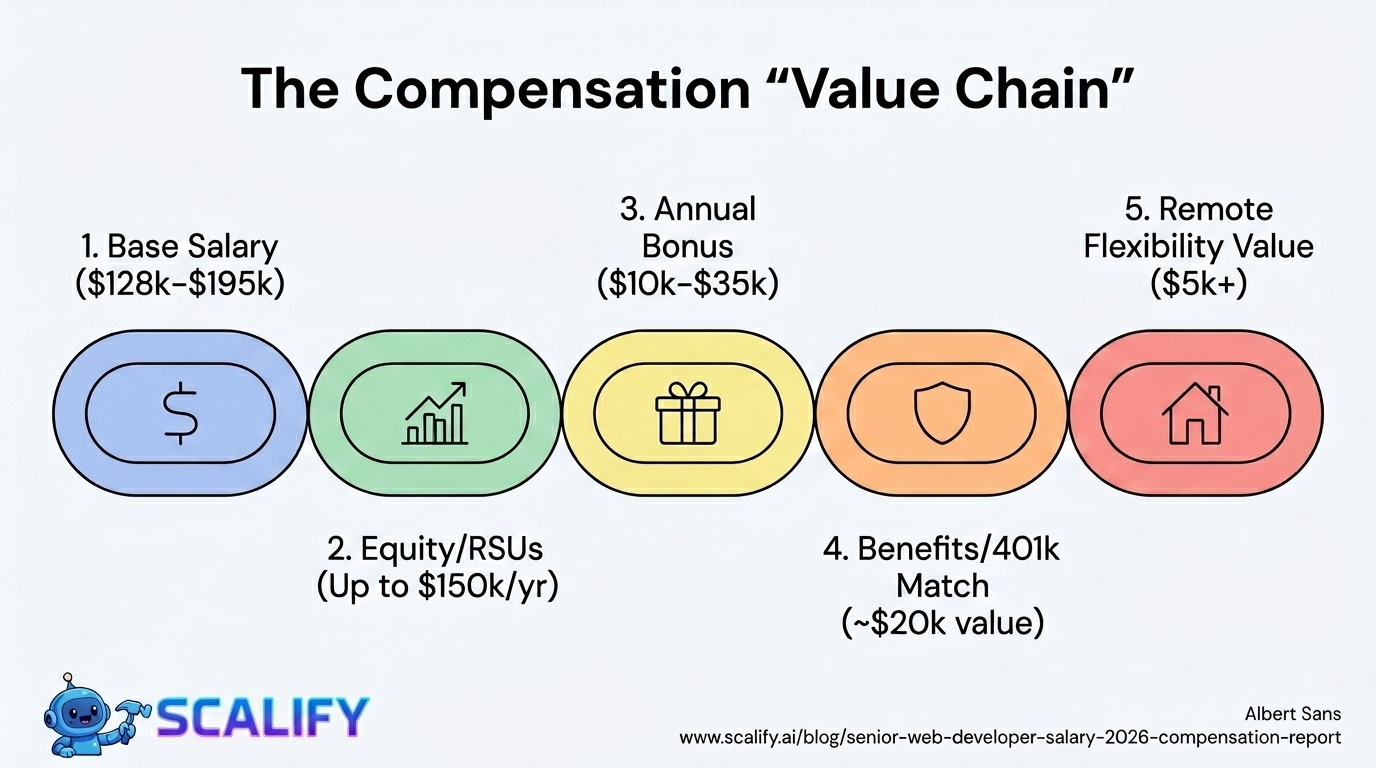
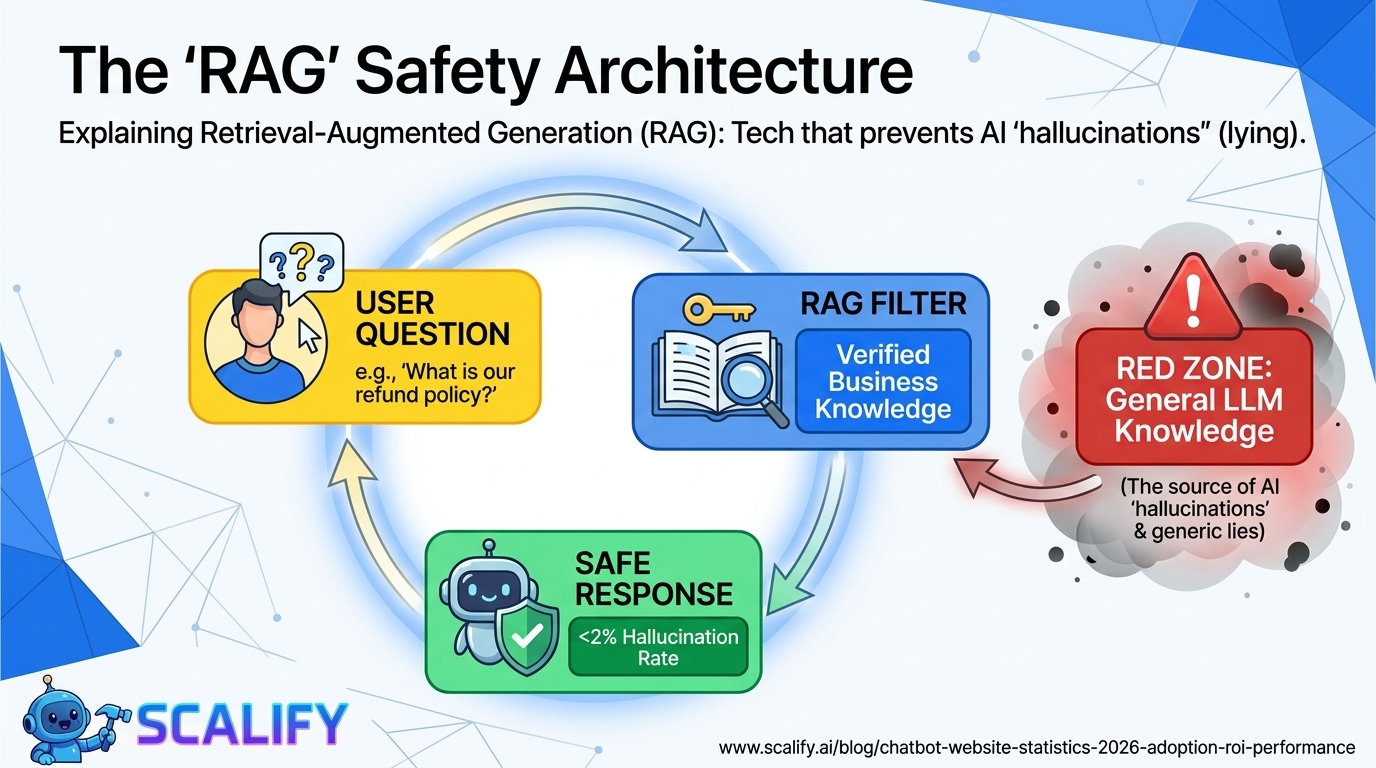
The skill commanding the largest salary premium in 2026 — developers who can build applications powered by Large Language Models (GPT-4, Claude, Gemini) are in extraordinary demand and extremely short supply. AI integration engineering involves: designing and implementing RAG (Retrieval-Augmented Generation) systems, building streaming UI for AI responses, managing context windows and token optimization, implementing function calling and tool use, building AI agent workflows, and evaluating model outputs for accuracy and safety. Salaries range from $165,000 to $215,000 for senior-level AI integration engineers — $30,000–$50,000 above equivalent traditional web developers.
2. DevOps and Platform Engineering
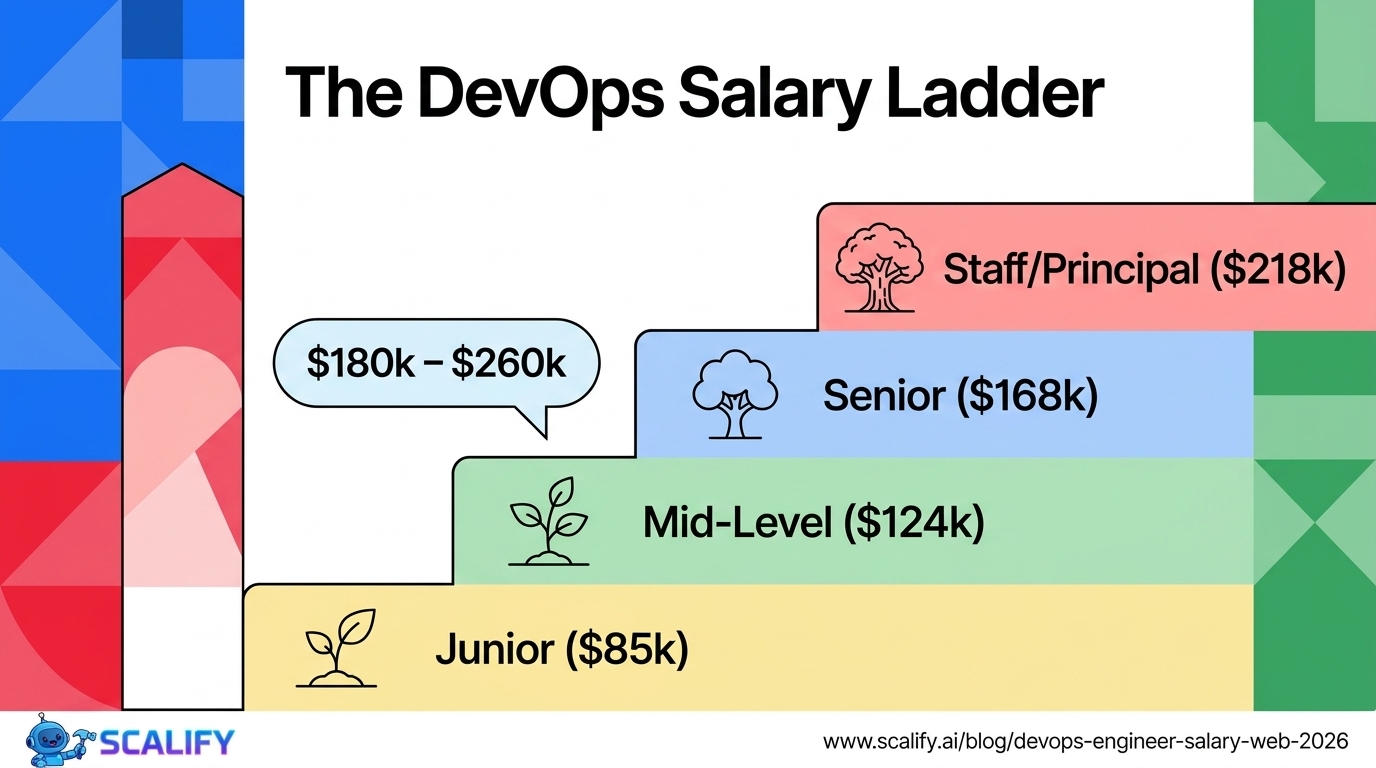
Developers who can build and maintain the infrastructure that production applications run on — Kubernetes clusters, CI/CD pipelines, cloud cost optimization, monitoring and observability systems, security hardening — command salaries of $148,000–$195,000 at senior level. The scarcity of developers who are equally comfortable writing application code and configuring production infrastructure creates a premium that pure software engineers or pure infrastructure engineers don't command individually. This skill combination is sometimes called "full-stack DevOps" or platform engineering.
3. TypeScript Expert (React + Node)
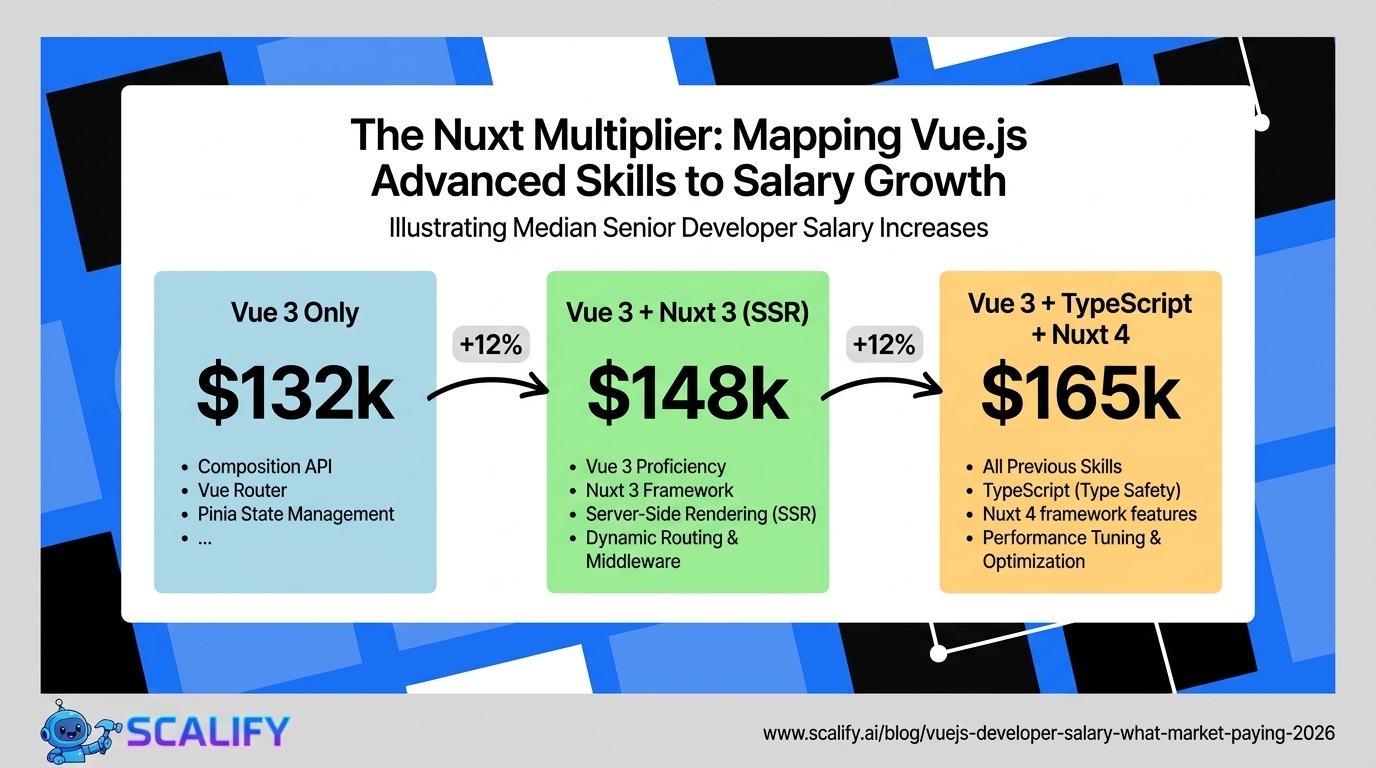
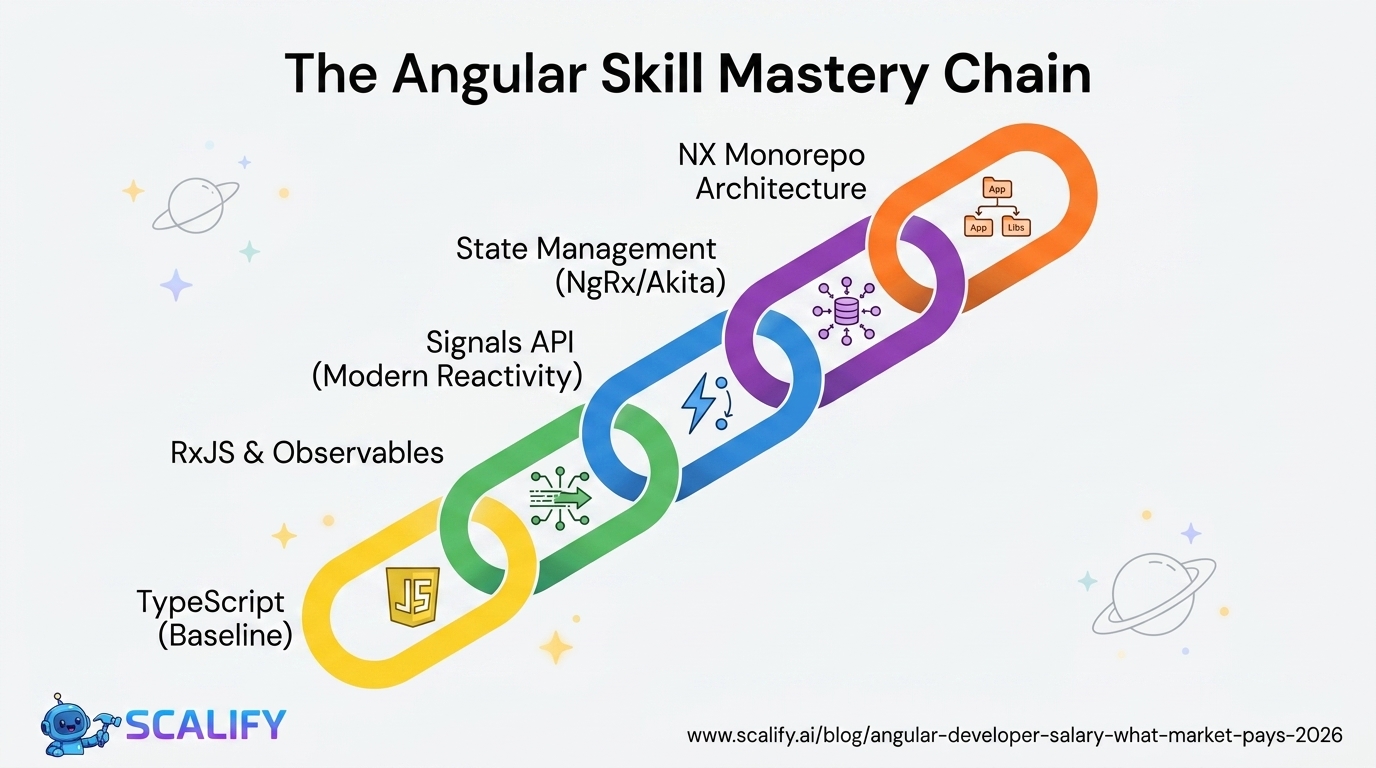
TypeScript proficiency throughout the stack — React components with proper generic types, Node.js APIs with full type safety, shared type definitions between front and back end — commands $12,000–$20,000 over JavaScript-only developers. The premium reflects both genuine skill differentiation (TypeScript is harder to master than JavaScript, and many developers have surface TypeScript knowledge without genuine expertise) and market demand (78% of React job postings at serious companies require TypeScript). TypeScript expert compensation at senior level: $145,000–$185,000.
4. Cybersecurity / Application Security
Web application security — penetration testing, secure code review, OAuth/OIDC implementation, OWASP vulnerability remediation, security architecture — commands a substantial premium because the consequences of getting it wrong are severe and security expertise is genuinely rare among web developers. Application security specialists earn $145,000–$195,000 at senior level. Security-focused web development encompasses: implementing authentication systems correctly, securing APIs against injection and authorization attacks, managing secrets and credentials safely, and auditing codebases for vulnerabilities. The healthcare, finance, and government sectors pay the highest security premiums.
5. WebAssembly (Wasm)
WebAssembly allows near-native performance in the browser for computationally intensive applications — image processing, video encoding, game engines, scientific simulations, and complex data visualization. Developers with genuine Wasm expertise (including Rust or C++ for Wasm compilation targets, browser memory management, and Worker thread integration) are extremely rare and command $150,000–$200,000 at senior level. Wasm is growing in importance as browser applications take on increasingly complex workloads previously requiring native applications.
6. Performance Engineering
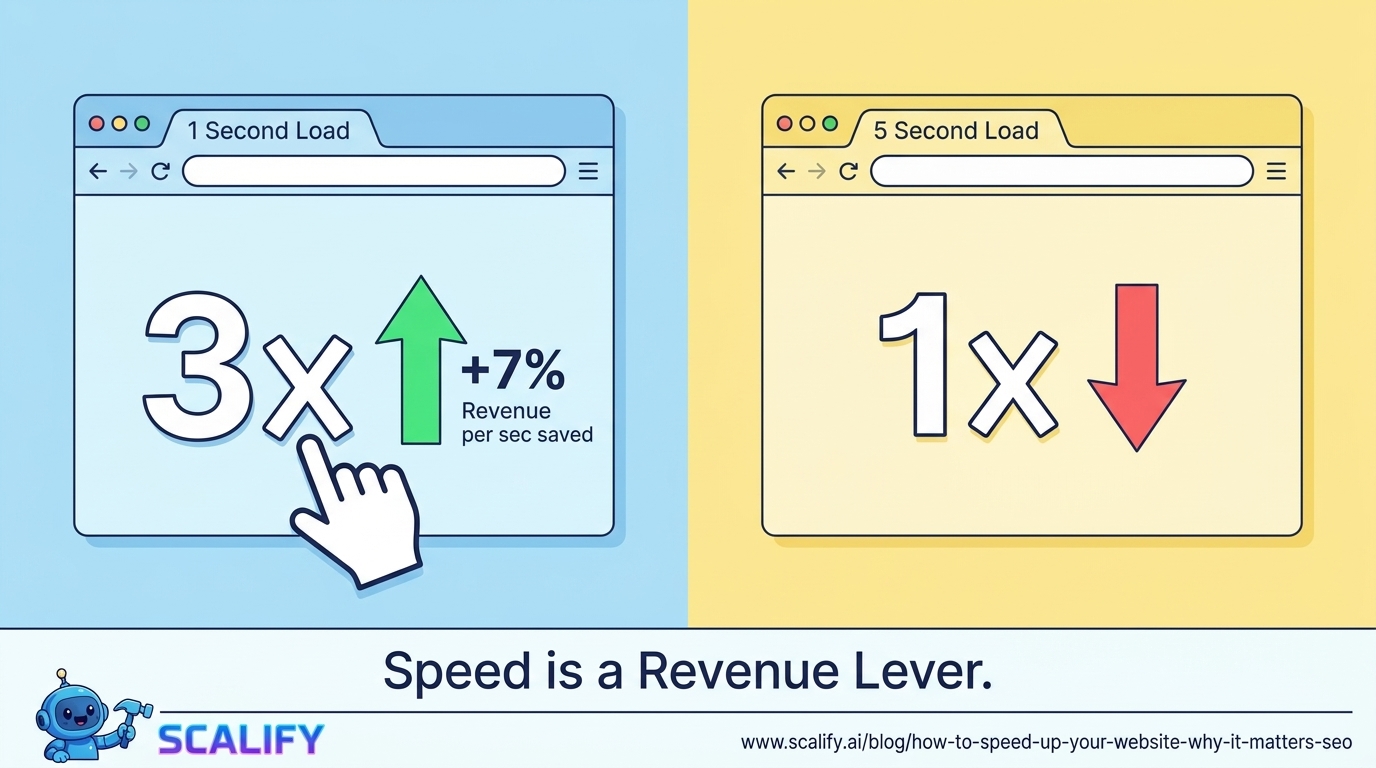
Web performance engineering — Core Web Vitals optimization, bundle size reduction, critical rendering path optimization, database query optimization, API response time improvement — commands a premium because performance has direct, measurable revenue impact. A developer who takes a site from failing Core Web Vitals to passing, or reduces API p95 latency from 800ms to 200ms, is delivering quantifiable business value. Senior performance engineers earn $145,000–$190,000. The skill requires depth across both front-end (browser rendering, JavaScript execution, image optimization) and back-end (database, caching, CDN) — making it a natural fit for experienced full-stack developers.
7. Real-Time Systems (WebSockets, WebRTC)
Developers who can build real-time systems — multiplayer games, collaborative editing, live chat, video conferencing, real-time analytics dashboards — with WebSockets, WebRTC, or server-sent events have a specialization that most web developers lack. Real-time system architecture requires understanding of connection management at scale, message delivery guarantees, conflict resolution in collaborative editing, NAT traversal for P2P connections, and the infrastructure to support thousands of concurrent WebSocket connections. Senior real-time systems developers earn $148,000–$195,000.
8. Accessibility Engineering
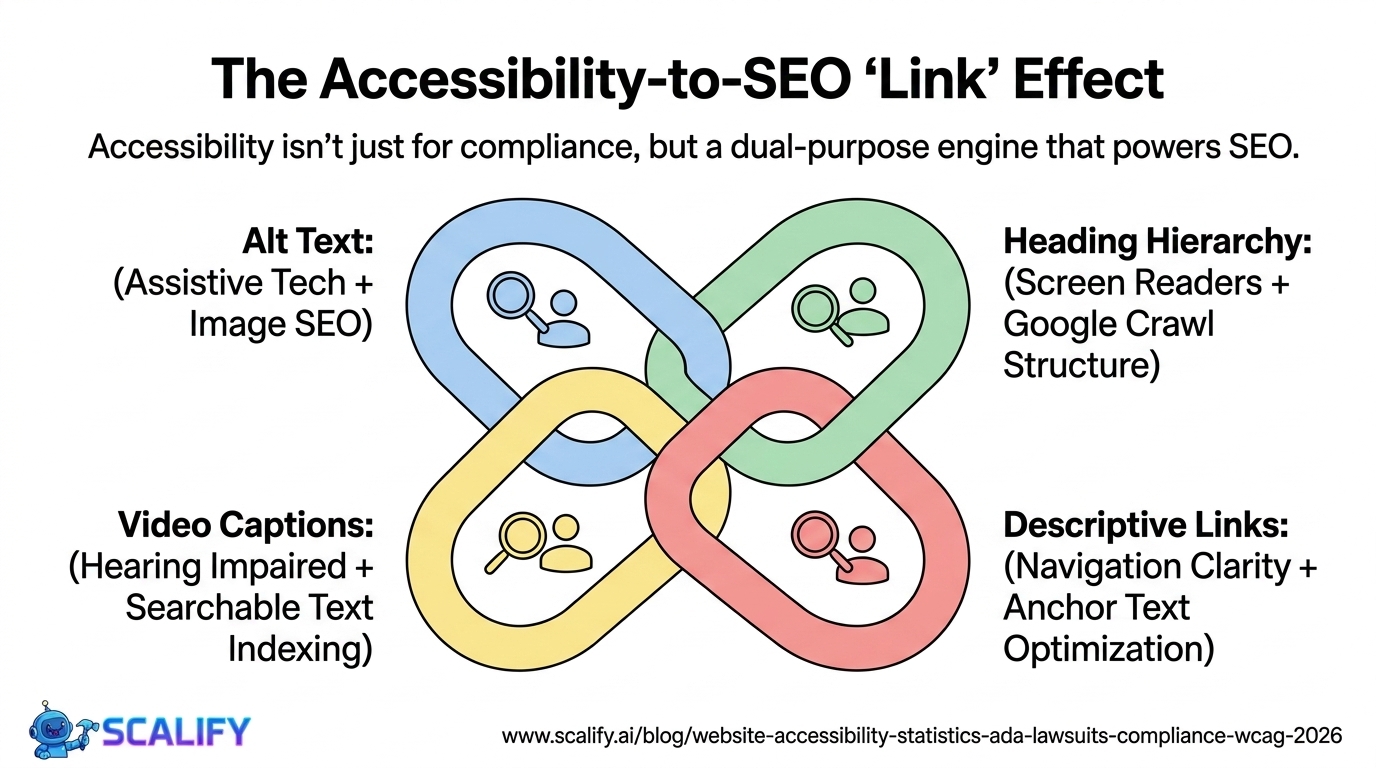
Web accessibility — WCAG compliance, ARIA implementation, screen reader optimization, keyboard navigation, and inclusive design — is both a legal requirement in many jurisdictions and a growing quality expectation. Developers with genuine accessibility expertise command $130,000–$175,000 at senior level. The skill is rarer than most developers realize: many teams have minimal accessibility knowledge, creating demand for specialists who can audit codebases, implement compliant components, and train teams on accessibility best practices. Government, healthcare, and financial services sectors pay the highest accessibility premiums due to regulatory requirements.
9. Blockchain/Web3 Development
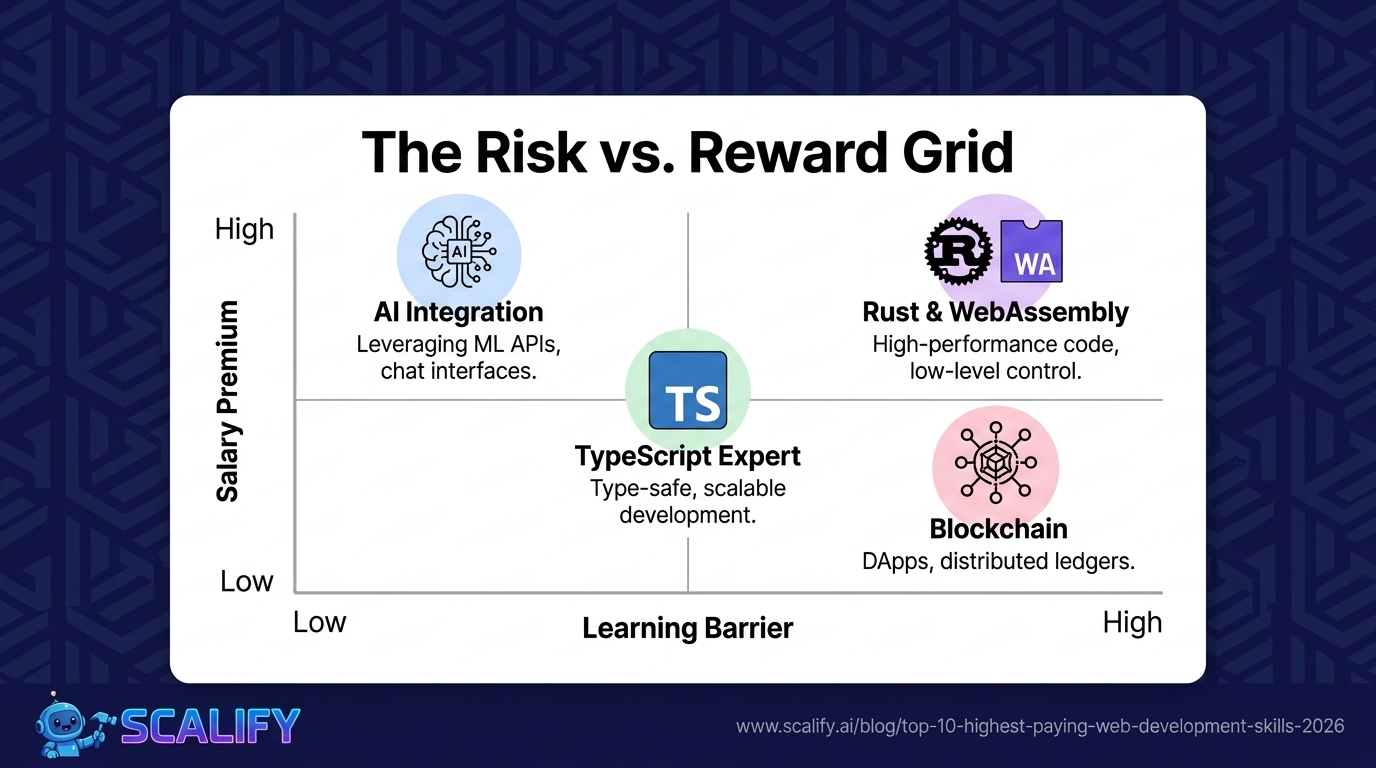
Smart contract development (Solidity, Rust for Solana), decentralized application (dApp) development, and Web3 integration remain niche but high-paying skills for developers who believe in the use cases. Senior Web3 developers in active markets earn $155,000–$210,000 — above market for general web development. The market is volatile (tied to crypto market cycles) and more specialized than most skills on this list, making it high-risk/high-reward as a specialization choice.
10. Rust for Web Development
Rust's adoption for web-adjacent use cases — WebAssembly compilation targets, high-performance APIs, systems programming that interfaces with web services, and increasingly web frameworks like Actix and Axum — is creating demand for Rust-capable web developers who command $145,000–$200,000. Rust's steep learning curve makes genuine Rust expertise genuinely scarce, and its performance and safety characteristics make it ideal for performance-critical web infrastructure that Python, Node.js, or Go can't match. The skill has the highest learning barrier of any on this list and the most specific applicability — but the compensation ceiling is very high for developers who achieve genuine proficiency.
Salary Summary Table
SkillSenior Salary RangePremium vs. General Web DevDemand TrendAI/LLM Integration$165,000 – $215,000+$30,000 – $50,000⬆️ Very High GrowthDevOps / Platform Engineering$148,000 – $195,000+$20,000 – $40,000⬆️ High GrowthTypeScript Expert (React+Node)$145,000 – $185,000+$12,000 – $20,000⬆️ GrowingApplication Security$145,000 – $195,000+$20,000 – $40,000➡️ Stable High DemandWebAssembly (Wasm)$150,000 – $200,000+$25,000 – $45,000⬆️ GrowingPerformance Engineering$145,000 – $190,000+$20,000 – $35,000➡️ Stable High DemandReal-Time Systems$148,000 – $195,000+$20,000 – $40,000➡️ Stable GrowingAccessibility Engineering$130,000 – $175,000+$10,000 – $25,000⬆️ Growing (regulatory)Blockchain/Web3$155,000 – $210,000+$25,000 – $55,000⬇️ Cyclical/VolatileRust for Web$145,000 – $200,000+$20,000 – $45,000⬆️ Growing
How to Develop Premium Skills: A Learning Path
Most premium skills share a learning pattern: start with the fundamentals of your current stack, identify adjacent high-value skills that build on your existing knowledge, invest 6–12 months of deliberate learning and project work to reach proficiency, and build visible portfolio evidence of the skill before marketing it.
For AI/LLM integration: Start with the OpenAI or Anthropic API documentation → build a simple chatbot application → expand to RAG (retrieval-augmented generation) with a vector database → build a streaming UI → deploy a production-grade AI application. The full path from zero to employable AI integration takes 3–6 months for an experienced web developer.
For TypeScript expertise: Add TypeScript to an existing JavaScript project → study advanced TypeScript patterns (conditional types, mapped types, template literal types) → implement generic components and utility types → contribute to a TypeScript open-source project. This path takes 2–4 months for a JavaScript developer.
For performance engineering: Take a website through the full Core Web Vitals optimization process → profile and optimize a Node.js API → study browser rendering mechanics and bundle optimization → build a lighthouse score improvement case study with measurable results. Documenting the before/after of a real performance project is the most compelling portfolio piece for this specialization.
The Generalist vs. Specialist Decision Revisited
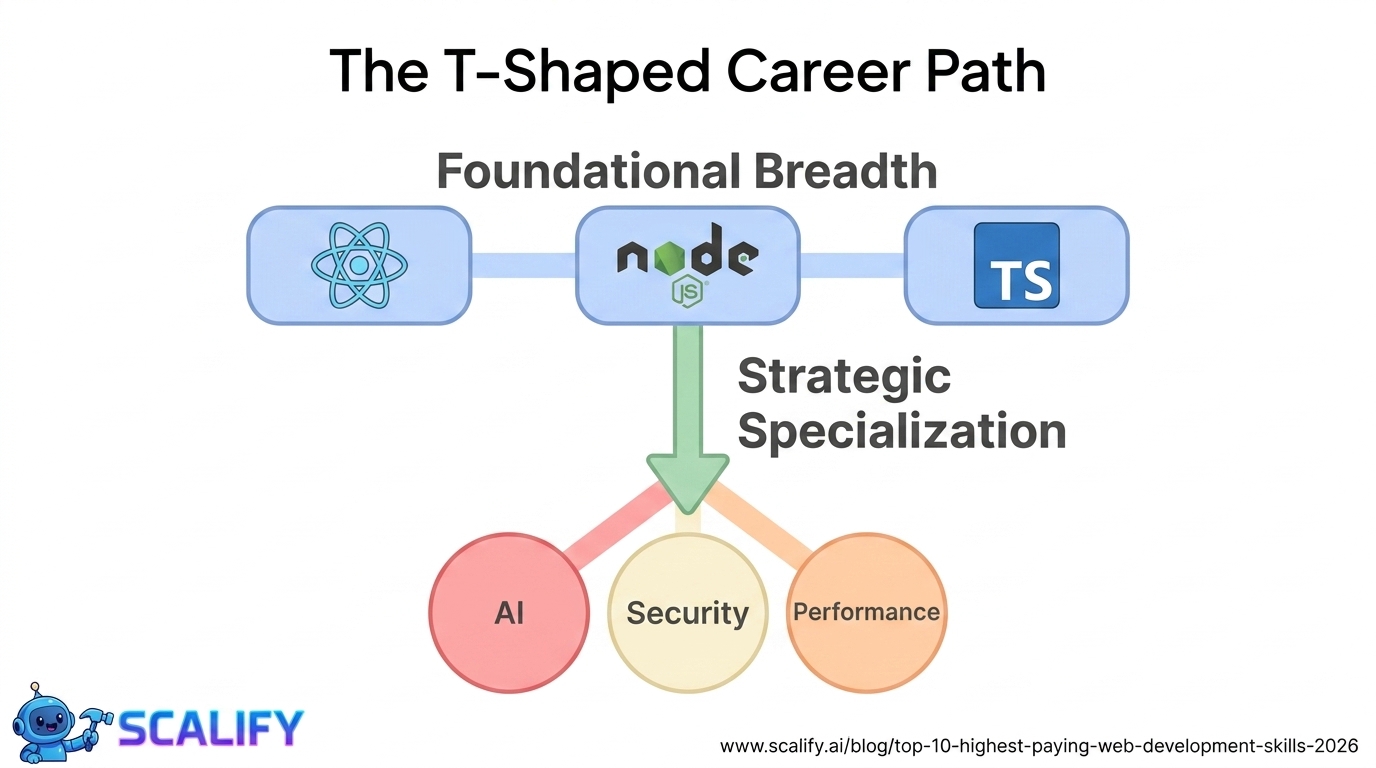
The conventional wisdom is that specialists earn more than generalists — and the data supports this at senior and expert levels. But the path matters: developers who specialize too early (before building foundational breadth) often find their specialization limits their optionality when markets shift. The optimal path for most developers is breadth first (full-stack React/Node.js, TypeScript), then depth in one high-value adjacent area (AI integration, DevOps, security, performance). This produces a developer who is both versatile enough to be genuinely useful across a wide range of engineering problems and specialized enough in at least one area to command a meaningful premium.
The Bottom Line
The highest-paying web development skills in 2026 — AI/LLM integration, DevOps, TypeScript expertise, application security, WebAssembly, performance engineering, and real-time systems — command $20,000–$55,000 premiums over equivalent general web development roles. These premiums reflect genuine skill scarcity: these areas are either technically demanding, require deep expertise in adjacent domains (infrastructure, security, systems programming), or address problems that have immediate, quantifiable business impact. Investing deliberately in one of these specializations — 6–12 months of focused learning and portfolio-building — represents one of the highest-ROI career investments available to any mid-level or senior web developer.
At Scalify, we work with developers across all specializations — building professional websites in 10 business days that give every engineer a polished digital presence to match their technical expertise.
Top 5 Sources
Building Portfolio Evidence for Premium Skills
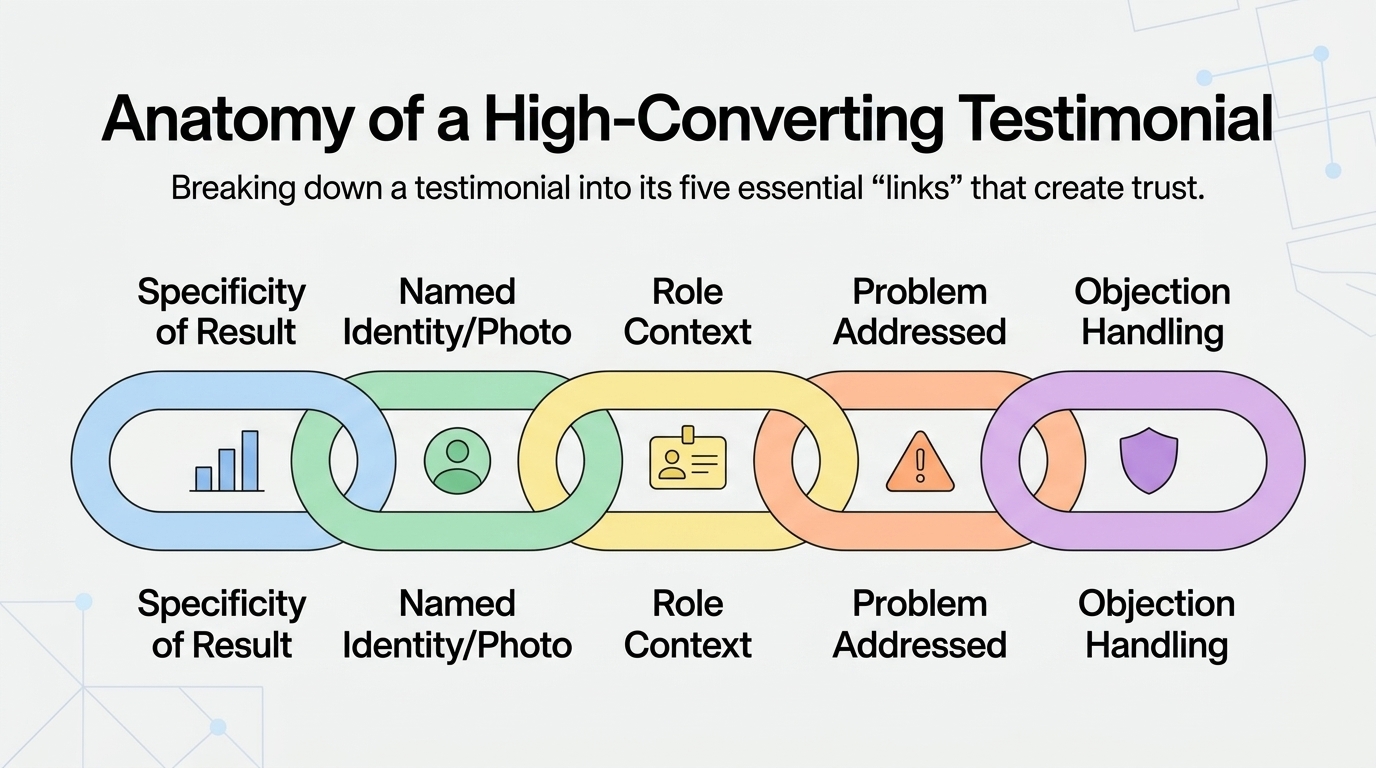
The challenge with premium skill specializations is that many developers have surface knowledge but lack the portfolio evidence that demonstrates genuine expertise to hiring managers. A developer who says "I know TypeScript" is indistinguishable from a developer who truly knows TypeScript advanced patterns without portfolio evidence. The solution: build projects that require genuine skill application and document them thoroughly.
High-signal portfolio projects for premium skills:
The AI Integration Premium: Why It's Different
The AI/LLM integration premium deserves special discussion because it's the fastest-growing specialization and the one where the skill gap between supply and demand is currently widest. The practical skills that command the premium are not "using ChatGPT" — every developer and non-developer can do that. The premium is for developers who can: design and implement the infrastructure that makes AI applications reliable and maintainable in production, optimize prompts and system instructions systematically using evaluation frameworks, implement context management strategies for applications where conversation history matters, build retrieval systems that make AI responses accurate for domain-specific knowledge bases, and handle the specific failure modes of LLM-powered applications (hallucinations, context window limitations, latency, cost management).
These engineering skills require depth in both the AI domain (understanding how LLMs work, their limitations, and the current best practices for working with them) and traditional software engineering (state management, API design, error handling, testing). The combination is genuinely rare in 2026 — most AI researchers aren't strong software engineers, and most software engineers haven't invested in AI-specific skills. The $30,000–$50,000 premium reflects this genuine supply shortage relative to the rapidly expanding demand for production AI application development.
Certification and Credentials for Premium Skills
Skill AreaRelevant CertificationsValue of CertificationDevOps / CloudAWS Solutions Architect, Google Cloud Professional, CKA (Kubernetes)High — credentials are recognized and trusted by employersSecurityOSCP, CEH, CISSP, CompTIA Security+Very High — security certifications are meaningful credentialsAI/MLGoogle ML Engineer, AWS AI Practitioner, Anthropic coursesMedium — portfolio matters more than certs in this areaTypeScript/ReactMeta React certificationLow-Medium — skills demonstrated through portfolio matter morePerformanceGoogle Performance certification (limited), Web.dev coursesLow — case study portfolio matters more than credentials hereAccessibilityIAAP CPACC, WAS certificationHigh — formal accessibility certifications are genuinely valued
For most premium web development skills, portfolio evidence outweighs certification credentials — a GitHub repository with production-quality AI integration code is more compelling than a completed online course. The exceptions are DevOps/cloud and security, where formal certifications (AWS SA, OSCP) are widely recognized by hiring managers as meaningful signals of verified knowledge.


.jpeg)
.jpeg)

78 SW 7th St, Miami, FL 33130