

What Percentage of Small Businesses Have a Website? (2026 Data)
By Josh Ternyak

April 20, 2026
Comprehensive 2026 guide: What Percentage of Small Businesses Have a Website? (2026 Data)
Key Statistics: Small Business Website Adoption
Small Business Website Adoption: Current State
The question of small business website ownership sits at an interesting intersection of technology adoption, business sophistication, and economic reality. The headline number — 73% of small businesses having a website — sounds like strong progress, but the detail behind it reveals important nuances about what "having a website" actually means in practice and which segments of the small business market remain significantly underserved by the web.
The data in this guide draws primarily from the U.S. Small Business Administration, Deloitte's Connected Small Business research, GoDaddy's Small Business technology surveys, and Clutch's annual small business website research. These sources measure slightly different things (some include social media presence as a "website equivalent," others require a standalone domain), so we've standardized to businesses with standalone websites where possible.
Website Ownership Rate by Business Size
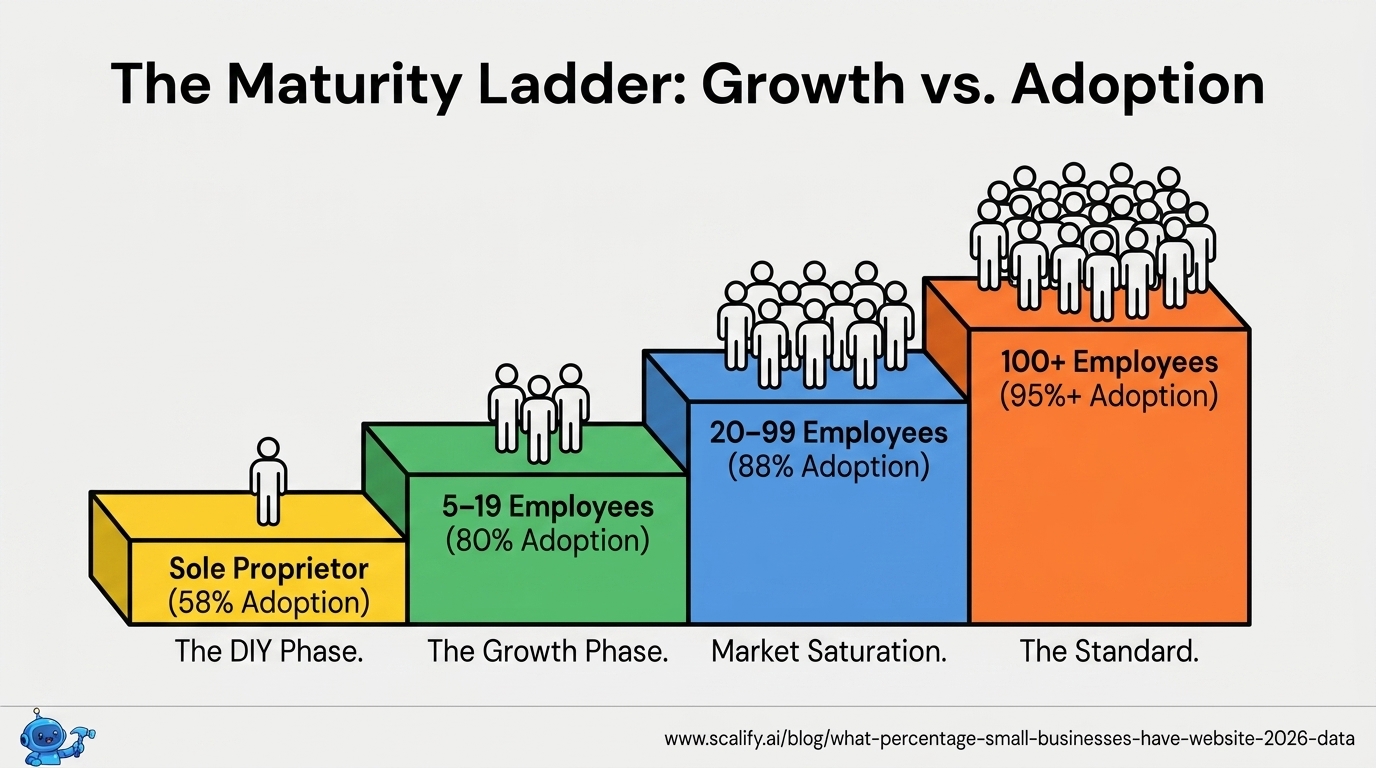
Business Size (Employees)% With Website% Without WebsiteTrendSole proprietor / 1 employee58%42%Growing, but slowly2–4 employees65%35%Growing steadily5–9 employees72%28%Growing steadily10–19 employees80%20%Strong growth20–99 employees88%12%Near saturation100–499 employees95%5%Near saturation500+ employees99%1%Saturated
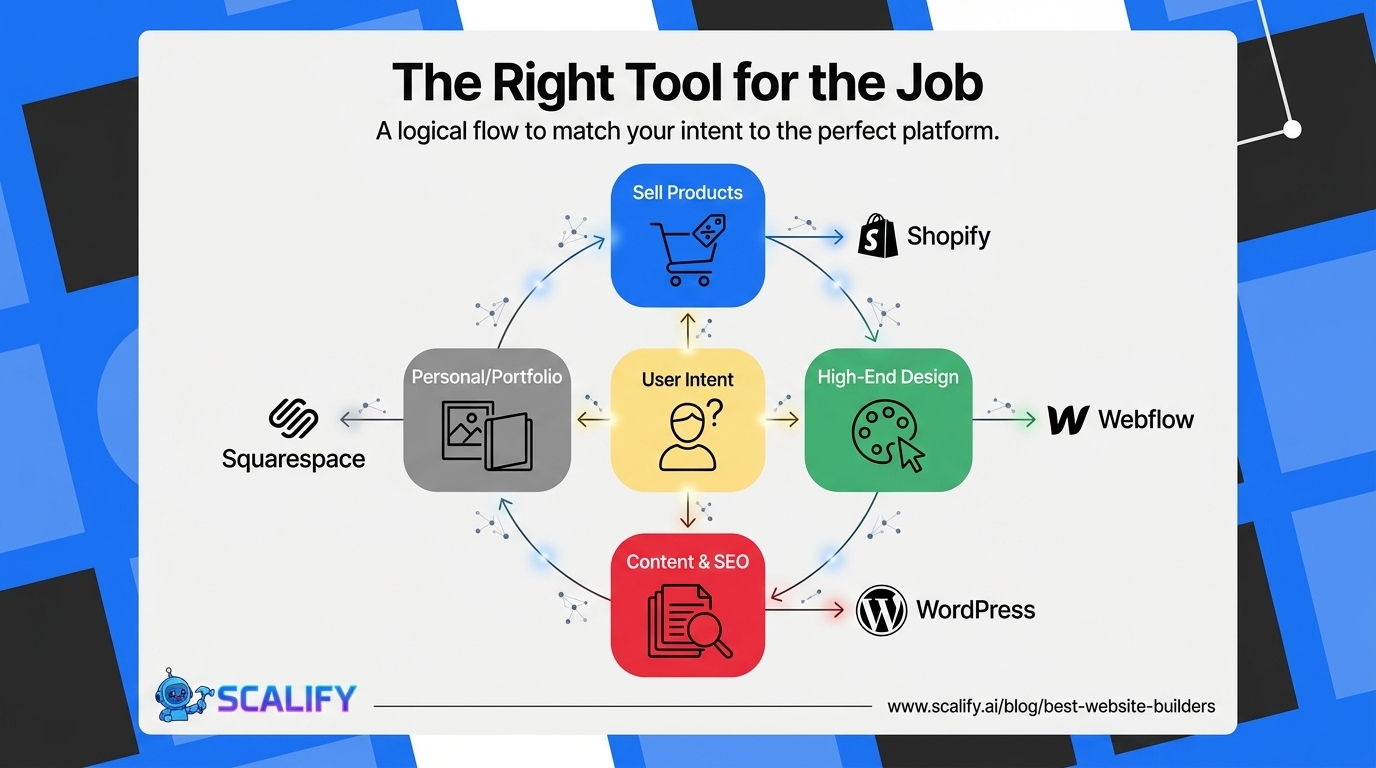
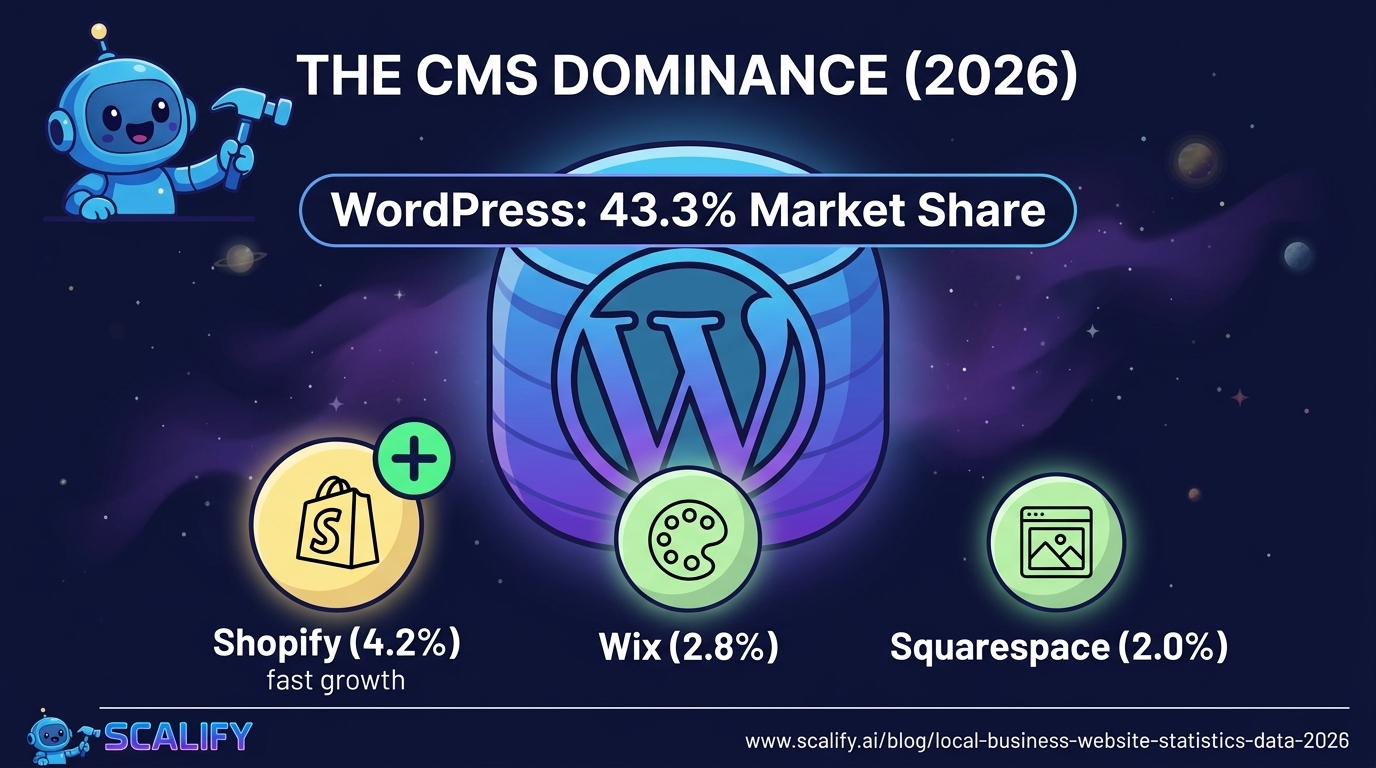
The data shows a clear correlation between business size and website ownership. The smallest businesses — sole proprietors and micro-businesses — are the most likely to lack websites, and they're also the most likely to have cited cost and "don't know how" as barriers. This is the market most affected by the rise of DIY website builders like Wix, Squarespace, and the expansion of Shopify's presence in the small business market.
Website Adoption Rate by Industry
Industry% of Small Businesses With WebsiteNotesProfessional Services (law, accounting, consulting)91%Credibility driver — near-essentialTechnology / Software98%Near-universal; industry expectationHealthcare / Medical87%Patient acquisition; insurance requirementsReal Estate89%Listing presentation; lead generationHome Services (HVAC, plumbing, etc.)74%Local search critical for discoveryBeauty / Salon / Personal Services68%Instagram often substitutesRetail (brick-and-mortar)61%Social media often used as substituteFood Service (restaurants, cafes)58%Lowest adoption; high social media relianceConstruction / Trades72%Growing adoption; referral heavyEducation / Tutoring79%Parent discovery driver
Historical Trend: Small Business Website Adoption Over Time
Year% of Small Businesses With WebsiteKey Driver201551%Mobile web growth awareness201756%Google My Business integration pressure201964%DIY builder price drops, ease of use202068%COVID-19 acceleration — survival necessity202171%Post-COVID digital investment continuation202372%AI tools lowering creation barriers202673%Continued gradual growth; plateau visible
COVID-19 was the single most significant accelerator of small business website adoption in history. When physical storefronts closed in 2020, businesses that had delayed website creation for years created them within weeks out of pure survival necessity. The restaurant industry, which had the lowest adoption rate pre-pandemic, saw the largest proportional increase — online ordering, contactless menus, and curbside pickup all required digital infrastructure that forced website creation for businesses that had previously operated entirely without one.
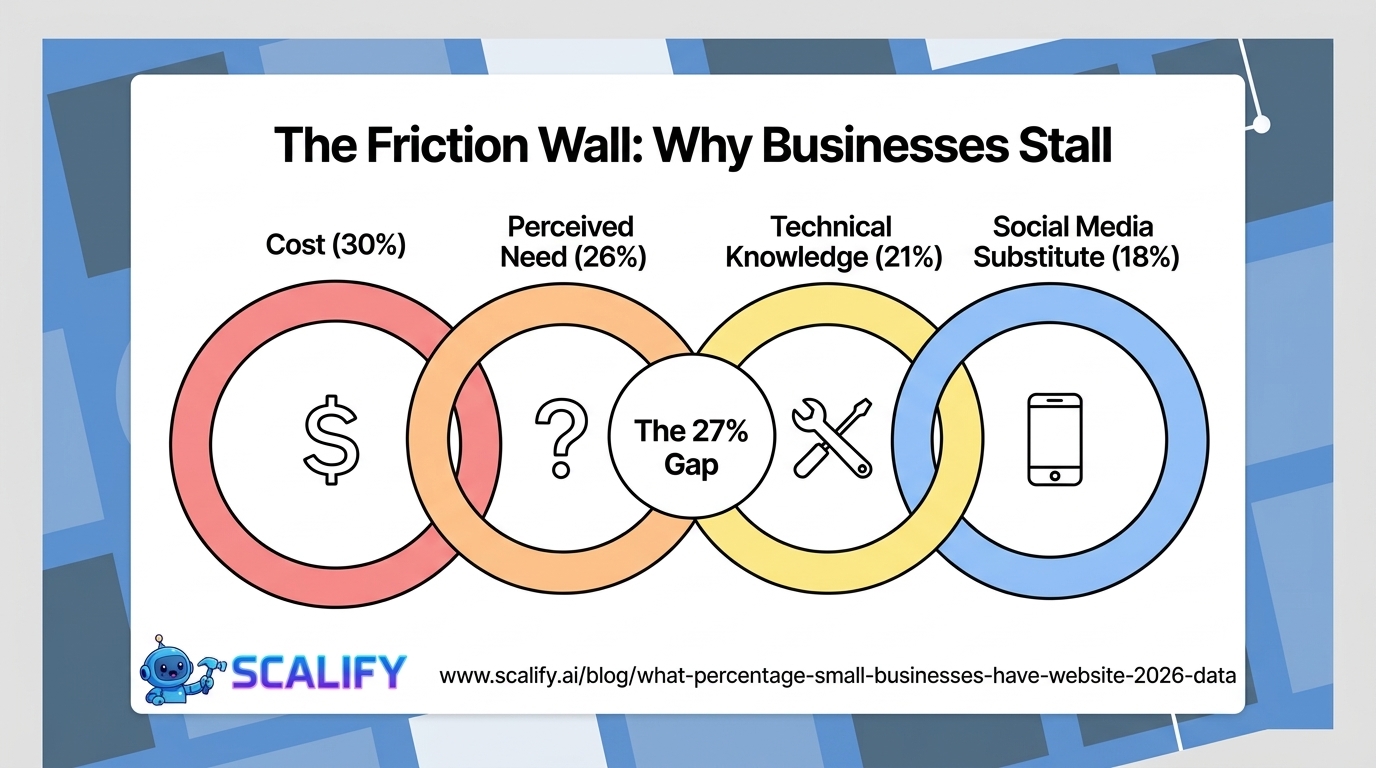
The growth has slowed significantly since 2021. The remaining 27% of businesses without websites represent a harder-to-convert segment — those who have actively decided they don't need one, those for whom cost remains a genuine barrier, and those for whom social media has become a functional substitute for a business website.
Why Small Businesses Say They Don't Have a Website
Reason Given% of Businesses Without WebsiteCost is too high30%Don't think we need one26%Don't know how to create/manage21%Use social media instead18%Don't have time15%Our business type doesn't need one12%Bad experience with previous website6%
The "don't think we need one" barrier is the most resistant to market forces. These businesses have made a judgment that their referral network, local reputation, or social media presence is sufficient. For some businesses — particularly those in extremely local markets, operating primarily through word-of-mouth — this may be temporarily accurate. Research suggests, however, that this belief often doesn't survive the first time a direct competitor with a strong website captures significant local search traffic.
The Revenue Impact of Having a Website
The financial case for small business websites is well-documented in multiple independent studies:
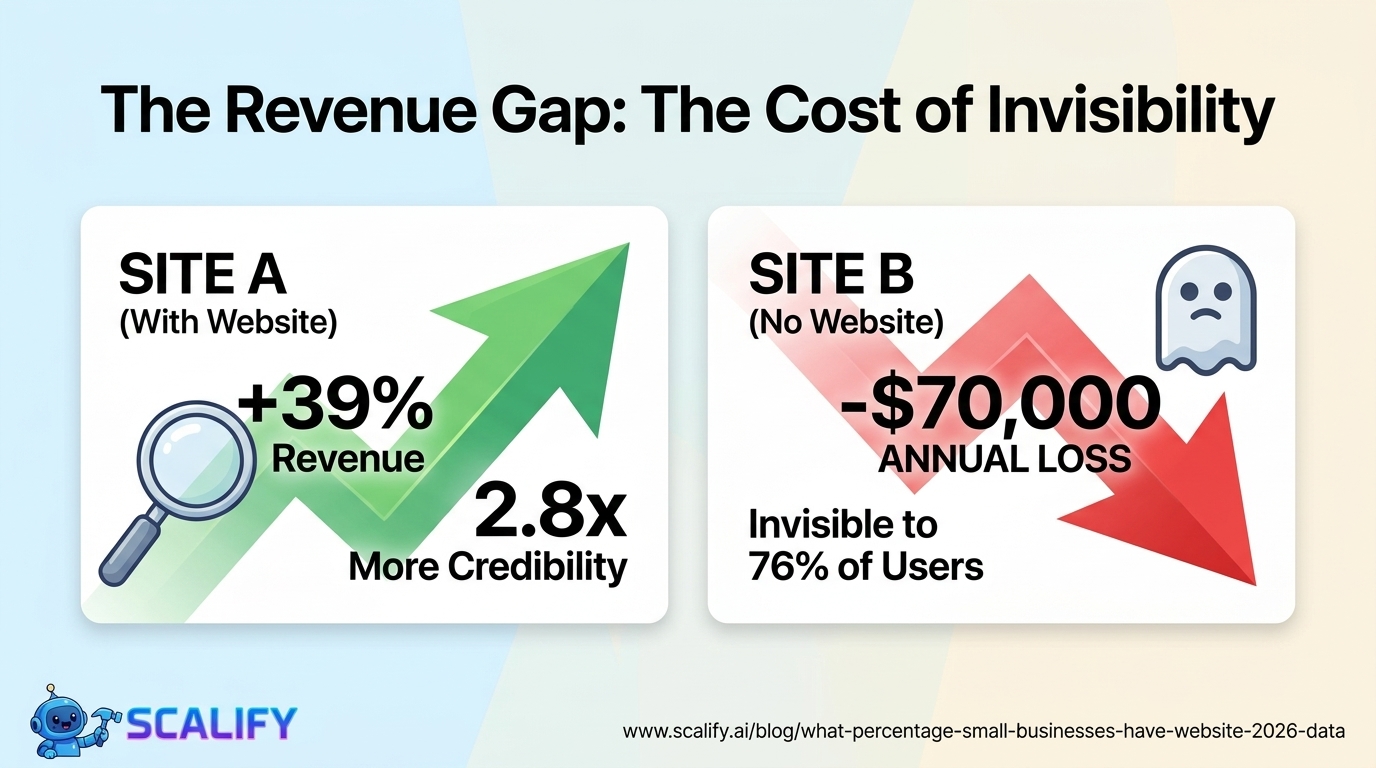
Research FindingSourceSmall businesses with websites earn 39% more revenue on averageDeloitte Connected Small Business StudyBusinesses with websites are 2.8x more likely to be considered for purchaseLSA (Local Search Association)76% of consumers check a website before visiting a businessBrightLocal Consumer Review Survey30% of consumers won't consider a business without a websiteVerisign / IPSOS SMB SurveyBusinesses without websites lose an average of $70,000 annually in online revenueNFIB Small Business Economic Survey
The 39% revenue premium is one of the most cited statistics in the small business website space, and it withstands scrutiny — businesses that invest in professional digital infrastructure tend to be more operationally sophisticated in general, which creates some correlation bias. But even controlling for business maturity, multiple studies confirm a meaningful causal relationship between website presence and revenue, primarily through increased discoverability in local search and increased consumer confidence.
Social Media as a Website Substitute: Does It Work?
One of the most significant trends in the small business website data is the explicit choice to use social media (primarily Instagram and Facebook) as a substitute for a standalone website. Among food service, retail, and beauty businesses, this is particularly common — Instagram profiles with menus, product photos, and booking links have replaced websites for a meaningful segment of the market.
The research on this is nuanced. Social media presence is effective for discovery within the platform's ecosystem, but it has documented limitations as a full website substitute:
Website Quality vs Website Existence
Among the 73% of small businesses that do have websites, quality and effectiveness vary enormously. Having a website technically exists on a different dimension from having a website that generates business outcomes:
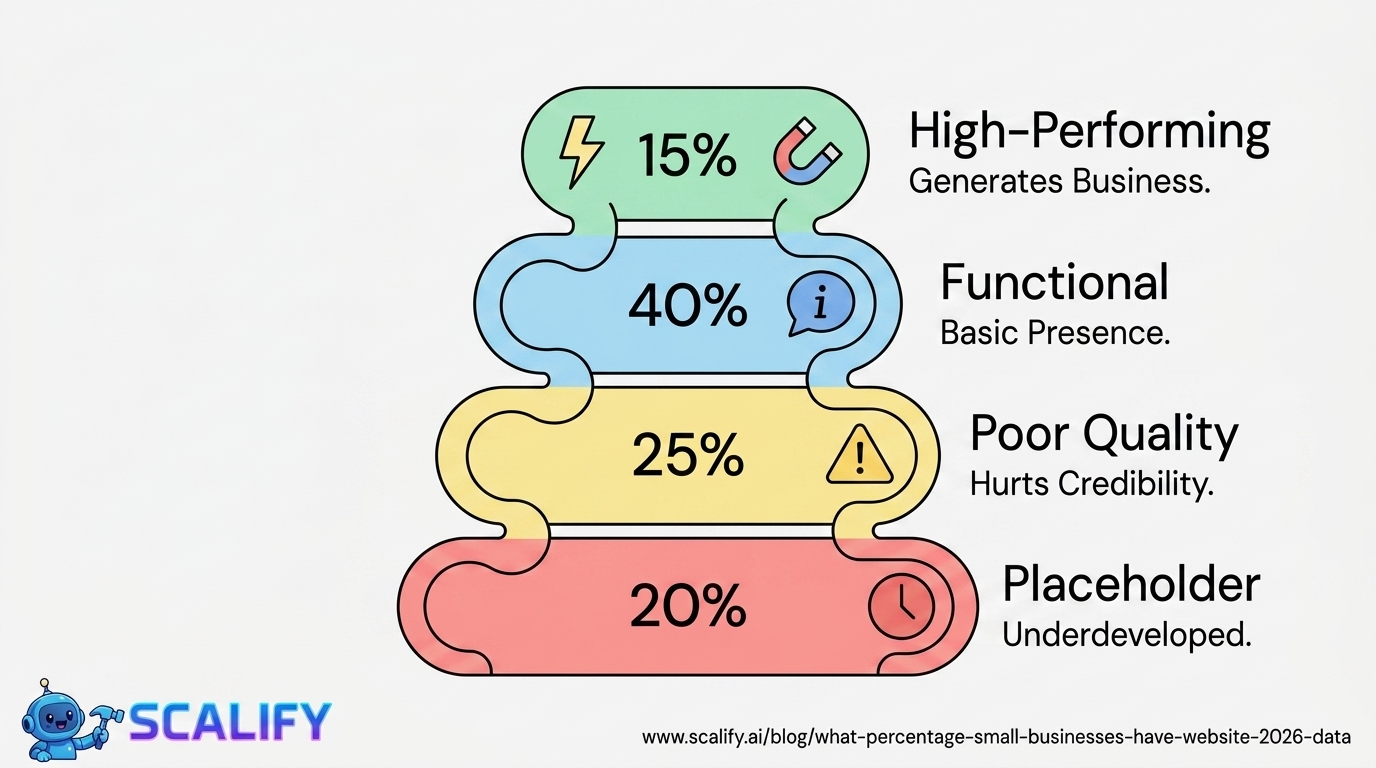
Website Quality CategoryEst. % of Small Business WebsitesCharacteristicsHigh-performing (generates consistent leads)~15%Mobile-optimized, fast, local SEO, clear CTAFunctional (adequate, not optimized)~40%Basic info, not well-ranked, minimal conversionPoor quality (hurts more than helps)~25%Outdated, slow, not mobile-friendlyPlaceholder / empty (minimal content)~20%Domain purchased but underdeveloped
This means only approximately 15% of small businesses have websites that actively generate meaningful business outcomes. The "have a website" statistic, while important, understates the depth of the digital underperformance problem — many businesses have technically ticked the box without getting the benefit.
What This Means for Small Business Owners
If you own a small business, the data presents two distinct challenges depending on which side of the line you're on:
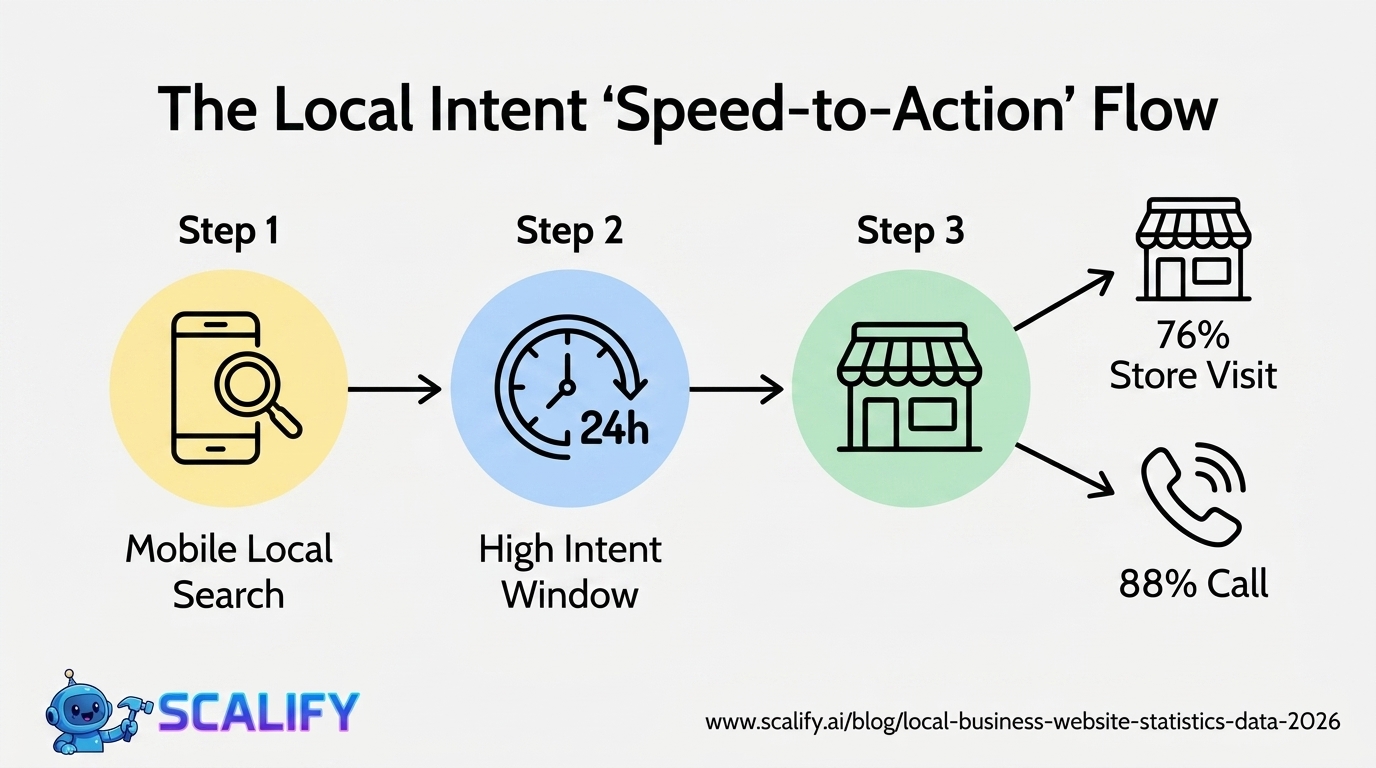
If you don't have a website: The research is unambiguous — you're losing money and customers to competitors who do. The 76% of consumers who check a business's website before visiting represents a constant stream of potential customers you're effectively invisible to. The cost barrier, which 30% of businesses cite, has dropped dramatically — professional websites are now accessible at price points that make the ROI calculation favorable for virtually any business category.
If you have a website but it's not generating business: You're in the larger and more hidden problem category. The website's existence is meeting a checkbox but not delivering value. The gap between a functional website and a business-generating website is typically addressable with professional design, local SEO optimization, clear calls-to-action, and mobile optimization — the investment required is a fraction of the revenue opportunity that an optimized website unlocks.
At Scalify, we build professional websites for small businesses in 10 business days — the kind that generate leads, build credibility, and convert visitors into customers.
Top 5 Sources
Building a Sustainable Digital Marketing System
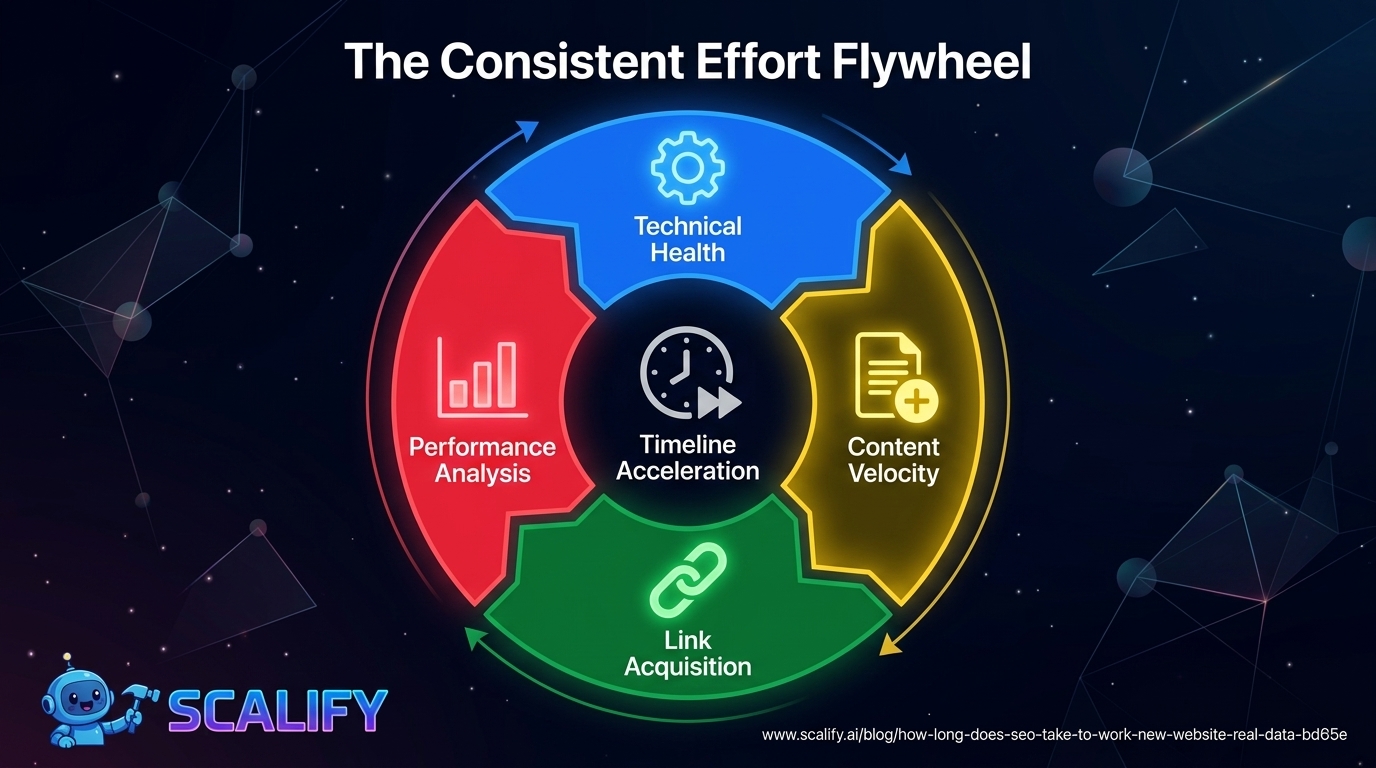
The most effective websites are not built once and left static — they're living systems that improve continuously as the business learns what resonates with its audience, what converts visitors, and what generates organic traffic. Building this improvement discipline requires three things: measurement infrastructure that makes performance visible (Google Analytics 4, Search Console, Core Web Vitals monitoring), a regular cadence of improvement work (monthly or quarterly audits and optimization cycles), and the willingness to make changes based on what the data shows rather than aesthetic preferences or past decisions.
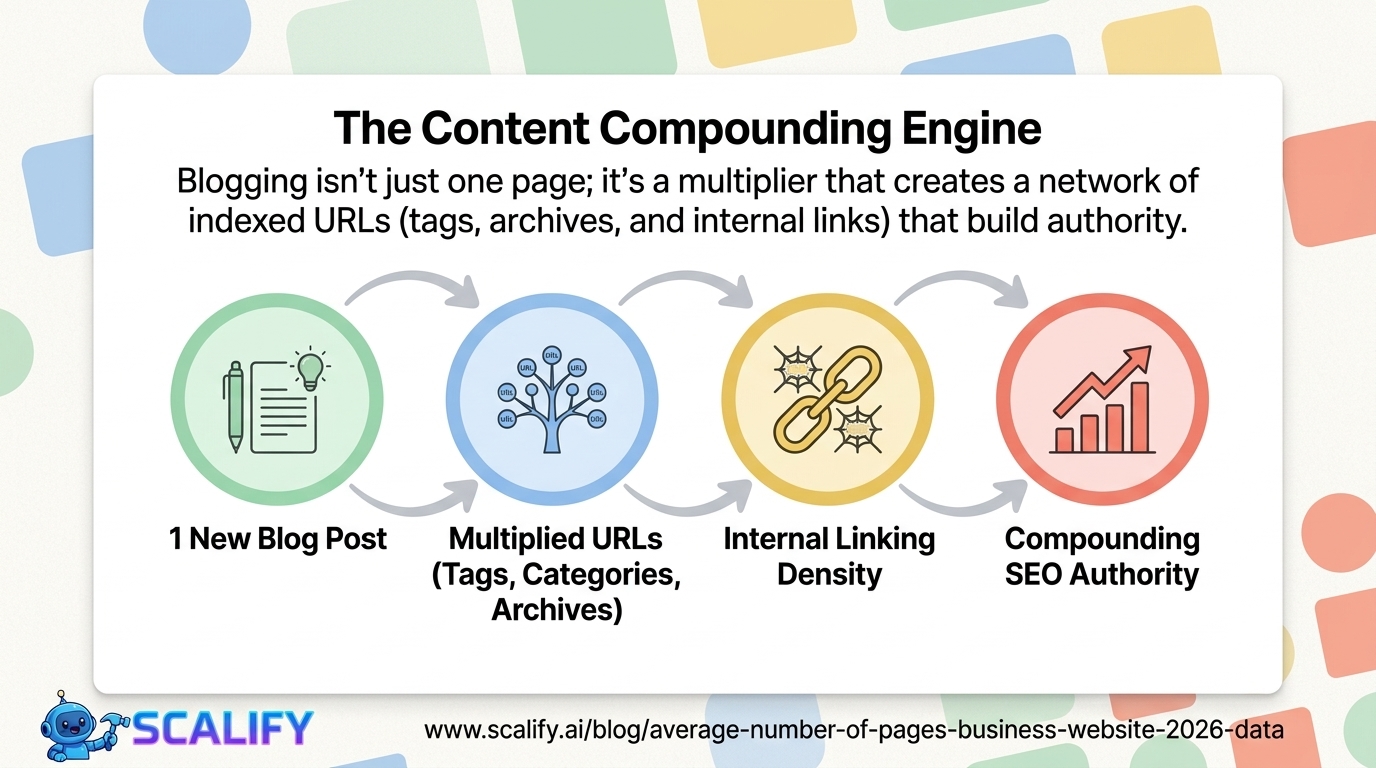
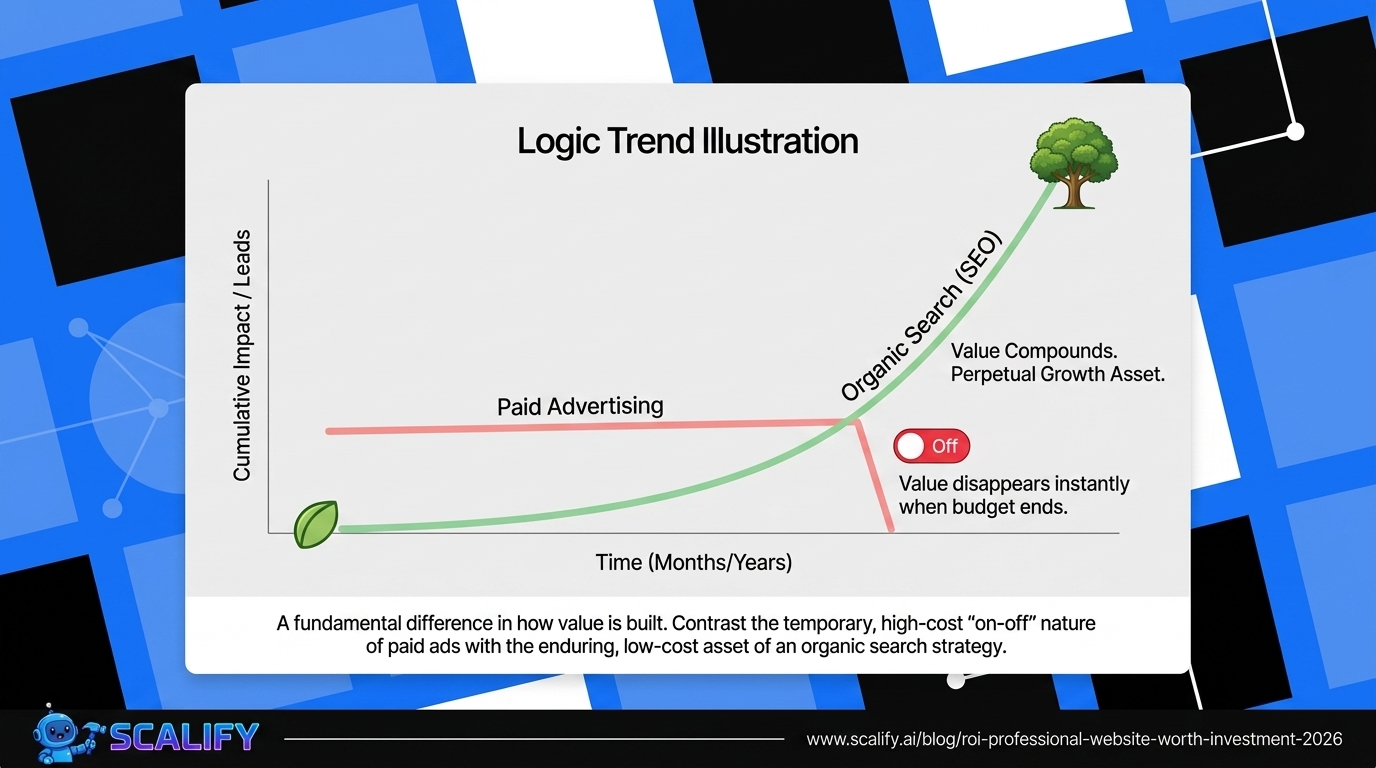
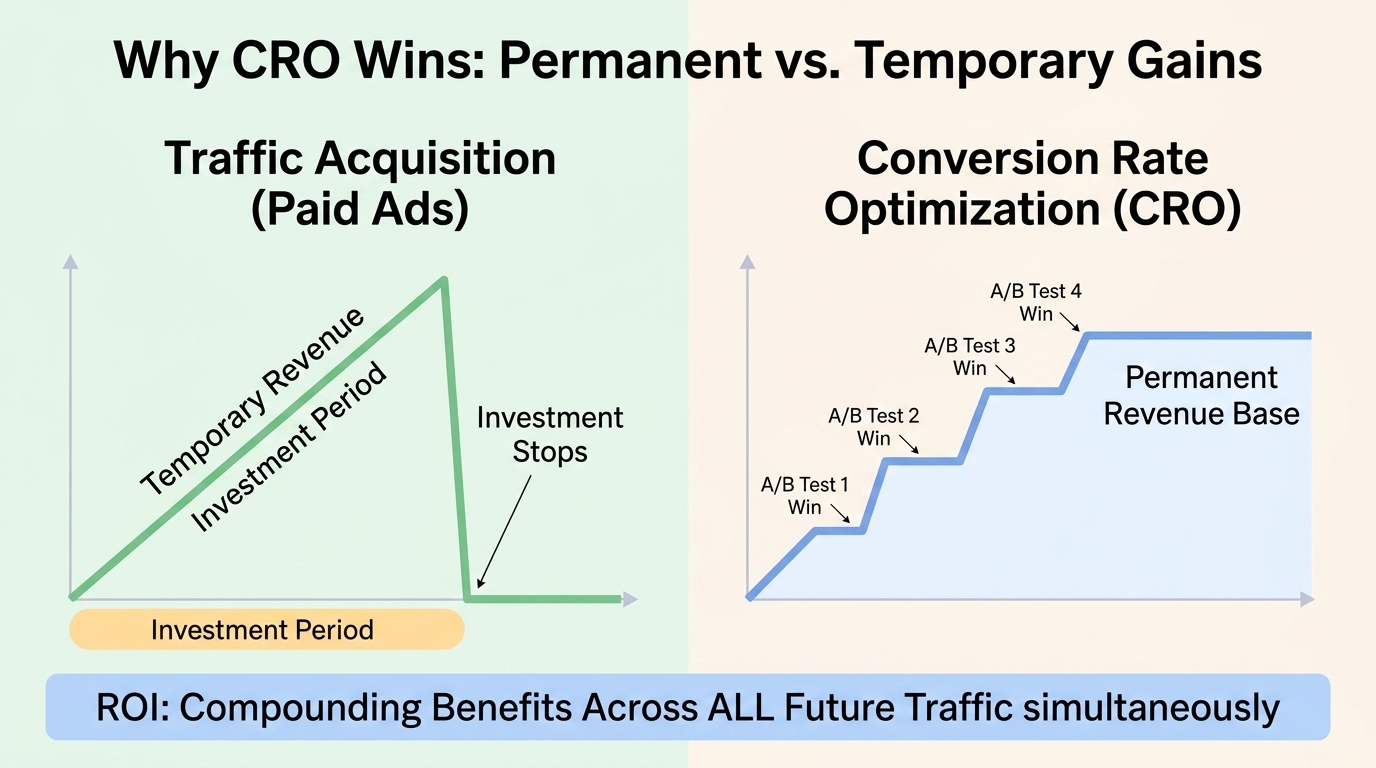
The businesses that achieve the strongest digital marketing outcomes over 3–5 years are consistently those that treat their website as a compounding investment — not a cost that was incurred and is now sunk. Each improvement builds on previous ones: content that ranks brings organic traffic that generates leads that fund more content investment. Backlinks earned improve rankings for future content. Performance improvements make every marketing dollar more efficient by converting more of the traffic those campaigns generate. This compounding structure means the businesses that start investing systematically earliest build the most durable competitive advantages — and those that defer the investment face increasingly expensive catch-up costs as competitors accumulate authority that takes time to replicate.
The practical starting point for any business that hasn't yet built this system: set up Google Analytics 4 and Search Console if not already in place, establish baseline metrics for organic traffic, conversion rate, and Core Web Vitals, and identify the single highest-impact improvement available based on those metrics. Implement that improvement, measure the result after 30 days, and plan the next improvement. This iterative discipline, maintained consistently, produces the compounding returns that transform a business's digital marketing from a cost center into one of its most valuable revenue-generating assets.
At Scalify, our websites are built with analytics, performance optimization, and SEO foundations that give every business the starting point for this compounding improvement discipline — delivered professionally in 10 business days.



.jpeg)
.jpeg)

78 SW 7th St, Miami, FL 33130