
Motion Designer Salary for Web Projects in 2026
By Josh Ternyak

April 20, 2026
Comprehensive 2026 guide: Motion Designer Salary for Web Projects in 2026
Motion Design for Web: A Specialization With a Meaningful Premium
Motion design for web occupies a specific and financially rewarding niche at the intersection of animation craft, UI design, and front-end technical knowledge. It's a specialization that most web designers and developers can't do well — creating purposeful, performant motion that enhances user experience rather than distracting from it requires a combination of skills that most people only develop one side of.
In 2026, the demand for skilled web motion designers has grown alongside the sophistication of web experiences — scroll-driven animations, microinteraction design, Lottie animations in product UI, GSAP-powered marketing sites, and interactive 3D content built with Three.js have become standard at companies competing on digital experience quality. The salary data reflects sustained demand at the intersection of rare skills.
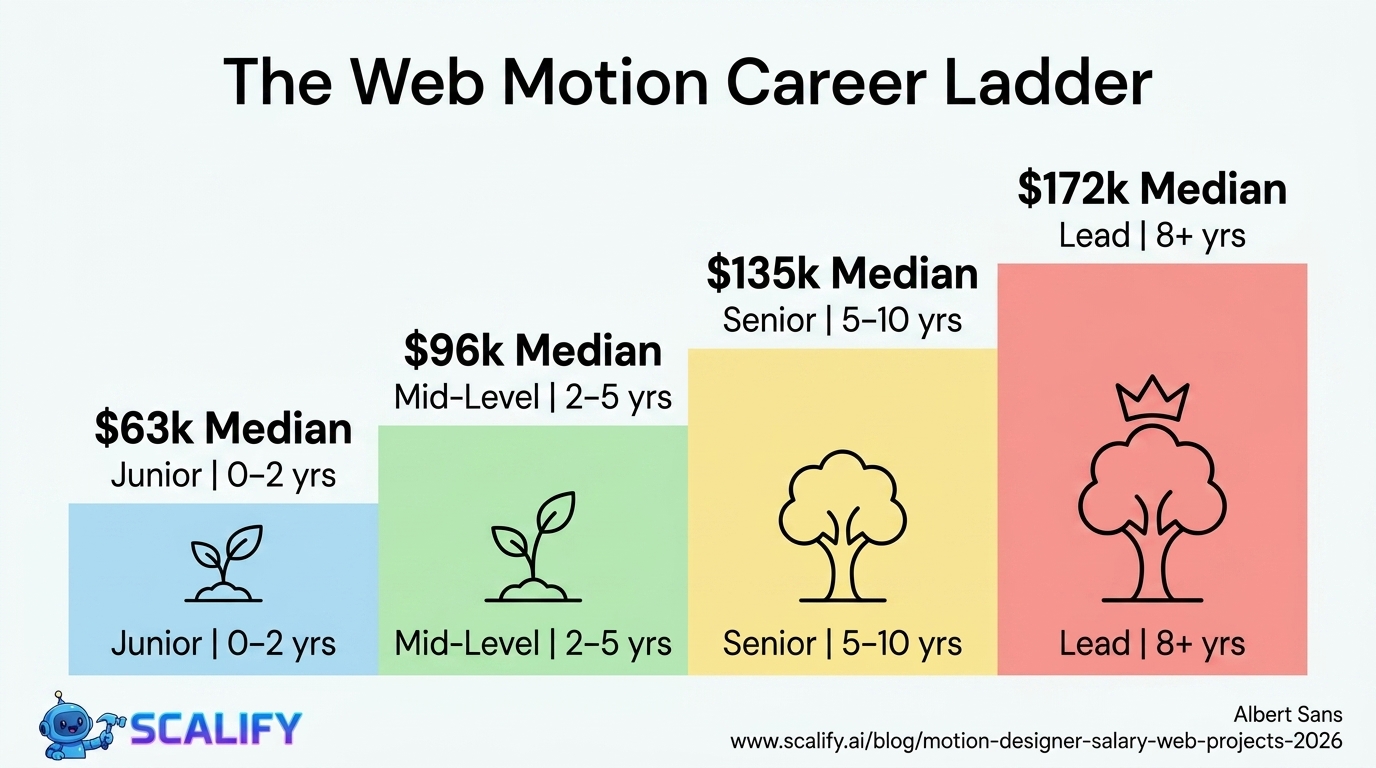
Motion Designer Salary by Experience Level (Web-Focused)
LevelYears ExperienceSalary RangeMedianJunior Motion Designer (Web)0–2 years$52,000 – $78,000$63,000Mid-Level Motion Designer (Web)2–5 years$78,000 – $118,000$96,000Senior Motion Designer (Web)5–10 years$112,000 – $162,000$135,000Lead / Creative Director (Motion)8+ years$145,000 – $210,000+$172,000
Motion Designer Salary by Specialization
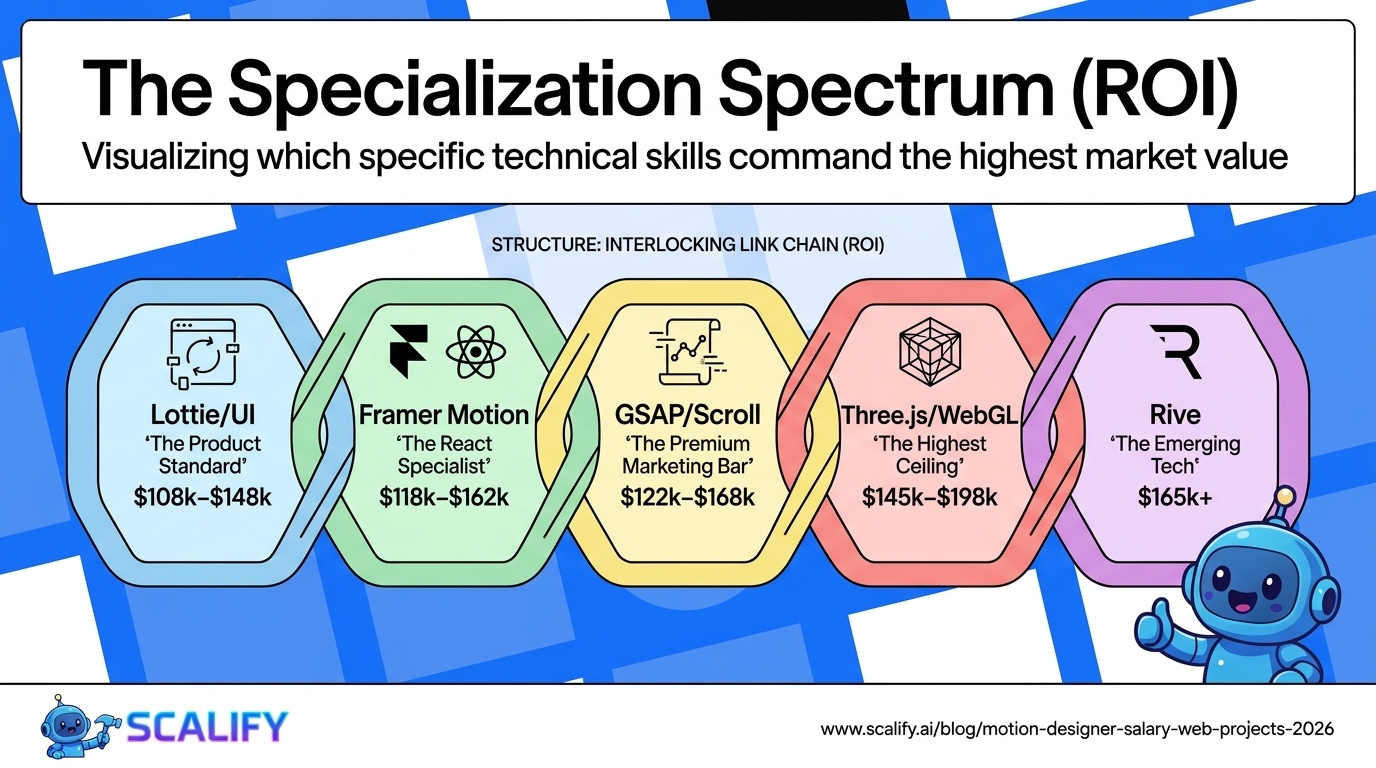
SpecializationMid-LevelSeniorPremium DriverUI Motion / Microinteractions$82,000 – $118,000$115,000 – $158,000Product design integrationGSAP / ScrollTrigger Web Animation$88,000 – $125,000$122,000 – $168,000Technical + creative combinedLottie / JSON Animation$78,000 – $112,000$108,000 – $148,000Performance-friendly UI animationThree.js / WebGL / 3D Web$105,000 – $145,000$145,000 – $198,000Rarest, highest technical barFramer Motion (React animation)$88,000 – $125,000$118,000 – $162,000Product company premiumAfter Effects + Web Delivery$72,000 – $105,000$98,000 – $135,000Traditional motion + web pipeline
The Technical Motion Designer Premium
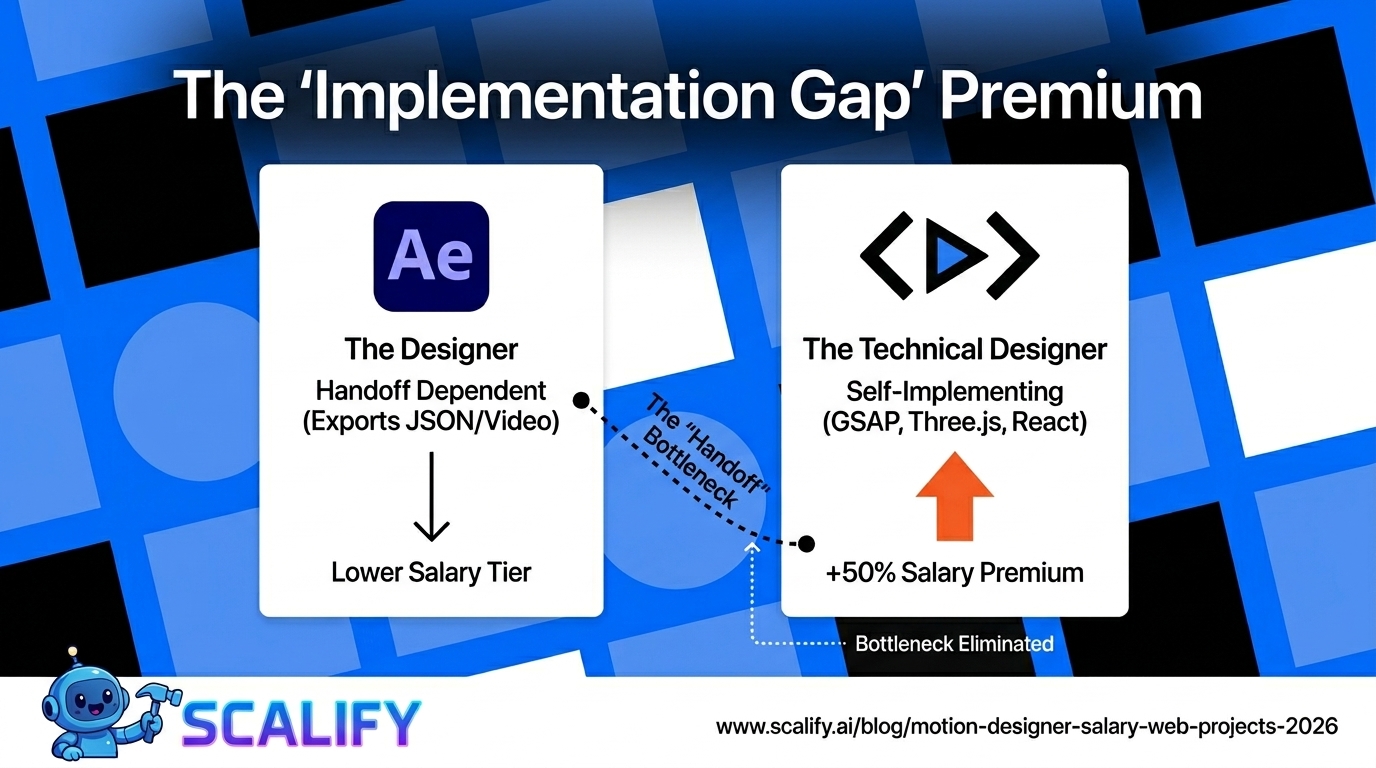
The most significant salary driver in web motion design is the combination of creative skill with technical implementation ability. This distinction produces a salary gap of 30–50% at equivalent experience levels.
The Design-Only Motion Designer
A motion designer who works primarily in After Effects, exports videos or Lottie JSON files, and hands off to developers for implementation earns in the lower portion of the salary range. This profile is valuable — creating the motion direction, the easing curves, the visual language of animation for a brand or product is genuinely skilled work. But it's dependent on developer implementation, which limits the scope of what can be built and how quickly.
The Technical Motion Designer
A motion designer who can implement their animations directly in the browser — using GSAP, Framer Motion, CSS animations and transitions, or WebGL — eliminates the handoff dependency entirely. They can build what they design, iterate quickly, and be the sole owner of a complex animated experience from concept through production. This independence is worth significantly more to employers and clients because it removes the most common bottleneck in producing high-quality web animation.
Senior technical motion designers — those who are genuinely strong at both the animation craft and the JavaScript/WebGL implementation — are among the most sought-after professionals in the web industry. They're rare because the skill combination is genuinely difficult: excellent animation requires different brain muscles than excellent programming, and most people with one don't have deep facility with the other.
GSAP and ScrollTrigger: The Most Commercially Valuable Web Animation Skill
GSAP (GreenSock Animation Platform) is the industry-standard JavaScript animation library for complex web animations — used by nearly every award-winning marketing site you've seen in the past 5 years. GSAP's ScrollTrigger plugin, specifically, has transformed what's possible with scroll-driven web experiences, enabling the kind of parallax, pin, and timeline animations that define premium brand websites.
Designers who can architect and implement complex GSAP+ScrollTrigger experiences — multi-section scroll narratives, performance-optimized pinned animations, SVG path animations, stagger sequences — are serving a specific, high-budget market. Award-winning agencies (Fantasy Interactive, AKQA, Jam3, Instrument) build these experiences for Fortune 500 brand campaigns, and they pay $145,000–$185,000 for senior technical motion designers who can deliver this level of work.
Three.js and WebGL: The Highest Ceiling in Web Motion
The highest compensation in web motion design belongs to developers who work at the intersection of creative 3D and the browser: Three.js developers, WebGL shader programmers, and creative technologists who build immersive 3D web experiences. These professionals are rare — the skills require both strong creative instincts and genuine technical depth in 3D rendering, shader programming, and browser performance optimization.
Senior Three.js / WebGL creative developers earn $145,000–$198,000 at product companies and agencies building 3D brand experiences. Top-tier creative developers at agencies like Resn, Active Theory, or department who work on the most complex interactive projects can earn $160,000–$220,000+. Freelance Three.js developers charge $175–$300+/hr for complex 3D web work.
Motion Designer Salary by Company Type
Company TypeMid-LevelSeniorNotesProduct Tech Companies (in-house)$95,000 – $128,000$128,000 – $172,000UI motion, microinteractions, Framer MotionAward-Winning Creative Agencies$88,000 – $118,000$118,000 – $162,000GSAP, Three.js, production-grade experiencesBrand Agencies / Digital Studios$78,000 – $108,000$105,000 – $145,000Mixed motion types, brand campaignsStreaming / Entertainment Tech$92,000 – $125,000$125,000 – $168,000Netflix, Disney+, Spotify — UX motion focusGame Studio Web Teams$85,000 – $118,000$115,000 – $155,000Interactive, often WebGLFreelance (established)$80 – $145/hr$145 – $300+/hrHighest ceiling for technical specialists
Lottie Animation: The UI Motion Sweet Spot
Lottie animations — JSON-format animations created in After Effects using the BodyMovin plugin, exported to play in web browsers and mobile apps at full quality with tiny file sizes — have become the standard format for UI animations in product design. Loading animations, success states, empty states, onboarding illustrations, and micro-interactions are all commonly implemented as Lottie files.
Motion designers who specialize in creating polished, optimized Lottie animations are serving a specific product design market that has very consistent demand. The skills: After Effects proficiency at a motion graphic level, understanding of how After Effects features translate (and don't translate) to Lottie JSON, optimization techniques for file size reduction, and the ability to integrate with developers implementing in React-Lottie or rive.app.
Senior Lottie specialists at product companies earn $108,000–$148,000. Those who also understand Rive (the newer, more flexible alternative to Lottie that allows state machines and interactive transitions) earn toward the top of that range and beyond, as Rive adoption is growing rapidly in 2026.
Motion Designer Salary by City
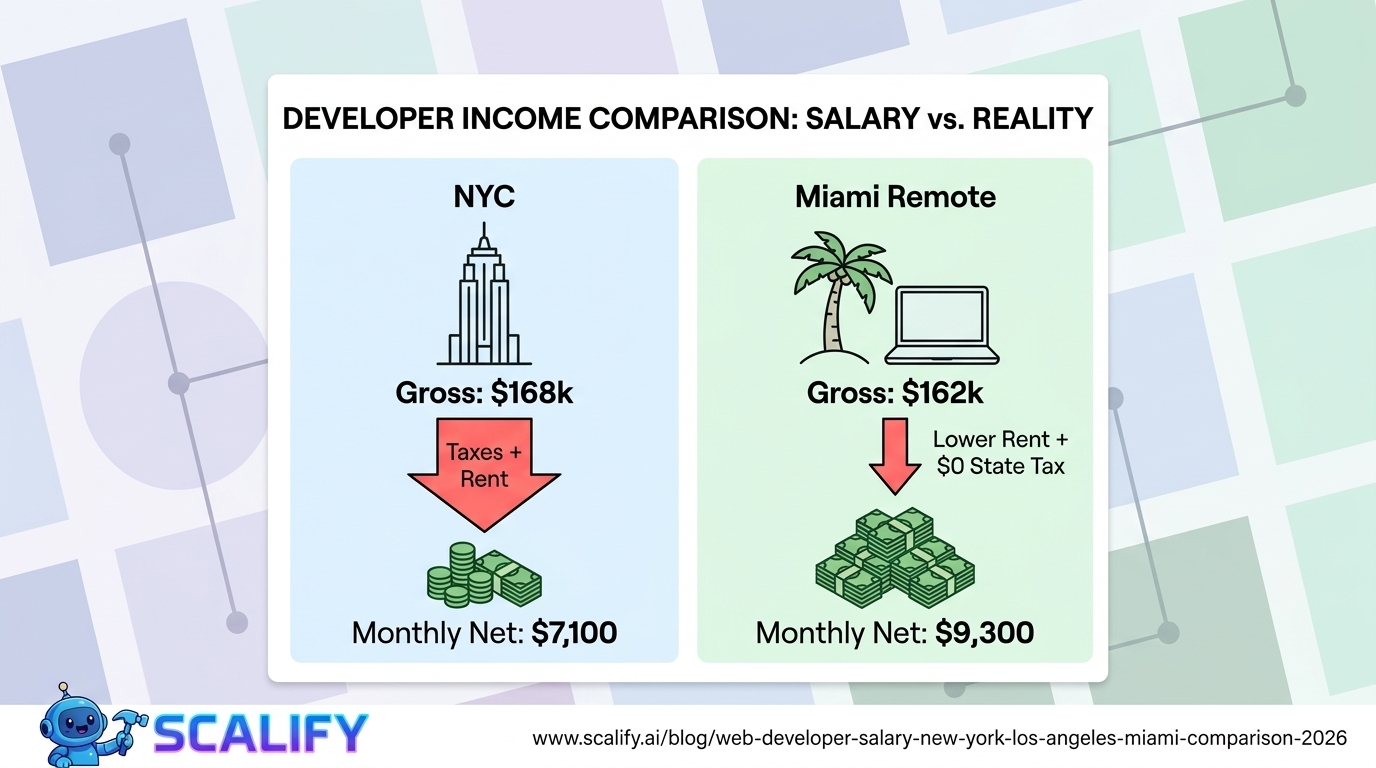
CityMid-LevelSeniorSan Francisco Bay Area$108,000 – $142,000$148,000 – $205,000New York City$100,000 – $132,000$135,000 – $188,000Los Angeles$95,000 – $128,000$128,000 – $178,000Seattle / Austin$85,000 – $118,000$115,000 – $158,000Miami$72,000 – $102,000$98,000 – $138,000Non-tech hub markets$55,000 – $82,000$82,000 – $115,000
Freelance Motion Designer Rates for Web
SpecializationHourly RateProject RangeUI Motion / Lottie Animations$65 – $120/hr$2,000 – $15,000GSAP Marketing Site Animations$120 – $195/hr$8,000 – $40,000Scroll Storytelling Experiences$145 – $225/hr$15,000 – $60,000+Three.js / WebGL Creative Dev$175 – $300+/hr$20,000 – $100,000+Rive Interactive Animation$100 – $165/hr$5,000 – $25,000
Building a Portfolio That Commands Premium Motion Rates
Motion design portfolios need to demonstrate something that most design portfolios don't: actual motion. A PDF case study describing an animation is not the same as showing the animation. The practical requirements for a portfolio that commands senior rates:
How Motion Designers Transition to Higher-Paying Roles
The path to the top of web motion compensation:
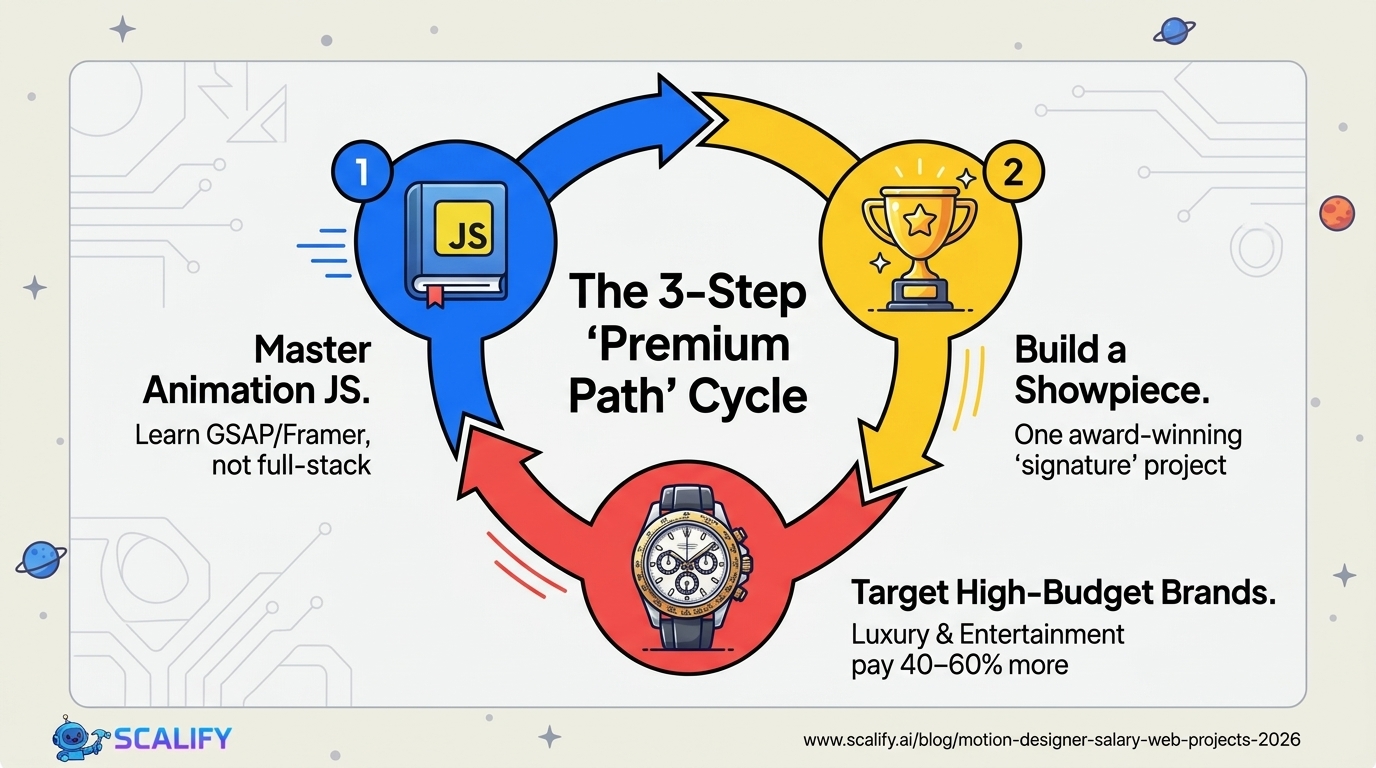
Learn JavaScript at the JavaScript-for-motion level. You don't need to become a full-stack developer. You need to be comfortable with variables, functions, loops, DOM manipulation, and the specific APIs and libraries that enable web animation: GSAP, Framer Motion, CSS animation API, Web Animations API. This investment typically takes 3–6 months of focused practice and immediately expands the scope of work you can deliver independently.
Build a signature showpiece project. The motion designers who land top-tier agency roles and high-value client work almost always have one project in their portfolio that's genuinely exceptional — something that stops people while scrolling. Building that project deliberately (choosing a concept specifically for its portfolio value, spending disproportionate time on it, submitting it to Awwwards or CSS Design Awards) produces outsized career returns.
Target brands, not just tech companies. The highest-budget web motion work often comes from large consumer brands (automotive, luxury, fashion, entertainment) commissioning premium digital experiences. These projects typically pay 40–60% more than equivalent technical complexity work for technology company websites, because brand budget expectations are different.
The Bottom Line
Web motion designer salaries in 2026 range from $52,000 for junior After Effects-only motion designers to $210,000+ for technical Three.js / WebGL creative developers and senior GSAP specialists at award-winning agencies. The premium for technical implementation capability — the ability to code what you design — is 30–50% above the design-only baseline at equivalent experience levels. Three.js and WebGL represent the highest ceiling in the field. GSAP expertise for marketing sites and Framer Motion for product UI are the most commercially abundant premium skills. For motion designers looking to maximize compensation, the clearest path is developing genuine JavaScript proficiency for animation — not full-stack development, but animation-specific JavaScript that enables building complex web experiences independently.
At Scalify, we build professional portfolio websites for motion designers and creative technologists in 10 business days — the live, animated showcase that demonstrates your expertise better than any static PDF ever could.
Key Takeaways and Next Steps
The principles and data in this guide reflect what actually works in professional web development and digital marketing in 2026 — not theoretical best practices but measured, documented outcomes from implementations at scale. The gap between knowing these principles and benefiting from them is always execution: the businesses that act on what they read, implement changes systematically, and measure the results consistently outperform those who consume information without converting it to action.
For any improvement described in this guide, the implementation sequence that produces the best outcomes: assess your current situation against the benchmarks provided, identify the 2–3 highest-impact improvements specific to your situation, implement them with measurement tracking in place, evaluate results after 30–60 days, and plan the next iteration based on what you learned. This cycle — assess, prioritize, implement, measure, iterate — is the operational foundation of continuous improvement that compounds into significant competitive advantage over the 12–24 month horizon.
The compounding returns from consistent web presence investment are not linear: a website that improves slightly each month accumulates to dramatic improvements over a year, and those improvements multiply with each other. Faster load times improve both search rankings and conversion rates simultaneously. Better content attracts backlinks that improve rankings that attract more traffic. More testimonials build trust that improves conversion rates that improve revenue that funds more investment. The interconnected nature of website performance means that each improvement amplifies the value of every other improvement — making the decision to invest consistently, across multiple dimensions simultaneously, the highest-ROI approach to digital marketing available to most businesses.
At Scalify, every website we build reflects these principles — technically optimized, conversion-focused, SEO-ready, and designed to compound in value over time as content, backlinks, and organic authority accumulate on the strong foundation we deliver in 10 business days.


.jpeg)
.jpeg)

78 SW 7th St, Miami, FL 33130