

Hidden Costs of a Website That Nobody Tells You About (2026)
By Josh Ternyak

April 18, 2026
Complete hidden website cost guide.
Hidden Costs of a Website That Nobody Tells You About
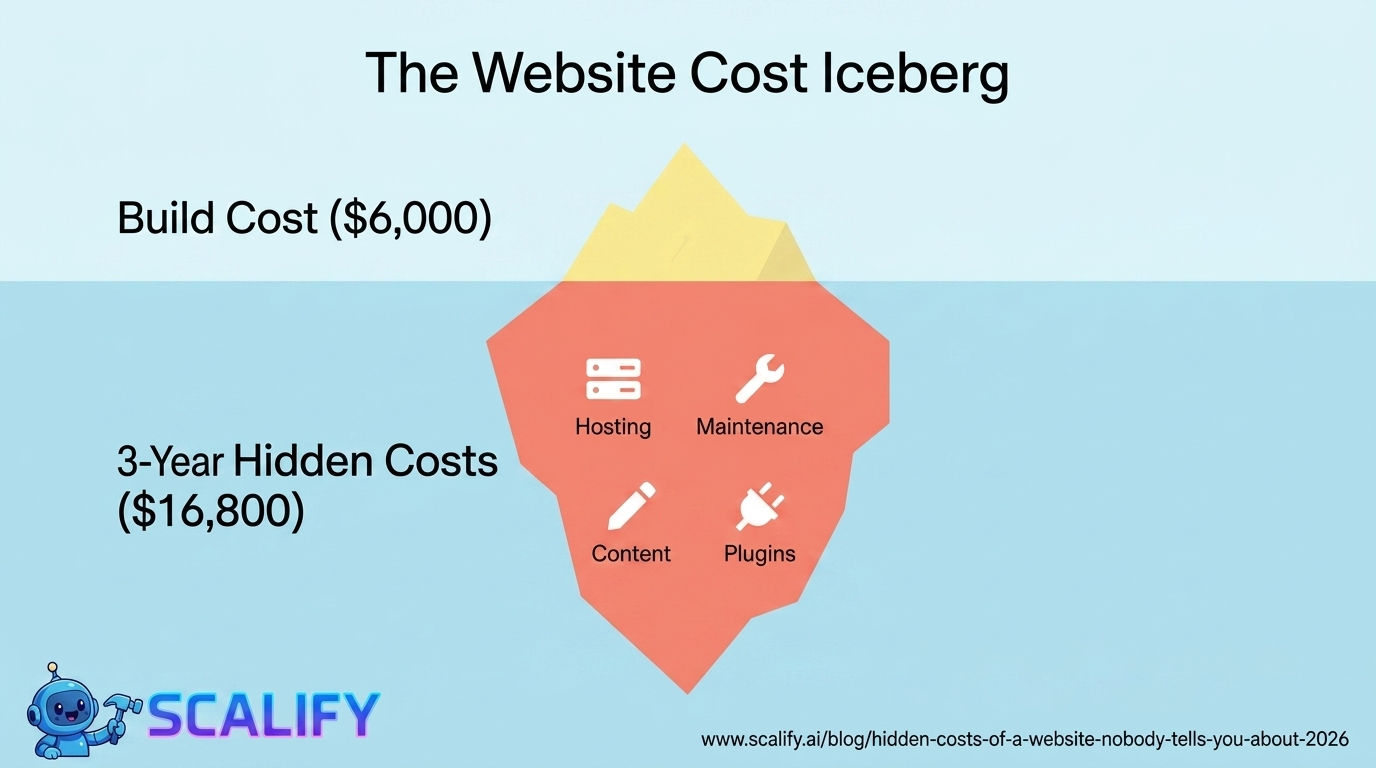
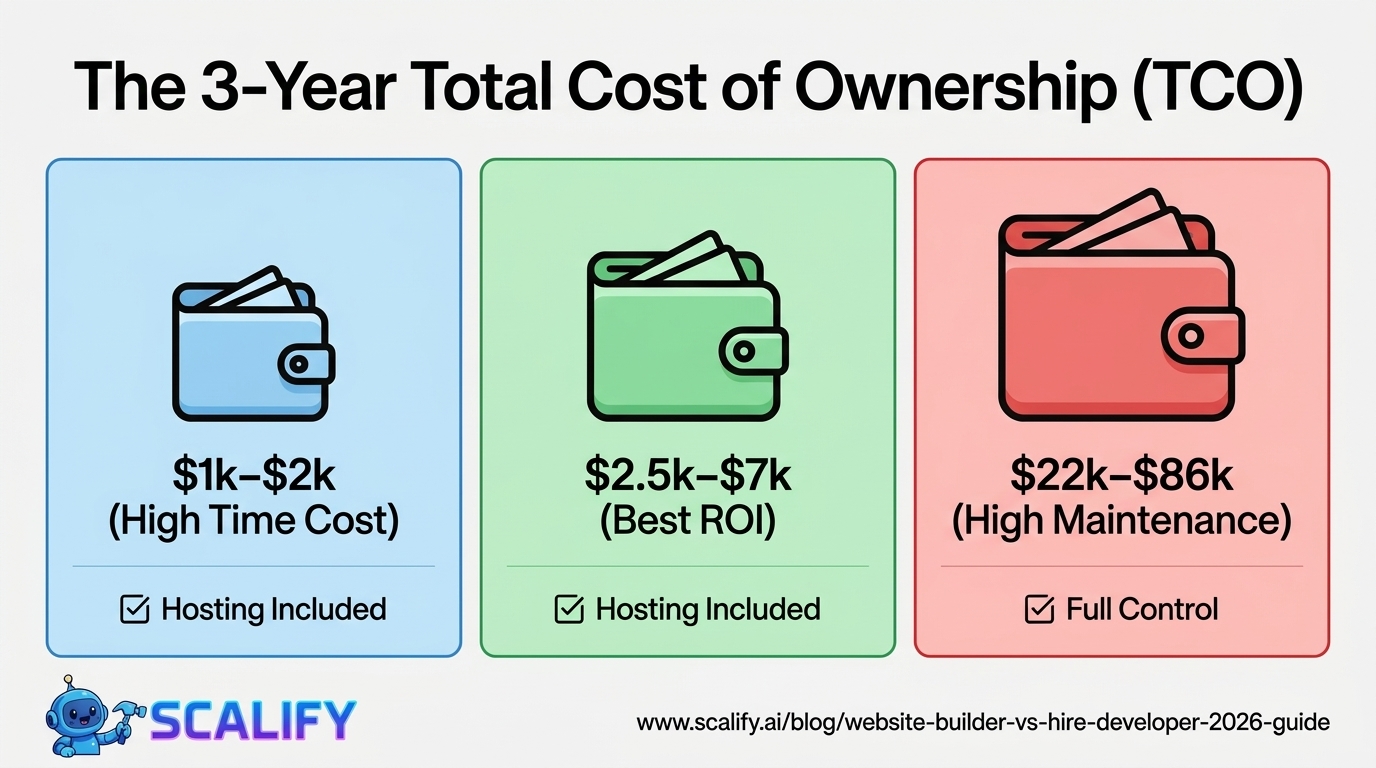
Every website quote includes the build cost. Few website discussions adequately cover the ongoing costs that accumulate after launch — the hosting, maintenance, content, tools, and unexpected expenses that determine whether your website investment is financially sustainable over time. A $6,000 website with $400/month in ongoing costs is a $22,800 three-year investment, not a $6,000 purchase. Understanding the full cost picture before committing prevents the unpleasant discovery that the ongoing costs exceed the original budget.
The Complete Website Cost Picture
Cost CategoryTypical RangeFrequencyOften Overlooked?Domain name$10–$50/yearAnnualNo — usually disclosedWebsite hosting$15–$500/monthMonthlySometimes — range is largeSSL certificate$0–$200/yearAnnualOften — many hosts include freeCMS platform fees$14–$299/monthMonthlyOften — depends on platformPremium plugins/apps$20–$500/monthMonthlyVery Often — accumulatesEmail hosting$5–$25/user/monthMonthlyOften — assumed to be includedContent updates/management$200–$2,000/monthOngoingVery Often — major hidden costSecurity monitoring$10–$100/monthMonthlyOften — skipped until breachBackups$5–$50/monthMonthlyOften — until data is lostAnalytics tools$0–$200/monthMonthlyRarely — GA4 is freeDeveloper maintenance$100–$2,000/monthOngoingVery Often — largest hidden costPerformance/CDN tools$20–$200/monthMonthlySometimes
Hosting: The Range Is Enormous
Hosting cost is one of the most variable ongoing website expenses, with a 30x range between the cheapest and most appropriate hosting for a given site. Shared hosting at $5–$15/month sounds attractive but provides insufficient resources for any site with meaningful traffic — slow load times, frequent downtime, and security vulnerabilities that shared hosting creates often cost more in lost conversions and developer remediation than the savings justify. Quality managed hosting for most business websites (Kinsta, WP Engine for WordPress; Vercel, Netlify for modern frameworks; Shopify's included hosting for e-commerce) runs $30–$150/month and provides the performance, security, and uptime that business sites require. The $50/month additional cost of proper hosting vs. cheap shared hosting typically produces far more than $50/month in recovered conversion performance — but it's not disclosed as a requirement in most website project quotes.
Plugin and App Subscription Creep
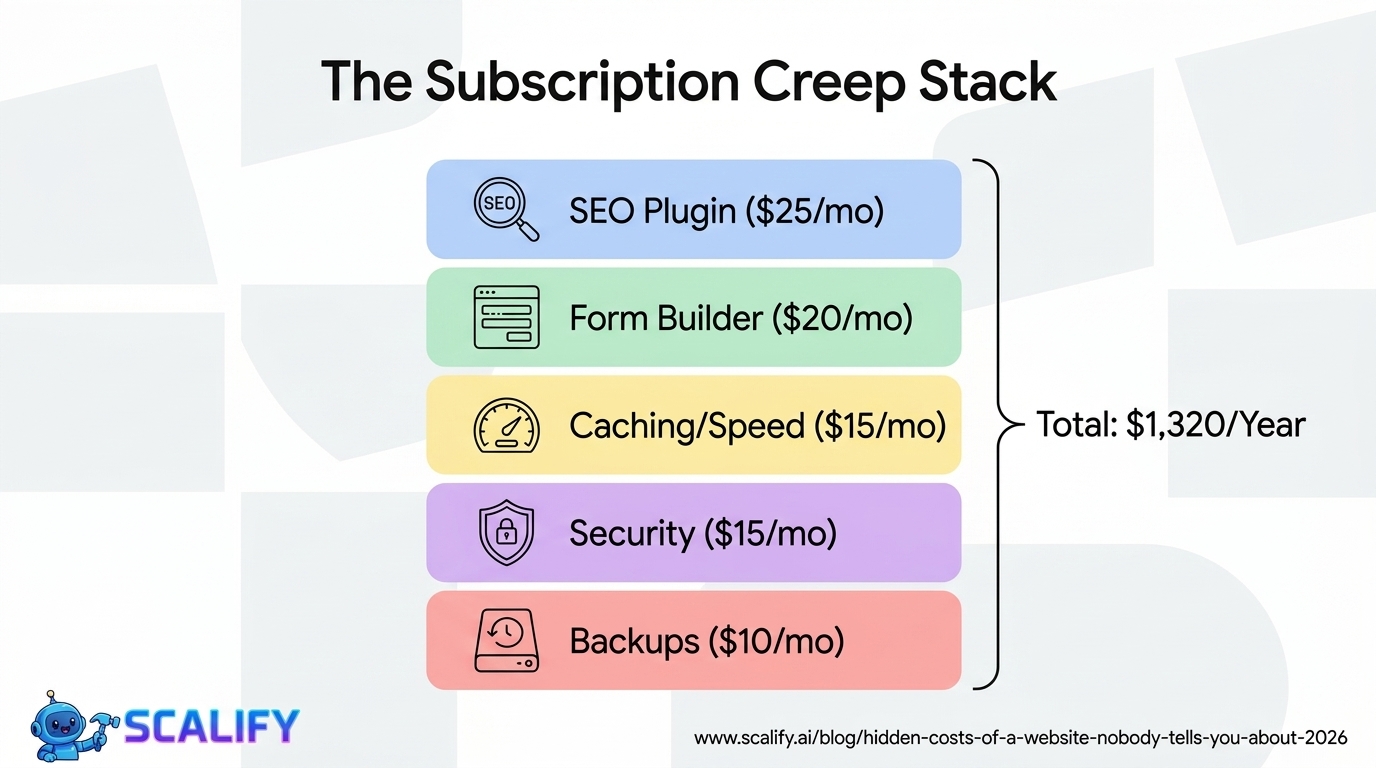
WordPress sites accumulate paid plugin subscriptions that each seem small but add up to significant monthly cost: a premium SEO plugin at $25/month, a form builder at $20/month, a caching plugin at $15/month, a page builder at $25/month, a backup service at $10/month, a security scanner at $15/month. These six plugins alone add $110/month — $1,320/year — to a site that may have been built for $5,000. Plugin cost is rarely discussed in initial website proposals because most developers don't know in advance exactly which plugins will be needed, or which ones the client already has subscriptions for. Build a complete plugin inventory before launch and include the monthly costs in your ongoing budget.
Content: The Biggest Ongoing Cost Nobody Plans For
Content is the most underestimated ongoing website cost. A website that doesn't publish new content, update existing pages, and maintain current information gradually loses organic search rankings, appears stale to visitors, and fails to capture new search demand as it emerges. The content investment required to maintain and grow organic search traffic: 2–4 articles per month at 2,000+ words each, requiring either internal writing time ($50–$200/article in staff time) or professional content writing ($150–$500/article). Annually: $1,800–$24,000 in content costs alone for a meaningful organic content program. Many businesses discover this cost only after launching a website and watching their rankings plateau or decline because no new content was published after launch.
Developer Maintenance: The Invisible Budget Line
Every dynamic website requires ongoing developer maintenance: security updates, plugin updates that occasionally break things, feature requests from the business, bug fixes as browsers evolve, and annual performance audits. Businesses that don't budget for this typically discover it as an emergency cost — paying 3x the hourly rate for urgent fixes because they didn't plan for maintenance at all. Realistic maintenance cost estimates: WordPress sites $150–$400/month for updates, security monitoring, and minor fixes; custom-built sites $300–$800/month; e-commerce sites $400–$1,200/month given higher transaction stakes. This should be line-itemed in any website budget conversation before launch, not discovered post-launch.
.jpeg)
The 3-Year Total Cost Model
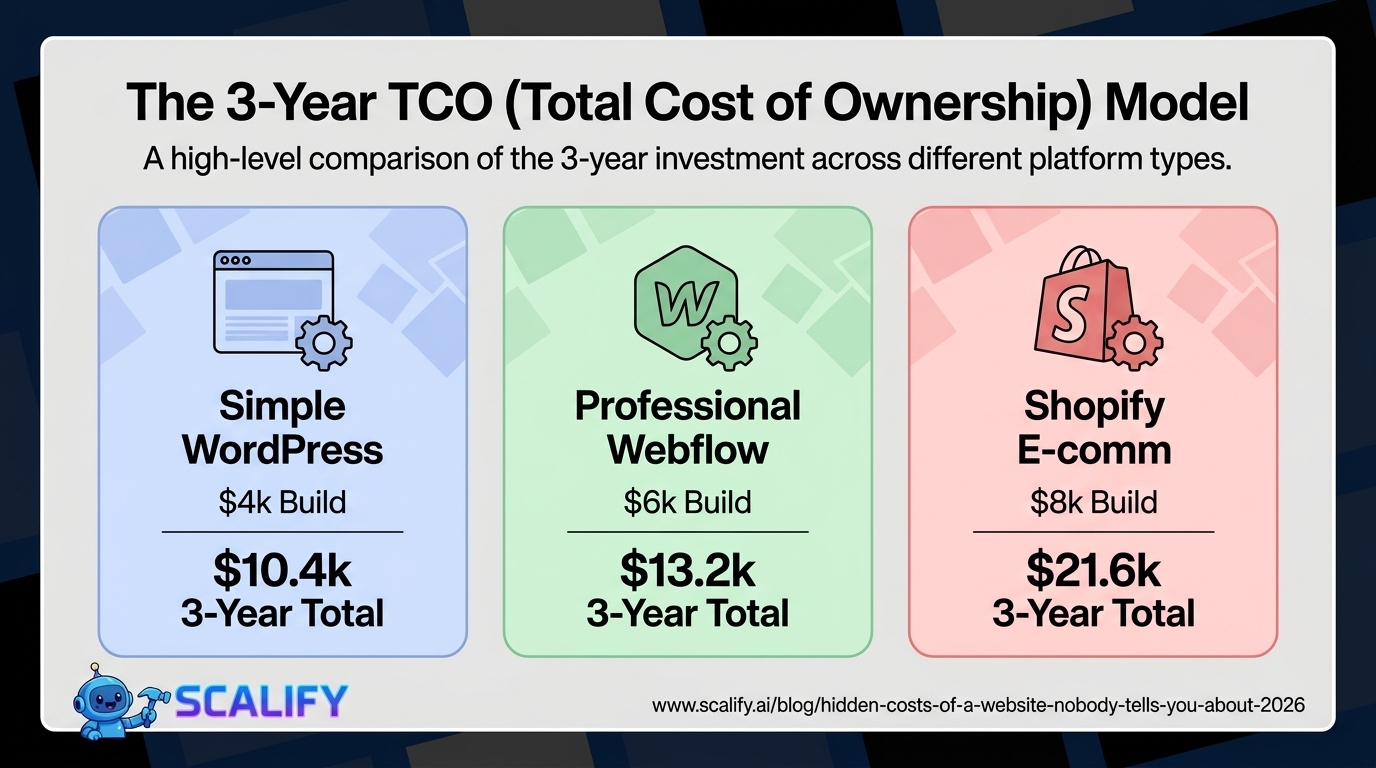
Website TypeBuild CostMonthly Ongoing3-Year TotalSimple business site (WordPress)$4,000$180 (hosting + plugins + backup)$10,480Business site with content program$6,000$780 (hosting + plugins + content)$34,080E-commerce (Shopify)$8,000$380 (platform + apps + support)$21,680Custom-built site with active dev$25,000$1,200 (hosting + dev maintenance)$68,200Webflow site (professional)$6,000$200 (platform + minor maintenance)$13,200
Reducing Hidden Costs: What Actually Helps
Strategies for reducing ongoing website costs without sacrificing quality: choose platforms with hosting included at reasonable rates (Webflow includes CDN hosting; Shopify includes e-commerce infrastructure; Squarespace includes hosting) rather than self-hosted platforms requiring separate hosting management; audit active plugins/apps annually and remove any that aren't actively providing value; consolidate multiple single-purpose tools into all-in-one platforms where quality doesn't suffer; negotiate annual contracts with vendors who offer monthly pricing (typically 15–25% discount); and build internal content capacity rather than relying entirely on expensive agency content production.
Questions to Ask Before Commissioning a Website
Before signing any website development contract, get specific answers to these questions: What will hosting cost per month after launch, and on what provider? Which plugins or apps are required for the features you're building, and what do they cost? What ongoing maintenance is required and what will it cost? Who owns the website files, domain, and hosting after delivery? What's the process and cost for making content updates? These questions convert a website proposal into a complete financial picture — and the answers often change the comparative economics of different platform and development approaches significantly.
The Bottom Line
The build cost of a website is typically 30–60% of its 3-year total cost — the remaining 40–70% is ongoing hosting, maintenance, content, and tooling. Understanding the full cost picture before committing prevents budget surprises and enables genuine comparison between options: a $15,000 custom WordPress build with $600/month ongoing costs may be more expensive over 3 years than a $6,000 Webflow build at $200/month. Budget for all categories, get specifics about ongoing costs from any developer you work with, and plan content investment alongside technical investment from the start.
At Scalify, we build websites in 10 business days on Webflow — which includes hosting, CDN, and SSL at a predictable platform cost with minimal ongoing maintenance overhead.
Top 5 Sources
Domain and Email Costs: Often Assumed, Rarely Budgeted
Domain registration is often assumed to be a one-time cost, but renewal fees after the first year (typically $10–$50/year depending on TLD) are ongoing. More significantly, premium domains (.io, .ai, .co) can cost $50–$200/year, and domain transfer or acquisition from a current owner (if the .com you want is already registered) can cost thousands to millions. Email hosting is another assumption-driven cost: many businesses assume professional email (you@yourdomain.com) is included in their website hosting when it's actually a separate service. Google Workspace (Gmail with your domain) costs $6/user/month; Microsoft 365 costs $6–$22/user/month. For a team of 10, this adds $720–$2,640/year to the website's total cost of ownership — a budget line that's routinely missing from initial website project budgets.
E-Commerce Hidden Costs: The Transaction Fee Trap
E-commerce websites carry a category of hidden cost that non-e-commerce sites don't: transaction fees on every sale. Shopify charges 0.5–2% per transaction (depending on plan) unless you use Shopify Payments. Third-party payment processors (PayPal, Stripe) charge 2.7–3.5% per transaction. On a business doing $20,000/month in online sales, a 2.5% effective rate costs $500/month — $6,000/year — in payment processing fees that many e-commerce businesses don't factor into their profitability calculations when evaluating website platform costs. Additionally, app subscriptions for e-commerce features — abandoned cart recovery, upsell apps, review platforms, loyalty programs — add $50–$300/month in necessary functionality that platform marketing materials don't highlight as required for competitive feature parity.
The Cost of NOT Having Good Hosting
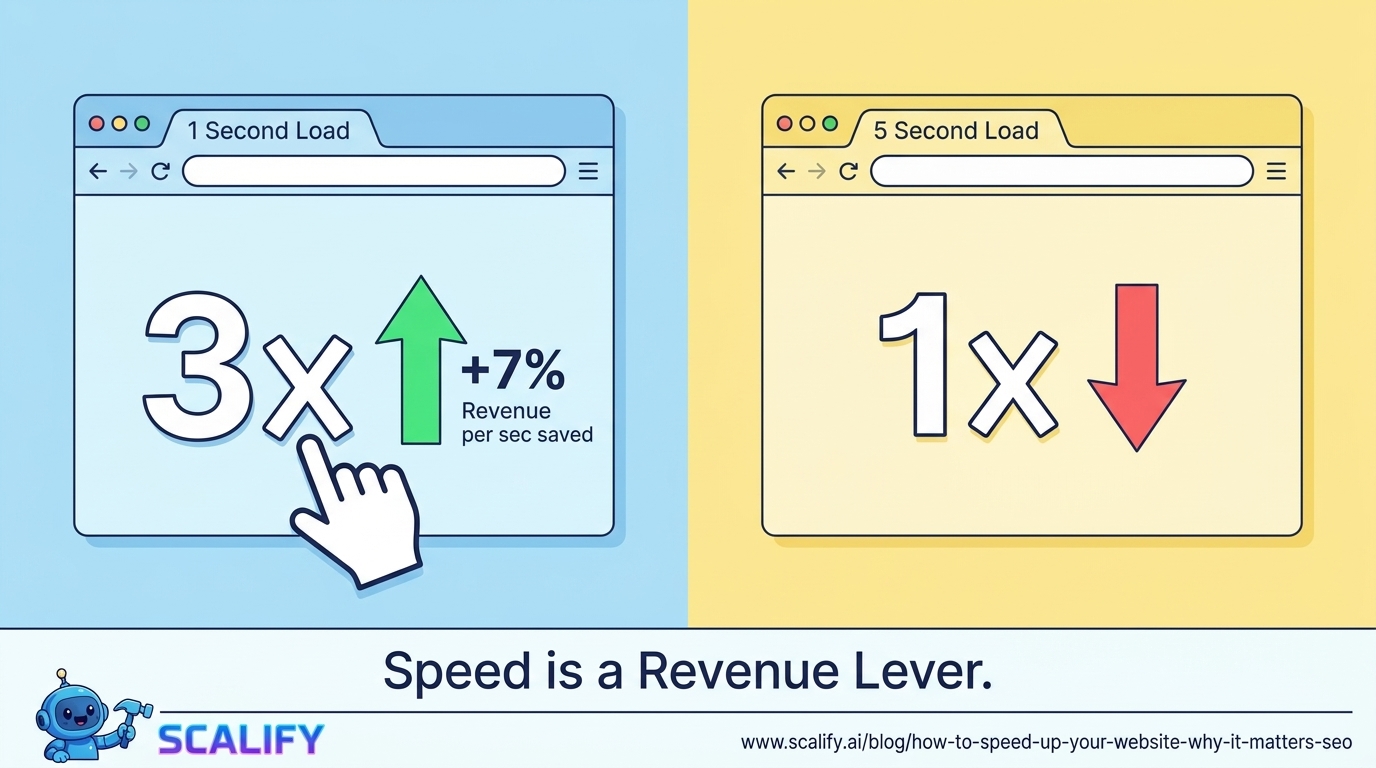
The most significant hidden cost is the opportunity cost of poor performance — the revenue that cheap hosting costs in lost conversions. A website on shared hosting that loads in 5 seconds converts 3x worse than the same website on quality hosting loading in 1 second. For a business generating $20,000/month through its website with a 2% conversion rate on 50,000 monthly visitors, a 2x conversion improvement from better hosting performance generates $20,000 additional monthly revenue — compared to a hosting cost difference of $50–$100/month. This makes "cheap" hosting one of the most expensive choices a business website can make, quantified in terms of actual lost revenue rather than just abstract user experience principles.
SEO and Marketing Tool Subscriptions
Once a website is live, the question of how to drive traffic to it inevitably surfaces — and with it, a new category of subscription costs. Ahrefs or Semrush for SEO research: $99–$119/month. Email marketing platform (Mailchimp, ConvertKit, Klaviyo): $20–$150/month depending on list size. Live chat (Intercom, Tidio): $19–$200/month. CRM integration: $15–$100/month. Heatmap and session recording (Hotjar, Clarity free tier): $0–$80/month. These tools don't appear in website development proposals but become necessary within months of launch for any business taking digital marketing seriously. Budget $200–$500/month for the core marketing tool stack in any website financial planning — and start with free tiers where available before committing to paid plans.
Cybersecurity Costs: The Price of Getting Hacked
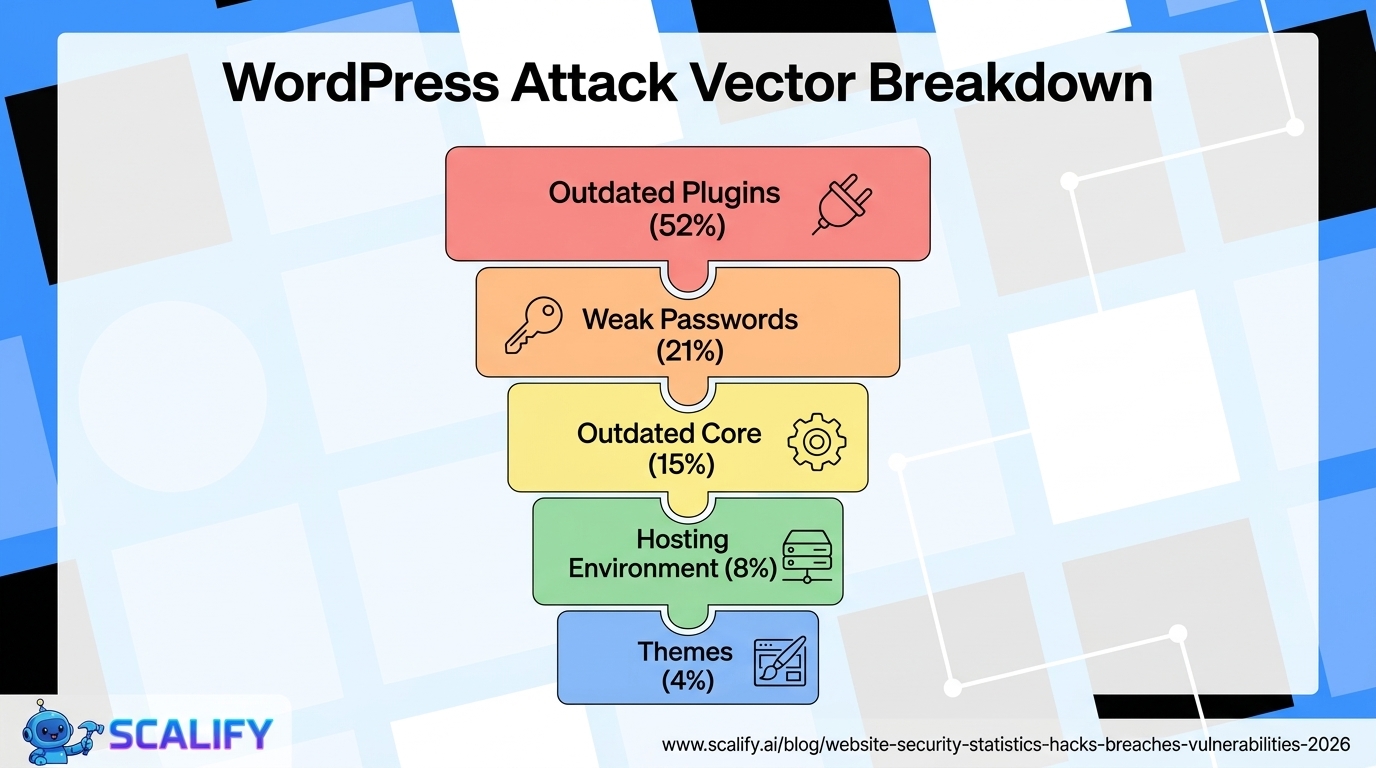
Website security is often treated as optional until a breach demonstrates otherwise. The real costs of inadequate security dwarf the preventive investment: a hacked WordPress site typically requires $200–$2,000 in cleanup services, loses days or weeks of organic rankings (Google de-indexes malware-infected sites), and creates customer trust damage that lasts beyond the technical remediation. Security investment that prevents this: a managed firewall and malware scanner (Wordfence, Sucuri) at $10–$30/month, automatic plugin updates (reduces vulnerability window), and managed hosting with security included ($50–$150/month includes security at most quality hosts). The $500–$800 annual security investment that prevents one breach — which would cost $1,000–$5,000 to remediate plus lost revenue during downtime — is unambiguously good financial management.
What to Do with This Information
The purpose of understanding hidden costs is not to be discouraged from investing in a website — it's to plan the investment accurately. The businesses that get the best ROI from website investments are those that budget for the full picture: initial build, ongoing platform costs, content production, developer maintenance, and marketing tools. They treat their website as an ongoing business system rather than a one-time purchase, and they allocate consistent budget to keep it performing well. The $600/month in ongoing costs for a well-maintained, well-marketed business website producing $10,000/month in attributable revenue is one of the best marketing ROIs available — but only if the ongoing costs are managed and invested in rather than ignored until something breaks.
Redesign and Migration Costs: The 3-Year Reset
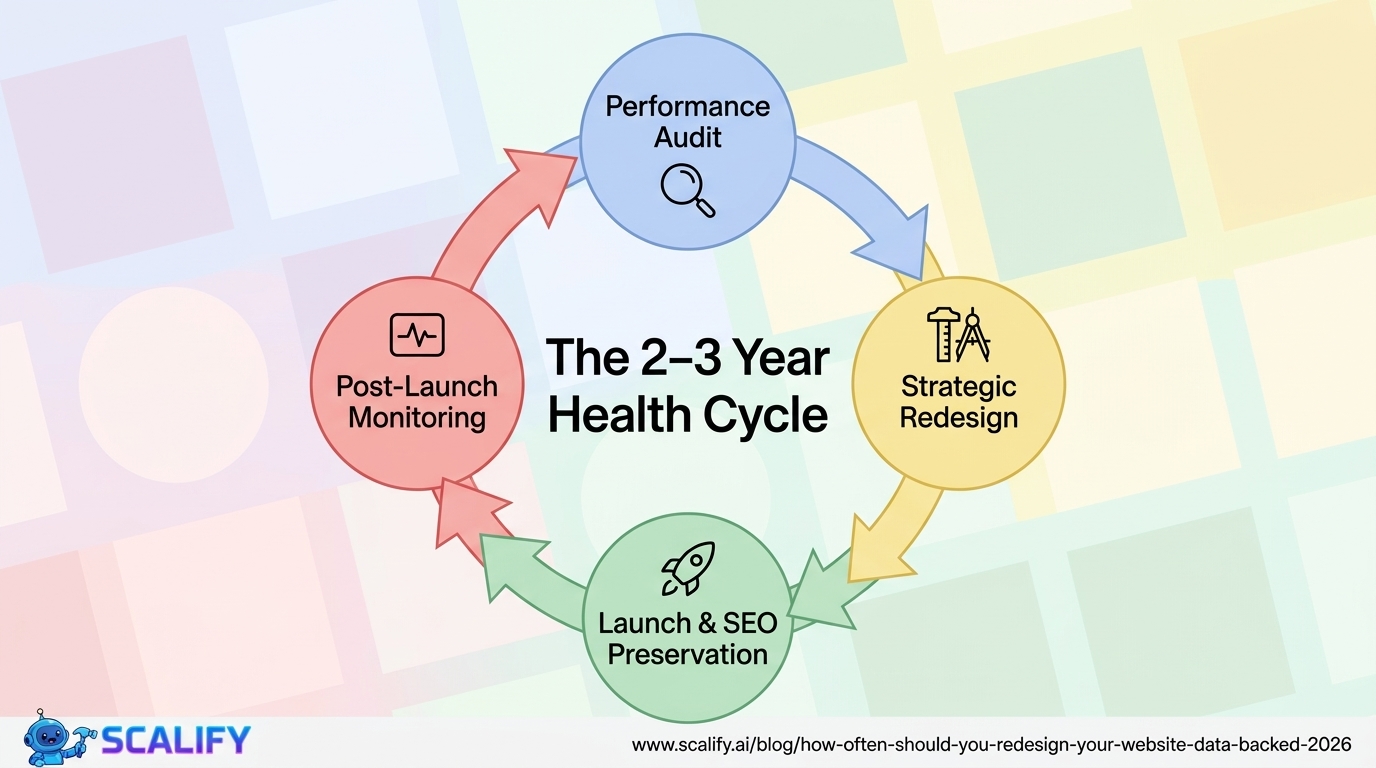
Most business websites need a meaningful update every 2–3 years — whether a full redesign, platform migration, or major content overhaul. This cost is rarely included in initial website financial planning because it feels distant at launch time. In practice, 3-year redesign costs of $4,000–$20,000 should be amortized into the annual cost of website ownership: $1,300–$6,700/year in a dedicated redesign reserve. Businesses that don't plan for this either: defer the redesign past the point where the site is limiting business outcomes (paying in lost revenue rather than explicit budget), or treat it as an unexpected expense that strains budgets when it becomes necessary. Planning for it from the start makes the financial management predictable.
Platform migration costs — moving from WordPress to Webflow, from a custom build to Shopify, or any other platform change — add a one-time cost of $2,000–$15,000 on top of the new build cost, primarily for content migration and URL redirect implementation. Including potential migration costs in the long-term budget prevents being locked into a platform that no longer serves the business's needs simply because the migration cost wasn't anticipated when the original platform decision was made.


.jpeg)
.jpeg)



78 SW 7th St, Miami, FL 33130