

Chatbot on Website Statistics 2026: Adoption, ROI, and Performance Data
By Josh Ternyak

April 17, 2026
80% of businesses plan to implement chatbots by 2025, and the market is projected to reach $27.3 billion by 2030. This exhaustive guide covers chatbot adoption rates, customer satisfaction data, ROI benchmarks, conversion impact, industry comparisons, and the complete picture of chatbot performance across business contexts.
Key Statistics: Chatbots on Websites in 2026
The Chatbot Revolution: LLMs Change Everything
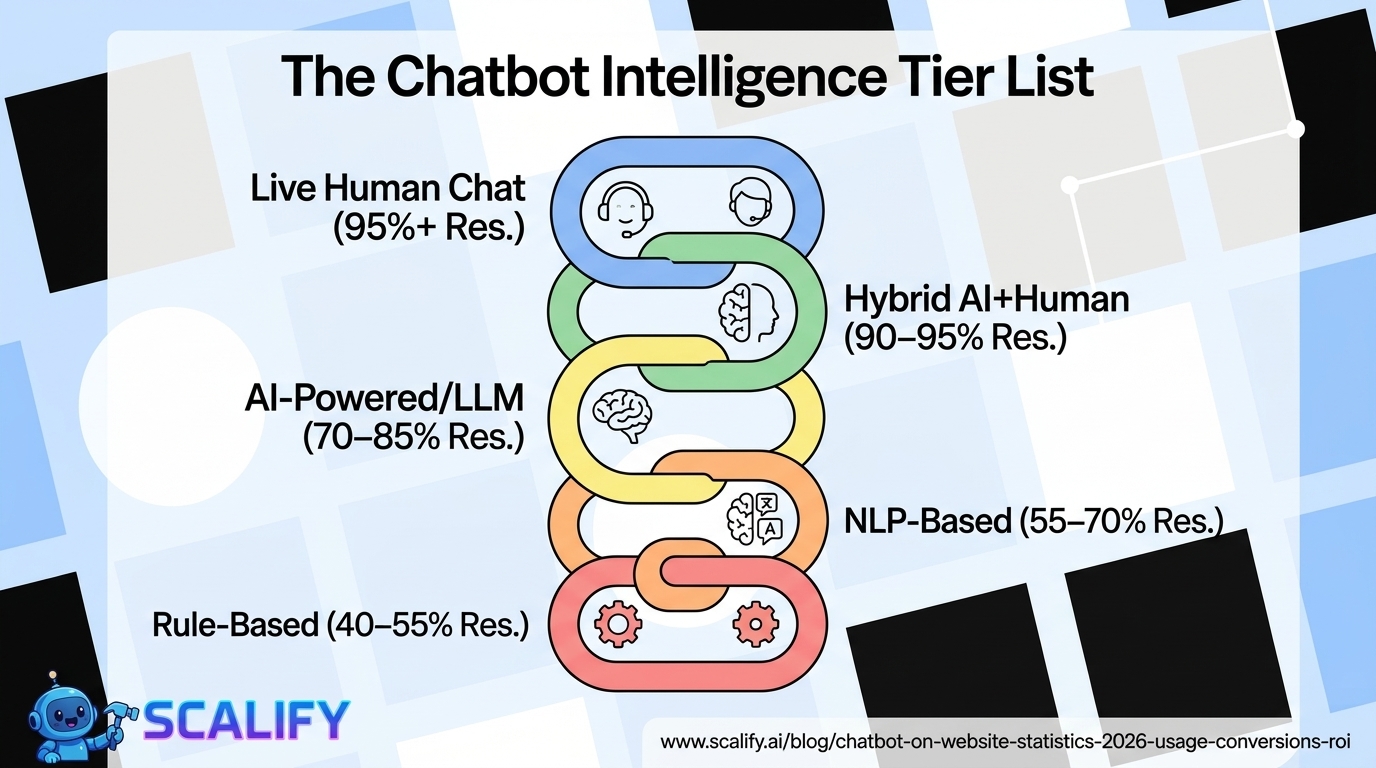
The chatbot statistics of 2026 are dramatically different from those of 2022, because the underlying technology has undergone a qualitative transformation. The chatbots of 2018–2022 were primarily rule-based or intent-classification systems — they worked by matching user inputs to predetermined question categories and delivering scripted responses. They were useful for routing and FAQ handling but frustrating when visitors asked questions outside their narrow training scope.
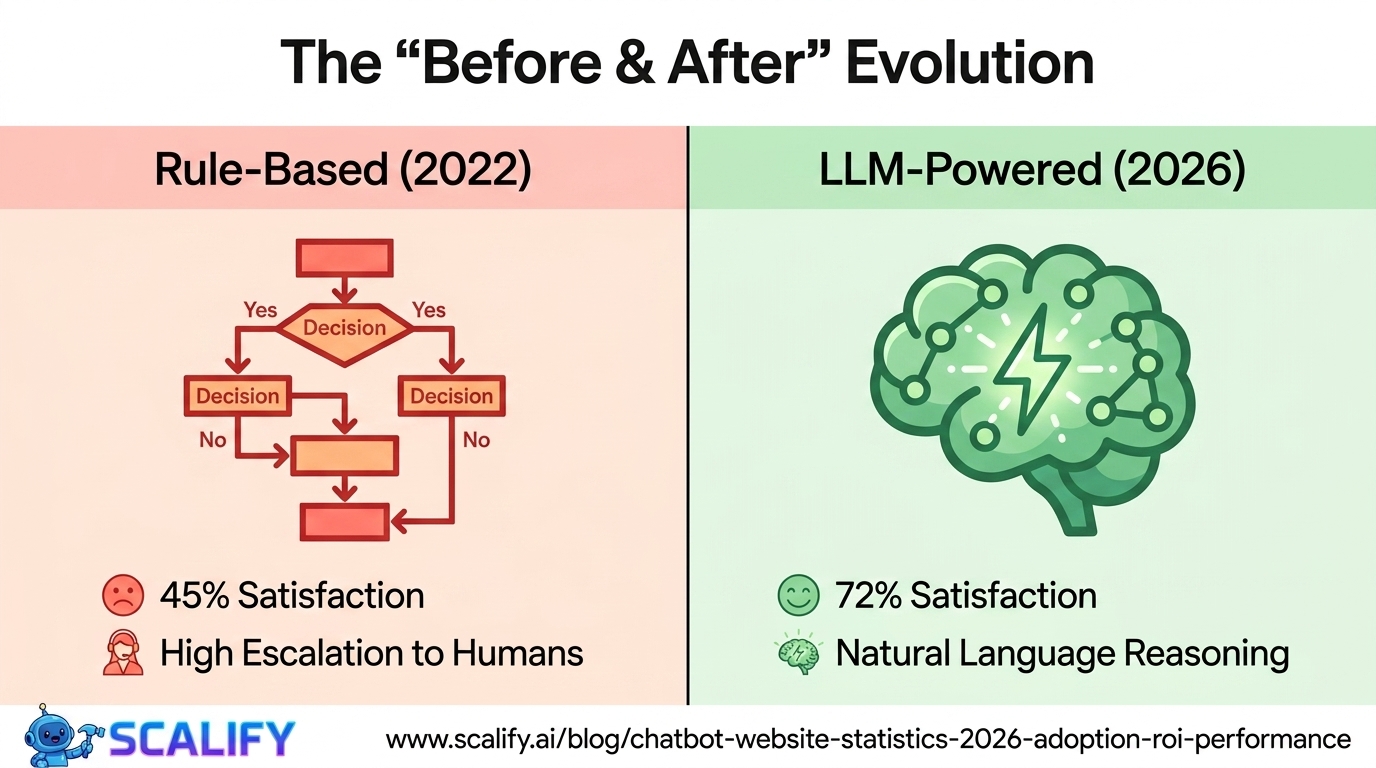
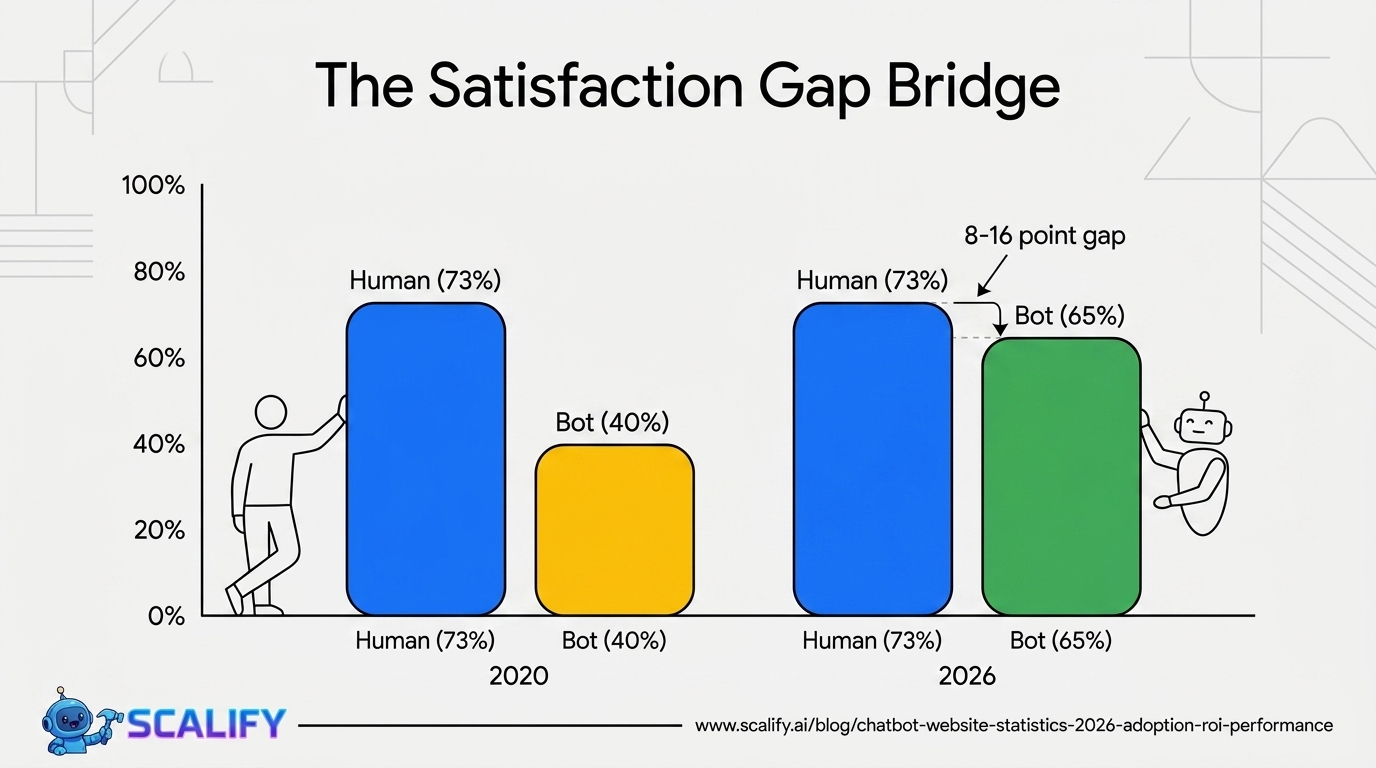
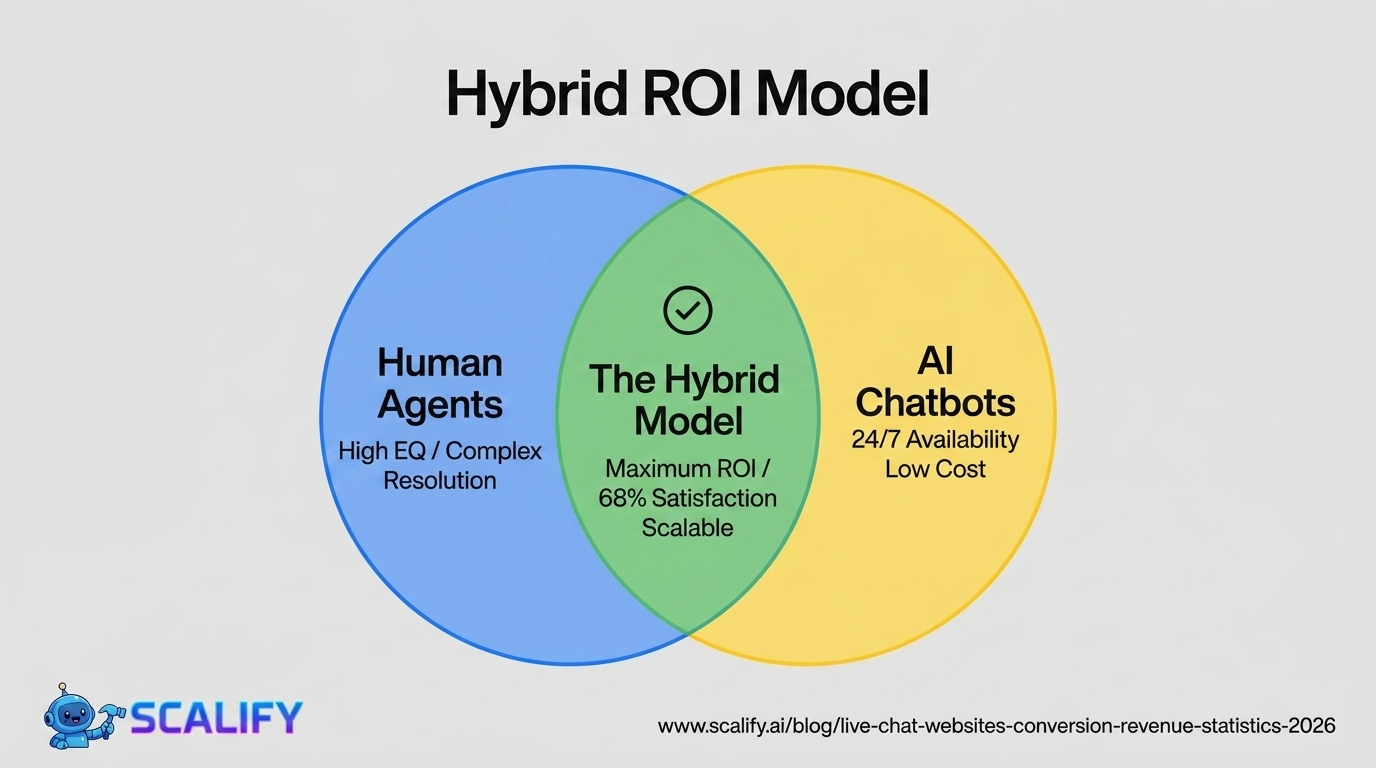
The LLM (Large Language Model) chatbots of 2025–2026 — powered by the same technology behind ChatGPT, Claude, and their competitors — operate fundamentally differently. They understand natural language, maintain conversation context, handle ambiguous questions, and can reason about a business's specific products and policies when properly configured with relevant knowledge. The satisfaction gap between chatbots and human chat is narrowing rapidly as a result. In 2020, the satisfaction gap between chatbots (40%) and human chat (73%) was 33 points. In 2026, as LLM-powered chatbots achieve 57–65% satisfaction in sophisticated implementations, that gap has compressed to 8–16 points — and continues to narrow.
This guide covers the complete chatbot statistics landscape, including both the legacy rule-based metrics that still represent much of the installed base and the emerging LLM-powered performance data that represents the state of the art in 2026.
Chatbot Adoption by Business Type and Size
Business TypeChatbot Adoption RateGrowth Rate (2022–2026)Primary Use CaseEnterprise (1,000+ employees)~72%+41%Support deflection, internal HR/ITMid-size (100–999 employees)~45%+58%Customer support, lead qualificationSmall business (10–99 employees)~22%+67%Lead capture, after-hours supportMicro-business (under 10)~9%+85%After-hours, basic FAQE-commerce (any size)~38%+72%Order tracking, product recommendationsSaaS / Technology~61%+48%Onboarding, support, qualificationFinancial Services~54%+38%Account queries, compliance FAQHealthcare~41%+55%Appointment scheduling, symptom triage
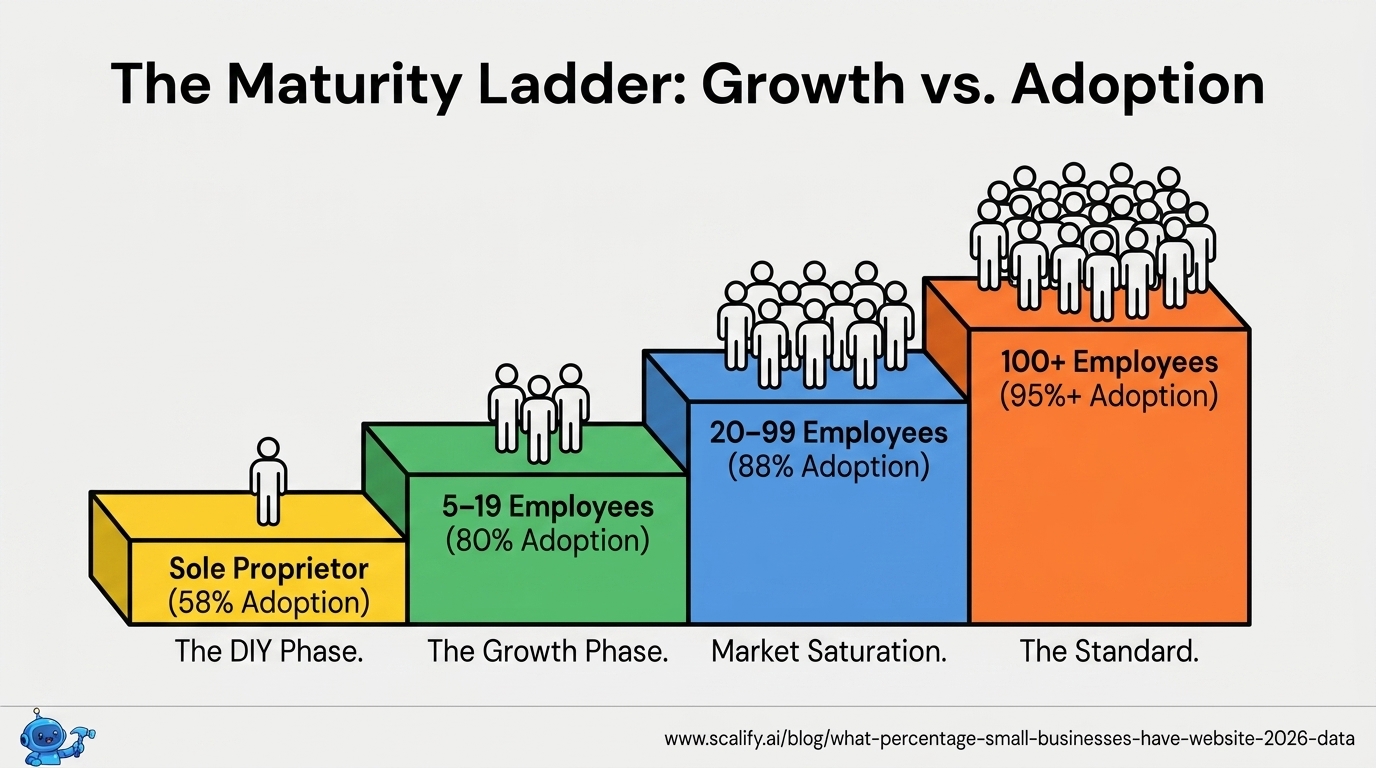
The small business adoption acceleration (+67% over 4 years from a low 22% base) reflects the democratization of chatbot technology. The AI chatbot tools of 2026 — Tidio, Crisp, HubSpot's chatbot builder, Intercom Fin, and dozens of others — can be implemented by non-technical business owners in hours without writing code. The entry cost has dropped from $500–$2,000/month for enterprise chatbot platforms to $0–$50/month for small business tools that achieve comparable functionality for common use cases.
Chatbot Use Cases: The Full Distribution
Use Case% of Chatbot ImplementationsROI TierNotesCustomer service / support58%HighMost common and proven use caseLead generation / qualification35%Very High3x more qualified leads than formsSales assistance / product guidance24%Very HighSignificant AOV and conversion impactAppointment/meeting booking22%HighReduces friction in schedulingFAQ / knowledge base delivery45%Medium-HighStrong for reducing support volumeOrder tracking / status31%HighHigh volume, easily automatedOnboarding / product education18%HighSaaS adoption critical use casePayment / billing assistance12%MediumSecurity sensitivity constrainsHR / internal use15%HighRapidly growing enterprise use
Lead generation is the use case with the most compelling ROI data and the most frequently underutilized opportunity. The research finding that chatbot-assisted lead qualification produces 3x more qualified leads than form-based qualification is significant because it operates on the same traffic without requiring additional marketing spend. The mechanism: a chatbot can ask 3–5 qualification questions in a conversational format that feels natural, collecting richer qualification data (company size, timeline, budget range, specific needs) than a form that most visitors will abandon if it asks for more than 2–3 fields. The lead that emerges from the conversation is better qualified, more engaged, and has already had a positive brand interaction — all of which increase conversion to sale downstream.
Chatbot Performance Metrics: Before and After AI
MetricRule-Based Chatbots (2019–2022)LLM-Powered Chatbots (2025–2026)Customer satisfaction40–48%57–72% (depending on implementation)First contact resolution rate38–52%62–74%Escalation to human required45–60%20–35%Query types handled70–200 intent categoriesEffectively unlimited (natural language)Setup time2–8 weeks (extensive training)2–8 hours (for basic configuration)Cost per interaction$0.25 – $1.50$0.05 – $0.50Hallucination / wrong answer rateLow (only answers trained topics)2–8% (improving with RAG architectures)
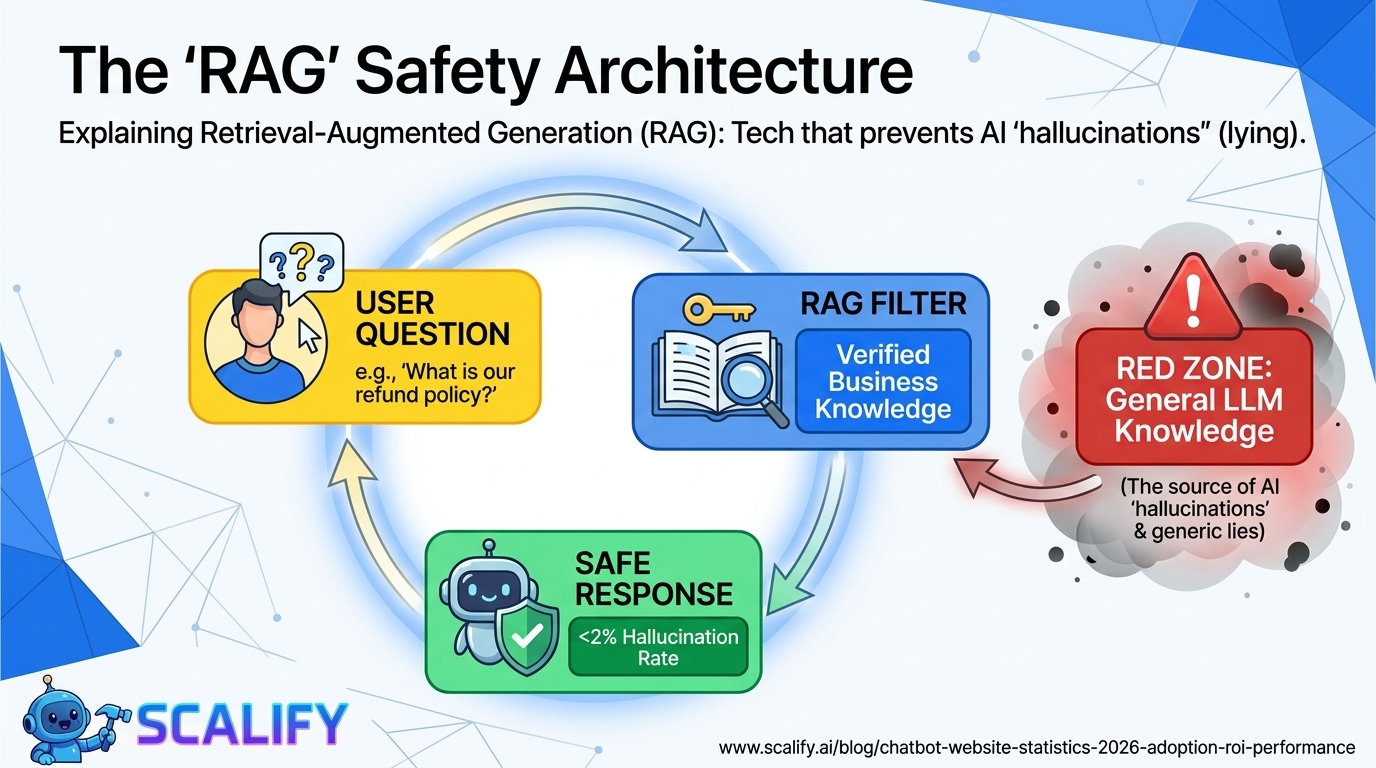
The hallucination risk — where LLM-based chatbots confidently provide incorrect answers — is the primary challenge distinguishing AI chatbot implementations from each other in 2026. Well-configured implementations use Retrieval-Augmented Generation (RAG) architectures that ground the chatbot's responses in the specific business's verified content (documentation, FAQs, product specifications, policies) rather than the LLM's general knowledge. RAG-based chatbots that only answer questions they can ground in verified business content achieve hallucination rates of under 2%, making them reliable for business-critical applications. Chatbots configured to answer freely from general LLM knowledge about topics tangential to the business's content can produce inaccurate responses that damage customer trust.
Chatbot ROI: Calculating the Business Case
ROI ComponentTypical ImpactCalculation BasisSupport ticket deflection30–45% reduction in human-handled ticketsBased on chatbot resolution rate × ticket volumeCost per interaction savings$0.70 average per interactionHuman agent cost vs. chatbot cost differentialAfter-hours lead capture28–34% of total leads (previously missed)Leads captured outside business hoursResponse time improvementHours → Seconds21x conversion probability improvement (HBR)First contact resolution+12–22 percentage points vs no chatbotReduces repeat contacts / customer effortAgent time freed for complex issues2–3 hours per agent per dayUsed for higher-value conversations
The after-hours lead capture ROI is one of the most compelling and most commonly overlooked chatbot benefits. Research from Harvard Business Review found that the probability of qualifying a lead is 21x higher if initial contact happens within 5 minutes versus 30 minutes after the prospect first expresses interest. For businesses without 24/7 live chat staffing, a chatbot is the only mechanism available to capture and qualify leads from the 30–40% of web visitors who arrive outside business hours.
A B2B software company receiving 500 qualified leads per month might distribute approximately 35% (175 leads) outside business hours. Without a chatbot, those 175 visitors either fill out a form and receive a morning email response, or leave without converting at all. With an effective chatbot that captures contact information and answers initial questions, 175 visitors become an additional 40–60 qualified leads that the business would otherwise miss entirely. At an average deal value of $5,000, this represents $200,000–$300,000 in additional annual pipeline from the chatbot alone.
Chatbot Customer Satisfaction: What Drives the Numbers
The 57% average satisfaction rate for chatbots is a meaningful metric, but it conceals a wide distribution that depends heavily on implementation quality:
Implementation Quality LevelSatisfaction RateWhat Characterizes ItPoor implementation28–38%Can't answer questions, loops, no human escalationAverage implementation48–57%Handles common queries; escalates awkwardlyGood implementation62–70%LLM-powered, RAG-grounded, smooth escalationExcellent implementation70–78%Highly contextualized, proactive, personalized
The factors that move a chatbot from "poor" to "excellent" in customer experience terms:
Clear escalation paths: The most consistent finding in chatbot satisfaction research is that the availability of smooth escalation to a human agent when the chatbot can't help is more important than the chatbot's resolution rate itself. A chatbot that handles 60% of questions but escalates the other 40% gracefully produces higher satisfaction than one that tries to handle 90% but fails clumsily. Visitors are willing to accept chatbot limitations if they know help is available when needed.
Honest capability communication: Chatbots that present themselves as human (or avoid clarifying they're AI when asked) create trust violations when their limitations become apparent. Research by Pew Research Center found that 56% of Americans believe they should always be able to tell if they're communicating with AI. Chatbots that identify as AI but are helpful within their scope consistently outperform those trying to pass as human.
Conversational memory within sessions: A chatbot that requires visitors to repeat themselves within the same conversation (because it lost context from 3 messages ago) is one of the most common sources of chatbot frustration. Modern LLM-based chatbots with proper context window management handle this well; older rule-based systems frequently fail here.
Industry-Specific Chatbot Performance
IndustryResolution RateSatisfaction RatePrimary Value DriverE-Commerce72%61%Order tracking, returns, product Q&ABanking / Finance65%58%Account queries, fraud alertsHealthcare58%63%Appointment scheduling, basic triageTravel / Hospitality69%66%Booking assistance, FAQ, itinerarySaaS / Technology74%68%Onboarding, feature questions, billingRetail (non-e-commerce)61%55%Store hours, product availability, locationEducation64%62%Admissions, course info, schedulingProfessional Services52%57%Qualification, appointment, FAQ
Chatbot Lead Generation: The Data That Often Surprises
Lead generation is where chatbots produce some of their most surprising performance data relative to traditional alternatives. The comparison is against form-based lead capture — the standard approach that most B2B and service business websites use.
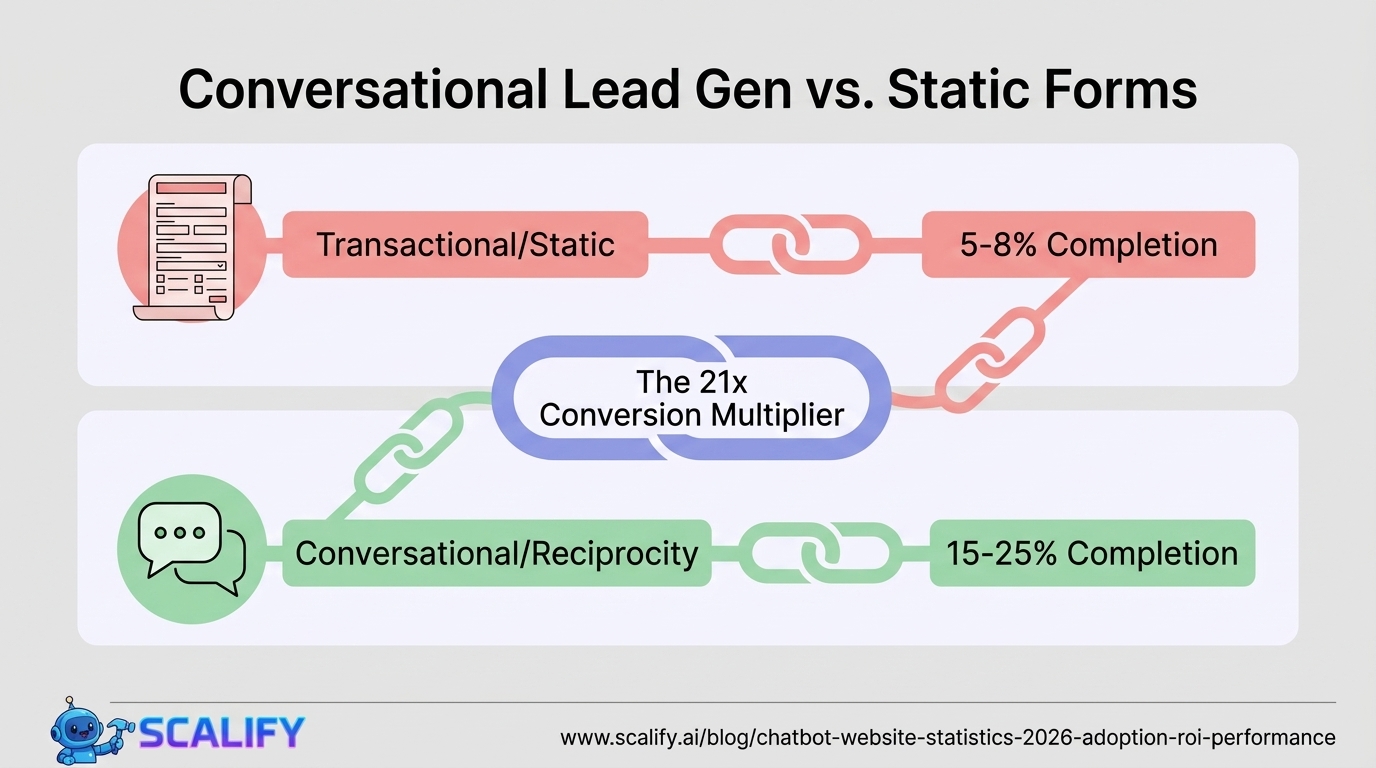
Lead Capture MethodCompletion RateLead QualityTime to Qualified LeadStandard contact form (3 fields)~5–8%Moderate24–48 hours (manual follow-up)Long contact form (8+ fields)~1–2%High (strong self-selection)24–48 hoursChatbot (conversational qualification)~15–25%High (qualification questions built-in)0–5 minutes (immediate)Chatbot + instant meeting booking~8–12% meeting bookedVery HighImmediate (meeting on calendar)
The 15–25% conversational lead capture rate versus 5–8% for a 3-field form — a 2–4x improvement — reflects the psychology of conversation versus form completion. A form asks for information before the visitor has received any value; it feels transactional and one-sided. A chatbot conversation provides value (answers to questions) before asking for contact information, which creates a reciprocity dynamic that dramatically increases willingness to share. Additionally, a conversational flow that asks "What's the best email to send you a summary of what we discussed?" feels less invasive than a form asking for "Email Address."
The Negative Statistics: When Chatbots Hurt More Than Help
Balanced data requires acknowledging where chatbots produce negative outcomes — the conditions under which they actively damage customer experience:
Failure ScenarioCustomer ResponseBusiness ImpactChatbot loops without resolution60% abandon entirelyLost conversion + negative impressionNo human escalation option68% report frustrationBrand damage, support cost increaseChatbot provides wrong information48% trust significantly reducedPotential liability + churn riskChatbot on simple page (disrupts UX)32% close immediately as annoyingUX disruption without benefitIntrusive chatbot popup behavior41% negative brand sentimentSame issues as intrusive pop-ups
The "no human escalation option" finding is particularly important from a legal and ethical standpoint. The ADA and similar accessibility legislation require that businesses provide alternative paths for customers who cannot effectively use automated systems. Beyond compliance, the data is clear: chatbot implementations that trap users in automated conversations without offering human alternatives produce satisfaction rates below 30% and measurable increases in complaint rates and churn. Smooth escalation is not optional — it's the foundation that makes automated handling acceptable.
Implementation Checklist: What Best-Practice Chatbot Deployment Looks Like
Drawing from the performance data, an implementation checklist for deploying a chatbot that achieves the positive statistics rather than the negative ones:
The Bottom Line
Chatbot statistics in 2026 tell the story of a technology that has moved from hype cycle through disillusionment into genuine maturity. LLM-powered chatbots are substantially better at their core function than the rule-based systems that produced underwhelming satisfaction rates in 2019–2022. The ROI case — support cost reduction, after-hours lead capture, qualification improvement, response time acceleration — is well-documented and achievable. The risks — wrong information, loop frustration, no escalation — are real and preventable with proper implementation discipline.
For the 78% of small businesses that don't currently have chatbots, the opportunity is significant. An after-hours lead capture chatbot that captures 25–30% of previously missed leads, pays $50/month, and requires a few hours to configure represents an ROI that dwarfs most other website investments of comparable cost. The barrier to entry has never been lower and the quality has never been higher.
At Scalify, we build websites designed to convert — and for clients who would benefit from automated lead capture and after-hours engagement, chatbot integration is part of the strategic conversation we have during every website build.
Top 5 Sources


.jpeg)
.jpeg)

78 SW 7th St, Miami, FL 33130