

Vue.js Developer Salary: What the Market Is Paying in 2026
By Josh Ternyak

April 20, 2026
Vue.js developer salaries range from $62,000 to $185,000+ in 2026. This comprehensive guide covers pay by experience level, Vue 3 Composition API premium, company type, and how Vue compares to React and Angular in both salary and job market demand.
Vue.js Developer Compensation in 2026: The Full Picture
Vue.js occupies a distinct and increasingly interesting position in the front-end framework landscape. It's not the dominant framework by job posting volume (React holds that position firmly), and it's not the enterprise-scale workhorse with decades of large organization adoption (that's Angular's territory). What Vue is, in 2026, is a genuinely excellent framework with a loyal developer community, a strong presence in specific market segments, and a progressive adoption model that makes it accessible to a wide range of team sizes and technical sophistication levels.
Compensation for Vue developers reflects this market position — solid and growing, but with important nuances about where Vue pays the most and what specific skills command premiums. This guide breaks it all down comprehensively.
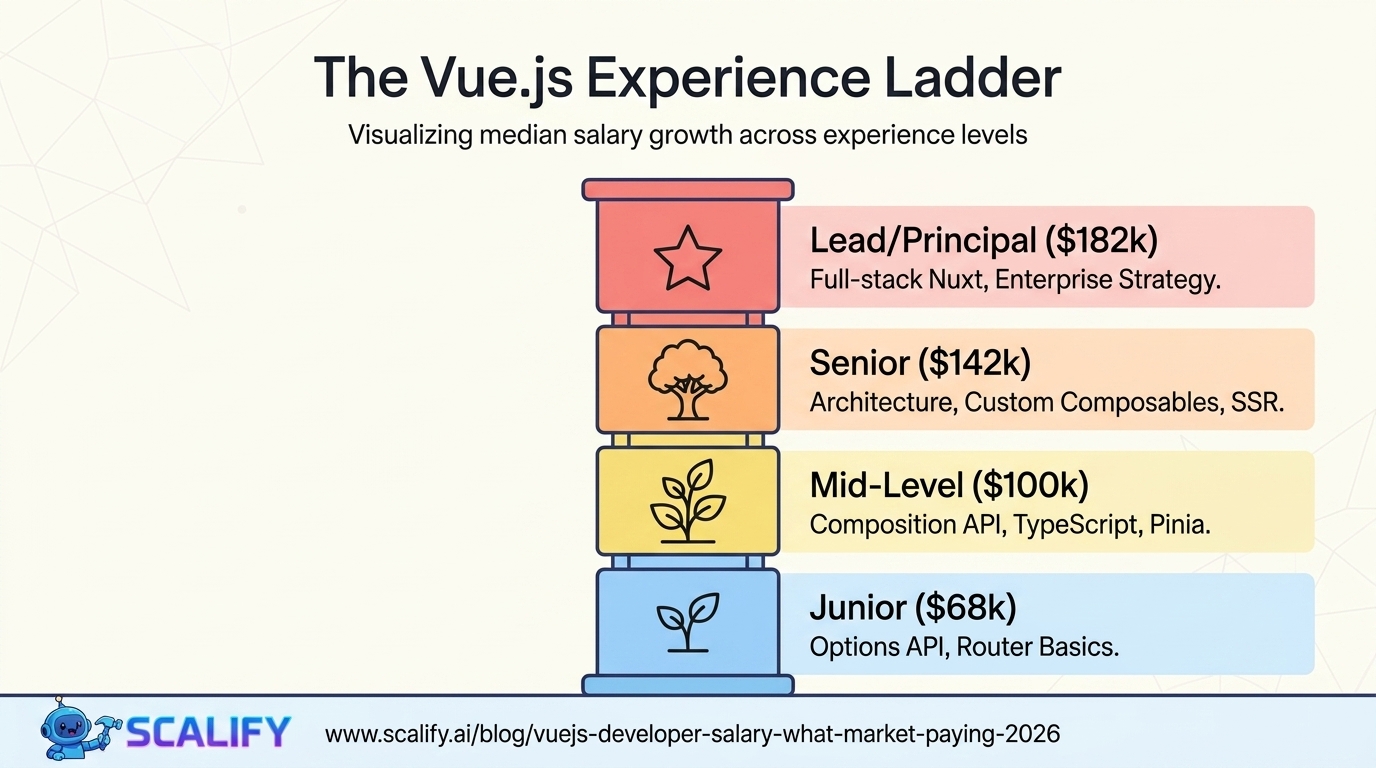
Vue.js Developer Salary by Experience Level
Experience LevelYears ExperienceSalary RangeMedianWhat's ExpectedJunior Vue Developer0–2 years$58,000 – $82,000$68,000Options API, basic Vue Router, Vuex/Pinia basicsMid-Level Vue Developer2–5 years$82,000 – $122,000$100,000Composition API, Pinia, Nuxt.js, TypeScriptSenior Vue Developer5–10 years$118,000 – $172,000$142,000Architecture, custom composables, SSR, performanceVue Tech Lead / Principal8+ years$152,000 – $225,000+$182,000Full-stack Nuxt, enterprise architecture, team leadership
Junior Vue Developer ($58,000 – $82,000)
At junior level you're building Vue components using the Options API or the Composition API (increasingly the default in 2026), implementing Vue Router navigation, and working with Pinia for state management. Vue's learning curve is gentler than React's for developers coming from an HTML/CSS background — the template syntax is more familiar, the component structure is explicit, and the debugging experience with Vue DevTools is excellent. This accessibility is part of why Vue has such broad adoption in agencies, startups, and international markets.
The bottom of the junior range is typically at web agencies using Vue for client projects. The top is at funded startups in primary markets that have standardized on Vue + Nuxt.js for their full-stack development.
Mid-Level Vue Developer ($82,000 – $122,000)
The most important skill transition at mid-level is genuine mastery of the Composition API and the Vue 3 reactivity system. Many developers who know "Vue" are still primarily Options API developers — comfortable with the older pattern but not fully fluent in the Composition API's provide/inject pattern, composable functions (the Vue equivalent of React Hooks), ref vs reactive, and the watchEffect / watch behavioral differences. Vue 3's Composition API represents a significant architectural improvement for complex components, and mid-level developers who haven't fully internalized it are limiting their ceiling.
TypeScript with Vue is the second critical mid-level differentiator. Vue 3's full TypeScript support (particularly the defineComponent + TypeScript + SFC approach, or the script setup syntax with TypeScript) enables significantly better type safety and IDE support. Companies that treat Vue seriously in 2026 expect TypeScript — developers who resist it are increasingly passing on jobs where they'd command higher pay.
Nuxt.js — Vue's full-stack meta-framework analogous to Next.js for React — is the third mid-level expectation at product companies. Understanding server-side rendering, static site generation, Nuxt's routing and layout system, and the Nuxt 3 server engine (Nitro) is the difference between a developer who can only work on Vue front-end projects and one who can own a complete Nuxt full-stack application.
Senior Vue Developer ($118,000 – $172,000)
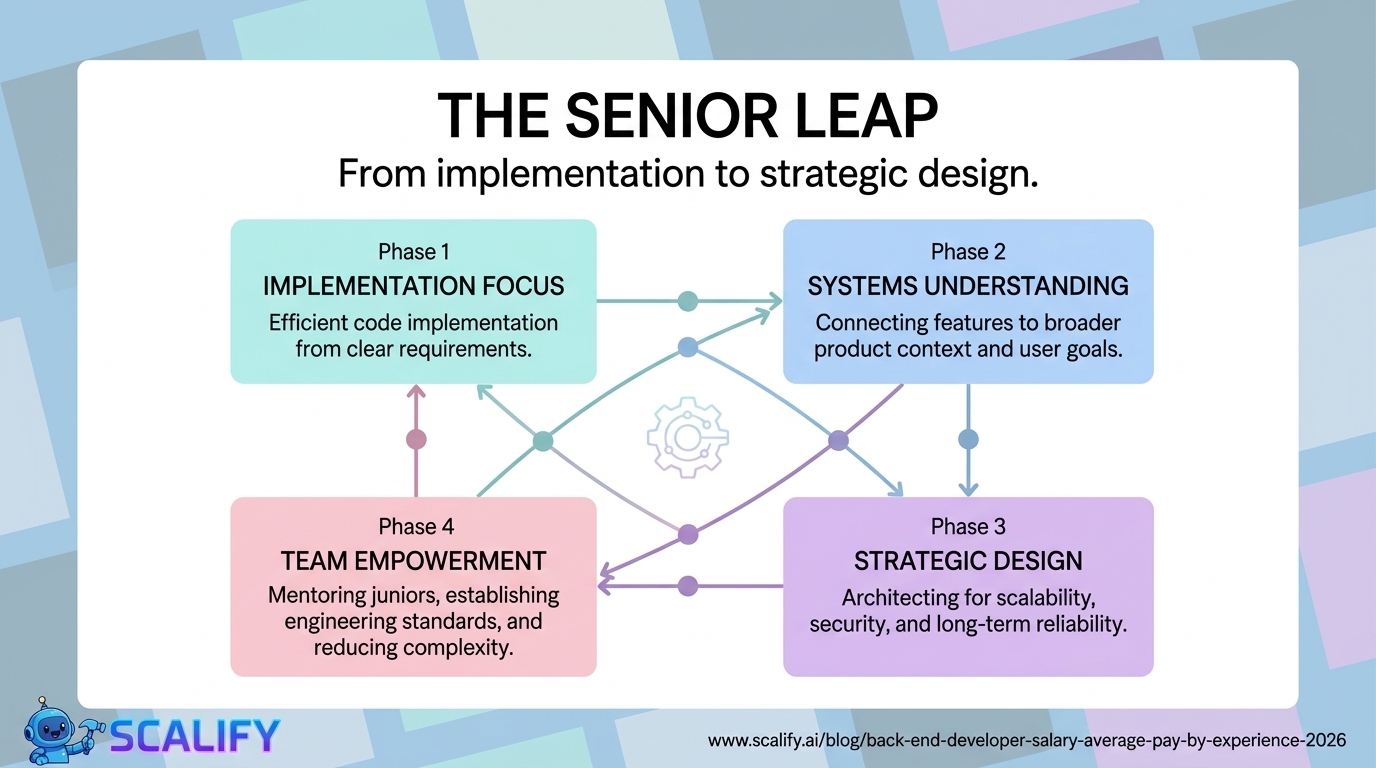
Senior Vue developers are architectural decision-makers. You're designing the composable library strategy that the whole team uses, establishing TypeScript patterns for the Vue codebase, making decisions about when to use SSR vs SSG vs CSR in Nuxt, implementing custom Vue plugins and directives that provide app-wide functionality, and ensuring the Vue application's reactivity system is implemented correctly and doesn't have performance issues (watcher recursion, inappropriate computed property dependencies, reactive system overhead).
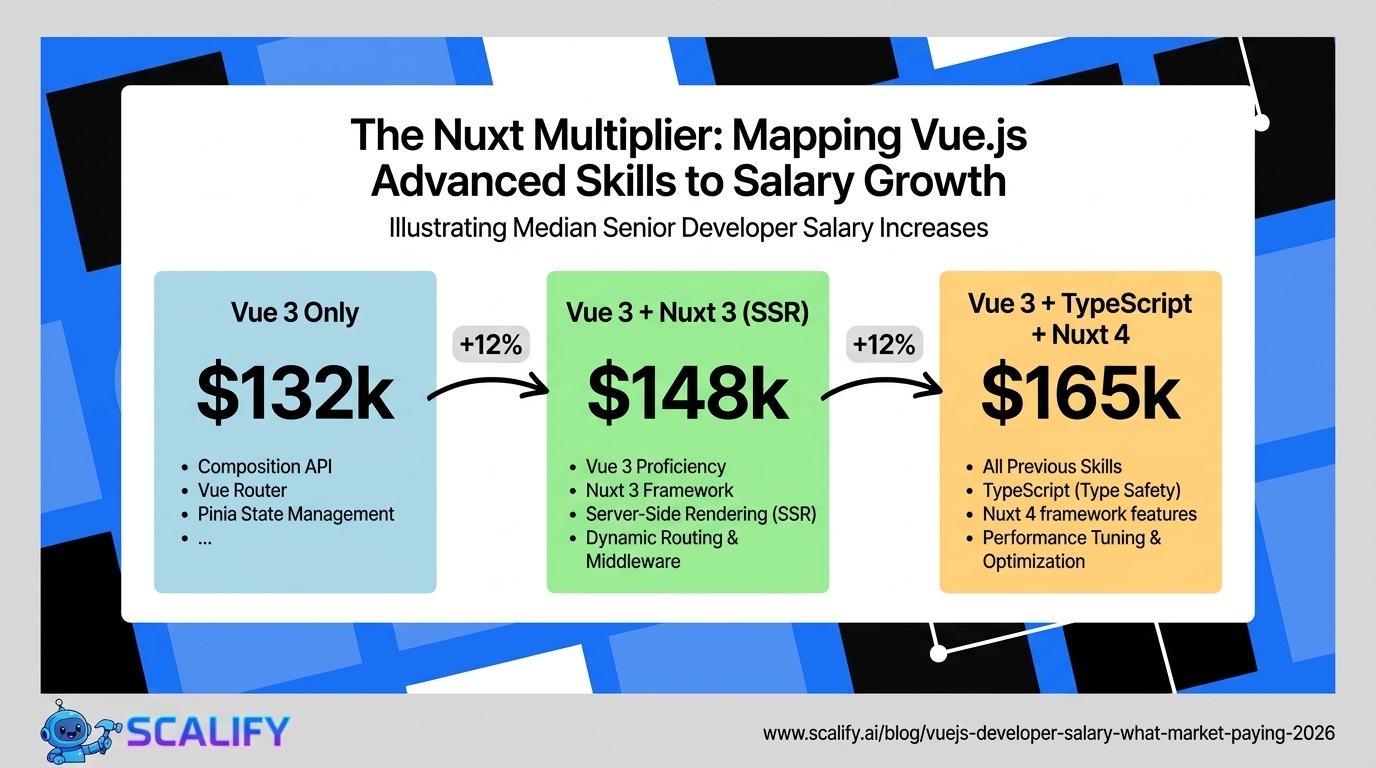
An increasingly important senior-level Vue skill in 2026: Nuxt 4 and the server-first rendering model. Nuxt's Nitro server engine and the unified full-stack patterns it enables — server routes, API handlers, server-side data fetching with useAsyncData and useFetch, hybrid rendering per-route — represent the most compelling full-stack capability in Vue's ecosystem, and developers who can architect Nuxt applications at production scale are commanding the top of the senior range.
Vue.js Developer Salary by Nuxt.js Expertise Level
Vue/Nuxt LevelMid-Level MedianSenior MedianMarket DemandVue 3 Only (no Nuxt)$95,000$132,000ModerateVue 3 + Nuxt 3 (SSR)$105,000$148,000HighVue 3 + Nuxt 3 (Full-Stack)$112,000$158,000High, growingVue 3 + TypeScript + Nuxt 4$118,000$165,000Growing fastVue 3 + Vite Plugin Ecosystem Expert$108,000$152,000High at product companies
Vue.js Developer Salary by Company Type
Company TypeMid-LevelSeniorTotal Comp / EquityProduct Startups (Vue stack)$100,000 – $132,000$138,000 – $180,000Meaningful equity potentialEstablished SaaS (Vue stack)$98,000 – $128,000$132,000 – $172,000Moderate equityE-Commerce Companies$88,000 – $120,000$120,000 – $162,000Low-moderate equityDigital Agencies$68,000 – $95,000$92,000 – $122,000NoneNon-Tech Enterprises$78,000 – $108,000$105,000 – $142,000None/lowFreelance / Contract$80 – $130/hr$130 – $200/hrN/A — project-based
Vue.js Developer Salary by City
CityMid-LevelSeniorSan Francisco Bay Area$112,000 – $145,000$158,000 – $210,000New York City$105,000 – $138,000$148,000 – $195,000Seattle$105,000 – $135,000$145,000 – $190,000Austin / Denver$88,000 – $118,000$120,000 – $158,000Miami$78,000 – $108,000$105,000 – $142,000Chicago$85,000 – $112,000$112,000 – $148,000Non-tech hub markets$65,000 – $92,000$88,000 – $120,000
Vue vs React vs Angular: Comprehensive Salary Comparison
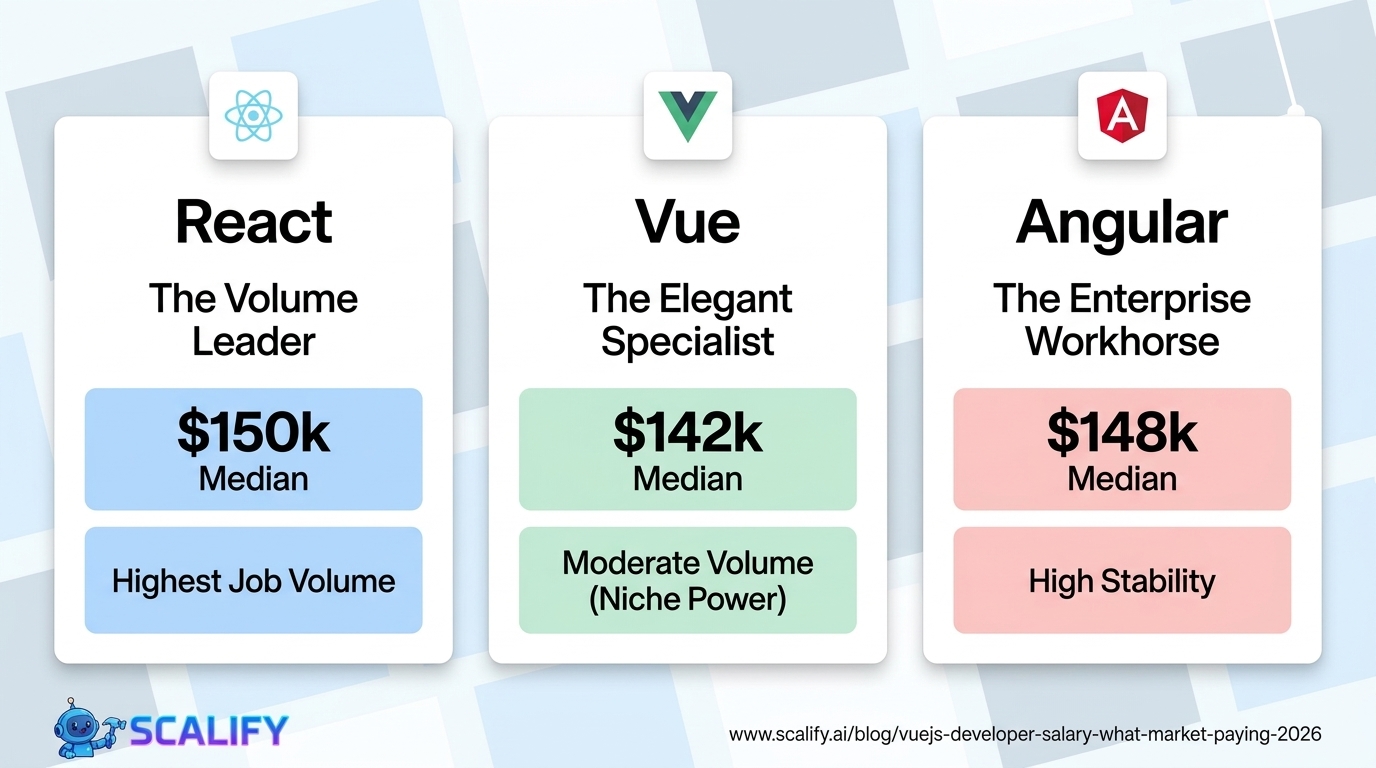
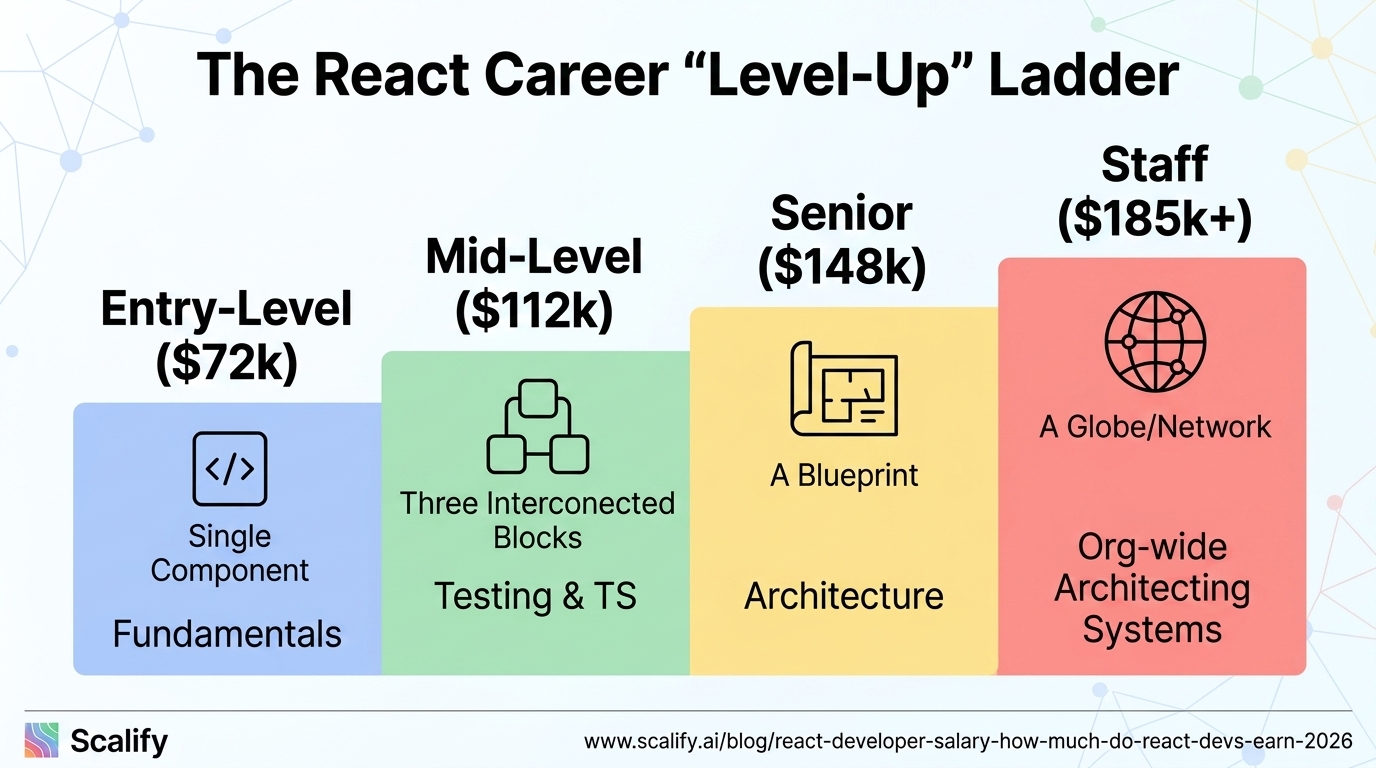
FrameworkJunior MedianMid-Level MedianSenior MedianJob VolumeTop Employer TypesReact$72,000$107,000$150,000HighestStartups, product co., all sectorsAngular$73,000$108,000$148,000High (enterprise)Banks, government, consultingVue.js$68,000$100,000$142,000ModerateStartups, e-commerce, internationalNext.js (React)$75,000$112,000$158,000Very HighFull-stack product companiesNuxt.js (Vue)$70,000$105,000$148,000Moderate-HighFull-stack startups, e-commerce
The Vue salary gap versus React (approximately 6–8% at equivalent levels) reflects the job volume and employer type difference rather than any inherent skill value gap. Vue developers are excellent developers — the framework itself is technically sophisticated and the Composition API with TypeScript is a genuinely elegant approach to component development. The compensation gap comes from React's dominant position in job market volume, which gives React developers more negotiating leverage and access to more high-paying employers.
Critically: the gap between Vue+Nuxt (full-stack) developers and Vue-only front-end developers is larger than the gap between Vue and React. The full-stack Nuxt capability is highly valued and narrows the React compensation gap significantly.
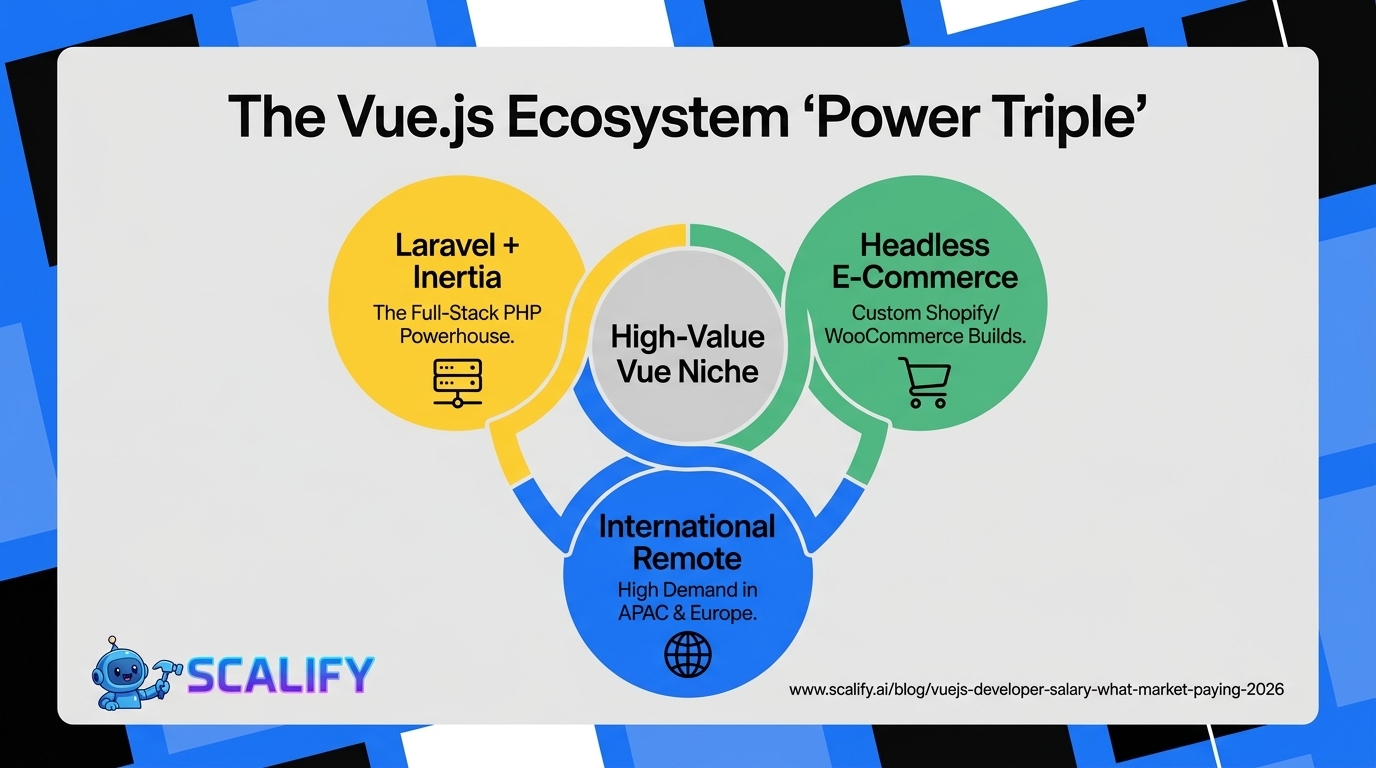
Where Vue Specifically Dominates: Market Segments Worth Knowing
Vue has disproportionate strength in specific market segments that are worth understanding:
E-Commerce (Particularly WooCommerce and Custom Shop Builds)
Vue is the default front-end framework for many WooCommerce headless implementations, custom e-commerce applications, and Laravel-based online stores. The Laravel + Vue combination (using Inertia.js or a separate Vue SPA) is extremely common in mid-size e-commerce development. If you're targeting e-commerce development as a specialization, Vue is at minimum a co-equal option to React in this market.
International Markets (Asia-Pacific, Europe)
Vue has significantly higher market share outside North America than the US-centric job posting data suggests. In China (where Vue creator Evan You is from), Japan, South Korea, and many European markets, Vue's adoption is substantially higher. Remote developers working with international clients or companies find Vue expertise more strategically valuable than domestic market data alone would indicate.
Laravel + Vue Ecosystem
Laravel (PHP framework) and Vue have a close historical relationship — they were shipped together in older Laravel versions and still pair extremely naturally. The Laravel + Vue + Inertia.js stack is a popular choice for full-stack PHP/Vue applications, and developers with both Laravel and Vue expertise are particularly valuable for this common combination. This tends to come up more at agencies and smaller product companies than at large startups.
Small-to-Medium SaaS Products
Vue's "progressive" adoption model — the ability to use it as a simple script include for modest interactivity or as a full SPA framework — makes it appealing for SaaS products that want front-end sophistication without the overhead of a React + full toolchain setup. Many SaaS products in the $1M–$20M ARR range run Vue as their front-end framework with happy, well-compensated Vue developer teams.
High-Value Vue.js Specializations
Custom Composables Library Development
Vue 3's Composable functions (the Composition API equivalent of React Hooks) enable building reusable stateful logic that can be shared across components. Building a well-designed, TypeScript-first composables library for a large Vue application — handling data fetching patterns, form handling, animation, browser API abstractions — is a senior-level skill that differentiates architectural thinkers from component-level implementors. The VueUse open-source library demonstrates what a well-designed composable library looks like, and contributing to it or building something similar is an excellent portfolio signal.
Vue 3 Performance Engineering
Vue's reactivity system, while excellent, can be inadvertently undermined by incorrect usage: reactive objects that trigger more re-renders than necessary, computed properties with incorrect dependency tracking, v-for without :key attributes causing unnecessary DOM operations, and watchers that fire more frequently than intended. Senior Vue performance engineers who can profile, diagnose, and fix these issues — using Vue DevTools' timeline, Chrome DevTools, and Lighthouse — earn a meaningful premium over developers who only know how to implement features.
Nuxt Full-Stack Architecture
Nuxt 3/4 has become one of the most powerful full-stack web frameworks available — its Nitro server engine, hybrid rendering per-route, server routes, and built-in TypeScript support make it a genuinely excellent choice for full-stack applications. Senior developers who can architect Nuxt applications correctly — making smart decisions about what renders server-side vs client-side, implementing the Nuxt data fetching patterns correctly (useFetch, useAsyncData, $fetch), and deploying to edge platforms like Cloudflare Workers — are in strong demand at companies using the Vue/Nuxt stack.
Vue.js Freelance Rates
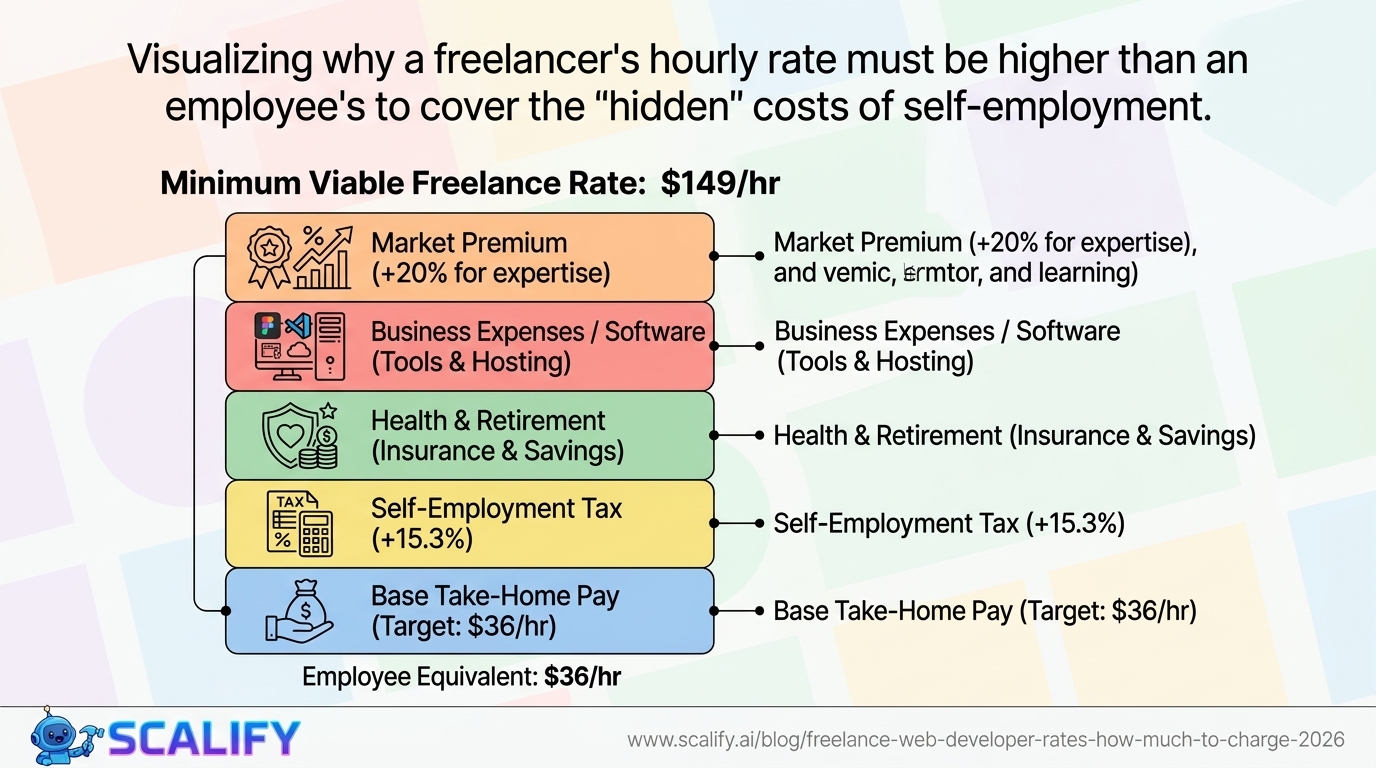
Level / SpecializationHourly RateAnnual Equivalent (1,400 hrs)Junior Vue Developer$50 – $80/hr$70,000 – $112,000Mid-Level Vue Developer$80 – $130/hr$112,000 – $182,000Senior Vue / Nuxt Developer$130 – $200/hr$182,000 – $280,000Vue + Laravel Full-Stack Expert$120 – $190/hr$168,000 – $266,000Nuxt Architecture / Performance Consultant$165 – $250+/hr$231,000 – $350,000+
The Vue Transition: Options API to Composition API
Many existing Vue developers — those who learned Vue 2 or early Vue 3 — are still primarily using the Options API. Understanding when and how to migrate to the Composition API is both practically important for codebases and professionally important for compensation. Companies with Vue codebases are increasingly looking for developers who can lead Options-to-Composition API migrations, which involves:
This migration expertise — being the developer who can plan and execute a phased Options to Composition API migration for a large Vue 2/3 codebase — is a consulting-valued skill that commands $150–$225/hr for senior developers.
Is Vue Worth Specializing In vs Learning React?
For developers weighing Vue against React, the honest analysis:
Vue pays slightly less at the median — the 6–8% gap is real, driven by job volume and employer type differences, not skill value. If pure compensation maximization is the primary goal, React has a small but real statistical advantage.
Vue has a better developer experience for many developers — particularly those who prefer template-based HTML over JSX, those who find Angular too heavy and React's minimal opinions challenging, and those building server-rendered applications where Nuxt's developer ergonomics are excellent. Developer satisfaction matters for career sustainability — learning and maintaining expertise in a framework you enjoy working with pays compounding dividends.
Vue's international premium is underrepresented in US salary data — developers targeting remote work with international companies or European/Asian employers find Vue expertise more strategically valuable than domestic salary data suggests.
The best answer for most developers: If you know Vue well, build Nuxt expertise to maximize the Vue stack value. If you're choosing a first framework, React has more raw opportunity volume. If you're experienced and looking for differentiation, Vue + Laravel + Nuxt full-stack in the e-commerce market is a compelling niche with strong freelance rates and genuine demand.
The Bottom Line
Vue.js developer salaries in 2026 range from $58,000 for junior developers to $225,000+ for principal engineers and senior consultants. The median senior Vue developer earns approximately $142,000 — about 5–8% below equivalent React developers, reflecting job market volume differences rather than skill value differences. Nuxt.js full-stack expertise, Composition API mastery with TypeScript, and e-commerce/Laravel specialization are the highest-value Vue skill combinations. Vue's strength in international markets, e-commerce, and Laravel-based development represents genuine niches where Vue expertise is strategically more valuable than the overall job posting data suggests.
At Scalify, we build professional websites for Vue.js developers, Nuxt specialists, and front-end engineering teams in 10 business days — built to convert visitors into clients and opportunities.







.jpeg)

.jpeg)





78 SW 7th St, Miami, FL 33130