

Contract vs Full-Time Web Developer: Salary Comparison 2026
By Josh Ternyak

April 20, 2026
Contract web developers earn 30-60% more gross hourly but must cover their own taxes and benefits. This comprehensive guide compares total compensation, tax implications, benefits costs, job security, career growth, rate-setting calculations, and who each employment model suits best.
Contract vs. Full-Time Web Developer: Which Pays More?
The contract vs. full-time decision is one of the most consequential career choices a web developer makes — affecting not just gross income but tax liability, benefits costs, job security, career trajectory, and daily work experience. The answer to "which pays more" is almost always "contract" in gross hourly terms, but the total compensation comparison is more nuanced when accounting for everything full-time employment provides that contract work doesn't.
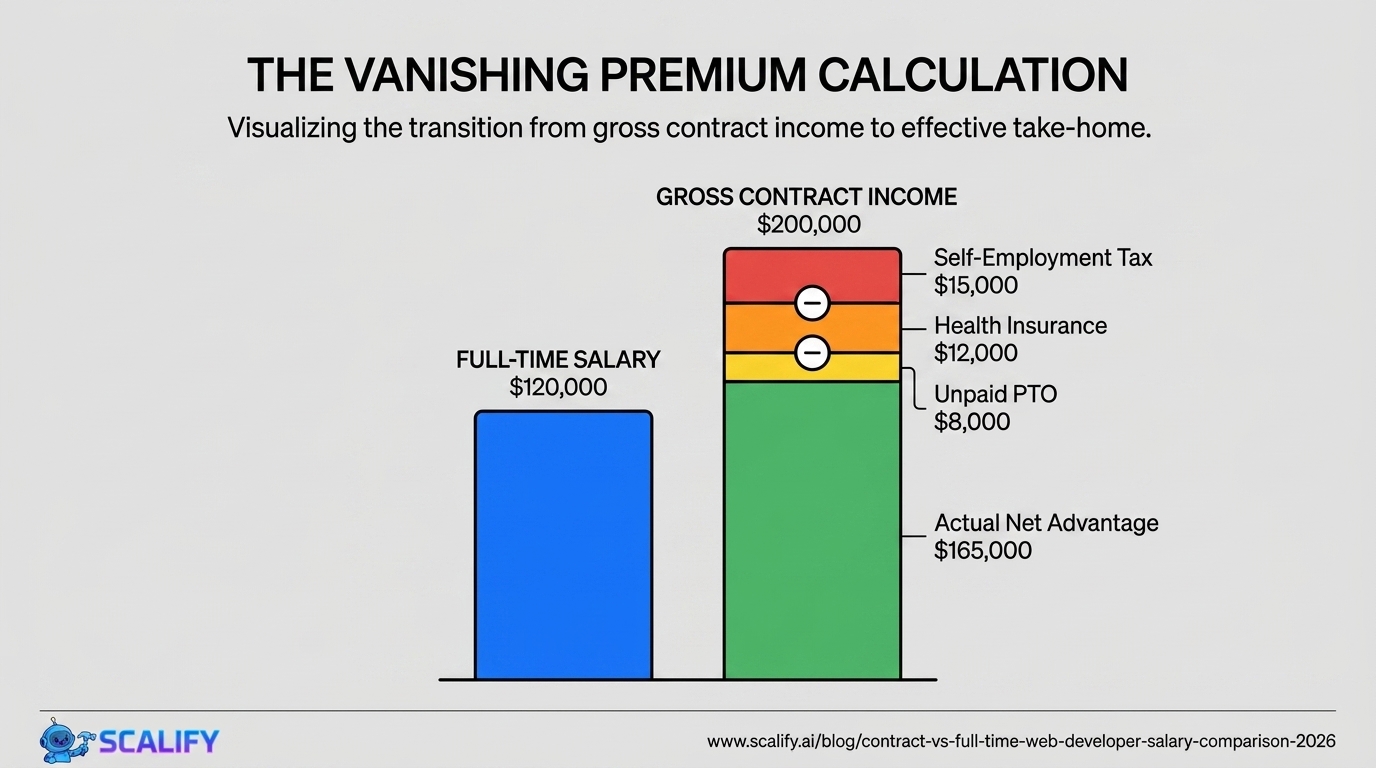
In 2026, experienced mid-level and senior web developers can typically earn 30–60% more in gross hourly income as contractors compared to equivalent full-time positions. But that premium must offset self-employment tax (15.3%), health insurance (often $400–$1,200/month individually), retirement contributions that would otherwise be employer-matched, paid time off that doesn't exist in contract work, and the overhead of running a business. Whether the contractor premium is a genuine financial advantage depends on how well a developer manages these costs and how consistently they maintain billable work.
Key Statistics: Contract vs. Full-Time Web Developer Compensation
Gross Compensation Comparison
Experience LevelFull-Time Annual SalaryFull-Time Hourly Equiv.Contract RateContract Annual (46 weeks)Gross DifferenceMid-Level (3–5 yrs)$108,000$52/hr$85 – $110/hr$156,000 – $202,000+$48,000–$94,000Senior (5–9 yrs)$148,000$71/hr$120 – $160/hr$220,000 – $294,000+$72,000–$146,000Staff/Principal (8+ yrs)$190,000$91/hr$160 – $220/hr$294,000 – $404,000+$104,000–$214,000
The True Cost Comparison: Total Compensation Reality
Cost FactorFull-Time Employee CostIndependent Contractor CostAnnual DifferenceHealth insurance (individual)$0 – $3,000 (employer covers most)$5,000 – $14,000 (fully self-paid)-$5,000 to -$14,000 for contractorDental + vision$0 – $600 (employer-subsidized)$800 – $2,400 (self-paid)-$800 to -$2,400Retirement (401k match)$3,000 – $8,000 (employer contribution)$0 (self-funded SEP-IRA or solo 401k)-$3,000 to -$8,000FICA / self-employment tax7.65% employee share only15.3% self-employment tax on net-$8,000 to -$20,000 (at senior rates)Paid time off (3 weeks avg)Paid — no income lossUnpaid — $10,000–$25,000+ income loss-$10,000 to -$25,000Business overhead (software, equipment, accounting)$0 (employer provides)$3,000 – $8,000/year-$3,000 to -$8,000Total additional contractor costs-$29,800 to -$77,400/year
When the additional contractor costs are subtracted from the gross rate premium, the effective net advantage of contracting over full-time employment at the senior level is typically $25,000–$70,000 annually — real and meaningful, but not as dramatic as the gross rate difference suggests. The financial case for contracting is strongest for senior developers who can maintain high rates ($150+/hour) with minimal downtime between engagements.
Tax Advantages That Favor Contract Work
While contractors pay higher total tax rates on gross income, they also have access to deductions and retirement contribution strategies that full-time employees don't. Key tax advantages for independent contractor developers:
Job Security: The Real Risk of Contract Work
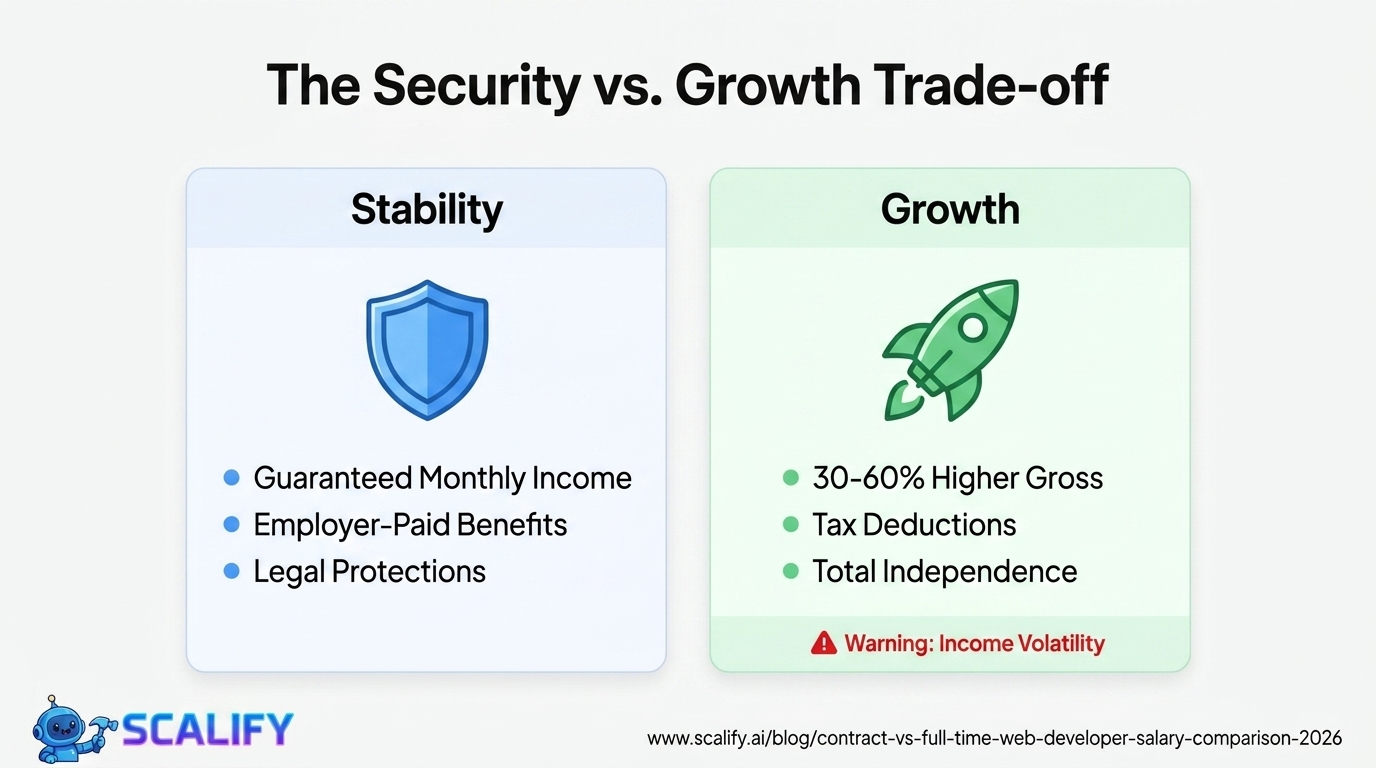
Security FactorFull-Time EmployeeIndependent ContractorIncome stabilityConsistent — paid even during slow periodsVariable — no billing = no incomeNotice period / severanceTypically 2–12 weeks notice, potential severanceOften immediate termination of engagementBenefits continuityContinues through employmentImmediately self-responsible on gapUnemployment eligibilityYes — eligible if laid offNo — independent contractors don't qualifyLegal protection (wrongful termination, discrimination)Full employment law protectionLimited — contract terms govern the relationshipMarket volatility exposureSomewhat buffered by employerDirectly exposed — clients cut budgets quickly
Career Growth: How Each Path Develops Your Skills
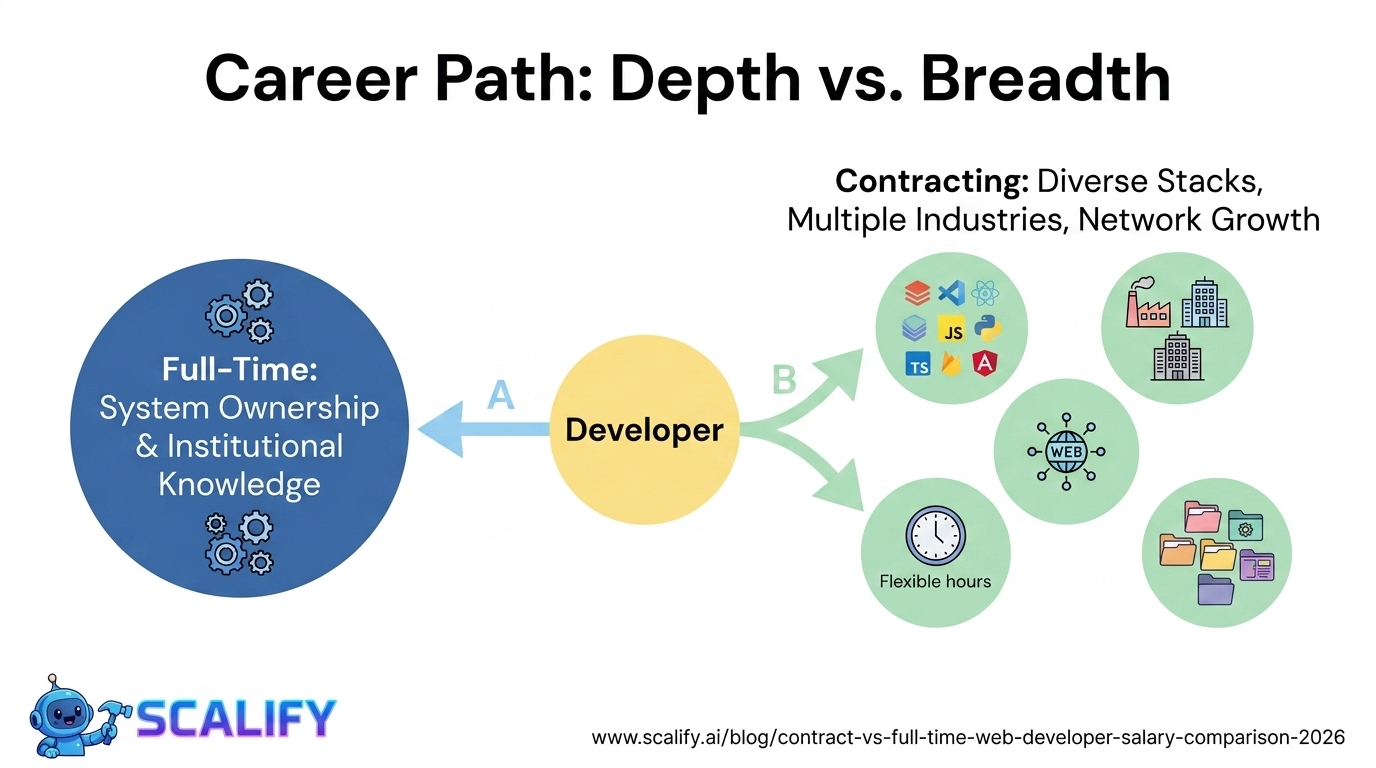
Full-time employment provides deeper but narrower experience — working on the same codebase, the same tech stack, and the same domain over years builds genuine expertise in a specific context. This depth can be valuable for senior and staff engineering careers where institutional knowledge and system ownership matter.
Contract work provides breadth — working across multiple codebases, companies, industries, and tech stacks in the same period. This breadth accelerates skill development in some ways (exposure to many approaches) while limiting depth in others (you're rarely around long enough to deal with the consequences of architectural decisions). Contractors who work primarily on similar types of projects (e.g., always React + Node.js e-commerce builds) develop domain depth alongside the breadth that comes from multiple client contexts.
Who Contract Work Is Best Suited For
Contract web development is best suited for: senior developers with 5+ years of experience who have established skills and portfolio that can attract premium clients; developers who value variety and don't want to spend 3+ years on the same codebase; people with low fixed expenses (no dependents, manageable housing costs) where income variability is less stressful; developers in high-demand specializations (React, Node.js, Python/AI, DevOps) where finding the next engagement is relatively predictable; and those who have worked with a specific company or industry long enough to have a referral network that generates consistent opportunities.
Full-time employment is better suited for: developers who are still building foundational skills and benefit from mentorship structures; those with high fixed expenses (mortgage, family healthcare costs, student loans) where income variability creates genuine financial stress; developers who value career progression into management or staff engineering roles, which are more accessible through internal promotion than contractor-to-hire paths; and anyone who prefers the social structure of being part of a team over the independent structure of contractor work.
The Bottom Line
Contract web developers earn 30–60% more in gross hourly terms than equivalent full-time employees — a meaningful premium that narrows to 15–25% in effective take-home after accounting for self-employment tax, benefits costs, and unpaid time off. The financial case for contracting is strongest for senior developers who can maintain $120+/hour rates with minimal gap time. The non-financial factors — variety vs. depth, independence vs. team structure, variability vs. stability — matter as much as the numbers for long-term career satisfaction, and the right choice depends more on individual circumstances and preferences than on a universal financial calculation.
At Scalify, we work with independent contractors, full-time developers, and development agencies — building professional websites and digital presences in 10 business days.
Top 5 Sources
Converting Contract Work Into Full-Time Offers
Approximately 40% of contract engagements convert to full-time offers when both parties are satisfied with the relationship. Contractors who want to convert — because they enjoy the company culture, find the work engaging, or value the stability of full-time employment — can increase their conversion probability by treating the engagement as an extended interview: delivering consistently excellent work, participating actively in team communication and culture, demonstrating business context awareness (not just technical execution), and expressing genuine interest in the company's mission and trajectory. Companies that have worked with a contractor for 3–6 months have far more insight into that person's capabilities and work style than they gain from any interview process — which makes conversion offers less risky for them than external hiring.
Contractors who don't want to convert can also manage that dynamic effectively — by being transparent about their preference for project-based work, by delivering excellent work that makes them worth retaining for future projects, and by maintaining professional relationships with former clients who become part of the referral network that sustains contract income over time.
Setting Your Contract Rate: The Calculation
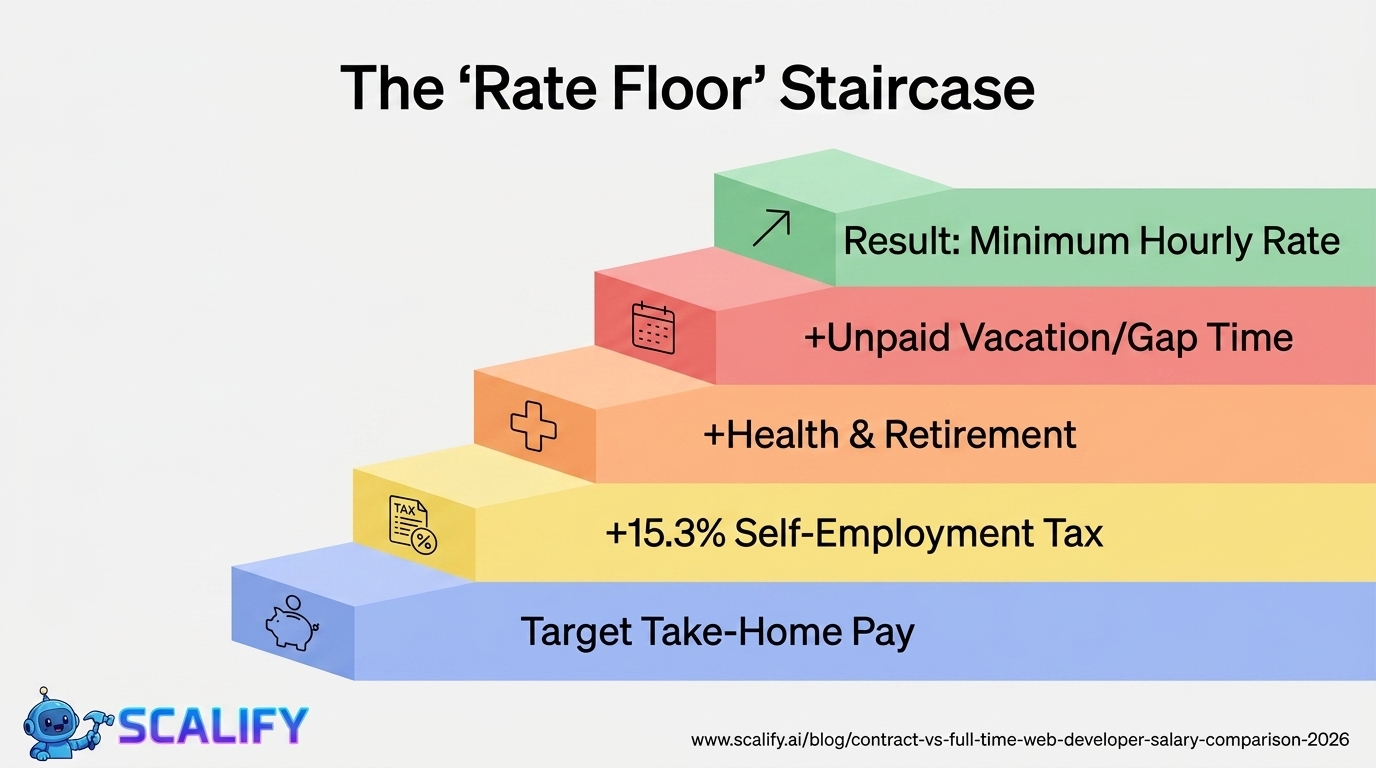
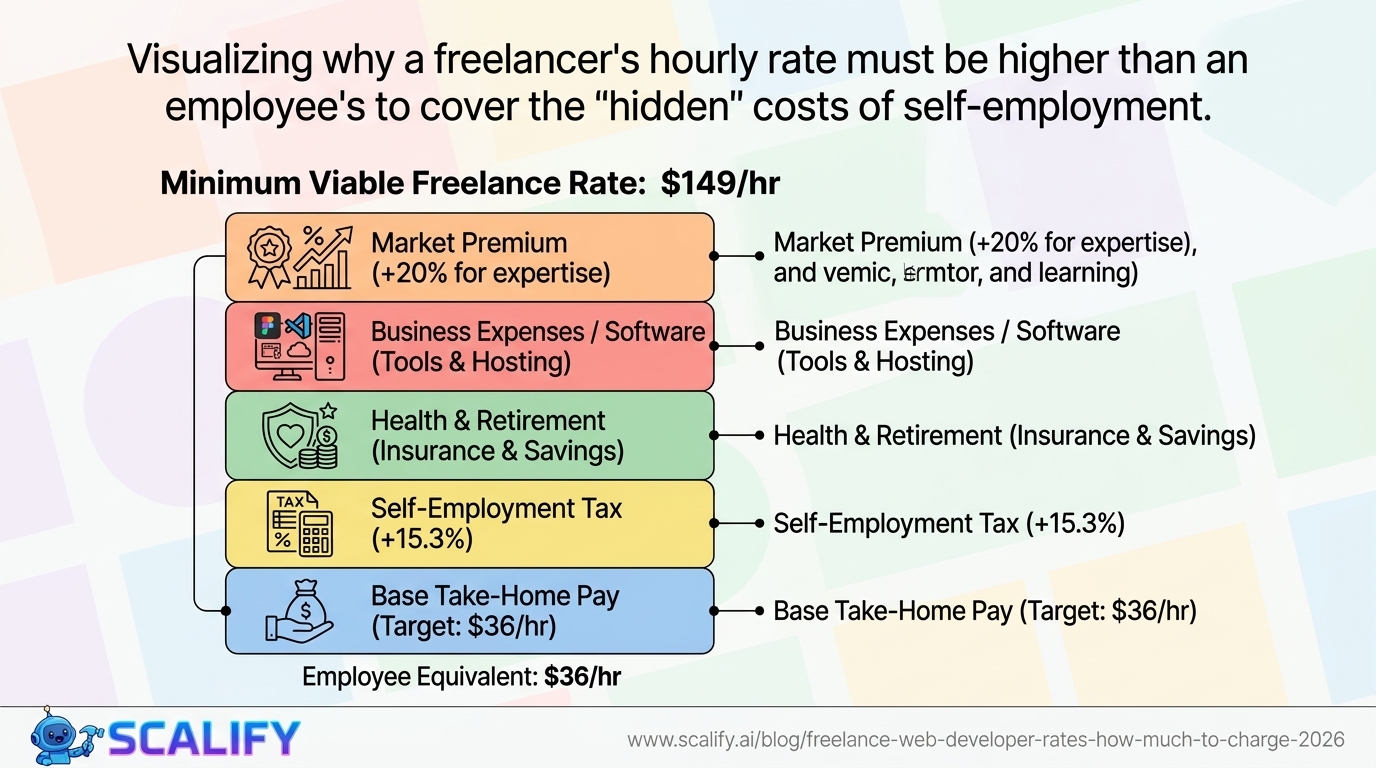
Setting a contract rate that accurately accounts for all costs is one of the most important financial skills an independent developer acquires. A simple framework for calculating the minimum viable contract rate from a target annual income:
FactorExample CalculationNotesTarget annual take-home income$150,000Starting point+ Self-employment tax (15.3% of net)+$22,950Approximation before deductions+ Health insurance+$9,600$800/month individual coverage+ Retirement contributions+$15,000SEP-IRA contribution goal+ Overhead (software, accounting, equipment)+$5,000Annual business expenses= Required gross billing$202,550Before unpaid time÷ Billable hours (46 weeks × 40 hrs)÷ 1,840Assumes 6 weeks gap/vacation= Minimum viable hourly rate$110/hrAbsolute floor to meet targets+ Market premium (20–30%)$132–$143/hrActual rate to charge
This calculation reveals why many contractors chronically underprice themselves — they compare their rate to their full-time salary without accounting for the additional costs they're absorbing. A contractor charging $85/hour when the calculation above shows they need $110/hour to match a $150,000 full-time income equivalent is effectively taking a significant pay cut compared to employment while carrying all the additional administrative burden of self-employment.
Managing Contract Income: The Financial Discipline Required
Successful independent contractor web developers treat their contracting income with more financial discipline than most full-time employees apply to their salary. The fundamentals: maintaining a separate business bank account, setting aside 25–30% of every payment for quarterly estimated taxes immediately (before it can be spent), maintaining a 3–6 month operating reserve to cover slow periods, tracking all business expenses throughout the year rather than scrambling at tax time, and working with an accountant who specializes in self-employed technology workers. The administrative overhead of self-employment is real — typically 5–10 hours per month on invoicing, tax preparation, expense tracking, and business management — and should be factored into the effective hourly rate charged to clients.
Hybrid Models: Part-Time Contract Alongside Full-Time Employment
Many web developers begin their contracting journey not by leaving full-time employment but by taking on contract work alongside it — building a client base, testing their market rate, and developing the business development skills that sustain independent contracting before making the full commitment. This hybrid approach is legally viable for most developers (employment contracts should be reviewed for non-compete or outside-work clauses), reduces the income risk of the transition, and allows real-world rate testing before leaving employer-provided benefits. Developers who successfully build a $30,000–$60,000 side contracting income before going independent have concrete evidence that their market rate is viable and their client acquisition process works — reducing the most significant uncertainty in the transition.
The hybrid model has clear limits: the best clients expect full availability during business hours, and the most lucrative contracts often require full-time commitment from the contractor. The hybrid model works best for project-based work with flexible timelines — website builds, component libraries, API integrations — rather than retainer or staff augmentation engagements that expect consistent daily availability. Using the hybrid model as a 12–18 month runway to full contracting independence is a sound strategy; using it indefinitely often leads to burnout from the combined workload without fully capturing the financial benefits of either path.




.jpeg)

.jpeg)





78 SW 7th St, Miami, FL 33130