

How to Negotiate Your Web Developer Salary: A Tactical Guide
By Josh Ternyak

April 22, 2026
Comprehensive guide: How to Negotiate Your Web Developer Salary: A Tactical Guide
Why Most Developers Don't Negotiate — and What It Costs Them
Only about 37% of employees always negotiate their salary when offered a new job. Among software developers, the number is higher but still far from universal — and among early-career developers, it drops dramatically. The reasons are predictable: fear of losing the offer, imposter syndrome about whether they deserve more, uncertainty about how to approach the conversation, and a general discomfort with the transactional nature of salary negotiation.
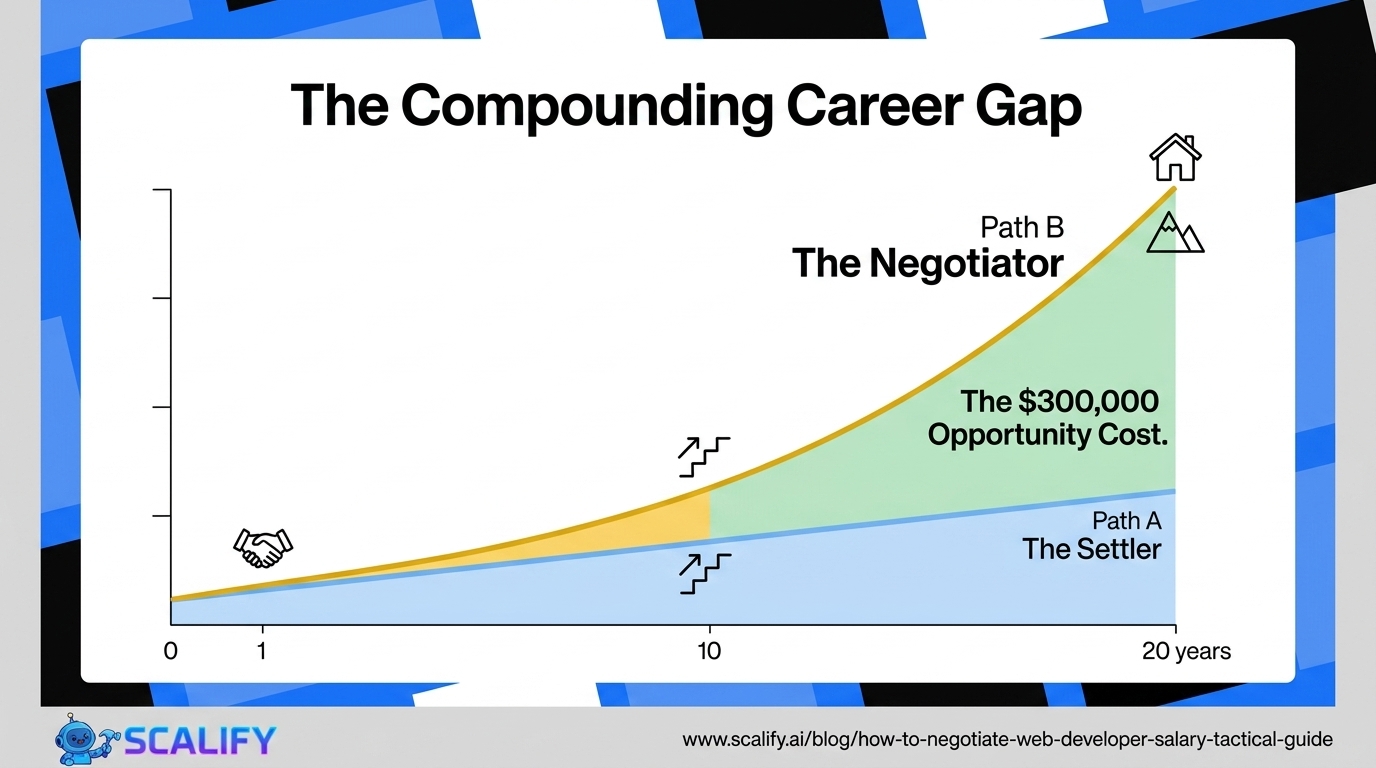
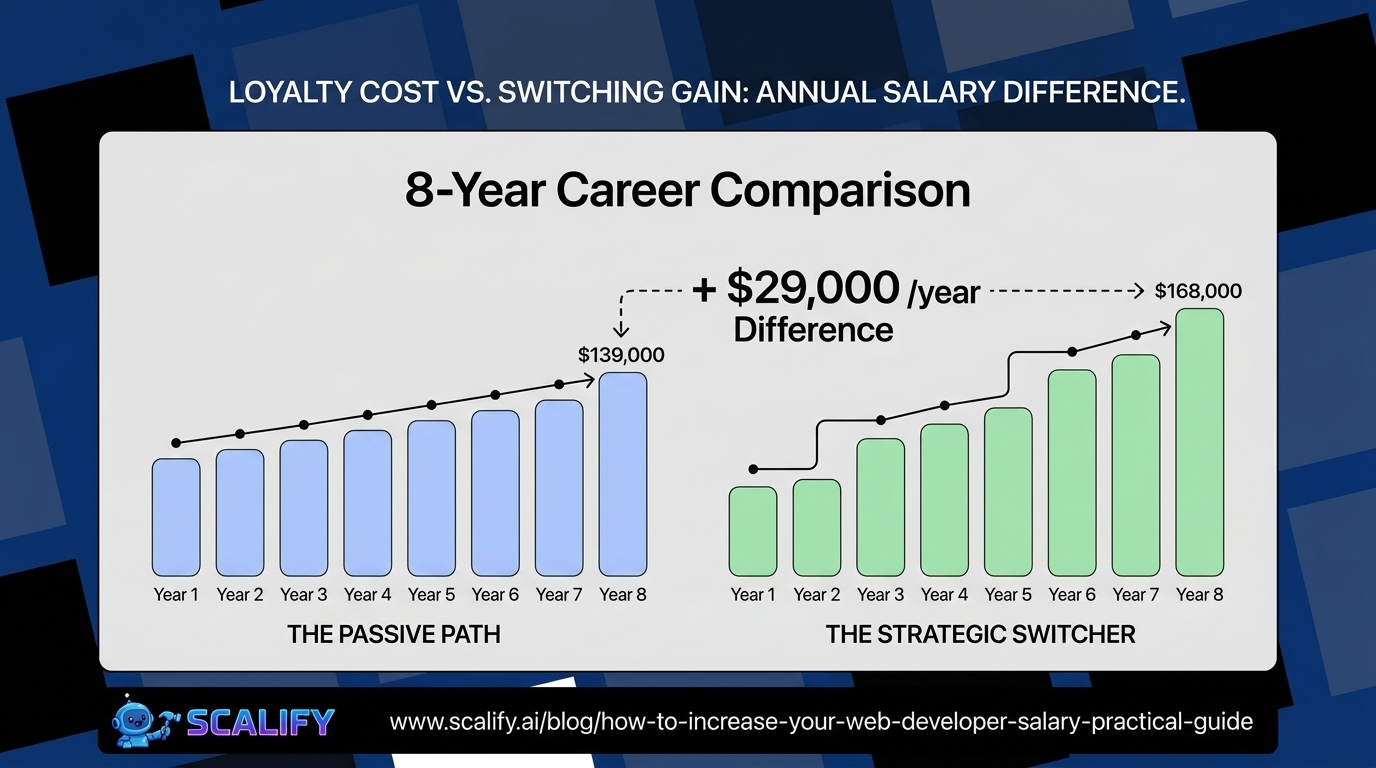
What this costs over a career is staggering. A developer who accepts a $92,000 offer without negotiating — when the company had $105,000 in budget — doesn't just lose $13,000 in year one. Every future raise is calculated as a percentage of that lower base. Every future job negotiation starts from a lower number. Compounded over a 20-year career, a single failed negotiation can cost $100,000–$300,000 in total earnings.
This guide is the tactical playbook: exactly what to say, when to say it, and how to handle every common response employers give to developer salary negotiations.
The Core Principle: Negotiation Is Expected
Before tactics, mindset: salary negotiation is not aggressive, inappropriate, or career-threatening. Hiring managers expect it. Recruiters plan for it. Almost every job offer in the tech industry has budget flexibility built in precisely because the company expects candidates to negotiate. When you don't negotiate, the company keeps the money it had budgeted for you.
No company has ever rescinded a web developer job offer because the candidate negotiated politely and professionally. That fear — the most common reason developers don't negotiate — is not supported by any evidence and contradicted by thousands of developer experiences who have negotiated and moved forward successfully.
Before You Negotiate: Research Your Market Rate
Effective negotiation requires knowing your actual market value. The tools:
ResourceWhat It ShowsReliabilityLevels.fyiTotal compensation at specific companies by levelExcellent for FAANG/large techGlassdoorSelf-reported salaries by role and companyGood, use with caution for small cosLinkedIn SalaryMarket ranges by role and locationGood aggregate dataBlind (app)Anonymous developer salary sharingUseful for current data pointsPayscaleComprehensive salary databaseGood for non-tech employer rangesRecruiter dataWhat recruiters tell you the role paysSpecific but potentially biasedJob postings with listed salaryActual budgeted rangesHighly relevant, increasingly available
Collect data from at least 3 sources before entering any negotiation. You want to know: what does this specific role at this type of company in this geographic market pay at your experience level? The more specific your research, the more confident and effective your negotiation.
The Salary Negotiation Sequence: Step by Step
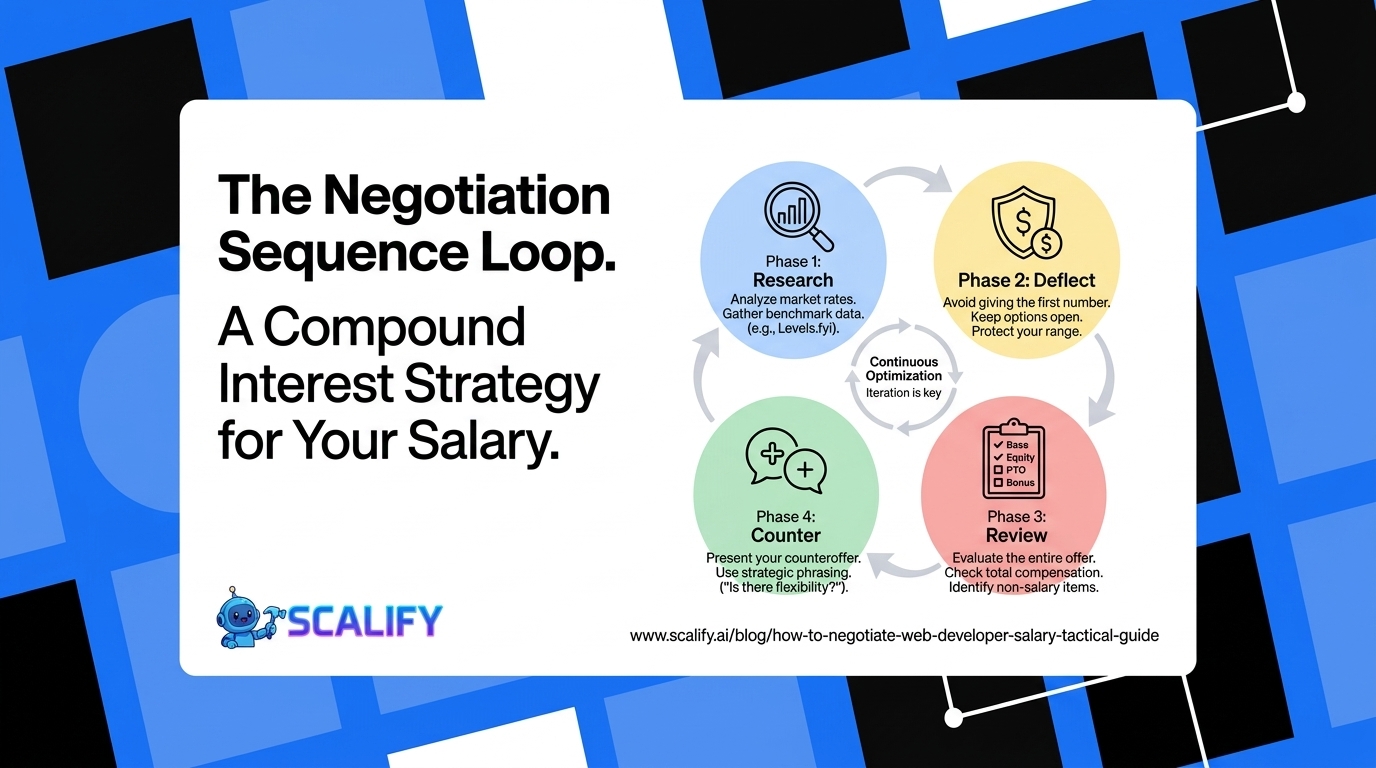
Step 1: Never Give the First Number
The most common negotiation mistake: volunteering your salary expectations before you have an offer. When applications ask for "desired salary" or when recruiters ask early in the process "what are you looking for," the correct response deflects without being evasive.
Script: "I'm more focused on finding the right opportunity than optimizing for a specific number right now. I'd love to understand the full scope of the role and your compensation range before getting into specifics — what's the budgeted range for this position?"
This response accomplishes two things: it keeps you from anchoring too low, and it often surfaces the company's actual budget range, which becomes your negotiation baseline.
Step 2: When You Have an Offer — Take Time
When an offer is extended, don't accept or negotiate immediately. Always ask for time to consider it.
Script: "Thank you so much — I'm genuinely excited about this role. I'd like to take a couple of days to review the full offer package thoughtfully. Would it be okay to get back to you by [specific day, 2–3 business days out]?"
This is always acceptable. It gives you time to research, think, and prepare. Companies never expect immediate acceptance of offers — the request for time is professional and expected.
Step 3: Review the Full Offer Package
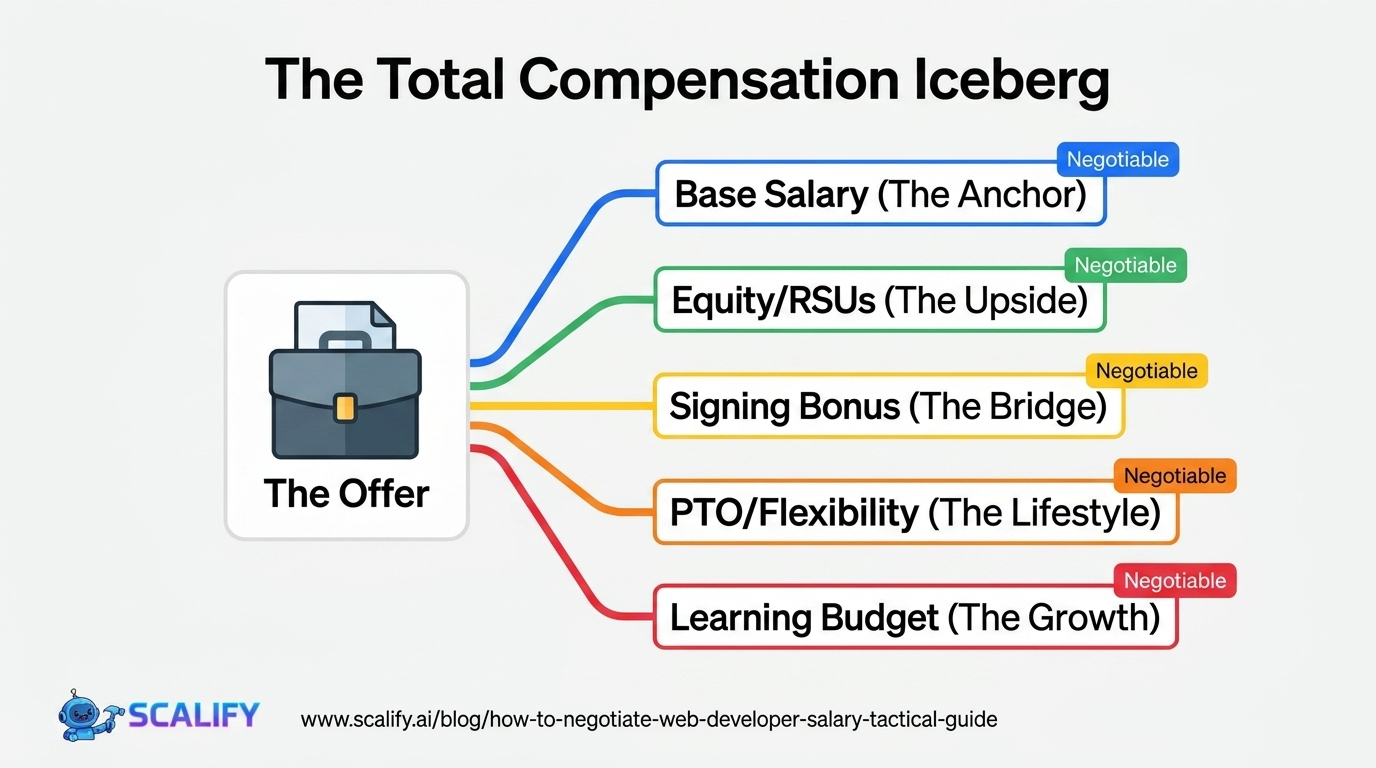
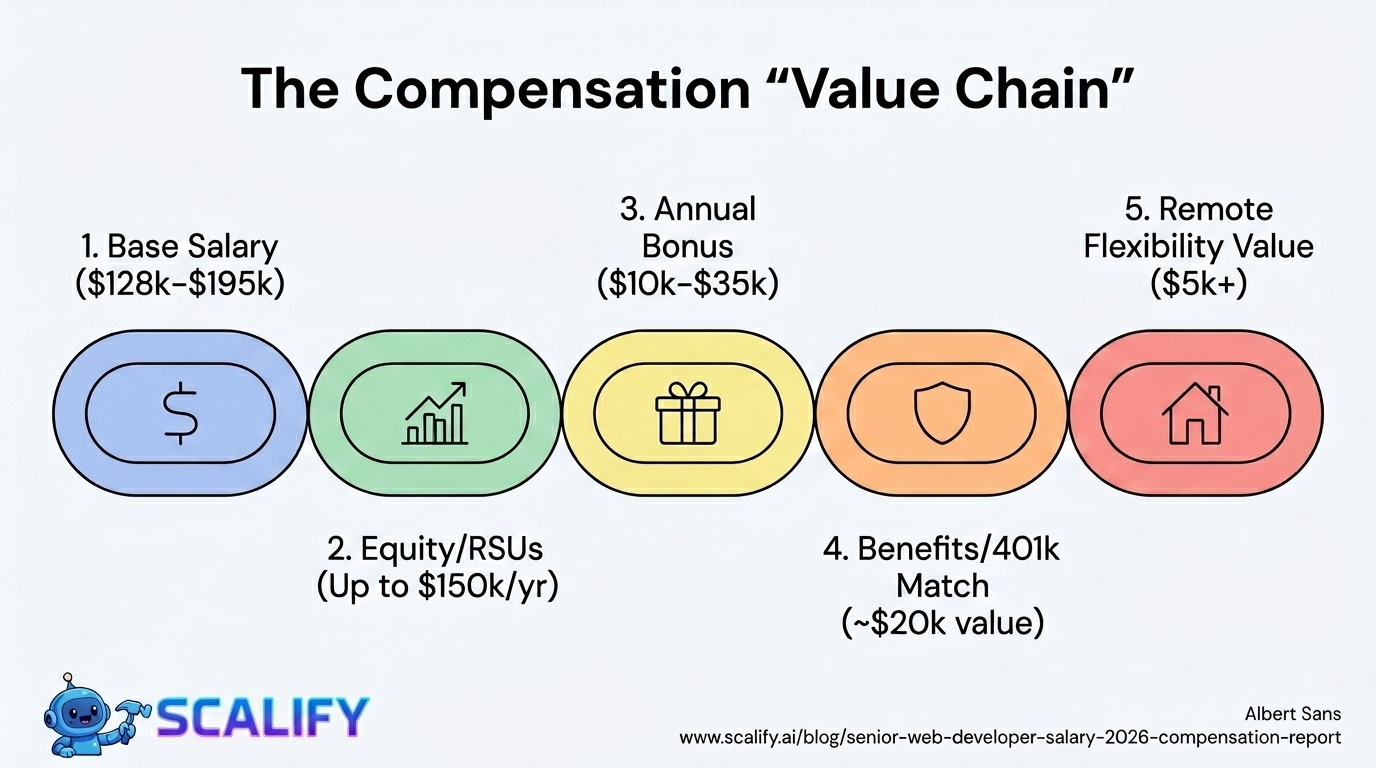
Before negotiating, understand what you're negotiating. Full compensation includes:
ComponentQuestions to AskBase SalaryIs this negotiable? What's the band?Signing BonusIs this offered? Can it be increased?Equity (RSUs or options)How much, what vesting schedule, what's the current value?Annual BonusWhat's the target, what's the range, is it guaranteed?Health InsuranceWhat plans, what does the company cover?401k / RetirementWhat's the match, when does it vest?Remote / FlexibilityFully remote, hybrid, in-office expectations?PTOHow many days, is it unlimited or accrued?Professional DevelopmentLearning budget, conference allowance?
Step 4: Make Your Counter-Offer
This is the moment most developers dread. It doesn't have to be difficult. The formula for an effective salary counter-offer:
Script (for a $92,000 offer when you believe $105,000 is appropriate):
"I'm really excited about this role and the team — I think this is a great fit. Based on my research into the market rate for this role in [city] and my [X years of] experience with [React/Next.js/etc.], I was hoping we could get to $108,000. Is there flexibility there?"
Key elements of this script:
Handling Common Employer Responses
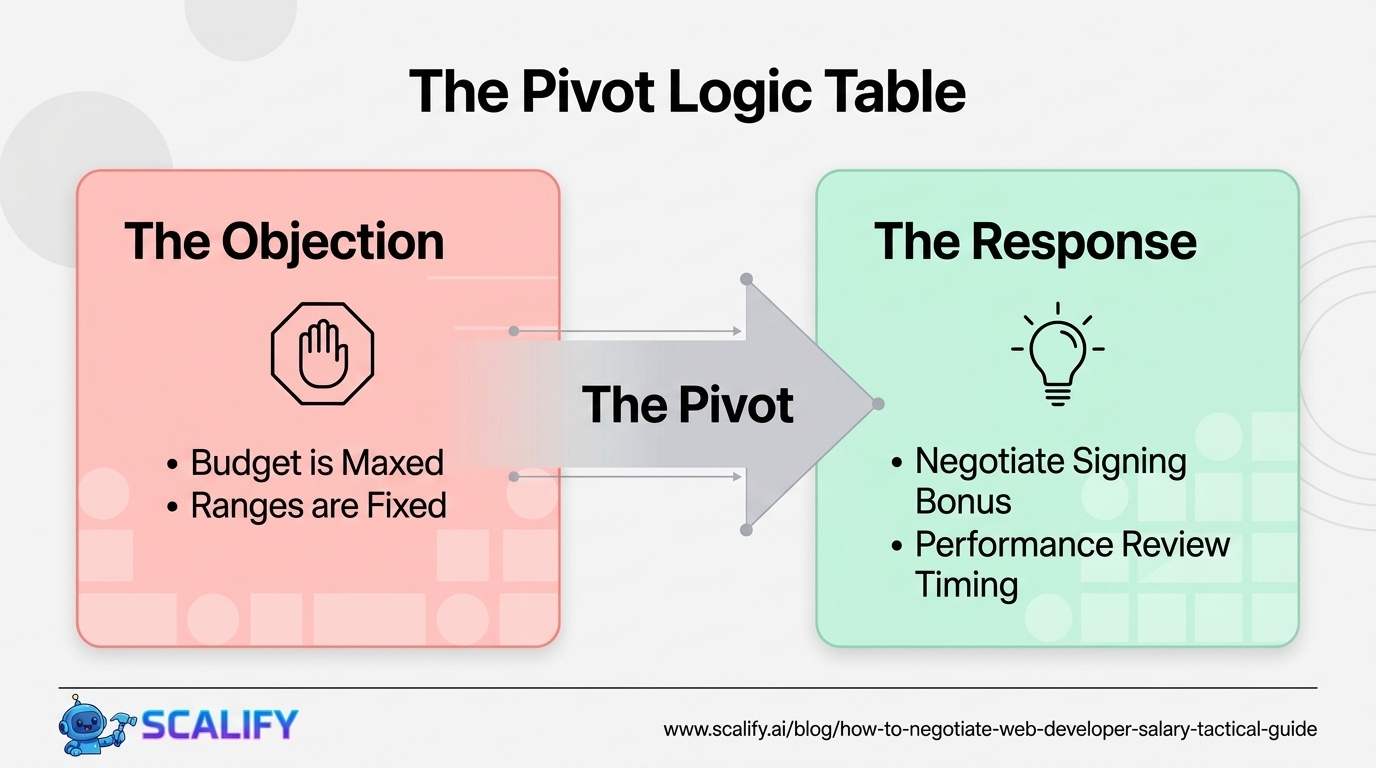
Employer ResponseWhat It Usually MeansHow to Respond"That's above our budget for this role"Sometimes true, sometimes an opening position"I understand. Is there flexibility in other components — equity, signing bonus, or performance review timing?""Our ranges are fixed and non-negotiable"Often means base is fixed but total comp isn't"Understood — could we look at the signing bonus or equity component to bridge the gap?""What's your current salary?"Attempting to anchor to your current number"I prefer to keep that confidential — I'd rather focus on what's appropriate for this role specifically." (Illegal to ask in many states)"We can go to $98,000 but that's our max"Genuine counter — should you accept?Evaluate: is $98K the right number? Can you get more in signing bonus? Ask: "Can we do $98K with a $10K signing bonus to bridge the gap?"Silence / taking time to respondNormal — they're checking budgetWait comfortably. Don't fill silence by lowering your ask.
Negotiating a Raise at Your Current Job
New job negotiation is only one context. Asking for a raise in your current role is equally important — and requires a different approach.
The Right Time to Ask
The Raise Conversation Script
"I wanted to schedule some time to discuss my compensation. Over the past [period], I've [specific accomplishments: led the migration of X, reduced load time by 40%, mentored two junior developers who are now shipping independently]. Based on my market research and the increased scope of my role, I believe $[specific number] is appropriate. What would we need to accomplish to make that happen?"
The key elements: specific accomplishments (not just tenure), market research reference (you've done your homework), a specific number, and framing it as a collaborative discussion rather than an ultimatum.
The Competing Offer Negotiation: The Most Powerful Move
A competing offer is the single most effective negotiating tool available. When you have a legitimate offer from another company, your current employer's options are: match it, counter it, or lose you. Most good employers will at least counter.
How to handle it: "I received an offer from [company type] for [amount]. I'm not actively looking to leave — I'm genuinely invested in this team and what we're building. But this gap in compensation is hard to ignore. Is there something we can do to close that gap?"
The framing matters: you're not threatening, you're sharing a real situation and giving them the chance to respond. This is the most honest and effective approach.
What to Do When They Say No
A clear "no — we cannot go higher" response is actually informative. Your options:
How Much to Ask For: The Rules of Thumb
SituationHow Much to CounterNew job offer within 10% of your targetCounter 10–15% above the offerNew job offer 15%+ below your targetCounter at your target, be prepared to walkAsking for a raise at current jobAsk for 10–20% above current, with specific justificationLateral move, same levelCounter 15–20% above current (job change premium)Promotion with title changeCounter 20–30% above current (scope change premium)
The Bottom Line
Salary negotiation is one of the highest-return activities available to any developer — 2–4 hours of preparation and a 10-minute conversation can add $10,000–$30,000 to your annual income with zero additional skill development required. Most developers don't negotiate enough, most companies have budget flexibility they don't volunteer, and no one has ever lost a job offer for negotiating professionally. Start doing it, every time, without exception.
At Scalify, we build professional portfolio websites that help developers present their work at the level their skills deserve — because better presentation leads to better opportunities and stronger negotiating positions.
Negotiation Psychology: Understanding the Employer's Perspective
Effective salary negotiation requires understanding what the employer is actually evaluating when they receive a counter-offer. They're not evaluating whether you "deserve" more money in an abstract sense — they're evaluating whether you're worth more than your current offer to them specifically, and whether they risk losing you to a competitor if they don't counter. This framing changes the negotiation approach: the most persuasive arguments are those that speak to your specific value to this employer and your genuine alternatives, not those that emphasize your personal financial needs or generic market data without specificity.
The highest-leverage negotiation moments: the initial offer stage (first offers almost always have room to negotiate — employers budget for this), the annual review (come prepared with documented impact and market data), and when you have a competing offer (the most powerful leverage available — even if you prefer the current employer, having an alternative offer creates real negotiation pressure). Each of these moments requires different preparation, but all share the principle that the negotiation should be grounded in specific evidence — your specific impact on business outcomes, the specific market rate for your specific skills in your specific market — rather than subjective assertions of worth.
Negotiation is a learnable skill that improves with practice. Most developers have negotiated salary fewer than 5 times in their careers — far too few repetitions to develop genuine fluency with the discomfort and uncertainty the process involves. Treating each negotiation as a learning opportunity, debriefing what worked and what didn't, and building the specific scripts and market research habits that make future negotiations smoother compounds into a career-long advantage that the majority of developers who avoid negotiation never develop.
The compounding nature of consistent execution is the most important concept in digital marketing: individual tactics produce modest results; systematic implementation of multiple well-chosen tactics over 12–24 months produces transformative results. Identify the highest-impact improvements available to your specific situation, implement them with measurement infrastructure in place, and build the discipline to iterate based on what the data shows rather than intuition or industry trends that may not apply to your specific business and market.






.jpeg)

.jpeg)









78 SW 7th St, Miami, FL 33130