

Angular Developer Salary: What the Market Pays in 2026
By Josh Ternyak

April 20, 2026
Angular developer salaries range from $68,000 to $195,000+ in 2026. This in-depth guide covers pay by experience level, company type, city, and how Angular compares to React and Vue in both salary and job market demand — with complete salary tables throughout.
Angular in 2026: Still a Major Framework, Still Paying Well
Angular is one of the most polarizing topics in web development circles — developers either love its opinionated, full-featured architecture or find it verbose and over-engineered compared to React's more minimal approach. But the salary data doesn't lie: Angular remains a major enterprise framework used extensively by large organizations across banking, insurance, healthcare, and government technology, and skilled Angular developers continue to earn strong compensation.
The question isn't whether Angular pays well — it does, particularly at the enterprise level. The more interesting questions are: how does Angular compare to React and Vue compensation-wise, where is Angular most in demand, and what specific Angular skills command the highest rates? This guide answers all of them in depth.
Angular Developer Salary by Experience Level
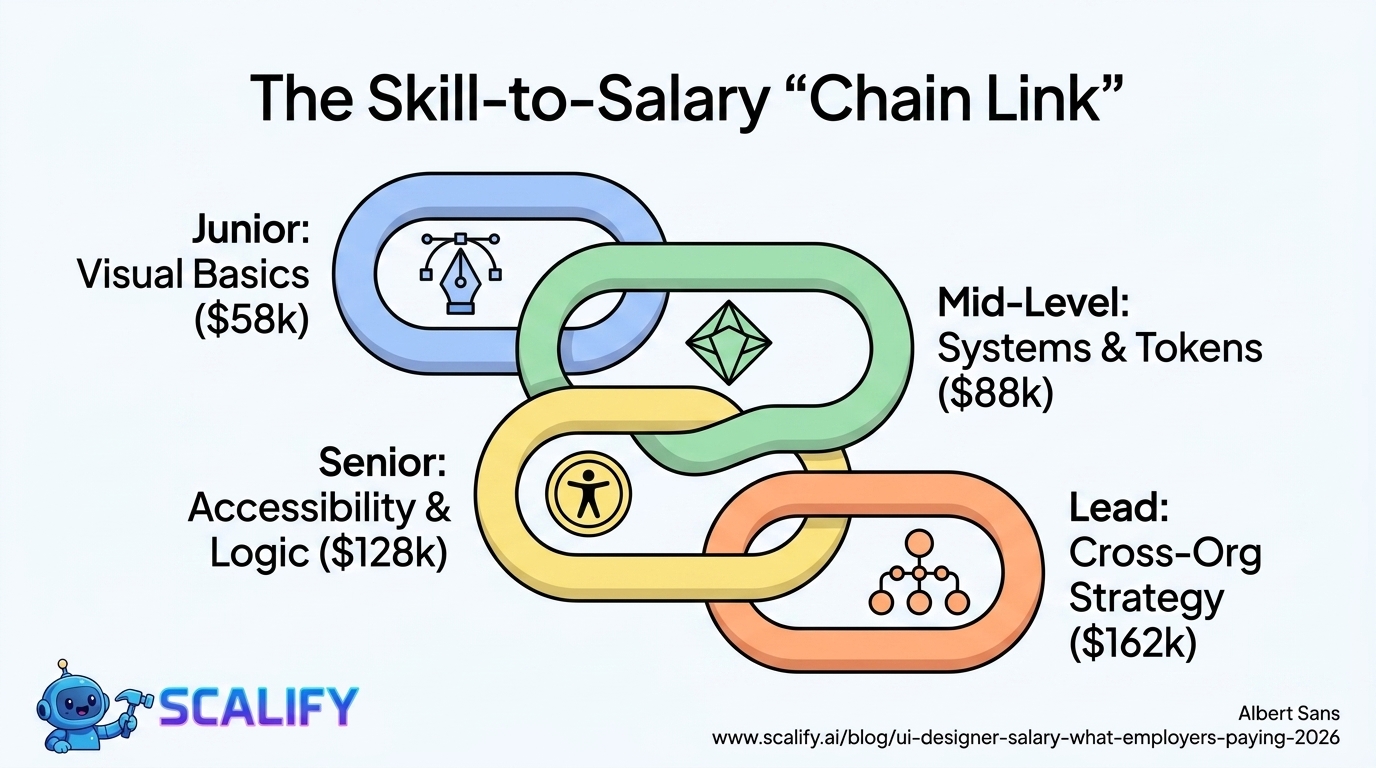
Experience LevelYears ExperienceSalary RangeMedianNotesJunior Angular Developer0–2 years$62,000 – $88,000$73,000TypeScript + basic Angular requiredMid-Level Angular Developer2–5 years$88,000 – $132,000$108,000RxJS, state management, lazy loadingSenior Angular Developer5–10 years$125,000 – $180,000$150,000Architecture, performance, mentorshipAngular Tech Lead / Principal8+ years$162,000 – $245,000+$195,000Enterprise scale, cross-team leadership
Junior Angular Developer ($62,000 – $88,000)
At junior level you're implementing Angular components, services, and modules within established architectural patterns. Angular is unique in that it requires TypeScript from the start (it's not optional the way it is in React), which means junior Angular developers have a higher baseline TypeScript requirement than junior developers in other frameworks. You're working with Angular's dependency injection system, building reactive forms, understanding the difference between OnPush and Default change detection strategies at a surface level, and learning to navigate an Angular codebase that can be significantly larger and more layered than a comparable React application.
The bottom of this range is typically at consulting firms or agencies in secondary markets. The top is at well-funded startups or established tech companies in primary markets that use Angular for specific product areas.
Mid-Level Angular Developer ($88,000 – $132,000)
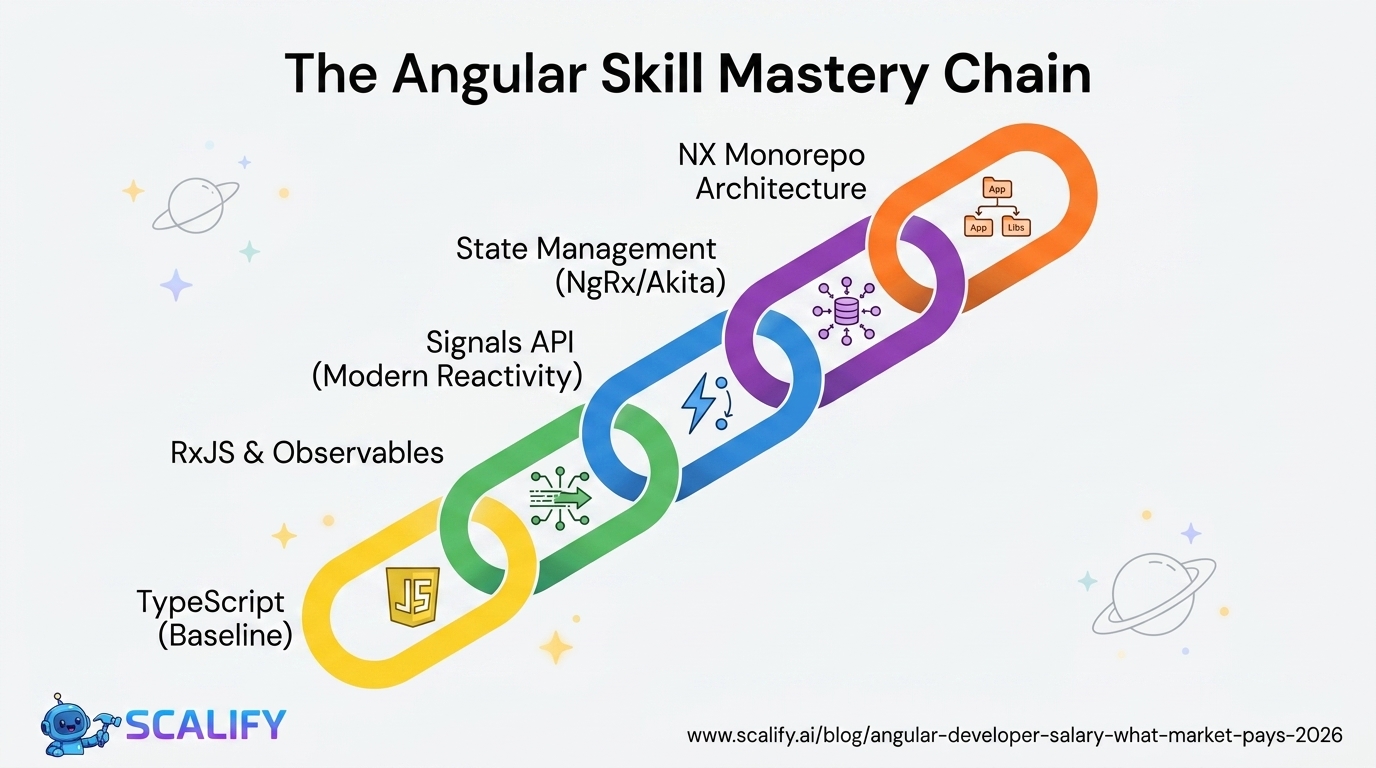
At mid-level you're expected to understand Angular's architecture at a meaningful depth. This means: comfortable with RxJS and reactive programming patterns (switchMap, combineLatest, BehaviorSubject vs Subject, unsubscription patterns), understanding Angular's lifecycle hooks and when to use each, building lazy-loaded feature modules with proper routing configuration, implementing state management with NgRx or Akita, and building reusable component libraries that work within Angular's component model.
RxJS is where many developers get stuck at mid-level Angular. Angular's extensive use of Observables and reactive patterns (rather than Promises) creates a steeper learning curve than most other front-end frameworks. Developers who genuinely master RxJS — who can debug complex observable chains, understand hot vs cold observables, implement proper error handling, and optimize subscription management — differentiate themselves significantly from developers who use RxJS superficially.
Senior Angular Developer ($125,000 – $180,000)
Senior Angular developers are making architectural decisions that affect the entire application and team. You're designing the feature module structure, establishing coding standards and patterns, making decisions about state management architecture (NgRx, Akita, Elf, or simpler service-based state), optimizing bundle sizes through code splitting and tree shaking, implementing custom structural directives and attribute directives, and ensuring the application's change detection strategy is properly optimized for scale.
The Angular Signals API (introduced and stabilized in Angular 16–17) represents the most significant architectural shift in Angular's recent history — moving toward a reactive primitives model that reduces the need for complex RxJS patterns for simple state management. Senior Angular developers who deeply understand the Signals model and how it interacts with traditional Observable-based patterns are in the strongest demand in 2026.
At major enterprise employers (banks, insurance companies, consulting firms serving enterprise clients, large government tech departments), senior Angular developers earn toward the top of this range. At product startups that use Angular, compensation can reach $170,000–$180,000+ with equity.

Angular Developer Salary: Enterprise vs Startup vs Agency
Employer TypeMid-Level SalarySenior SalaryEquityCulture NotesLarge Enterprise (banks, insurance, healthcare)$95,000 – $132,000$132,000 – $178,000Low to noneStability, slower pace, Angular dominantGovernment Technology / Defense$92,000 – $128,000$128,000 – $172,000NoneHigh security clearance premium possibleConsulting / Professional Services (Accenture, Deloitte)$90,000 – $125,000$125,000 – $168,000LowAngular common, varied client workProduct Startups (Angular stack)$100,000 – $138,000$138,000 – $182,000Meaningful equityRarer but highest total compDigital Agencies$72,000 – $98,000$95,000 – $125,000NoneBreadth exposure, lower ceiling
Angular's most important employer characteristic: it is overwhelmingly the framework of choice for large enterprises, financial institutions, government technology, and complex B2B applications. If you want to work at a major bank's technology division, at an insurance company's digital team, or at a consulting firm serving Fortune 500 clients, Angular is likely in the job description. These employers offer good stability and solid compensation, though typically without the equity upside of product startups.
Angular Developer Salary by City
CityMid-LevelSeniorKey IndustriesNew York City$108,000 – $142,000$148,000 – $195,000Fintech, banking, media techSan Francisco Bay Area$115,000 – $148,000$158,000 – $208,000Google (uses Angular/Dart Frog), various enterpriseWashington D.C. / Northern Virginia$105,000 – $140,000$142,000 – $190,000Government tech, defense, consultingChicago$95,000 – $128,000$128,000 – $172,000Insurance, finance, enterprise SaaSBoston$98,000 – $132,000$132,000 – $175,000Biotech tech, financial services, consultingSeattle$108,000 – $140,000$145,000 – $192,000Microsoft (uses Angular), enterprise techAustin / Atlanta$88,000 – $122,000$122,000 – $162,000Growing enterprise tech marketsMiami$80,000 – $112,000$108,000 – $148,000Fintech, healthcare IT
Washington D.C. and Northern Virginia deserve special mention: the concentration of government technology contractors, defense companies, and federal agencies — many of which standardized on Angular years ago and continue using it — makes this one of the strongest Angular-specific markets in the country. Angular developers with security clearances or clearance eligibility can earn premiums of $15,000–$30,000 above the base rates listed here.
Angular vs React vs Vue: Salary Comparison
FrameworkMid-Level MedianSenior MedianJob VolumePrimary Employer TypesReact$107,000$150,000Highest (4–5x Angular)Startups, product companies, all sectorsAngular$105,000$148,000High (enterprise-concentrated)Enterprise, government, financial servicesVue.js$98,000$138,000ModerateMixed, strong in Asia-Pacific marketSvelte$102,000$142,000Low-Moderate (growing)Product startups, performance-focused teamsNext.js (React)$112,000$158,000Very High (growing)Full-stack, product companies, marketing sites
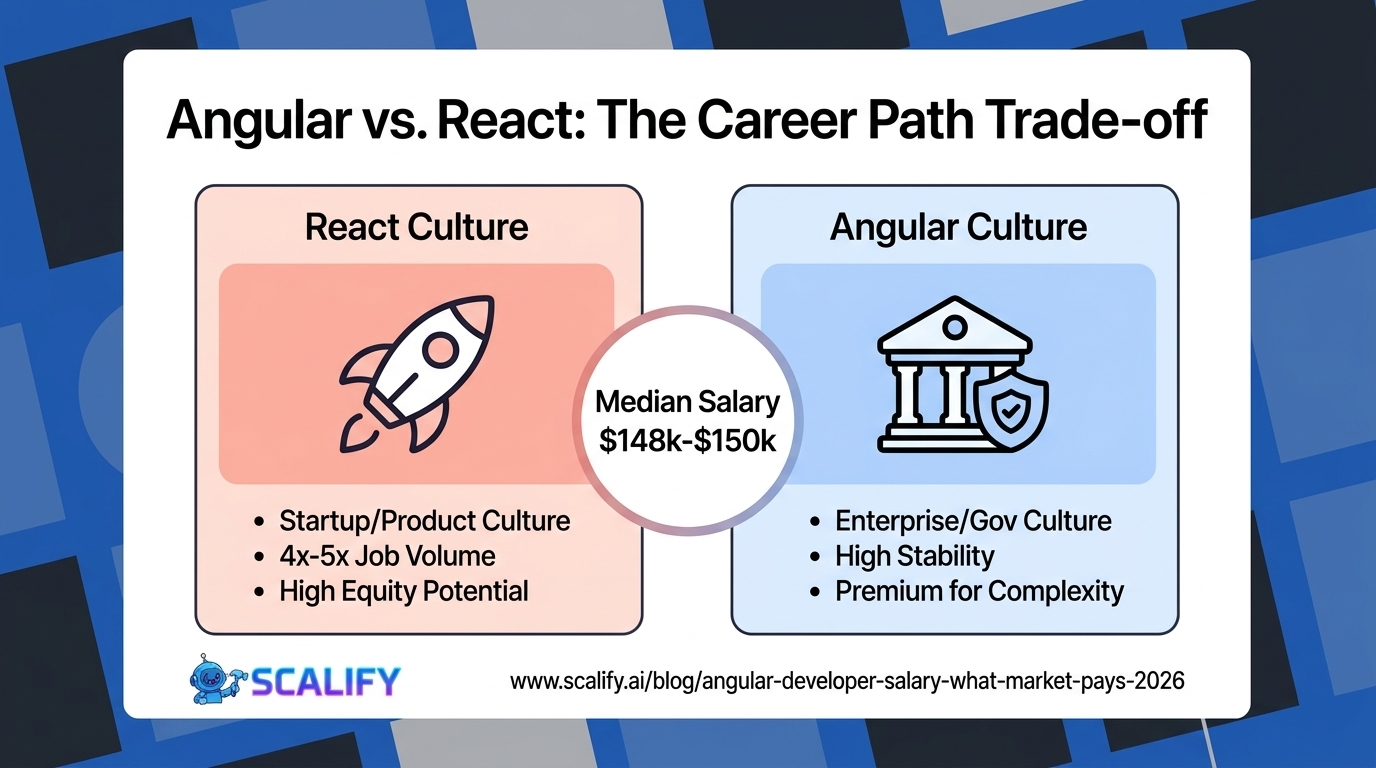
The compensation gap between Angular and React at median levels is relatively modest (2–3%). The more significant difference is in job volume and employer type mix. React has dramatically more job postings — roughly 4–5 times more than Angular in most job board analyses — which gives React developers more leverage in job searches (more options means better negotiating position). Angular jobs are more concentrated in enterprise, which means different culture and compensation structure (less equity, more base salary stability).
Angular developers who want equity upside typically need to either find the smaller number of product startups using Angular, or develop React skills as a complement that allows them to access the broader startup market. Angular developers who want stability and strong base salaries at reliable enterprises are in an excellent position — those opportunities are numerous and well-compensated.
The Angular Signals Revolution: New Skills, New Premiums
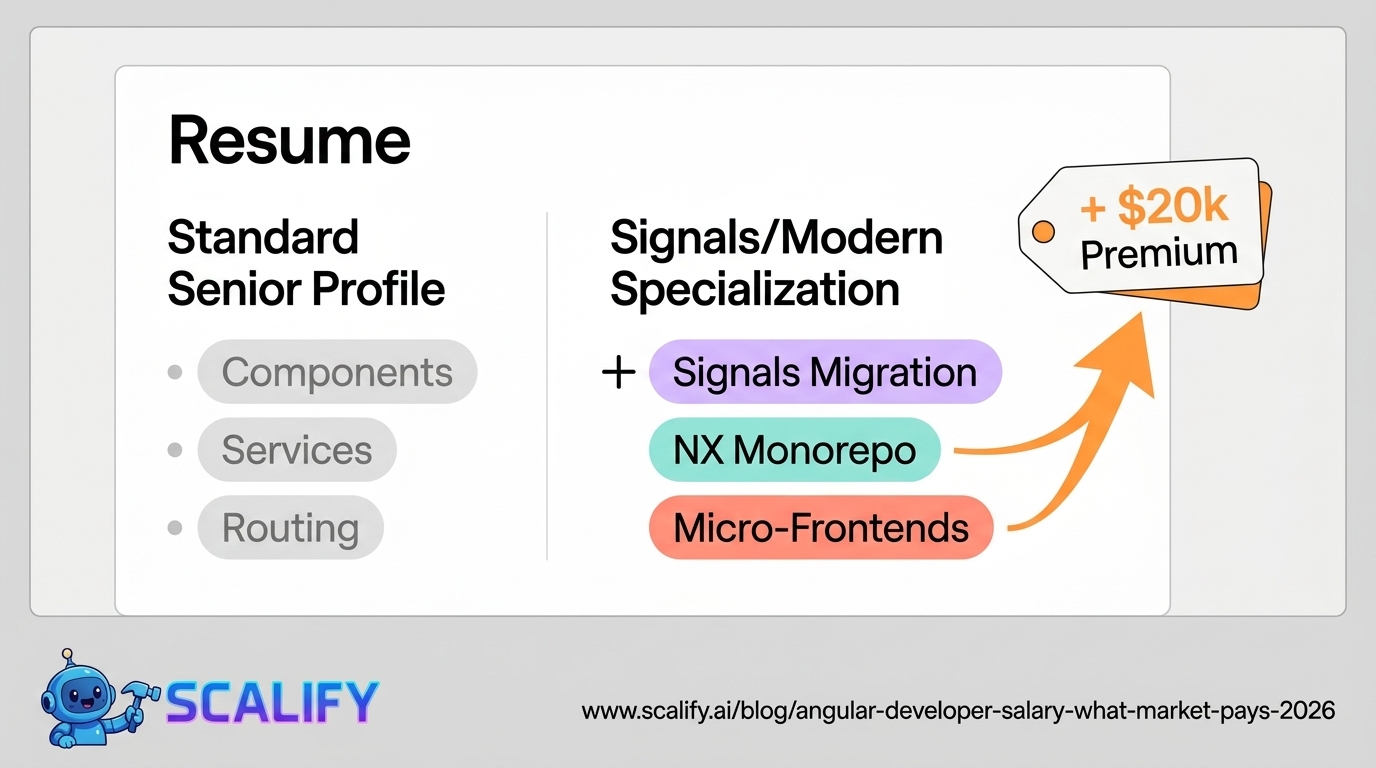
One of the most significant developments in Angular's recent history is the introduction and maturation of Signals — Angular's new reactive primitives system. Signals represent a fundamental change in how Angular handles reactivity and change detection, and understanding them deeply is increasingly distinguishing senior Angular developers in 2026.
What Signals mean for compensation:
High-Value Angular Specializations and Their Salary Impact
Angular + NX Monorepo Architecture
NX (from Nrwl) is a build system and monorepo management tool that's become the standard for large Angular codebases — particularly at enterprises managing multiple related applications. NX expertise, including understanding affected project analysis, custom generators, and distributed caching, is a meaningful differentiator for senior Angular developers targeting enterprise roles. Premium: approximately $10,000–$20,000 above general senior Angular rates.
NgRx / State Management Architecture
NgRx is Angular's most popular Redux-based state management solution. Senior developers who can architect NgRx stores correctly — designing action models, effect chains, selectors with proper memoization, and entity adapters — are genuinely scarce. Many Angular developers have used NgRx but few have designed a complex NgRx architecture from scratch in a way that scales cleanly. This expertise is specifically valued at financial and enterprise tech employers building complex data-intensive SPAs.
Angular + Micro-Frontends
Module Federation (Webpack 5) enables micro-frontend architectures where multiple independent Angular applications can be composed into a single user experience. Large enterprise teams building complex portals increasingly use this architecture to enable independent team deployments and avoid the complexity of monolithic SPAs. Architects who can design and implement Angular micro-frontend solutions earn $160,000–$200,000+ at major enterprises.
Angular Performance Engineering
Angular applications can have significant performance issues if not carefully managed — excessive change detection cycles, memory leaks from unsubscribed observables, large initial bundle sizes from eager-loaded modules. Developers who can profile, diagnose, and fix Angular performance issues — using Angular DevTools, Chrome Performance panel, and bundle analyzers — command a meaningful premium, particularly at companies where they have underperforming existing Angular applications.
Angular Freelance and Consulting Rates
Level / SpecializationHourly RateCommon Project TypesJunior Angular Developer$55 – $85/hrFeature implementation, bug fixesMid-Level Angular Developer$85 – $140/hrFeature modules, integrationsSenior Angular Developer$140 – $220/hrArchitecture, complex SPAsNgRx / State Architecture Specialist$165 – $250/hrState refactors, performance, architectureAngular Enterprise Consultant$175 – $300+/hrMigration, team coaching, architecture reviews
Angular consulting and freelancing has a strong market at the enterprise end. Large organizations with Angular codebases regularly need external expertise for: architecture reviews, performance optimization, migrations from AngularJS (Angular 1) to modern Angular, Angular version upgrades, and building complex features that internal teams lack the depth to implement. Senior Angular consultants who specialize in enterprise use cases can charge $200–$300+/hr for this work.
AngularJS to Angular Migration: A Premium Skill
AngularJS (Angular 1) was one of the most widely adopted JavaScript frameworks of the early-to-mid 2010s. Many enterprise applications were built on it and are still running on it — maintaining legacy AngularJS code, updating dependencies, and eventually migrating to modern Angular. Developers who understand both AngularJS and modern Angular, and can plan and execute hybrid migration strategies (running AngularJS and Angular side-by-side during migration using ngUpgrade), are addressing a specific pain point at large organizations with real urgency. This specialized work commands premium consulting rates of $175–$275/hr.
Career Advice: Should You Learn Angular in 2026?
If you're a web developer deciding whether to invest in Angular expertise, here's the honest assessment:
Learn Angular if: You want to work at large enterprises, financial institutions, or government technology organizations where Angular is the standard stack. The enterprise market for Angular is large and stable — these organizations aren't switching frameworks anytime soon, and they pay competitive salaries with good benefits and stability. If you're in Washington D.C., Chicago, or New York targeting the enterprise market, Angular expertise is strategically valuable.
Learn React instead if: You want access to the broadest possible job market, you want to target product startups and tech companies, or you want the most equity upside potential. React's job volume advantage means more opportunities and better negotiating leverage, and the startup/product company sector that most heavily uses React offers the highest equity upside.
Learn both if: You're early in your career and undecided, you're building consulting capacity that spans enterprise and startup clients, or you want to maximize the range of opportunities available to you. Angular and React share TypeScript, component-based architecture, and similar testing philosophies — learning one deeply makes the other meaningfully more accessible.
The Bottom Line
Angular developer salaries in 2026 range from $62,000 for junior developers to $245,000+ for principal engineers and consultants at major enterprise clients. The median senior Angular developer earns $148,000–$150,000 — essentially equivalent to React at the same level, though with a different employer mix. Angular's strength is in the enterprise: financial services, healthcare, government, and large consulting firms represent the largest and most stable demand pool. The specializations commanding the highest premiums are NgRx architecture, NX monorepo management, micro-frontends, and Angular Signals migration expertise. For developers committed to the enterprise market, Angular expertise is a genuine and financially rewarding career path.
At Scalify, we build professional websites for Angular developers, enterprise engineering consultants, and technology agencies in 10 business days — the portfolio that matches the caliber of your work.





.jpeg)
.jpeg)


78 SW 7th St, Miami, FL 33130