


How Does a Website Actually Work? Step-by-Step Explanation
By Josh Ternyak

March 28, 2026
Ever wondered what actually happens between typing a URL and seeing a webpage? This step-by-step guide breaks down exactly how websites work — servers, DNS, browsers, and everything in between — in plain English.
The Magic Trick Nobody Explains
Here's something that happens billions of times every single day, all around the world, and almost nobody stops to think about it: someone types a web address into a browser, hits enter, and within two seconds a fully designed, fully functional page appears on their screen — pulling together text, images, fonts, videos, and live data from servers that might be located on the other side of the planet.
It feels like magic. It isn't. It's a precise, multi-step process that involves your device, multiple servers, a global naming system, and a set of communication protocols that have been refined over decades. Once you understand how it works, you'll see websites differently — and more importantly, you'll understand why they sometimes go wrong, why some load instantly while others crawl, and what actually needs to happen for one to perform well.
Let's walk through the whole thing, step by step, from the moment your fingers hit the keyboard to the moment the page finishes loading.
Before We Start: The Key Players
Think of loading a website like ordering something from a restaurant. Before we trace the order, it helps to know who's in the kitchen.
Your browser — Chrome, Safari, Firefox, Edge — is the customer. It's the one placing the order and consuming the result. It knows how to speak the language of the web and how to render what it receives into something a human can see and interact with.
Your internet connection and ISP is the road network. It physically carries the request from your device to wherever it needs to go and brings the response back.
DNS servers are the phone book. They translate the human-friendly address you typed (like scalify.ai) into the numerical address computers actually use to find each other.
The web server is the kitchen. It's the computer where the website's files actually live, sitting in a data center somewhere, waiting for orders and sending out responses 24 hours a day.
The website's files — HTML, CSS, JavaScript, images — are the food. They're what gets prepared and delivered to you.
Now let's follow the order from start to finish.
Step 1: You Type a URL Into the Browser
It starts simply enough. You type something like scalify.ai into your browser's address bar and press enter.
At this point, your browser doesn't know what to do with "scalify.ai" as a string of text. Computers don't communicate using domain names — they communicate using IP addresses, which are numerical identifiers that look something like 104.21.45.67. The domain name is just a human-friendly alias layered on top of the real address.
So before it can do anything else, your browser needs to find the actual IP address behind the domain name you typed. This is where DNS comes in.
Step 2: The DNS Lookup — Translating the Address
DNS stands for Domain Name System. It's one of the foundational infrastructure layers of the internet, and it works remarkably similarly to a phone book or a contacts list on your phone. You know someone by their name; the phone book tells you their number.
When you press enter, your browser first checks its own cache — a short-term memory of domain lookups it's done recently. If you visited scalify.ai an hour ago, the IP address is probably still stored locally and the DNS step is nearly instant.
If it's not cached, your browser asks your operating system if it knows the answer. Your OS checks its own cache and a local file called the "hosts file" before passing the question on.
If neither of those have the answer, the request goes to a recursive DNS resolver — typically operated by your ISP (Internet Service Provider) or a public DNS service like Google (8.8.8.8) or Cloudflare (1.1.1.1). This resolver is the main lookup engine. It either knows the answer from its own cache or goes hunting for it.
When the resolver needs to find an unfamiliar address, it contacts a series of authoritative DNS servers in a hierarchy:
First it asks a root nameserver — one of 13 sets of global servers at the very top of the DNS hierarchy — which points it toward the right top-level domain server (the one responsible for .ai, .com, .net, etc.).
Then it asks that TLD nameserver, which points toward the authoritative nameserver for the specific domain (scalify.ai).
Finally it asks that authoritative nameserver, which has the definitive answer: here's the IP address.
The resolver sends that IP address back to your browser. The whole chain — from browser to root to TLD to authoritative server and back — typically takes 20 to 120 milliseconds. Often you'd never notice it happening.
Now your browser knows where to go.
Step 3: Establishing a Connection — The TCP Handshake
Your browser now has an IP address. Before it can send any actual data, it needs to establish a reliable connection with the server at that address. This happens through a process called the TCP three-way handshake.
TCP stands for Transmission Control Protocol. It's the set of rules that governs how data gets broken up, transmitted, and reassembled reliably across the internet. Think of it as the rules of the road — both sides need to agree they're ready to communicate before any actual content gets exchanged.
The handshake goes like this:
Your browser sends a SYN (synchronize) message to the server: "Hey, I want to talk to you."
The server responds with a SYN-ACK (synchronize-acknowledge): "Got it, I'm ready. Are you?"
Your browser sends an ACK (acknowledge): "Yes. Let's go."
Three messages. Happens in milliseconds. Now both sides have agreed on the parameters of the connection and are ready to exchange data.
Step 4: The TLS Handshake (For HTTPS Sites)
If the site uses HTTPS — which all modern sites should — there's an additional handshake that happens right after the TCP connection is established. This is the TLS handshake (Transport Layer Security), and it's what creates the encrypted tunnel that keeps your data private in transit.
In simplified terms, here's what happens:
Your browser tells the server which encryption methods it supports. The server responds by choosing one and presenting its SSL/TLS certificate — a digital credential that proves the server is who it claims to be and isn't an impersonator.
Your browser verifies that certificate against a list of trusted Certificate Authorities. If everything checks out, the two sides generate shared encryption keys and agree to use them for the rest of the session.
From this point forward, everything that passes between your browser and the server is encrypted. Someone intercepting the traffic in transit would see scrambled gibberish instead of readable data.
This whole process adds a small amount of latency — typically 100–300 milliseconds — but it's the reason the padlock appears in your browser's address bar and the reason you can safely enter passwords and payment information on trusted sites.
Step 5: The Browser Sends an HTTP Request
Now the connection is established and secured. Your browser sends an HTTP request to the server.
HTTP stands for HyperText Transfer Protocol. It's the language browsers and web servers speak to each other. An HTTP request is a formatted message that essentially says: "Please give me the resource at this location."
The most common request type is a GET request, which means: "I want to retrieve something." Your browser sends a GET request for the page you typed — including information about itself (which browser it is, what languages it prefers, what file types it can handle) and any relevant cookies from previous visits.
This message travels across the internet from your device to the web server's IP address. Depending on how far away the server is physically, this alone can take anywhere from 5 milliseconds (a server in your city) to 150+ milliseconds (a server on another continent). This is called latency, and it's why CDNs (Content Delivery Networks) exist — but we'll get to that.
Step 6: The Server Processes the Request
The web server receives your HTTP request and needs to figure out what to send back.
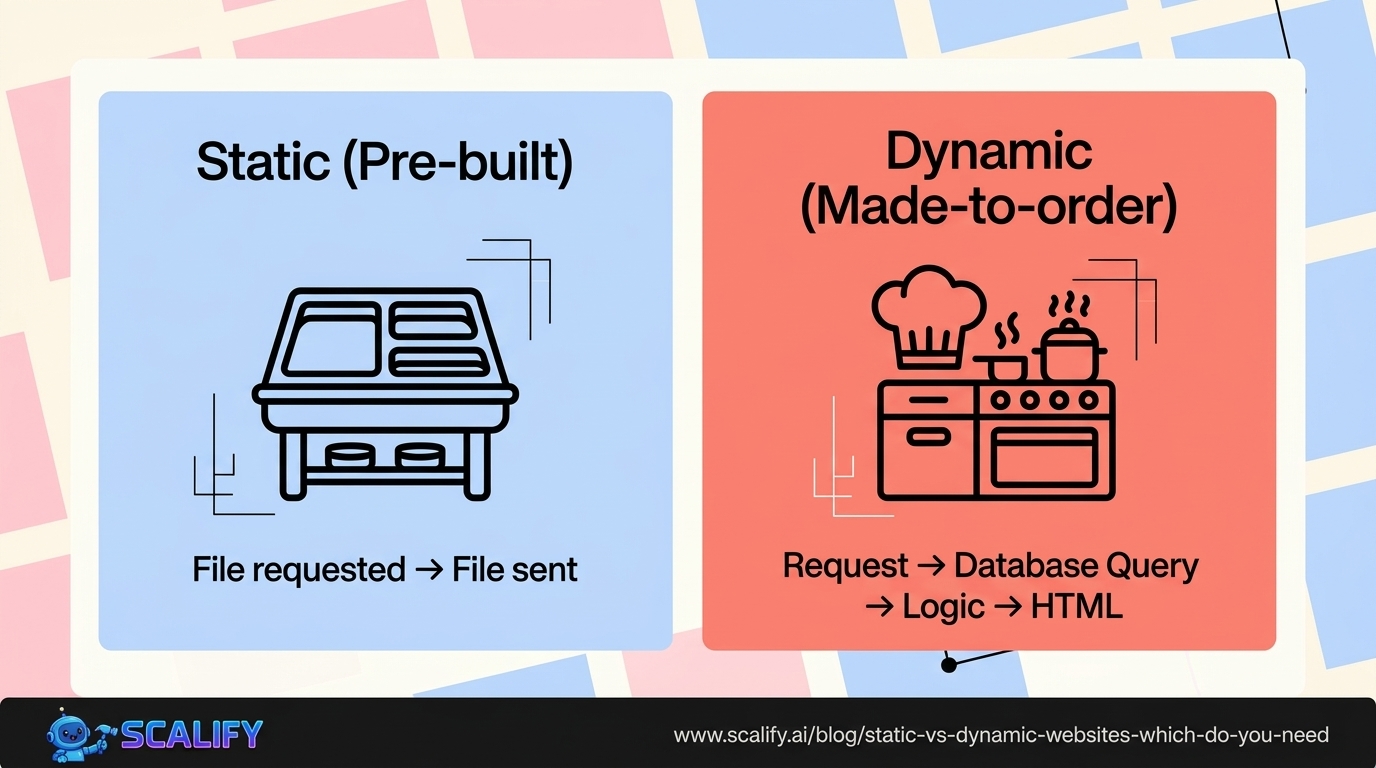
For a static website, this is simple: the server looks up the file you requested (say, index.html for the homepage) and sends it back. No processing needed — it's just reading and transmitting a file that already exists.
For a dynamic website, it's more involved. The server might need to:
- Query a database to retrieve content (like your profile information, a list of products, recent blog posts)
- Run application logic (check if you're logged in, personalize the content, calculate prices)
- Assemble the page from templates and data pulled from multiple sources
- Call other services or APIs to fetch additional information
This server-side processing is where a lot of the speed difference between websites comes from. A well-optimized dynamic site can process a request in under 100 milliseconds. A poorly built one can take several seconds just to assemble the page before it even sends anything back to you.
Once the server has everything ready, it sends back an HTTP response. This response includes a status code (200 means success; 404 means the requested page wasn't found; 500 means something broke on the server), headers with metadata about the response, and the actual content — usually starting with an HTML file.
Step 7: The Browser Receives and Parses the HTML
Your browser receives the HTML file and immediately starts working — it doesn't wait for the entire file before beginning. It reads the HTML from top to bottom, building a model of the page's structure in memory called the DOM (Document Object Model).
As it reads through the HTML, it discovers references to other resources it needs: a CSS stylesheet here, a JavaScript file there, an image, a font. Each of these triggers a new request back to the server (or to wherever that resource is hosted).
This is why page load time isn't just about one file — it's about the entire chain of resources a page needs. A page that references 50 external resources has 50 separate round trips happening, even if some of them are parallelized.
Step 8: CSS Is Downloaded and Applied
CSS files are critical path resources — the browser stops rendering the page until it has downloaded and processed the CSS. This makes sense: if it started painting the screen before it had the styles, everything would flash from unstyled to styled in a jarring way (you've probably seen this happen on a slow connection).
Once the CSS is downloaded, the browser parses it and creates a CSSOM (CSS Object Model) — the CSS equivalent of the DOM. It then combines the DOM and CSSOM into a Render Tree: a complete model of everything that will appear on screen and how it will look.
Step 9: JavaScript Is Downloaded and Executed
JavaScript files are downloaded and executed, often at this stage (though where in the page load process JS runs depends on how it's loaded — whether it's in the head or body of the HTML, and whether it has async or defer attributes).
JavaScript can both read and modify the DOM and CSSOM. It can add elements, remove elements, change styles, fetch additional data from servers, respond to user interactions. It's what makes the page dynamic and interactive.
Poorly handled JavaScript is one of the most common causes of slow page loads. A large JavaScript bundle that blocks rendering can add hundreds of milliseconds or more to the time before a user sees anything useful. This is why web performance engineers spend so much time on JS optimization — splitting bundles, lazy-loading code, deferring non-critical scripts.
Step 10: Layout, Paint, and Composite — The Screen Lights Up
With the HTML parsed, CSS applied, and JavaScript executed, the browser enters the final rendering stages:
Layout (also called Reflow): The browser calculates the exact position and size of every element on the page. Where does this heading go? How wide is this image? How many lines does this paragraph wrap to? This computation can be intensive on complex pages.
Paint: The browser fills in the pixels — drawing text, colors, borders, shadows, images. It creates a series of layers that represent different parts of the page.
Composite: The layers are combined in the correct order and sent to your screen. For elements that move or animate, compositing can be handled by the GPU, which is why CSS animations are generally smoother than JavaScript animations.
The result: pixels light up on your screen, and the page appears.
The Role of CDNs: Why Geography Matters
One thing we've glossed over so far: the physical distance between you and the server matters enormously. Every request has to travel at the speed of light (roughly) through physical cables — fiber optic, submarine cables across ocean floors, copper wire for the last mile. The farther the data has to travel, the longer it takes.
A request from Miami to a server in Miami might take 5 milliseconds round trip. The same request to a server in London might take 100ms. To Singapore, 200ms+. And that latency multiplies across every resource the page needs.
This is why CDNs (Content Delivery Networks) exist. A CDN is a globally distributed network of servers (called "edge nodes" or "Points of Presence") that store cached copies of your website's static assets — images, CSS, JavaScript, fonts. When you visit a site that uses a CDN, these assets are served from whichever node is geographically closest to you, dramatically reducing latency.
Cloudflare, Fastly, Akamai, AWS CloudFront — these are the major CDN providers. Most modern hosting platforms include CDN functionality by default. For a business with a global or even national audience, CDN usage isn't optional — it's the difference between a fast site and a slow one for anyone outside your hosting region.
What Happens When Something Goes Wrong
Understanding the normal process also helps explain the failure modes — the things that go wrong and why.
DNS failure: If the DNS lookup fails — because your domain's DNS records are misconfigured, or the DNS server is down — the browser can't resolve the address and shows a "server not found" error. This is why changing your domain's DNS settings can take time to propagate globally; every DNS server in the chain needs to update its cache.
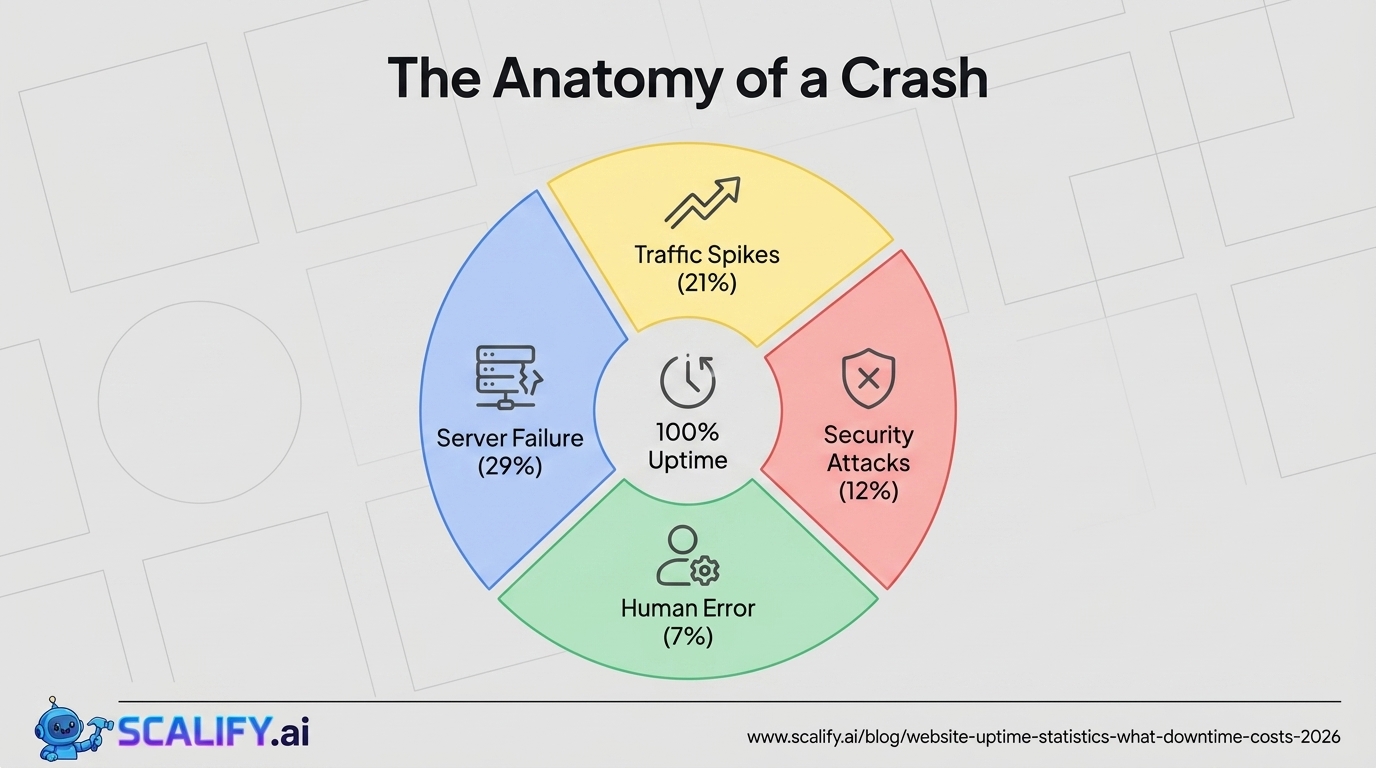
Server down: If the web server is offline — because of a hardware failure, a traffic overload, or a software crash — the TCP connection attempt fails and you get a "connection refused" or "connection timed out" error. This is what "the site is down" actually means.
Slow server response: If the server is overloaded or the application code is inefficient, the Time to First Byte (TTFB) — the time between sending the request and receiving the first bit of the response — can be very slow. A TTFB above 600ms is considered problematic. Users experience this as a blank white screen that takes forever before anything appears.
404 errors: If the server receives the request but can't find the specific file or page requested — because it was deleted, moved, or the URL was typed incorrectly — it returns a 404 status code. Most sites have a custom 404 page to handle this gracefully.
Certificate errors: If the SSL certificate is expired, invalid, or from an untrusted source, the browser will block the connection and show a security warning. Users see a red warning page instead of your site. This is a conversion-killing trust issue that's entirely preventable with proper certificate management.
JavaScript errors: If JavaScript code throws an uncaught error during execution, it can prevent parts of the page from working — or in severe cases, stop the page from loading at all. This is why testing across different browsers and devices matters — JavaScript behavior can vary.
Why Page Speed Matters More Than You Think
Now that you understand the full pipeline, you can see why optimizing for speed requires attention at multiple points in the chain. It's not just "get a faster server" (though that helps). It's about reducing DNS lookup time, minimizing the number of requests, compressing file sizes, caching aggressively, using a CDN, optimizing rendering performance, and deferring non-critical resources.
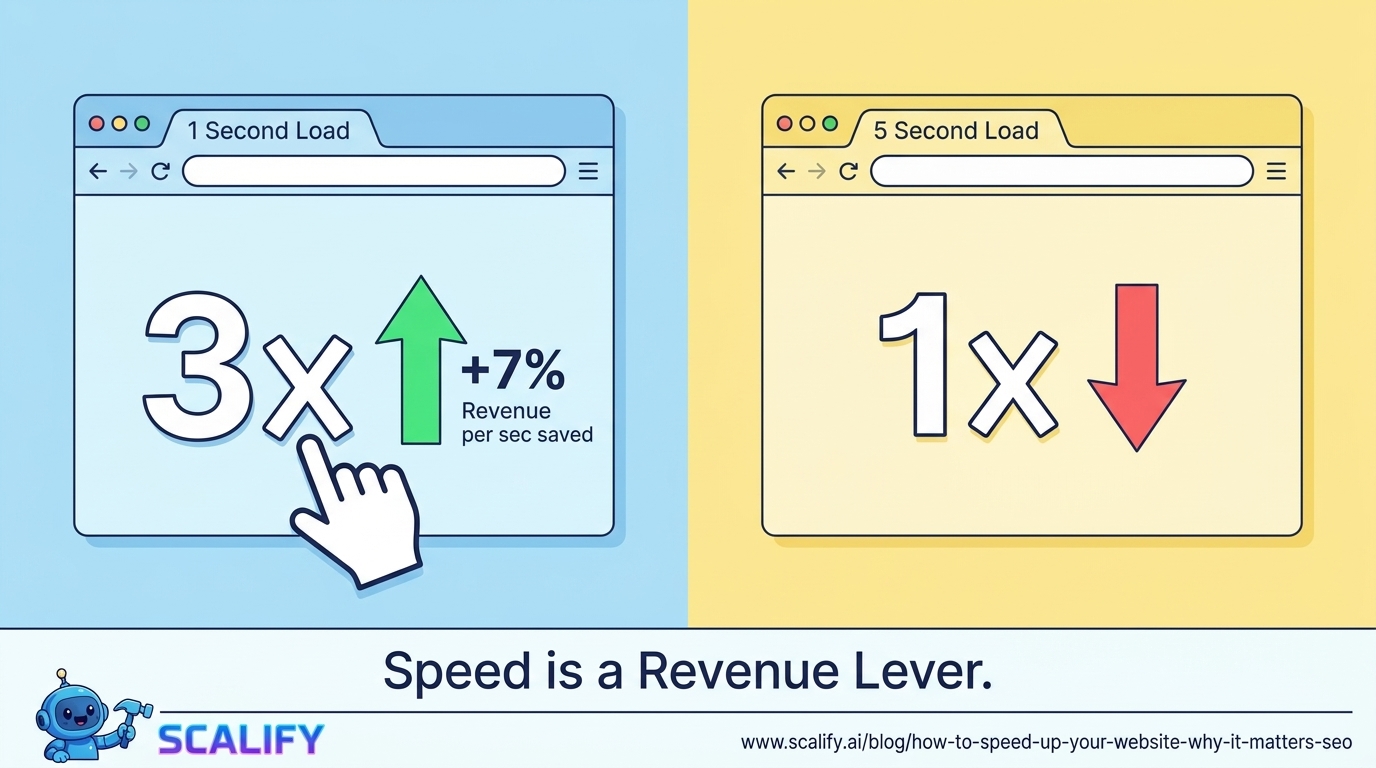
The stakes are real. Google has published research showing that as load time increases from 1 second to 3 seconds, bounce rate increases by 32%. From 1 second to 5 seconds, it increases 90%. From 1 second to 10 seconds — which still happens on poorly optimized sites — it jumps 123%.
And page speed is a direct Google ranking factor. Faster sites rank higher. Faster sites convert better. Faster sites retain users longer. The technical complexity behind "how a website works" translates directly into measurable business outcomes.
The Modern Web: What's Changed
The process above describes how the web fundamentally works — and it's been largely consistent since the early 1990s. But modern websites layer significant additional complexity on top of this foundation.
Single Page Applications (SPAs): Frameworks like React, Vue, and Angular load a single HTML page and then dynamically swap out content using JavaScript as you navigate, rather than triggering full page loads for each new URL. This can make interactions feel faster and more app-like, but it changes how the browser handles routing and can create challenges for SEO if not implemented carefully.
Server-Side Rendering (SSR) and Static Site Generation (SSG): Modern frameworks have developed hybrid approaches where some content is rendered on the server (for speed and SEO) and some is hydrated with JavaScript on the client (for interactivity). Next.js has become dominant here.
HTTP/2 and HTTP/3: Newer versions of the HTTP protocol allow multiple requests to be sent over a single connection simultaneously (rather than one at a time), dramatically reducing the overhead of loading pages with many resources. Most modern servers and CDNs support HTTP/2 and increasingly HTTP/3.
Service Workers and Progressive Web Apps (PWAs): Service workers are JavaScript scripts that run in the background, separate from the main browser thread. They can intercept network requests, cache resources, and even serve pages when you're offline. Sites built with service workers behave much more like native mobile apps.
Why This Matters for Your Business
You don't need to understand every protocol and rendering step in detail to make good decisions about your website. But having a mental model of the pipeline helps you ask better questions and understand why certain things cost what they cost.
When a developer tells you your site needs a CDN, you now understand why — geography and latency. When someone says your Time to First Byte is too high, you understand that means the server is slow to respond, not just that the page has large files. When you're told your JavaScript bundle is too large and needs code splitting, you understand that large JS files block rendering and slow down what users see first.
Understanding how websites work is one of those foundational pieces of knowledge that compounds. Every decision — about hosting, about tech stack, about what features to add, about performance optimization — gets clearer once you understand the system those decisions operate within.
The Bottom Line
Loading a webpage is a multi-step chain involving your browser, DNS servers, TCP connections, TLS encryption, HTTP requests and responses, server-side processing, resource loading, and browser rendering. Each link in that chain is a potential bottleneck — and a potential optimization point.
The best websites are the ones where every step in this chain has been thought about and optimized: fast DNS, reliable servers with low TTFB, HTTPS implemented correctly, CDN distribution, lean resource loading, and efficient rendering. That's what separates a site that loads in under a second from one that makes users wait and eventually leave.
If you want a website built with all of this handled correctly from the start — architecture, performance, security, and everything else that makes a site actually work — that's exactly what Scalify delivers. Professional custom websites, built right the first time, so you can focus on your business instead of your infrastructure.








.jpeg)

.jpeg)




78 SW 7th St, Miami, FL 33130