


How to Choose a Web Design Agency: The Complete Guide
By Josh Ternyak

March 29, 2026
Choosing the wrong web design agency is a costly, time-consuming mistake. This guide gives you the exact questions to ask, the portfolio signals to evaluate, and the red flags to avoid before signing any contract.
The Decision That Determines Your Website's Success
The web design agency market is enormous and profoundly inconsistent. From boutique studios producing award-winning work to shops that deliver cookie-cutter templates at premium prices, the range of quality behind similar-looking websites and marketing claims is staggering. A business that chooses wrong doesn't just get a mediocre website — they often spend months in a difficult project, pay the agreed price, and end up with something that doesn't work for their business and needs to be redone within two years.
The good news: agencies that deliver excellent work and agencies that don't are distinguishable before you sign anything. The quality signals are there — in portfolio work, in how they run their process, in the questions they ask during initial conversations, in the specificity of their proposals, and in what you find when you talk to their past clients.
This guide walks through every dimension of agency evaluation: what to look for in portfolio review, what to ask and how to interpret the answers, what process indicators distinguish professional operations from disorganized ones, and what the contractual protections that matter most look like.
Step 1: Define What You Actually Need Before Looking at Any Agency
The agencies that appear to be a good fit are the ones that appear to match your needs. If you haven't defined your needs before starting the evaluation, you can't evaluate fit effectively.
Define your goals: What specific business outcome should the website achieve? More leads, more revenue, more credibility, more talent applications, more donations? Be as specific as you can — "increase qualified leads from our website by 50%" is more useful than "better website."
Define your audience: Who are the primary visitors? What do they need from the website? What would success look like from their perspective?
Define your requirements: What pages and sections are needed? What functionality (e-commerce, booking system, member portal, CMS)? What integrations (CRM, email platform, payment processing)?
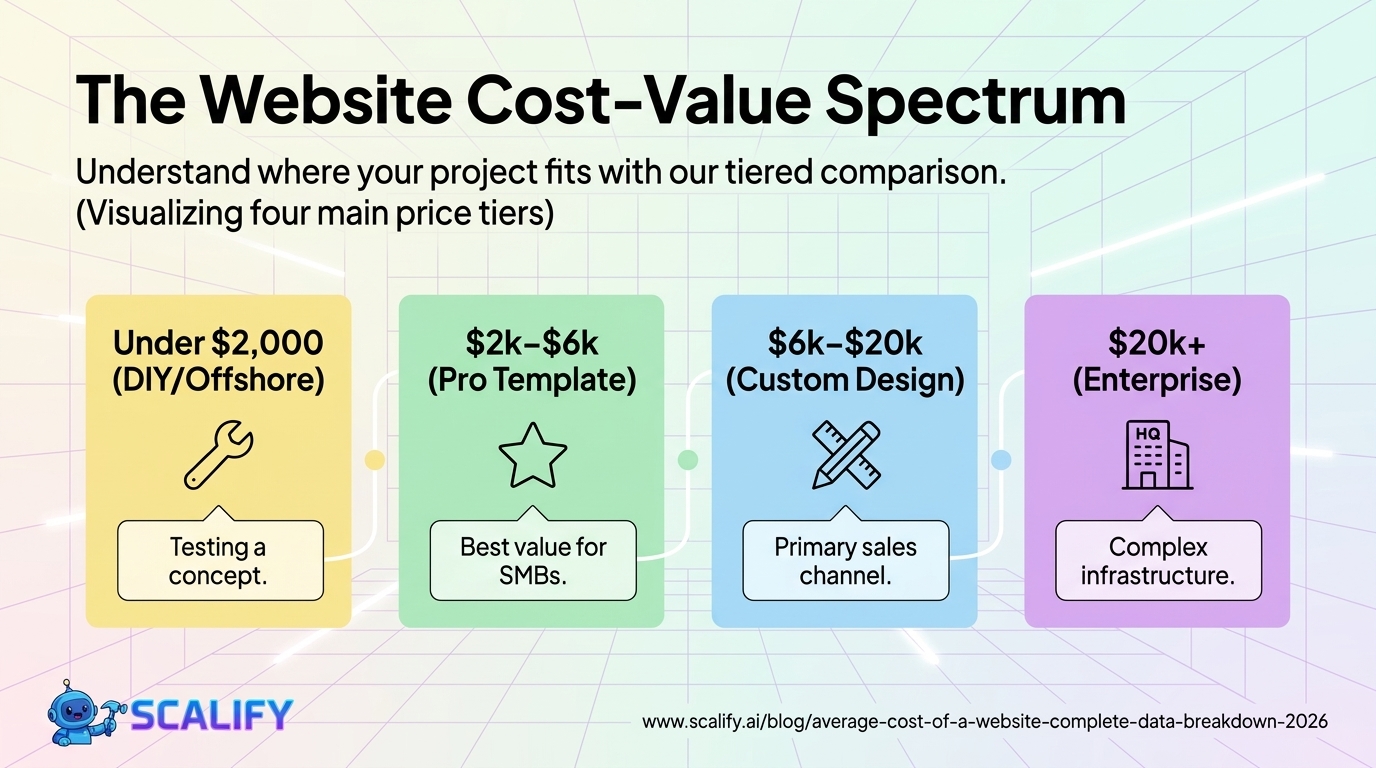
Define your constraints: What's your budget range? What's your timeline? Do you have content ready or do you need help creating it? Do you have brand guidelines and design assets or do you need brand development?
With these defined, you can evaluate each agency against your specific situation rather than against a generic notion of "good agency."
Step 2: Portfolio Evaluation — Looking at the Right Things
Portfolio review is the most important part of agency evaluation, but most buyers look at portfolios wrong — they evaluate aesthetics and say "I like their style" or "that's not really my taste." This is insufficient. A portfolio should answer much more specific questions.
Have They Done Work Similar to Yours?
An agency that has built excellent websites for luxury consumer brands has not demonstrated they can build excellent websites for industrial B2B manufacturers. Different client types have different audiences, different conversion goals, different tone requirements, and different technical needs. Look for work in your general category — similar industry, similar business size, similar audience type.
This doesn't mean perfect match is required. An agency without your exact industry experience but strong work in adjacent categories (a professional services firm for another professional services sector) is often fine. An agency whose portfolio is entirely e-commerce when you're a service business is a flag.
Click Through to Live Sites
Screenshots are carefully curated moments. The live website reveals the full reality: how fast it loads, how well the mobile layout actually works, whether the navigation makes sense, whether the design holds up in the full context of real content.
When reviewing live portfolio sites, check:
- Load speed on your phone on a 4G connection (not your fast office WiFi)
- Mobile layout — is it as polished as desktop, or does it feel like an afterthought?
- Navigation — is it intuitive, or do you have to hunt for things?
- Content presentation — does the design serve the content, or fight it?
- Conversion elements — are CTAs visible and compelling?
Check for Process, Not Just Aesthetics
Some agencies present case studies alongside portfolio work — showing not just what they built but why they made specific decisions and what the outcomes were. These process-showing case studies reveal whether the agency thinks about design strategically or just aesthetically. An agency that can articulate why they made specific design choices — and connect those choices to client business outcomes — is operating at a higher level than one that can only show finished work.
Assess Consistency
One excellent project in a portfolio of mediocre ones suggests the excellent project may have had factors (great client, exceptional designer now gone, client-driven decisions that happened to work) that aren't reproducible. Consistent quality across multiple portfolio projects gives more confidence that the quality is systematic rather than accidental.
Step 3: The Initial Conversation — What Good Agencies Do
How an agency runs the initial conversation tells you a great deal about how they run projects. The behaviors to observe:
They Ask About Your Business Before Talking About Theirs
Agencies that lead initial conversations with their credentials, their process, and their portfolio before learning anything about your business are optimized for selling. Agencies that lead with questions about your goals, your audience, your current situation, and what would make this project successful are optimized for serving. The questions they ask reveal what they actually care about.
Questions a good agency should ask in early conversations: What are you trying to accomplish with this website? Who are your target customers? What does a successful project look like in 6 months? What hasn't worked with past web design projects or your current site?
They Give Honest Assessments, Not Just Agreement
If you tell an agency what you want and they respond with enthusiasm and agreement on every point, they may be a good listener or they may be telling you what you want to hear. Agencies with genuine expertise occasionally push back — they suggest a different approach, question an assumption, or flag a potential problem. This is not being difficult; it's being genuinely useful.
"I'd actually push back on that approach — in our experience with similar businesses, the single-page layout you're describing tends to hurt lead conversion because..." is the kind of response that indicates an agency has real expertise and is willing to apply it, even when the client has expressed a preference.
They Communicate With Clarity and Professionalism
The quality of communication during the sales process is predictive of communication during the project. Agencies that are slow to respond, vague in their answers, or disorganized in their process before the contract is signed will be the same way once you're paying them. Agencies that respond promptly, communicate clearly, and run organized sales processes tend to run organized projects.
Step 4: The Proposal — What to Look For
A serious agency proposal should include specific, documented information about what they're going to do and how. Vague proposals that are thin on specifics are a consistent indicator of agencies that haven't thought carefully about your specific project.
Clearly Defined Scope
The proposal should specify: exactly which pages will be designed and built, what functionality is included and what isn't, how many rounds of revisions are included and what "revision" means (a small adjustment vs. a significant direction change), what deliverables are included (design files, style guide, training, documentation), and what is explicitly excluded from the scope.
Proposals without clear scope definitions create the conditions for scope disputes — "we thought this was included" is one of the most common sources of client-agency conflict, and it's almost entirely preventable with clear scope documentation upfront.
Timeline With Milestones
A project timeline should show not just the end date but the intermediate milestones: when wireframes are delivered, when design mockups are presented, when development begins, when the review period occurs, when launch happens. This lets you evaluate whether the timeline is realistic and provides checkpoints for assessing project health.
What They Need From You
The proposal should specify what the client is responsible for providing: content (copy, images, existing materials), decisions (approval of designs within a defined timeframe), access (to existing accounts, hosting environments, third-party tools). Proposals that don't address client responsibilities set up projects for delays when the agency is waiting on client deliverables.
Payment Structure
Standard for web design: 30–50% deposit, milestone payments tied to project stages, final payment on or just before launch. A proposal requiring 100% payment upfront before any work has been seen is a risk. A proposal requiring no deposit at all often indicates financial instability.
Step 5: The Questions to Ask Before Signing
The most revealing questions to ask in final agency evaluation:
"Can you walk me through how the project will actually work, week by week?" — Agencies with clear processes can answer this in detail. Agencies without clear processes give vague answers about "discovery and design phases."
"What happens if the project timeline slips?" — The honest answer addresses that delays are often caused by waiting for client content or approvals, but also how the agency handles their own delays. Listen for: do they have a plan, or is this clearly something they haven't thought about?
"How do you handle revision requests that go significantly beyond what was discussed?" — Change orders are the standard approach. Good agencies have a clear change order process; agencies without one often absorb unlimited revisions resentfully or argue about scope.
"Who specifically will be working on my project, and can I talk to them?" — At many agencies, the account manager who sells the project is not the designer or developer who executes it. Meeting the actual project team before signing can reveal significant gaps between who sold you and who will serve you.
"What do you wish clients understood before starting a web design project?" — An open-ended question that reveals the agency's priorities and pain points. Good agencies give honest, useful answers about content preparation, decision-making authority, or feedback specificity. Evasive answers or sales-speak are a signal.
Step 6: Reference Checks — What to Actually Ask
Reference checks are among the most underutilized parts of agency evaluation. Many buyers either skip them entirely or ask questions that don't produce useful information. The questions that reveal the most:
"Did the project come in on time and on budget?" — A yes/no answer followed by "what caused any overruns?" The explanation is as informative as the answer.
"How was communication throughout the project?" — Were they responsive? Did they proactively communicate problems or hide them until they became bigger issues?
"Was there anything that surprised you — positively or negatively?" — Open-ended questions surface things that don't fit in yes/no structures.
"What was it like when a problem came up?" — Every project has problems. How the agency handled them is more informative than whether the project went smoothly. "When we had a technical issue after launch, they fixed it the same day without charging us" tells you something. "When there was a problem, we had to chase them for a week" tells you something different.
"Would you hire them again?" — This question gets a more honest answer than "would you recommend them?" because it requires the reference to personally commit rather than just express approval.
Red Flags That Should Stop the Evaluation
No clear portfolio of completed, live websites: Mockups, concept work, and in-progress projects aren't evidence of delivery capability. If an agency can't show you multiple completed live websites with clients willing to be referenced, the track record is insufficient.
Unwillingness to provide client references: Agencies with satisfied clients have clients willing to speak to their experience. Refusal to provide references or providing only email addresses (not phone numbers or willingness to have a call) suggests the reference check is expected to be disappointing.
Vague proposals: A proposal that describes "the design phase" without specifying deliverables, revision count, or timeline is not a real proposal. Vague proposals protect the agency from scope accountability while creating unlimited scope expectations for the client.
Pressure to sign immediately: "This price is only available if you sign by Friday" is a sales pressure tactic, not a legitimate business constraint. Agencies that apply artificial urgency to force premature decisions are optimizing for their sales cycle, not your interests.
Only positive answers to every question: If asking "what challenges do you anticipate with this project?" produces "I don't foresee any challenges, we do this all the time," either the agency hasn't thought carefully about your specific project or they're unwilling to be honest. Genuine expertise includes recognizing genuine challenges.
No discovery process: An agency that's ready to give you a fixed price without any discovery is either pricing very conservatively (high price to cover unknowns) or hasn't accounted for project-specific complexity. Serious agencies want to understand the project before committing to a price.
The Contract: What Must Be Clear
The contract formalizes the proposal. Key provisions to verify are present and clear:
- Intellectual property: Who owns the design files and the built website after the project is complete and paid for? The default is often that the agency retains ownership of design files. If you want the Figma source files, make sure the contract specifies this.
- Revision definition and limit: How many rounds of revisions are included? What constitutes a revision vs. a scope change?
- Cancellation clauses: What happens if you cancel partway through? What happens if the agency fails to deliver?
- Launch criteria: What constitutes project completion? When is the final payment due relative to launch?
- Post-launch support: What support is included after launch and for how long?
The Bottom Line
Choosing the right web design agency is one of the most consequential marketing decisions a business makes. A good match produces a website that serves as a reliable, growing business asset for years. A poor match produces months of frustrating process, a disappointing result, and the cost of starting over.
The right choice is found through systematic evaluation: portfolio review that looks beyond aesthetics to live site quality and consistency, initial conversations that reveal strategic thinking and honest communication, proposals with clear scope and milestones, reference checks with substantive questions, and contract review focused on IP ownership and scope definition.
At Scalify, we've built our process specifically to address the most common agency frustrations: clear scope from day one, specific milestones, 10-day delivery, and complete IP transfer on final payment. We believe the right agency earns trust through transparency, not through salesmanship.


.jpeg)
.jpeg)


78 SW 7th St, Miami, FL 33130