


How to Design a Website for an Older Audience: A Complete Guide
By Josh Ternyak

March 29, 2026
Designing for older users isn't about dumbing things down — it's about removing friction that shouldn't exist for anyone. This guide covers the specific design and content adjustments that make websites genuinely usable for audiences 55 and older.
The Audience Most Websites Are Accidentally Excluding
The 55+ demographic controls approximately 70% of disposable income in the United States. They're one of the fastest-growing online shopping demographics. They're active, engaged, and increasingly digitally literate. And most websites are designed in ways that create unnecessary friction for them — not maliciously, but because the people who design and evaluate websites skew young, have excellent eyesight, and are using high-end hardware.
The irony is that designing for older users doesn't require dumbing anything down or creating a visually impoverished experience. The adaptations that make websites more usable for 55+ audiences — larger text, better contrast, clearer navigation, less cognitive load, more explicit feedback — make websites better for everyone. Accessibility and good design consistently overlap in this way: removing barriers for users who face them also removes friction for users who don't.
This guide covers the specific design, typography, interaction, and content decisions that meaningfully improve website usability for older audiences — based on usability research, accessibility standards, and the specific challenges this demographic faces online.
Understanding How Aging Affects Digital Experience
Before jumping to solutions, it's worth understanding the underlying challenges. The usability issues older users face aren't random — they stem from specific, predictable changes in vision, motor ability, cognitive processing, and technology familiarity that accumulate with age.
Vision Changes
Starting in the early 40s, most people experience presbyopia — reduced ability to focus on close objects, including screens. This makes small text genuinely harder to read, not just annoying to read. Color perception also changes with age: the lens of the eye yellows slightly, reducing blue light transmission and making it harder to distinguish between blue, green, and violet hues. Contrast sensitivity declines — low-contrast text that a 25-year-old can read easily may be genuinely difficult for a 65-year-old to process.
By age 65, many people experience clinically reduced visual acuity even with corrective lenses. Cataracts (which reduce overall visual clarity and increase sensitivity to glare) are common. This isn't rare edge-case disability — it's normal aging that affects the majority of the 65+ population.
Motor Ability Changes
Fine motor precision declines with age. This affects mouse control — the ability to accurately target small click areas, execute precise hover interactions, and drag elements. It also affects touchscreen interactions — tapping small touch targets accurately becomes more difficult, and accidental double-taps are more common.
Tremors, whether mild or more pronounced, make precise pointing difficult. Arthritis can reduce grip strength and finger dexterity. These aren't conditions that affect only the very old or very ill — subtle motor changes begin in the 50s and accumulate.
Cognitive Processing Changes
Processing speed — the rate at which new information is absorbed and evaluated — slows with age. This means that websites with rapid movement, information-dense layouts, or complex interaction patterns require more cognitive effort for older users than for younger ones.
Working memory capacity also changes. Older users may have more difficulty remembering where they were in a multi-step process, what they've already filled in a form before the page reloaded, or how to navigate back to where they started. This doesn't indicate reduced intelligence — it reflects the specific way working memory shifts over time.
Technology Familiarity
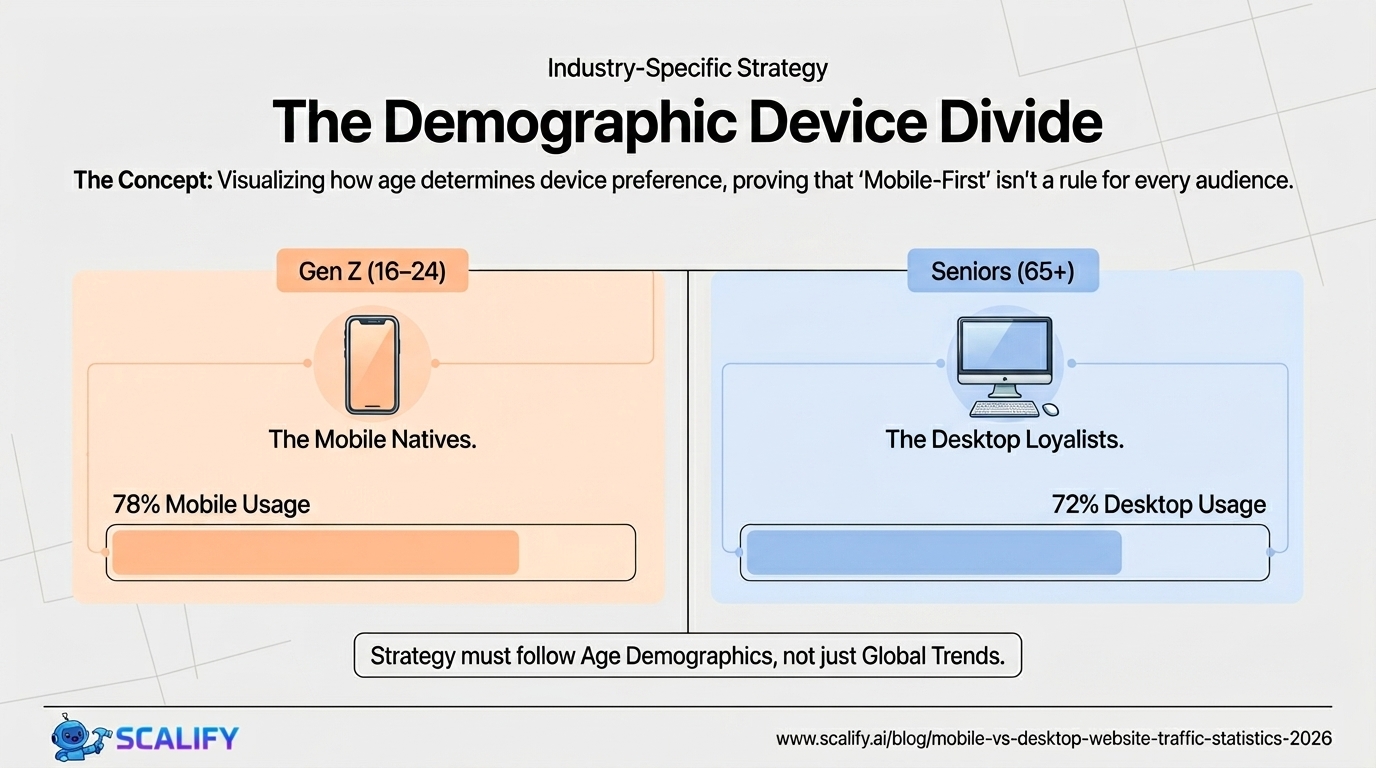
Today's 70-year-old grew up without computers, adopted them as adults, and has navigated multiple generations of changing interfaces and conventions. Their mental models for how websites work may differ from younger users. They're less likely to intuit interaction patterns that seem obvious to someone who grew up with touchscreens and gesture-based interfaces.
This familiarity gap is shrinking with every cohort — today's 55-year-olds are significantly more technology-literate than 55-year-olds of a decade ago. But it remains a real consideration, particularly for novel interaction patterns that depend on conventions that haven't fully solidified.
Typography: The Highest-Impact Design Decision
Font Size
The most common reason older users struggle with websites is text that's too small. The general web average of 16px body text is a floor, not a target. For audiences skewing 55+, 18px body text is a reasonable default; 20px is appropriate for audiences skewing 65+.
Critically, this should be implemented in relative units (rem or em) rather than fixed pixels so that users who have increased their browser's default font size — a common accommodation for older users — see proportionally larger text. Hard-coding font sizes in pixels overrides user browser settings, which is why the many older users who have already adjusted their browsers still struggle on sites that ignore those settings.
Heading sizes should scale proportionally. An H1 that's 200% of body text size maintains its visual hierarchy regardless of what base size the user sees.
Line Height and Measure
Dense, tightly-set text is more challenging to track line-to-line for older readers. A line height of 1.5–1.75× the font size (compared to the default browser 1.2×) substantially improves readability. The extra space between lines makes it easier to follow from the end of one line to the beginning of the next without losing your place.
Measure — the number of characters per line — also affects reading comfort. 50–70 characters per line (roughly 8–12 words) is the research-supported range for comfortable reading. Wider columns that produce 100+ character lines require more horizontal eye tracking, which is more fatiguing for older readers.
Font Choice
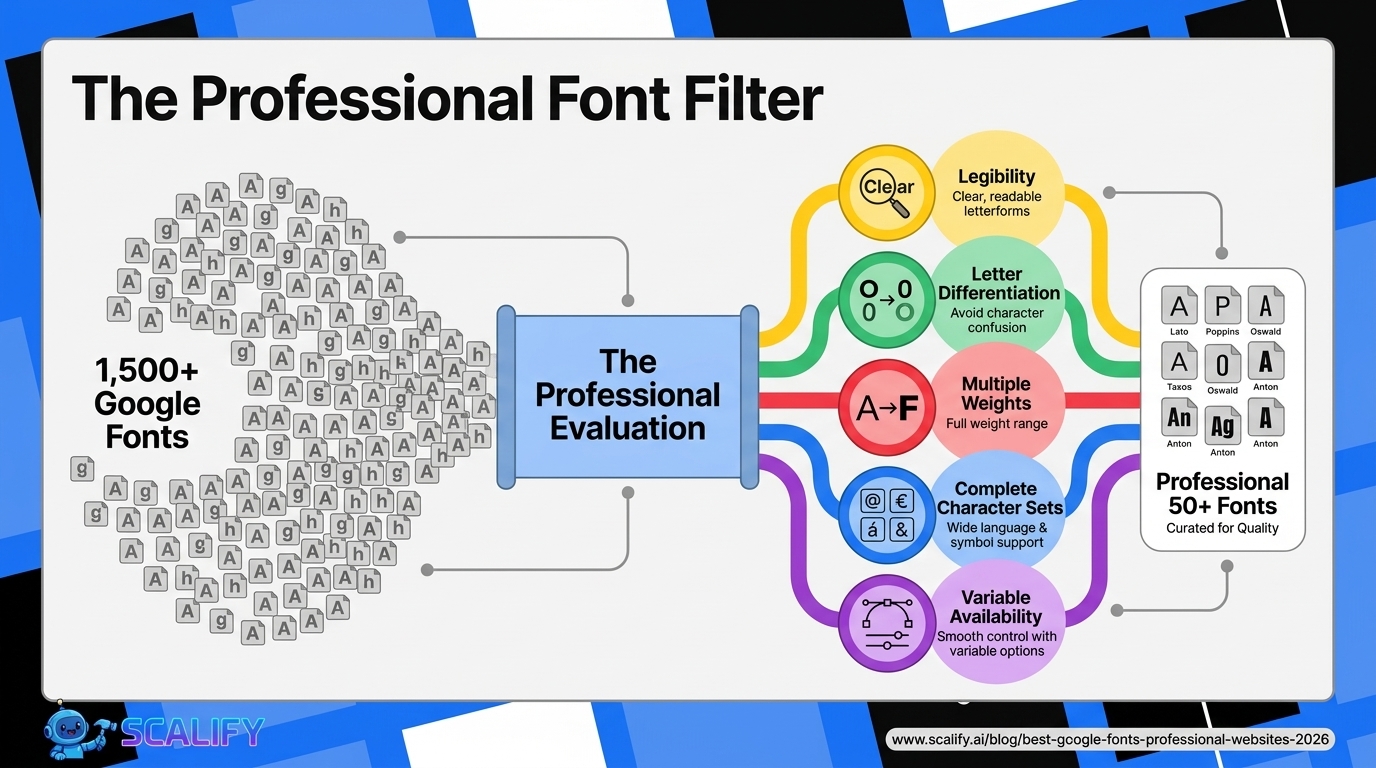
For body text, highly legible typefaces with clear letterform differentiation are essential. The letters that are most commonly confused — lowercase l, I (capital i), and 1 (one) — should be clearly distinct in the chosen typeface. Open apertures (the openings in letters like 'c', 'e', 'a') improve legibility at smaller sizes and for users with reduced visual acuity.
Humanist sans-serifs (like Inter, Source Sans Pro, or Gill Sans) tend to perform well for older audiences because they maintain legibility at smaller sizes. Geometric sans-serifs with very uniform strokes can be harder to read at smaller sizes because the letters are more visually similar. Serif typefaces with strong stroke contrast (like Garamond or Bodoni) can be harder to read at small sizes on screens because the thin strokes may disappear.
Most important: test any typeface at the actual size it will be used by your audience, on the types of screens they use (not just a high-resolution designer's monitor).
Contrast
WCAG AA requires a minimum 4.5:1 contrast ratio between text and background for normal text. This is the legal minimum for accessibility compliance, not the target for optimal readability. For audiences skewing 65+, aiming for 7:1 (the WCAG AAA threshold) is appropriate for body text.
The most common contrast failure in modern web design: light gray text on white backgrounds. This trend toward low-contrast text is driven by aesthetic preferences among designers working on high-resolution screens in good lighting conditions — conditions that differ substantially from the varying lighting conditions older users may be reading in (including outdoors on a mobile phone, in a brightly lit room where screen glare reduces effective contrast, or in a dimly lit environment).
Never use color alone to convey information. Red text to indicate errors, green text to indicate success — these conventions rely on color differentiation that may be unavailable to users with color vision deficiencies, which are more prevalent in older populations (and in all populations — approximately 8% of males have some form of color vision deficiency).
Layout and Navigation
Simple, Consistent Navigation
Navigation that changes between pages, requires hover to reveal sub-items, or uses unusual interaction patterns creates confusion for older users who may not anticipate or recognize these behaviors. Navigation should be:
- Visible without requiring hover or click to discover it
- Consistent across all pages — the same navigation in the same position
- Labeled with plain language that clearly describes what's behind each link
- Limited to the number of options a user can reasonably hold in working memory (generally under 7 top-level items)
Breadcrumb navigation is particularly valuable for older audiences because it provides persistent context about where they are in the site hierarchy and easy access to parent pages without requiring the user to remember how they got there.
Sufficient Target Size
All interactive elements — buttons, links, form fields, navigation items — should have tap/click targets of at least 44×44 pixels. This is Apple's Human Interface Guidelines recommendation, WCAG 2.5.5's AAA recommendation, and the threshold supported by touchscreen usability research.
For audiences with known motor precision challenges, larger targets (56×56px or larger for primary CTAs) reduce misclick rates. Adequate spacing between adjacent interactive elements prevents accidental activation of the wrong element.
Links within body text should have sufficient line height that users can click the target link rather than accidentally clicking an adjacent line. Inline links that are the standard underlined-text style are appropriate; tiny text links embedded in paragraphs without visual distinction are a motor precision problem.
Avoid Requiring Precise Hover Interactions
Any functionality that requires the user to precisely hover over an element before it becomes visible or activates is a barrier for users with reduced motor precision. This includes:
- Dropdown navigation that only opens on hover (not on click)
- Tooltips that are the only location for important information
- Image galleries where captions or controls only appear on hover
- Actions that require hovering over a specific small area
If hover interactions are included, ensure the content they reveal is also accessible through a click or other non-hover mechanism.
Predictable Page Structure
Older users benefit from predictable page layouts where the same types of content appear in the same locations across the site. Header with navigation, main content in the center, sidebar (if present) on the right, footer at the bottom — this standard layout allows users to build accurate mental models of where to look for different types of information.
Creative layouts that reorganize the visual hierarchy in unexpected ways — floating navigation, full-screen video intros that delay content access, non-linear page structures — create additional cognitive load that can make sites genuinely difficult to navigate for older users.
Forms and Interactive Elements
Visible, Persistent Form Labels
Form fields with placeholder text as the only label — where the label disappears when the user starts typing — are a significant usability problem for older users. Users who need to check what they're filling in (or who look away from the screen to find a document with the information they're entering) lose the field label as soon as they begin.
Every form field should have a persistent label above the field, in addition to any placeholder text used for examples. Placeholder text should never serve as the only label.
Clear, Specific Error Messages
Error messages that are specific and actionable ("Please enter your email address in the format name@example.com" rather than "Invalid email") allow users to understand and correct mistakes efficiently. Error indicators that use only color (a red border) without text explanation create barriers for users with color vision deficiencies.
Inline validation that shows whether an entry is correct as soon as the field is completed — rather than only after form submission — prevents the confusion of having to return to errors after completing an entire multi-field form.
Sufficient Time Limits
Many websites implement session timeouts or transaction time limits that may be appropriate for security or technical reasons but are set at intervals that create problems for slower users. A 10-minute timeout on a checkout process may be fine for a fast typist on a familiar interface; it may be genuinely problematic for an older user moving through the same process more carefully.
Where time limits exist for necessary reasons, provide clear warning before the limit is reached, sufficient time after the warning to take action, and a way to extend the session without losing entered data.
Content Writing and Communication
Plain Language
Plain language isn't dumbing down — it's respecting your reader's time and cognitive load. Medical jargon, financial terminology, legal language, and technical vocabulary all require additional processing for non-specialist readers. Plain language alternatives communicate the same information with less mental effort.
For older audiences who may be navigating topics they haven't previously encountered — Medicare enrollment, retirement account decisions, first-time online purchases in new categories — plain language is genuinely essential. The information needs to be accessible to someone encountering it for the first time without specialized background.
Chunk Information Into Digestible Pieces
Large blocks of continuous text are harder for all users and particularly challenging for users with reduced visual acuity or processing speed. Breaking content into short paragraphs, using headers to create clear sections, using bulleted lists for items that benefit from visual separation — all of these reduce the cognitive effort required to extract information from the page.
This is good writing practice in general; it's especially important for older audiences.
Explain Unfamiliar Concepts
Don't assume that interaction conventions that feel obvious to designers are universally understood. "Swipe left," "tap to reveal," "click the hamburger menu" — these are conventions that younger users have internalized but that may not be intuitive for users who've been using digital interfaces for a shorter time or in different contexts.
Consider brief, clear explanations the first time unusual interactions appear. Not condescending instructional text, but natural contextual cues: a slightly visible menu icon with "Menu" text rather than just the three-line icon; a "Click to expand" prompt for accordion sections the first time they appear.
Testing With Actual Older Users
The most valuable insight for designing for older audiences comes from watching older users actually use your website. No amount of designer intuition or checklist compliance replaces real observation of real users encountering real friction.
If your target audience includes significant numbers of users 55+, include members of this demographic in any user testing you conduct. Usability problems invisible to younger designers and testers become immediately apparent when watching users who actually represent the audience.
Remote usability testing tools (UserTesting.com, Maze) allow recruiting testers who match specific demographic criteria including age. Even three to five sessions with users in the 65+ range will surface the most significant friction points.
The Bottom Line
Designing for older audiences is not a niche accessibility consideration — it's designing for one of the largest, most economically powerful demographic segments. The adaptations that make websites usable for 55+ users (larger text, better contrast, clearer navigation, simpler forms, consistent structure) are identical to the adaptations that make websites better for all users. The designer who argues that accessibility compromises aesthetic quality is making design decisions that inadvertently exclude significant audience segments and revenue.
Audit your current site against these principles. Run contrast checkers, test at 1.5× text zoom, navigate using only the keyboard, look at the site on a standard-definition monitor in a bright room. The friction you discover is friction your older audience is experiencing every day.
At Scalify, accessibility and usability are design requirements, not afterthoughts — every website we build is tested for the contrast, target sizes, and interaction clarity that make it genuinely usable across the full range of users who will encounter it.













.jpeg)
.jpeg)



78 SW 7th St, Miami, FL 33130