


How to Write Website Copy That Actually Converts
By Josh Ternyak

March 29, 2026
Most website copy reads like a corporate brochure and converts like one too. This guide teaches you how to write website copy that speaks to real people, addresses their real concerns, and drives them to take action.
The Words That Do the Selling When Nobody's Watching
A website is your best salesperson — available 24 hours a day, seven days a week, never having a bad day, never forgetting to mention a key benefit, never failing to follow a proven pitch. But only if the words are right.
Most website copy is not right. Most website copy reads like a press release written by committee, reviewed by legal, edited for brand safety, and drained of every human quality that makes communication persuasive. It describes the company in the third person. It uses words like "leverage" and "solution" and "synergy." It leads with what the company does rather than why that matters to the visitor. It's impressive-sounding and persuasively empty.
The websites that convert — that turn strangers into leads, browsers into buyers, visitors into clients — are written differently. They speak directly to a specific person's specific problem. They acknowledge what that person is thinking and feeling. They make clear, specific claims about outcomes. They remove the friction of doubt and hesitation. They make it obvious what to do next.
This guide covers the principles and tactics of effective website copywriting — from the headline that either earns or loses the page in three seconds, to the CTA that either triggers the action or lets the moment pass.
The Foundation: Know Exactly Who You're Writing For
The most common copywriting mistake isn't weak headline technique or bad CTA phrasing. It's writing for everyone and therefore resonating with no one.
Copy that tries to speak to everyone uses language that's general, safe, and inoffensive. It avoids being specific because being specific excludes some audience. It describes features rather than outcomes because outcomes require knowing what matters to the reader. It never says anything that anyone would disagree with, because it never says anything sharp enough to land.
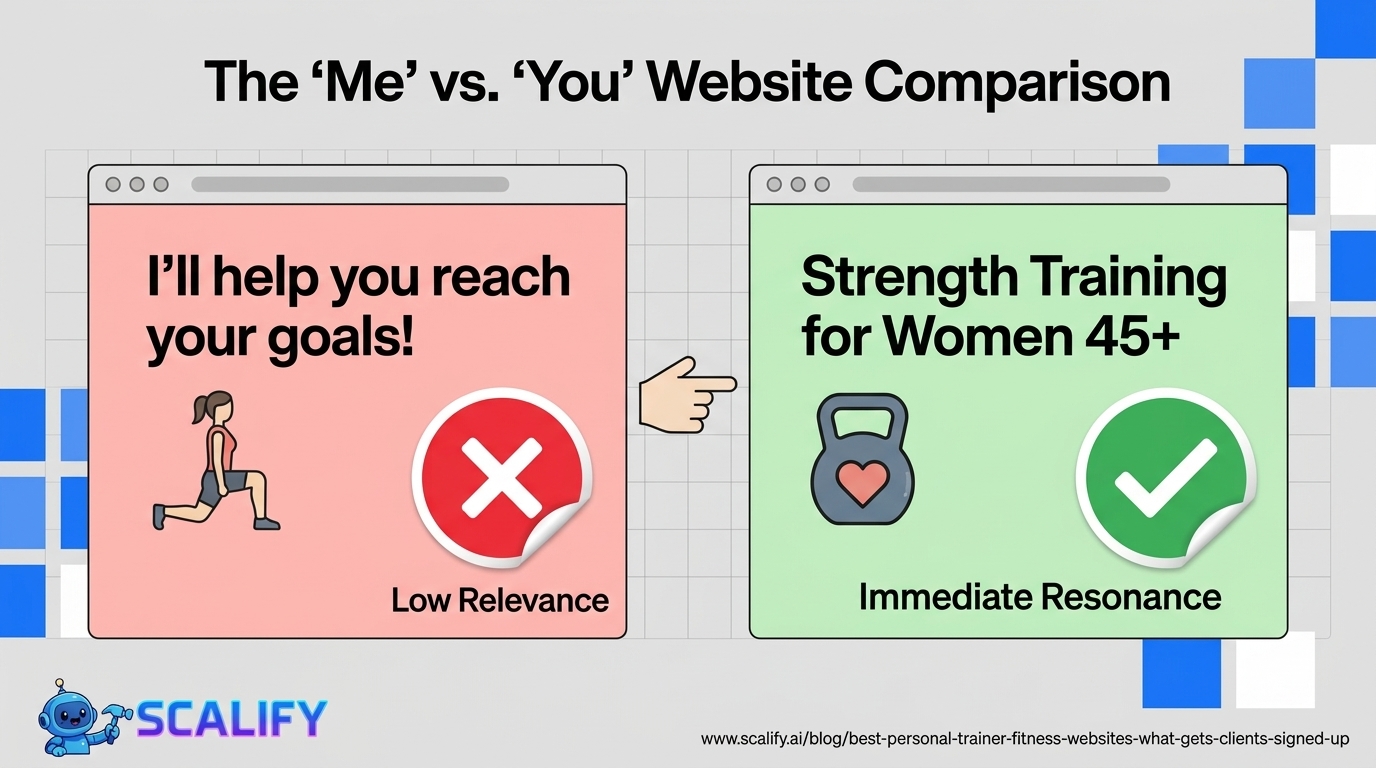
Copy that converts is specific. It speaks to a specific person with specific problems, specific desires, specific fears, and specific objections. "We help businesses grow" speaks to nobody. "We build custom websites for service businesses that need to start generating leads instead of sending prospects to a site that embarrasses them" speaks to someone specific, and that person recognizes themselves immediately.
Before writing a word, answer these questions about your primary audience:
- What specific problem are they trying to solve when they come to your site?
- What words do they use when they describe that problem to others?
- What have they tried before that hasn't worked?
- What are they afraid of getting wrong?
- What would their life or business look like if the problem were solved?
- What's making them hesitate from taking action?
The answers to these questions are the raw material of your copy. Your job is to organize and express those answers in language that makes visitors feel understood — and then demonstrate that your solution addresses what they've been struggling with.
Headlines: The Three-Second Test
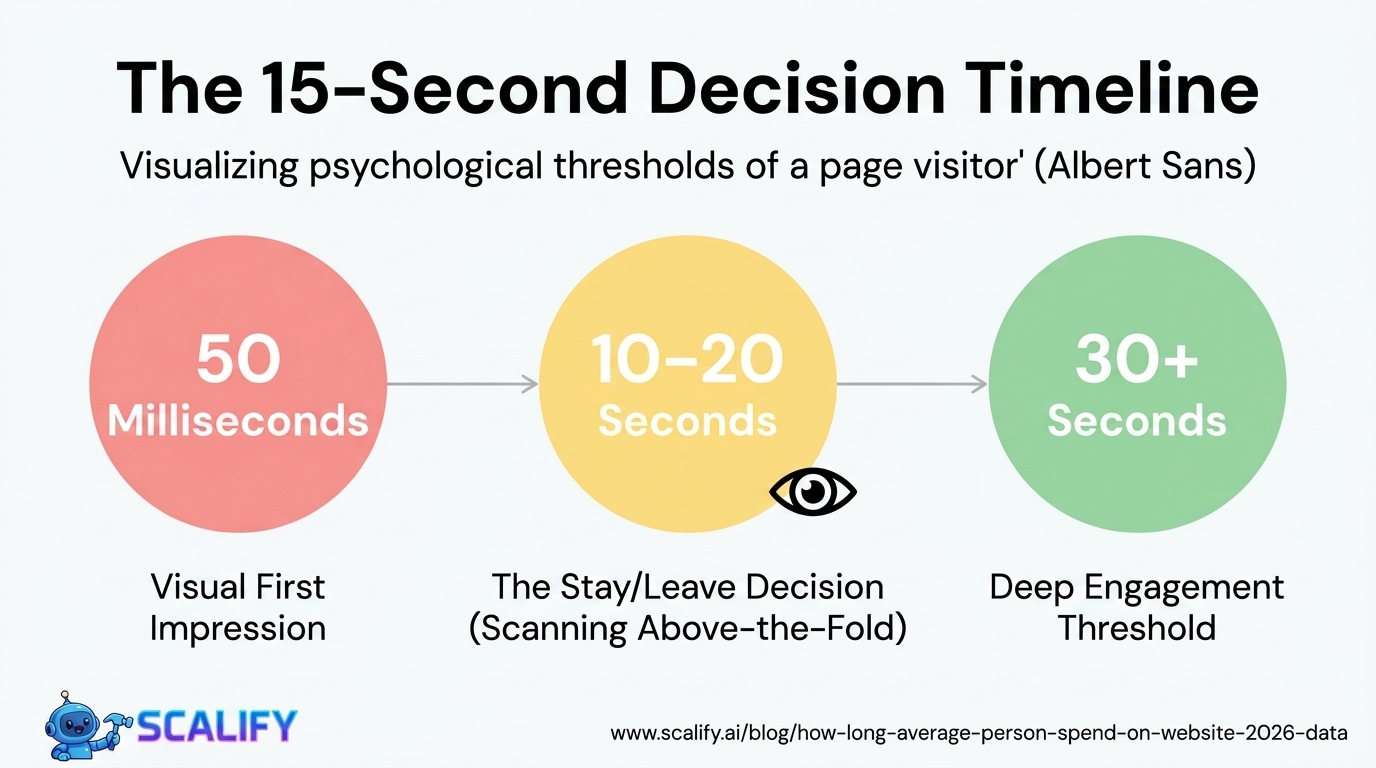
You have approximately three seconds before a visitor decides whether to stay or leave. In those three seconds, the primary headline is doing almost all the work. If the headline fails, no visitor reads the rest.
A headline fails when it's vague, generic, or company-centric. "Welcome to Our Website." "Innovative Solutions for Your Business." "Where Excellence Meets Service." These headlines tell the visitor nothing about whether they're in the right place for their specific problem. The visitor has no reason to stay.
A headline succeeds when it communicates, immediately and specifically, who this is for and what it does for them. The framework that consistently works:
[Primary benefit] for [specific audience]
Examples:
- "Custom Websites That Generate Leads, Built and Launched in 10 Days"
- "The Accounting Software That Saves Small Business Owners 8 Hours Per Week"
- "Miami's Highest-Rated Emergency Plumber — Available 24/7, On-Site in Under an Hour"
Each of these headlines passes the three-second test: a visitor knows immediately what this is, who it's for, and what they get. If they match the target audience, they're immediately interested. If they don't match, they leave — which is also correct. Not every visitor is the right visitor, and copy that filters in the right audience is more valuable than copy that tries to appeal to everyone.
Test multiple headline variants. Even small differences in phrasing produce measurable differences in conversion rate. "Professional Custom Websites in 10 Days" and "Custom Websites Built and Launched in 10 Business Days" are subtly different — one or the other consistently outperforms, and you don't know which until you test.
Subheadlines and Supporting Copy
After the headline hooks attention, the subheadline and supporting copy have one job: confirm the promise and build enough confidence for the visitor to keep reading and eventually act.
The subheadline elaborates on the headline's promise. Where the headline is necessarily brief, the subheadline can add the most important supporting context: what specifically you do, how it works, or why it's different. Keep it to one or two sentences.
The supporting copy in the hero section — the first paragraph or two below the headline/subheadline — does the bridge work: acknowledging the visitor's current situation (the problem they're experiencing), hinting at the transformation (what their situation looks like after), and positioning your solution as the bridge between those two states.
The classic copywriting formula: Problem → Agitate → Solution (PAS).
Problem: "Your website isn't generating the leads your business needs."
Agitate: "Every month your site fails to convert visitors is a month of potential clients going to competitors who have better websites. And the longer it goes on, the further behind you fall."
Solution: "Scalify builds you a custom professional website in 10 business days — professionally designed, built to convert, and launched ready to grow."
This structure works because it meets visitors where they are (acknowledging the problem), intensifies their motivation to solve it (agitating the consequences), and presents your solution as the resolution they've been looking for.
Features vs. Benefits: The Most Important Distinction in Copywriting
Every copywriter has heard "sell benefits, not features." Most website copy still gets this wrong.
A feature is what your product or service is or does. "We use a responsive design framework." "Our team has 10 years of experience." "We offer 30-day revisions." These are facts about the offering.
A benefit is what that feature means for the customer — the result or improvement in their life or business. "Your website works perfectly on every device — no more mobile visitors bouncing from a broken layout." "You get a partner who's been through enough client situations to handle whatever comes up." "You can request changes without fear of extra charges during the first month."
The customer doesn't care about your features. They care about their outcomes. Features are evidence; benefits are conclusions. Your job in copy is to write the conclusions — to make the relevance of your features explicit rather than expecting visitors to make that connection themselves.
The transition from feature to benefit happens with a few words: "which means," "so you can," "so that," "which results in."
Feature: "We deliver websites in 10 business days."
Benefit: "Which means you can stop losing leads to your current site in two weeks from now, not three months."
Apply this to every feature on your site. Ask: "So what? What does this mean for the visitor? Why should they care?" The answer to those questions is your benefit.
Voice and Tone: Sound Like a Human
The biggest credibility killer in website copy is corporate language that sounds like nobody talks in real life. "We leverage best-in-class solutions to deliver synergistic outcomes for our valued clients." Nobody says this. Nobody thinks this. But a committee of people who aren't copywriters, reviewing copy for a company, will make copy sound like this.
Effective website copy sounds like a competent, trusted friend explaining something they know well. It uses the second person ("you," not "our clients"). It uses active voice ("we build" not "websites are built by us"). It uses specific words instead of vague ones ("in 10 business days" not "quickly"). It uses short sentences that breathe.
Read your copy aloud. If you couldn't say it to a person at a dinner party without them looking at you strangely, it needs to be more human. "We leverage integrated digital solutions" is not how anyone talks. "We build websites that generate leads" is how humans talk.
The voice should also match the brand and audience. A luxury brand targeting high-net-worth individuals should sound different from a startup targeting young entrepreneurs. A legal firm sounds different from a creative agency. The tone is calibrated to the specific audience — but the baseline principle of sounding human, using plain language, and speaking directly to the reader applies everywhere.
Social Proof Copy: Making Others Do Your Selling
Social proof — testimonials, case studies, reviews, client logos — is among the most persuasive content on any website. But how you present social proof matters as much as whether it exists.
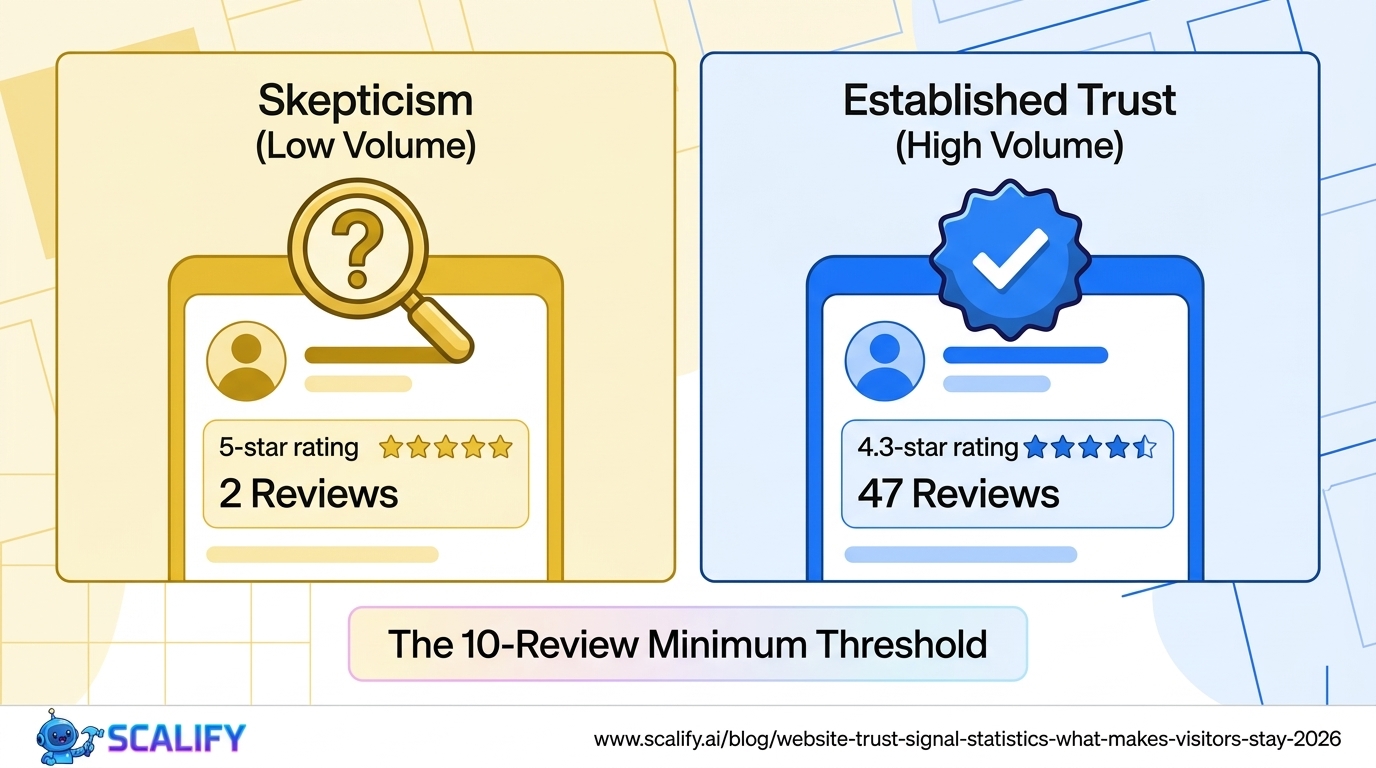
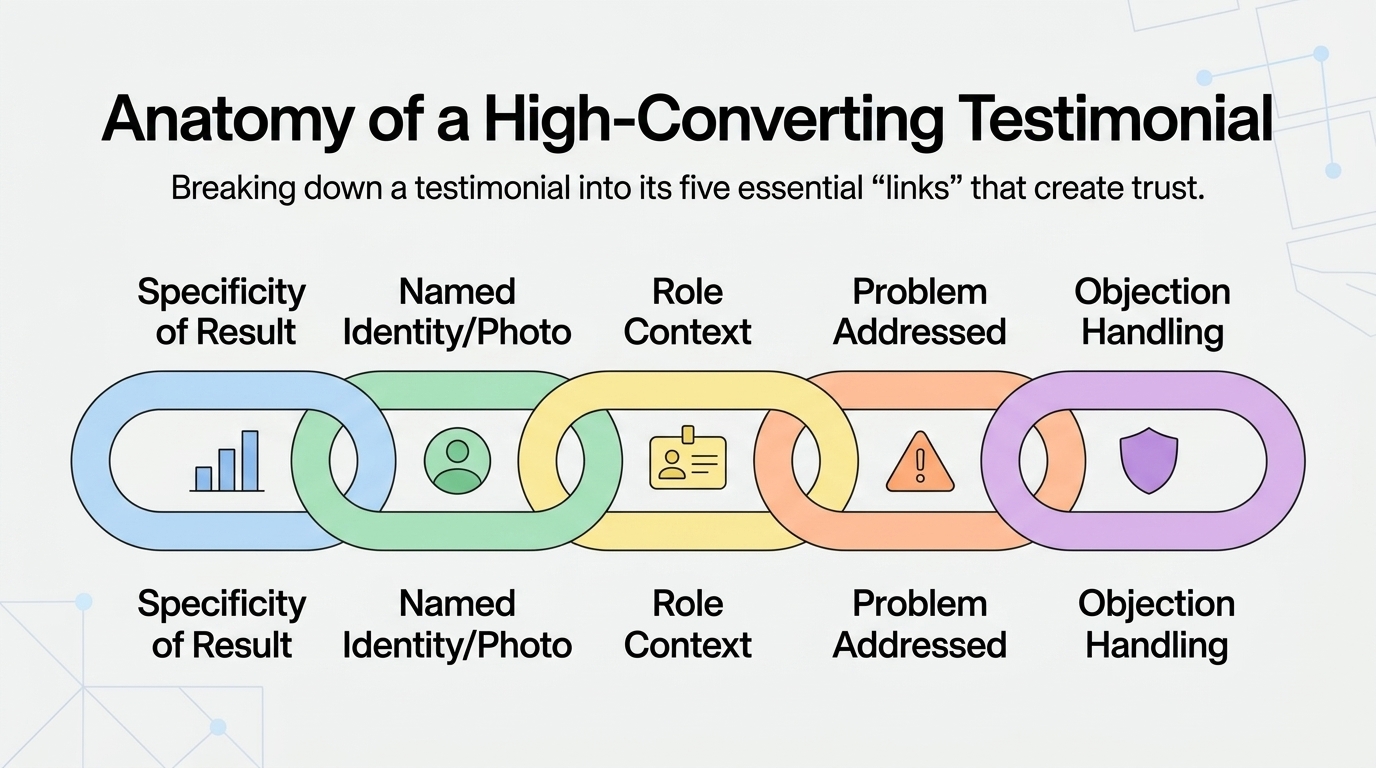
The weakest testimonials are generic: "Great company! Highly recommend!" These read as fabricated and provide no specific evidence of anything. The strongest testimonials are specific, outcome-focused, and attributed to real people with verifiable identities.
What makes a testimonial work:
Specificity: "Our new website launched in 8 days and we got 4 leads in the first week" is specific and verifiable. "Great service" is neither.
Before and after: The most persuasive testimonials describe a transformation. What was the situation before, and what changed after? This structure lets potential customers see themselves in the story.
Real attribution: Full name, company, location, and ideally a photo. The more specifically attributed a testimonial is, the more credible it reads. "Sarah Chen, Owner, Apex Coaching, Austin TX" with a headshot is dramatically more trustworthy than "S.C., Business Owner."
Proximity to conversion points: Place testimonials strategically — near CTAs, on pricing pages, after objection-handling sections. The moment of hesitation before acting is exactly when social proof provides maximum conversion value.
Case studies go further than testimonials: they tell the complete story of a specific client's result, with context, specifics, and measurable outcomes. A case study that describes a client who was losing leads to their outdated website, hired Scalify, got a new site in 10 days, and then generated 20 leads in the first month tells a story that resonates with every visitor experiencing the same problem.
Handling Objections in Copy
Every potential customer has objections — reasons they hesitate or decide not to act. These objections don't disappear when people leave your website; they just go unaddressed. Great website copy identifies the most common objections and addresses them directly on the page, removing barriers to conversion before visitors can use them as reasons to leave.
Common objection categories:
Price: "Is this too expensive for what we get?" Address by emphasizing value relative to price, offering a money-back guarantee, or providing transparent pricing that removes the uncertainty.
Risk: "What if I invest in this and it doesn't work?" Address with guarantees, case studies showing results, and testimonials from customers who were initially skeptical.
Timing: "I'm not sure I need this right now." Address by articulating the cost of delay — what they continue to lose while they wait to act.
Trust: "Can I trust this company?" Address with social proof, team information, transparent policies, and evidence of real results with real clients.
Fit: "Is this the right solution for my specific situation?" Address by being explicit about who you're best suited for and what types of clients get the best results.
The most impactful place to address objections is directly in the body copy and in FAQ sections — not in fine print or hidden pages. Visitors who have objections and can't find answers on your site leave rather than seeking answers elsewhere.
CTA Copy: The Line That Closes the Deal
The call to action is the last line of persuasion before a visitor either acts or doesn't. Even a visitor who's been persuaded by everything else on the page can be lost by a weak, vague, or uninviting CTA.
CTA copy principles that consistently improve conversion:
Specific outcome over generic action: "Get My Free Website Quote" beats "Contact Us." "Start My 14-Day Free Trial" beats "Sign Up." "Book My 20-Minute Strategy Call" beats "Schedule." Name what the visitor gets, not just what they do.
First person outperforms second person: "Get My Free Quote" (first person) consistently outperforms "Get Your Free Quote" (second person) in A/B tests. The first person creates a subtle sense of ownership and decision.
Reduce perceived risk: Address the most common hesitation directly adjacent to the CTA. "No credit card required." "Cancel anytime." "100% satisfaction guaranteed." "Free for 14 days." These reduce the perceived cost of clicking and consistently improve conversion rates.
Match CTA to offer value: A CTA for a major purchase decision should acknowledge the significance: "I'm Ready to Build My Website." A CTA for a free download can be lighter: "Download the Free Guide." The tone matches the weight of the action being requested.
Common Website Copy Mistakes to Avoid
"We" everywhere: Copy that leads every sentence with "We do this" and "We offer that" focuses on the company rather than the customer. Flip to second person: "You get..." "Your website will..." "You'll never have to..."
Jargon without translation: Industry terms that your team uses daily may be completely opaque to customers. Either define them or replace them with plain language. "Conversion rate optimization" might need translation to "we improve the percentage of visitors who contact you."
Long blocks of unbroken text: Online readers scan before they read. Long paragraphs get skipped. Use short paragraphs (2–4 sentences), subheadings, bullet points, and bold text to make key points visually scannable before a visitor has committed to reading in full.
Passive voice: "Websites are built by our team" is passive. "Our team builds websites" is active. "You'll receive a fully designed site" is better than "A fully designed site will be delivered to you." Active voice is more direct, more confident, and easier to read.
The credibility-undermining superlative: "World-class," "best in class," "unparalleled," "industry-leading" — these claims are so frequently used and so rarely substantiated that they're invisible to readers. Replace with specific evidence: numbers, results, verifiable facts.
The Bottom Line
Website copy is the voice of your brand when no human is in the room — and it either earns trust and drives action or loses visitors to competitors who communicate more clearly. The principles that separate effective copy from ineffective copy are learnable and applicable to any business: know specifically who you're writing for, lead with benefits not features, address objections directly, use human language, and make the CTA specific and compelling.
Great copy doesn't happen in one draft. Write a version, read it aloud, revise. Test different headlines. Review heatmaps to see where visitors stop reading. Check which CTAs get clicks and which don't. Treat copy as an ongoing optimization, not a one-time project, and you'll build an increasingly effective sales machine that compounds its returns over time.
At Scalify, every website we build includes copywriting guidance and review — because the words matter as much as the design, and we build websites that convert, not just websites that look good.


.jpeg)
.jpeg)

78 SW 7th St, Miami, FL 33130