


What Is a 404 Error and How Do You Fix It?
By Josh Ternyak

March 28, 2026
404 errors frustrate visitors, waste crawl budget, and erode SEO equity. Here's exactly what causes them, how to find them on your site, and the right way to fix each type.
The Error Everyone Sees, Few Know How to Handle
You've seen it hundreds of times. You click a link, follow a bookmark, or land from a search result, and instead of the page you were looking for, you get a stark message: "404 Not Found." Maybe it's a custom-branded error page, maybe it's a plain white screen with browser-default text, maybe it's a creative illustration of a sad robot. Same thing regardless of the dressing: the page doesn't exist at the URL you tried to access.
404 errors are one of the most common website problems — and one of the most frequently mishandled. They seem simple on the surface (broken link, missing page) but have compounding effects on user experience, SEO, and site quality that are worth understanding if you're responsible for maintaining a website that actually performs.
This guide covers what 404 errors are at a technical level, why they happen, how to find them, how to fix them correctly, and how to set up a 404 page that minimizes the damage when they inevitably occur anyway.
What a 404 Error Actually Means
HTTP status codes are three-digit numbers that web servers send back with every response. They tell the browser — and any service that's processing the response programmatically — what happened with the request.
The 4xx range of codes indicates client errors — requests that couldn't be fulfilled because something about the request itself was problematic. The most famous of these is 404, which means: "I received your request, I understood it, and there is nothing at the URL you asked for."
Specifically:
- 200 — OK. The request succeeded and the content is being sent back.
- 301 — Moved Permanently. The resource has been permanently moved to a new URL.
- 302 — Found (Temporary Redirect). The resource is temporarily at a different URL.
- 404 — Not Found. The server can't find what was requested at this URL.
- 410 — Gone. The resource has been permanently removed and won't be coming back. (More on this distinction later.)
- 500 — Internal Server Error. Something broke on the server side.
When a server returns a 404 response, it's saying: "This URL exists in the sense that I'm running and responding, but there's no content mapped to this specific address." The user gets the 404 page; the browser shows it; bots and crawlers log it and move on.
Why 404 Errors Happen
Understanding the root causes helps you fix them systematically rather than playing whack-a-mole with individual broken links.
Deleted pages. The most obvious cause. A page existed, was deleted, and its URL now returns 404. This happens when content is intentionally removed (a discontinued product, an old service, a blog post that's no longer accurate) or accidentally deleted during a site cleanup or CMS migration.
Changed URLs without redirects. A page is still live but at a different URL than it used to be. Maybe the slug was changed, the URL structure was reorganized, or the site was migrated to a new platform that changed how URLs are formatted. Anyone who had the old URL saved or bookmarked, plus any site linking to it, now gets a 404 when they try to access it.
CMS migrations and platform switches. Moving a site from WordPress to Webflow, from Shopify to a custom build, or from one URL structure to another frequently creates 404s if the URL mapping isn't handled carefully. Old URLs that aren't mapped to their new equivalents become 404s from the moment the migration goes live.
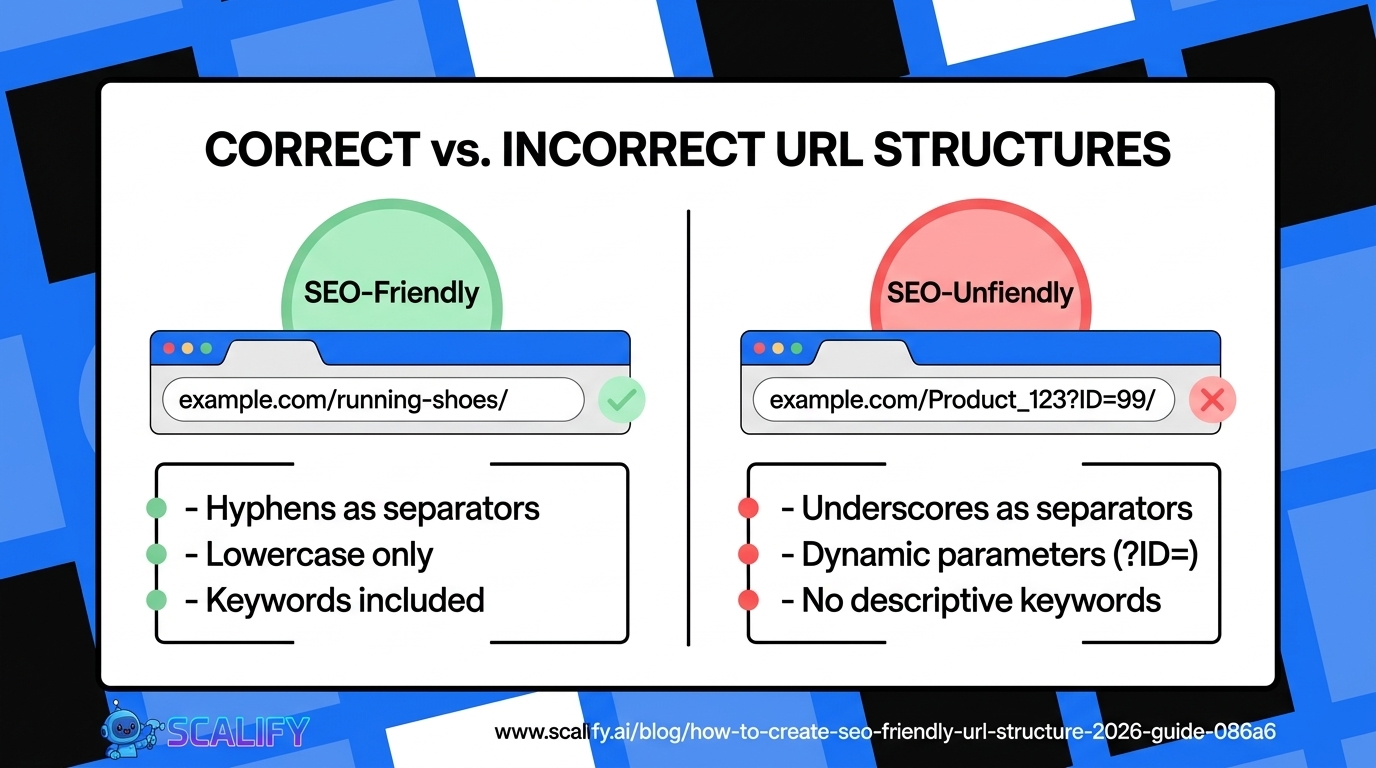
Typos in links. Someone writes "/serrvices" instead of "/services" in an internal link. An external site links to "/about-us" but your page is at "/about". Small typos that don't get caught during publishing create 404s for anyone following that specific link.
Case sensitivity. Many web servers treat URLs as case-sensitive. "/About" and "/about" may be different URLs on a Linux server (the most common web server operating system). If a link somewhere points to the capitalized version but the actual page is lowercase, the result is a 404.
Broken external links. Other websites that link to your pages can cause 404s if those links become outdated. You can't control when another site links to a page you've since deleted or moved — but you can detect these broken inbound links and redirect them.
Content that was never published. Links to pages that were planned but never created, products that were listed before their pages were ready, or internal links pointing to drafts that were never published.
Why 404 Errors Matter: The Real Impact
It's tempting to dismiss individual 404 errors as minor nuisances. In isolation, they often are. But the cumulative effects of unmanaged 404s are significant across three dimensions.
User Experience
A visitor who follows a link and hits a 404 has a decision to make: try to find what they were looking for somewhere else on your site, or leave. Most leave. A 404 from an important entry page — a product page, a blog post, a service page that ranks well in Google — means you're consistently losing visitors who had enough intent to click through in the first place.
The frustration compounds if the 404 page provides no guidance. A default server 404 page is a dead end. A well-designed custom 404 page can recover a significant portion of those visitors by directing them somewhere useful.
SEO and Link Equity
Inbound links from other websites are one of the most important SEO signals — they pass "link equity" (or PageRank) to the pages they link to, helping those pages rank higher in search results. When a page that has inbound links gets deleted without a redirect, those links are now pointing at a 404. The link equity they were passing is gone. The page that used to rank with the benefit of those links no longer exists.
For a page with many strong inbound links, losing it to a 404 without a redirect can mean losing years of accumulated SEO value overnight. A properly set up 301 redirect preserves the majority of that equity by passing it to the redirect destination.
Crawl Budget
Search engine crawlers have a finite crawl budget for each site — they won't crawl indefinitely, especially for smaller sites. Time spent crawling 404 URLs is time not spent discovering and indexing your actual content. A site with hundreds or thousands of 404s in its crawl history is wasting a meaningful portion of its crawl budget on dead ends.
Cleaning up 404s — either by fixing the content, implementing redirects, or removing the links pointing to deleted pages — frees up crawl budget for the pages that matter.
How to Find 404 Errors on Your Site
You can't fix problems you don't know about. Here are the main ways to discover where 404 errors exist on your site.
Google Search Console
The most authoritative source for 404s that Google has encountered. In Google Search Console, navigate to Indexing → Pages. Look for the "Not Found (404)" section, which lists URLs that Google tried to crawl and received a 404 response. This is particularly valuable because it shows 404s that were once indexed or linked to from other sites — the ones with the most SEO impact.
Search Console also shows "Crawl errors" that can be filtered to 404s specifically. Download the full list and prioritize by the URLs that had the most traffic or inbound links before they broke.
Screaming Frog SEO Spider
Screaming Frog is a desktop crawler that mimics how search engines crawl your site. Run it against your domain and it will crawl all linked pages, identify which URLs return 404 responses, and show you which pages on your site link to those broken URLs.
The free version crawls up to 500 URLs. The paid version (£199/year) handles any size site. For a thorough technical audit of any site, Screaming Frog is the industry standard tool.
Ahrefs / Semrush Site Audit
Both Ahrefs and Semrush offer site audit tools that crawl your site and report 404 errors alongside other technical SEO issues. These are particularly useful because they also show broken inbound links from other sites — 404s that you're losing link equity through, even if they're not linked internally.
Google Analytics
In GA4, you can find 404 pages by looking at your Page Title report and filtering for your 404 page title (usually something like "Page Not Found" or "404 Error"). This shows you which 404 pages are actually receiving traffic from visitors — these are the highest-priority ones to address because real users are hitting them.
Server Log Analysis
Your web server logs every request made to your site, including the status code returned. Analyzing these logs with a tool like AWStats, GoAccess, or by parsing the raw log files reveals every 404 that your server has responded with — including requests from bots, crawlers, and API calls that might not appear in other tools.
How to Fix 404 Errors: The Right Approach for Each Cause
The fix depends on why the 404 is occurring. Here's the decision tree:
The Page Was Moved or Renamed — Set Up a 301 Redirect
If content still exists but at a different URL, a 301 (permanent) redirect is the correct fix. A 301 redirect automatically sends anyone requesting the old URL to the new URL, passing the majority of link equity along in the process.
Set up 301 redirects in your hosting control panel, through your CMS's redirect settings (most CMSs and SEO plugins have a redirect management interface), or in your server configuration (.htaccess for Apache, nginx.conf for Nginx).
Always redirect to the most relevant, semantically close alternative. If you deleted a blog post about "WordPress hosting" and have a new article on "managed WordPress hosting," redirect the old URL to the new one. If there's no close alternative, redirect to the most relevant category or service page. Only redirect to the homepage as a last resort — it's a poor user experience and Google may choose to ignore redirects it considers a poor match.
The Page Was Permanently Deleted — Use 410 or a Relevant Redirect
If a page is genuinely gone and there's no equivalent content to redirect to, you have two options:
Use a 410 (Gone) status instead of 404. A 410 tells search engines "this was here, it's permanently gone, stop trying to crawl it." Google will deindex it faster and stop allocating crawl budget to it. This is the technically correct choice for content that's been intentionally and permanently removed.
Or, redirect to the most topically related page that does exist. Better for users; Google usually treats these redirects as 301s from a ranking perspective if the destination is reasonably relevant.
The Link Is Broken — Fix the Source Link
If a 404 is occurring because of a typo in an internal link, fix the link at the source. This is cleaner than creating a redirect for a URL that was never meant to exist.
Use Screaming Frog's output to identify exactly which pages on your site contain links to 404 URLs, then update those links to point to the correct destination.
The URL Was Never Correct — Investigate and Handle Appropriately
Sometimes 404 logs show URLs that were never valid — guesses made by bots looking for vulnerabilities (/wp-admin on a non-WordPress site, /phpmyadmin, etc.), or typos from external sites that you have no control over. These don't need redirects. Monitor them to confirm they're not real traffic, then set up rules to return 404 cleanly without consuming server resources.
How to Build a 404 Page That Actually Helps
Even with perfect redirect management, some visitors will inevitably land on your 404 page — followed old bookmarks, typed a URL wrong, arrived from an external link you couldn't control. A well-designed 404 page recovers a meaningful percentage of these visitors rather than sending them all the way back to Google.
What a good 404 page should include:
Clear acknowledgment that the page wasn't found. Don't be cryptic. Tell visitors plainly that this page doesn't exist, so they don't waste time waiting for it to load.
A search bar. The most useful recovery tool. A visitor looking for specific content can search directly from the 404 page rather than having to navigate to your homepage first.
Navigation links to key sections. Links to your most important pages — homepage, services, products, blog, contact — give visitors paths forward. Make them prominent and easy to see.
Popular or featured content. A curated selection of your best-performing pages gives visitors something compelling to explore even if it's not what they were originally looking for.
Your branding and tone. The 404 page is still part of your site experience. It should look like the rest of your site, not like an afterthought. Some brands use humor effectively here — a playful 404 page turns a frustrating moment into a memorable brand interaction. Just make sure the humor doesn't overshadow the utility.
A CTA. If appropriate for your business, include a contact or conversion option. A visitor who got a 404 while looking for a specific service might be receptive to "Can't find what you're looking for? Tell us what you need."
What a 404 page should not do: apologize excessively, provide an error code that means nothing to users, show no navigation options, or look so broken that visitors think the whole site is down.
Monitoring 404s Ongoing
Managing 404 errors isn't a one-time audit — it's an ongoing practice. New 404s emerge continuously as content is published and deleted, URL structures change, and external sites update (or fail to update) their links.
Set up a regular cadence — monthly for most sites, weekly for high-traffic or frequently updated ones — to check Google Search Console's coverage report for new 404s. Run periodic Screaming Frog audits when you make significant site changes. Set up uptime monitoring that alerts you to unusual spikes in 4xx responses, which can indicate a major content removal or URL structure change that created widespread 404s.
The goal isn't zero 404 errors forever — that's not achievable. The goal is catching and addressing 404s before they compound: before they've been sitting for months losing link equity, before multiple pages are linking to them, and before a significant volume of real visitors have been sent to dead ends.
The Bottom Line
404 errors are inevitable, but unmanaged 404 errors are a choice. The difference between a site that handles them well and one that doesn't is systematic detection, appropriate redirects for deleted or moved content, and a custom 404 page that helps visitors find what they're looking for instead of bouncing.
Get these three things right and 404s go from a nagging technical debt problem to a well-managed routine. The SEO equity is preserved, the user experience is protected, and the search engines keep their crawl budget focused on your real content.
At Scalify, technical SEO hygiene — including proper redirect management and 404 handling — is part of how every website is built and maintained. The foundation matters as much as the design.























.jpeg)
.jpeg)








78 SW 7th St, Miami, FL 33130