


What Is a Canonical Tag and How Does It Prevent Duplicate Content?
By Josh Ternyak

April 1, 2026
Comprehensive 2026 guide: What Is a Canonical Tag and How Does It Prevent Duplicate Content?
The SEO Problem That Hides in Plain Sight
Your website might have a duplicate content problem right now. Not because you copied anyone else's content — but because the same content is accessible at multiple URLs. Your homepage might be reachable at example.com, www.example.com, http://example.com, and http://www.example.com simultaneously. Your e-commerce products might appear at /products/blue-widget AND /categories/widgets/blue-widget. Your blog posts might be accessible at their permalink and again within paginated archive pages.
Google encounters these multiple URLs and faces a choice: which version represents the "real" page? Which version should accumulate rankings and link equity? Without explicit guidance, Google makes its own judgment — and it doesn't always choose the version you'd prefer. Worse, the SEO equity for that content gets split between multiple URLs rather than concentrated on one, reducing the ranking strength of all versions.
The canonical tag solves this problem by explicitly telling Google which URL is the authoritative version of a piece of content — the one that should receive indexing priority and accumulated ranking equity.
What a Canonical Tag Is
A canonical tag (officially called a canonical link element) is an HTML element in the <head> section of a web page that specifies the "canonical" (official, preferred) URL for that page's content. It uses the rel="canonical" attribute:
<link rel="canonical" href="https://example.com/preferred-url/">When Google crawls a page with a canonical tag pointing to a different URL, it treats the tagged page as a duplicate and concentrates its indexing and ranking signals on the canonical URL instead. All link equity, ranking authority, and organic traffic from that content flows to the canonical URL.
The canonical tag is a "hint" to Google rather than a directive — unlike robots.txt (which instructs crawlers) or noindex (which instructs the indexer), canonical tags can be overridden by Google if it disagrees with your canonical declaration based on other signals. Google follows canonical hints most reliably when the content across the duplicate URLs is genuinely identical or very similar.
When Duplicate Content Occurs (More Often Than You'd Think)
Duplicate content is significantly more common than most website owners realize. Common sources:
Protocol and www Variations
Most common source of unintentional duplicate content. Without proper redirects or canonical tags, your content may be accessible at:
- http://example.com
- https://example.com
- http://www.example.com
- https://www.example.com
Each of these is technically a different URL. All four serve identical content. Google sees four versions of your homepage and must choose which to index and which to treat as duplicates. The solution: 301 redirects from all non-canonical versions to the canonical one (e.g., all redirecting to https://example.com), with a self-referencing canonical tag on the canonical version as a belt-and-suspenders reinforcement.
Trailing Slash Variations
example.com/page and example.com/page/ are technically different URLs that may serve identical content. Most servers handle this with redirects, but if both are accessible, both should have canonical tags pointing to whichever you've chosen as the standard.
URL Parameters
Parameters added to URLs for tracking, sorting, filtering, or session management create near-infinite URL variations that may all serve the same or very similar content:
- example.com/products?sort=price (same products, sorted differently)
- example.com/products?color=blue (filtered products)
- example.com/page?utm_source=email (tracking parameter — identical content)
- example.com/page?sessionid=abc123 (session parameter — identical content)
Tracking parameters (utm_source, fbclid, gclid) are particularly common and particularly harmless if handled correctly — Google is generally good at recognizing tracking parameters. But sorting and filtering parameters that produce near-duplicate pages with slightly different content require explicit canonical handling.
E-Commerce Product Pages in Multiple Categories
A product might be accessible at both /products/blue-widget and /sale/blue-widget, or through multiple category paths. Both URLs serve identical product content. One should be canonical; the other should either redirect to the canonical or include a canonical tag pointing to the preferred URL.
Print or Mobile Versions
Sites that create separate print-friendly or mobile versions of pages (less common now but still present in older architectures) create duplicate content at alternative URLs. Canonical tags on the alternative versions pointing to the primary version handle this.
Content Syndication
If your content appears on other websites (guest posts republished, press releases, content partnerships), canonical tags on the syndicated copies pointing to your original URL ensure the ranking equity from any links to the syndicated version flows back to your site. This requires collaboration with the host site — they need to implement the canonical tag on their version.
Pagination
Paginated archives and category pages (/blog, /blog/page/2, /blog/page/3) present a nuanced duplicate content scenario. The first page and subsequent pages have different content (different posts listed) — they're not exact duplicates. But paginated pages often have enough identical navigation, header, footer, and surrounding content that they raise thin/duplicate content signals. The recommended current approach: let paginated pages be crawled and indexed normally (don't noindex), use self-canonical tags on each page, and ensure each page's unique content is substantial enough relative to the shared elements.
How to Implement Canonical Tags Correctly
Self-Referencing Canonicals
Every page on your site should have a canonical tag, including pages pointing to themselves. A self-referencing canonical (where a page's canonical points to its own URL) explicitly declares "this is the canonical version" rather than leaving it ambiguous.
<!-- On https://example.com/my-page/ -->
<link rel="canonical" href="https://example.com/my-page/">
This prevents Google from assuming a different URL (a parameter variation, a www variation) should be canonical for this page.
Cross-Domain Canonicals
Canonical tags can point to URLs on different domains — useful for content syndication where the original publisher wants to maintain canonical authority for their version:
<!-- On https://otherdomain.com/republished-article/ -->
<link rel="canonical" href="https://originaldomain.com/original-article/">
This requires the host site to implement the canonical tag, which they may or may not be willing to do. Without their cooperation, a noindex on the syndicated version is the alternative to prevent the duplicate from ranking.
HTTP Header Canonicals
For non-HTML content (PDFs, images, other file types that don't have HTML <head> sections), canonical information can be sent in HTTP response headers:
Link: <https://example.com/original.pdf>; rel="canonical"This is an advanced use case handled in server configuration (Apache/Nginx), not in HTML.
Platform-Specific Canonical Implementation
WordPress
Yoast SEO and Rank Math both generate canonical tags automatically for all pages and posts, using the permalink as the canonical URL. Both also provide per-page fields to set custom canonical URLs when the automatic canonical needs to be overridden. Without an SEO plugin, canonical tags must be added manually through theme functions or a header plugin.
Webflow
Webflow generates self-referencing canonical tags automatically for all published pages. Custom canonical URLs can be set per-page in the page settings under "SEO Settings." For CMS collection items, canonical tags are automatically generated for each item's unique URL.
Shopify
Shopify generates canonical tags automatically for products, collections, and pages. Products accessible through multiple collection paths get canonical tags pointing to the default product URL (/products/product-handle) rather than the collection-specific path. This is automatic and correct behavior for most standard Shopify implementations.
Custom or Framework-Based Sites
Next.js: Use next/head to include canonical tags, or a site-wide head component that generates canonicals based on the current URL. Many Next.js sites use next-seo for canonical management.
Other frameworks: Ensure the framework's rendering handles canonical tags in the <head> of generated HTML, either through template configuration or a head management library.
Common Canonical Tag Mistakes
Canonical pointing to a non-indexed page: If your canonical URL has a noindex tag, Google may index neither version — the duplicate is told not to index itself (via canonical hint), and the canonical is directly told not to index (via noindex). Canonicals should only point to pages that are meant to be indexed.
Canonical in the body instead of head: Canonical tags must be in the <head> section of the HTML. A canonical in the <body> is not valid and may be ignored by search engines.
Multiple canonical tags on one page: Having more than one canonical tag creates a conflicting signal. Google may ignore both or choose arbitrarily. Each page should have exactly one canonical tag.
Canonical pointing to a redirect: A canonical pointing to a URL that itself redirects to a third URL creates a confusing chain. Canonicals should point to the final destination URL — the actual preferred URL, not an intermediate redirect.
Conflicting canonicals and redirects: If page A has a canonical pointing to page B, but page A also 301 redirects to page B, the information is consistent (both say B is preferred), which is fine. But if page A has a canonical pointing to page B while page B has a canonical pointing to page C, the conflicting signals create confusion. Canonical chains should be resolved to point directly to the final preferred URL.
Using canonical to replace redirects: A canonical tag tells Google which URL is preferred for indexing and ranking — it doesn't redirect visitors. If a user navigates to the non-canonical URL, they still land there (no redirect occurs). For user experience and clean URL structure, 301 redirects to the canonical URL are better than relying solely on canonical tags for non-canonical URL handling.
Verifying Canonical Tag Implementation
Several methods for checking canonical tag status:
Google Search Console URL Inspection: The most authoritative check. Inspect a URL and look at the "Canonical URL" section — it shows both the Google-selected canonical and your declared canonical. If these differ, Google disagrees with your canonical declaration and is choosing a different URL.
Screaming Frog: Crawl your site and export the canonical data to see all canonical URLs across the site. Look for: missing canonicals, canonicals pointing to non-200 URLs, canonicals pointing to redirects, or pages where the canonical differs from the page URL (potentially intentional or potentially an error).
Browser View Source: On any page, View Source (Ctrl+U) and search for "canonical" to see the canonical tag directly in the HTML.
The Bottom Line
Canonical tags are the explicit signal that tells Google which URL is the authoritative version of content when multiple URLs could serve similar content. They prevent duplicate content from splitting ranking equity, ensure your preferred URLs accumulate the indexing and ranking authority your content earns, and provide clear guidance to search engine crawlers navigating the inevitable URL variations that appear in any real website.
Implement self-referencing canonicals on every page. Use cross-domain canonicals for syndicated content. Handle URL parameters with canonical tags or URL parameter configuration in Search Console. Verify implementation in Google Search Console's URL Inspection tool. And remember that canonical tags work best in combination with proper 301 redirects — they're complementary tools, not interchangeable ones.
At Scalify, proper canonical tag implementation is part of every site's technical SEO foundation — ensuring your content's ranking equity concentrates on the URLs that matter rather than being diluted across variations.
Key Takeaways and Next Steps
The principles and data in this guide reflect what actually works in professional web development and digital marketing in 2026 — not theoretical best practices but measured, documented outcomes from implementations at scale. The gap between knowing these principles and benefiting from them is always execution: the businesses that act on what they read, implement changes systematically, and measure the results consistently outperform those who consume information without converting it to action.
For any improvement described in this guide, the implementation sequence that produces the best outcomes: assess your current situation against the benchmarks provided, identify the 2–3 highest-impact improvements specific to your situation, implement them with measurement tracking in place, evaluate results after 30–60 days, and plan the next iteration based on what you learned. This cycle — assess, prioritize, implement, measure, iterate — is the operational foundation of continuous improvement that compounds into significant competitive advantage over the 12–24 month horizon.
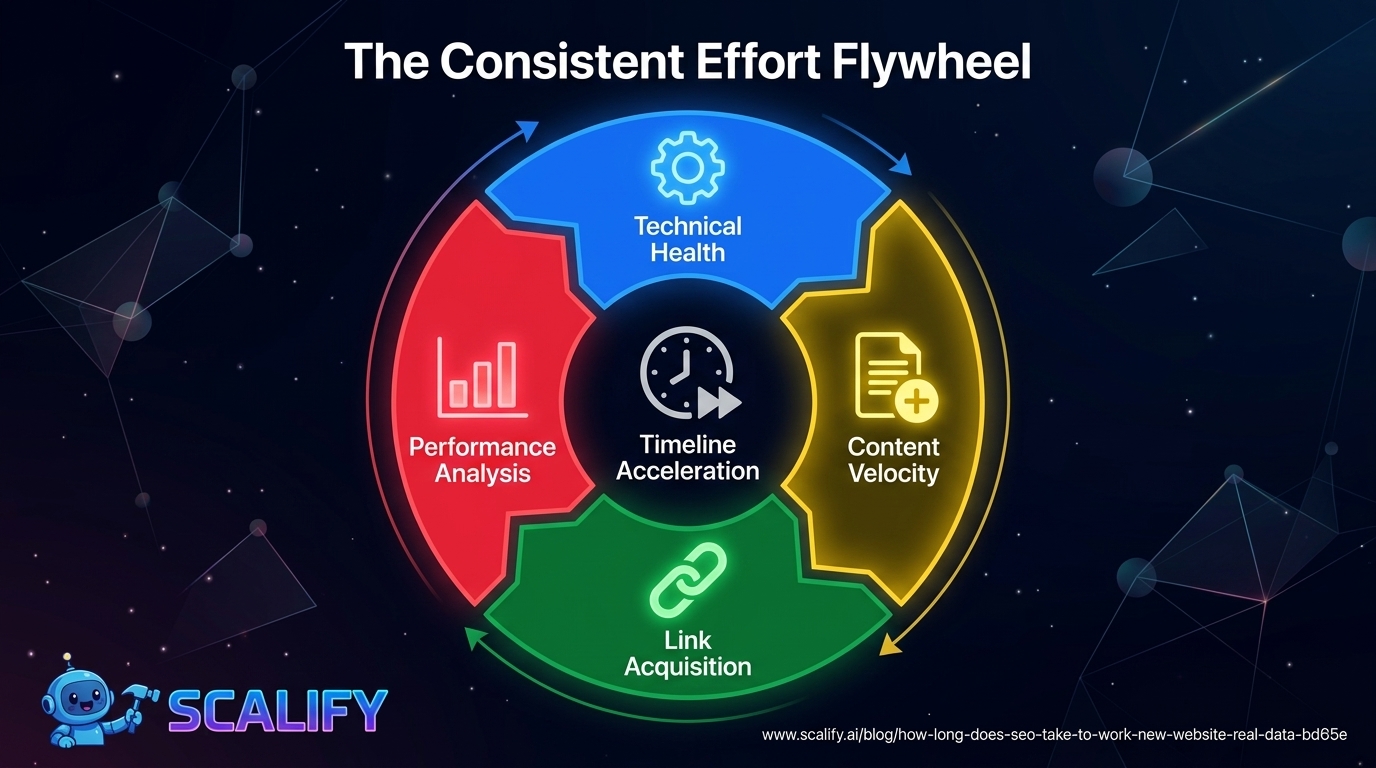
The compounding returns from consistent web presence investment are not linear: a website that improves slightly each month accumulates to dramatic improvements over a year, and those improvements multiply with each other. Faster load times improve both search rankings and conversion rates simultaneously. Better content attracts backlinks that improve rankings that attract more traffic. More testimonials build trust that improves conversion rates that improve revenue that funds more investment. The interconnected nature of website performance means that each improvement amplifies the value of every other improvement — making the decision to invest consistently, across multiple dimensions simultaneously, the highest-ROI approach to digital marketing available to most businesses.
At Scalify, every website we build reflects these principles — technically optimized, conversion-focused, SEO-ready, and designed to compound in value over time as content, backlinks, and organic authority accumulate on the strong foundation we deliver in 10 business days.




.jpeg)
.jpeg)

78 SW 7th St, Miami, FL 33130