


What Is a Design System and Does Your Website Need One?
By Josh Ternyak

March 31, 2026
A design system is the single source of truth for visual design — tokens, components, patterns, and guidelines that make consistency automatic. This comprehensive guide covers what design systems contain, famous examples, when you need one, when you don't, design tools, how to build one starting with tokens, accessibility integration, and how to maintain a design system so it compounds in value rather than decaying.
What Is a Design System and Does Your Website Need One?
A design system is a collection of reusable components, design tokens, and guidelines that define how a product looks and behaves across all surfaces — website, mobile app, email templates, and any other digital interface. It's the single source of truth for visual design decisions: the exact blue your primary buttons use, the precise spacing between elements, the specific font weight for H2 headings, and the exact behavior of dropdown menus. When implemented well, a design system makes building new features faster, keeps visual consistency automatic rather than manual, and dramatically improves collaboration between designers and developers.
Whether your website needs a design system depends almost entirely on its scale and team size. A one-person brochure website does not need a design system. A product with a team of 5+ designers and developers shipping features weekly almost certainly does.
Key Design System Statistics
- 70% of large organizations with product teams report having a design system in place (Figma State of Design 2024)
- Teams with mature design systems report 47% faster development cycles for UI-heavy features
- Design systems reduce the time to design a new page or feature by an average of 34%
- Inconsistency in UI is cited by 68% of developers as a top source of time waste — design systems address this directly
- The largest design systems (Google Material Design, Apple HCI, IBM Carbon) document over 300+ components
- Teams without design systems spend an average of 22% of design time recreating existing UI patterns
- Storybook — the primary tool for documenting component libraries — has been downloaded over 22 million times per week
- Companies with mature design systems report 58% fewer visual bugs in production
- The average time to build a production-ready design system from scratch is 3–6 months for a dedicated team
- Design systems increase designer-to-developer handoff efficiency by an average of 40%
What a Design System Contains
| Component | What It Defines | Example |
|---|---|---|
| Design tokens | The atomic values: colors, spacing, typography, shadows, border radii | --color-primary: #2563EB; --spacing-4: 1rem |
| Component library | Reusable UI components with all their variants and states | Button (primary/secondary/danger, small/medium/large, disabled/loading) |
| Pattern library | Combinations of components solving specific UX problems | Form patterns, navigation patterns, data display patterns |
| Design guidelines | Rules for when and how to use components | "Use primary buttons for one key action per page" |
| Content guidelines | Voice, tone, writing style, terminology | "Use 'sign in' not 'log in'; use active voice" |
| Accessibility standards | WCAG compliance rules applied to all components | Minimum 4.5:1 color contrast; keyboard navigation required |
| Motion and animation | Duration, easing, and behavior specifications for transitions | Modals open at 200ms with ease-out; hover transitions at 150ms |
Famous Design Systems Worth Studying
| Design System | Organization | Best Known For | URL |
|---|---|---|---|
| Material Design | Comprehensive; mobile-first; animation guidelines | m3.material.io | |
| Polaris | Shopify | E-commerce specificity; excellent documentation | polaris.shopify.com |
| Carbon | IBM | Enterprise patterns; accessibility-first | carbondesignsystem.com |
| Primer | GitHub | Developer-focused; open source contribution model | primer.style |
| Atlassian Design | Atlassian | Productivity software patterns; Jira/Confluence UI | atlassian.design |
| Apple HIG | Apple | iOS/macOS native patterns; premium quality bar | developer.apple.com/design |
| Spectrum | Adobe | Cross-product consistency across 100+ Adobe apps | spectrum.adobe.com |
When You Need a Design System
When your team ships UI features regularly. If your design and engineering team is shipping new pages, features, or UI changes on a weekly or bi-weekly cadence, a design system pays for itself quickly. Without one, every developer makes slightly different decisions about spacing, color values, and component behavior — creating visual inconsistency that accumulates with every release and requires constant one-off fixes.
When multiple designers are working on the same product. Two designers without a shared design system will make different decisions about the same type of element — one uses 4px border radius on cards, another uses 8px. One uses 16px body text, another uses 15px. These small differences compound across a product into a visual incoherence that communicates lack of craft and attention to detail. A design system makes consistency automatic by eliminating individual decision-making on solved problems.
When the same UI patterns appear in multiple contexts. If your design has buttons, forms, navigation, cards, and modals (which every product does), maintaining those patterns consistently across a growing codebase without a component library becomes increasingly expensive as the codebase grows. A button style change in a design system propagates instantly to every button; the same change without a design system requires finding and updating every button implementation individually.
When onboarding new designers or developers is frequent. A design system is the fastest way to bring new team members up to speed on how the product looks and behaves. Instead of months of implicit knowledge transfer about "how we do buttons" and "what spacing we use," a new designer or developer can read the design system documentation and make correct decisions from day one.
When You Don't Need a Design System
Solo designer / developer projects. A design system has a meaningful cost to build and maintain — the effort is only justified by the consistency and speed improvements it enables for a team working in parallel. A single person building a personal project or a small marketing website carries the consistency knowledge in their head and doesn't benefit from the documentation and tooling overhead.
One-off projects with no ongoing development. A website built once and rarely updated doesn't accrue the benefits of a design system because there's no ongoing development work that would use the system. Build the site with consistent patterns and document them minimally; a full design system is overkill.
Very early stage (pre-PMF) products. Before a product has found product-market fit, the UI changes too rapidly and too fundamentally for a design system to provide stable value. A design system built for a product that pivots significantly becomes a constraint rather than an enabler. Build a light component library but defer full design system investment until the product direction stabilizes.
Design System Tools
| Tool | Purpose | Best For | Price |
|---|---|---|---|
| Figma | Design source — components, variables, prototypes | All teams — industry standard | Free – $15/user/mo |
| Storybook | Component documentation and visual testing | Engineering component library documentation | Free (open source) |
| Zeroheight | Design system documentation site | Publishing design guidelines for team use | $149–$349/mo |
| Supernova | Design token management; Figma sync | Teams managing tokens across Figma and code | $159–$399/mo |
| Style Dictionary | Design token transformation (JSON → CSS/iOS/Android) | Engineering teams managing tokens across platforms | Free (open source) |
| Chromatic | Visual regression testing for Storybook components | Teams needing automated visual testing | Free–$149/mo |
Building a Design System: Where to Start
The most common design system failure is trying to build everything at once. Teams that approach a design system as a "big project" to complete before using it consistently abandon it before realizing value. The approach that works: start with the design tokens (colors, spacing, typography) because everything else builds on them, then extract the 5–8 most-used components from existing UI (usually: button, input, card, modal, navigation, badge, table), document and implement only those components first, and let the system grow organically as new common patterns emerge.
The design-code connection is the most important technical decision. Design tokens defined in Figma as variables should map directly to CSS custom properties in code — the same names, the same values. When a designer changes a color token in Figma, that change should be one step away from propagating to production CSS. Tools like Supernova, Style Dictionary, and Tokens Studio for Figma automate this synchronization. Without it, design systems drift between design and code as soon as the initial build is complete, undermining the primary benefit of consistency.
The Bottom Line
Design systems are transformative tools for product teams shipping UI at scale — reducing inconsistency, accelerating development, and making collaboration between designers and developers dramatically more efficient. For solo developers and small projects, the overhead isn't justified. The signal that you need a design system is usually visible: when you find your team debating button styles that should have been decided once, when new features have subtly different visual treatment than existing ones, or when onboarding a new team member requires extensive implicit knowledge transfer. At that point, a design system isn't a nice-to-have — it's the organizational investment that allows design quality to scale with team size.
At Scalify, we build professional websites with consistent design systems built in — component libraries that make future updates and additions fast and visually consistent.
Top 5 Sources
- Figma — State of Design Systems Report
- Storybook — Component Documentation Best Practices
- InVision — Complete Guide to Design Systems
- Sparkbox — Design System Survey
- Nielsen Norman Group — Design Systems 101
Design Tokens: The Foundation Everything Else Builds On
Design tokens are the atomic values that define the visual language of a product — they're the specific numbers and values behind every visual decision. Instead of hard-coding color: #2563EB throughout a codebase, a design token system defines --color-primary-600: #2563EB and uses that token everywhere. When the brand color needs to change, updating the token value updates every usage simultaneously — instantly, reliably, and without hunting through thousands of lines of CSS for every instance.
The most important token categories to define first:
| Token Category | Examples | Why It Matters First |
|---|---|---|
| Color palette | --color-blue-500: #3B82F6; --color-gray-900: #111827 | Every component uses color — define the palette first |
| Semantic colors | --color-primary, --color-success, --color-danger | Maps palette colors to usage context — decouple color from meaning |
| Spacing scale | --space-1: 4px; --space-2: 8px; --space-4: 16px; --space-8: 32px | Consistent spacing eliminates one of the most common inconsistencies |
| Typography | --font-size-sm: 14px; --font-weight-bold: 700; --line-height-normal: 1.5 | Font decisions affect every text element |
| Border radius | --radius-sm: 4px; --radius-md: 8px; --radius-full: 9999px | Consistent rounding defines the product's visual personality |
| Shadow | --shadow-sm: 0 1px 2px rgba(0,0,0,0.05); --shadow-md: 0 4px 6px rgba(0,0,0,0.07) | Elevation and depth signals |
Accessibility and Design Systems
Design systems are the most efficient mechanism for systematically improving accessibility across a product. When accessibility requirements are baked into components at the design system level — minimum color contrast ratios enforced on text tokens, keyboard navigation patterns implemented in interactive components, ARIA attributes included in component templates — accessibility improvements propagate automatically to every usage of that component. Without a design system, accessibility has to be audited and fixed component by component, screen by screen, which is dramatically more expensive and leaves gaps between audit cycles.
The most impactful accessibility decisions to encode in a design system: color token definitions that satisfy WCAG AA contrast requirements by default (4.5:1 for normal text, 3:1 for large text), focus styles that are clearly visible for keyboard navigation, semantic HTML structures for interactive components (buttons as <button> not <div>), and ARIA label patterns for icon-only buttons and custom controls. Teams that invest in accessible design system foundations consistently produce more accessible products with less ongoing remediation effort than teams that treat accessibility as a separate audit process.
Maintaining a Design System Over Time
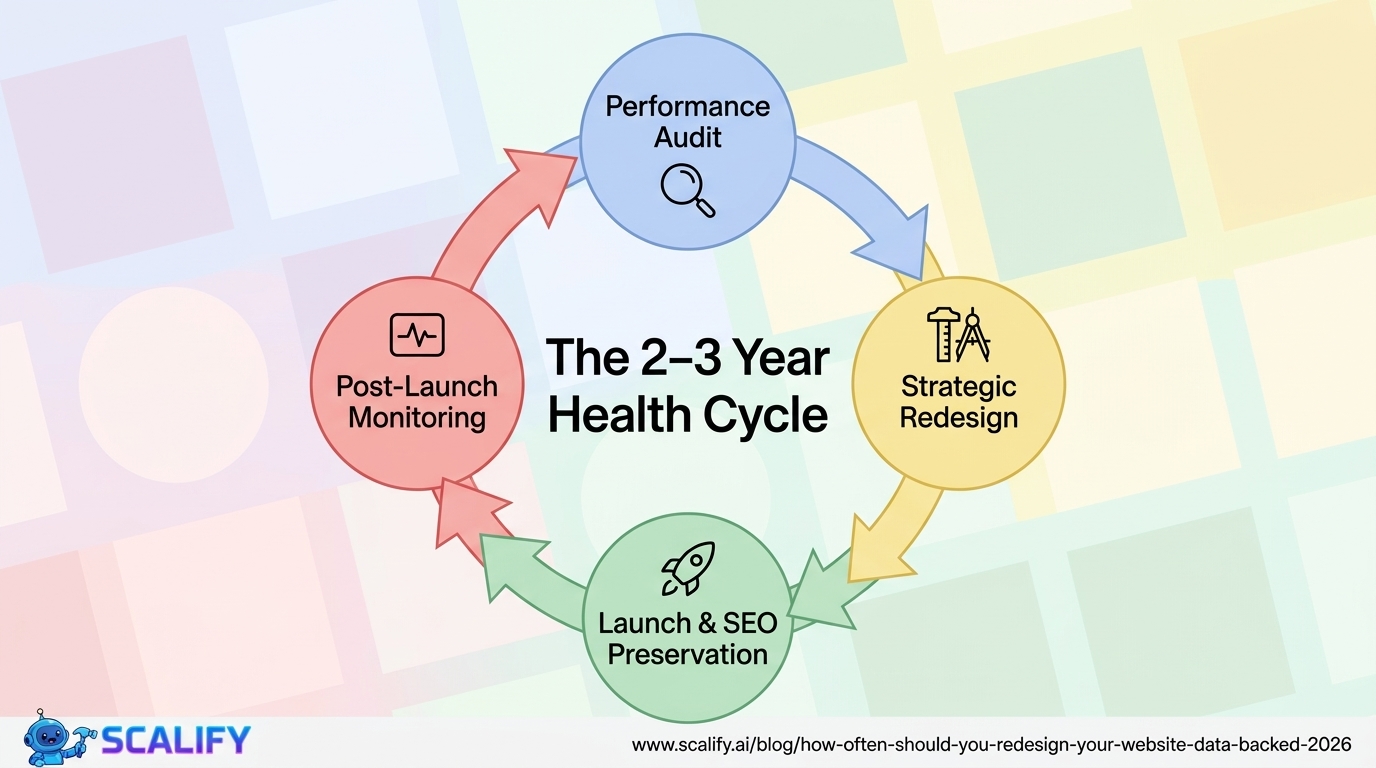
The most common design system failure mode is not the initial build — it's maintenance. Design systems that launch with fanfare and strong adoption frequently degrade within 12–18 months as the product evolves, new patterns emerge, and the team lacks the dedicated time to update the system. The symptom of a degrading design system is "drift" — new features use slightly different patterns than the system defines because the system hasn't kept pace with product evolution, and it becomes faster for individual developers to write one-off CSS than to use the system's outdated components.
Preventing this requires treating the design system as a product with its own roadmap and maintenance cycles — not a project that gets done and handed off. The minimum viable maintenance model: a designated design system owner who reviews new UI patterns quarterly and extracts recurring ones into the system, a clear contribution model so teams can propose additions without waiting for a central team, and automated visual regression testing (Chromatic with Storybook) that catches unintentional component changes before they reach production. Teams that implement these practices consistently see their design systems compound in value over time; teams that don't see them decay into partially-relevant artifacts that nobody trusts.





.jpeg)
.jpeg)



78 SW 7th St, Miami, FL 33130