


What Is a Domain Authority Score and Does It Actually Matter?
By Josh Ternyak

March 29, 2026
Domain Authority appears in almost every SEO conversation — but it's not a Google metric, and using it wrong leads to bad decisions. This guide explains what it actually measures, what it doesn't, and how to use it correctly.
The SEO Metric That Rules Conversations But Isn't What You Think
Ask an SEO about any website's "authority" and they'll probably give you a number between 1 and 100. Ask them if Google uses that number and they'll say no. Ask them why they keep using it then, and they'll explain it's a useful proxy. Ask what it's a proxy for and the answers start getting vague.
Domain Authority (DA) is one of the most discussed metrics in SEO and one of the most misunderstood. Created by Moz, referenced in thousands of SEO reports and proposals, used to evaluate link opportunities, assess competitors, and benchmark progress — and yet it's not a Google metric, Google doesn't use it, and it can be manipulated, gamed, and deeply misleading in certain contexts.
This guide explains what Domain Authority actually is, how it's calculated, what it legitimately tells you, what it doesn't tell you, and how to use it correctly (and when to ignore it entirely).
What Domain Authority Is
Domain Authority (DA) is a proprietary metric developed by Moz that predicts how likely a website is to rank in search engine results pages. It's calculated on a logarithmic scale from 1 to 100 — higher scores predict greater ranking ability.
The key phrase: "developed by Moz." DA is not a Google metric. Google doesn't use DA in its ranking algorithm. Google has its own internal signals — the descendants of the original PageRank algorithm — that assess a website's authority based on its link profile, but those internal signals are not publicly disclosed and not the same as Moz's DA.
DA is calculated primarily from the quantity and quality of links pointing to a domain from external websites — with quality heavily weighted and some adjustment for the diversity and relevance of linking domains. A website with many high-quality, relevant inbound links will have a higher DA than a website with few links or primarily low-quality links.
Competitors to Moz have developed their own similar metrics: Ahrefs has Domain Rating (DR), Semrush has Authority Score. These all measure roughly the same thing — link-based authority — using their own methodologies and their own link databases. They often produce different numbers for the same domain, which tells you something about their predictive accuracy: they're estimates, not measurements.
What DA Actually Measures
DA is essentially a compressed summary of a website's inbound link profile — the quantity and quality of links pointing to it from other domains on the web.
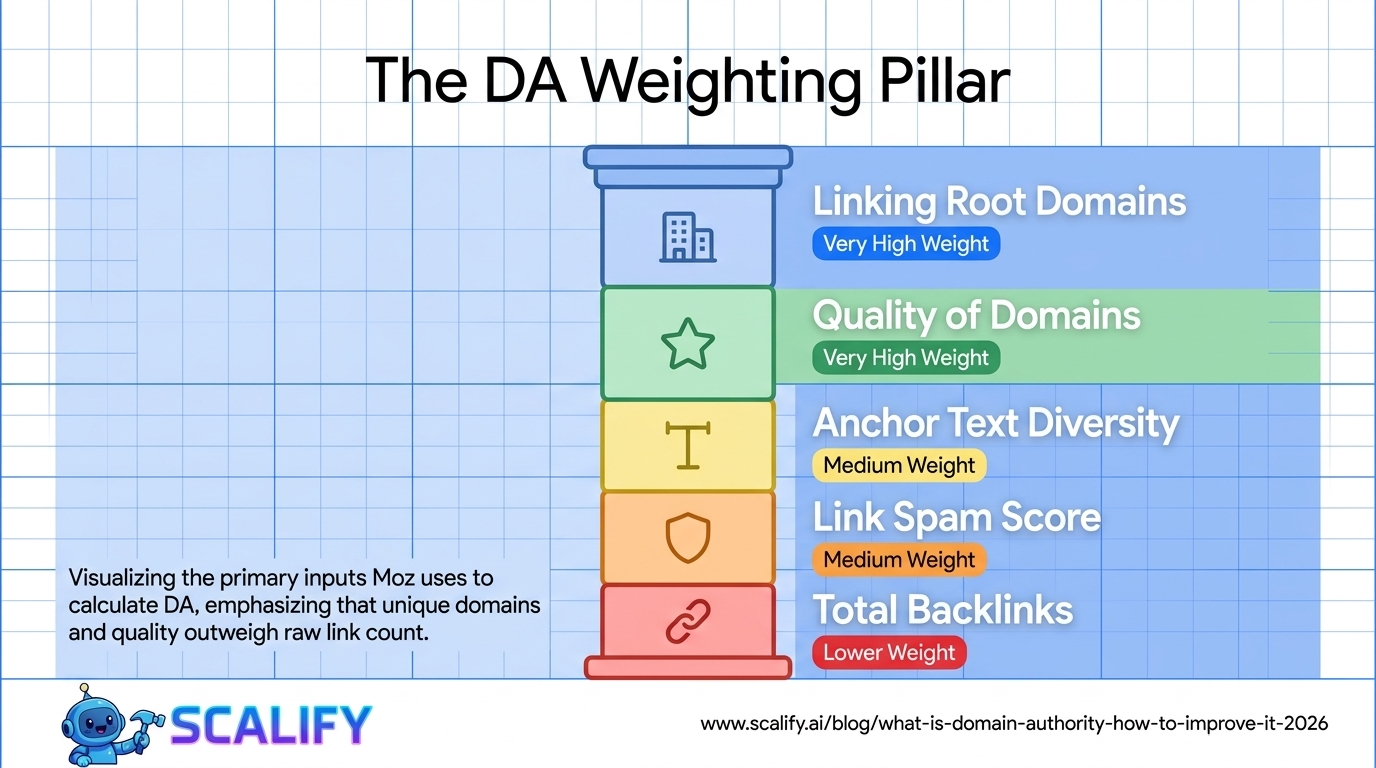
More specifically, Moz's DA calculation considers:
Linking root domains: The number of unique external domains linking to the site. A link from one domain is one vote regardless of how many pages on that domain link to you. 500 unique linking domains is more valuable than 10,000 links from 5 domains.
MozRank and MozTrust: Moz's own internal link quality metrics that assess the quality of linking pages and the trustworthiness of the link graph leading to the site.
Link profile quality: Links from high-authority sites are weighted more heavily than links from low-authority sites. A single link from a major national publication contributes more to DA than hundreds of links from low-quality directories.
What DA does not measure: content quality, user experience, brand strength, social signals, direct traffic, click-through rates from search, Core Web Vitals, or any of the other signals that Google uses to rank pages beyond its own link assessment.
Why DA Is Useful (When Used Correctly)
Despite not being a Google metric, DA is genuinely useful for several purposes when applied correctly:
Evaluating Link Building Opportunities
When evaluating whether a particular website is worth pursuing as a link source, DA provides a quick first-pass filter. A site with DA 70 is likely to pass significantly more link equity than a site with DA 15, all else being equal. This makes DA useful for prioritizing outreach — focus first on higher-DA opportunities in your target topic areas.
Important caveat: DA alone is not sufficient for evaluating link opportunities. Relevance matters as much or more than authority. A DA 50 site in your exact industry niche is often more valuable than a DA 70 site in a completely unrelated industry. Check both the authority score and the topical relevance of any link opportunity.
Competitive Benchmarking
Comparing your DA to competitors' DAs provides a rough benchmark of your link authority relative to the competition. If competitors ranking on page one for your target keywords have DA 50–60 and your site has DA 25, you have a significant link authority gap to close before you can expect to compete for those keywords.
This benchmarking is useful for setting realistic expectations about which keywords are achievable now versus which require more link building investment first. A realistic SEO strategy accounts for the authority gap rather than targeting keywords your site doesn't yet have the authority to rank for.
Tracking Link Building Progress
Since DA is primarily a function of your backlink profile, it tracks over time as you build links. A DA that's growing is a sign your link building efforts are paying off. A DA that's flat or declining might indicate issues with your link profile (loss of existing links, new low-quality links being identified and discounted) worth investigating.
Track DA as one metric among many — not as the sole indicator of SEO progress, but as one signal in the larger picture.
Why DA Is Misleading (When Used Incorrectly)
DA Can Be Manipulated
Because DA is based on links, and because businesses pay for links (despite Google's guidelines against this), DA can be artificially inflated. A site with 500 purchased links from low-quality link farms might have a surprisingly high DA without having any real organic authority that would produce search rankings.
Link sellers have learned to advertise using DA: "Get links from DA 50+ sites." This is one of the clearest indicators that a link building offer is problematic — legitimate, editorially earned links from quality publications are offered based on their editorial merit, not their DA score. Sellers who advertise primarily through DA metrics are typically selling links in ways that violate Google's guidelines.
Different Tools Produce Different Scores
A site might have DA 45 from Moz, DR 52 from Ahrefs, and Authority Score 38 from Semrush. All three are measuring something similar but using different methodologies and different link databases. A site's authority isn't a single objective number — it's an estimate that varies by measurement methodology.
This means comparing DA scores from different tools for different sites produces apples-to-oranges comparisons. If you use DA for benchmarking, use the same tool consistently and compare relative scores within that tool's measurement framework rather than treating absolute numbers as objective truth.
DA Doesn't Reflect Google's Actual Assessment
Google's ranking algorithm considers hundreds of signals beyond a site's link profile. Content quality, topical authority, user experience signals, Core Web Vitals, HTTPS, mobile-friendliness — these all contribute to ranking outcomes in ways that DA doesn't capture.
A site with DA 40 that publishes genuinely excellent, authoritative content in a specific niche can outrank a DA 60 site with thin content — because Google's actual ranking algorithm weights topical relevance and content quality heavily alongside link signals. Using DA as the primary or sole predictor of ranking ability oversimplifies the actual ranking process.
The Logarithmic Scale Creates Misunderstandings
DA is a logarithmic scale, not a linear one. The difference between DA 10 and DA 20 is much smaller than the difference between DA 60 and DA 70. Improving from DA 60 to DA 70 requires significantly more link building effort than improving from DA 10 to DA 20, because you're competing against stronger sites for link opportunities at the high end of the scale.
This means goals like "we want to reach DA 50" are less meaningful than they appear. DA 50 is dramatically easier to achieve than DA 70 — the resources required are very different. More practically useful goals focus on closing the authority gap to specific competitors rather than hitting a round DA number.
Page Authority vs. Domain Authority
Moz also provides Page Authority (PA) — the same concept applied at the individual page level rather than the domain level. PA predicts how likely a specific page is to rank in search results.
This distinction matters because Google actually ranks individual pages, not whole domains. A website with moderate domain authority can have specific pages rank above pages from higher-authority sites if those pages have earned significant links and have strong content. A site with DA 40 whose definitive guide to a topic has earned 100+ high-quality links can outrank DA 70 sites for that topic.
PA is often more immediately useful than DA for evaluating competitive opportunity on a query-by-query basis. Compare the PA of pages currently ranking for your target keyword against your own pages' PA to assess the difficulty more accurately than domain-level comparison alone.
Alternative Signals That Better Reflect Real Authority
For a more complete picture of a site's actual SEO authority, combine DA with these supplementary signals:
Organic traffic estimates: Ahrefs and Semrush both provide estimates of a site's monthly organic search traffic. Actual organic traffic is a much better indicator of real-world authority than link-based metrics alone. A site with DA 45 and 200,000 monthly organic visitors is more authoritative in practice than a site with DA 55 and 5,000 monthly visitors.
Linking root domains: The raw count of unique domains linking to a site (available in Ahrefs, Semrush, and Moz) is often a cleaner signal than the compressed DA score. Comparing raw linking root domain counts is useful for benchmarking and link building goal-setting.
Topical authority: Look at which topics and keyword clusters a site ranks for, not just its aggregate authority score. A site can be very authoritative in one topic area and weak in others. Topical relevance to your target queries matters more than overall domain authority.
Content quality signals: Are the pages on this site genuinely useful, comprehensive, and well-maintained? Content quality is a major Google ranking factor that link-based metrics don't capture. High-DA sites with thin, outdated, or poor-quality content often underperform their authority score in actual search rankings.
Practical Guidelines for Using DA
Use it as one signal, not the signal: DA provides useful context but should be combined with other signals rather than used as the primary evaluator of a site's authority or a link opportunity's value.
Use it for relative comparisons within a tool, not across tools: Compare DA scores from the same tool (Moz's DA, Ahrefs' DR, Semrush's Authority Score) consistently. Don't compare a Moz DA with an Ahrefs DR and draw conclusions from the difference.
Consider relevance alongside authority for link evaluation: A lower-DA site in your exact industry niche may provide more ranking benefit than a higher-DA site in an unrelated field. Relevance matters as much as authority.
Don't pay for links based on DA scores: Services advertising links from "DA 50+ sites" are typically selling links in ways that violate Google's guidelines. Legitimate link opportunities are earned through content quality and relationship, not purchased by DA score.
Use it for competitive benchmarking and realistic expectation-setting: If your site has DA 20 and your competitors ranking for target keywords have DA 50–60, that gap is real and needs to be closed through sustained link building before you can expect to compete for those keywords.
The Bottom Line
Domain Authority is a useful proxy metric for a website's link-based authority, created by Moz and not used by Google. It's helpful for competitive benchmarking, evaluating link opportunities, and tracking link building progress over time. It's not a Google ranking signal, it can be manipulated, it varies by tool, and it doesn't capture the full picture of what makes a site rank well in search.
Use it in context — as one of several signals evaluated together — not as a standalone verdict on a site's authority or ranking potential. The businesses that treat DA as a comprehensive authority measure make worse decisions than those who understand it as the limited but useful proxy it actually is.
Building genuine domain authority — through earning links from relevant, reputable sites with content that deserves to be referenced — is one of the core long-term SEO investments. At Scalify, every website we build has the technical foundation and content structure that makes link-building efforts compound effectively over time.






.jpeg)
.jpeg)


78 SW 7th St, Miami, FL 33130