


What Is Google Search Console and How Do You Use It?
By Josh Ternyak

March 29, 2026
Google Search Console is the most powerful free SEO tool available — and most website owners barely use it. This guide explains what it does, which reports actually matter, and how to use it to grow your organic traffic.
Google's Free Direct Line to How It Sees Your Website
Most SEO tools give you approximations. They estimate keyword rankings, infer backlink authority, and predict traffic potential based on models of Google's behavior. These estimates are useful — but they're third-party models of an opaque system, not direct insights from Google itself.
Google Search Console is different. It's a free tool from Google that gives you direct visibility into how Google actually sees, crawls, and ranks your website. When you look at Search Console, you're seeing Google's actual data: which queries triggered your pages to appear, how often your pages were clicked, which pages Google has indexed, and exactly what technical issues Google encountered when crawling your site.
This makes it qualitatively different from any third-party SEO tool — and it makes it one of the most valuable resources available to any business that cares about organic search performance. The problem: most business owners who have it set up use it sparingly if at all, and miss the insights it contains.
This guide covers what Google Search Console is, how to set it up, the specific reports that drive the most actionable insights, and how to build a routine around it that consistently improves your organic search performance.
What Google Search Console Is
Google Search Console (GSC) is a free web service provided by Google that helps website owners monitor, maintain, and troubleshoot their site's presence in Google Search results. It doesn't improve your rankings directly, but it provides the information you need to make informed decisions that improve your rankings.
GSC replaced Google Webmaster Tools in 2015 and has been substantially updated and expanded since. It provides data about:
- Which pages Google has indexed and which it has excluded
- Which search queries trigger your pages to appear in Google results
- How often your pages appear for those queries (impressions)
- How often searchers click your result (clicks)
- Your average position in search results for different queries
- Which external websites link to your pages
- Core Web Vitals performance data from real users
- Mobile usability issues
- Security issues and manual actions (if Google has penalized your site)
This data is collected from Google's actual crawling, indexing, and serving systems — not estimated or inferred from third-party models. It's the most authoritative source of information about your site's search presence.
How to Set Up Google Search Console
Setup takes about 15–20 minutes:
1. Go to search.google.com/search-console and sign in with a Google account
2. Click "Add Property" and enter your website URL
3. Choose your property type: "Domain" (covers all URLs and both HTTP/HTTPS) or "URL prefix" (covers a specific URL prefix). Domain property is generally preferable as it consolidates all data.
4. Verify ownership of the domain. Google provides several verification methods; the recommended approach is adding a DNS TXT record to your domain's DNS configuration (requires access to your domain registrar's DNS settings) or adding a meta tag to your website's HTML head.
5. Once verified, data begins accumulating. Historical data isn't available — GSC only shows data from the verification date forward.
If your site has both HTTP and HTTPS versions, verify both. If you have both www and non-www versions, verify the canonical one (the one you redirect to). If you manage a site on behalf of a client or employer, request access through their GSC account rather than adding it to your personal account — property access can be delegated without sharing credentials.
Connect GSC to Google Analytics for the full picture: traffic source data from GA combined with search query data from GSC gives a complete view from query to conversion.
The Reports That Drive the Most Value
Performance Report
The Performance report is the core of GSC for most SEO purposes. It shows your site's performance in Google search over a specified time period, measured by four metrics:
Total Clicks: How many times users clicked from Google search results to your website.
Total Impressions: How many times any URL from your site appeared in Google search results, regardless of whether it was clicked.
Average CTR (Click-Through Rate): Clicks divided by impressions. The percentage of impressions that resulted in a click.
Average Position: Your average ranking position across all impressions. Position 1 is the top organic result; higher numbers mean lower positions. A page averaging position 7 ranks typically on the first page near the bottom or in the top of page two.
The Performance report becomes most valuable when you filter and segment it:
Filter by date: Compare the current 3 months against the same 3 months last year to see year-over-year trend. Compare the last 28 days against the previous 28 days to see recent trends.
View by Query: See which search queries are generating impressions and clicks. Sort by impressions to see which queries are showing your pages most frequently. Sort by clicks to see which queries are driving the most traffic. Sort by CTR to find high-impression, low-CTR queries — these are pages that are ranking but not being clicked, indicating a title/meta description optimization opportunity.
View by Page: See which pages are generating the most traffic and impressions. Click on any page to see which queries that specific page is ranking for — this is invaluable for understanding each page's actual keyword footprint versus its intended targets.
The high-impressions, low-CTR opportunity: Filter for queries or pages with impressions over a threshold (say, 100+/month) and CTR below 3–5%. These are pages where significant search traffic exists but you're not capturing it. Improving the title tag and meta description to be more compelling and specific typically produces immediate CTR improvements and more organic traffic from existing rankings — without any change in ranking position.
The position 11–20 opportunity: Filter for queries where your average position is between 11 and 20. These are keywords where you're ranking on page 2 or early page 3 — close to page 1. Even modest improvements to page quality, additional internal links, or a few good backlinks can push these to page 1 visibility, which typically produces 3–10x more clicks (page 2 organic CTR is dramatically lower than page 1).
URL Inspection Tool
The URL Inspection tool lets you check the status of any individual URL on your site. Enter a URL and Google tells you:
- Is it indexed? If not, why not?
- What canonical URL does Google associate with this page?
- When was it last crawled?
- What HTTP response code did it return when crawled?
- Is it mobile-friendly?
- Does it have any structured data, and is that structured data valid?
The URL Inspection tool is invaluable for diagnosing why specific pages aren't appearing in search. If an important page isn't showing in Google, inspect its URL here to find out whether Google can access it, whether it's been indexed, and whether any technical issues are preventing indexation.
You can also request indexing of any page by clicking "Request Indexing" after inspecting a URL. This prompts Google to recrawl the URL sooner than it would in its normal crawl schedule — useful after updating a page or after fixing an issue that was preventing indexation.
Pages Report (Coverage Report)
The Pages report (found under Indexing → Pages) shows which pages on your site are indexed and which are excluded, with reasons for exclusions. This is your map of Google's understanding of your site's content.
The most important sections:
Indexed: Pages Google has indexed. This should include all your important pages. If important pages are missing, investigate why.
Not Indexed - Reasons: Google categorizes excluded pages by reason:
- "Excluded by 'noindex' tag" — You've told Google not to index this page. Is this intentional?
- "Crawled - currently not indexed" — Google crawled the page but decided not to index it, usually due to thin or duplicate content. These pages need quality evaluation.
- "Discovered - currently not indexed" — Google knows the page exists but hasn't crawled it. Often a crawl budget or internal linking issue.
- "Duplicate, Google chose different canonical than user" — Google thinks another URL is the canonical version of this content and has indexed that instead. Check your canonical tags.
- "404 errors" — Pages that return a "not found" error. These need to be fixed or redirected.
Review the "Not Indexed" section regularly. Pages in your important content hierarchy that are excluded represent lost SEO opportunity. Understanding why they're excluded — and fixing the underlying issues — is often directly tied to organic traffic improvements.
Core Web Vitals Report
The Core Web Vitals report shows performance data measured by real users on your site — not synthetic lab tests. It groups URLs into "Good," "Needs Improvement," and "Poor" based on Largest Contentful Paint (LCP), Cumulative Layout Shift (CLS), and Interaction to Next Paint (INP).
Field data from GSC is more representative of real user experience than PageSpeed Insights lab data, because it reflects the actual devices, connections, and usage patterns of your real visitors. A page that tests well in a lab environment but has a "Poor" Core Web Vitals rating in GSC has a real-world performance problem that the lab test didn't capture.
Download the list of pages with "Poor" CWV ratings and prioritize them for performance optimization. Core Web Vitals are a Google ranking factor — poor-performing pages rank below their content quality otherwise justifies.
Links Report
The Links report shows:
External links: Which sites are linking to your pages and which of your pages have the most external links. This is not a comprehensive backlink database (Ahrefs or Semrush are more complete) but it's Google's own data about links it's discovered, which makes it authoritative for understanding what Google considers your link profile.
Internal links: Which of your pages have the most internal links from other pages on your site. Pages with many internal links receive more crawl priority and PageRank. If important pages have few internal links, this report identifies the opportunity to improve their link equity through additional internal linking.
Top linking sites: Which external domains are linking to you most often. This helps identify where your link equity is coming from and surfaces potential link relationships worth nurturing.
Sitemaps
The Sitemaps section shows your submitted sitemaps and their status — how many URLs were submitted versus how many were indexed. A significant gap between submitted and indexed (e.g., 200 URLs submitted, 80 indexed) indicates that Google isn't indexing a substantial portion of your submitted pages, usually due to content quality issues, canonicalization problems, or crawl accessibility issues.
Submit your sitemap here if you haven't already. Every site should have an XML sitemap submitted to GSC to ensure Google is aware of all your important pages.
Security and Manual Actions
Check these periodically, though they're only relevant when something has gone wrong:
Security Issues: If Google has detected malware or hacked content on your site, it reports it here. Security issues in GSC are urgent — they affect your rankings, trigger browser warnings to visitors, and indicate a compromised site that needs immediate remediation.
Manual Actions: If Google's webspam team has manually penalized your site (for unnatural links, thin content, or other guidelines violations), the penalty is reported here with details. Manual actions are serious and require the underlying issue to be fixed before submitting a reconsideration request.
Building a GSC Review Routine
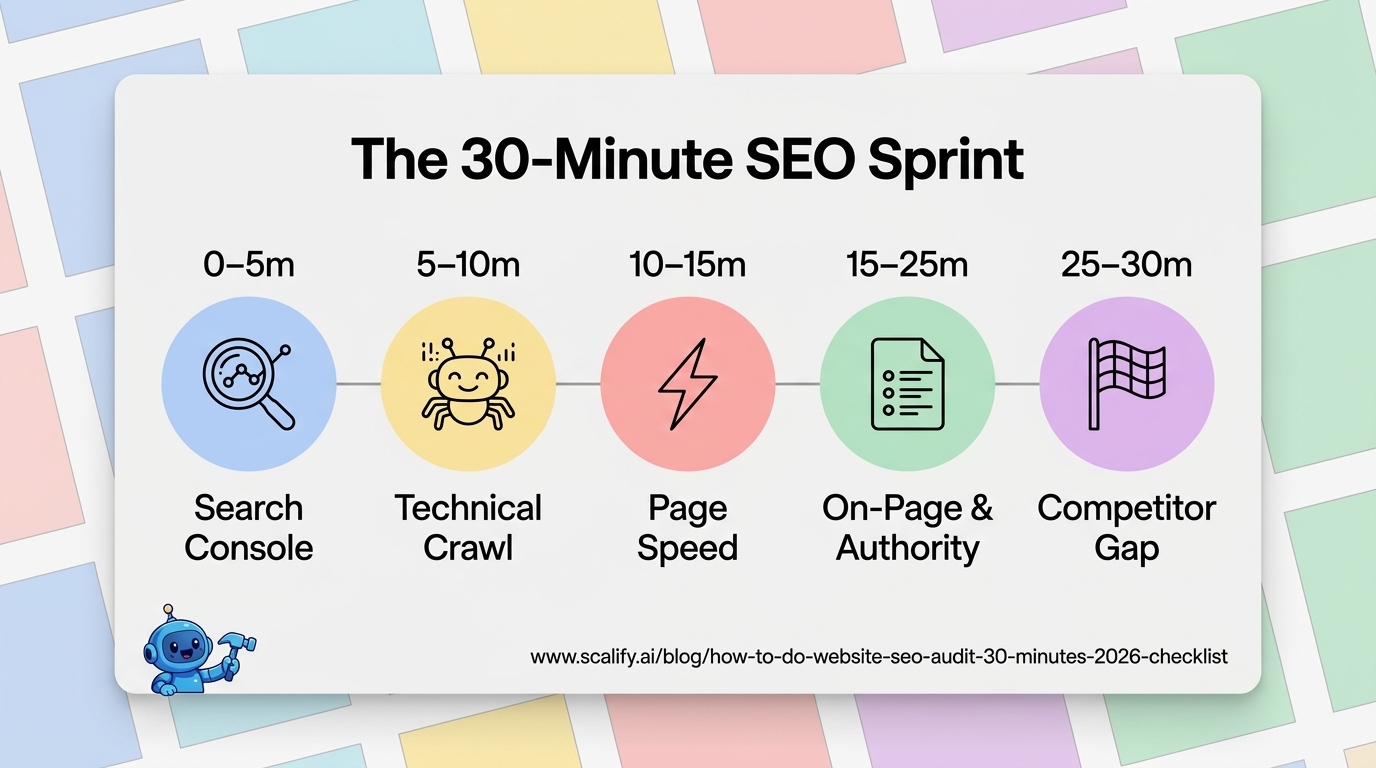
The value of GSC compounds when you review it regularly rather than sporadically. A simple routine:
Weekly (10 minutes): Check the Performance report for significant traffic changes compared to the previous week. Check Coverage for new errors. Check Security Issues and Manual Actions.
Monthly (30 minutes): Review the Performance report comparing current month to previous month. Identify high-impression, low-CTR queries for title/description improvement. Identify position 11–20 keywords for optimization. Review the Pages report for newly excluded pages. Check Core Web Vitals for any new "Poor" pages.
Quarterly (1–2 hours): Full analysis of performance trends. Compare against same quarter last year. Review top landing pages from search and assess optimization opportunities. Audit submitted sitemap vs. indexed pages gap. Review internal links and identify key pages that could benefit from more internal linking.
Common GSC Mistakes
Not having it set up at all: You can't optimize what you can't measure. GSC is free and the setup takes 15 minutes. There's no reason not to have it on every site you own or manage.
Only checking when traffic drops: GSC is most valuable as a proactive monitoring tool. By the time a traffic drop is visible in analytics, the underlying issue may have been present for weeks. Regular GSC review catches problems earlier.
Ignoring the URL Inspection tool: Investigating specific pages' index status and crawlability directly answers questions that most other tools can only approximate. When a specific page isn't performing, inspect its URL.
Not acting on Coverage issues: "Not Indexed" pages in the Coverage report are a map of SEO opportunity. Diagnosing and fixing indexation issues for pages that should be indexed can produce significant organic traffic improvements.
The Bottom Line
Google Search Console is the most authoritative, most direct, and most free tool available for understanding your website's organic search performance. It's Google's own data — actual queries triggering your pages, actual impressions and clicks, actual indexation status, actual crawl issues — not third-party approximations.
Set it up if you haven't. Review it regularly — weekly for critical issues, monthly for strategic insights. Act on what you find: optimize title tags for low-CTR queries, fix excluded pages, address Core Web Vitals issues, build internal links to position 11–20 keywords. The compounding improvements from systematic GSC use are among the most cost-effective SEO investments available.
At Scalify, every website we build is set up with Google Search Console configured and verified from day one — so you're collecting data from launch, not weeks later when you remember to set it up.





.jpeg)
.jpeg)



78 SW 7th St, Miami, FL 33130