


What Is HTML? A Non-Technical Explanation
By Josh Ternyak

March 28, 2026
HTML is the foundation of every web page ever built — but most explanations assume you already know what you're looking at. This guide explains HTML in plain English with zero assumed knowledge.
The Language of the Web, Explained for Humans
Every web page you've ever visited — this one, Google, Amazon, your bank's website, the blog you read over breakfast — is built on HTML. It's been there since the beginning of the web, it's there right now as you read this, and it will be there for the foreseeable future. HTML is the bedrock of everything on the internet that a browser displays.
And yet most people have no idea what it actually is. They know it's something technical. They've heard the term in the context of "learning to code" or "website development." They may have accidentally seen it when they clicked "View Source" in a browser and saw a wall of unfamiliar text with angle brackets everywhere.
This guide is not a coding tutorial. It's an explanation — what HTML is, what it does, how it works, and why it matters — written for people who want to understand the web without becoming developers. No assumed knowledge. No jargon without explanation.
What HTML Stands For and What It Means
HTML stands for HyperText Markup Language. Each word tells you something about what it is:
HyperText — text that contains links to other text (or content). "Hyper" here means "connected," not "energetic." The hypertext in HTML is what makes the web a web — documents that link to other documents, creating the interconnected network of pages we navigate every day. The concept predates the web itself but was central to Tim Berners-Lee's vision when he invented the World Wide Web in 1989.
Markup — a system of annotations added to text that describe how the text should be structured or displayed. Markup languages existed long before computers — editors would "mark up" manuscript text with symbols indicating formatting, structure, and instructions for typesetters. HTML is a markup language that describes web content structure using tags.
Language — not a spoken or written natural language, but a formal language with defined syntax (rules about what's allowed) that computers can interpret consistently. HTML has specific rules about how it must be written; follow them and browsers understand it; break them and browsers either attempt to compensate or display something unexpected.
Combined: HTML is a markup language for creating structured documents with hyperlinks that browsers can display as web pages.
What HTML Actually Does: Structure and Meaning
HTML's job is to give content structure and meaning. It answers questions like: is this text a heading or a paragraph? Is this a list or flowing prose? Is this an image or a button? Is this a link to another page?
Without HTML, a browser would have a document full of text and have no way to know what role each piece plays. HTML provides that metadata — the annotations that say "this is important enough to be the main heading," "this is body text," "this is a navigation menu," "this is a button the user can click."
It's worth emphasizing: HTML describes structure and meaning, not appearance. What things look like is CSS's job. HTML says "this is a heading." CSS says "headings should be displayed in this size, this font, this color." The separation of structure (HTML) from presentation (CSS) is fundamental to how the web works, even though in practice they're always used together.
Tags: How HTML Works
HTML uses a system of tags to mark up content. A tag is a keyword enclosed in angle brackets: <keyword>. Most HTML elements use a pair of tags: an opening tag and a closing tag, with the content between them. The closing tag is the same keyword with a forward slash: </keyword>.
For example:
<p>This is a paragraph of text.</p>
The <p> tag tells the browser "what follows is a paragraph." The </p> tag tells it "the paragraph ends here." The text between is the paragraph's content.
Another example:
<h1>This Is the Main Heading</h1>
The <h1> tag means "heading level 1" — the most important heading on the page. There are six heading levels: h1 through h6, with h1 being most important and h6 being least important. This hierarchy helps both browsers (which default to displaying them at decreasing sizes) and search engines (which weight h1 content more heavily for relevance signals).
The Most Common HTML Tags and What They Do
There are over 100 HTML tags, but a relatively small set handles the majority of web content. Here are the most important ones, explained in plain language:
<html> — The root element. Everything in an HTML document is wrapped inside <html> tags. It tells the browser: "what follows is HTML."
<head> — The section that contains metadata about the page — information that browsers and search engines use but that isn't displayed to visitors. Page title, meta description, links to CSS files, character encoding declaration — all in the <head>.
<body> — The section that contains everything visible to visitors. All the text, images, buttons, links, and other displayed content lives in the <body>.
<title> — Sets the page title that appears in the browser tab and in search engine results. Critical for SEO and user navigation. Goes inside <head>.
<h1> through <h6> — Headings from most important (h1) to least (h6). Structurally important for both readability and SEO. A page should typically have one h1 (the main topic of the page) and can have multiple h2s, h3s, etc. for sub-sections.
<p> — Paragraph. The default container for body text. Creates a block of text with default spacing before and after.
<a> — Anchor. The tag that creates links. The destination URL is specified in the href attribute: <a href="https://scalify.ai">Visit Scalify</a>. The text between the tags becomes the clickable link text (anchor text), which matters for SEO.
<img> — Image. A self-closing tag (no closing tag needed) that embeds an image. The image source URL goes in the src attribute: <img src="photo.jpg" alt="Description of the photo">. The alt attribute provides alternative text for screen readers and search engines — critical for both accessibility and SEO.
<ul> and <ol> — Unordered list (bulleted) and Ordered list (numbered). Each list item goes inside an <li> (list item) tag.
<div> — Division. A generic container with no inherent meaning. Used to group elements for styling and layout purposes. One of the most commonly used tags in modern web development, though best practice is to use semantically meaningful tags where they exist.
<span> — An inline container, similar to <div> but for inline content rather than block-level grouping. Used to apply styling to a specific portion of text within a paragraph.
<button> — A clickable button. The text between the tags is the button label. JavaScript handles what happens when it's clicked.
<form>, <input>, <textarea>, <select> — Form elements. The <form> wrapper, text inputs, multi-line text areas, and dropdown menus. Together these create the forms through which users enter and submit information — contact forms, search boxes, login fields, checkout forms.
<nav> — Semantic tag for navigation. Tells browsers and screen readers "this section contains navigation links."
<header> and <footer> — Semantic tags for page header and footer sections. Browsers display these no differently than a <div>, but they convey meaning to search engines and assistive technologies.
<main>, <article>, <section>, <aside> — Semantic structural elements. <main> for the primary content area. <article> for self-contained content (like a blog post). <section> for a thematic grouping of content. <aside> for secondary content like a sidebar.
Attributes: Extra Information Within Tags
Many HTML tags accept attributes — additional information placed inside the opening tag that modify the element's behavior or provide extra data.
You've already seen a few: the href attribute on links (specifying the destination), the src attribute on images (specifying the image file), the alt attribute on images (providing alternative text).
Other common attributes:
class — assigns a CSS class to an element so CSS rules can be applied to it: <p class="intro-text">. Multiple elements can share the same class.
id — assigns a unique identifier to an element: <section id="about">. Used for anchor links (linking to a specific section of a page), CSS targeting, and JavaScript interaction. Each id should be unique on a page.
style — applies inline CSS directly to an element: <p style="color: red;">. Functional but generally poor practice compared to external CSS — it mixes presentation into the HTML structure.
type — specifies the type for certain elements. For input fields: <input type="email"> tells mobile browsers to show the email keyboard and tells browsers to validate the format. Type values include "text", "email", "password", "number", "checkbox", "radio", "submit".
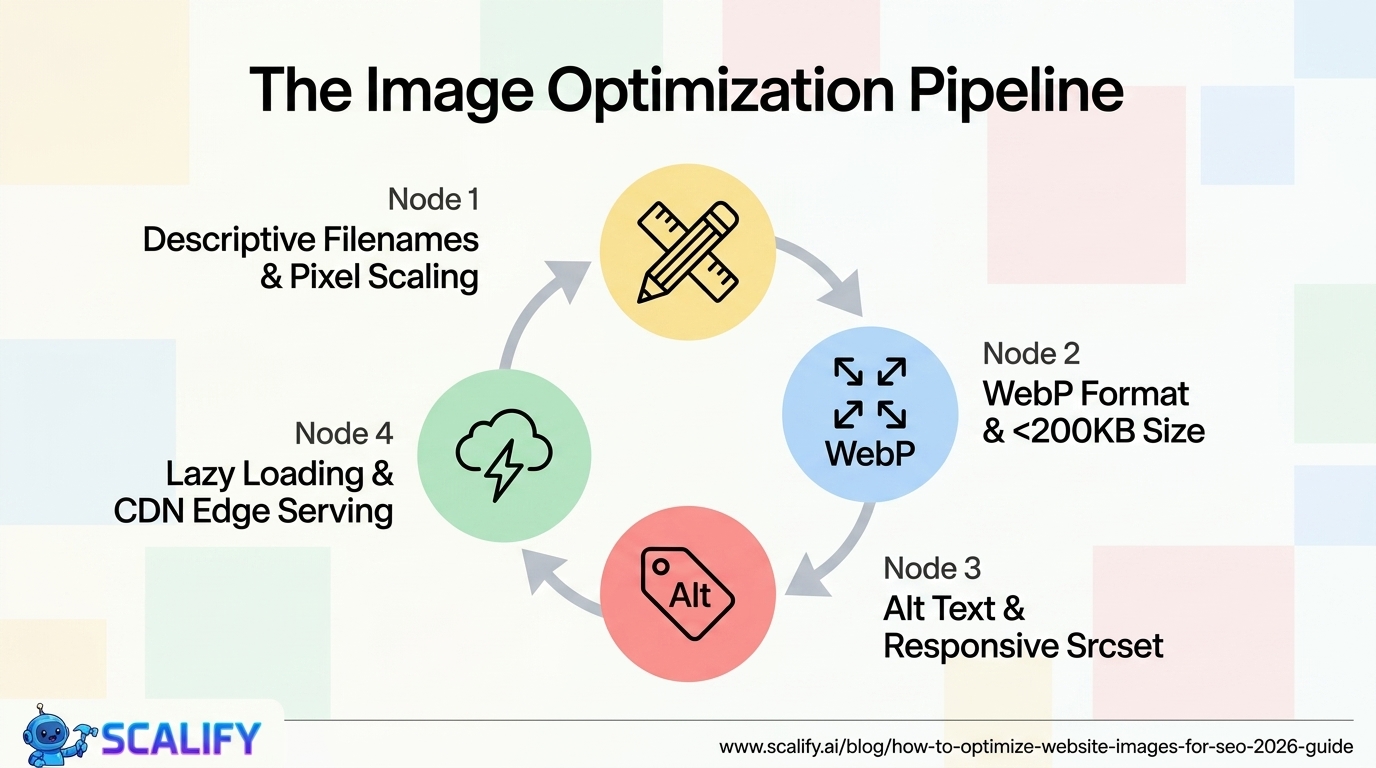
loading — for images: <img loading="lazy"> enables lazy loading (not downloading the image until the user scrolls near it).
A Minimal HTML Document
Every HTML document has a basic structure. Here's the minimum valid HTML page:
<!DOCTYPE html>
<html lang="en">
  <head>
    <meta charset="UTF-8">
    <meta name="viewport" content="width=device-width, initial-scale=1.0">
    <title>Page Title</title>
  </head>
  <body>
    <h1>Hello, World</h1>
    <p>This is a web page.</p>
  </body>
</html>
Breaking this down: the <!DOCTYPE html> declaration tells the browser this is an HTML5 document. The lang="en" attribute declares the page language. The charset meta tag declares UTF-8 encoding. The viewport meta tag enables responsive scaling on mobile devices. The title appears in the browser tab. The body contains the visible content.
Every web page, from the simplest to the most complex, starts from this structure and adds to it.
HTML and SEO: Why Structure Matters to Google
Search engines read your HTML to understand what your page is about and how its content is organized. The choices you make in your HTML structure directly affect how well your pages rank in search.
The most important HTML elements for SEO:
Title tag: The <title> in the <head> is the most heavily weighted on-page SEO element. It appears in search results as the blue clickable headline. It should be unique to each page and include the primary keyword for that page.
H1 tag: The main heading on the page. Google uses this to understand the page's primary topic. One h1 per page, describing what the page is about.
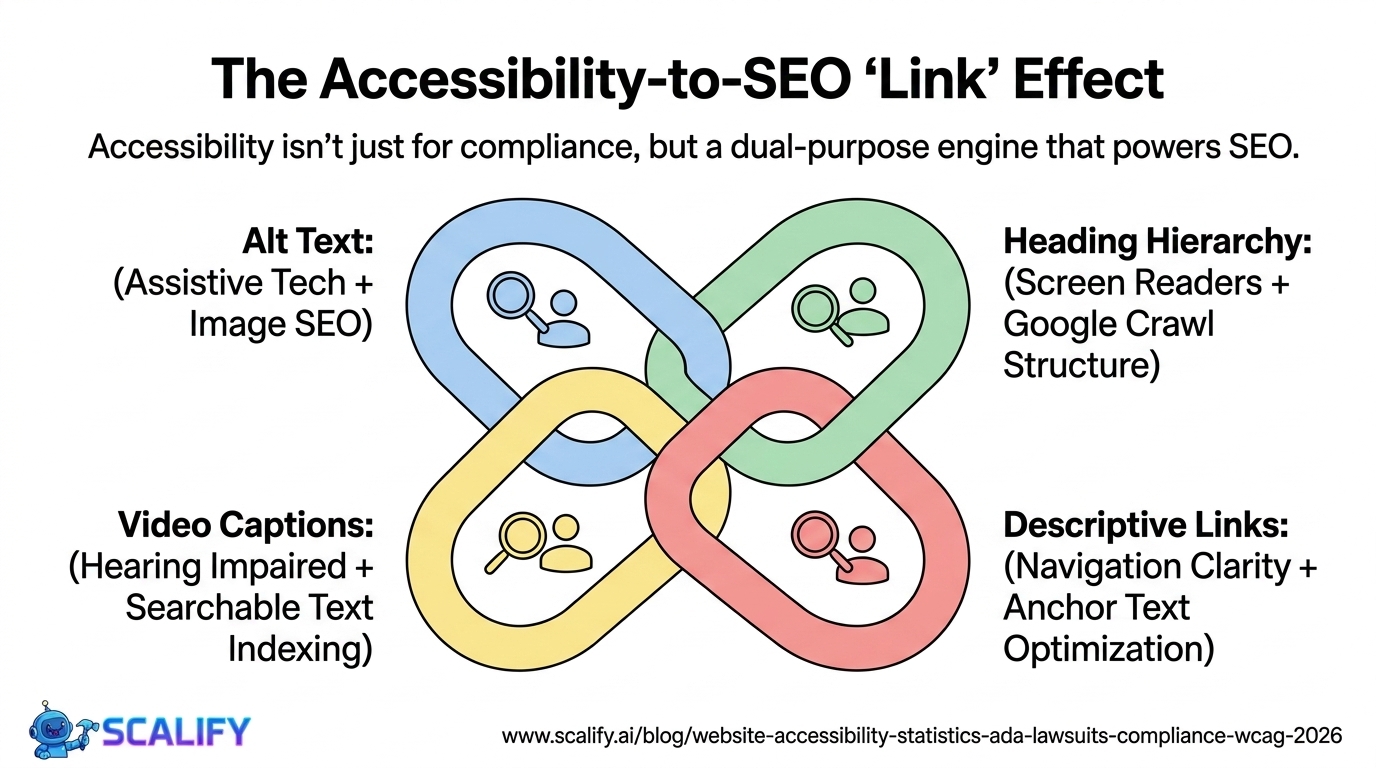
Alt text on images: The alt attribute provides text that describes image content. Search engines can't see images; they read alt text to understand what images show. Missing alt text means search engines (and screen readers) have no context for your images.
Link anchor text: The text between anchor tags (<a>) tells both users and search engines what the linked page is about. "Click here" is terrible anchor text. "Custom website design services" is descriptive anchor text that benefits both usability and SEO.
Semantic structure: Using semantically correct tags — <nav> for navigation, <main> for main content, <article> for articles — helps search engines understand your page structure beyond the visual layout.
Viewing HTML: How to See What's Under Any Web Page
You can view the HTML of any web page. Right-click anywhere on a page and select "View Page Source" — you'll see the raw HTML document that your browser received from the server.
More useful: right-click a specific element and select "Inspect" (Chrome, Firefox) or "Inspect Element" (Safari). This opens DevTools and shows you the HTML for exactly that element, along with the CSS styles applied to it. Hovering over elements in the HTML panel highlights them on the page.
This is how web developers debug layouts, understand how competitor sites are built, and experiment with CSS changes in real-time. It's a free window into any site's code, and exploring it is an excellent way to learn.
HTML Is Not Enough on Its Own
HTML handles structure and content. It has nothing to say about color, typography, spacing, layout, or any visual property. Without CSS, an HTML page displays as unstyled text — black text on a white background, default browser typography, no column layouts, no color, no visual hierarchy.
This separation is intentional and valuable. HTML conveys meaning; CSS conveys presentation. The same HTML content can be presented completely differently by applying different CSS. News sites, CMS themes, and responsive design all leverage this separation — the same underlying content can be restyled without touching the HTML.
JavaScript, the third layer, adds interactivity and behavior. Dropdown menus, form validation, animations, real-time updates, single-page application navigation — all JavaScript. HTML defines the structure; CSS defines the appearance; JavaScript defines the behavior.
The Bottom Line
HTML is the markup language that gives web content structure and meaning. It uses pairs of tags to define what different pieces of content are — headings, paragraphs, links, images, lists, forms, buttons. Browsers read this markup and render it into the visual pages we experience. Search engines read it to understand page content and context.
You don't need to write HTML to have a great website in 2026 — every major platform generates HTML for you. But understanding what HTML is and what its elements mean makes you a more informed owner of your web presence, better able to understand what developers and tools are doing and why.
For everything else — the design, the development, the structure — Scalify handles the technical layer so you can focus on running your business.



.jpeg)
.jpeg)

78 SW 7th St, Miami, FL 33130