


What Is JavaScript and Do You Need It on Your Website?
By Josh Ternyak

March 28, 2026
JavaScript is what makes websites do things — interactive menus, live forms, animations, real-time data. This guide explains what it is, how it works, and whether your site actually needs it (and how much).
The Layer That Makes Web Pages Come Alive
You've already encountered the first two layers of a web page without necessarily naming them. HTML is the structure — the scaffolding that defines what content exists and what role it plays. CSS is the presentation — the visual layer that makes that structure look like something. Both of these are essentially declarative: you declare what things are and how they should look, and the browser obeys.
JavaScript is different. JavaScript is a programming language — a set of instructions that the browser executes, line by line, producing behavior that's dynamic and responsive to what users do. The drop-down menu that appears when you hover. The form that validates your email before you submit it. The counter that shows how many items are in your cart. The chat widget that opens when you click. The map that updates as you drag it. The infinite scroll that loads new content as you reach the bottom. All JavaScript.
This guide explains what JavaScript is, how it works in the browser, where it appears on websites you interact with every day, and helps you think through how much of it your website actually needs.
What JavaScript Is
JavaScript is a programming language originally created in 1995 by Brendan Eich while at Netscape. It was designed specifically to run inside web browsers and add interactive behavior to web pages — and despite being famously created in 10 days as a prototype, it became the universal programming language of the web and eventually one of the most-used programming languages in the world for any purpose.
Unlike HTML and CSS, which are markup and style languages that describe static structure and appearance, JavaScript is a full programming language with variables, functions, conditional logic, loops, and the ability to manipulate the HTML and CSS of a page in real time in response to events and conditions.
Every modern browser includes a JavaScript engine — a program that reads, compiles, and executes JavaScript code. Chrome and Edge use V8. Safari uses JavaScriptCore. Firefox uses SpiderMonkey. These engines have become extraordinarily sophisticated — modern JavaScript runs at speeds that would have seemed impossible 15 years ago, enabling entire complex applications to run in a browser tab.
What JavaScript Does on a Web Page
The scope of what JavaScript enables is enormous. Here are the major categories of things it does on web pages:
DOM Manipulation: Changing the Page in Real Time
The DOM (Document Object Model) is the browser's in-memory representation of the HTML document — a tree structure of objects, one for each HTML element. JavaScript can read from and write to this tree at any time: adding new elements, removing existing ones, changing text content, modifying CSS classes and styles, updating attributes.
When you click "Add to Cart" and the cart counter in the header updates from "2" to "3" without the page reloading — JavaScript has accessed the DOM element containing that number and changed its text content. When a "Read More" section expands in response to a click — JavaScript has toggled a CSS class that changes the element's display or height. The page didn't reload; JavaScript modified what's already there.
Event Handling: Responding to User Actions
JavaScript can attach "event listeners" to any element on a page — functions that execute when specified events occur. Events include: click, mouseover, mouseout, keypress, scroll, resize, focus, blur, submit, and many others.
When you hover over a navigation item and a dropdown appears — an event listener on that nav item fires a function when the mouseover event occurs, and that function modifies the dropdown's CSS to make it visible. When you start typing in a search field and suggestions appear below it — a keypress event triggers a function that sends a request to a search API and displays the results.
Event handling is what makes websites interactive rather than passive. Without JavaScript's event system, web pages would only respond to user actions through page reloads — clicking a link, submitting a form, navigating to a new URL. With JavaScript, pages can respond to any user action in any way, immediately, without any server round-trip.
Network Requests: Fetching Data Without Reloading
Perhaps the most transformative capability JavaScript gave the web: the ability to make HTTP requests in the background — fetching data from servers without reloading the page. This technique, initially called AJAX (Asynchronous JavaScript and XML), is now typically done using the Fetch API or the Axios library.
When you search on Twitter and results update as you type — each keystroke triggers a JavaScript Fetch request to Twitter's search API, which returns results, which JavaScript renders into the results list. When Instagram's feed loads new posts as you scroll — JavaScript detects you've reached the bottom, makes a request for the next batch of posts, and renders them into the DOM. No page reload. Just dynamic content updates in response to user behavior.
This capability is the foundation of what became known as Web 2.0 and eventually Single Page Applications — the architecture where a page loads once and all subsequent navigation and data fetching happens through JavaScript API calls rather than traditional page loads. Gmail, Google Maps, Facebook, Twitter — all built on this architecture.
Form Validation and Interaction
Forms with JavaScript can validate input in real time, showing error messages immediately rather than waiting for form submission. An email field that turns red when you type something that doesn't look like an email address — that's JavaScript checking the format before you click Submit. A password field that shows "too weak" or "strong" as you type — JavaScript evaluating password complexity in real time.
JavaScript also handles conditional form logic: showing or hiding form fields based on earlier selections, dynamically updating options in a select dropdown based on another dropdown's value, calculating totals in real time as quantities are adjusted.
Animations and Visual Effects
While CSS handles simple transitions and many animations excellently, JavaScript enables animations that require logic — that respond to user input, that depend on calculated values, that coordinate multiple elements in complex sequences.
Parallax scrolling effects (where elements move at different speeds as you scroll) are typically JavaScript-driven, calculating element positions based on scroll position. Complex scroll-triggered animations that fade elements in, slide content into view, or count up statistics as you scroll past them use JavaScript to detect scroll position and trigger CSS transitions.
Libraries like GSAP (GreenSock Animation Platform) and Framer Motion provide JavaScript-based animation systems that go far beyond what CSS animations alone can accomplish — enabling physics-based motion, complex orchestrated sequences, and interactions that would be practically impossible in pure CSS.
Local Storage and Session Management
JavaScript can read and write to browser storage — localStorage (persists across browser sessions) and sessionStorage (clears when the tab closes). This enables features like: saving form progress so a partially filled form isn't lost if the page is accidentally closed, remembering user preferences (dark mode, language selection) without requiring a server round-trip, or caching data locally to reduce repeated network requests.
Client-Side vs. Server-Side JavaScript
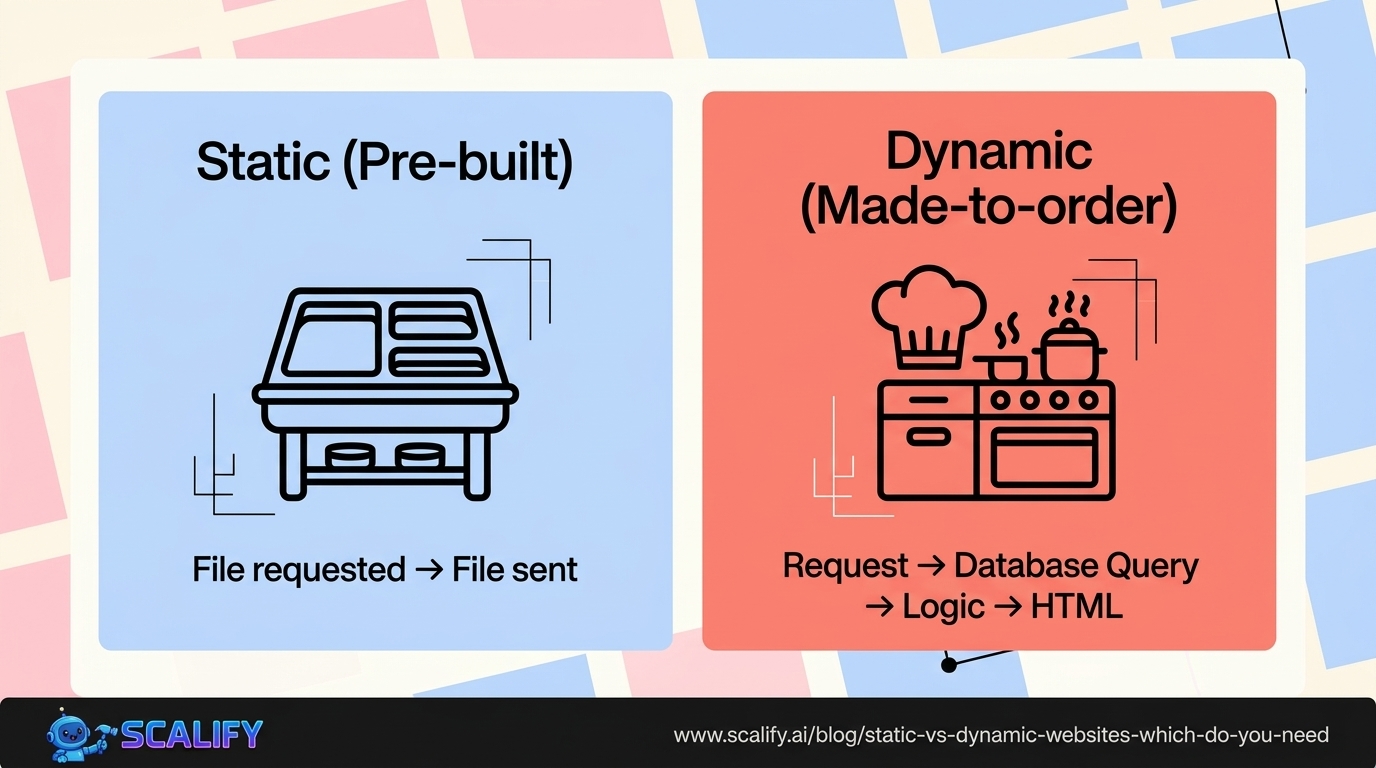
JavaScript was originally only a browser (client-side) language. In 2009, Node.js extended JavaScript to run on servers — using the same V8 engine that Chrome uses, but outside the browser, on the command line, with access to the file system, operating system, and network.
This distinction matters:
Client-side JavaScript runs in the visitor's browser. It has access to the DOM, the browser's APIs (location, camera, notifications), and runs on the visitor's device's CPU. Each visitor's browser runs your client-side JavaScript independently.
Server-side JavaScript (Node.js) runs on your server before any HTML is sent to the visitor. It can query databases, make API calls with private credentials, generate HTML from templates, handle authentication, and perform any server-side operation. The visitor never sees this JavaScript directly — they receive its output (usually HTML or JSON).
Many modern frameworks (Next.js, Nuxt.js) run the same JavaScript on both the server (for initial page generation) and the client (for subsequent interactivity), creating "isomorphic" or "universal" applications. This hybrid approach combines the SEO and performance benefits of server-rendered pages with the interactivity of client-side JavaScript.
The Performance Trade-Off: How Much JavaScript Is Too Much?
JavaScript is powerful but not free. Every JavaScript file your website loads adds to:
Download time: JavaScript files must be downloaded before they can execute. Large JS bundles on slow connections delay page functionality.
Parse and compile time: Before JavaScript executes, the browser must parse and compile it. This is CPU-intensive and blocks the main thread — the same thread that handles rendering.
Execution time: JavaScript code running on the main thread competes with rendering. Long-running JavaScript tasks (tasks exceeding 50ms) block rendering and make pages feel unresponsive — the "janky" experience of pages that don't respond immediately to clicks and scrolls.
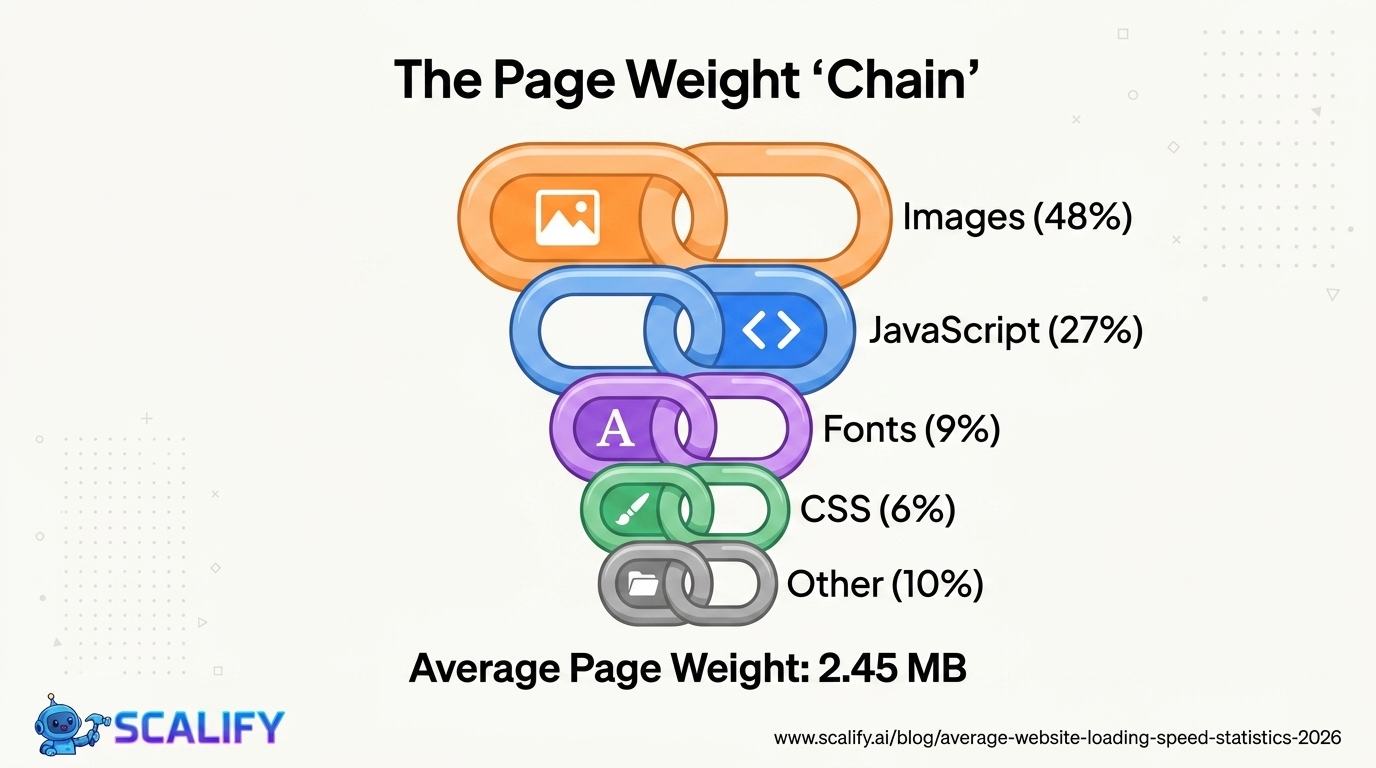
The modern web performance movement is substantially about managing JavaScript weight. The average web page now includes over 500KB of JavaScript — enough that on mid-range mobile devices on average networks, JavaScript parsing and execution adds seconds to the time before a page is interactive.
Best practices for managing JavaScript impact: code splitting (only loading JavaScript needed for the current page, deferring the rest), tree shaking (removing unused code from bundles), lazy loading of non-critical scripts, using async and defer attributes for scripts that don't need to block rendering, and critically evaluating every third-party script added to a site.
Does Your Website Need JavaScript?
The honest answer: yes, but probably not as much as you think.
A simple informational website — service business, portfolio, blog, brochure site — can be built with very little JavaScript. CSS handles most animations and transitions well. HTML handles most layout. A contact form can submit without JavaScript (traditional form submission to a server). Navigation can work without JavaScript. The page can be readable and usable and professional with minimal or no custom JavaScript.
Where JavaScript becomes genuinely necessary:
Interactive UI components: Dropdown menus that work on touch devices, modal dialogs, tabs, accordions, carousels, image galleries with keyboard support. These need JavaScript for proper accessibility and interaction handling.
Forms with validation and logic: Real-time validation, conditional fields, multi-step forms — JavaScript is the right tool here.
Dynamic content loading: Infinite scroll, live search, content that updates without page reloads.
Third-party integrations: Analytics (Google Analytics is JavaScript), live chat widgets, booking systems, payment buttons, chatbots — all JavaScript.
Complex applications: Anything that's truly an application rather than a document — dashboards, editors, project management tools, anything with real-time collaboration or complex user interactions.
The important insight: the JavaScript you control (custom code for your site's interactions) is usually not the problem. The JavaScript you don't control — third-party scripts from analytics platforms, chat tools, advertising, heatmap tools, social widgets — accumulates quickly and can represent the majority of your site's JavaScript weight. Every third-party script added to a site is a performance decision that should be made deliberately.
JavaScript Libraries and Frameworks
Rather than writing JavaScript from scratch for every project, developers use libraries and frameworks that provide pre-built solutions for common problems:
jQuery: Once dominant, now declining in new projects. A library that simplified DOM manipulation and event handling when browsers were less consistent. Still on millions of sites but largely unnecessary for new development given modern browser APIs.
React: Facebook's UI library for building component-based user interfaces. The most-used frontend library by a substantial margin. React organizes UI into reusable components with their own state, making complex interactive UIs more manageable to build and maintain. Used by Facebook, Netflix, Airbnb, and a significant majority of new web applications.
Vue.js: A progressive framework with a gentler learning curve than React. Popular for adding interactivity to existing sites and building full SPAs. Particularly strong in Asia and in certain developer communities.
Next.js: A framework built on top of React that adds server-side rendering, static site generation, routing, and API routes. The most-used framework for building production React applications. What many modern web projects are built with.
Alpine.js: A lightweight JavaScript framework for adding interactivity to HTML templates without the overhead of a full framework. Excellent for adding sprinkles of interactivity to otherwise static pages.
The Bottom Line
JavaScript is the programming layer that makes web pages interactive, dynamic, and responsive. Everything that "does something" on a modern website — menus, forms, animations, real-time updates, applications — is powered by JavaScript. It's the language of the web and the foundation of everything from simple interactive forms to complex single-page applications.
For most websites, some JavaScript is genuinely necessary for good UX. The key is being deliberate about how much: custom JavaScript for the interactions your site actually needs, discipline around third-party scripts, and recognition that every JavaScript addition is a performance trade-off worth evaluating consciously.
At Scalify, we use JavaScript purposefully — the right amount for the right interactions — and we're deliberate about performance at every layer, including the JavaScript layer.





















.jpeg)
.jpeg)





78 SW 7th St, Miami, FL 33130