


What Is Keyword Research and How Do You Do It?
By Josh Ternyak

March 29, 2026
Keyword research is the starting point for every effective SEO strategy. This step-by-step guide explains what it is, how to find the right keywords for your business, and how to prioritize them for maximum impact.
The Research That Determines Whether Your Content Gets Found
You can spend months writing excellent content and building a well-structured website. If that content isn't targeting terms people actually search for — with language that matches how they think and talk about those topics — it won't rank. The most comprehensive guide to a topic nobody searches for generates zero organic traffic.
Keyword research is the process of discovering what your target audience actually types into search engines when looking for things related to your business. It's the foundation of any content strategy that generates organic traffic, and it's one of the most valuable research activities available to any business building a digital presence.
This guide covers what keyword research is, the tools and methods used to conduct it effectively, how to evaluate any keyword's value, and how to turn keyword research insights into a content plan that drives real results.
What Keyword Research Actually Is
Keyword research is the systematic process of identifying search terms your target audience uses when looking for information, products, or services related to your business — and evaluating those terms for their potential value as SEO targets.
The goal isn't to find every term related to your business. It's to find the terms that represent:
- Real search volume — enough people are searching to make it worth targeting
- Relevant intent — searchers using this term are looking for what you offer
- Achievable difficulty — you can realistically rank for this term given your site's current authority
- Business value — traffic from this term would include people who could become customers
Keyword research is not about cramming as many keywords as possible into your content. That approach — keyword stuffing — was counterproductive even in the early days of SEO and is now a reliable path to ranking penalties. Modern keyword research is about understanding what your audience is searching for so you can create content that genuinely answers those queries better than what's currently ranking.
The Three Keyword Metrics That Matter
Search Volume
Search volume is the average number of times a keyword is searched per month in a given geographic area. Tools report this as either exact monthly searches or an approximation range (100–1,000 searches/month).
The common mistake with search volume: assuming higher is always better. A keyword with 50,000 monthly searches and fierce competition from major authority sites is far less valuable than a keyword with 2,000 monthly searches that your site can actually rank for. Realistic ranking probability transforms search volume into actual traffic.
Also worth knowing: very specific, long-tail keywords often have lower individual search volumes but convert at much higher rates because searchers are further along in their decision process. "Custom web design services for small businesses in Miami" has much lower volume than "web design" but the searcher using the specific term is far closer to purchasing.
Keyword Difficulty
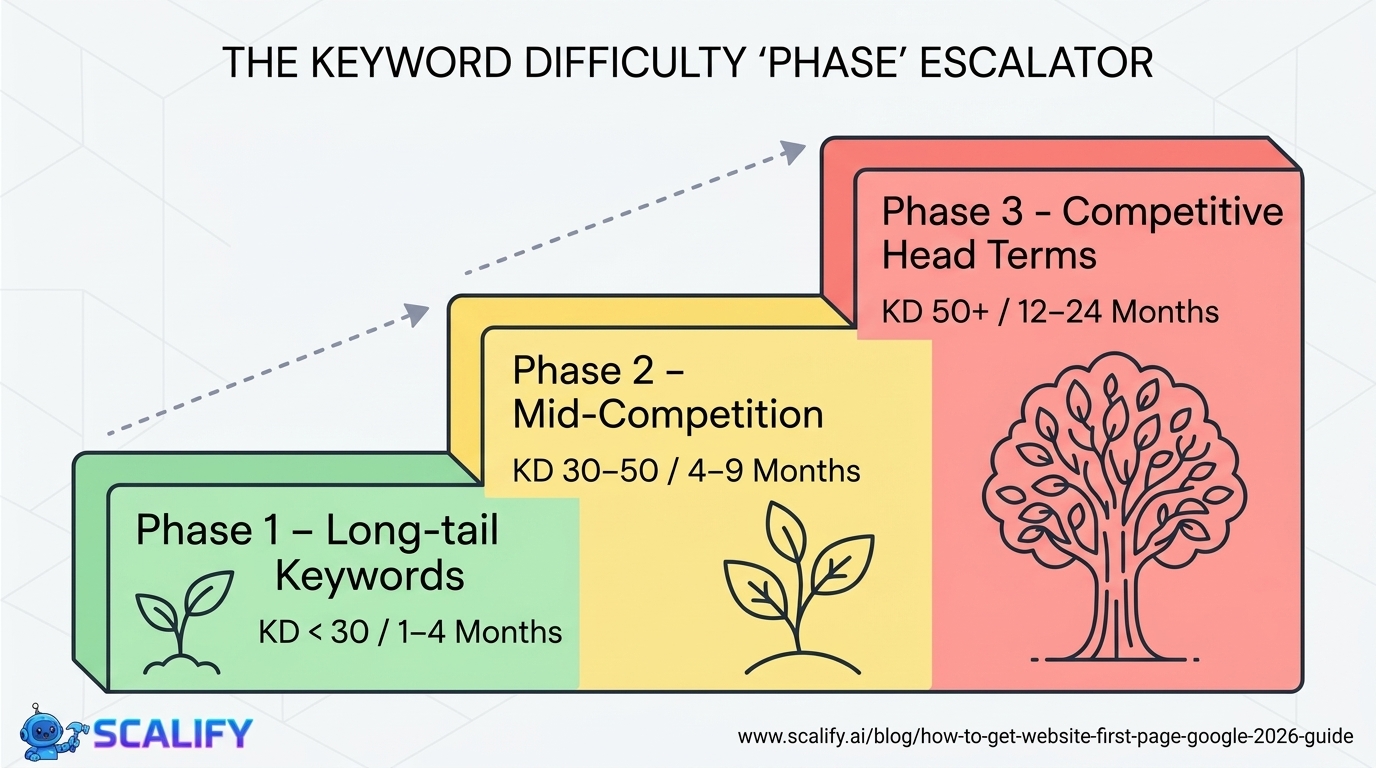
Keyword difficulty (sometimes called KD or competition) is a metric estimating how hard it would be to rank on the first page of Google for a given keyword. It's expressed as a number (typically 0–100) or a relative scale (easy, medium, hard) by different tools.
Keyword difficulty is calculated by analyzing the authority and quality of the pages currently ranking for the keyword. A keyword where the top 10 results are all from high-authority domains (major news outlets, established industry leaders, Wikipedia) has high difficulty. A keyword where the top results include smaller, less authoritative sites has lower difficulty and more opportunity for a newcomer.
New websites with limited authority should target keywords with low difficulty (typically KD under 20–30) to build rankings and traffic. As authority grows, you can target progressively more competitive keywords.
Search Intent
Search intent is the underlying goal behind a search query — what the person is actually trying to accomplish. This is the most important keyword metric and the one most frequently ignored by SEO beginners.
If your content doesn't match the search intent of the keyword you're targeting, it will not rank — regardless of optimization, authority, or quality. Google has become exceptionally good at identifying what type of content satisfies each query, and it ranks that content type above others.
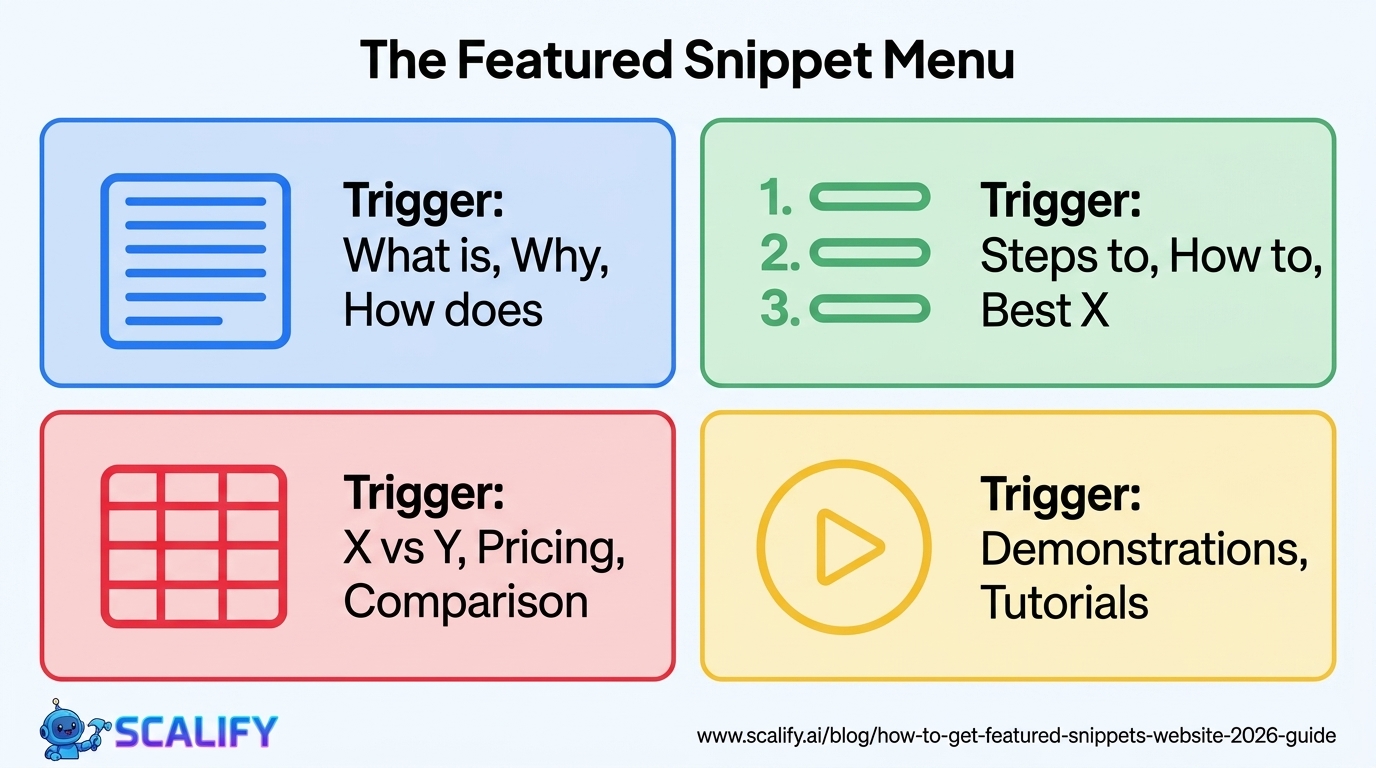
The four intent categories:
Informational: "What is keyword research," "how does DNS work," "why is my website slow." The searcher wants to learn. Required content type: educational articles, guides, explainers.
Navigational: "Ahrefs login," "Webflow pricing," "Scalify contact." The searcher wants to reach a specific site. Only the referenced brand can rank here.
Commercial investigation: "Best keyword research tools," "Ahrefs vs Semrush," "website builder comparison." The searcher is researching before a decision. Required content type: comparison posts, reviews, "best of" roundups.
Transactional: "Buy keyword research tool," "keyword research service," "custom website order." The searcher wants to purchase. Required content type: product/service pages.
Always check the SERP (search results page) before deciding whether a keyword is worth targeting. The content types currently ranking tell you exactly what Google believes the intent is — match that type.
Keyword Research Tools
Free Tools
Google Search Console: If you have an existing website, this is your most valuable keyword source — it shows exactly what queries your site is currently appearing for, how many impressions and clicks each query generates, and your average position. This is real data about your actual search presence, not estimates. Start here before using any paid tool.
Google Keyword Planner: Originally designed for Google Ads but useful for SEO research. Provides search volume ranges and related keyword suggestions for any starting keyword. Free with a Google account, though more accurate for higher-volume keywords.
Google Autocomplete: Type any keyword into Google and observe the autocomplete suggestions. These are real searches people are making frequently enough for Google to suggest them. Also check "People Also Ask" boxes and "Related Searches" at the bottom of results — all of these surface real user queries.
AnswerThePublic: Enter a keyword and get a visual map of questions people ask related to that topic. Excellent for finding question-based content opportunities. Free tier provides limited searches per day.
Ubersuggest: Neil Patel's tool provides keyword volume estimates, difficulty scores, and content ideas. Free tier offers limited but useful functionality for basic research.
Paid Tools
Ahrefs ($99–$499/month): The industry standard for comprehensive keyword research. Provides accurate search volumes, keyword difficulty scores based on linking domain analysis, competitor keyword gaps, content gap analysis, and the most comprehensive backlink database available. The Keywords Explorer tool is the most powerful in the industry for finding and evaluating keyword opportunities.
Semrush ($119–$449/month): Direct competitor to Ahrefs with slightly different strengths. Its Keyword Magic Tool provides extensive related keyword suggestions. Position tracking and competitive intelligence are particularly strong. Many SEOs use both depending on specific research needs.
Moz Pro ($99–$299/month): Ahrefs and Semrush are generally considered stronger for keyword research, but Moz has a loyal user base and its Keyword Explorer is capable. Moz's Domain Authority metric (though not a Google signal) is widely used as a proxy for site authority.
Keywords Everywhere (browser extension, pay-per-credit): Shows search volume data for any term you search in Google directly in the browser. Extremely practical for quick research without logging into a dedicated tool. Very affordable for light to moderate use.
How to Actually Conduct Keyword Research: Step by Step
Step 1: Define Your Seed Keywords
Seed keywords are the broad, fundamental terms that describe what your business does. They're not the keywords you'll necessarily target — they're the starting points you'll use to discover more specific opportunities.
For a web design company, seeds might be: web design, website builder, custom website, website development, web designer. For a Miami plumber: plumber, plumbing services, plumbing repair, emergency plumber. These are obvious, competitive terms — the research you'll do from them surfaces the specific, targetable opportunities.
Sources for initial seed keywords:
- Terms you'd use to describe your own business
- Terms your customers use when describing what they need from you
- Terms your competitors appear to be targeting (look at their page titles and headings)
- Terms appearing in your Google Search Console data
Step 2: Expand with Keyword Research Tools
Enter your seed keywords into your keyword research tool and explore the results. In Ahrefs Keywords Explorer: search your seed keyword, then explore "Matching terms" (keywords containing your seed), "Related terms" (semantically related keywords), and "Questions" (question-based queries related to your topic).
You'll typically discover hundreds or thousands of related keywords. The goal here is breadth — gather as many potentially relevant terms as possible before filtering.
Step 3: Analyze Competitor Keywords
Your competitors who rank well for terms you want have already done significant keyword research. In Ahrefs or Semrush, enter a competitor's domain and look at "Organic Keywords" — every keyword they rank for, their position, and the traffic that keyword generates.
This surfaces keywords you might not have thought of and validates that certain terms are achievable (if a competitor with similar authority is ranking, you can too). The "Content Gap" or "Keyword Gap" feature in these tools shows keywords competitors rank for that you don't — a direct prioritized list of content opportunities.
Step 4: Evaluate and Filter
With a large list of potential keywords, filter down to the most valuable targets. Evaluate each keyword on:
Business relevance: Would traffic from this keyword include people who could be customers? Eliminate irrelevant terms no matter how high their volume.
Search intent alignment: Can you create content that matches the intent of this keyword and that aligns with your business goals? A highly relevant informational keyword is worth targeting with an article even if you can't directly sell on that page.
Difficulty vs. current authority: Is this realistically rankable given your site's current domain authority? Use difficulty scores as a guide — new sites should focus on low-difficulty keywords, established sites can target moderate and high difficulty.
Volume vs. specificity trade-off: A high-volume keyword with fierce competition may be less valuable than 20 specific long-tail keywords with lower individual volumes but achievable rankings. Long-tail keywords collectively often represent more traffic opportunity than single high-volume keywords.
Step 5: Group Keywords into Topics
Individual keywords rarely live in isolation — they cluster around topics. "Keyword research," "how to do keyword research," "keyword research tools," "keyword research for beginners," and "keyword research guide" are all variants of the same topic.
Create one comprehensive page targeting the full cluster rather than five thin pages each targeting one keyword variant. Google's ability to understand semantic relationships between terms means a page optimized for the full cluster typically outranks multiple pages each targeting individual variants.
Grouping keywords into topic clusters also naturally aligns with building topical authority — demonstrating through comprehensive coverage that your site is an authoritative resource on a topic area.
Step 6: Map Keywords to Content
For each keyword cluster, decide what type of content will satisfy the search intent and assign it to a specific page or a new content piece to create:
- Homepage: targets brand terms and primary commercial keywords
- Service pages: target specific service-related commercial/transactional keywords
- Blog posts: target informational and commercial investigation keywords
- Location pages: target local keywords for specific geographic markets
This keyword-to-content mapping becomes your content plan — a prioritized queue of pages to create or optimize, each targeting a specific keyword cluster, with defined content type and intent alignment.
Long-Tail Keywords: The Undervalued Opportunity
Long-tail keywords are specific, multi-word phrases with lower search volumes. "Web design" is a head keyword. "Web design services for small businesses in Miami" is a long-tail keyword.
Long-tail keywords have three consistent advantages that make them disproportionately valuable for most businesses:
Lower competition: Fewer competitors are targeting specific long-tail phrases, making first-page rankings achievable even for sites with limited authority.
Higher conversion rates: Specific searches indicate more advanced intent. Someone searching "web design services for restaurants in Miami" is far closer to hiring someone than someone searching "web design." Lower volume, but higher quality traffic.
Volume adds up: The combined search volume across hundreds or thousands of long-tail keyword variations often exceeds the volume of high-traffic head keywords. The long tail of the search demand curve is enormous — most searches are unique queries that have never been searched before.
A content strategy that systematically targets long-tail keywords across an entire topic area can generate substantial organic traffic from many specific queries rather than competing directly against major authorities for high-volume head keywords.
Keyword Research for Local Businesses
Local keyword research has specific patterns and priorities:
Geographic modifiers: "[Service] in [city]," "[Service] near me," "[City] [service provider]." These are the primary targets for local businesses. "Plumber Miami," "web design agency New York," "coffee shop Denver" — geographic intent means Google shows local results, including the map pack.
"Near me" searches: Search volume for "[service] near me" queries has grown dramatically with mobile use. These queries trigger local results and are valuable for any business with a physical location or geographic service area.
Service-specific local terms: "Emergency plumber Miami," "24/7 locksmith Denver," "same day carpet cleaning Austin." These specific local variants often have lower competition than the general geographic term and higher purchase intent.
Google Business Profile keywords: Your Google Business Profile can rank in the map pack for keywords in your category even without explicit on-page optimization. The categories and services you select in your GBP affect which local queries you appear for.
Avoiding Common Keyword Research Mistakes
Targeting only high-volume keywords: The highest-volume keywords are almost always the most competitive. Building an entire content strategy around high-volume terms your new site can't realistically rank for produces months of effort with zero results.
Ignoring search intent: Creating a product page for an informational keyword, or a blog post for a transactional keyword, means your content type doesn't match what Google wants to rank for that query. Analyze the SERP for every keyword before creating content.
Keyword cannibalization: Multiple pages on the same site targeting the same keyword compete against each other and dilute your ranking strength for that term. Each keyword cluster should map to exactly one page. If you have multiple overlapping pages, consolidate them.
Not updating keyword research: Search volumes, competition levels, and the terms people use to find things change over time. Keyword research isn't a one-time activity — revisit it annually or when you're planning new content initiatives.
The Bottom Line
Keyword research is the compass for any content strategy. Without it, you're creating content and hoping it happens to match what people search for. With it, you're creating content specifically designed to appear when your target audience is actively looking for what you offer — one of the most efficient marketing activities available.
Start with free tools (Google Search Console, Keyword Planner, Autocomplete) if you're early-stage. Graduate to Ahrefs or Semrush as your SEO investment grows and competitor analysis becomes important. Evaluate every keyword on volume, difficulty, intent, and business relevance. Map your findings to specific content pieces. Publish and measure results. Iterate based on what you learn.
At Scalify, every website we build is built with SEO structure in mind from the start — proper page architecture, semantic HTML, and technical foundations that give your future keyword-targeted content the best possible chance to rank.





.jpeg)
.jpeg)


78 SW 7th St, Miami, FL 33130