


What Is Responsive Web Design and Why Every Site Needs It
By Josh Ternyak

March 29, 2026
Responsive design isn't optional anymore — it's the baseline expectation for any website in 2026. This guide explains exactly what it is, how it works, and what happens to your business when you get it wrong.
The Design Approach That Became Non-Negotiable
In 2010, when Ethan Marcotte published an article in A List Apart coining the term "responsive web design," it described a novel approach to an emerging problem: websites were being built for desktop screens, but mobile phones were increasingly becoming the primary device people used to access the web. The solution Marcotte proposed — fluid grids, flexible images, and media queries — became the dominant paradigm in web design within a few years and has remained so ever since.
Today, responsive design isn't a feature or a trend. It's the baseline. A website that doesn't work correctly on mobile isn't just inconvenient — it actively damages your business, hurts your search rankings, and fails more than half your visitors before they've seen a single word of your content.
This guide explains what responsive design actually means technically, why it matters for your business in concrete and measurable ways, and what to look for when evaluating whether a website is genuinely responsive or just sort of mobile-compatible.
What Responsive Design Is
Responsive web design is an approach to web development where a website's layout and content adapt fluidly to the size of the screen it's being viewed on. Rather than building a separate "mobile version" of a site or a fixed-width design that looks good on desktop and broken on phones, a responsive site uses a single codebase with flexible, adaptive design that works correctly on any screen size — from 320px wide smartphones to 3440px wide ultrawide monitors.
The three technical foundations Marcotte originally described remain the core of responsive design:
Fluid grids: Using relative units (percentages, em, rem, viewport units) for layout dimensions rather than fixed pixel values. A column that's 50% wide adapts automatically — it's 50% of 1440px on a large desktop, 50% of 375px on an iPhone. Fixed pixel widths don't adapt; percentage-based widths do.
Flexible images: Images that scale within their containers rather than overflowing at their native size. The CSS rule max-width: 100% applied to images prevents them from exceeding their container's width, allowing them to display correctly at any screen size without overflow or distortion.
Media queries: CSS conditional rules that apply different styles based on viewport characteristics. A media query like @media (max-width: 768px) applies the styles within it only when the viewport is 768 pixels wide or narrower — allowing the navigation to collapse to a hamburger menu on mobile while remaining a horizontal bar on desktop, or a three-column grid to stack into a single column.
Modern responsive design has expanded significantly beyond these three pillars. CSS Grid and Flexbox provide more powerful layout systems than float-based grids. Viewport units (vw, vh, vmin, vmax) enable sizing relative to the screen itself. CSS custom properties and container queries enable more sophisticated responsive behavior. But the fundamental principle — one codebase that adapts to the viewport — remains unchanged.
Mobile Traffic: The Numbers That Make This Non-Optional
The business case for responsive design starts with traffic data that's been clear for years and continues to deepen:
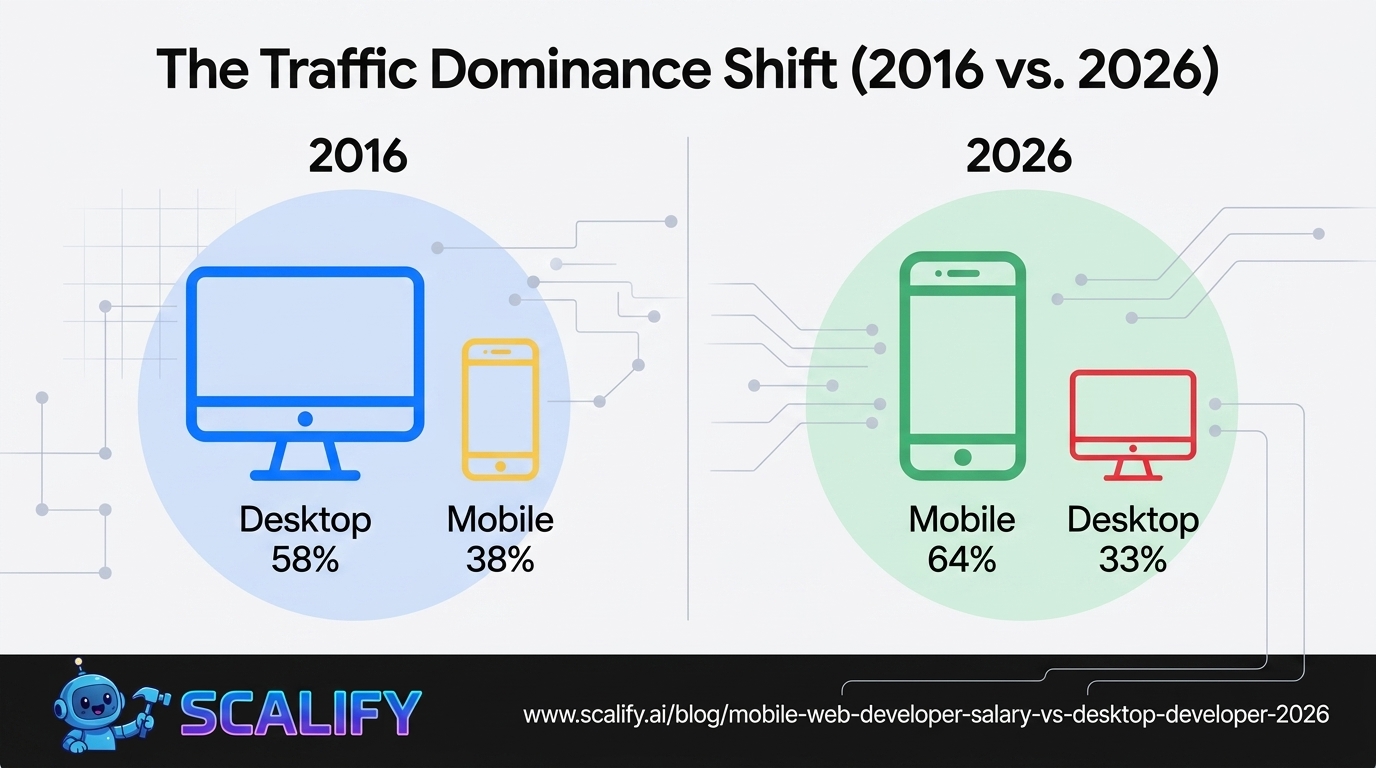
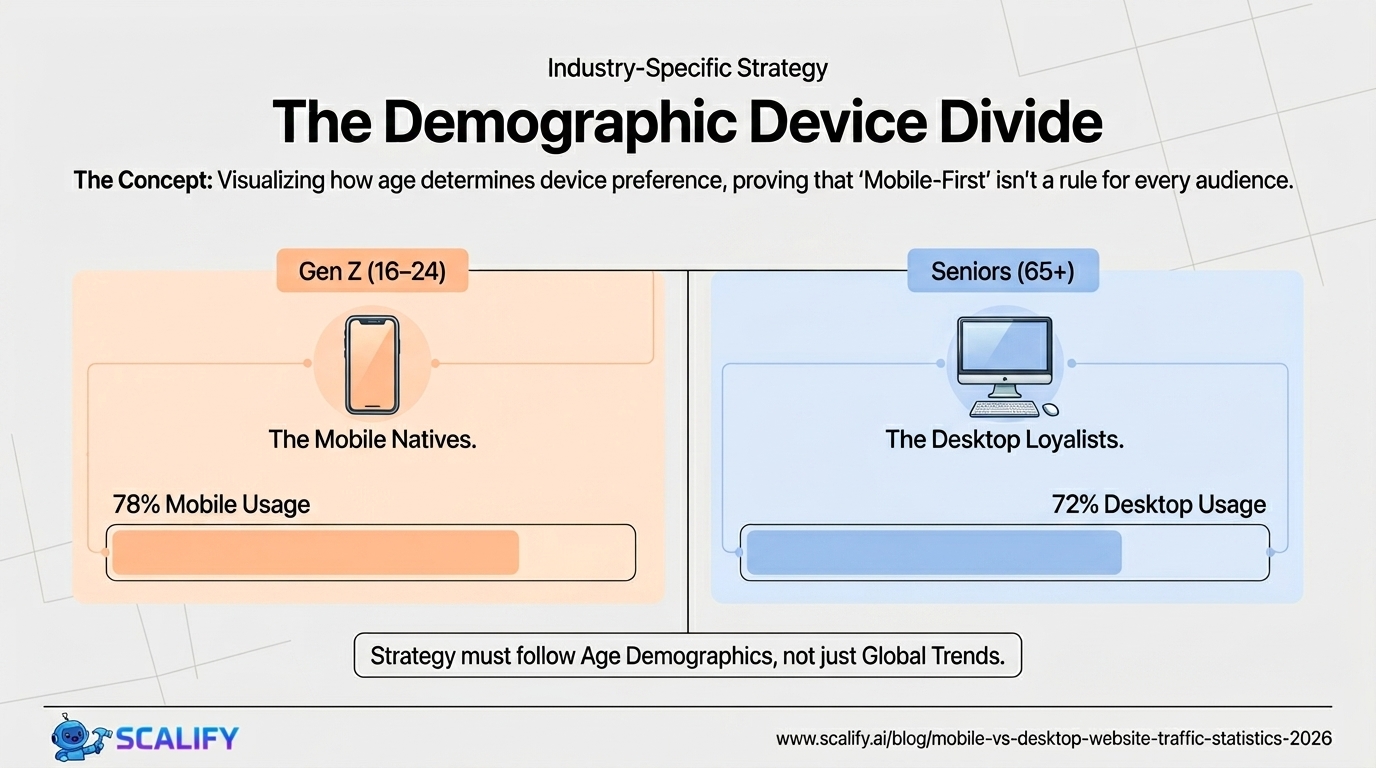
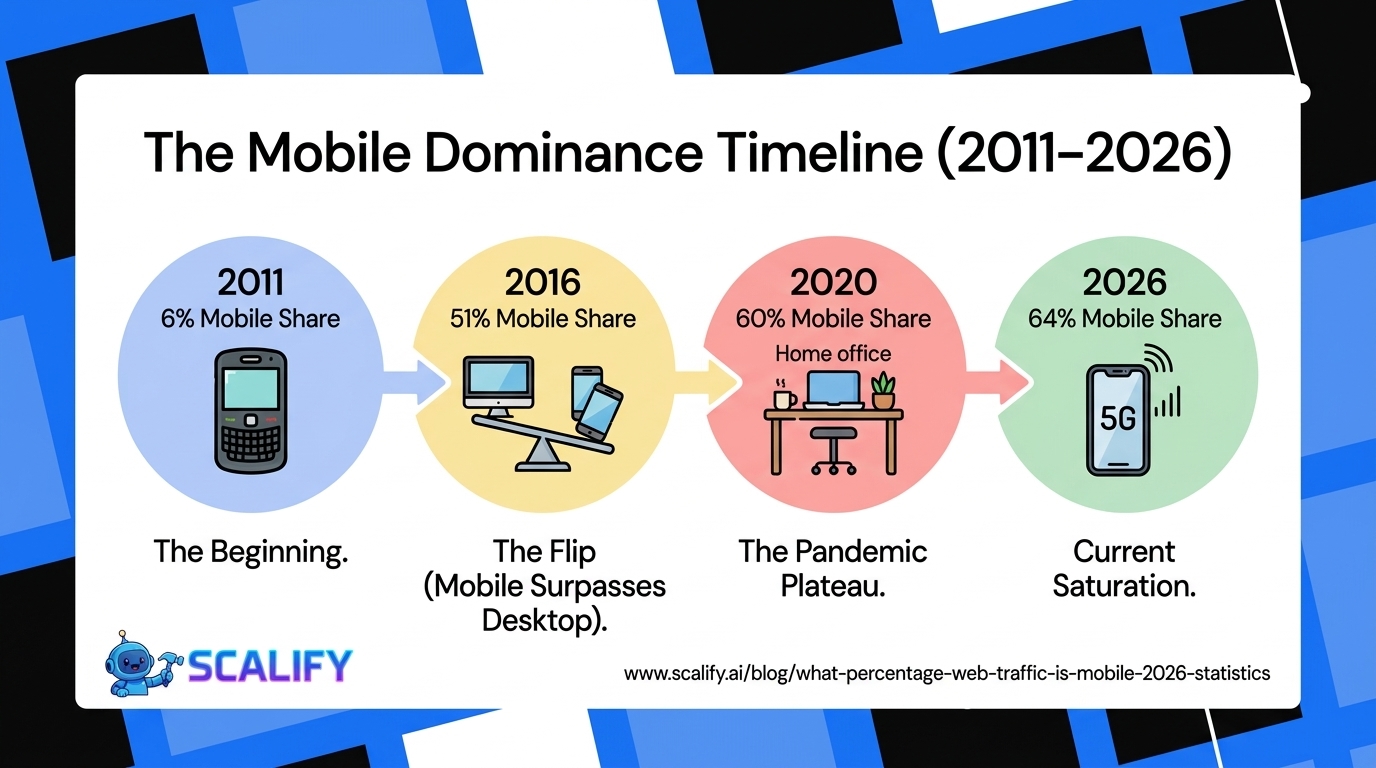
Over 60% of global web traffic now comes from mobile devices. In many industries and markets, the percentage is even higher — retail, travel, food services, and entertainment regularly see 70–80% mobile traffic. For businesses targeting younger demographics (under 35), mobile-first behavior is essentially universal.
The practical implication: if your site doesn't work well on mobile, you're providing a degraded experience to the majority of your visitors. Those visitors bounce at higher rates, spend less time engaging with your content, and convert at dramatically lower rates — or not at all.
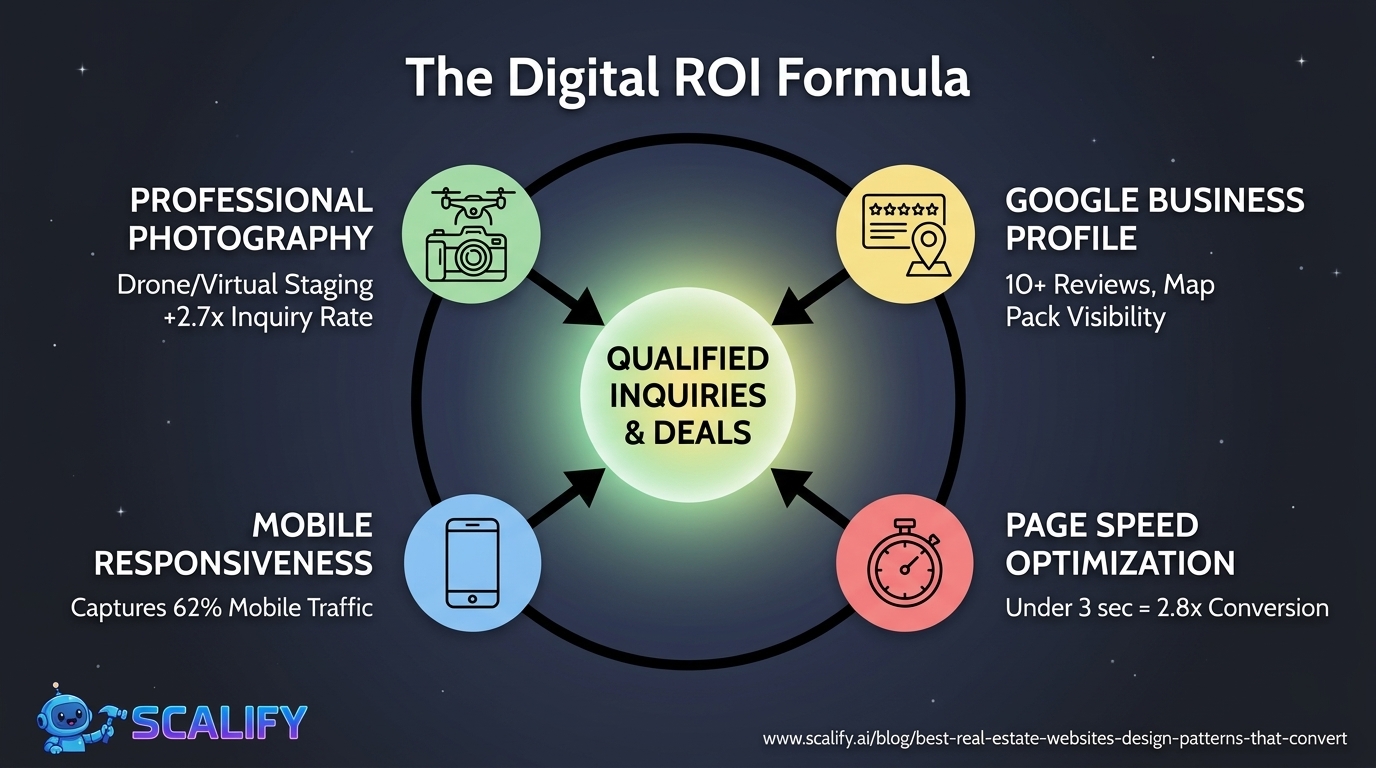
Research by Google found that 53% of mobile visitors abandon a page if it takes more than 3 seconds to load. Separate research found that a site that doesn't render correctly on mobile can see mobile conversion rates drop by up to 70% compared to a mobile-optimized experience. These aren't marginal effects — they represent majority of your traffic leaving without converting.
Google's Mobile-First Indexing: The SEO Dimension
Beyond user experience, responsive design affects your search rankings directly through Google's mobile-first indexing policy, implemented since 2018 and now universal across all sites.
Mobile-first indexing means that Google primarily uses the mobile version of your site's content for ranking and indexing. Not the desktop version — the mobile version. If your site has content that's visible on desktop but hidden on mobile (a common issue with non-responsive or poorly responsive sites), Google may not index that content at all. If your mobile experience is slow or broken, that's what Google evaluates.
Additionally, page experience is a direct Google ranking factor, and mobile experience is a significant component of that evaluation. Google's Core Web Vitals — Largest Contentful Paint, Cumulative Layout Shift, Interaction to Next Paint — are measured on mobile by default for ranking purposes. A site that performs beautifully on desktop but poorly on mobile scores poorly on the metrics that affect rankings.
The combined effect: a non-responsive or poorly responsive website is penalized twice — by losing visitors who bounce immediately from a bad mobile experience, and by ranking lower in search results because Google evaluates it primarily through a mobile lens.
Common Responsive Design Failures and What They Look Like
Understanding what responsive design failure looks like helps you evaluate your current site and spot problems before they compound:
Horizontal overflow (the most visible failure): Content extends beyond the right edge of the mobile screen, requiring horizontal scrolling to see the full page. This usually happens because elements have fixed pixel widths that exceed the mobile viewport width. Visitors are immediately disoriented — horizontal scrolling on mobile is a universally bad experience.
Text too small to read without zooming: A site designed for desktop that displays at desktop scale on mobile results in text that's 6–8px when viewed on a phone — technically present but practically illegible. Proper responsive design uses the viewport meta tag and appropriately scaled typography to ensure text is readable at native mobile resolution.
Tap targets too small to tap accurately: Buttons, links, and form fields that are sized for mouse cursor precision are too small for finger tapping accuracy. A link text that's 12px tall with no padding requires surgical precision that most thumbs can't deliver. The result: missed taps, frustrated visitors, accidental clicks on adjacent elements. Apple's Human Interface Guidelines specify 44×44 points as the minimum tap target.
Navigation that doesn't work on mobile: Desktop navigation with hover-triggered dropdowns can't be triggered on touchscreens where there's no hover event. A navigation bar with 8 items that fits on a 1440px desktop screen doesn't fit on a 375px phone screen. Responsive navigation — typically a hamburger menu that reveals a mobile-appropriate nav on tap — is not optional.
Images that load at desktop sizes on mobile: Serving a 3000px wide image to a 375px mobile screen is wasteful and slow — the browser downloads enormous files only to display them at 375px wide. Proper responsive images use the srcset attribute and sizes attribute to serve appropriately-sized images to appropriately-sized screens.
Content that's cut off or overlapping: Text that overflows its container, elements that overlap on small screens, columns that collapse in the wrong order — these are CSS failures where the layout hasn't been tested at mobile dimensions. They're common in sites built primarily for desktop without genuine mobile testing.
How to Test Your Site's Responsiveness
Testing responsive behavior correctly requires checking the actual experience at relevant screen sizes, not just resizing a browser window:
Browser DevTools device emulation: In Chrome (F12 → Devices icon) or Firefox (F12 → Responsive Design Mode), you can emulate specific device screen sizes. This is fast and catches most layout issues, but doesn't perfectly replicate real device rendering — particularly for touch interactions and some CSS behavior on Safari/WebKit.
Real device testing: The gold standard. Load your site on an actual iPhone (Safari), an Android phone (Chrome for Android, Samsung Internet), and ideally a tablet. Real device testing catches issues that emulators miss — font rendering differences, touch event behavior, iOS Safari's specific CSS quirks.
Google's Mobile-Friendly Test: A free tool from Google (search.google.com/test/mobile-friendly) that analyzes a page and reports whether it meets Google's mobile-friendly criteria. Also shows a screenshot of how Googlebot renders the mobile version of your page.
PageSpeed Insights mobile scores: Google PageSpeed Insights tests both desktop and mobile performance separately. The mobile score reflects real mobile user experience including load time — a page that loads quickly on desktop can still load slowly on mobile if images aren't optimized for mobile or if render-blocking resources aren't addressed.
Responsive Design vs. Mobile-First Design
Responsive design (a site that adapts to any screen) and mobile-first design (designing for mobile first, then progressively enhancing for larger screens) are related but distinct concepts worth distinguishing.
Traditional responsive design was often designed desktop-first: build the full desktop experience, then write media queries to adapt it down to mobile. The problem with this approach: mobile experience is often an afterthought — elements get hidden, navigation gets simplified, content gets cut. The desktop experience is "real" and mobile is the constrained version.
Mobile-first design inverts this: start with the constraints of the smallest screen and build up. What's the essential content? What's the most important user journey? What's the minimum navigation that serves mobile users? Designing these answers first produces a leaner, more focused experience that works excellently on mobile — then enhanced for larger screens rather than compressed for smaller ones.
Mobile-first design consistently produces better mobile experiences than desktop-first responsive design. Given that mobile represents the majority of traffic for most sites, the approach that treats mobile as the primary case rather than the fallback is architecturally more aligned with reality.
The Performance Dimension of Responsive Design
Responsive design and performance are inseparable concerns for mobile. A site that has correct layouts at mobile screen sizes but loads in 8 seconds on a 4G connection is still a failed mobile experience.
Key performance considerations specific to mobile:
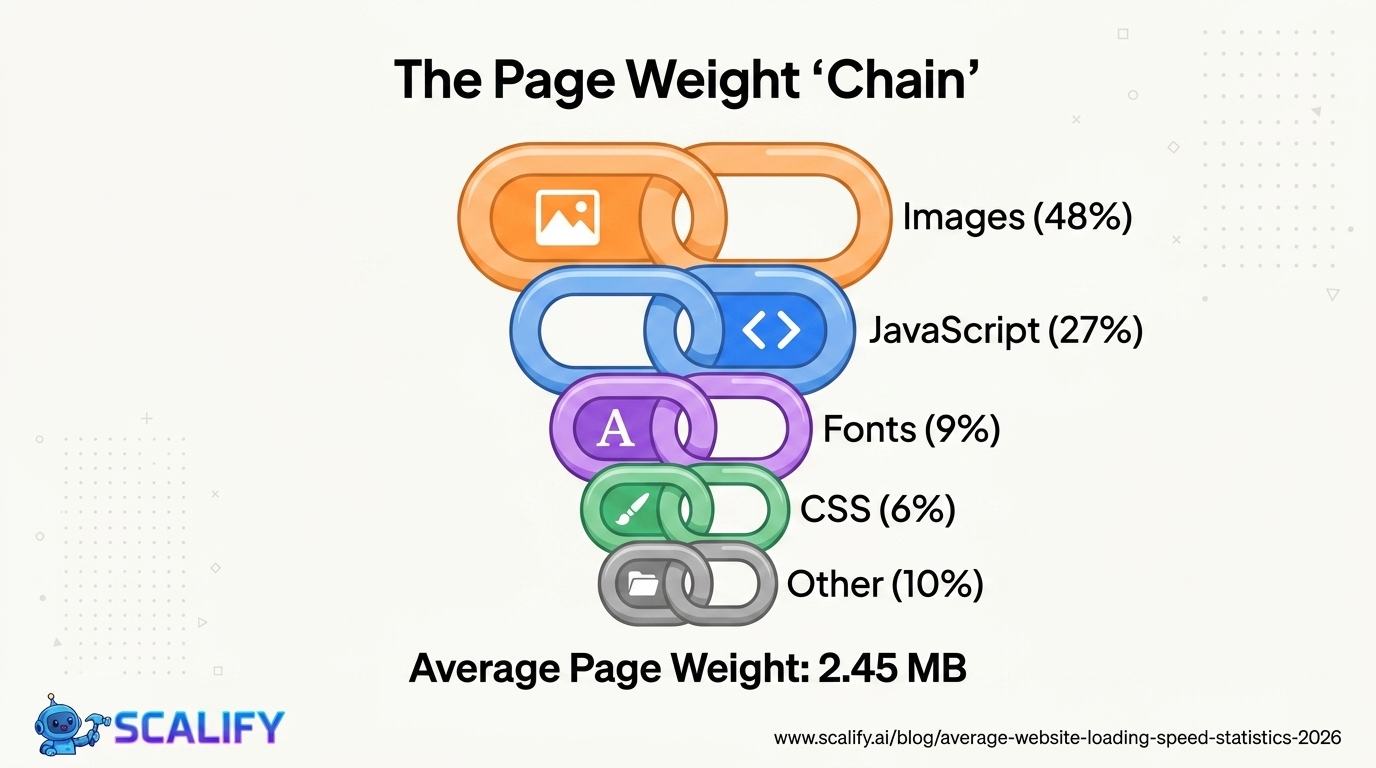
Network conditions: Mobile users are frequently on slower connections than desktop users — 4G instead of broadband, weak signal areas, congested networks. Page weight that's acceptable on broadband can be brutal on mobile networks. Every kilobyte of unnecessary resource is a performance cost paid disproportionately by mobile users.
Responsive images: The srcset and sizes attributes on img elements let browsers choose the appropriately-sized image for the current viewport and display density. A 3000px image served to a 375px mobile screen downloads 5–10x more image data than necessary. Responsive image implementation is both a performance optimization and a responsive design requirement.
Mobile CPU constraints: Mid-range Android devices have significantly less JavaScript processing power than laptops. Large JavaScript bundles that execute quickly on a developer's MacBook Pro can cause visible delays on the actual devices many mobile users carry. Testing performance on a representative mobile device — not just Chrome DevTools CPU throttling — catches these issues.
What Good Responsive Design Looks Like
Beyond the absence of failures, genuinely good responsive design has positive characteristics:
Content priority is rethought for mobile, not just rearranged. The desktop homepage might have four columns of content visible above the fold; the mobile version might show one primary message and one CTA. This isn't missing content — it's prioritized content that serves mobile intent patterns.
Navigation is designed for thumbs, not cursors. Mobile navigation menus have large tap targets, adequate spacing between items, and clear visual states for active selections. They open and close reliably without requiring precise tapping.
Forms are usable on mobile keyboards. Input fields trigger the appropriate keyboard type (email fields trigger the email keyboard with @ visible, phone number fields trigger the numeric keyboard). Fields are large enough to tap accurately. Labels are above the field (not as placeholder text that disappears when typing begins).
Images are served at appropriate resolutions. A 375px wide mobile screen with a standard (1x) display density needs images at 375px wide. A 375px wide phone with a 2x Retina display needs 750px images. Responsive images using srcset handle this automatically.
Typography scales appropriately. Font sizes that work on desktop — 14px body text, 12px navigation — are too small for mobile. A genuine responsive typography system adjusts font sizes, line heights, and letter spacing for readability at smaller viewport sizes.
The Bottom Line
Responsive design is the baseline expectation for any professional website in 2026 — not an optional enhancement or a premium feature. With over 60% of web traffic on mobile, Google's mobile-first indexing, and user tolerance for mobile failures effectively at zero, a site that doesn't work well on all screen sizes is a site that fails more than half its visitors and ranks below its full potential.
Genuine responsive design goes beyond fitting on a small screen to delivering an experience genuinely designed for how mobile users actually use the web: thumb navigation, slower connections, different tasks, different contexts. The sites that get this right don't just accommodate mobile — they're built for it.
Every website Scalify delivers is built responsive from the ground up — tested on real devices, optimized for mobile performance, and designed with mobile users as the primary consideration rather than the afterthought.










































.jpeg)


.jpeg)
















78 SW 7th St, Miami, FL 33130