


What Is Social Proof and How Do You Use It on Your Website?
By Josh Ternyak

March 29, 2026
Social proof is the most persuasive element on any website — and most businesses are using it wrong. This guide explains the psychology behind it, the different types, and exactly how to deploy it for maximum conversion impact.
The Persuasion Principle That Works Without a Single Word From You
When a restaurant has a line out the door, you assume the food is good. When a book has 10,000 five-star reviews on Amazon, you read it differently than a book with 3 reviews. When everyone at a party seems to know a person you've just met, you treat them with more interest and credibility than you'd extend to a complete unknown.
You didn't consciously decide to apply these assumptions. They happened automatically, through a cognitive shortcut: when many other people have evaluated something and found it good, that consensus evidence is more reliable than your own untested judgment. Psychologist Robert Cialdini called this "social proof" in his landmark 1984 book Influence, and it's one of the most powerful and most consistent forces in human decision-making.
On your website, social proof is the evidence that other people — particularly people similar to your visitor — have trusted you and found that trust well-placed. It reduces the uncertainty that every first-time visitor has about your business, and it does so more persuasively than anything you say about yourself.
This guide covers the psychology behind social proof, the different types available to most businesses, where and how to deploy them for maximum conversion impact, and the mistakes that make social proof less effective than it should be.
The Psychology: Why Social Proof Works So Well
Social proof exploits a fundamental limitation of human cognition: we can't independently evaluate every decision we make. When you're deciding whether to hire a web design company you've never worked with, you don't have direct evidence of their competence. What you have is the available proxy evidence — what other people who have worked with them say about the experience.
The brain treats this proxy evidence as more reliable than no evidence, even when it can't verify that the evidence is accurate. This is why fake reviews work (unfortunately), but it's also why genuine testimonials from credible sources are genuinely persuasive rather than just marginally helpful.
Cialdini identified several specific conditions that amplify social proof's effect:
Similarity: Proof from people like you is more persuasive than proof from people unlike you. A testimonial from a restaurant owner resonates more with a restaurant owner than a testimonial from a technology startup. When visitors can identify with the person providing the social proof, they apply that person's experience to their own anticipated experience.
Expertise: Proof from recognized experts or authorities carries extra weight. A recommendation from someone the visitor recognizes as credible in the relevant domain carries more conversion power than an equivalent recommendation from an unknown source.
Quantity: More social proof signals broader consensus. "3,000 businesses trust Scalify" is more persuasive than "10 businesses trust Scalify" — not because 3,000 is an intrinsically important number, but because it suggests a broad consensus rather than a handful of anomalies.
Recency: Recent proof is more relevant than old proof. A review from this month carries more weight than a review from three years ago — the business may have changed, the market may have changed, and the product or service may have changed. Recent social proof signals an active, current business.
The Types of Social Proof
Customer Testimonials
Testimonials are quotes from customers about their experience with your business. They're the most universally applicable form of social proof — available to virtually every business, in every industry, at every stage of growth.
The quality of a testimonial matters enormously. The least persuasive testimonials are short, generic, and vaguely positive: "Great service! Highly recommend!" The most persuasive are specific, outcome-focused, and attributable to a real, identified person:
Weak: "They did a great job with our website. — J.M."
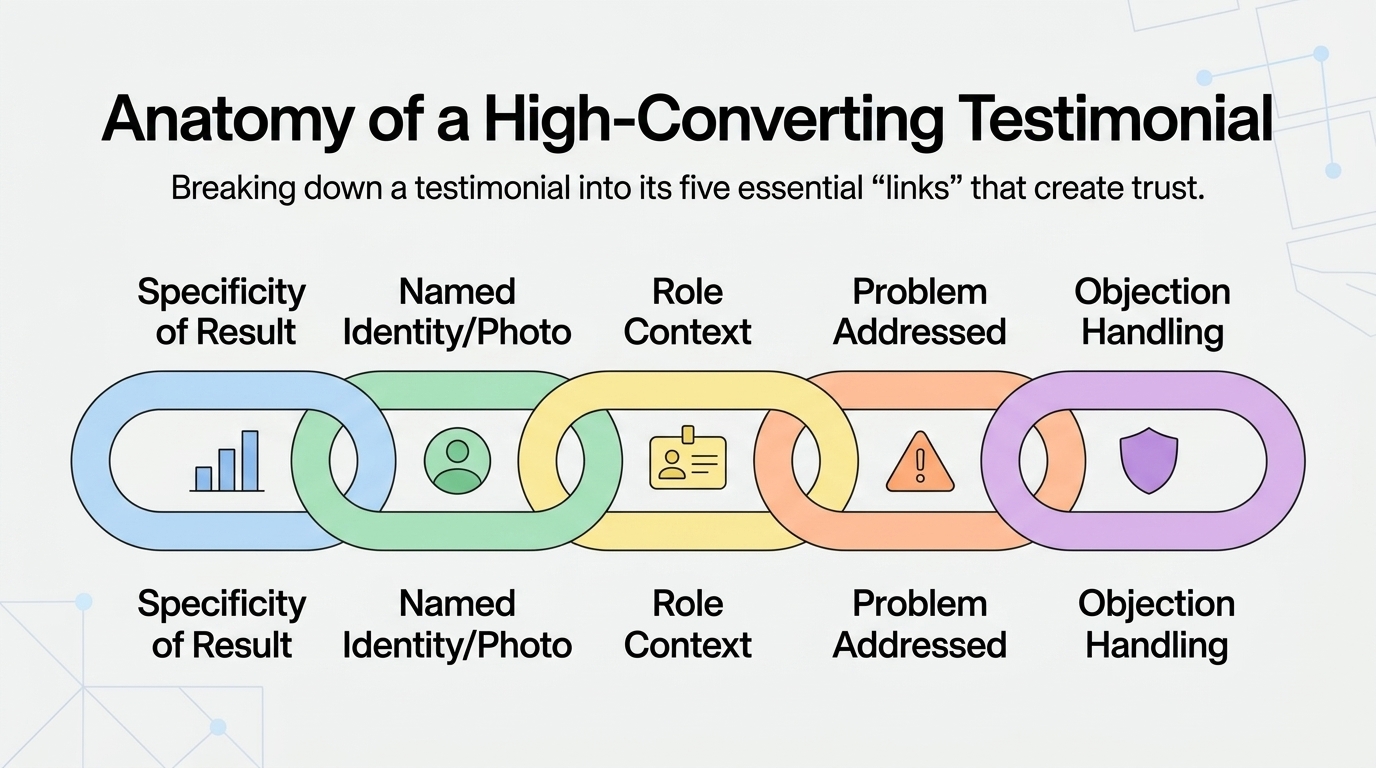
Strong: "Our new website launched in 9 days and we booked 4 new clients in the first two weeks. The design was exactly what we had in mind and the process was smoother than any agency we've worked with before. — Sarah Chen, Owner, Apex Coaching, Austin TX"
The strong testimonial works because it's specific (9 days, 4 clients, two weeks), it describes an outcome (new clients), it addresses a common objection (process smoothness), and it's attributed to a real, identified person whose identity can be verified. Every detail increases credibility.
How to get great testimonials: Ask specifically. After a successful project or purchase, email clients with a specific request that guides them toward useful content: "Would you be willing to leave us a brief testimonial? It would help if you could mention: what your situation was before working with us, what was most valuable about the experience, and what results you've seen since." Specific prompts produce specific, useful testimonials instead of generic praise.
Case Studies
Case studies are the long-form version of testimonials — detailed stories of specific client engagements, problems solved, and results achieved. Where a testimonial is a soundbite, a case study is a narrative.
The best case studies follow a consistent story structure: the client's situation before (establishing the problem), why they chose you (establishing relevance), the work done (establishing your approach), and the measurable outcomes (establishing the value delivered). This narrative arc lets potential customers see themselves in the story — their situation maps to the client's before-state, and the outcomes become what they're aspiring toward.
Case studies are particularly effective for high-consideration purchases where the buyer needs more evidence than a brief testimonial provides. A $50,000 software implementation, a major marketing engagement, a significant construction project — these categories benefit from case studies that demonstrate capability at the required scope and complexity.
Star Ratings and Review Platform Integrations
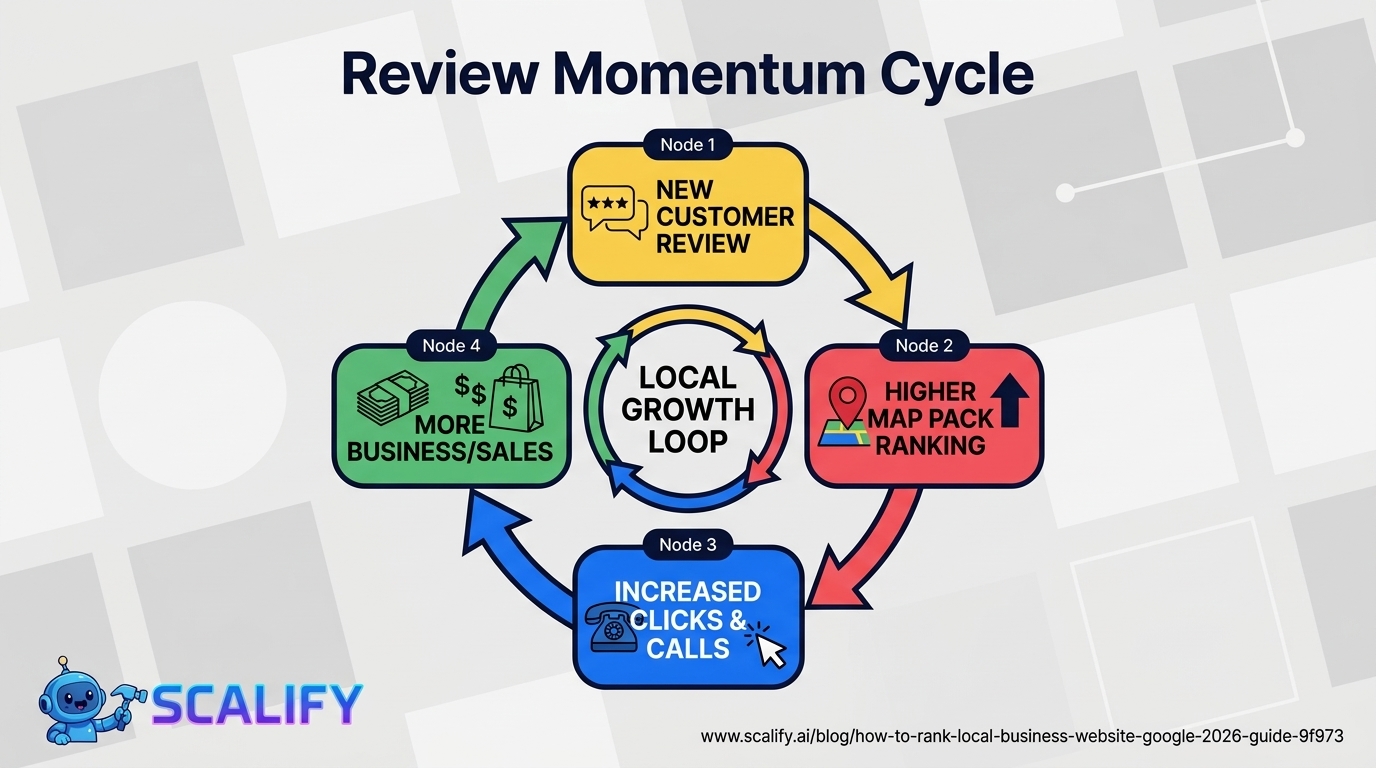
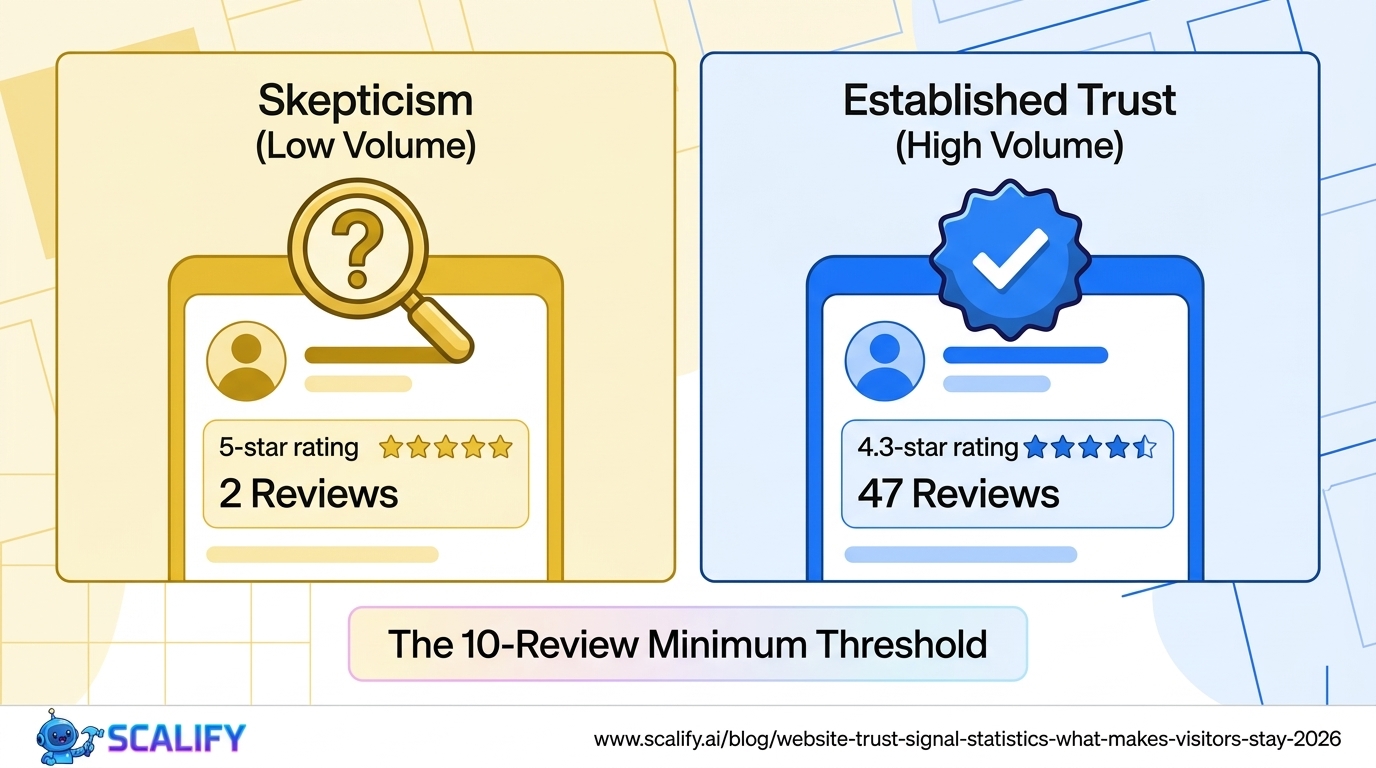
Aggregate ratings from third-party platforms (Google Reviews, Trustpilot, G2, Clutch, Yelp) carry credibility that self-published testimonials don't — because the platform is independent and the ratings include negative as well as positive reviews. Visitors know these ratings can't be selectively curated by the business.
Displaying a "4.9 stars based on 127 Google Reviews" badge on your website (with a link to verify) provides proof with built-in credibility verification. The high volume (127 reviews) signals broad consensus; the platform link provides the option to independently verify.
For e-commerce, product reviews with star ratings are among the most impactful conversion elements available — they're often the first thing shoppers look at when evaluating a product they haven't used before, and their presence (or absence) directly correlates with purchase rates.
Client Logos
Displaying logos of companies you've worked with is a form of social proof by association — if respected companies have trusted you, you must be trustworthy. This works most effectively when the logos are recognizable to your target audience and credible in the context of the work you do.
A web design agency displaying logos of recognizable brands they've built websites for creates instant credibility with visitors who recognize those brands. The implicit reasoning: if companies of that caliber used them, they must be good.
The effectiveness depends entirely on logo recognition. Displaying logos that your visitors don't recognize provides little social proof value. Displaying logos your visitors recognize and respect provides significant proof. When in doubt, include the most recognizable logos first and be selective rather than comprehensive.
Social Media Follower Counts and Engagement
Large social media following counts ("followed by 50,000 business owners") signal broad appeal and legitimacy — particularly for consumer-facing brands. This proof form works when the numbers are genuinely large in context; small follower counts can actually undermine social proof by highlighting limited reach.
User-generated content — customers posting about your products or services and being featured on your website or marketing — is a particularly authentic form of social proof because it's unsolicited third-party advocacy. Brands that successfully cultivate and feature UGC create a community feel that traditional testimonials can't replicate.
Press Mentions and Media Coverage
"As featured in Forbes, TechCrunch, Inc." — earned media coverage signals legitimacy and credibility through third-party editorial validation. The editorial standards of credible publications mean they don't feature businesses randomly; being featured implies some level of independent validation.
Media logos work even when visitors haven't read the specific articles. The association with credible publications creates a halo effect that benefits brand perception independently of whether visitors verify the coverage.
Numbers and Statistics
Quantified claims provide specific, memorable social proof that generic testimonials can't: "3,200 websites delivered," "98% client satisfaction rate," "Average launch: 9 business days." These numbers translate subjective quality claims into objective evidence.
The specificity matters: "3,247 websites delivered" is more credible than "3,000+ websites delivered" because precise numbers feel measured and real; round numbers feel estimated or inflated. If your actual number is 3,247, use it.
Expert Endorsements and Certifications
Endorsements from recognized experts in your field, certifications from industry bodies, or partner status with major platforms (Google Partner, Shopify Partner, HubSpot Certified) provide expert-authority social proof. These signals indicate that authoritative parties have assessed and validated your competence.
Where to Place Social Proof on Your Website
Placement matters as much as the type and quality of social proof. The principle: social proof should appear at the moments of maximum uncertainty and hesitation — where visitors are making decisions about whether to continue engaging with your brand.
Homepage hero or immediately below: Establish social proof before visitors have made any significant exploration of the site. A row of client logos or a brief testimonial quote immediately below the hero addresses the fundamental credibility question as early as possible.
Near every CTA: The moment before clicking a CTA is a moment of decision and potential hesitation. A testimonial or rating adjacent to a "Get a Quote" or "Start Free Trial" button provides reassurance exactly when hesitation is highest. This proximity consistently improves CTA conversion rates.
On pricing pages: Pricing pages are where sticker shock and value uncertainty combine to create maximum hesitation. Testimonials that specifically address value ("worth every dollar," "ROI within 60 days") and results-focused case studies on pricing pages counter price objections with outcome evidence.
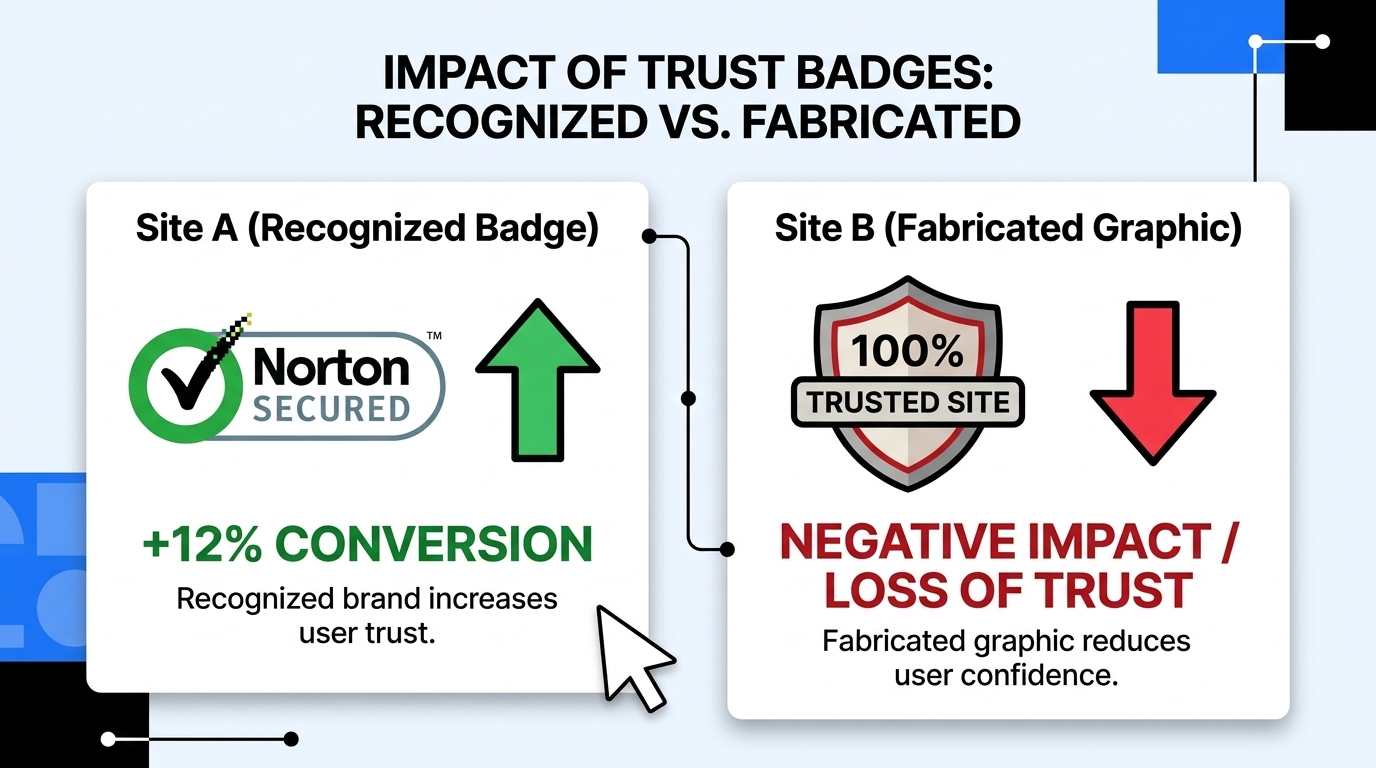
On checkout pages: Last-minute abandonment is a major conversion loss for e-commerce. Security badges, money-back guarantees, and brief testimonials near the "Complete Order" button provide final reassurance for buyers on the fence.
On about and team pages: These are trust-building pages where visitors are evaluating the people behind the business. Client logos, partnership badges, and press mentions reinforce legitimacy.
On service and product pages: Specific testimonials that speak to the specific service or product being described are most effective — a testimonial about your web design services on the web design services page is more relevant than a generic company testimonial.
Common Social Proof Mistakes
Generic testimonials that say nothing specific: "Great company! Highly recommend!" provides zero specific evidence of value and reads as potentially fabricated. Seek specific, outcome-focused testimonials and decline to publish vague ones.
Unattributed or anonymized testimonials: "- J.M." provides no verification path. A full name, role, company, and photo creates a verifiable identity. Visitors who are skeptical (healthy skepticism is appropriate with testimonials) can't verify a testimonial with initials only.
Outdated social proof: Reviews and testimonials with years-old dates signal a business that hasn't attracted positive feedback recently. Fresh social proof is more credible. Prioritize recent testimonials and display dates to signal recency.
Logos of companies visitors don't recognize: Logos that mean nothing to your audience provide no social proof value. Curate to the most recognizable, most relevant logos rather than displaying everything.
Placing all social proof on one page: A dedicated "Testimonials" page is a social proof graveyard — visitors who have doubts aren't navigating to a testimonials page to resolve them. Distribute social proof throughout the conversion path, at the moments when doubts are most likely to arise.
Building a Social Proof Collection System
Social proof doesn't accumulate by accident. Build systems for collecting it consistently:
Automated testimonial requests: Set up an email sequence that triggers 7–14 days after project completion or product delivery, asking for a brief testimonial with specific prompts. Most satisfied customers will provide it if asked with the right guidance.
Review platform monitoring: Set up Google alerts for your business name and monitor major review platforms weekly. Respond to all reviews, positive and negative.
Post-project case study interviews: After successful projects, conduct a brief interview with clients willing to be featured. Record it, transcribe it, and build case studies from the verbatim language customers use to describe their experience — their exact words are more authentic than polished marketing copy.
Permission to use logos: When a recognizable company engages your services, get permission to use their logo in your marketing as part of the engagement documentation. Most clients are happy to allow this.
The Bottom Line
Social proof is the evidence that other people — particularly people similar to your visitor — have trusted your business and found that trust well-placed. It reduces the uncertainty that prevents first-time visitors from converting, and it does so more effectively than anything you say about yourself.
Collect it systematically. Use specific, outcome-focused, fully attributed testimonials rather than vague praise. Display it at the moments of maximum hesitation — near CTAs, on pricing pages, at checkout. Distribute it throughout the conversion path rather than concentrating it on a single testimonials page.
Every website Scalify builds incorporates social proof strategically — positioned where it matters most, structured to maximize credibility, and integrated into the conversion architecture from the very beginning.







.jpeg)
.jpeg)

78 SW 7th St, Miami, FL 33130