


What Is Tailwind CSS and Is It Worth Learning?
By Josh Ternyak

March 31, 2026
Tailwind CSS is used by 40% of professional developers and is the most loved CSS framework for 3 consecutive years. This comprehensive guide covers how utility-first CSS works, honest comparison with Bootstrap and custom CSS, advantages and disadvantages, who should learn it, salary impact, production performance, and framework integrations.
What Is Tailwind CSS and Is It Worth Learning?
Tailwind CSS is a utility-first CSS framework that has fundamentally changed how many developers write and maintain styles for websites and web applications. Rather than writing custom CSS classes that describe components ("card", "button-primary", "hero-section"), Tailwind provides thousands of small utility classes that each do one thing — "flex", "text-lg", "bg-blue-500", "rounded-md", "p-4" — and you compose them directly in your HTML to build any design you want.
Since its release in 2017, Tailwind has grown from a niche alternative to Bootstrap into one of the most widely adopted CSS frameworks in the world. It's used by companies like GitHub, Shopify, Microsoft, and thousands of agencies and independent developers who have concluded that utility-first CSS produces better results faster than traditional component-based approaches. This guide covers what Tailwind CSS actually is, how it compares to alternatives, the genuine advantages and disadvantages, who should learn it, and whether it's worth the time investment for your specific situation.
Key Statistics: Tailwind CSS Adoption
- Tailwind CSS is used by 40.1% of professional developers according to Stack Overflow's 2024 survey — up from 26% in 2022
- Tailwind is the #1 most loved CSS framework for the third consecutive year (Stack Overflow Developer Survey)
- Over 7.5 million websites use Tailwind CSS as of 2026 (BuiltWith data)
- Tailwind developers report 30–50% faster CSS development compared to writing custom CSS from scratch
- Job postings requiring Tailwind CSS grew 180% from 2022 to 2026
- Tailwind paired with React is the most common front-end stack at product companies and agencies
- Tailwind CSS IntelliSense has been installed over 10 million times in VS Code
- Developers who learn Tailwind report an average $8,000–$15,000 salary premium over those using only custom CSS
How Tailwind CSS Works: The Utility-First Concept
Traditional CSS frameworks like Bootstrap give you pre-built components: a .btn class that styles buttons, a .card class that creates card layouts, a .navbar class that creates navigation bars. You use these components and customize them with overrides. The result is fast to start but often produces websites that look like Bootstrap — because everyone using Bootstrap is starting from the same visual foundation.
Tailwind takes the opposite approach. Instead of components, it gives you utilities — atomic classes that each apply a single CSS property. To build a button in Tailwind, you write something like:
class="bg-blue-600 hover:bg-blue-700 text-white font-semibold py-2 px-4 rounded-lg transition-colors"
This looks verbose compared to a single .btn class — and it is, in terms of HTML length. But it gives you complete control over every visual property without writing a single line of custom CSS, without naming a component, and without creating a stylesheet that grows unwieldy as the project scales.
Tailwind vs. Bootstrap vs. Custom CSS: The Honest Comparison
| Factor | Tailwind CSS | Bootstrap | Custom CSS |
|---|---|---|---|
| Learning curve | Moderate — utility class system | Low — pre-built components | High — full CSS knowledge required |
| Design uniqueness | High — no default component look | Low — recognizable Bootstrap look | Unlimited — complete control |
| Development speed (experienced) | Very Fast | Fast | Slow |
| Development speed (beginner) | Slow initially | Fast | Very Slow |
| Bundle size | Very small (PurgeCSS removes unused) | Large (includes unused components) | Depends on discipline |
| Maintenance | Easy — styles colocated with HTML | Medium — override complexity grows | Hard — large stylesheets |
| Design system support | Excellent — config-driven tokens | Moderate — variable system | Depends on implementation |
| Job market demand | Very High — rapidly growing | Declining — legacy projects | Always relevant |
The Real Advantages of Tailwind CSS
You stop naming things. Naming CSS classes is genuinely hard and time-consuming. What do you call the container for the marketing section on the pricing page that has a blue background and rounded corners? With Tailwind, you don't name it — you just apply the utilities directly. This eliminates hours of bikeshedding and reduces the cognitive overhead of CSS authoring significantly.
No context switching. With custom CSS, you write HTML in one file, switch to a CSS file to write styles, switch back to HTML to see the result, adjust the CSS, repeat. With Tailwind, your styles live directly in your markup. The feedback loop is immediate and the context switch disappears.
Dead code elimination is automatic. Tailwind's PurgeCSS integration analyzes your HTML and JavaScript at build time and removes every utility class that isn't used. A production Tailwind build typically results in 5–20KB of CSS — far smaller than any traditional framework build that includes all components regardless of whether they're used.
Consistency through design tokens. Tailwind's configuration file lets you define your design system — your brand colors, your spacing scale, your typography sizes, your breakpoints — as configuration that all utilities derive from. When you use bg-brand-500 or text-heading-lg across your project, you're using the same values everywhere. Design consistency becomes automatic rather than discipline-dependent.
Responsive design becomes straightforward. Tailwind's responsive prefix system — sm:, md:, lg:, xl: — lets you write mobile-first responsive styles directly in your markup without media query files. class="text-sm md:text-base lg:text-lg" applies different font sizes at different breakpoints in a single class string. Developers consistently report that responsive design feels significantly easier with Tailwind than with custom media queries.
The Genuine Disadvantages of Tailwind
HTML becomes very verbose. A Tailwind class string of 15–25 utility classes on a single element is common. For developers who value clean, minimal HTML markup, this can feel genuinely uncomfortable — especially when those class strings are repeated across multiple similar elements.
There is a learning curve. Tailwind has hundreds of utility classes, each with a specific naming pattern. Remembering that px-4 means 1rem of horizontal padding, that text-lg means 1.125rem font size, that rounded-md means 0.375rem border radius — these are things that take time to internalize. The first week of Tailwind development involves frequent documentation lookups.
It requires a build process. Tailwind is not a drop-in CSS file. Using it properly requires a build step — typically webpack, Vite, or Parcel — that processes your Tailwind configuration and purges unused utilities. This adds tooling complexity that's inappropriate for very simple projects or for developers not yet comfortable with JavaScript build tools.
Who Should Learn Tailwind CSS
| Developer Profile | Should Learn Tailwind? | Why |
|---|---|---|
| React / Next.js developer | Strongly yes | Tailwind + React is the dominant front-end stack — it's effectively expected |
| Webflow developer | Recommended | Tailwind knowledge improves custom code work; many clients use it |
| WordPress developer | Beneficial | Gutenberg block development increasingly uses Tailwind |
| Full-stack developer | Strongly yes | Speeds up front-end work significantly; growing requirement in job postings |
| Beginner (first CSS framework) | Moderate — consider Bootstrap first | Bootstrap teaches component-based thinking; Tailwind assumes CSS understanding |
| Designer who codes | Yes | Tailwind's design-token approach aligns with design system thinking |
The Salary Impact of Tailwind CSS Knowledge
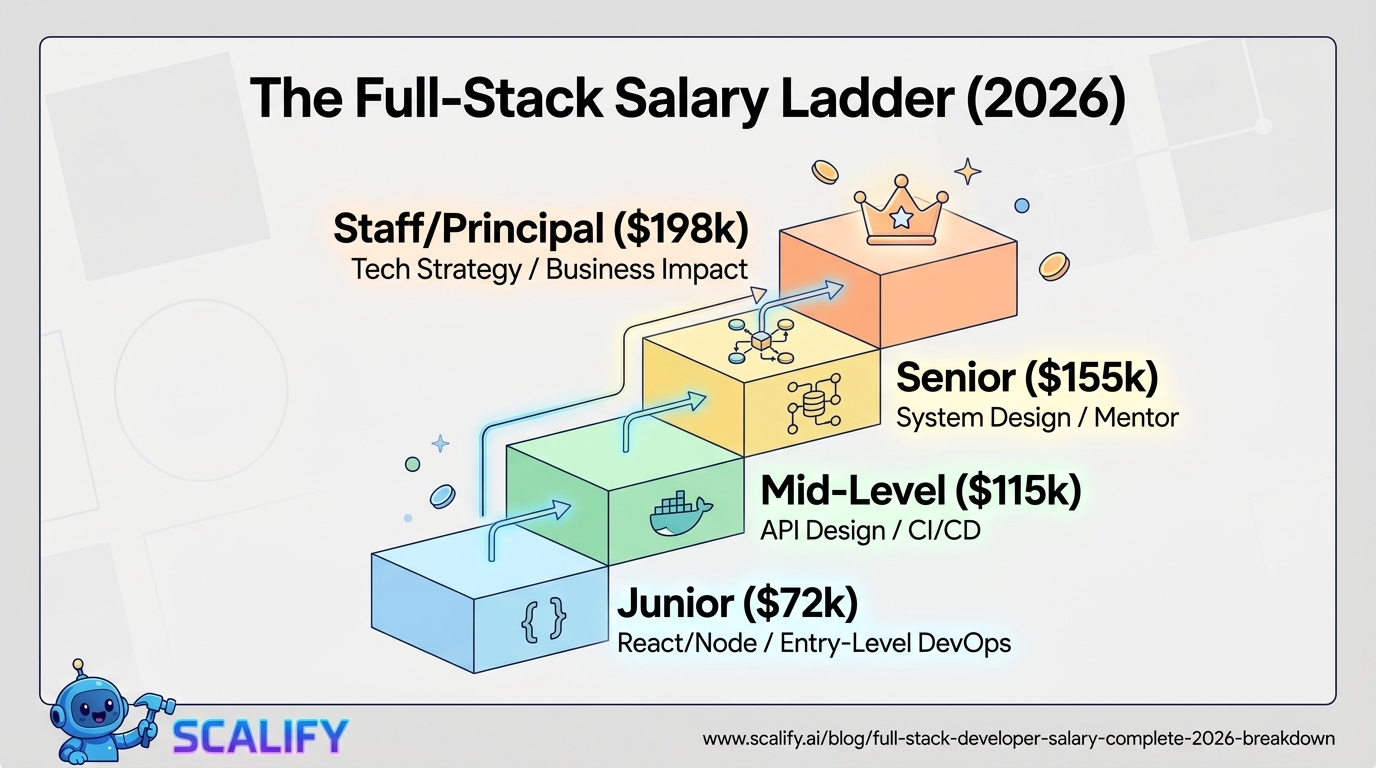
Tailwind CSS knowledge has become a meaningful salary differentiator — particularly for front-end and full-stack developers. The $8,000–$15,000 premium for Tailwind proficiency reflects its rapid adoption as a standard at product companies and agencies that build modern React applications. Job postings that list Tailwind CSS as a requirement grew 180% from 2022 to 2026 — and postings that list it as a "nice to have" have become "strongly preferred" as the framework has matured and proven itself in production environments.
Developers who learn Tailwind and combine it with React and TypeScript are building the most in-demand front-end skill set in the current market. The three technologies together — React for component architecture, TypeScript for type safety, Tailwind for utility-first styling — represent the dominant stack at growth-stage companies and are consistently appearing as requirements in senior front-end and full-stack job postings paying $120,000–$160,000+.
How Long Does It Take to Learn Tailwind?
Tailwind CSS has a relatively short learning curve for developers who already understand CSS fundamentals. The utility class naming system is systematic and logical — once you understand the pattern (size scales, color scales, spacing scales), most class names are predictable. Developers with solid CSS knowledge typically reach comfortable Tailwind proficiency within 2–4 weeks of daily use, and feel genuinely faster with Tailwind than custom CSS within 4–8 weeks.
The best way to learn Tailwind: start the official documentation's utility class reference, build one medium-sized project from scratch using Tailwind, and use the VS Code IntelliSense extension that autocompletes class names and shows their CSS output. The combination of building something real and having autocomplete that prevents constant documentation lookups is the fastest path from unfamiliar to productive.
The Bottom Line
Tailwind CSS is worth learning for any developer who builds websites or web applications professionally in 2026. Its 40.1% adoption rate, #1 loved framework status, 180% growth in job posting requirements, and the genuine development speed advantages it provides make it one of the clearest "invest your time here" skills in modern front-end development. The learning curve is real but short, and the productivity gains — faster styling, better design consistency, smaller production builds, and no context switching between HTML and CSS — are genuine and durable. Tailwind paired with React and TypeScript is the dominant modern front-end stack, and proficiency in all three is the most reliable path to the top of the front-end developer salary range.
At Scalify, we build professional websites using modern technology stacks including Tailwind CSS and Webflow — delivering clean, fast, well-structured front-ends in 10 business days.
Top 5 Sources
- Stack Overflow Developer Survey — Tailwind CSS adoption rates, sentiment data, and salary correlation
- Tailwind CSS Official Documentation — Framework reference, configuration guide, and utility class documentation
- State of CSS Survey — Annual survey tracking CSS framework adoption and developer satisfaction
- BuiltWith — Tailwind CSS Usage Data — Technology adoption tracking across millions of websites
- npm Trends — Tailwind vs Bootstrap Downloads — Weekly download comparison showing Tailwind's growth trajectory vs Bootstrap
Tailwind CSS in Production: Real-World Performance
One of the most consistent findings from teams that have adopted Tailwind in production is that it scales better than traditional CSS approaches. The problem with custom CSS in large projects is that the stylesheet grows continuously — every new component adds new classes, naming conflicts emerge, dead code accumulates, and the stylesheet becomes a liability that developers are afraid to change because they don't know what else might break. Tailwind eliminates this problem structurally: because styles are colocated with markup and unused utilities are purged at build time, the CSS output stays small and predictable regardless of how large the project grows.
Teams at companies like GitHub, Shopify, and Vercel have publicly documented their Tailwind adoption and the productivity gains they've experienced. The common themes: faster onboarding of new developers (the utility class system is learnable in days, custom CSS systems take weeks to understand), fewer design inconsistencies (utilities enforce the design token system that custom CSS often violates), and smaller production CSS bundles (Tailwind's purged output is typically 10–50KB vs. custom stylesheets that can grow to 200KB+).
Tailwind CSS With Popular Frameworks and Tools
| Framework / Tool | Tailwind Integration | Difficulty | Notes |
|---|---|---|---|
| Next.js | First-class — official documentation | Very Easy | Create Next App includes Tailwind option |
| React (Vite) | Excellent — standard configuration | Easy | Most common production setup |
| Remix | Excellent | Easy | Shopify's framework of choice |
| Astro | First-class — official integration | Very Easy | One command setup |
| SvelteKit | Good | Easy | Growing community |
| Laravel (Breeze/Jetstream) | Default — included out of box | Very Easy | Laravel's default CSS approach |
| Webflow (custom code) | Not applicable — different paradigm | N/A | Webflow has its own system |
The seamless integration between Tailwind and Next.js deserves specific emphasis. Next.js is the dominant React framework for production applications, and Tailwind is Next's recommended CSS solution — the official create-next-app scaffolding includes a Tailwind option that configures everything correctly in one command. For developers building Next.js applications, learning Tailwind is not optional if you want to use community components, contribute to existing codebases, or follow established patterns — it's the ecosystem default.
Tailwind CSS's integration with the broader JavaScript ecosystem — combined with its growing adoption in PHP frameworks like Laravel and Ruby on Rails through Hotwire — means that proficiency transfers across the technology stacks most professional developers work in. It is one of the rare technology investments that appreciates across multiple career paths rather than locking you into a single ecosystem.










.jpeg)
.jpeg)






78 SW 7th St, Miami, FL 33130