


What Is TypeScript and Should You Use It for Your Website?
By Josh Ternyak

March 31, 2026
TypeScript is used by 43% of developers and commands a $10,000-18,000 salary premium. This comprehensive guide covers what TypeScript is, TypeScript vs JavaScript comparison, when to use it by project type, core concepts (interfaces, generics, unions), React + TypeScript integration, migration strategies, common mistakes, tsconfig settings, and the career investment case for learning TypeScript.
What Is TypeScript and Should You Use It for Your Website?
TypeScript is a superset of JavaScript that adds static type annotations — meaning you declare what type of data each variable, function parameter, and return value should hold, and TypeScript checks that your code respects those declarations at compile time rather than discovering mismatches as runtime errors. TypeScript code compiles to plain JavaScript, which runs in browsers and Node.js exactly as JavaScript does — TypeScript is purely a development-time tool, adding none of its overhead to the production code your users run.
The practical case for TypeScript is simple: large JavaScript codebases are hard to maintain because JavaScript's dynamic typing allows bugs that could have been caught at compile time to surface as production runtime errors instead. TypeScript catches a class of bugs — calling a method on undefined, passing a string where a number is expected, accessing a property that doesn't exist on an object — before they ever reach production. For solo projects and small scripts, JavaScript's flexibility is genuinely convenient. For codebases with multiple developers, significant complexity, or requirements for long-term maintenance, TypeScript's type safety produces measurably fewer bugs and significantly faster development velocity through better IDE tooling.
Key TypeScript Statistics
- TypeScript is used by 43.4% of professional developers — up from 34% in 2022 (Stack Overflow 2024)
- TypeScript is the #5 most popular programming language overall and the most popular typed JavaScript option
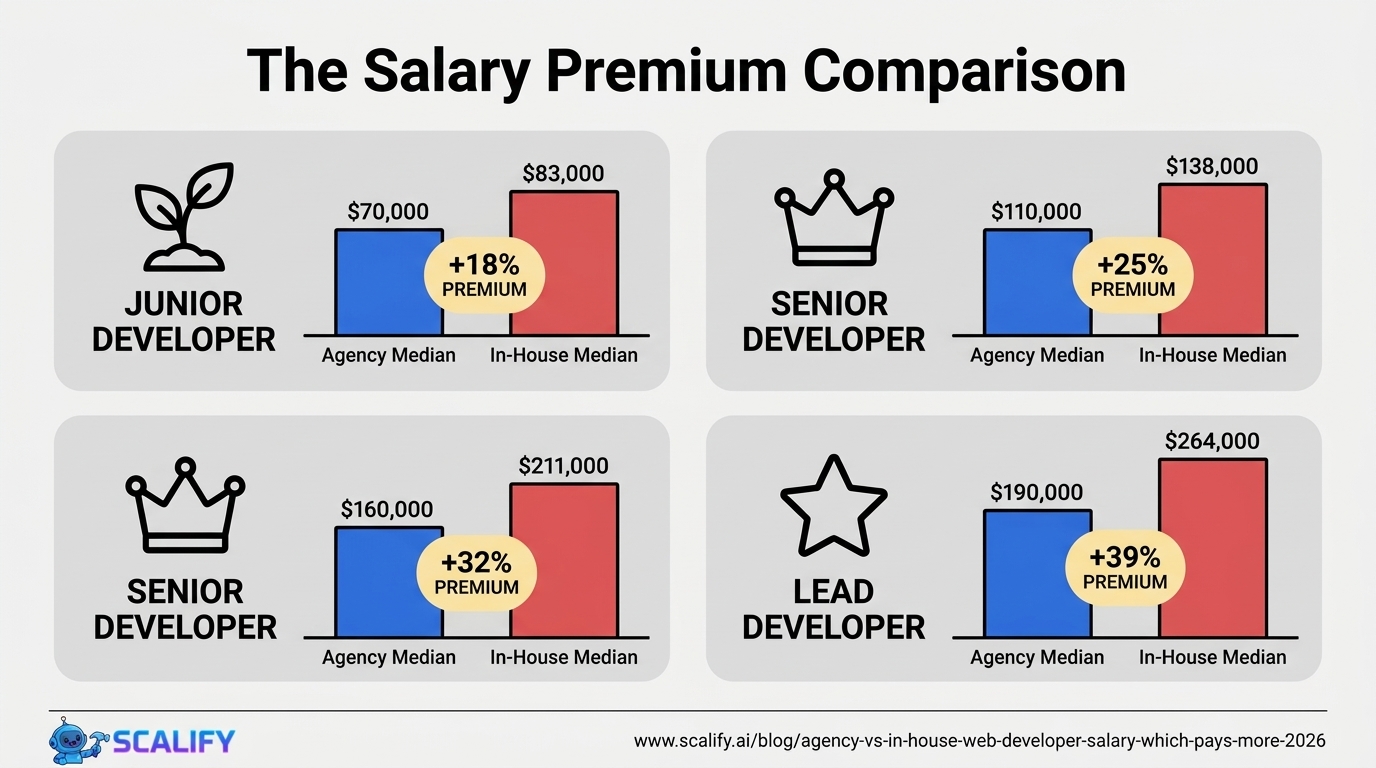
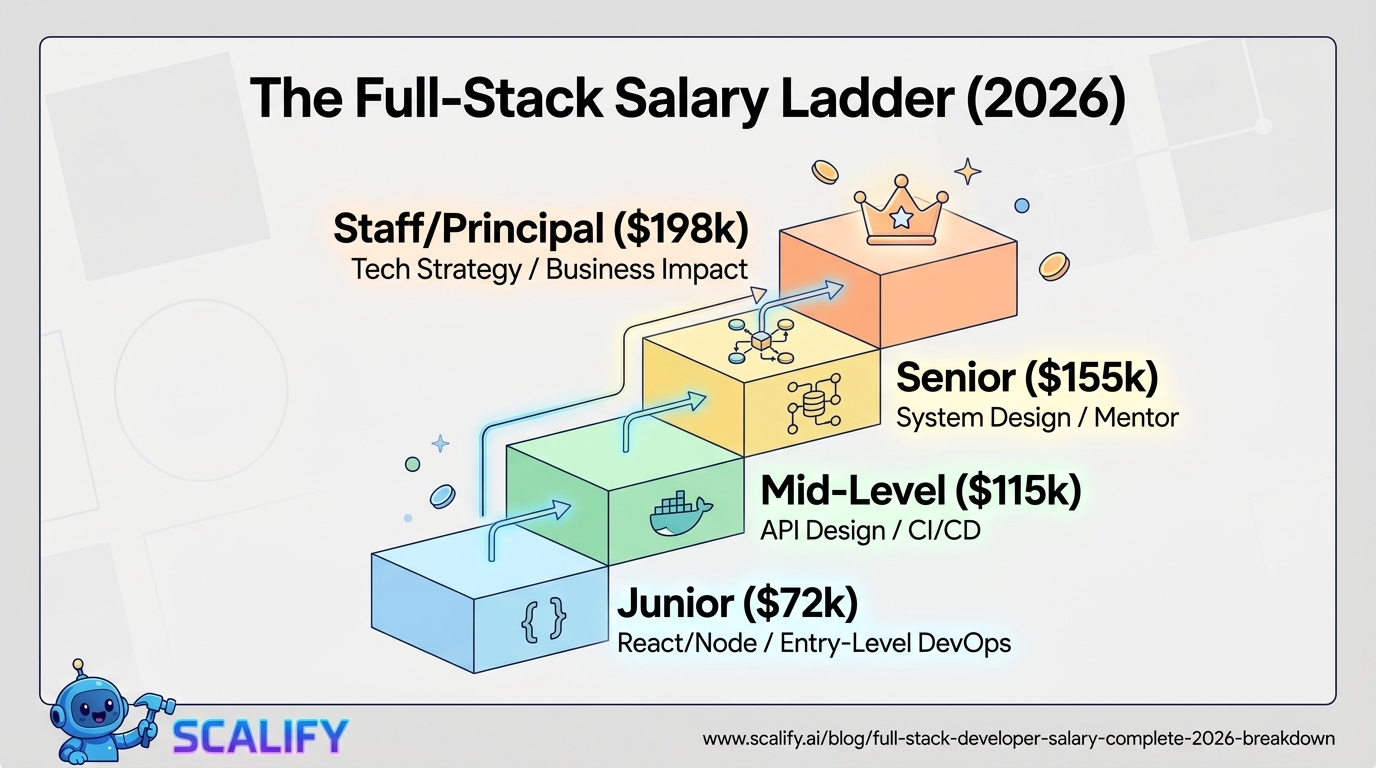
- TypeScript developers earn on average $10,000–$18,000 more than equivalent JavaScript-only developers
- 78% of large-scale JavaScript projects at companies with 50+ engineers use TypeScript
- TypeScript's VS Code integration provides IntelliSense that reduces development time by 25–40% on complex codebases through autocomplete and inline documentation
- Teams that migrate to TypeScript report 15% fewer production bugs on average in the first year
- TypeScript is now the default for create-next-app (Next.js scaffolding) and most major React starter templates
- 82% of the NPM packages in the top 1,000 by downloads either ship TypeScript types or have @types packages
- TypeScript has been in the top 10 most wanted technologies for 5 consecutive years in Stack Overflow surveys
- Google, Microsoft, Airbnb, and Slack are among the companies that have adopted TypeScript as their standard for JavaScript projects
TypeScript vs. JavaScript: The Key Differences
| Factor | JavaScript | TypeScript | Impact |
|---|---|---|---|
| Type checking | None — runtime only | Compile-time static checking | TypeScript catches bugs before they run |
| IDE support | Basic autocomplete | Full IntelliSense, inline docs, refactoring | TypeScript dramatically faster to write |
| Refactoring safety | Manual — easy to miss references | Automated — TypeScript finds all uses | TypeScript makes large refactors safe |
| Learning curve | None additional | 2–8 weeks to proficiency | Initial investment for long-term gain |
| Build step required | No — runs directly | Yes — compiles to JS | Minor — already standard in modern projects |
| Third-party library support | Always available | 95%+ of major libraries have types | Near parity in 2026 |
| Team onboarding speed | Fast for JS developers | Slower initially, faster after ramp-up | TypeScript pays back during long-term maintenance |
| Code documentation value | Comments required | Types ARE documentation | TypeScript reduces need for separate docs |
Should Your Website Use TypeScript?
| Project Type | Recommendation | Reasoning |
|---|---|---|
| Simple static website with minimal JS | No — plain JS is fine | TypeScript overhead not justified for a few event listeners and API calls |
| React SPA or Next.js application | Yes — strongly recommended | TypeScript is the ecosystem default; component props typing prevents entire classes of bugs |
| Node.js API or back-end service | Yes — strongly recommended | API contracts are exactly what TypeScript types model and protect |
| Shared component library or design system | Yes — essential | Types provide the API contract that consumers of the library need |
| Solo project / prototype | Optional — good habit building | Adds some overhead but builds muscle memory for team contexts |
| Legacy JavaScript codebase | Gradual migration recommended | TypeScript allows incremental adoption — don't need to convert everything at once |
| Large team (5+ developers) | Yes — near mandatory | TypeScript is the primary mechanism for maintaining code contracts across a team |
TypeScript Core Concepts Every Web Developer Needs
Basic Type Annotations
TypeScript's most basic feature is annotating variables and function parameters with their expected types. This looks like: const name: string = "Josh" or function greet(name: string): string { return \`Hello, ${name}\`; }. The type annotation after the colon tells TypeScript what type the value must be — and TypeScript will show an error if you try to assign a different type.
Interfaces and Type Aliases
Interfaces and type aliases let you define the shape of complex objects. If you have a User object throughout your application, you define it once: interface User { id: number; name: string; email: string; role: "admin" | "user" }. Now everywhere in the codebase that expects a User gets TypeScript's full verification that the object has all the required fields with the right types. This is TypeScript's most powerful feature for web applications — it transforms string-based duck typing into verified contracts.
Generics
Generics allow functions and components to work with multiple types while maintaining type safety. A generic fetch function — async function fetchData<T>(url: string): Promise<T> — returns data of whatever type the caller expects, with TypeScript verifying the return type at the call site. React developers use generics constantly: useState<User | null>(null) tells TypeScript that the state can be either a User or null, and it will catch any code that treats the state as always a User without checking for null first.
Union and Intersection Types
Union types (string | number) allow a value to be one of multiple types. Intersection types (TypeA & TypeB) require a value to satisfy multiple type definitions simultaneously. These features enable modeling the complex, conditional data structures that real web applications work with — API responses that can be success or error, UI components that accept either controlled or uncontrolled modes, configuration objects that extend base configs with environment-specific overrides.
TypeScript in the React Ecosystem
TypeScript and React are deeply integrated in 2026 — create-next-app defaults to TypeScript, Vite's React template includes TypeScript by default, and the vast majority of new React projects at professional organizations start with TypeScript from day one. The TypeScript features most valuable in React development:
| React + TypeScript Feature | What It Does | Why It Matters |
|---|---|---|
| Component prop types | Defines what props a component accepts and their types | Prevents passing wrong prop types; provides IntelliSense for prop names |
| useState generic | useState<User | null>(null) — types the state | TypeScript knows the state shape; catches null access errors |
| Event handler types | React.ChangeEvent<HTMLInputElement> etc. | Correct event object type in all handlers; prevents wrong property access |
| API response types | Interface matching API response shape | Verifies that API data is used correctly throughout the app |
| Custom hook return types | Explicit return types on hooks | Hook consumers know what they're getting; refactoring is safe |
Migrating an Existing JavaScript Project to TypeScript
TypeScript supports incremental migration — you don't need to convert an entire codebase at once. The recommended approach: add a tsconfig.json with allowJs: true and checkJs: false, which lets TypeScript and JavaScript files coexist and won't error on untyped JS files. Then convert files to TypeScript one at a time, starting with the most-shared utilities and types that will provide the widest benefit from type checking. Increase the strictness settings in tsconfig.json gradually as the codebase becomes more typed. This approach allows teams to migrate large codebases over months without disrupting ongoing development.
Common TypeScript Mistakes to Avoid
Overusing "any". The any type disables TypeScript's checking for that value — using it liberally defeats the purpose of TypeScript entirely. Every any in your codebase is a hole in your type safety. Use unknown instead when the type is genuinely unknown, and narrow it with type guards before using it. Reserve any for the rare cases where a third-party library has genuinely untyped interfaces that can't be worked around.
Type assertions instead of type guards. Writing user as User tells TypeScript to trust you that the value is a User — but provides no runtime verification. If the value is actually something else, you've suppressed the error without fixing it. Type guards (functions that verify the type at runtime using instanceof or property checks) are the correct alternative — they both satisfy TypeScript's type checker and actually verify the type at runtime.
Ignoring strict mode. TypeScript's strict configuration setting enables the most important safety checks — strict null checks, no implicit any, exact optional properties. Projects started without strict mode enabled gradually accumulate code that wouldn't pass strict checks, making future migration to strict mode expensive. Start new projects with strict: true and benefit from the most comprehensive type checking from day one.
The Bottom Line
TypeScript should be the default choice for any new React, Next.js, or Node.js project in 2026 — the ecosystem has fully converged on it, the tooling is excellent, the job market rewards it, and the maintainability benefits compound over the lifetime of any significant codebase. The learning curve is real but short — 2–4 weeks of focused use to reach comfortable proficiency. For existing JavaScript projects, incremental TypeScript adoption is achievable and worthwhile. For new projects, there is no good reason to start with plain JavaScript when TypeScript produces fewer bugs, better tooling, and better salary outcomes for the same development effort.
At Scalify, we use TypeScript throughout our development work — building professional websites and web applications with the type safety and tooling quality that production code deserves.
Top 5 Sources
- Stack Overflow Developer Survey — TypeScript adoption rates and salary correlation data
- TypeScript Official Documentation — Language reference, handbook, and migration guides
- State of JavaScript Survey — Annual TypeScript adoption and satisfaction tracking
- npm Trends — TypeScript Download Data — Weekly download growth showing adoption trajectory
- The New Stack — TypeScript Adoption Research
TypeScript Configuration: Key tsconfig.json Settings
| Setting | Recommended Value | What It Does |
|---|---|---|
| strict | true | Enables all strict type checking options — recommended for all new projects |
| target | ES2022 or ESNext | Which JavaScript version TypeScript compiles to |
| module | ESNext (bundler projects) or CommonJS (Node.js) | Module format for compiled output |
| moduleResolution | Bundler (Vite/webpack) or Node (Node.js) | How TypeScript resolves module imports |
| jsx | react-jsx (React 17+) | Enables JSX support without React import in every file |
| paths | Configure path aliases | Enables @/components/Button instead of ../../components/Button |
| noUnusedLocals | true | Errors on declared but unused variables — keeps code clean |
| noImplicitReturns | true | Requires explicit return in all branches of a function |
TypeScript's Salary Premium: The Career Investment Case
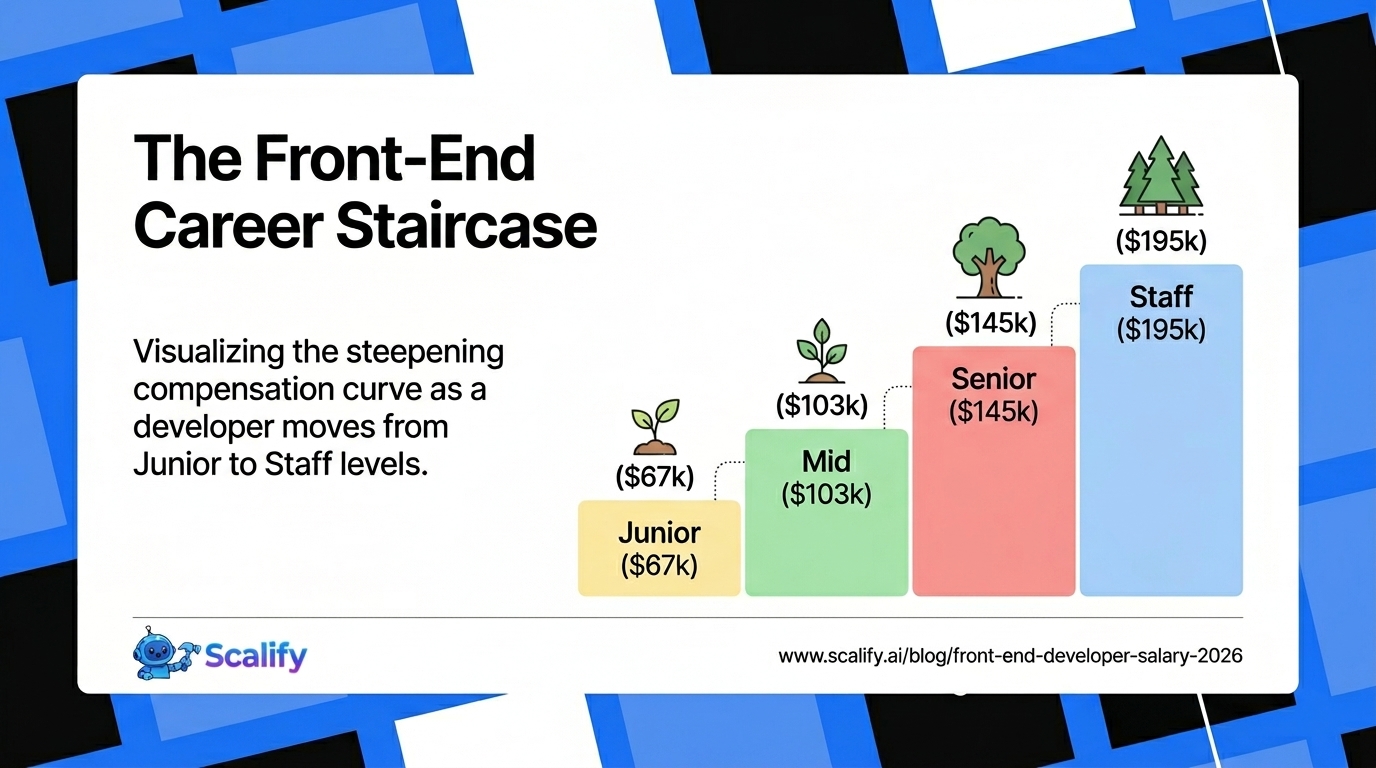
The $10,000–$18,000 salary premium for TypeScript developers over equivalent JavaScript-only developers in 2026 reflects a genuine market reality: the majority of mid-size and large companies have standardized on TypeScript for React and Node.js development, and job postings that list TypeScript as required — now representing 72% of senior front-end and full-stack postings — simply don't consider JavaScript-only candidates. TypeScript proficiency is no longer a differentiating skill that commands a premium in the way it did in 2019 — it's increasingly a baseline expectation, and the premium it commands represents the gap between meeting that baseline and failing to meet it.
For developers currently building their skills, this means TypeScript is not optional career investment — it's essential maintenance of market relevance. The developers who haven't yet invested in TypeScript and are currently competing for roles at companies with TypeScript codebases are competing with a meaningful disadvantage that is getting larger, not smaller, as TypeScript adoption continues to grow. A focused 6–8 week TypeScript learning project — converting an existing JavaScript React application to TypeScript, adding proper generics and utility types, configuring strict mode — produces the proficiency needed to compete effectively for TypeScript-required roles and commands the salary premium that represents the return on that learning investment.
The Future of TypeScript
TypeScript's trajectory is strongly positive. Microsoft's continued investment in the language, its integration as the default in major frameworks (Next.js, Angular, NestJS, Remix), and its growing adoption in the React Native mobile ecosystem suggest that TypeScript will continue widening its developer market share for the foreseeable future. The language's quarterly release cycle continues adding features that address real developer pain points — improved type inference, better performance for large codebases, enhanced IDE integration. For developers making language investment decisions, TypeScript is the safest long-term bet in the JavaScript ecosystem: already the standard in enterprise development, growing rapidly in startup and agency contexts, and actively developed with clear roadmap momentum.









.jpeg)

.jpeg)





78 SW 7th St, Miami, FL 33130