


What Is Typography in Web Design and Why Does It Make or Break Your Site?
By Josh Ternyak

March 29, 2026
Typography is the single biggest factor in whether a website looks professional or amateur — yet most people barely think about it. This guide explains what typography is, how it works on the web, and how to get it right.
The Element That Does the Most Work While Getting the Least Credit
Look at two websites side by side. One looks polished and professional. The other looks slightly off — you can't quite put your finger on why, but something about it feels less credible, less trustworthy, less carefully made. More often than not, the difference is typography.
Typography is the art and technique of arranging type to make written language legible, readable, and appealing. In web design, it encompasses every decision about typefaces, sizes, weights, line heights, letter spacing, and the hierarchy that tells readers where to look and in what order. And unlike color (which visitors often consciously notice) or layout (which visitors consciously navigate), typography works mostly below conscious awareness — shaping perception without announcement.
The effect is significant. Research by the Wichita State University usability labs found that typography quality is one of the primary signals people use to assess website credibility. Studies on reading comprehension consistently show that better typography produces better retention and understanding. Typography isn't decoration — it's doing real functional work in addition to its aesthetic contribution.
This guide explains what typography is in web design, the specific decisions it involves, the principles that separate good web typography from bad, and how to apply them in practice.
The Fundamentals: What Typography Involves
Typefaces and Fonts
A typeface is a family of related fonts sharing a common design — Helvetica, Georgia, Garamond. A font is a specific variation within that family — Helvetica Bold, Georgia Italic, Garamond Regular. The distinction matters because choosing a typeface gives you access to its full family of variants, and the range of variants available (weights, widths, styles) affects how flexible the typeface is in practice.
Web typefaces fall into several broad categories with distinct visual personalities and appropriate use cases:
Serif typefaces have small decorative strokes (serifs) at the ends of letterforms. Classic examples: Times New Roman, Georgia, Garamond, Playfair Display. Visual associations: tradition, authority, elegance, trustworthiness. Common in editorial contexts, luxury brands, financial services, and any brand that wants to communicate heritage and credibility.
Sans-serif typefaces have no serifs — clean, unadorned letterforms. Examples: Helvetica, Inter, Roboto, Open Sans. Visual associations: modernity, clarity, accessibility, straightforwardness. The dominant choice in modern digital interfaces, technology brands, and contemporary business design.
Display typefaces are designed for large sizes — headings, hero text, brand statements. They're often more decorative, more expressive, or more distinctive than text typefaces designed for readability at small sizes. Used for personality and visual impact in headlines; never for body text.
Monospace typefaces have equal-width characters — originally designed for typewriters and code terminals. In web design, used specifically for code samples and technical content where character alignment matters.
Type Size
Size establishes visual hierarchy — larger text is read first, smaller text is secondary. In web design, sizes are typically specified in pixels (px), ems (relative to parent element's font size), rems (relative to root font size — the most consistent and accessible unit for body text), or responsive units like viewport-relative values (vw, vmin).
The base body text size matters more than any other single typographic decision. For most reading contexts on modern screens: 16–18px is the sweet spot for body text. Smaller than 16px and the text becomes uncomfortable to read on mobile without zooming. Larger than 20px can feel clunky for sustained paragraph reading.
Everything else in the type scale is relative to this base: headings are multiples of the base size, captions and fine print are fractions. A consistent mathematical scale (based on a ratio like 1.25, 1.333, or 1.5) produces harmonious size relationships throughout the design.
Line Height (Leading)
Line height is the vertical distance between baselines of successive text lines. Insufficient line height makes text feel cramped and difficult to track from line to line. Too much line height makes paragraphs feel disconnected.
For body text: a line height of 1.4–1.6× the font size is the standard recommendation. At 16px font size, a line height of 24–26px (1.5–1.6×) produces comfortable reading rhythm. Larger text (headings) can use tighter line heights (1.1–1.3×) because fewer words per line make tracking easier at any line height.
Letter Spacing (Tracking)
Letter spacing controls the horizontal distance between characters. Small adjustments in letter spacing can significantly affect a text's visual character and readability:
- Slightly positive letter spacing (+0.01–0.05em) on body text improves readability at smaller sizes
- Moderate positive letter spacing (+0.05–0.15em) on all-caps text is almost always needed — all-caps without letter spacing looks cramped
- Large display text often benefits from slightly negative letter spacing (-0.01–0.03em) — the natural spacing at display sizes can feel too loose
The principle: letter spacing adjustments should improve readability or visual polish, never be arbitrary. Tracking changes are subtle — the goal is to make text feel natural, not to make it obviously spaced.
Font Weight
Font weight (the thickness of strokes) creates emphasis and hierarchy within a type system. Most professional typefaces offer multiple weights: Thin (100), Light (300), Regular (400), Medium (500), Semibold (600), Bold (700), Extrabold (800), Black (900).
Weight differentiation is the primary tool for creating hierarchy within the same typeface. A bold heading over a regular-weight body paragraph creates immediate hierarchy through weight contrast alone, without needing size differences. This is why multi-weight type families are so valuable — the expressive range available within one consistent typeface visual personality.
Building a Web Typography System
Choosing Your Typefaces
Most professional web typography systems use 2–3 typefaces. The most common structure:
Display/heading font: A font with personality and presence, used for headlines and prominent text. Can be distinctive, decorative, or expressive — its job is to communicate brand personality at large sizes.
Body font: Highly readable, neutral in personality, comfortable at paragraph text sizes. Clarity and readability are the primary selection criteria — not visual distinctiveness.
Optional third font (used sparingly): Sometimes a monospace font for code, a script for specific accent applications, or an additional personality font for specific use cases. If you need a third, use it sparingly and with clear purpose.
The pairing between heading and body fonts is the critical judgment call in typeface selection. Strong pairings typically share some underlying quality (both geometric, both humanist, both classical) while having enough contrast to feel distinct. A pairing where both fonts look nearly identical provides no useful contrast; a pairing where both fonts feel like they're from completely different eras creates visual discord.
Web-Safe Fonts and Web Fonts
Web-safe fonts are typefaces installed on virtually every operating system — Arial, Helvetica, Georgia, Times New Roman, Courier New. They load instantly because they're already on the user's device, but they offer limited visual distinction and no ability to differentiate your brand from anyone else using the same fonts.
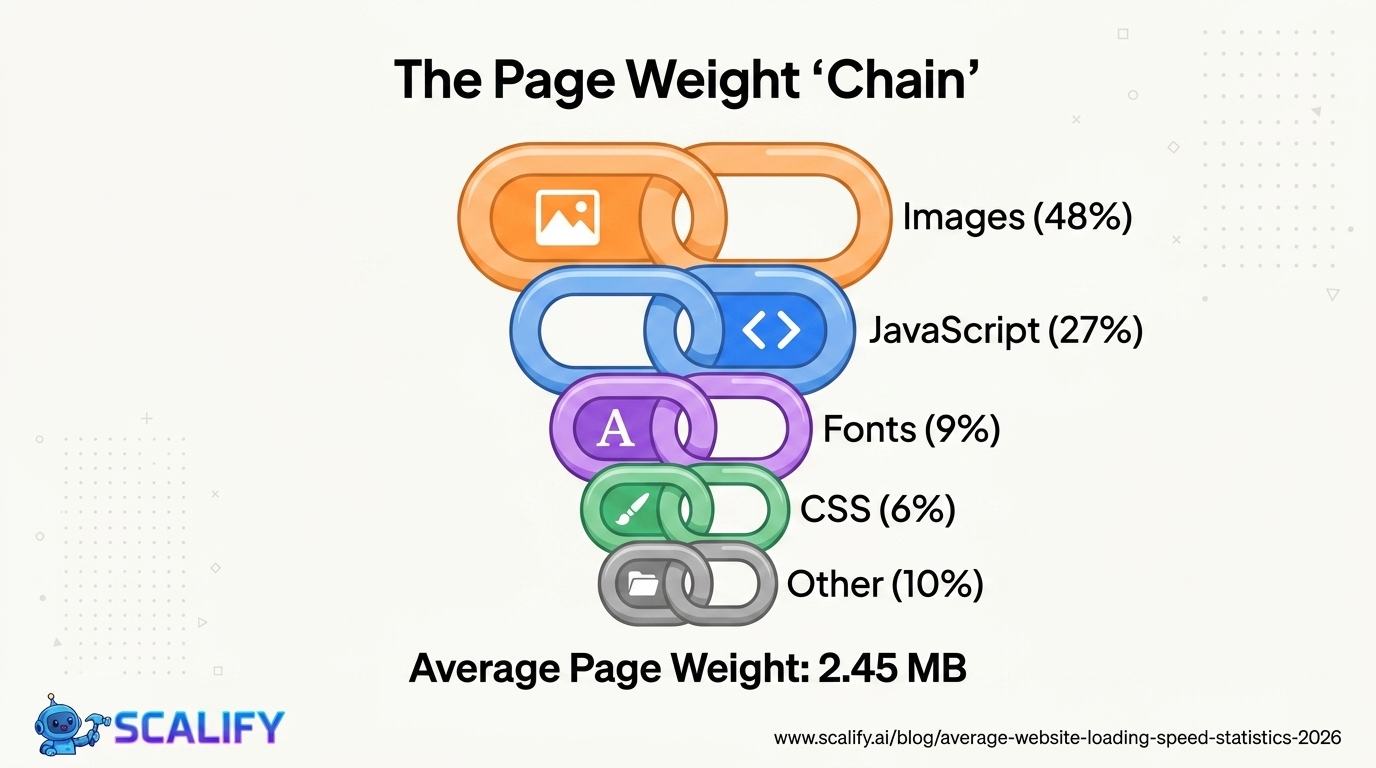
Web fonts are custom typefaces loaded from external sources — Google Fonts (free, thousands of options, hosted on Google's servers), Adobe Fonts (via Creative Cloud subscription), or self-hosted font files. They offer full control over brand typography at the cost of additional page load weight and render time.
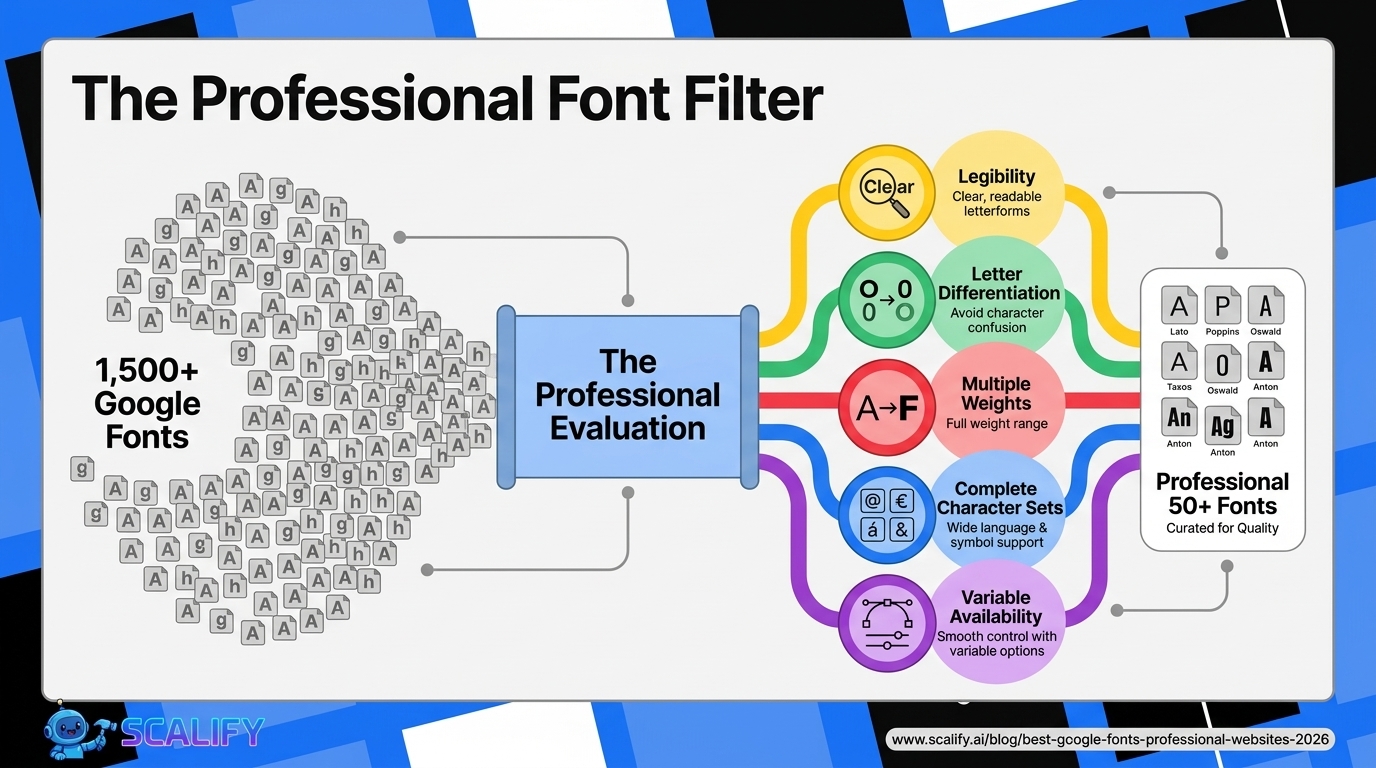
Google Fonts: The most accessible source. Free, well-maintained, with high-quality options across every style category. Popular choices: Inter and Roboto for clean sans-serif body text, Playfair Display for elegant serif headings, DM Serif Display for editorial serif headings, Plus Jakarta Sans for modern sans-serif with personality.
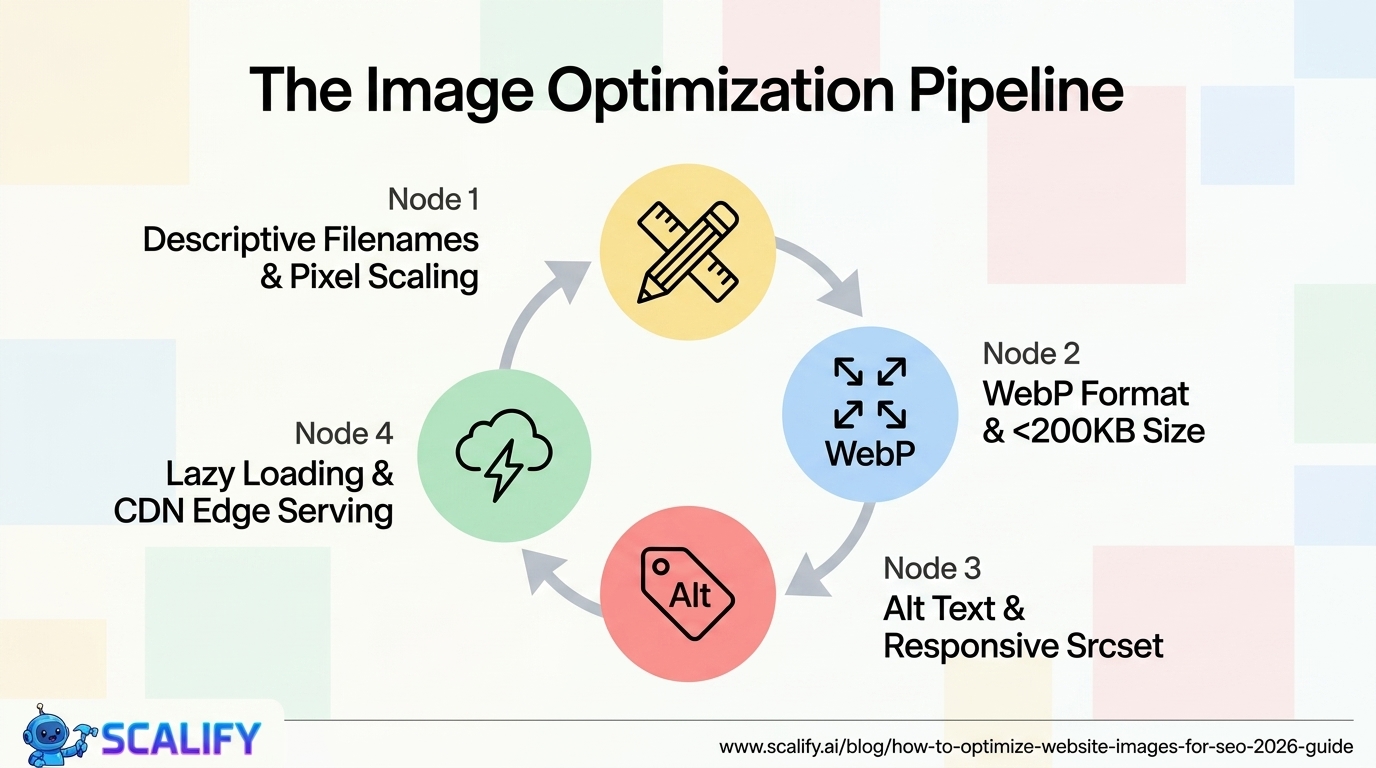
Performance considerations: Each font weight loaded adds to page weight. A site that loads 4 font weights × 2 typefaces = 8 font files adds 200–400KB of load. Load only the weights you actually use. Preconnect to font servers (<link rel="preconnect">) and use font-display: swap to prevent invisible text during font loading.
Creating a Type Scale
A type scale is a systematic set of text sizes used throughout the design. Rather than choosing sizes arbitrarily, a mathematical scale creates harmonious size relationships:
Starting at 16px (base body text) and using a 1.25 ratio (Major Third scale):
- xs: 12.8px (0.8rem) — captions, fine print
- sm: 14.4px (0.9rem) — secondary text, labels
- base: 16px (1rem) — body text
- lg: 18px (1.125rem) — lead paragraphs, intro text
- xl: 20px (1.25rem) — small headings, H4/H5
- 2xl: 24px (1.5rem) — H3
- 3xl: 30px (1.875rem) — H2
- 4xl: 38px (2.375rem) — H1 on mobile
- 5xl: 48px (3rem) — H1 on desktop
- 6xl: 60px+ — hero/display text
Using a scale like this means every size choice has a rational relationship to every other size — the visual harmony isn't accidental, it's structural.
Typography Hierarchy on Web Pages
Visual hierarchy through typography guides readers through content in the intended order and communicates the relative importance of different content elements. The hierarchy is established through combinations of size, weight, color, and spacing:
H1 (largest, most prominent): The page's primary topic. One per page. Typically the largest text element, heaviest weight, and most distinctive typographic treatment. Should be immediately visible and communicate the page's main subject to a scanning visitor.
H2 (major sections): Top-level section headings. Clearly subordinate to H1 in size and weight but clearly dominant over body text. The primary navigation landmark for a scanning reader.
H3 (sub-sections): Divisions within major sections. Visually distinct from H2 but subordinate to it. This is where many typography systems start to blur — H3 needs to be clearly different from both H2 and body text, which requires enough typographic range in the system to create three clearly distinct levels.
Body text: The majority of content. Optimized for readability and sustained reading comfort over visual impact. Should be the most comfortable, neutral text in the system.
Caption/secondary text: Supporting information, photo captions, fine print. Smaller than body, lighter in weight or color. Clearly secondary without being illegible.
Responsive Typography
Type sizes that work well on a desktop monitor are often too large for mobile screens — or need to be larger for small screens where reading distance is shorter. Responsive typography adjusts text sizing, line heights, and sometimes font choices across breakpoints:
A common approach: define base sizes for mobile-first, then scale up at larger breakpoints. A 32px H1 on mobile becomes 48px on desktop. Body text might stay at 16px across breakpoints while line height adjusts (tighter line height works better on very large displays where line lengths can become excessive).
CSS clamp() enables fluid responsive typography that scales smoothly between minimum and maximum sizes without breakpoint jumps: font-size: clamp(1.75rem, 4vw, 3rem) produces an H1 that's always at least 28px, scales with viewport width, and never exceeds 48px.
The Most Common Web Typography Mistakes
Line length too long or too short: Optimal reading line length is 45–75 characters (about 12–18 words). Too long and readers lose their place at line breaks; too short and reading feels fragmented. On wide-screen layouts, use max-width constraints on text containers to prevent lines from stretching uncomfortably wide.
Insufficient contrast between text levels: When H2 and H3 look nearly identical, the hierarchy isn't doing its job. Each level needs to be clearly distinguishable from adjacent levels.
Body text too small on mobile: 12–14px body text on mobile requires constant zooming and causes immediate abandonment. 16px minimum for body text, 15px minimum for secondary text.
Too many typefaces: Three typefaces used thoughtfully look professional. Four typefaces usually look like indecision. Five or more look like every font was chosen individually without consideration of the system. Constrain to 2–3 typefaces and use weight and size variation within them to create range.
All-caps body text: Extended passages of all-caps text are significantly harder to read than mixed case — all-caps works for short labels, headings, and functional text but becomes uncomfortable at paragraph length.
System fonts as a cop-out: Defaulting to Arial or Helvetica because "it works" produces generic results that communicate low design investment. The performance benefit of system fonts doesn't justify the brand quality cost for any site where visual identity matters.
The Bottom Line
Typography is the foundation of visual quality in web design. The choices about typefaces, sizes, weights, line heights, and spacing accumulate into an overall impression that either communicates craftsmanship and credibility or signals generic, low-effort design. Getting it right requires understanding the principles of type hierarchy, scale, and readability — and applying them consistently through a documented type system.
The good news: quality web typography doesn't require expensive custom fonts or an advanced design degree. Google Fonts offers excellent typefaces for free. A simple two-font system with a mathematical type scale and appropriate spacing will produce professional results that outperform most websites relying on default system fonts and arbitrary size choices.
At Scalify, every website we build includes a carefully considered type system — selected typefaces, documented size scale, appropriate spacing — that makes the site immediately feel professional rather than requiring visitors to consciously evaluate whether it looks good.







.jpeg)
.jpeg)


78 SW 7th St, Miami, FL 33130