


What Is Web Accessibility and Why Is It Non-Negotiable?
By Josh Ternyak

March 28, 2026
Web accessibility is about making websites usable by everyone — including the 1.3 billion people with disabilities. This guide explains what it means in practice, why it matters legally and morally, and how to get it right.
The Billion Users Most Websites Are Ignoring
There are approximately 1.3 billion people in the world living with some form of disability — visual impairments, hearing loss, motor limitations, cognitive disabilities. That's roughly 16% of the global population. And the majority of websites on the internet are, to varying degrees, inaccessible to them.
Not intentionally. Web accessibility failures are almost never deliberate exclusion. They're the result of building for the assumed average user — sighted, hearing, able to use a mouse, cognitively typical — without considering the range of ways real people actually interact with the web. The result is websites that work well for most visitors and fail, quietly and consistently, for millions of others.
Web accessibility is the discipline of building websites that work for everyone — regardless of ability, disability, or assistive technology. It's a technical concern, a design concern, a legal concern, and an ethical one. This guide covers all four angles and gives you a practical understanding of what accessibility means, what it requires, and why no serious website should neglect it.
What Web Accessibility Actually Means
Accessibility isn't a single feature or checkbox. It's a property of a website — whether it can be perceived, operated, understood, and navigated by people with a wide range of abilities and limitations.
The Web Content Accessibility Guidelines (WCAG) — the international standard for web accessibility, developed by the W3C — organize accessibility requirements around four principles, often abbreviated as POUR:
Perceivable: Information and user interface components must be presentable to users in ways they can perceive. Content can't be invisible to all of their senses. Blind users who rely on screen readers can't perceive images without alt text. Deaf users can't perceive audio content without captions or transcripts.
Operable: Interface components and navigation must be operable. Users can't be required to use an interaction they can't perform. Users with motor disabilities who navigate by keyboard can't operate interfaces that require mouse hover. Users with tremors can't operate tiny click targets precisely.
Understandable: Information and the operation of the interface must be understandable. Content must be readable. Interfaces must behave predictably. Users with cognitive disabilities need clear language, consistent navigation, and helpful error messages.
Robust: Content must be robust enough to be interpreted reliably by a wide variety of user agents, including assistive technologies. Code must be clean enough that screen readers and other tools can parse and present it correctly.
Who Benefits from Accessible Websites
Before going into specifics, it's worth understanding the scope of who accessible websites serve — because "people with disabilities" encompasses a much broader and more varied group than most people picture:
Blind and low-vision users navigate websites using screen readers — software that reads content aloud. JAWS and NVDA are the most common on Windows; VoiceOver is built into Mac, iPhone, and iPad; TalkBack into Android. Screen readers read text, convey interface element types (button, link, form field), and navigate through headings and landmarks. A website that's well-structured for screen readers is entirely usable by blind users; one that's poorly structured is effectively inaccessible.
Users with motor disabilities may be unable to use a mouse. They navigate by keyboard (Tab to move between focusable elements, Enter to activate), by switch access (a single input device that cycles through interface options), by voice control (software like Dragon NaturallySpeaking), or by eye tracking. Websites that can't be fully operated by keyboard alone are inaccessible to these users.
Deaf and hard of hearing users can't access audio content without alternatives. Video without captions, audio-only content without transcripts, websites where important information is communicated only through sound — all inaccessible to deaf users.
Users with cognitive disabilities — including dyslexia, ADHD, learning disabilities, and cognitive impairments — benefit from clear language, consistent navigation, distraction-free interfaces, and content that doesn't require complex interpretation. Many mainstream UX best practices (plain language, clear headings, ample whitespace) overlap substantially with cognitive accessibility best practices.
Users with vestibular disorders and seizure conditions can be affected by excessive animation, parallax effects, flashing content, or rapid visual movement. WCAG requires that blinking and flashing content meet safety thresholds and that animations respect user preferences for reduced motion.
Situational and temporary impairments: Accessibility benefits extend well beyond permanent disabilities. A broken arm makes mouse use difficult. Bright sunlight makes screens hard to see. A noisy environment makes audio hard to hear. An elderly user with slightly reduced vision benefits from good contrast ratios. The accessibility features that serve people with permanent disabilities often serve everyone in specific circumstances.
The Legal Landscape: Why Ignoring Accessibility Is a Legal Risk
In many jurisdictions, web accessibility isn't optional — it's legally required. The legal landscape varies by country and is evolving, but the direction globally is toward stronger accessibility requirements with real enforcement.
United States: The Americans with Disabilities Act (ADA) has been interpreted by courts to require that the websites of businesses open to the public be accessible to people with disabilities. There has been substantial litigation — thousands of ADA accessibility lawsuits are filed in the US each year. The most common targets: e-commerce sites, financial services, healthcare providers, and entertainment. Settlements often involve both monetary damages and committed remediation work.
Section 508 of the Rehabilitation Act explicitly requires that federal agencies' websites and software be accessible. Government contractors are also often subject to these requirements.
European Union: The European Accessibility Act requires that certain digital products and services — including e-commerce platforms, banking services, and transport — meet accessibility standards by 2025. EU member states are implementing this legislation with their own enforcement mechanisms.
United Kingdom: The Equality Act 2010 requires that service providers make "reasonable adjustments" to avoid putting disabled people at a substantial disadvantage. This has been interpreted to apply to websites.
Canada, Australia, and many other countries have similar legislation with varying levels of specificity about digital accessibility requirements.
The practical implication: if your business serves the public and has an online presence, you have legal exposure from accessibility failures. The risk is not hypothetical — accessibility lawsuits have targeted companies of every size, from one-person startups to Fortune 500 enterprises. Proactive accessibility investment is a legal risk management strategy as much as a user experience one.
WCAG: The Standard and Its Levels
WCAG (Web Content Accessibility Guidelines) is the internationally recognized standard for web accessibility. The current widely referenced version is WCAG 2.1, with WCAG 2.2 released in 2023 and WCAG 3.0 in development. WCAG is organized into three conformance levels:
Level A: The minimum. Failures at Level A create barriers that make content inaccessible to some users entirely. Examples: providing text alternatives for non-text content, ensuring content can be navigated by keyboard, providing captions for prerecorded video.
Level AA: The recommended standard for most organizations. Level AA builds on Level A and addresses the most common and impactful accessibility barriers. This is the level required by most accessibility laws and typically specified in accessibility policies. Examples: sufficient color contrast ratios, clear focus indicators for keyboard navigation, error identification in forms, resize text up to 200% without loss of functionality.
Level AAA: The highest level, addressing nuanced situations and edge cases. Full AAA conformance is generally not required or achievable for all content — many Level AAA criteria apply only in specific contexts. Examples: sign language interpretation for all prerecorded video, captions for all live audio, extended audio descriptions.
WCAG 2.1 Level AA is the standard most organizations should aim for and is the level referenced in most legal contexts. Building to this standard means addressing the most significant barriers for the broadest range of users.
The Most Common Accessibility Failures
The WebAIM Million — an annual study of one million homepage accessibility — consistently identifies the same categories of failures as the most prevalent:
Low contrast text. Text that doesn't have sufficient contrast against its background is difficult or impossible to read for users with low vision or color blindness. WCAG requires a contrast ratio of at least 4.5:1 for normal text and 3:1 for large text. Light gray text on white backgrounds — fashionable in modern design — often fails this requirement. Checking contrast ratios with tools like the WebAIM Contrast Checker or the browser's built-in accessibility tools should be part of every design review.
Missing alt text on images. Screen readers read alt text when they encounter an image. An image without alt text is effectively invisible to screen reader users — they may know an image is there but get no information about what it shows. All informative images need descriptive alt text. Decorative images (purely visual, conveying no information) should have empty alt attributes (alt="") so screen readers skip them.
Missing form labels. Form inputs without associated labels are difficult to use for screen reader users (who may not understand what the field expects) and for voice control users (who need the label text to activate the field by voice). Every input needs a label, either visible or programmatically associated via aria-label or aria-labelledby.
Keyboard navigation failures. Features that require mouse hover, click-only interactions, or don't provide visible focus indicators are inaccessible to keyboard users. Every interactive element (links, buttons, form controls, custom widgets) needs to be focusable, operable, and visibly indicated when focused.
Missing language declaration. The lang attribute on the html element (<html lang="en">) tells screen readers what language to use for pronunciation. Without it, screen readers may use incorrect pronunciation rules, making content unintelligible.
Unclear link text. Links whose text is "click here" or "read more" — without context — don't communicate the destination to screen reader users who navigate by listing links. Descriptive link text ("Read our 2026 web design guide") serves both screen readers and sighted users.
Practical Steps Toward Accessibility
Automated testing as a baseline. Tools like axe (a browser extension), WAVE, or Lighthouse's accessibility audit catch many Level A and AA failures automatically. Run an audit on your site and address the flagged issues. Automated testing catches about 30–40% of accessibility issues — it's a floor, not a ceiling.
Manual keyboard testing. Navigate through your site using only the Tab key (and Shift+Tab to go backward), Enter to activate links and buttons, and arrow keys for within-component navigation. Can you reach every interactive element? Is there always a visible focus indicator? Can you complete every key task? This takes 20–30 minutes and reveals problems automated tools miss.
Screen reader testing. Download NVDA (free, Windows) or use VoiceOver (built into Mac, iPhone, iPad). Attempt to navigate key pages and complete core tasks with the screen reader. This reveals how real assistive technology users experience your site — and produces a humbling experience if accessibility hasn't been considered.
Design with contrast and visibility in mind. Use sufficient contrast ratios throughout the design phase, not as a retrofit. Ensure interactive elements have clear focus styles. Make sure error states are conveyed through more than just color (add an icon or text, not just red text).
Write semantic HTML. HTML's semantic elements (headings, lists, landmarks, buttons, links) communicate meaning to assistive technologies. A div styled to look like a button doesn't behave like a button for keyboard and screen reader users — use an actual button element. A heading hierarchy helps screen reader users navigate by section. Using the right HTML elements for the right purposes is foundational to accessibility.
The Business Case Beyond Compliance
Beyond legal compliance, accessible websites have measurable business benefits:
Larger addressable market. 16% of the global population with disabilities represents substantial purchasing power. The US disability community alone has over $490 billion in annual disposable income. Inaccessible websites exclude a segment of the market that competitors who prioritize accessibility capture instead.
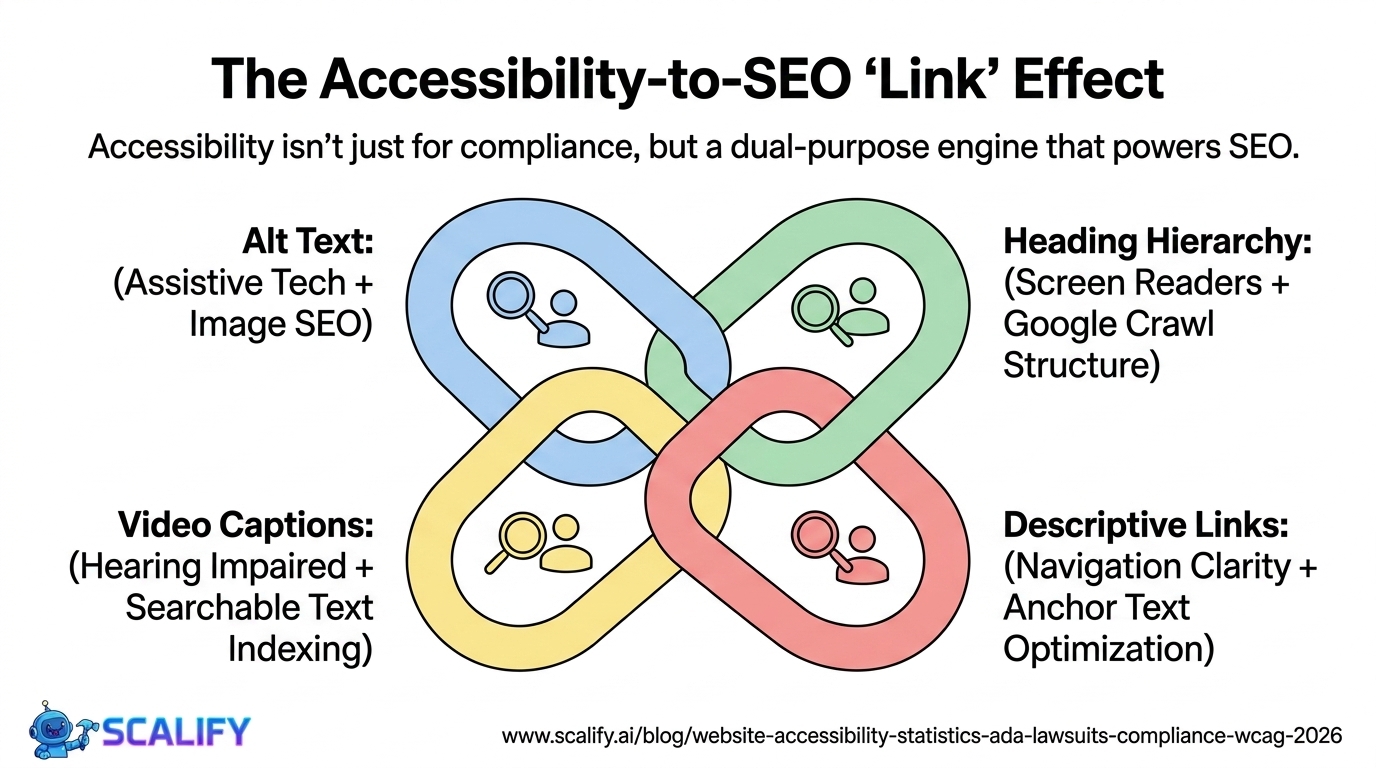
SEO overlap. Many accessibility best practices are also SEO best practices. Alt text on images helps both screen reader users and Google Image Search. Semantic headings help both screen readers and search engine crawlers understand content hierarchy. Clean, meaningful HTML benefits both accessibility and crawlability. Accessibility investment often produces SEO dividends.
Better UX for everyone. The accessibility improvements that serve users with disabilities — clear language, good contrast, consistent navigation, visible focus states, captions on video — improve the experience for all users. Captions help people watching in noisy environments. Clear language helps people who aren't native speakers. Good contrast helps people outdoors in bright light.
The Bottom Line
Web accessibility is the practice of building websites that work for everyone — including the hundreds of millions of people who use assistive technologies or have disabilities that affect how they interact with the web. It's required by law in many jurisdictions, carries significant legal risk when neglected, and has concrete business benefits beyond compliance.
The most common failures — low contrast, missing alt text, keyboard navigation gaps — are fixable. The most impactful investment is building accessibility in from the start: semantic HTML, sufficient contrast by design, tested keyboard navigation, and content that's written for clarity. Retrofitting accessibility after the fact is always more expensive than building with it in mind from day one.
At Scalify, accessibility is part of how we build — semantic HTML, proper contrast, keyboard-operable interfaces — not an optional add-on that gets addressed after launch.






.jpeg)
.jpeg)


78 SW 7th St, Miami, FL 33130