


What Is Web Accessibility and Why Does It Matter for Your Business?
By Josh Ternyak

April 1, 2026
Comprehensive guide: What Is Web Accessibility and Why Does It Matter for Your Business?
Building for Everyone, Not Just Most People
Imagine spending weeks designing a beautiful restaurant. Perfect lighting. Thoughtful layout. Excellent menu. Then placing it on the third floor of a building with no elevator. A portion of your potential customers — anyone who uses a wheelchair, anyone with difficulty climbing stairs, anyone with a stroller — simply can't enter. The restaurant serves a narrower audience than it needed to, not because of the quality of the food or ambiance, but because of an access barrier that was preventable.
Web accessibility is the digital equivalent of removing that access barrier. It's the practice of designing and building websites that can be used by people with disabilities — visual impairments, hearing loss, motor limitations, cognitive disabilities — as effectively as by people without them. And like the restaurant analogy, websites that exclude people with disabilities aren't just failing a moral obligation — they're turning away a significant portion of potential customers for entirely preventable reasons.
The World Health Organization estimates 16% of the global population — 1.3 billion people — lives with some form of disability. That's a larger market than the entire continent of North America. Building inaccessible websites doesn't just create ethical problems. It creates business problems.
What Web Accessibility Is
Web accessibility refers to the inclusive practice of ensuring websites, web applications, and digital tools can be used by people with a wide range of abilities and disabilities. An accessible website doesn't require any particular ability to use — it accommodates the full spectrum of how people interact with digital content.
The disabilities that web accessibility addresses include:
Visual disabilities: Blindness, low vision, color blindness. Users with blindness rely on screen readers — software that reads page content aloud. Users with low vision may use screen magnification. Users with color blindness can't distinguish certain color combinations.
Auditory disabilities: Deafness and hearing loss. Users who are deaf or hard of hearing cannot access audio content without text alternatives.
Motor/physical disabilities: Limited fine motor control, paralysis, tremors. Users with motor disabilities may navigate with keyboards only (no mouse), switch controls, eye-tracking systems, or voice control rather than standard mouse and keyboard.
Cognitive disabilities: Learning disabilities, attention deficit disorders, memory impairments. Users with cognitive disabilities may benefit from clear, consistent navigation, plain language, and reduced cognitive load.
Web accessibility isn't just about these specific populations — it's about designing for the full range of human variation, including temporary disabilities (a broken arm that makes mouse use difficult), situational limitations (using a phone in bright sunlight, watching a video in a noisy environment without headphones), and aging-related changes in vision, hearing, and motor control.
The WCAG Standard: The Accessibility Rulebook
Web Content Accessibility Guidelines (WCAG) is the internationally recognized standard for web accessibility, developed by the World Wide Web Consortium (W3C). WCAG provides specific, testable criteria for accessible web design organized around four principles:
Perceivable: Information and user interface components must be presentable to users in ways they can perceive. Nothing can be invisible to all senses. Key requirements: text alternatives for images (alt text), captions for audio and video, sufficient color contrast for text readability.
Operable: User interface components and navigation must be operable. Users must be able to interact with the interface using their chosen method. Key requirements: keyboard navigability (all functionality available without a mouse), no seizure-triggering content, sufficient time to complete tasks.
Understandable: Information and operation of user interface must be understandable. Key requirements: readable text (appropriate language, clear writing), predictable navigation behavior, error identification and correction assistance in forms.
Robust: Content must be robust enough to be interpreted reliably by a wide variety of user agents, including assistive technologies. Key requirements: valid HTML, proper use of ARIA (Accessible Rich Internet Applications) attributes, compatibility with current and future assistive technologies.
WCAG defines three conformance levels:
- Level A: Minimum accessibility — essential barriers removed
- Level AA: Standard accessibility — the level most laws and regulations require
- Level AAA: Enhanced accessibility — highest level, not required for all content
For most business websites, achieving WCAG 2.1 AA is the appropriate target — it addresses the most significant barriers, meets legal requirements in most jurisdictions, and represents a meaningful commitment to inclusive design.
The Legal Dimension: ADA, Section 508, and EAA
Web accessibility has legal implications that have become increasingly significant:
Americans with Disabilities Act (ADA): The ADA prohibits discrimination against people with disabilities in places of public accommodation. US courts have increasingly interpreted websites as places of public accommodation subject to ADA requirements. ADA website accessibility lawsuits have grown dramatically — over 4,000 were filed in 2023 alone. Most targeted businesses that had no accessible alternative for disabled users. The plaintiffs are often successful, and settlements typically require accessibility remediation plus legal fees.
Section 508 (US): Requires federal agencies and organizations receiving federal funding to make their electronic information accessible. If you provide services to government entities or receive federal funding, Section 508 compliance may be required.
European Accessibility Act (EAA): EU legislation requiring private sector digital products and services to be accessible under European Standard EN 301 549 (based on WCAG 2.1 AA). EAA compliance is required for covered products and services by June 2025. Businesses operating in or selling to EU markets need to understand EAA requirements.
Accessibility for Ontarians with Disabilities Act (AODA, Canada): Requires Ontario organizations to meet WCAG 2.0 Level AA standards.
The practical legal implication: accessibility lawsuits in the US have expanded beyond large corporations to include small and mid-size businesses. Any business with a website that serves the public faces potential legal exposure from inaccessible design. Proactive accessibility improvement is significantly cheaper than reactive litigation settlement.
The Business Case: Beyond Compliance
1.3 Billion Potential Customers
16% of the global population has a disability. In the US, approximately 26% of adults have some form of disability. This is not a niche market — it's a substantial segment with significant purchasing power. The disability market globally controls over $8 trillion in disposable income. Inaccessible websites exclude these consumers from the products and services they want to buy.
SEO Benefits
Many accessibility best practices are also SEO best practices:
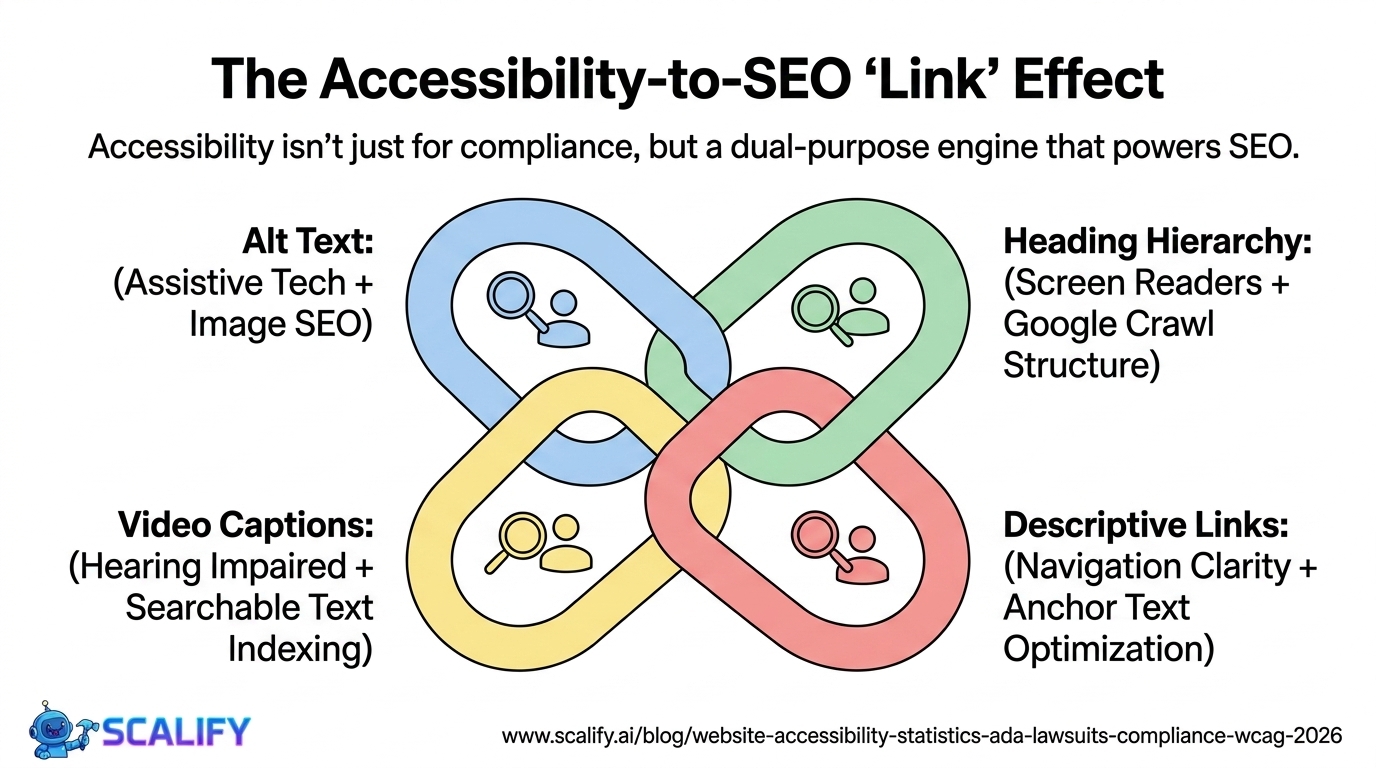
- Alt text for images helps both screen readers and Google Images understand image content
- Semantic HTML structure (proper heading hierarchy, landmark elements) helps both screen readers and Google's crawler understand page structure
- Descriptive link text (not "click here") helps both screen readers and Google understand link context
- Fast loading (important for assistive technology performance) is a Core Web Vitals signal
- Captions and transcripts for video create text content Google can index
An accessible website is almost always a better-SEO'd website. The overlap in best practices is substantial.
Better Experience for Everyone
Curb cuts — the ramped curb cutouts designed for wheelchair users — are used constantly by people with strollers, cyclists, delivery workers, and anyone with heavy rolling luggage. The accessibility feature serves everyone. The same pattern applies to web accessibility:
- High contrast text helps everyone in bright ambient light
- Clear, simple navigation helps users with cognitive limitations and also impatient users
- Video captions help deaf users and also users watching in noise-sensitive environments
- Keyboard navigation helps motor-disabled users and also power users who prefer keyboard shortcuts
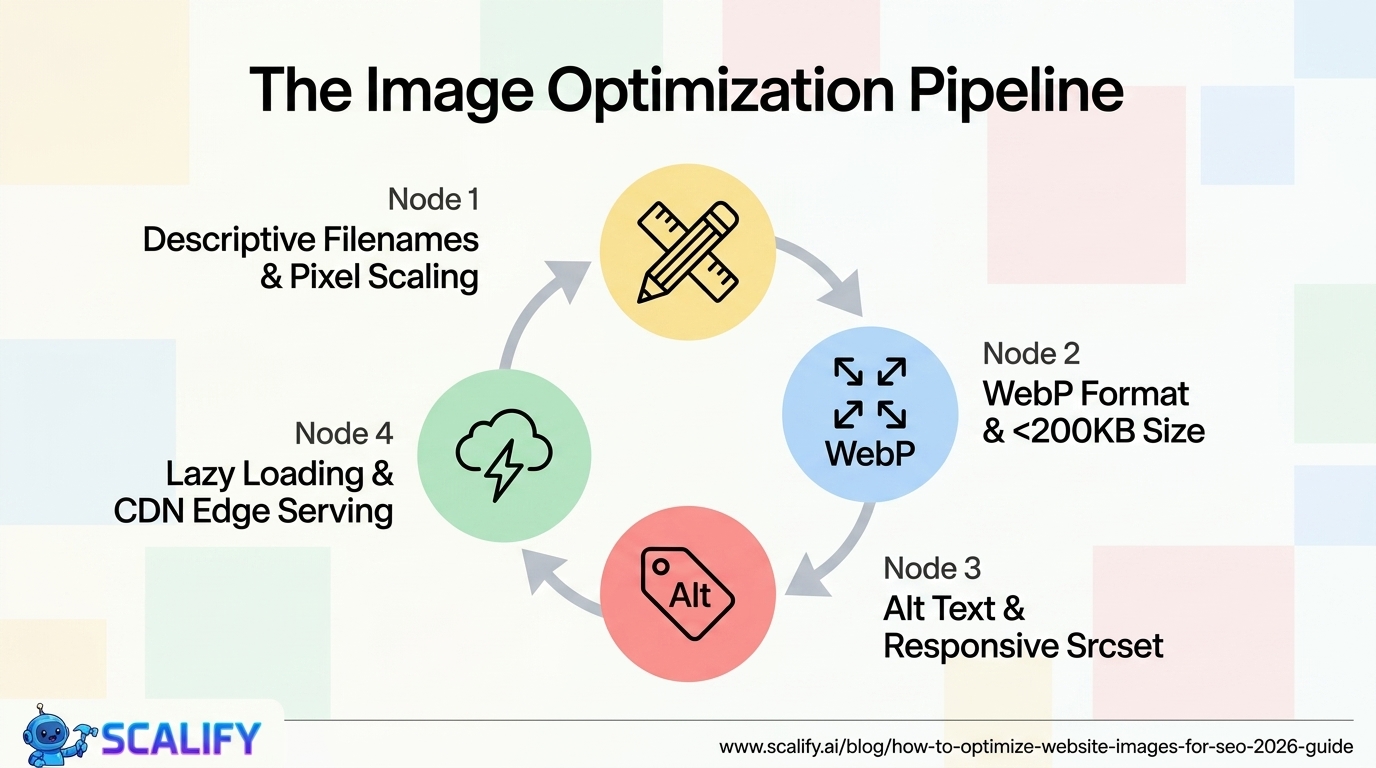
- Alt text helps screen reader users and also users when images fail to load
Designing for accessibility almost always produces designs that are better for everyone — more readable, more navigable, more robust across different contexts.
Brand Reputation
Accessibility signals values. A company that has invested in making its website accessible demonstrates genuine commitment to inclusion — not just marketing talk about diversity and inclusion, but evidence of it. This matters to customers who share these values, to employees who care about their employer's ethics, and to partners and investors who evaluate corporate responsibility.
The Most Common Web Accessibility Failures
Missing Alt Text
The WebAIM Million — an annual study of the accessibility of the top 1 million websites — consistently finds that missing image alt text is the most common accessibility failure, appearing on over 50% of tested pages. For every image that conveys information, alt text must be provided that conveys the same information to users who can't see the image.
Decorative images (purely visual design elements that don't convey information) should have empty alt attributes (alt="") so screen readers skip them. Informative images — charts, diagrams, product photos, team photos — need descriptive alt text.
Insufficient Color Contrast
The second most common failure. WCAG requires a 4.5:1 contrast ratio for normal text against its background. Light gray text on white backgrounds (fashionable in modern flat design) commonly fails. Color-only information communication (red = error, green = success with no other indicator) fails for colorblind users.
Missing Form Labels
Form fields without proper <label> elements are inaccessible to screen readers. Placeholder text alone (the gray hint text inside the field) doesn't serve as an accessible label — it disappears when the user starts typing, leaving screen reader users without field identification during data entry.
Keyboard Inaccessibility
Custom interactive components (dropdowns, modals, tabs, accordions, sliders) built with div or span elements instead of semantic HTML don't inherit the keyboard accessibility of native HTML elements. A custom dropdown that opens on mouse hover with no keyboard equivalent is inaccessible to keyboard-only users.
Cursor-removed CSS (outline: none with no replacement) makes keyboard focus invisible — users who navigate by keyboard have no visual indicator of which element is currently focused.
Missing Video Captions
Videos without captions exclude deaf and hard-of-hearing users from audio content. Auto-generated captions from YouTube or video platforms are often inaccurate — especially for technical content, proper nouns, and accented speech. Human-reviewed captions are the accessibility standard.
Getting Started with Accessibility
Step 1: Automated Audit
Run your site through axe DevTools (browser extension) or WAVE (webaim.org/resources/wave). These free tools automatically detect many WCAG failures and provide specific guidance for fixing them. Automated testing catches approximately 30–40% of accessibility issues — a meaningful starting point but not comprehensive.
Step 2: Manual Testing
Test keyboard navigation: unplug your mouse and navigate the site using only Tab (forward), Shift+Tab (backward), Enter, Space, and Arrow keys. Can you reach every interactive element? Is there always a visible focus indicator? Can you complete your site's primary user flows without a mouse?
Step 3: Screen Reader Testing
Use NVDA (free, Windows) or VoiceOver (built-in, Mac/iOS). Navigate your most important pages. Are images announced with meaningful descriptions? Are form fields properly labeled? Does dynamic content update announce changes? The experience often reveals issues that neither automated tools nor keyboard testing uncover.
Step 4: Remediate in Priority Order
Fix issues by impact: critical barriers that make the site completely unusable for some users (keyboard traps, completely inaccessible forms) first. Then significant issues affecting broad user groups (contrast, alt text, navigation). Then moderate issues affecting specific scenarios.
Step 5: Build into Process
One-time remediation addresses current issues. Sustainable accessibility requires integrating accessibility into the design and development process so new issues don't accumulate. Accessibility review becomes part of design review. Keyboard and screen reader testing becomes part of QA. Alt text is written when images are added, not retroactively after launch.
The Bottom Line
Web accessibility is the practice of building websites that work for all users — including the 1.3 billion people globally who live with disabilities. It's both an ethical obligation and a business opportunity: accessible websites serve more customers, rank better in Google through shared best practices, reduce legal risk, and demonstrate genuine commitment to inclusion.
Start with an automated audit to identify obvious issues. Add keyboard and screen reader testing to find what automation misses. Prioritize fixes by impact. Build accessibility into your process so you're not perpetually remediating new issues. Aim for WCAG 2.1 AA as the appropriate standard for most business websites.
At Scalify, accessibility is part of how we build — semantic HTML, proper contrast, keyboard-navigable interfaces, and alt text as standard practice rather than afterthought, because good websites work for everyone.
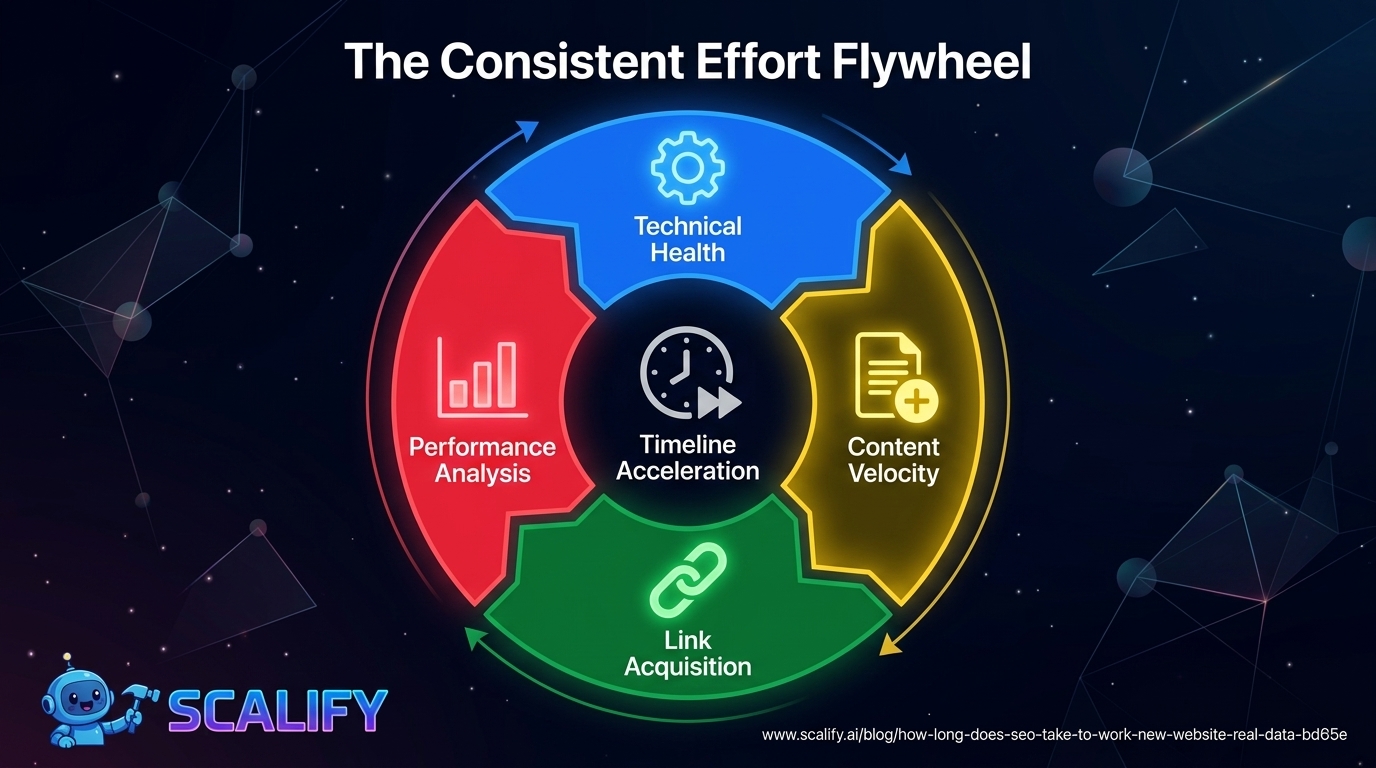
The compounding nature of consistent execution is the most important concept in digital marketing: individual tactics produce modest results; systematic implementation of multiple well-chosen tactics over 12–24 months produces transformative results. Identify the highest-impact improvements available to your specific situation, implement them with measurement infrastructure in place, and build the discipline to iterate based on what the data shows rather than intuition or industry trends that may not apply to your specific business and market.




.jpeg)
.jpeg)


78 SW 7th St, Miami, FL 33130