


What Is Website Accessibility Testing and How Do You Do It?
By Josh Ternyak

March 29, 2026
Most accessibility problems are invisible to the people who build websites — which is exactly why testing matters. This guide covers every method for finding and fixing accessibility issues before they cost you users and legal exposure.
Finding What You Can't See When You're Sighted
Here's the challenge with web accessibility: if you don't have a disability, you won't encounter the problems your site creates for users who do. You won't experience the screen reader announcing "image image image" because alt text wasn't written. You won't get stuck on a form that can't be tabbed through. You won't fail to notice that the error message is communicated only through color — invisible to colorblind users.
Accessibility problems are, by definition, problems experienced by a specific group of users that most developers and designers don't belong to. This is precisely why accessibility testing — deliberately evaluating your site through the lens of users who interact with it differently — is irreplaceable. You cannot find what you're not looking for, and you cannot look for what you haven't learned to see.
This guide covers every meaningful accessibility testing method: the automated tools that catch the obvious issues, the manual testing that catches what automation misses, the real device testing that validates the experience for actual assistive technology users, and the systematic approach that turns one-time fixes into ongoing accessibility culture.
Why Accessibility Testing Matters Beyond Compliance
The accessibility testing conversation usually starts with compliance — WCAG 2.1 AA, ADA requirements, the risk of lawsuits. These are real and valid reasons. But they're not the only reasons.
1.3 billion people. The WHO estimates 16% of the global population lives with some disability. These users aren't edge cases — they're a significant segment of the public. Inaccessible websites exclude them from commerce, information, and services. That exclusion has both ethical and practical dimensions: you're denying access to a large population, and you're leaving business on the table from customers who can't use your site.
Beyond the disability dimension: accessibility improvements consistently improve experience for everyone. Captions help users watching in noisy environments. Keyboard navigation helps power users who prefer keyboard shortcuts. Sufficient color contrast helps users on low-quality screens or in bright sunlight. Alt text helps when images fail to load. The accessibility improvements that serve users with disabilities improve the experience for a much broader population.
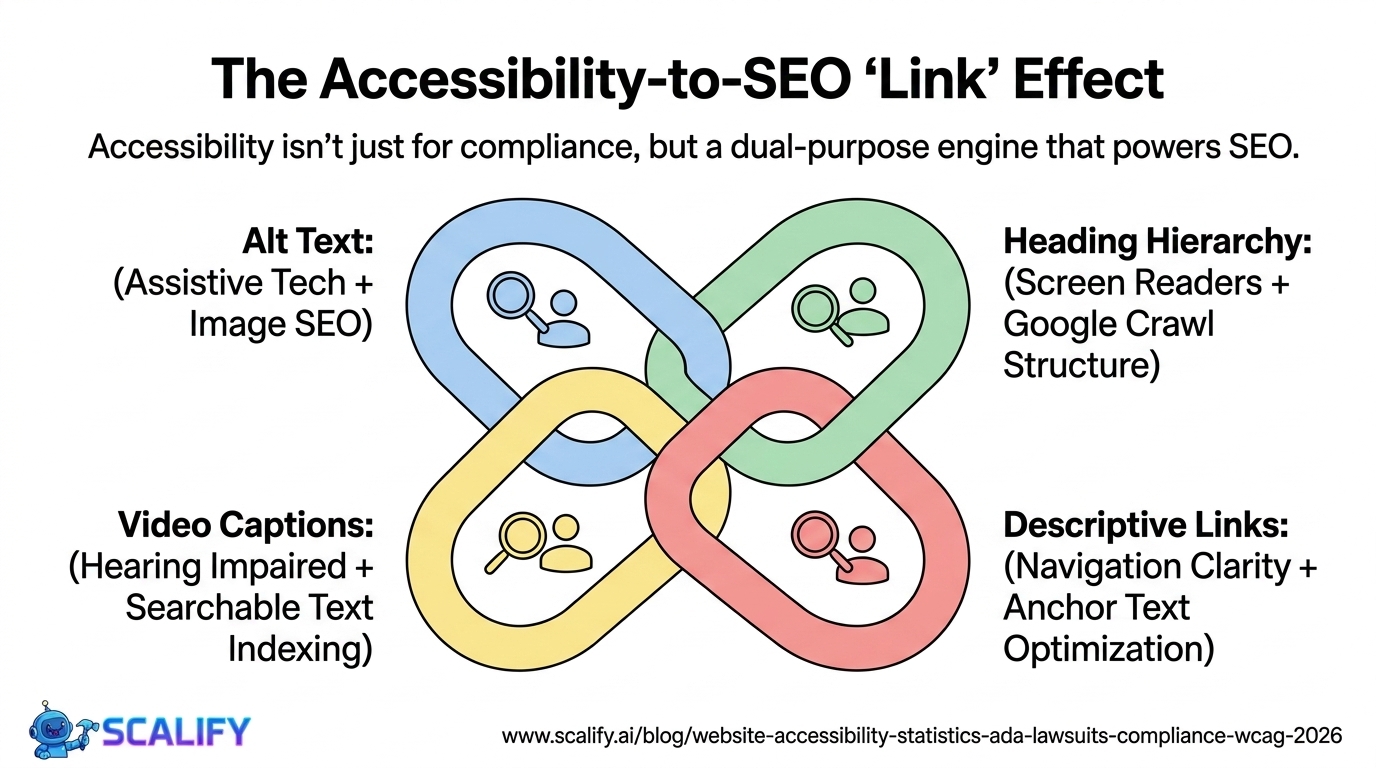
And the SEO dimension: many accessibility best practices — semantic HTML, meaningful link text, image alt text, logical heading hierarchy, fast load times — are also SEO best practices. Investing in accessibility consistently produces SEO improvements as a side effect.
The Accessibility Testing Toolkit
1. Automated Tools: The First Pass
Automated accessibility tools scan your HTML and flag violations of WCAG criteria that can be detected algorithmically. They're fast, consistent, and produce detailed reports. They are not, however, comprehensive — estimates consistently put automated testing at catching about 30–40% of accessibility issues. The majority of real-world accessibility failures require human judgment to detect.
The most useful automated tools:
axe DevTools (browser extension): The most widely-used automated accessibility testing tool. Available as a Chrome and Firefox extension. Run it on any page for an immediate report of violations, impact level (critical, serious, moderate, minor), and specific guidance for fixing each issue. The free version is excellent; the Pro version adds guided testing workflows.
Google Lighthouse: Built into Chrome DevTools (F12 → Lighthouse tab). Runs an accessibility audit alongside performance, SEO, and best practices audits. The accessibility score and specific recommendations are derived from axe's engine. Convenient because it's already in your browser and combines multiple audit types in one run.
WAVE (Web Accessibility Evaluation Tool): Free browser extension and web tool from WebAIM. Produces a visual overlay directly on the page showing accessibility issues in context — you see exactly where problems are located rather than reading through a list of violations. Excellent for understanding the spatial relationship between issues and page content.
AMP (Accessibility Management Platform) / Deque's axe Monitor: For organizations running accessibility testing at scale — across many pages, many sites, regularly over time. Enterprise-tier tools that automate testing across entire site crawls and provide dashboards for tracking accessibility compliance trends.
What automated testing reliably catches: Missing image alt text, insufficient color contrast, missing form labels, missing page language, duplicate IDs, keyboard focus trapping, obvious ARIA misuse. These are the most common and most findable violations.
What automated testing cannot catch: Whether alt text is actually descriptive (a blank alt text is different from a bad alt text), whether heading hierarchy is logical, whether the reading order makes sense, whether the content is understandable, whether keyboard interactions are actually usable for complex components. These require human judgment.
2. Manual Keyboard Testing: The Navigation Check
Keyboard testing is the single most impactful manual accessibility test. It validates whether someone who cannot use a mouse can navigate and use your site. Motor disabilities affect millions of users who rely on keyboard navigation, switch access, or voice control — all of which depend on functional keyboard accessibility.
The basic keyboard test:
1. Open your website in Chrome or Firefox
2. Disconnect or ignore your mouse
3. Navigate using: Tab (move forward through interactive elements), Shift+Tab (move backward), Enter/Space (activate buttons and links), Arrow keys (navigate within components like dropdown menus, radio groups, and tabs)
4. Try to complete your primary user tasks: navigate to the services page, find the contact form, submit a contact form
What you're checking:
Can you reach every interactive element? Every link, button, form field, and interactive component should be reachable by Tab. If Tab skips elements, those elements are inaccessible to keyboard users.
Is there always a visible focus indicator? When you Tab to an element, you should see a clear visual indicator of which element is focused — a highlight, outline, or other visible change. Many CSS resets and design choices remove the default browser focus outline (often with outline: none). Without visible focus, keyboard users can't tell where they are on the page. This is one of the most common accessibility failures on modern websites.
Is the focus order logical? Tab should move focus in a logical order that mirrors the visual layout. If focus jumps from the header to the footer to the middle of the page to a sidebar, the reading order is broken and navigation is confusing.
Can you escape any context? Modal dialogs, dropdown menus, and other overlay components should be dismissible with the Escape key and should trap focus within them (focus shouldn't escape to the page behind the modal while it's open).
Do all interactive elements have keyboard-accessible functions? A custom dropdown built with div elements instead of native select might look like a dropdown but might not respond to arrow keys the way a native select does. Custom UI components require explicit keyboard interaction implementation.
3. Screen Reader Testing: The Real Assistive Technology Test
Screen readers are software that reads page content aloud and provides navigation mechanisms for blind and low-vision users. Testing with an actual screen reader reveals how your site communicates to users who can't see the visual interface.
Getting started with screen readers:
NVDA (Windows, free): The most widely-used screen reader on Windows. Download from nvda-project.org. Pair with Firefox or Chrome. The most important keyboard shortcuts: Insert+F7 (elements list — shows all headings, links, and form elements), H (navigate by heading), Enter (follow link), Space (activate button).
VoiceOver (Mac/iOS, built-in): Turn on with Command+F5 on Mac. VoiceOver with Safari is the dominant combination for iOS/Mac users. On iPhone, turn on in Settings → Accessibility → VoiceOver. Three-finger swipe to navigate, double-tap to activate.
JAWS (Windows, paid): The most-used screen reader in enterprise and professional contexts. Expensive but often available through free trial. Important for testing if your audience includes enterprise users who may be using JAWS.
What to listen for during screen reader testing:
Images: Are informative images described? The screen reader should read meaningful alt text, not "image" or the filename. Decorative images should be silent (empty alt attribute).
Form labels: When you navigate to a form field, does the screen reader announce what the field is for? "Email address, required, text field" is correct. "Text field" alone is insufficient.
Buttons and links: Are interactive elements described with meaningful names? "Submit" is usable. "Click here" is not — it provides no context about what happens when activated.
Heading structure: Navigate by heading (H key in NVDA). Does the heading structure provide a logical outline of the page? H1 → H2 → H3 → H2 → H3 hierarchy makes the page navigable by heading; H1 → H4 → H2 → H5 creates confusion.
Dynamic content updates: When content changes without a page reload (form validation messages, live search results, loading spinners), are those changes announced to the screen reader? Dynamic content that appears visually but isn't announced is invisible to screen reader users.
4. Color Contrast Testing
Contrast testing ensures that text is readable by users with color vision deficiencies or reduced visual acuity. WCAG requires a 4.5:1 contrast ratio for normal text and 3:1 for large text.
Tools:
WebAIM Contrast Checker (webaim.org/resources/contrastchecker): Enter foreground and background colors, see the ratio and whether it passes WCAG AA and AAA levels. Also shows how the color combination looks to different types of color vision deficiency.
Colour Contrast Analyser (desktop app, free from TPGi): Picks colors from your screen using an eyedropper — useful for checking contrast in your actual rendered pages rather than theoretical color values. Shows real-time ratio as you hover over different elements.
Stark (Figma plugin): Checks contrast in designs before they're built, catching issues during design rather than after development.
Common contrast failures to check: Light gray text on white backgrounds, colored text on colored backgrounds (any text on a non-white background), white text on medium-value backgrounds, placeholder text in form fields (typically much lower contrast than label text), and disabled state text.
5. Zoom and Text Scaling Testing
WCAG requires that content doesn't lose functionality when text is scaled to 200%. Many users with low vision rely on browser text scaling or system-level zoom as their primary accessibility accommodation.
Test: In Chrome (Settings → Appearance → Font size), increase text size to Very Large. Or use browser zoom (Ctrl/Cmd + until the page reaches 200%+). Navigate the site at this zoom level:
- Is content still readable? Does text overflow its containers?
- Does horizontal scrolling appear when it shouldn't?
- Do interactive elements remain accessible and tappable?
- Do dropdown menus still work?
- Are any elements hidden or truncated that shouldn't be?
Fixed-width layouts often break at high zoom levels. Layouts built with flexible units (rem, em, %, vw) are more resilient to zoom.
6. Real Device Testing with Mobile Screen Readers
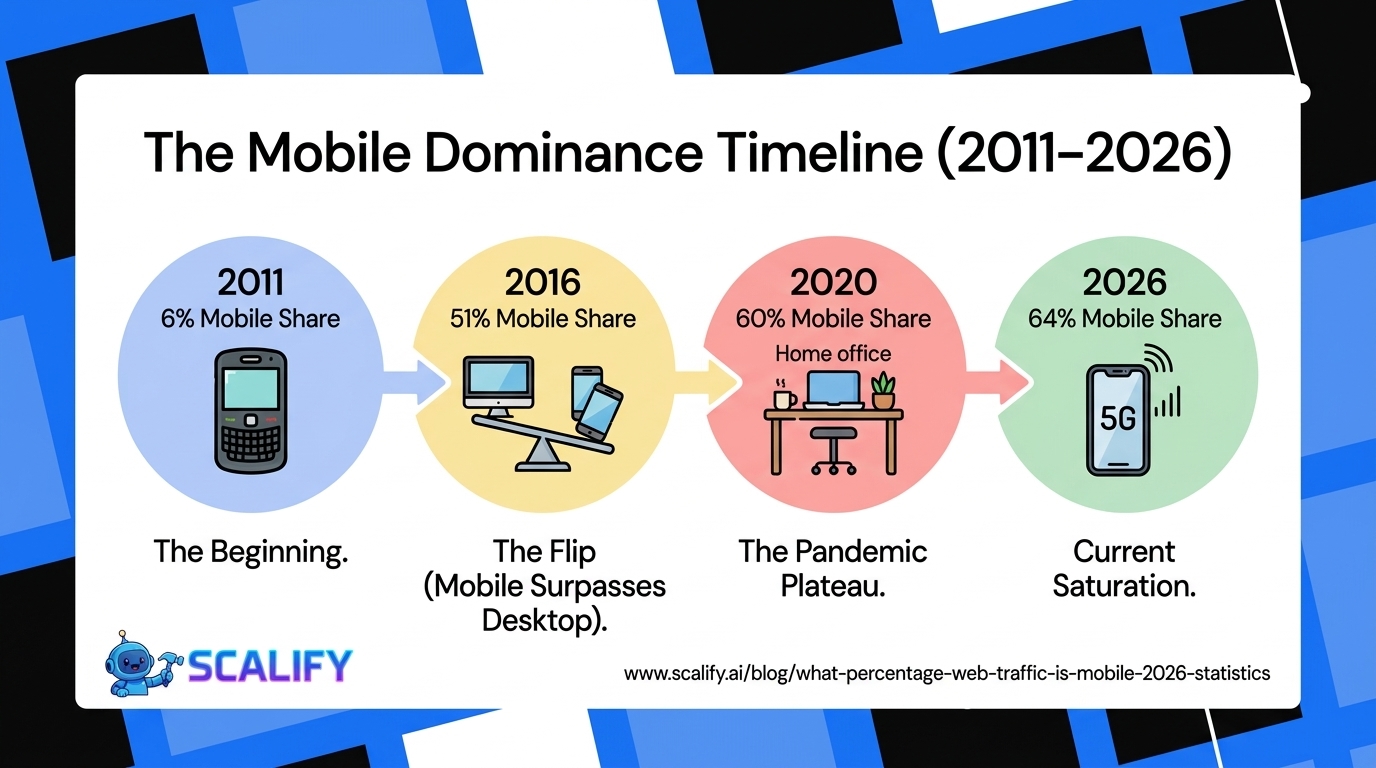
Given that over 60% of web traffic is mobile, testing with mobile screen readers is as important as desktop testing. VoiceOver on iPhone and TalkBack on Android are the dominant mobile screen readers.
Mobile screen reader behavior is different from desktop — the interaction model is gesture-based (swipe right to move to next element, double-tap to activate) rather than keyboard-based. Features that pass desktop keyboard testing may behave differently with mobile screen readers.
Focus particularly on: custom interactive components (carousels, tabs, accordions), forms and form submission, modal dialogs, and any custom gesture-based interactions.
7. Cognitive Accessibility Review
Cognitive accessibility — ensuring content is understandable to people with cognitive disabilities — is the most subjective and most commonly overlooked aspect of accessibility testing. It includes:
Plain language: Is the content written at an appropriate reading level? Are technical terms explained? Is jargon avoided or defined?
Consistent navigation: Does the navigation appear in the same location and work the same way across all pages?
Error prevention and recovery: Are forms forgiving? Can actions be undone? Are error messages specific and actionable?
No time limits: Are there any time-based interactions that force decisions before users are ready?
No distracting animations: Does any content flash, blink, or move in ways that can trigger seizures or create distraction?
Building an Accessibility Testing Process
During Design
The cheapest time to catch accessibility issues is before anything is built. Design-phase accessibility checks:
- Color contrast checks on all text/background combinations using Stark or Colour Contrast Analyser
- Color not used as the sole communication mechanism (error states use text + icon, not just red)
- Visible focus styles designed for all interactive elements
- Sufficient touch target sizes (minimum 44×44px for interactive elements)
- Form designs with persistent labels (not just placeholder text)
During Development
- Run axe DevTools on each page template as it's built
- Keyboard test each template's key user journeys
- Verify alt text implementation as images are added
- Verify heading hierarchy as pages are structured
- Test ARIA implementation on any custom components
Pre-Launch
- Comprehensive axe DevTools scan on all unique page templates
- Full keyboard testing of all critical user flows
- Screen reader testing on key pages (homepage, primary service/product page, contact/checkout)
- Zoom testing at 200% on all templates
- Mobile screen reader spot-check on key flows
Ongoing
- Include accessibility testing in any new feature development process
- Run automated scans quarterly (or monthly for high-profile sites)
- Invite users with disabilities to provide feedback through a dedicated feedback mechanism
- Track and remediate issues in a documented log
Prioritizing What to Fix
When testing reveals multiple accessibility issues (and it will), prioritize remediation by:
Impact severity: Critical issues (keyboard trapping, broken screen reader navigation, complete form inaccessibility) first. These make the site unusable for entire categories of users.
Affected page importance: Issues on your homepage and primary conversion pages get fixed before issues on deep archive pages.
Fix complexity vs. impact ratio: Some fixes are trivial (adding alt text, fixing contrast by adjusting a color value) and have high impact. Some fixes are complex (re-architecting a custom component for accessibility) and should be scheduled. Do the quick wins immediately; plan the complex work into development sprints.
The Bottom Line
Accessibility testing is how you find the problems your users with disabilities are experiencing but can never tell you about — because they've already left your site. Automated tools provide the first pass. Manual keyboard testing finds the navigation failures. Screen reader testing reveals the experience gaps. Contrast testing catches the visual failures. Together they produce a comprehensive picture of where your site fails users who interact with it differently.
Build testing into your process rather than treating it as a one-time audit. Accessibility achieved and then left untested degrades as the site evolves. The sites that maintain genuinely good accessibility have made testing a regular part of their development culture, not a compliance exercise they perform before a launch.
Every website Scalify builds goes through an accessibility review process — semantic HTML, proper contrast, keyboard-navigable interfaces, and ARIA implementation where needed — because accessibility isn't an add-on; it's how good websites are built.




.jpeg)
.jpeg)

78 SW 7th St, Miami, FL 33130