


What Is a Website Audit Tool and Which Ones Are Actually Worth Using?
By Josh Ternyak

April 1, 2026
Comprehensive guide: What Is a Website Audit Tool and Which Ones Are Actually Worth Using?
The Software That Finds What's Broken Before Google Does
Your website has problems you don't know about. Pages that aren't indexed because of a misconfigured robots.txt rule. Images missing alt text across 80% of blog posts. A redirect chain that's dissipating link equity from your best backlinks. A page loading in 6 seconds on mobile because of an unoptimized hero image. Internal links pointing to 404 pages.
None of these announce themselves. They accumulate silently, each one incrementally limiting the organic traffic and conversion performance your site could be achieving. The only way to find them — before they compound into serious performance problems — is systematic auditing with the right tools.
Website audit tools automate the discovery of technical, on-page, and performance issues that manual review would take days to find. But the market is crowded with tools that overlap significantly, and using all of them indiscriminately produces more confusion than clarity. This guide covers which tools are genuinely valuable, what each specializes in, and how to combine them for comprehensive auditing without redundancy.
The Categories of Website Audit
Before the tools, the categories — because different tools excel at different audit dimensions:
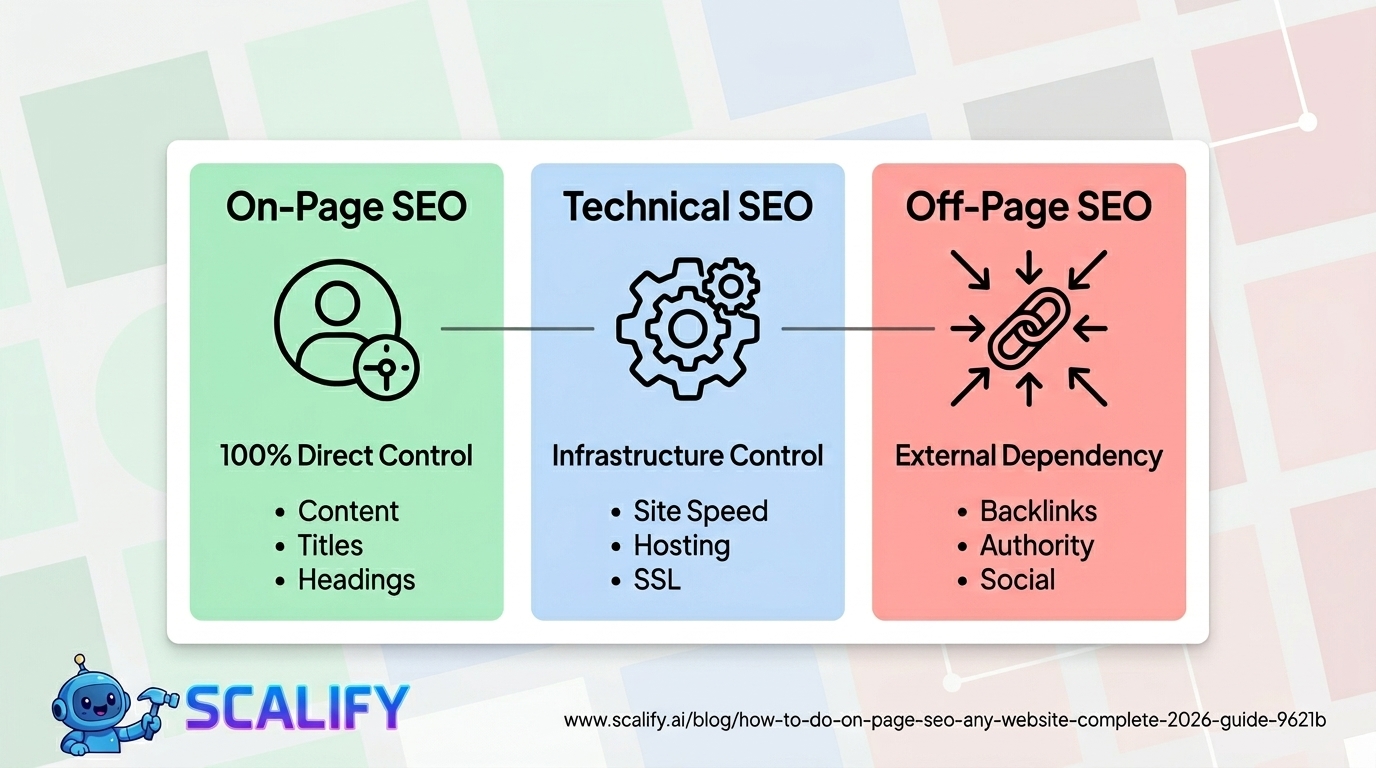
Technical SEO audit: Crawlability, indexation, redirect issues, canonical tags, structured data, page speed, mobile-friendliness.
On-page SEO audit: Title tags, meta descriptions, heading structure, keyword optimization, internal linking, duplicate content.
Performance audit: Core Web Vitals, page load time, resource optimization, rendering performance.
Backlink audit: Link profile quality, toxic links, lost links, link opportunities.
Content audit: Content quality, thin content, duplicate content, outdated content, content gaps.
UX/Conversion audit: User flow analysis, conversion funnel performance, heatmaps, form analytics.
Accessibility audit: WCAG compliance, screen reader compatibility, keyboard navigation, color contrast.
No single tool covers all categories well. A comprehensive audit requires combining specialized tools.
The Essential Website Audit Tools
1. Google Search Console (Free) — The Ground Truth
Any audit starts here. Google Search Console is not a third-party estimate of your site's performance — it's Google's own data about how it sees and interacts with your site.
What to audit in Search Console:
Coverage/Pages report: How many pages are indexed? What pages are excluded and why? "Crawled — currently not indexed" pages often indicate thin or duplicate content issues. "Excluded by noindex tag" pages should be verified as intentionally excluded. "Not found (404)" errors need redirect or content restoration.
Core Web Vitals report: Field data (real user experience) showing which pages have Poor, Needs Improvement, or Good scores. The Poor pages list is your performance fix priority list.
Performance report: Which queries drive impressions and clicks? Which pages have high impressions but low CTR? Which pages are ranking in positions 11–20 (closest to page 1 — worth optimization attention)?
Manual Actions: Any Google penalties? If this section is clear, no penalty issues exist.
Links report: Which pages have the most external backlinks? Which domains link to you most frequently?
Best for: Understanding Google's actual assessment of your site. Non-negotiable as the starting point for any SEO audit.
2. Google PageSpeed Insights (Free) — Performance Diagnostics
Provides both field data (from Chrome User Experience Report for pages with sufficient traffic) and lab data (synthetic test from Google's infrastructure). The lab data is particularly valuable for diagnosis — it identifies specific resources, code patterns, and configurations causing performance issues and estimates the improvement from fixing each one.
Run on your homepage, top service pages, and highest-traffic blog posts. The "Opportunities" section in lab data is your performance fix list, ranked by estimated impact. The field data shows whether the performance issues are actually affecting real users.
Best for: Diagnosing Core Web Vitals issues with specific, actionable improvement recommendations.
3. Screaming Frog SEO Spider (Free up to 500 URLs, £149/year for unlimited)
The most widely used SEO crawling tool among professionals. Screaming Frog crawls your website like a search engine would, pulling data on every URL it discovers. The resulting dataset allows bulk analysis of on-page elements across every page simultaneously.
What Screaming Frog audits:
The free version handles sites up to 500 URLs — adequate for most small business sites. Larger sites require the paid license.
Best for: Comprehensive technical and on-page SEO audits, especially the bulk analysis of title tags, meta descriptions, and link architecture across an entire site.
4. Ahrefs Site Audit (Paid — $99–$449/month)
Ahrefs' cloud-based site audit crawler combines technical SEO auditing with integration into Ahrefs' backlink database, keyword rankings, and content analysis. The Site Audit component identifies technical issues (similar to Screaming Frog) and presents them in a prioritized health score with categorized issue lists.
Ahrefs-specific audit capabilities:
Best for: Teams doing regular, ongoing SEO work who also use Ahrefs for keyword research and backlink analysis. The integrated platform is more efficient than managing multiple separate tools.
5. Semrush Site Audit (Paid — $119–$449/month)
Similar scope to Ahrefs Site Audit, with some differences in issue detection methodology and interface design. Semrush's Site Audit categorizes issues by severity and provides a site health score. The On-Page SEO Checker component provides specific optimization recommendations for individual pages.
Best for: Teams already using Semrush for keyword research who want audit functionality in the same platform.
6. Lighthouse / Chrome DevTools (Free)
Google's open-source automated auditing tool, built into Chrome DevTools (F12 → Lighthouse tab). Runs audits in four categories: Performance, Accessibility, Best Practices, and SEO. Each produces a score (0–100) and specific flagged issues with documentation.
The advantage over PageSpeed Insights: you can run Lighthouse directly on your local development environment before publishing, catching issues before they go live. Also produces a more comprehensive SEO audit than PageSpeed Insights (checking for missing title tags, missing meta descriptions, non-crawlable links, and many other SEO fundamentals alongside performance).
Best for: Pre-launch QA, quick on-demand audits of any page, and accessibility + performance + SEO combined in a single tool.
7. Screaming Frog Log File Analyser (Free up to 1,000 lines)
A separate tool for analyzing server log files — the actual record of which URLs Googlebot has been crawling, how often, and with what response codes. Log file analysis provides the most accurate picture of real Googlebot crawl behavior (vs. simulated crawls from audit tools).
Reveals: which pages Googlebot actually visits vs. which it ignores, crawl frequency per URL, which URLs are getting crawl budget consumed by non-important pages, and whether recent site changes are being discovered.
Best for: Technical SEO professionals investigating crawl budget issues on large sites or diagnosing why specific pages aren't being indexed.
8. Ahrefs / Semrush Backlink Audit (Paid)
Both Ahrefs and Semrush provide comprehensive backlink audit tools that identify: all links pointing to your site, the authority and relevance of linking domains, toxic or potentially harmful links, links you've recently lost (link reclamation opportunities), and the anchor text distribution across your link profile.
Ahrefs' backlink database is generally considered more comprehensive and faster to update than Semrush's, though both are significantly better than Google Search Console's backlink data for a complete link audit.
Best for: Understanding your link profile health, identifying disavowal candidates, and finding link building opportunities.
9. WebPageTest.org (Free)
The most detailed free performance testing tool available. Where PageSpeed Insights provides summary scores, WebPageTest provides a detailed waterfall chart showing every resource loaded, in what order, taking how long, from which server. It tests from real browsers in multiple geographic locations, at multiple connection speeds, and shows screenshots of what the page looks like at different points during loading.
The information density is significantly higher than PageSpeed Insights — appropriate for diagnosing complex performance issues that high-level scores don't reveal.
Best for: Deep performance diagnosis when PageSpeed Insights has identified a problem but the cause isn't clear from its recommendations alone.
10. WAVE / axe DevTools (Free) — Accessibility
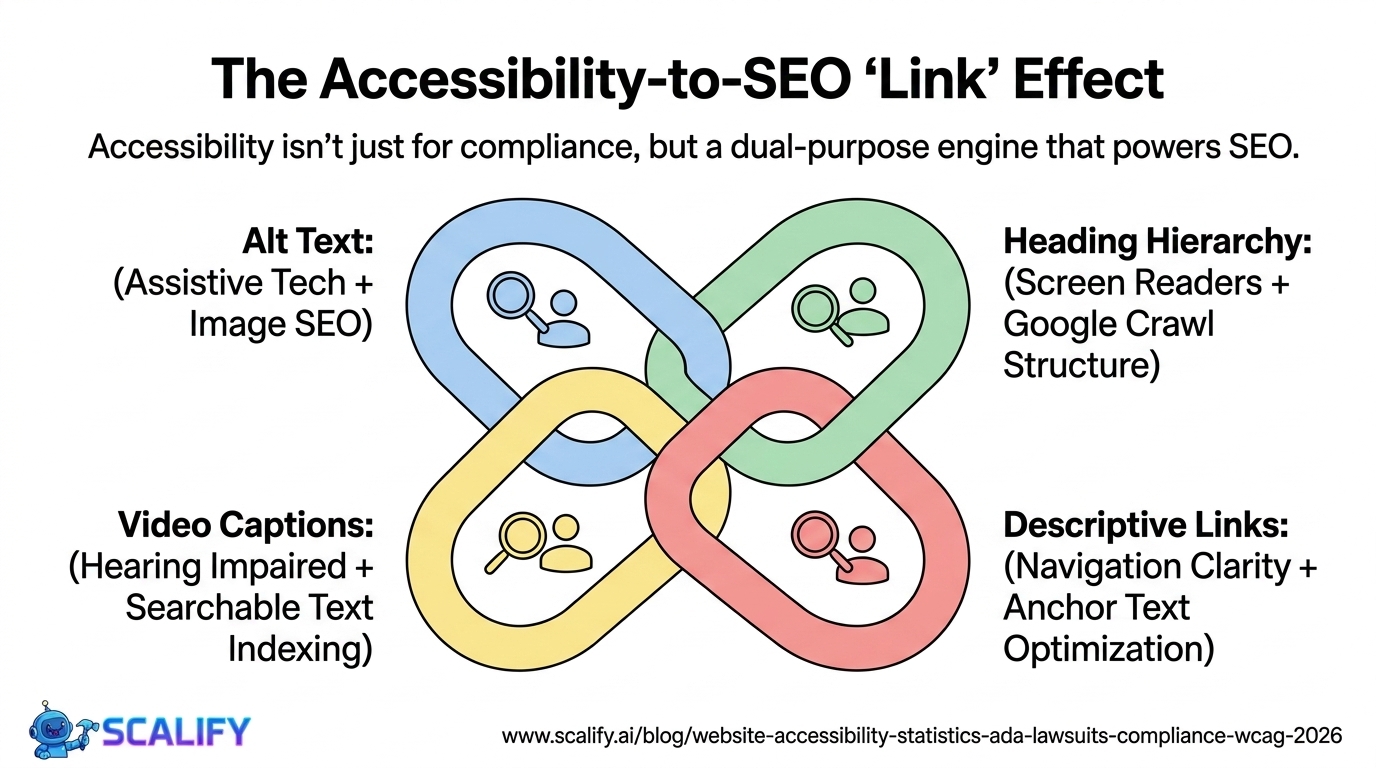
WAVE (webaim.org/resources/wave) and axe DevTools (browser extension) are the primary tools for automated accessibility auditing. Both identify WCAG violations across a page and provide specific guidance for remediation.
axe DevTools integrates with Chrome DevTools (accessible through the DevTools panel) and identifies issues with severity ratings, affected elements, and fix guidance. WAVE shows issues as a visual overlay directly on the page — useful for understanding the spatial relationship between issues and page layout.
Best for: Accessibility auditing for WCAG 2.1 AA compliance, legal risk reduction, and inclusive UX practice.
Building a Website Audit Process
With this toolkit, here's a practical audit workflow:
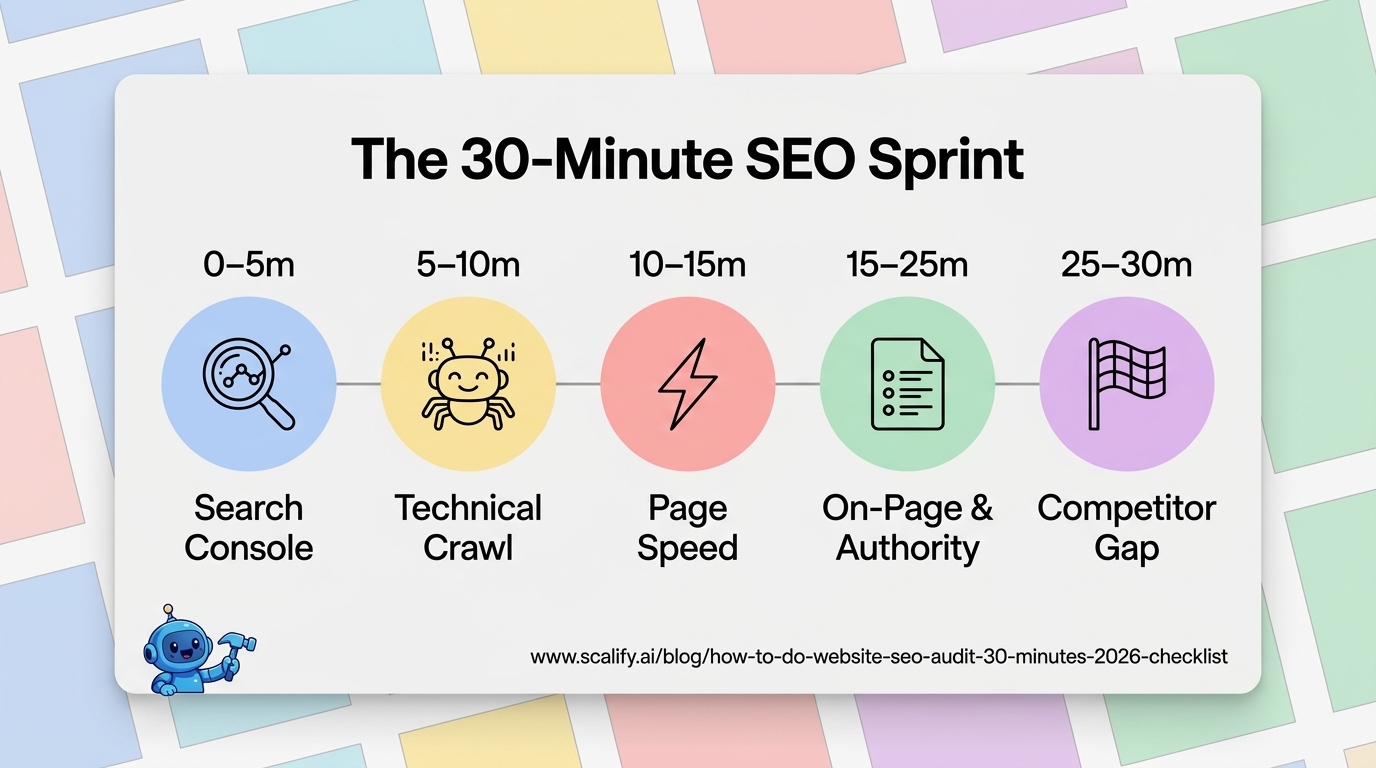
Monthly (30 minutes):
Quarterly (2–4 hours):
Annually (half day):
Prioritizing What to Fix
Audits produce long lists of issues. Priority framework:
Fix immediately: Anything blocking Google from crawling or indexing key pages (robots.txt errors, sitemaps with broken URLs, noindex on important pages). Broken checkout or contact forms. Security issues. Any issue affecting more than 20% of pages.
Fix within 1–2 weeks: Core Web Vitals issues on high-traffic pages. Missing title tags on important pages. Redirect chains on linked URLs. Pages with significant organic traffic and poor on-page optimization.
Fix within 1 month: Missing alt text across images. Duplicate title tags. Broken internal links. Pages in positions 11–20 that could be optimized to first page.
Schedule for future: Minor performance improvements on low-traffic pages. Non-critical accessibility issues. Content improvements on low-performing posts.
The Bottom Line
The essential website audit toolkit: Google Search Console and PageSpeed Insights (free, always active), Screaming Frog for comprehensive technical and on-page crawl audits, Lighthouse for combined performance/SEO/accessibility, and WAVE or axe for dedicated accessibility testing. Add Ahrefs or Semrush if budget allows for deeper SEO analysis and backlink auditing.
The audit process matters as much as the tools: regular scheduled audits rather than reactive auditing when something obviously breaks, prioritized fix lists rather than attempting to fix everything at once, and measurement after fixes to verify that changes produced the expected improvements.
At Scalify, every website we build goes through a pre-launch audit checklist — Lighthouse, accessibility tools, and manual testing — so sites launch with a clean technical foundation rather than accumulating problems from day one.
Building a Regular Website Audit Routine
Website auditing is most valuable as a regular practice rather than a reactive one. A website that's audited quarterly catches technical drift (newly broken links, new crawl errors, performance regression) before it accumulates into significant ranking or conversion impact. A website audited only when problems become obvious has typically lost months of traffic and conversions that regular auditing would have prevented. The minimum audit cadence for any business-critical website: monthly crawl error check in Google Search Console, quarterly full technical audit with a crawl tool, bi-annual content audit comparing rankings and traffic against targets, and annual competitive benchmark comparing your site's performance against competitors using shared target keywords.
The output of each audit should be a prioritized action list — not a raw technical report — with each issue classified by: severity (how much traffic or conversion impact is the issue causing or risking?), effort to fix (how much developer time is required?), and confidence (how certain are we that fixing this specific issue will produce the expected improvement?). Prioritizing high-severity, low-effort, high-confidence fixes first produces the fastest ROI from audit investment. Deferring complex, uncertain improvements in favor of clear quick wins is the most effective audit execution discipline for teams with limited development capacity.
At Scalify, website audits are a standard part of our client onboarding process — ensuring every website we inherit or build has a clean technical foundation before optimization work begins.
Putting It All Together: The Strategic Perspective
The most important takeaway from any technical or strategic guide is that individual tactics only produce results when they're embedded in a coherent strategy and executed consistently. A single well-optimized page, a single great testimonial, or a single speed improvement produces modest impact. The same investments compounded over 12–24 months — more optimized pages, more testimonials placed strategically, systematic performance maintenance — produce the compounding returns that separate high-performing websites from average ones in the same competitive landscape.
Every improvement documented in this guide is most valuable when it's implemented as part of a systematic, data-driven approach: measure current performance, identify the highest-impact opportunity, implement the improvement, measure again, and iterate. The businesses that achieve exceptional digital marketing results are almost never those who found a single breakthrough tactic — they're those who executed fundamentals consistently, measured what worked, and allocated their resources toward the highest-ROI improvements available at each stage of the



.jpeg)
.jpeg)


78 SW 7th St, Miami, FL 33130