


What Is a Website Hosting Plan and How Do You Choose the Right One?
By Josh Ternyak

March 29, 2026
Web hosting is where your website actually lives — and the wrong choice costs you in speed, reliability, and security. This guide breaks down every hosting type, what you actually need, and how to avoid expensive mistakes.
The Foundation Your Entire Website Depends On
Every website lives somewhere. The files, the database, the code — all of it sits on a server in a data center somewhere in the world, waiting to respond to requests from browsers around the globe. Web hosting is the service that provides that server space, and the quality of your hosting directly determines how fast your site loads, how reliably it stays online, and how secure it is against attack.
Most business owners treat hosting as a commodity — find the cheapest option, sign up, and forget about it. This produces predictable results: sites that load slowly, go down at inconvenient times, and require constant firefighting when security issues emerge. The difference between $5/month hosting and $30/month managed hosting is not just price. It's performance, reliability, and the time you spend dealing with hosting problems.
This guide explains every type of hosting, what each is actually appropriate for, how to evaluate the claims hosting companies make, and how to choose the right plan for your situation without overpaying or undershooting.
What Web Hosting Is
Web hosting is a service that provides the server infrastructure needed to make your website accessible on the internet. When someone types your domain name into a browser, the browser contacts a server operated by your hosting provider, which responds by delivering your website's files. The speed, reliability, and security of that server directly affects every visitor's experience of your website.
Hosting services vary enormously in what they include: some provide just server space and basic infrastructure; others include domain registration, email accounts, SSL certificates, automated backups, malware scanning, performance optimization, and technical support. The right hosting plan for your business depends on the type of website you're running, your technical capabilities, your traffic volume, and how much of the infrastructure management you want to handle yourself.
The Main Types of Web Hosting
Shared Hosting ($3–$15/month)
The most common entry-level hosting type. Your website shares server resources — CPU, RAM, disk space — with hundreds or thousands of other websites on the same physical server. Hosting providers achieve economies of scale by filling servers with many tenants, passing some of those savings to customers through low prices.
When shared hosting works: Personal blogs, early-stage websites with minimal traffic, hobby projects, and sites where load times and reliability aren't critical business factors.
When shared hosting fails: Any site that needs consistent performance, because shared hosting means your performance is affected by what other sites on your server are doing. A "noisy neighbor" — another site on your server experiencing a traffic spike or running inefficient code — can slow your site even when it has no traffic of its own. This is the defining limitation of shared hosting and why it's inappropriate for any site where performance matters.
Security risk: Shared hosting environments can allow security vulnerabilities in one account to affect others on the same server. A compromised site on your server doesn't automatically compromise yours, but it creates a higher-risk environment than isolated hosting.
Providers: Bluehost, HostGator, DreamHost, SiteGround's shared plans. All charge $3–15/month but often discount heavily for the first term and renew at significantly higher rates — read renewal pricing, not introductory pricing.
Virtual Private Server (VPS) Hosting ($15–$80/month)
VPS hosting uses virtualization to partition a physical server into isolated virtual machines. Each VPS has dedicated allocations of CPU, RAM, and storage — your resources are yours regardless of what other VPS instances on the same physical server are doing. You get more consistent performance than shared hosting, more control over server configuration, and better isolation.
When VPS works: Growing websites that have outgrown shared hosting's performance ceiling, developers who need root server access to install custom software, businesses running multiple WordPress sites, and any application that needs predictable resource allocation but doesn't justify a dedicated server.
The management requirement: Unmanaged VPS hosting requires you to configure the server, install and maintain software, handle security updates, and troubleshoot server-level issues yourself. This requires real Linux server administration knowledge. Managed VPS hosting handles these tasks for you at higher cost — typically $50–100+/month — but eliminates the technical burden.
Providers: DigitalOcean, Linode (Akamai Cloud), Vultr (unmanaged, developer-focused); Liquid Web, Kinsta (managed VPS for WordPress).
Managed WordPress Hosting ($25–$150/month)
Purpose-built hosting specifically optimized for WordPress. Managed WordPress hosts configure server environments to maximize WordPress performance (PHP versions, caching layers, database optimization), handle WordPress-specific security (WordPress core and plugin update management, malware scanning), provide automated daily backups with one-click restore, and offer support teams with genuine WordPress expertise.
This is the right choice for most serious WordPress sites. The price premium over shared hosting is justified by: significantly better performance (managed WordPress hosts consistently outperform shared hosting on WordPress benchmarks), dramatically less maintenance overhead (you're not managing server software), and the confidence of knowing your site is secured by people who specialize in WordPress environments.
What to look for: Automatic daily backups with easy restore, staging environments (test changes before pushing to production), malware monitoring and cleanup, performance optimization infrastructure (built-in caching, CDN integration), and support staff who actually know WordPress deeply.
Providers: Kinsta ($35–600/month depending on scale, consistently rated best), WP Engine ($25–500+/month, strong enterprise features), SiteGround ($15–90/month, good value at smaller scale), Flywheel ($15–290/month, excellent for agencies).
Cloud Hosting ($5–variable)
Cloud hosting runs your website across a distributed network of servers rather than a single physical machine. Resources scale elastically — when traffic spikes, more resources are automatically provisioned; when traffic drops, resources are released. You pay for what you use rather than a fixed monthly allocation.
The major cloud providers: Amazon Web Services (AWS), Google Cloud Platform, and Microsoft Azure dominate cloud infrastructure. These are primarily developer platforms requiring substantial technical expertise to configure and manage. Most businesses using cloud hosting do so through intermediaries (managed services built on top of AWS or GCP) rather than managing cloud infrastructure directly.
When cloud hosting makes sense: Applications with variable or unpredictable traffic (can't provision for peak capacity when most of the time traffic is low), applications that need to be highly available globally, and large-scale sites where the cost efficiency of pay-per-use justifies the operational complexity.
Modern static site cloud hosting: Vercel, Netlify, and Cloudflare Pages are cloud hosting specifically for static sites and JAMstack applications — technically cloud hosting but with dramatically simpler management. Free tiers handle significant traffic; paid plans start at $20/month. Ideal for Next.js, Gatsby, Hugo, and other static or server-rendered modern web frameworks.
Dedicated Server Hosting ($80–$400+/month)
An entire physical server allocated exclusively to your website(s). No resource sharing with any other customer. Maximum performance, maximum control, maximum cost. Requires either significant server administration expertise or a managed hosting service to handle it.
When dedicated servers are appropriate: High-traffic websites that consume significant server resources, applications with specific hardware requirements, businesses with strict data isolation requirements, and hosting environments for multiple high-traffic client sites.
For most businesses: Cloud hosting or managed VPS provides comparable performance with lower operational overhead and better cost efficiency. Dedicated servers are largely a legacy category that modern cloud and managed hosting approaches have supplanted for most use cases.
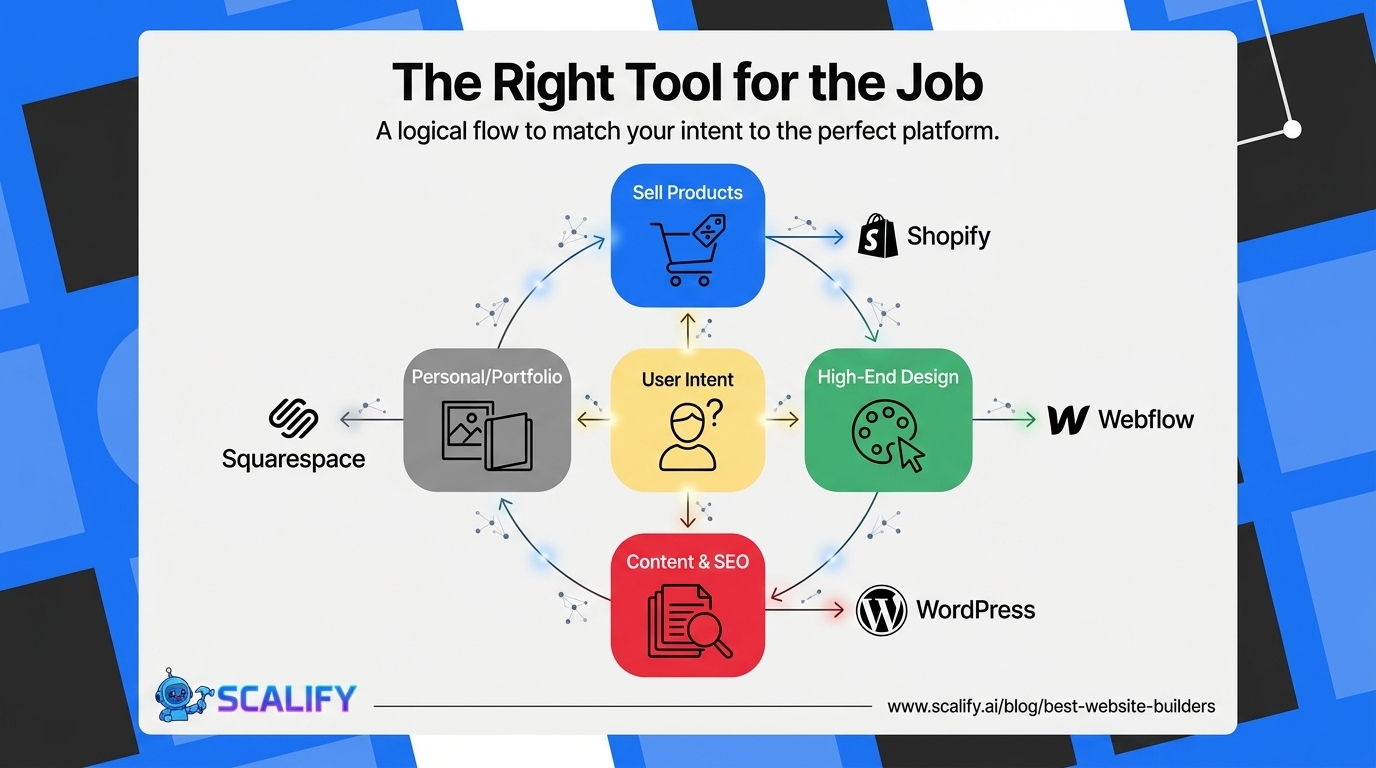
Platform-Included Hosting (Webflow, Shopify, Squarespace)
Website builders and e-commerce platforms include hosting as part of their subscription. Your monthly subscription fee covers both the software and the infrastructure to run it. You never think about servers, configurations, or hosting providers — it's just part of the platform.
The trade-off: Convenience and lower maintenance overhead in exchange for less flexibility and potentially higher cost per month compared to self-managed hosting. But when you factor in the time savings from not managing hosting infrastructure, platform-included hosting is often the better economic choice for non-technical business owners.
Webflow hosts on Fastly CDN — one of the best CDN networks available. Shopify uses similar enterprise-grade infrastructure. Page load times on these platforms are typically excellent out of the box, often better than self-managed WordPress on comparable hosting budgets.
Key Factors to Evaluate in Any Hosting Plan
Uptime and Reliability
Uptime is the percentage of time your site is accessible to visitors. "99.9% uptime" sounds excellent until you calculate it: that's 8.7 hours of downtime per year. "99.99% uptime" is 52 minutes per year. The difference matters for any business where the website generates significant revenue.
Marketing claims of "99.9% uptime" are made by virtually every provider regardless of actual performance. The only reliable evaluation method: third-party monitoring data. Cloudflare publishes reliability data for its hosted sites. Review sites like Trustpilot and G2 contain real user reports of downtime frequency. Check whether the provider offers uptime SLAs with actual penalties for failures — providers willing to put money behind their uptime guarantees have more credibility than those making unverifiable claims.
Server Location and CDN
A server in New York responds faster to requests from New York than to requests from Tokyo — because the physical distance that data must travel creates latency. For sites with a global audience, server location matters less than CDN presence.
A CDN (Content Delivery Network) caches your site's static assets (images, CSS, JavaScript) on servers distributed globally — typically 100–250+ locations worldwide. When a visitor in Tokyo loads your site, the CDN delivers cached assets from the nearest Tokyo edge node rather than from your New York server. This dramatically reduces load times for global audiences.
Quality hosting providers include CDN either natively (Webflow, Shopify, managed WordPress hosts like Kinsta) or offer straightforward CDN integration (Cloudflare is free and works with virtually all hosting). Evaluate whether CDN is included or requires separate setup and cost.
Performance and Speed Infrastructure
Beyond CDN, server-side performance depends on: server hardware (SSD storage vs. HDD, modern CPU generations), PHP version support (WordPress runs significantly faster on PHP 8.x than 7.x), built-in caching (server-level page caching dramatically reduces Time to First Byte), and memory allocation per account.
Look for: SSD storage (standard on quality providers, still offered as "premium" by some budget hosts), PHP 8.x support, built-in Redis or Memcached for object caching, and server-side page caching for WordPress. These are performance fundamentals, not premium add-ons.
Backup and Recovery
How often are backups taken? How long are they retained? How easy is restoration? Can you restore a single file or database table, or is it all-or-nothing? Is there an additional cost for backup storage or restoration?
Daily automated backups with 30-day retention and one-click restoration are the baseline for any business website. Some providers charge extra for backup features that should be standard. If a hosting plan's backup solution requires you to manage backups manually using plugins and third-party storage, budget for that time and cost separately.
Security Features
SSL certificate inclusion (should be free and automatic via Let's Encrypt — any host still charging for SSL is outdated), malware scanning and automated cleanup, DDoS protection, web application firewall (WAF), and two-factor authentication for control panel access are the security baseline for a business hosting environment.
For WordPress specifically: is the platform actively monitoring for compromised WordPress installations? Do they provide automated malware removal, or just notification? Managed WordPress hosts that proactively monitor and remediate security issues are significantly more valuable than those that only alert you after a compromise.
Support Quality
How do you contact support? Chat, phone, email, ticket? What are the response time SLAs? Is the support team genuinely knowledgeable about your specific platform (WordPress, Shopify, etc.) or are they generalists reading from knowledge base scripts?
The true test of support quality is only visible during problems — which is when you need it most. Read independent reviews specifically about support experiences during outages and technical problems, not just normal operations. Support that's prompt and helpful under stress is worth a significant premium over support that's only responsive for simple questions.
Common Hosting Mistakes
Choosing based on introductory price: Many hosts offer $2–3/month for the first year and renew at $12–18/month. The lifetime cost is significantly higher than the introductory offer suggests. Always check the renewal price, not just the sign-up price.
Hosting a business site on shared hosting: The performance and reliability ceiling of shared hosting is appropriate for personal projects, not for any site that generates leads or revenue. The $20–30/month premium for managed WordPress or quality VPS hosting is worth it for any site with commercial importance.
Not having a staging environment: Making changes to your live production site without testing them first is the most common source of site breakage. Managed WordPress hosts typically include staging environments; if yours doesn't, this is a meaningful operational risk for any site that gets regular updates.
Neglecting backup verification: Many businesses believe they're backed up because their host says backups are running. Many discover during a recovery event that backups were failing silently. Test your backup restoration process at least once per year.
Using the host's domain registrar: Many hosts bundle domain registration with hosting and make it easy to keep everything in one place. The downside: if you ever want to move your hosting, migrating your domain away from the same company is an extra friction point. Keep your domain registration at a reputable registrar (Cloudflare, Namecheap) separate from your hosting.
Hosting for Different Situations
Personal blog or new business site (low traffic, limited budget): SiteGround shared hosting or managed WordPress starter plan. The performance ceiling won't matter at low traffic volumes; the managed infrastructure is better than raw shared hosting.
Small business website generating leads (moderate traffic, business-critical): Managed WordPress hosting — Kinsta, WP Engine, or SiteGround's managed tiers. Budget $25–50/month and treat it as a business infrastructure cost.
E-commerce on WooCommerce (performance-sensitive, moderate to high traffic): Managed WordPress hosting with e-commerce optimization — Kinsta or Liquid Web's managed WooCommerce plans.
E-commerce on Shopify: Hosting is included in the Shopify plan. No separate hosting decision needed.
Website builder (Webflow, Squarespace): Hosting is included in the platform subscription. No separate hosting decision needed.
Custom or complex web application: VPS (managed) or cloud platform (Vercel, Render, or AWS/GCP for larger scale). The right choice depends on technical requirements and the team's operational capabilities.
The Bottom Line
Web hosting is foundational infrastructure — the wrong choice creates performance, reliability, and security problems that affect every visitor to your site every day. The right choice is invisible: your site loads fast, stays up, and stays secure without requiring ongoing attention.
Match the hosting type to your actual needs: platform-included hosting for website builder and e-commerce platforms, managed WordPress hosting for WordPress business sites, VPS or cloud for custom applications. Evaluate on uptime reliability, backup quality, support responsiveness, and performance infrastructure — not just price. And treat hosting as a business infrastructure investment, not a commodity to minimize.
At Scalify, every website we build is hosted on infrastructure matched to its needs — fast CDN delivery, automated backups, proper security configuration — so performance and reliability are built in, not bolted on after the fact.








.jpeg)


.jpeg)





78 SW 7th St, Miami, FL 33130