


What Is a Website Popup and How Do You Use One Without Ruining UX?
By Josh Ternyak

March 29, 2026
Popups have the highest hate-to-effectiveness ratio of any marketing tool. When done wrong, they destroy user experience. When done right, they're one of the best list-building tools available. Here's the complete guide.
The Tool Everyone Hates and Nobody Stops Using
Ask any web user about popups and you'll get an earful. They interrupt the reading experience. They appear before you've read anything. They're impossible to close on mobile. They're annoying, intrusive, and presumptuous. And yet — every major email newsletter, e-commerce brand, and content site uses them. Because they work.
This apparent contradiction resolves when you understand what separates popups that users hate from popups users tolerate and sometimes even respond to. The difference isn't whether a popup is shown — it's when, how, for what, and with what message. A popup that appears before you've read a single word of content, covering the entire screen on mobile with an offer for something irrelevant, is annoying. A popup that appears after you've read 80% of a relevant article, offering additional value directly related to what you were just reading, is something many users will actually appreciate.
This guide covers the full landscape of website popups: the types available, the use cases where they're effective, the design and copy principles that make them convert, the UX guidelines that prevent user experience damage, and the Google policies that affect whether popup use hurts your search rankings.
What a Website Popup Is
A website popup is an interface element that appears on top of the page content, typically in a modal overlay that requires user interaction (clicking, scrolling, or dismissing) before the visitor can continue interacting with the underlying page.
Popups are used primarily for: capturing email addresses (lead generation), promoting specific offers or content, collecting feedback or survey responses, displaying important notices or cookie consent, and announcing sales or limited-time offers.
They're called popups because they "pop up" over the page — interrupting the normal reading or browsing flow. This interruption is both their effectiveness mechanism (forcing attention) and their UX liability (creating friction and frustration when poorly implemented).
The Types of Popups
Entry Popups (Immediate Popups)
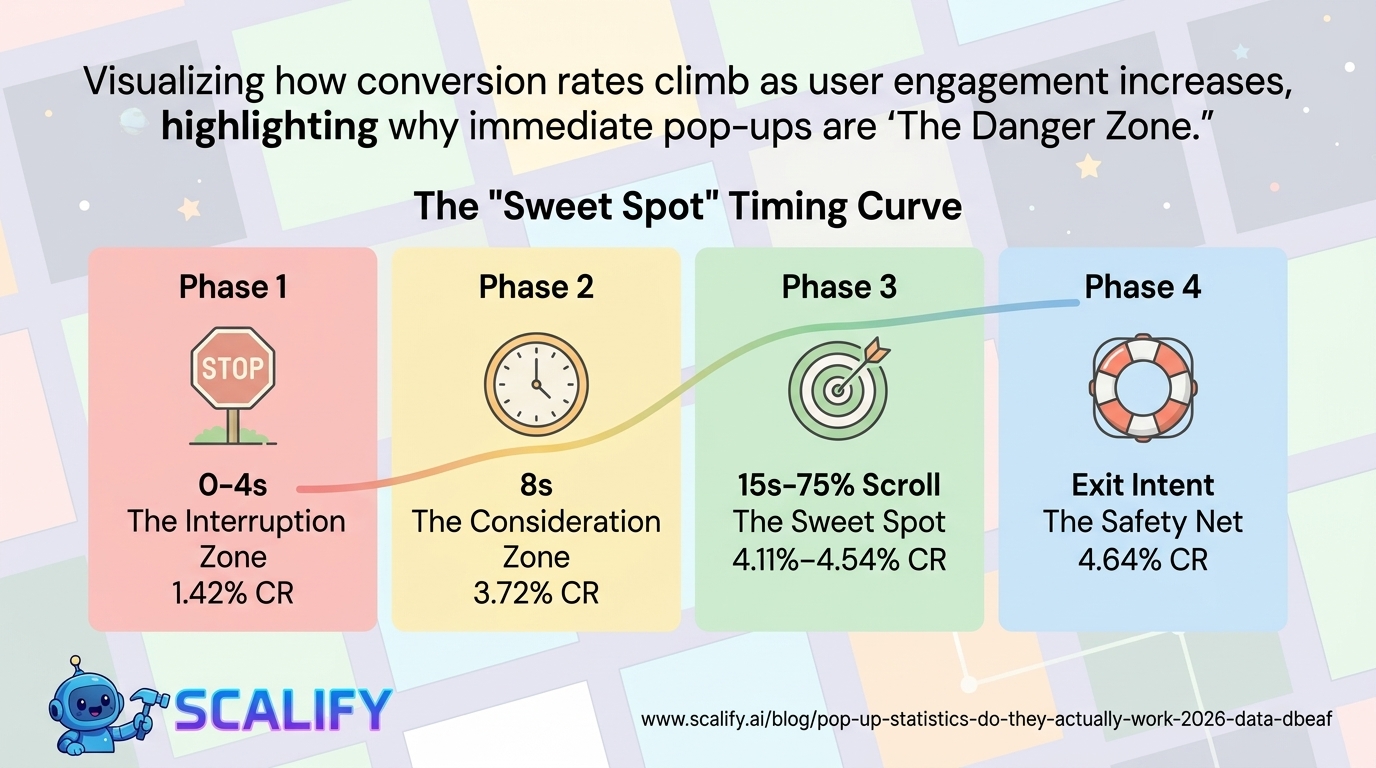
Popups that appear immediately (or within a few seconds) of a visitor landing on a page. The most common type and the most disliked by users — they interrupt before the visitor has received any value from the visit.
Entry popups have their place: for time-sensitive announcements that genuinely need immediate attention (site-wide sale ending today, important service notice), or for landing pages designed specifically for an offer where the popup IS the offer.
For content sites, product pages, and service websites: immediate popups typically produce negative UX and should be avoided. The visitor has expressed interest in your content — interrupting before they can access it is antagonistic. Google specifically penalizes intrusive interstitials (full-screen popups that appear on mobile after arriving from a search result) because they harm the mobile search experience.
Scroll-Triggered Popups
Popups triggered when a visitor has scrolled a specified percentage down the page — typically 50–70%. This type is significantly better UX than entry popups because it waits for demonstrated engagement before making an ask.
A visitor who has scrolled 60% through your blog post has demonstrated genuine interest in the content. An offer of related additional content or a newsletter subscription at that point is relevant and contextually appropriate. They're already engaged; the popup adds a relevant next step rather than interrupting an uncommitted browse.
Scroll triggers set too low (20–30%) still feel early and disruptive. Scroll triggers set at 70–80% reach a smaller percentage of visitors but have meaningfully higher conversion rates because they target only the most engaged readers.
Time-Delayed Popups
Popups triggered after a visitor has spent a specified amount of time on the page — typically 30 seconds to 2 minutes. Time triggers are similar to scroll triggers in philosophy: waiting for demonstrated engagement before making an ask.
Time triggers are useful for pages where visitors don't necessarily scroll far — product pages where visitors read above the fold, service pages with compact layouts, or pages where the primary interaction isn't scrolling.
Time triggers should be calibrated to the page's content: a 200-word page has been fully read in 30 seconds; a 3,000-word article takes 10+ minutes to read. A popup appearing after 30 seconds on a long-form article is similar to an entry popup for a visitor who reads slowly or carefully.
Exit-Intent Popups
Popups triggered when a visitor moves their cursor toward the browser bar or address bar — a signal that they're about to navigate away. Exit-intent technology detects this movement and displays a popup before the visitor leaves.
Exit-intent is generally the best-received popup type because it targets visitors who are already leaving — the popup doesn't interrupt a visit in progress, it intercepts a departure. A visitor who was going to leave anyway and sees an exit-intent popup has nothing to lose by reading it.
The UX case for exit-intent: the visitor experience is preserved during the active visit; the popup only appears when the visit is functionally over. Conversion rates on exit-intent popups are typically lower than on scroll-triggered popups (because some exit-intent visitors have decided definitively to leave and aren't persuadable), but the UX impact is significantly lower.
Exit-intent only works on desktop (cursor movement isn't available on touchscreens). Mobile alternatives: scroll-triggered at a high percentage, or a sticky footer bar rather than a full popup.
Scroll-Up Popups
A less common variant: a popup triggered when a visitor starts scrolling back up the page — often interpreted as a signal that they've finished reading and are considering their next action. This trigger point catches visitors at a natural pause in their engagement rather than interrupting it.
Click-Triggered Popups
Popups triggered by a visitor clicking a specific element — a button, an image, or a text link. The most user-friendly popup type because it's entirely opt-in: the visitor explicitly signals interest by clicking before any popup appears.
Click-triggered popups are ideal for: "click to see more details about this offer," "click to access the calculator," "click to view our pricing" when you want to gate detailed pricing information behind a click, or any situation where the popup content is supplementary to the main page content rather than a separate conversion ask.
Popup Design Principles That Reduce UX Damage
Make Closing Easy and Obvious
The most reliable way to make popups less annoying: make them easy to close. A large, obvious X button in the corner. Clear dismiss language ("No thanks" rather than "I don't want to improve my conversions" — the guilt-trip dismiss copy that became briefly popular is widely recognized as manipulative and damages trust). Pressing Escape should close the popup.
The UX philosophy here: visitors who don't want your offer should be able to get rid of the popup quickly and without friction. Attempting to make dismissal difficult through small X buttons, guilt-trip language, or confusing dismissal options doesn't convert more visitors — it just makes the ones who won't convert more frustrated.
Mobile-Specific Design
Popups designed for desktop frequently break on mobile: text too small to read, X button too small to tap, popup taller than the screen requiring scrolling inside the popup, close button hidden below the phone's bottom gesture area. Test every popup explicitly on mobile devices before deploying.
Mobile popup best practices: use the full screen width (don't try to replicate a desktop modal on mobile), ensure the headline and value proposition are visible above the fold, make the CTA button large and easily tappable (minimum 44px height), and place the close button in a tappable location (top right, with enough size to tap accurately).
Consider whether a full popup overlay is the right format on mobile at all. Alternatives: a slide-in from the bottom (less disruptive than full overlay), a sticky footer bar (always visible but non-blocking), or an inline form embedded in the content itself.
Relevance Is Everything
A popup offering your email newsletter while a visitor is reading a blog post about website design makes sense. A popup offering your email newsletter while a visitor is on your pricing page is contextually wrong — they're in buying mode, not content-consumption mode. A popup for a discount on product A while the visitor is viewing product B is irrelevant.
Context-aware popup delivery — showing different popups on different pages, different offers to different visitor segments — consistently outperforms showing the same popup to everyone everywhere. The effort of segmentation pays back in higher conversion rates and lower UX friction.
Frequency Capping
Set cookies or session flags to prevent showing the same popup to the same visitor repeatedly. A visitor who dismissed your popup yesterday shouldn't see it again on every subsequent visit. A visitor who converted (subscribed, made a purchase) should never see an email capture popup again — they're already on your list.
Standard frequency caps: show once per session, or once per 7–30 days per visitor. Adjust based on your audience's behavior patterns and the urgency of the offer.
Popup Copy That Actually Works
Lead with Value, Not the Ask
The common popup structure: "Sign up for our newsletter!" with an email field. This leads with the ask (your email address) rather than the value. A structure that converts better: lead with what the visitor receives, then ask for their email as the exchange.
"Get the Website Launch Checklist: 47 things to verify before your site goes live. Enter your email and we'll send it immediately." This structure leads with concrete value (the checklist), specifies what it is (47 items), and makes the exchange clear (your email for the checklist).
Be Specific About What You're Offering
Vague offers convert poorly. "Get valuable tips delivered to your inbox" is vague. "Every Tuesday, we send one actionable website tip to 12,000 business owners — 3 minutes to read, immediately applicable." The specificity (Tuesday, one tip, 12,000 subscribers, 3 minutes, actionable) communicates the actual value of the subscription.
Address the Fear of Spam
Email capture popups have an implicit anxiety: am I going to regret giving my email address? A brief reassurance line ("We send one email per week. Unsubscribe anytime. No spam, ever.") addresses this directly and removes a friction point.
Google's Policy on Intrusive Interstitials
Google has a specific policy that affects popup use on mobile: intrusive interstitials that make content difficult to access on mobile, after a user clicks from a Google search result, are a negative ranking signal. Specifically penalized:
- Popups that cover the main content immediately after arriving from search (entry popups on mobile)
- Full-screen interstitials that must be dismissed before content is visible
- Above-the-fold standalone interstitials that obscure the main content
Permitted (not penalized):
- Cookie consent popups (legally required in many jurisdictions)
- Age verification popups where legally required
- Small banners that don't cover the main content
- Popups triggered by scroll or time delay after initial page load
- Exit-intent popups
The practical implication: don't use full-screen entry popups on mobile for pages receiving organic search traffic. Scroll-triggered, time-delayed, and exit-intent popups are Google-safe alternatives that also produce better UX outcomes.
Popup Tools
OptinMonster ($9–49+/month): The most feature-rich dedicated popup tool. Extensive targeting options, A/B testing, deep analytics, multiple form types. Best for serious email list builders who want granular control over popup behavior and segmentation.
Sumo (Free–$39/month): Good free tier, integrates well with WordPress and other platforms, includes email capture and social sharing tools. Suitable for businesses starting with list building who don't need enterprise features.
Sleeknote ($49+/month): Design-focused popup tool with emphasis on UX quality. Popups look more polished than most tools; better for design-conscious brands who don't want their popups to look like generic opt-in forms.
Built-in email platform tools: Mailchimp, Klaviyo, ConvertKit, and most email platforms include popup builders. Less sophisticated than dedicated tools but free with the email platform subscription and sufficient for most basic list-building use cases.
The Bottom Line
Popups are effective at capturing email addresses and promoting offers — the data consistently shows that they increase list growth rates when implemented thoughtfully. The key distinction between popups that harm UX and popups that users tolerate is: timing (scroll/time/exit-intent vs. immediate), relevance (matching the page context), ease of dismissal (obvious close button, no guilt-trip copy), and frequency capping (not showing the same popup to the same visitor repeatedly).
For most websites: scroll-triggered at 60–70% scroll depth is the starting point. Exit-intent for visitors about to leave. No full-screen entry popups on mobile. Relevance-matched content between the popup offer and the page being viewed. Easy dismissal always.
At Scalify, we design and build websites that balance list-building effectiveness with excellent user experience — including thoughtful popup implementation when email capture is a client priority.




.jpeg)
.jpeg)




78 SW 7th St, Miami, FL 33130