


What Is a Website Style Guide and Why Does Your Business Need One?
By Josh Ternyak

March 29, 2026
A style guide is the system that keeps your website looking and sounding consistent as it grows. This guide explains what one includes, why it matters, and how to create one that actually gets used.
The Document That Makes Your Website Consistent at Scale
Here's a scenario that plays out constantly in growing businesses. The website launches and looks great — cohesive, professional, clearly branded. Six months later, a marketing manager adds a blog post with a slightly different heading style. The developer adds a new section with a button color that's close to the brand blue but not quite. A freelancer creates a landing page that uses a font from a different type family. The about page gets updated with photos taken in different lighting than the rest of the site.
Each individual change is minor. Cumulatively, they produce a site that feels inconsistent — not quite as polished or professional as it was at launch. The brand dilution is real, the credibility cost is real, and fixing it requires a systematic effort that could have been prevented.
A website style guide prevents this. It's the documented system that defines exactly how the website should look and sound — the rules that any designer, developer, or content creator follows to maintain consistency regardless of when they join the project or how little context they have about the original design decisions.
What a Website Style Guide Is
A website style guide (also called a design system, UI style guide, or brand standards document) is a comprehensive reference document that defines the visual and verbal standards for a website. It specifies:
- Exactly which colors are used and in what contexts
- Which fonts are used at which sizes and weights for which purposes
- How spacing, padding, and layout grids work
- What every UI component looks like (buttons, forms, cards, navigation)
- How imagery is selected and treated
- How content should be written — the tone, vocabulary, and formatting conventions
Done well, a style guide makes it possible for any competent designer or developer to create new pages and components that feel native to the existing site — without needing to ask the original designer a hundred questions or guess at what the right choices are.
Style guides range from minimal to comprehensive. A minimal style guide for a small business site might be two pages defining colors, fonts, and basic button styles. A comprehensive design system for a large product might be a Figma library with hundreds of documented components, an interactive web-based reference, and detailed usage guidelines for every pattern. The right scope depends on the complexity of the site and how many people are creating content for it.
What a Website Style Guide Includes
Color System
The color section defines every color used in the design system with precise specifications:
Primary brand colors: The 1–2 main colors that define the brand's visual identity. Used for primary buttons, key highlights, brand elements.
Secondary colors: Supporting palette that complements the primaries. Used for section backgrounds, secondary UI elements, visual variety.
Neutral palette: Grays, whites, and blacks used for text, backgrounds, dividers, and the majority of the interface. Often the most-used colors on any website.
Semantic colors: Colors with specific meaning — success (typically green), warning (yellow/orange), error (red), information (blue). Used for form validation feedback, status indicators, alerts.
Usage rules: Not just the colors, but when to use each one. "Primary blue is used for all primary CTA buttons. Secondary blue (lighter tint) is used for secondary buttons and hover states. Never use primary blue for body text — use Neutral Dark for all body text."
Each color should be specified in HEX (for web) and RGB values, with accessibility contrast ratios documented for common text/background combinations. Colors that don't meet WCAG contrast standards for text use should be explicitly marked as "background only — not for text."
Typography System
The typography section defines every typographic decision in the design:
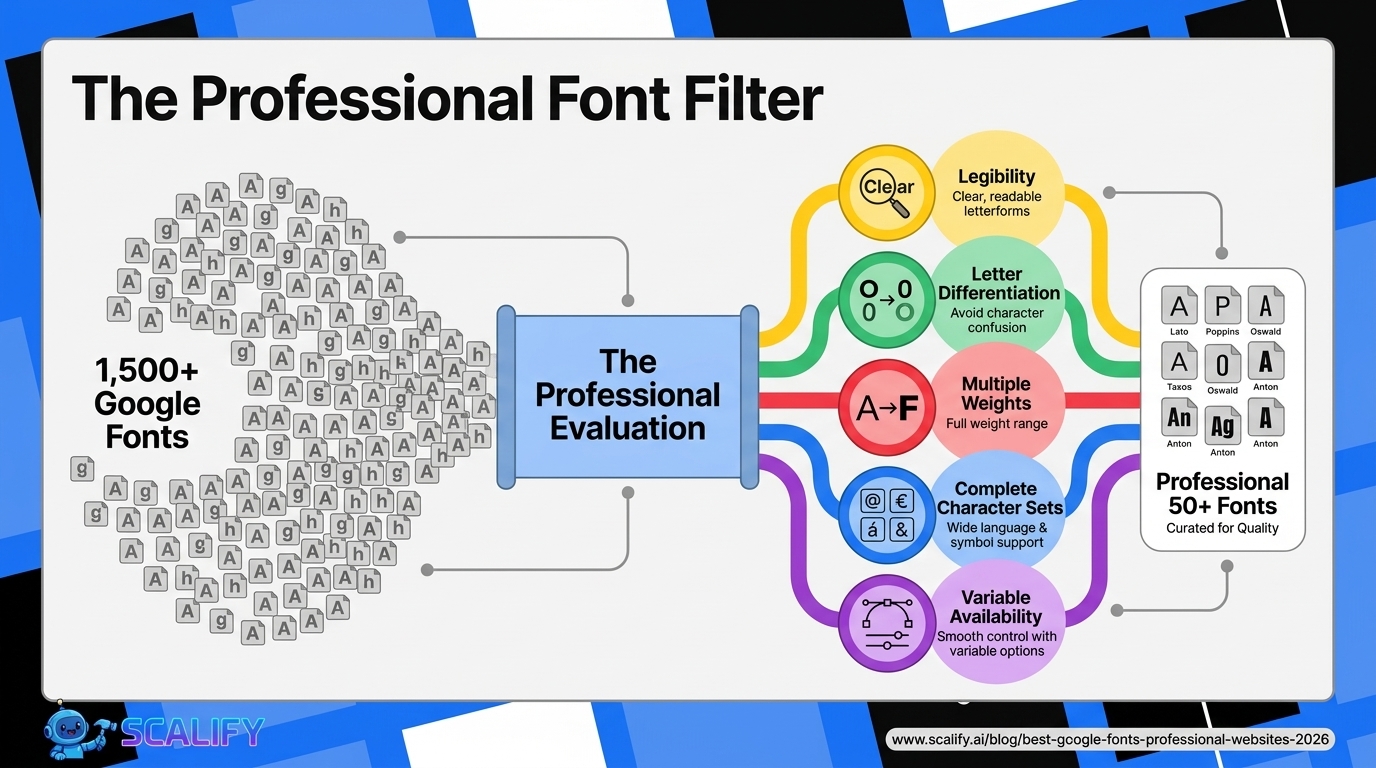
Font families: Which fonts are used and where they're hosted (Google Fonts, Adobe Fonts, self-hosted). Include the CSS font-family declarations so developers can implement them correctly.
Type scale: Every text size used in the design, named and specified. Not just "H1 is big" — "H1: 48px/56px line height, Bold (700), Heading Font. H2: 36px/44px, Semibold (600), Heading Font. Body: 16px/24px, Regular (400), Body Font."
Type hierarchy: How different text levels relate to each other visually and semantically. The difference between H2 and H3 in visual weight and when to use each.
Responsive type: How type sizes scale on mobile vs. desktop. A heading that's 48px on desktop might be 32px on mobile — these breakpoint-specific sizes should be documented.
Text formatting rules: When to bold, when to italicize, how to handle links within body text, whether to use sentence case or title case for different heading levels, how to format numbers and dates.
Spacing System
Consistent spacing creates visual order and rhythm. A defined spacing system prevents the ad hoc padding decisions that produce inconsistent-feeling layouts:
Most well-designed systems use an 8-point or 4-point base unit — all spacing values are multiples of 8 (or 4) pixels: 4, 8, 16, 24, 32, 48, 64, 96px. This creates mathematical harmony in the layout — elements relate to each other through multiples of the same base unit rather than arbitrary values.
Document the standard spacing values with named tokens: "Spacing-XS: 4px, Spacing-S: 8px, Spacing-M: 16px, Spacing-L: 24px, Spacing-XL: 32px, Spacing-2XL: 48px, Spacing-3XL: 64px." With CSS variables, these tokens can be applied consistently across the entire codebase.
Component Library
The component library documents every reusable UI element in the design system. For a typical business website:
Buttons: Primary button (filled, brand color, white text), secondary button (outlined or lighter color), ghost button (transparent with border), destructive button (red for dangerous actions), disabled state for all variants. Each documented with exact specifications and usage guidelines.
Form elements: Text inputs (default, focus, error, disabled states), select dropdowns, checkboxes, radio buttons, text areas, form labels, validation messages. Consistent form design is critical for usability and brand quality.
Navigation: Desktop navigation, mobile navigation (hamburger menu), active state, dropdown behavior.
Cards: Any card-based content containers — blog post cards, service cards, team member cards, testimonial cards. Each variant documented with its structure and spacing.
Typography components: Blockquotes, code blocks, ordered and unordered lists, tables.
Layout components: Grid system, container widths, section padding, dividers.
Each component should show all its states (default, hover, active, focus, disabled, error where applicable) and include implementation notes for developers.
Imagery Guidelines
The imagery section establishes standards for photography and illustration across the site:
Photography style: The aesthetic qualities that define on-brand imagery. Natural lighting vs. studio? Candid vs. posed? People-forward vs. environment-focused? Color grading style (warm, cool, neutral)? These aren't arbitrary preferences — they define how the brand presents its visual world and should be documented clearly enough that any photographer or image curator can identify on-brand imagery.
What to avoid: As important as what to include. "No generic stock photography clichés — handshakes, people pointing at whiteboards, smiling perfectly diverse groups" gives negative guidance that's often more useful than positive guidance.
Technical specifications: Minimum image dimensions for different uses, accepted file formats, maximum file sizes for performance, whether images should have rounded corners or be presented in specific aspect ratios.
Alt text standards: How to write image alt text — specific guidance for the content team on what descriptive language looks like and what to avoid (empty alt text for decorative images, keyword-stuffed alt text for SEO).
Voice and Tone Guidelines
The written voice of a website is as much a part of its identity as the visual design. Style guides should include:
Brand voice attributes: 3–5 adjectives describing how the brand sounds in writing. "Expert but accessible." "Direct and confident." "Warm but professional." For each attribute, show what it looks like in practice with before/after examples — "We leverage integrated solutions" (off-brand) vs. "We build websites that work" (on-brand).
Tone variations by context: The voice stays consistent; the tone varies by situation. The tone for a support page is different from the tone for a product announcement. Document the appropriate tone range for key content contexts.
Specific writing rules: Capitalization conventions (sentence case vs. title case for different elements), how to punctuate (Oxford comma or not, em dash usage), how to refer to the company (first or third person), how to write CTAs (action verbs, first person), and formatting conventions for different content types.
Word choices to avoid: Jargon, buzzwords, corporate language. "Leverage synergistic solutions to drive value creation" is the exact opposite of clear communication. "Avoid: synergy, leverage, circle back, ping, deep dive as business verbs" gives content creators explicit guidance.
Why a Style Guide Matters Beyond the Launch
Enabling Scale
When your team is small and everyone knows the design system intimately, informal consistency is possible. When the team grows, when contractors are brought in, when the website expands to hundreds of pages — informal consistency fails. The style guide is the system that maintains quality regardless of who's creating content.
Onboarding New Team Members
A well-documented style guide is the fastest path to making new designers, developers, or content creators productive on an existing website. Instead of shadowing current team members or making decisions based on guesswork, new contributors can reference the style guide to understand exactly how things should work.
Avoiding Inconsistency Debt
Every inconsistency in a design accumulates into "inconsistency debt" — the growing divergence from a coherent design system that requires increasing effort to address. A style guide prevents inconsistency from entering the design in the first place, avoiding the costly remediation work that fixing accumulated inconsistencies requires.
Speeding Up Design and Development
When every design decision doesn't need to be made from scratch — when there are established button styles, spacing values, and component patterns — design and development move faster. The style guide eliminates the time spent making decisions that have already been made and documented.
How to Create a Style Guide
Start with What Exists
Don't create a style guide in the abstract. Document the actual design that's been built. Extract the colors used in the design, the fonts and sizes, the spacing values. If the design is consistent, this documentation is straightforward. If it's inconsistent (different shades of blue used in different places, multiple type sizes used for the same purpose), the documentation process reveals the inconsistencies that need to be resolved into a coherent system.
Use the Right Tools
Figma: The dominant design tool for creating visual style guides. Component libraries in Figma can be published and shared — designers working on the site access the component library directly in Figma and use the correct components. Changes to the master component update everywhere it's used.
Storybook: For code-based design systems, Storybook creates an interactive component library where components are documented in their actual implementation — designers and developers see the real components, not design representations of them. Used by engineering teams building systematic UI.
Zeroheight, Supernova, Notion: Tools for creating web-based style guide documentation that combines design assets (often synced from Figma) with written guidelines. Good for sharing across teams that include non-designers who need to reference standards.
Simple PDF or Google Doc: For small teams, a well-structured document with color swatches, font specimens, and component screenshots is sufficient. The format matters less than the clarity and completeness of the content.
Keep It Maintained
A style guide that's created at launch and never updated becomes a historical document rather than an operational resource. As the design evolves, the style guide must evolve with it. Designate someone responsible for keeping the style guide current — typically the lead designer or design lead. Schedule a quarterly review to identify where the documented standards and the actual implementation have diverged.
The Bottom Line
A website style guide is the system that maintains consistency, quality, and brand coherence as your website grows. It enables any contributor to create on-brand work without asking the original designer for guidance. It prevents the slow accumulation of inconsistencies that makes websites feel less professional over time. And it dramatically speeds up design and development by eliminating the need to make already-made decisions repeatedly.
Every business website that will be maintained and expanded over time benefits from a style guide. The investment in creating it is modest compared to the cost of the inconsistency it prevents.
At Scalify, every website we deliver comes with documented design standards — color codes, font specifications, and component guidelines — so your team can maintain and extend the site without losing the quality built into the original design.



















.jpeg)
.jpeg)








78 SW 7th St, Miami, FL 33130