


What Is White Space in Web Design and Why Does It Matter?
By Josh Ternyak

April 1, 2026
White space increases comprehension 20% and user attention 50% on key elements. This comprehensive guide covers types of white space, user perception psychology, conversion impact, typography standards, mobile design, common mistakes, context-specific applications, measurement tools, and cultural variation in white space conventions.
What Is White Space in Web Design and Why Does It Matter?
White space — also called negative space — is the empty area between and around design elements. Despite its name, it doesn't have to be white: it's whatever color, texture, or pattern forms the background behind content. White space is not wasted space. It's an active, intentional design element that shapes how information is perceived, how content is organized, and how premium or cluttered a brand appears. The most sophisticated brands in the world — Apple, Porsche, luxury fashion houses — use generous white space as a primary signal of quality and confidence. The most cluttered, low-trust websites are often that way because someone tried to eliminate white space in favor of fitting "more content."
Key White Space Statistics
- Increasing white space in marketing copy increases reader comprehension by 20% (Wichita State University research)
- Websites with generous white space see 50% higher user attention on key elements vs. cluttered layouts
- White space between paragraphs and menu items increases readability by up to 20%
- Nielsen Norman Group research finds that users spend 70% of time on the left half of web pages — white space on the right manages attention distribution
- Adding white space around ads reduces their click-through rate — suggesting users process white-spaced ads as more premium but less urgent
- Typography with adequate line spacing (1.4–1.6 line-height) improves reading speed by 8–12% over cramped text
- 69% of users in eye-tracking studies first look at headlines, then scan for white space clusters to find secondary content
- Premium brands consistently use 40–70% more white space than value brands in equivalent design contexts
Types of White Space
| Type | Location | Purpose | Example |
|---|---|---|---|
| Micro white space | Between letters, words, lines, paragraphs | Typography readability; text breathing room | Line height, letter spacing, paragraph margins |
| Macro white space | Between major page sections and content blocks | Visual grouping; section separation; hierarchy | Space between hero and features; between columns |
| Active white space | Intentionally placed to guide eye movement | Direct attention; create emphasis | Space around a CTA to isolate it visually |
| Passive white space | Naturally occurring around irregular elements | Composition balance | Space around an asymmetrically placed image |
How White Space Affects User Perception
White space communicates before a visitor reads a single word. The psychological effects of different white space levels:
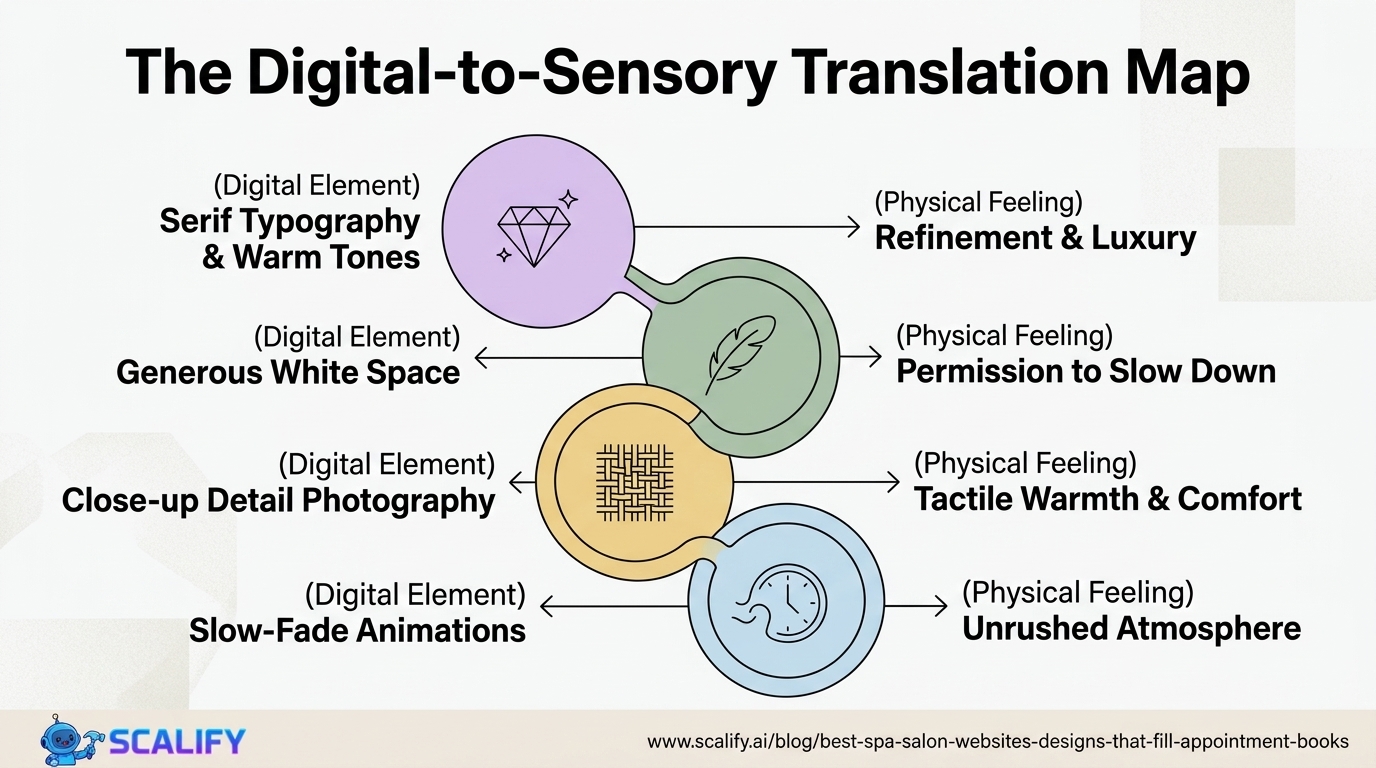
Generous white space signals: Premium and high-quality (more expensive products use more white space), confidence and stability (no need to compete for attention), attention to detail (someone thought carefully about every element), and clarity of purpose (focus on what matters most). Apple's website is the most studied example — the white space around product images and typography communicates that Apple's products are premium objects worthy of contemplation, not cheap commodities needing to shout for attention.
Cluttered design signals: Urgency and low price (sale sites, deal aggregators, tabloid news), overwhelming choice (which can reduce conversion through decision paralysis), lower trust (cognitive research shows cluttered designs are rated as less trustworthy), and lower perceived quality. These associations are not always wrong — urgency design does work for certain contexts — but they're reliably accurate for how users perceive the brand before evaluating the offer.
White Space and Conversion Rate
White space's relationship with conversion is nuanced — more white space doesn't universally produce higher conversion. The relationship depends on what the white space is isolating. White space around a CTA button increases conversion by making the CTA visually prominent and unmissable. White space in a product listing page can reduce conversion by reducing the number of products visible above the fold, requiring more scroll before the right product appears. The designer's job is not to maximize white space but to apply it strategically to the elements that benefit from isolation: CTAs, key value propositions, important data, and calls to action.
White Space in Typography
Typography white space — line height, letter spacing, paragraph spacing, and margin around text blocks — is the most directly usability-relevant form of white space. The research-backed typography white space standards for web:
| Typography Element | Recommended Range | Why |
|---|---|---|
| Line height (body text) | 1.4–1.6 (unitless) | Adequate vertical space between lines prevents visual crowding |
| Paragraph spacing | 1em (equal to font size) minimum | Clearly separates paragraphs without them running together |
| Letter spacing (body) | 0 to 0.02em | Normal tracking; tighter degrades readability |
| Letter spacing (all caps) | 0.05–0.15em | All-caps text needs more spacing to maintain readability |
| Maximum line length | 50–75 characters | Optimal reading range — the eye doesn't lose its place |
| Margin around text blocks | At least 1.5× the font size top and bottom | Text blocks need breathing room from adjacent elements |
White Space and Mobile Design
Mobile design creates specific white space challenges because the small viewport makes every pixel of space more consequential. The temptation is to compress white space on mobile to fit more content above the fold — but this is almost always the wrong trade-off. Touch targets need minimum 44px height including surrounding space to prevent accidental mis-taps. Text needs adequate line height and paragraph spacing for comfortable reading on a screen held at arm's length. The cognitive load of dense mobile layouts is higher than for desktop, because the smaller visual field requires more scrolling to understand the full page structure.
Mobile white space best practices: maintain desktop-level line height and paragraph spacing (or increase them slightly), give tap targets extra surrounding space beyond the 44px minimum, increase font size relative to desktop to maintain comfortable reading, and use vertical rhythm (consistent vertical spacing increments) to create predictable visual structure that helps users orient in longer pages.
Common White Space Mistakes
Compressing white space to "fit more content." This is the most pervasive white space mistake — the misguided assumption that users want to see more content per screen. What users want is clear, readable, easily navigable content. Dense layouts with compressed white space force users to work harder to find what they need — reducing time on page, increasing frustration, and decreasing conversion. The white space you removed made room for content the user now can't comfortably read.
Inconsistent white space across sections. White space works as a system — consistent spacing increments create visual rhythm that the brain processes automatically. Random spacing (20px here, 32px there, 40px in a similar context) creates visual noise that the brain has to actively resolve rather than processing smoothly. Establishing a spacing scale (8px, 16px, 24px, 32px, 48px, 64px) and using only these increments across the design creates consistency that users perceive as polish without consciously noticing the mechanism.
Adding white space without adding hierarchy. White space creates visual separation — but separation without hierarchy creates ambiguity. If all sections have equal white space between them, none signal more importance than others. The sections that deserve the most attention should have the most surrounding space; secondary sections should have less. White space needs to be distributed according to the content hierarchy, not applied uniformly.
The Bottom Line
White space is the most powerful tool in a web designer's toolkit for creating the perception of quality, guiding attention, and improving readability — yet it's consistently underused because it looks like "nothing." The most effective websites use white space as an intentional design system: generous macro white space that separates sections and creates visual hierarchy, precise micro white space that makes typography comfortable to read, and strategic active white space that isolates CTAs and key elements for maximum attention and conversion. When in doubt about whether a design has enough white space, add more — it's almost always less than you think is needed, and the benefit of additional space is almost always positive.
At Scalify, we design every website with deliberate white space architecture — because the breathing room between elements is what makes the elements themselves land with impact.
Top 5 Sources
- Nielsen Norman Group — White Space in Web Design
- Smashing Magazine — White Space and Good Design
- CXL Institute — White Space and Conversion Research
- Interaction Design Foundation — White Space in UX
- Wichita State University — White Space Comprehension Research
White Space in Specific Design Contexts
Landing Pages
Landing pages — where the entire purpose is to convert a single type of visitor action — benefit enormously from generous, strategically placed white space. The isolation principle: every element that is important to the conversion decision (headline, benefit points, CTA button) should have enough surrounding white space that it stands alone visually, without competing for attention with adjacent elements. Landing pages that achieve this isolation consistently convert at higher rates than those where every pixel is filled. The question to ask for each element: "Does the white space around this make it stand out, or does it disappear into the surrounding content?"
E-Commerce Product Pages
Product page white space needs to balance three competing needs: showing the product clearly, providing necessary information, and driving the add-to-cart action. The best-practice approach: generous white space around the primary product image (the visual focus), compact but readable product details with adequate line height, and isolated CTA button with whitespace separating it from competing elements. Cluttered product pages where the price, reviews, variants, and CTA button are all competing for attention at equal visual weight reduce the path to purchase by creating decision uncertainty.
Blog and Long-Form Content
Long-form content white space optimization primarily affects readability and time on page. The two most impactful white space improvements for content pages: increasing line height from typical 1.5 to 1.6 (subtle but measurably improves reading comfort), and increasing the left and right margins beyond the content column so text doesn't stretch to full browser width on large monitors. Research on optimal reading line length (50–75 characters) is why most well-designed blog layouts constrain text width to 680–760px even on desktop screens with 1440px of available width — the white space on either side of the text column is not wasted; it's improving reading comfort.
White Space Tools and Measurement
Unlike typography size or color contrast, white space has no universal measurement tool — it's evaluated through design judgment and user research. However, several practical approaches help evaluate whether white space is working:
The squint test: Squint until elements blur and only shapes remain. Do key elements (CTA, headline, main image) stand out clearly, or do they blur into surrounding content? Elements that disappear in the squint test don't have enough surrounding white space.
Heat map analysis: Microsoft Clarity or Hotjar heatmaps show where users actually look and click. Elements receiving less attention than they should may be under-isolated with white space. This data converts the subjective "does this have enough space?" to an objective "are users actually noticing this?"
8-point grid system: Designing to a consistent spacing scale (multiples of 8: 8, 16, 24, 32, 48, 64px) creates automatic white space consistency. Elements sized and spaced to this grid produce visual rhythm without requiring active judgment for every spacing decision.
White Space Across Cultures
White space conventions vary significantly across cultural design traditions. Western European and American design strongly favors the generous white space, minimalist composition approach associated with premium brands. East Asian design traditions — particularly Japanese design — often use significantly denser, more information-rich layouts that are less reliant on white space for organization. Korean and Chinese e-commerce sites (Coupang, Taobao) use much denser layouts than Western equivalents. If designing for international audiences or specific cultural markets, understanding the white space conventions of that market's design tradition is important — what signals "premium" in American design may signal "sparse" or "empty" in a cultural context where information density signals value.
White space is ultimately about respect for the user's attention — acknowledging that every element doesn't need to compete simultaneously, and that the most important elements communicate most powerfully when given room to breathe. Designers who master white space understand that what you remove from a composition is as important as what you add; the space around an element determines how much attention it receives just as much as the element itself does.
This understanding — that negative space is an active design element as powerful as the content itself — is what separates professional-grade web design from amateur work that fills every available pixel with something visible.






















.jpeg)

.jpeg)






78 SW 7th St, Miami, FL 33130