


WordPress vs Webflow vs Squarespace: Which Should You Use?
By Josh Ternyak

March 28, 2026
WordPress, Webflow, and Squarespace are three of the most popular ways to build a website — but they're designed for very different needs. This honest comparison breaks down who each platform is actually right for.
The Platform Decision That Shapes Everything Else
WordPress. Webflow. Squarespace. Ask ten web professionals which one you should use and you'll get ten different answers, usually with strong opinions attached. The WordPress crowd will tell you anything else is limiting. The Webflow advocates will tell you nothing else compares for design quality. The Squarespace users will tell you the other two are unnecessarily complicated.
They're all right — for the audiences they're describing. The question isn't which platform is objectively best. The question is which platform is best for your specific situation: your technical comfort level, your design requirements, your content needs, your budget, and where you want to be in two years.
This guide is an honest comparison — not a platform sales pitch, not a developer's ideological stance. Real trade-offs, real appropriate use cases, and a framework for making the decision that's right for you.
The Short Version: Who Each Platform Is For
Before the deep dive, here's the honest one-paragraph summary of each:
WordPress is for teams that need maximum flexibility and extensibility, already have technical resources or are willing to develop them, and need specific functionality that only the WordPress plugin ecosystem can provide. It's the most powerful and most complex option — the best ceiling but the most overhead.
Webflow is for designers, design-conscious businesses, and teams that want professional-quality custom design without writing code. It's the best option for visual quality and design control without developer dependency, and increasingly capable as a CMS for content-driven sites. Best ceiling for design; steeper learning curve than Squarespace.
Squarespace is for individuals, small businesses, and creative professionals who want a polished, professional website quickly with minimal learning curve. The easiest to get started with, the least flexible, and the fastest path from zero to published for straightforward projects.
If you know this summary already describes your situation — great, stop here. If you want the full picture of what these actually mean in practice, read on.
WordPress: The Powerhouse With Overhead
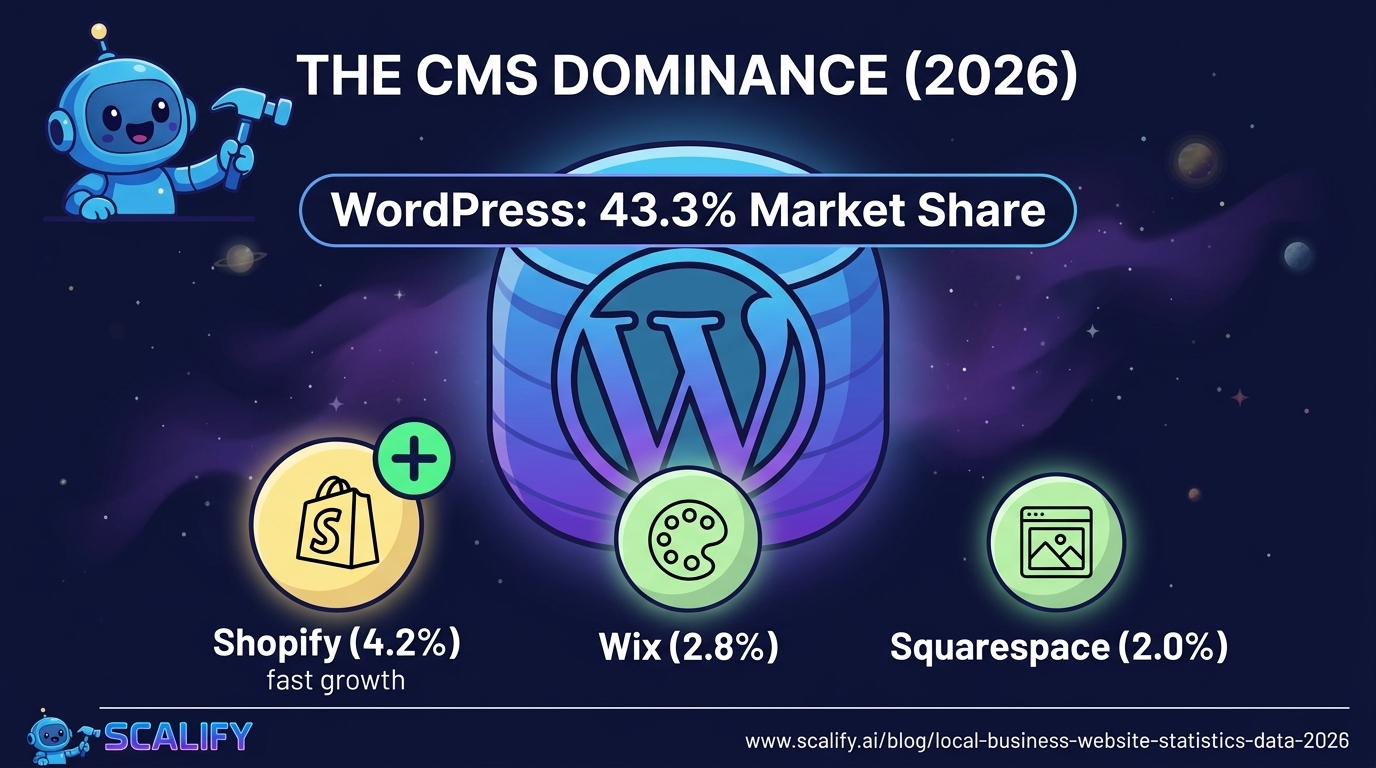
WordPress was launched in 2003 as a blogging platform and has since evolved into the world's most-used CMS, powering 43% of all websites. That remarkable market penetration tells you something: WordPress solves real problems for real businesses at scale. It also comes with real complexity that the other platforms don't.
What WordPress Does Well
Ecosystem depth. With over 60,000 plugins in the official directory and thousands more available commercially, WordPress can do virtually anything you can conceive for a website. Advanced e-commerce via WooCommerce. Membership sites. Learning management systems. Job boards. Real estate listings. Complex SEO tools. Advanced analytics. Every conceivable integration. No other platform comes close to this extensibility.
Developer availability. Because WordPress is so dominant, it has the largest pool of available developers. Finding someone to customize your WordPress site, fix a bug, or build a custom plugin is never difficult or expensive. The reverse is also true — if you hire and that person leaves, finding a replacement who can work on your codebase is straightforward.
Content management at scale. For high-volume content operations — news sites, large blogs, multi-author publications — WordPress's editorial workflow is mature and battle-tested. User roles, content scheduling, revision history, bulk operations — these are robust and well-developed.
SEO control. With plugins like Yoast SEO or Rank Math, WordPress provides extremely granular control over every SEO element. For serious SEO operations with technical requirements, WordPress's flexibility is hard to match.
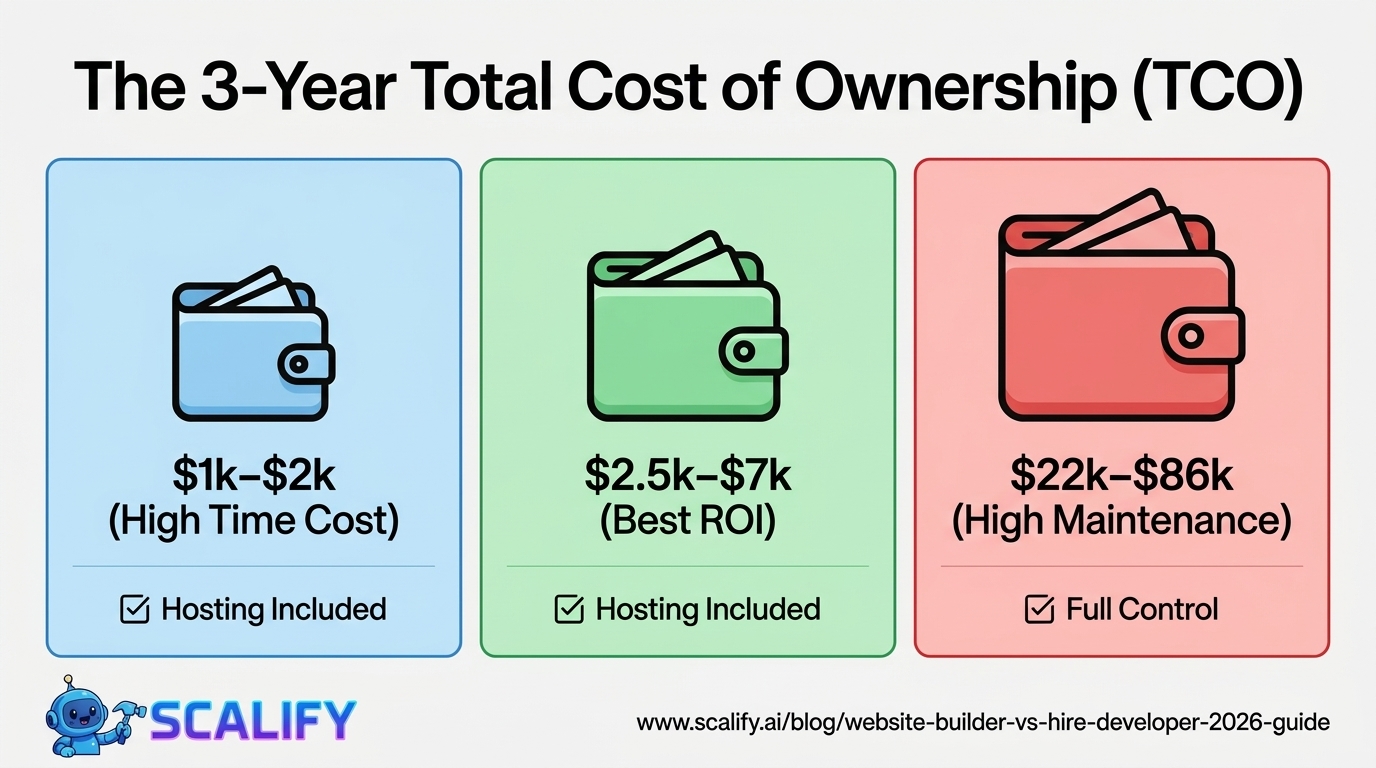
Cost at scale. WordPress core is free. Quality shared hosting starts around $10–15/month. A well-built WordPress site has lower ongoing platform fees than Webflow or Squarespace — though this is partially offset by maintenance costs.
WordPress's Real Challenges
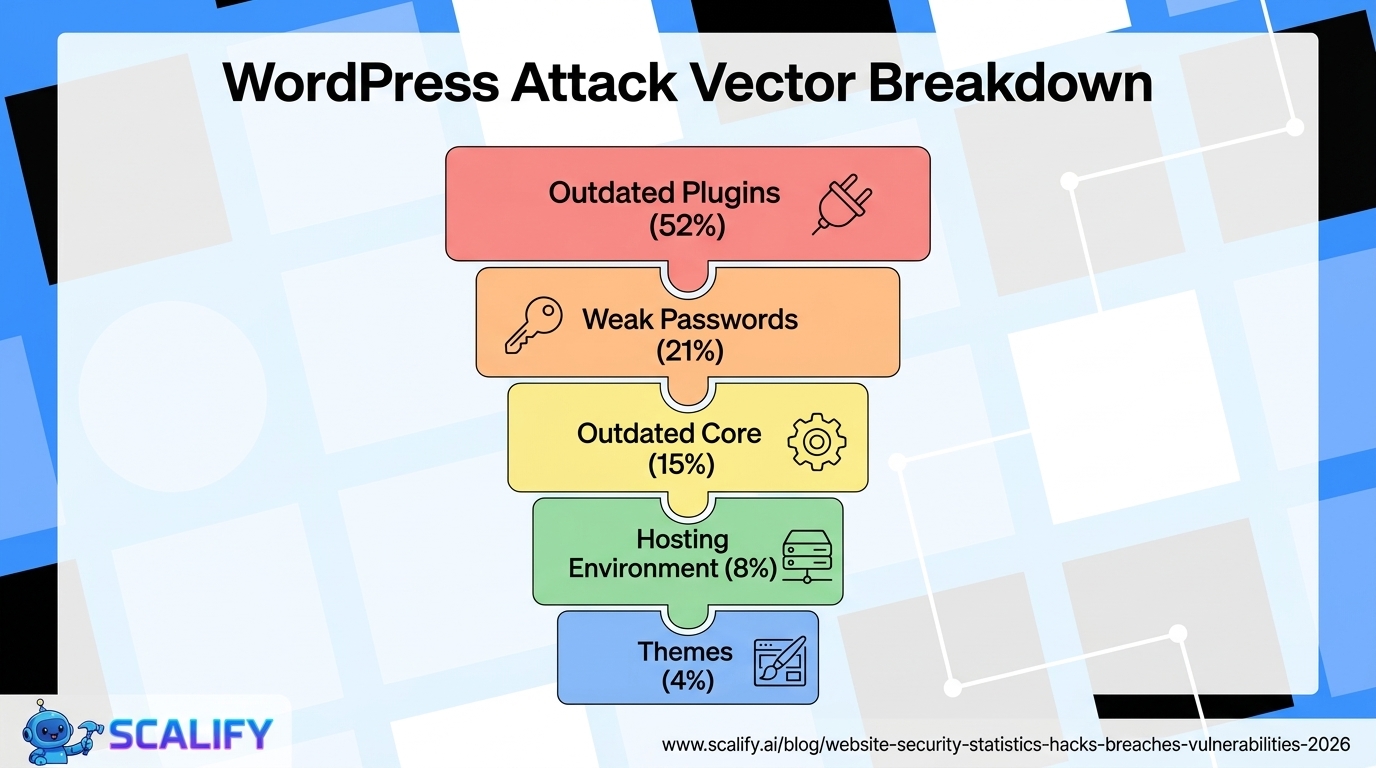
Maintenance overhead. A WordPress site requires ongoing maintenance: core updates, plugin updates, security monitoring, database optimization, backup management. Miss updates and you create security vulnerabilities — WordPress sites are the most frequently targeted for hacking precisely because they're so numerous and many are poorly maintained. Either you handle this yourself (learning curve), pay a developer (cost), or pay a managed hosting service (elevated cost).
Security. WordPress's popularity makes it a constant target for automated attacks. A poorly configured or outdated WordPress installation is genuinely more vulnerable than a well-maintained site on a managed platform. Good security practices (strong passwords, limited admin accounts, quality hosting, regular updates) mitigate this substantially — but it requires attention.
Performance by default. An out-of-the-box WordPress site with a typical theme and several plugins is not fast. Getting to good performance scores requires deliberate optimization: quality caching plugin, image optimization, CDN, and sometimes theme or plugin auditing. This is achievable but adds to setup complexity.
Learning curve for non-technical users. The WordPress admin interface has improved significantly with the Gutenberg block editor, but it's still more complex than Squarespace or Webflow's editor for day-to-day content management. Non-technical editors need some training to use it comfortably.
Design limitations without development. While WordPress themes have become more capable, getting a genuinely unique, custom-designed WordPress site still typically requires either significant theme customization (development work) or a page builder like Elementor (which introduces its own complexity and performance considerations).
WordPress Is Right for You If:
- You need specific functionality that only exists in the WordPress plugin ecosystem (WooCommerce for complex e-commerce, specific industry plugins, etc.)
- You have technical resources — a developer on the team or a budget for ongoing development and maintenance
- You're running a high-volume content operation with multiple editors and complex publishing workflows
- You're cost-sensitive and willing to invest time in management rather than platform fees
- You already have significant investment in an existing WordPress site and are evaluating whether to stay or switch
Webflow: The Designer's Platform That's Becoming a Developer's Tool
Webflow launched in 2013 with a clear proposition: let designers build production-quality websites without writing code. It has executed on that vision more successfully than any alternative, and in the past few years has expanded to become a genuine platform for content-driven sites and lightweight web applications.
What Webflow Does Well
Design quality and control. Webflow's visual editor is genuinely the best no-code design environment available. It maps directly to HTML and CSS concepts — you're setting padding, margin, flex properties, and positioning through a visual interface rather than writing properties by hand. The result is that what you build in Webflow looks exactly like what you intended, with precision that drag-and-drop builders with less granular control can't match.
Performance out of the box. Webflow generates clean, optimized HTML/CSS without the bloat that WordPress themes and plugins can introduce. Sites built on Webflow typically score well on Core Web Vitals without additional optimization work. The CDN (powered by Fastly) is included on all plans and handles global distribution automatically.
CMS capability for content sites. Webflow CMS allows you to create structured content types with custom fields — blog posts, case studies, team members, projects — and build collection pages that automatically render content from those types. For content-driven sites without complex publishing requirements, it's a genuinely capable CMS.
No maintenance overhead. Platform updates, security patches, hosting management — Webflow handles all of it. You build and publish; the infrastructure is their problem, not yours.
Clean code output. Webflow generates semantic HTML and clean CSS that can be exported. This is valuable if you ever need to hand off to a development team or migrate away from the platform.
Webflow's Real Challenges
Learning curve. Webflow is more capable than Squarespace but significantly harder to learn. Its design paradigm (which maps to CSS concepts) is unfamiliar to non-designers and takes time to get productive with. There's an excellent learning platform (Webflow University) but it requires genuine investment of time. Expect 10–20 hours to become comfortable with the basics for a typical learner.
Price. Webflow plans start at $23/month for basic sites and $29/month for CMS-enabled sites. E-commerce plans start at $29/month. These are higher than entry-level WordPress hosting, though comparable to quality managed WordPress hosting when you factor in the reduced maintenance overhead.
Limited extensibility compared to WordPress. Webflow has an App marketplace but it's far smaller than WordPress's plugin ecosystem. For business-specific functionality requirements, you're more likely to find a solution in WordPress than in Webflow. Complex e-commerce (multi-currency, complex discount rules, subscription management) is better served by Shopify than Webflow's native e-commerce.
CMS limitations for complex content operations. Webflow CMS is excellent for moderate-scale content, but it has limits on items per collection, lacks some editorial features (version history, complex approval workflows), and isn't well-suited for very large content operations. It's better than Squarespace for CMS, less capable than WordPress for high-volume content.
Webflow Is Right for You If:
- Design quality is a priority and you want genuine visual differentiation without developer dependency
- You're a designer or design-forward business building client sites
- You want a low-maintenance platform that handles infrastructure without requiring ongoing technical attention
- You're running a content site or CMS-powered site with moderate publishing volume
- You're willing to invest time in learning the platform (or hire a Webflow designer)
Squarespace: The Polished Beginner-Friendly Choice
Squarespace has positioned itself as the beautiful, simple alternative to the complexity of WordPress. It's succeeded: designers and creative professionals have made it a staple for portfolio sites, and its polished template library has set expectations for what a "nice website" looks like at the entry level.
What Squarespace Does Well
Ease of use. Squarespace's editing interface is the most accessible of the three. Block-based content editing, a limited but high-quality selection of templates, and an admin interface that non-technical users can navigate comfortably without training. The fastest path from "I want a website" to "I have a working website" among the three platforms.
Built-in features. Squarespace includes a surprising number of built-in features — blogging, basic e-commerce, email campaigns, scheduling (Acuity Scheduling integration), analytics, member areas, and more. For small businesses that need these features at modest scale, not having to install separate tools is genuinely convenient.
Template quality. Squarespace templates are genuinely beautiful and consistently updated to reflect current design trends. Starting from a Squarespace template produces better default visual quality than starting from most WordPress free themes.
No maintenance required. Like Webflow, Squarespace is a fully managed platform — you're never dealing with updates, security, or hosting.
Squarespace's Real Challenges
Limited design flexibility. What you see in the template is broadly what you get. Squarespace's customization system constrains you to the design parameters the template allows. Designers who want pixel-level control over layout, typography, and spacing find Squarespace frustrating quickly. You can achieve visually polished results within the template's design language; achieving something genuinely custom is difficult.
SEO limitations. Squarespace has improved its SEO tools significantly, but they remain more limited than WordPress with Yoast or Webflow's clean code output. For serious SEO investment, Squarespace's constraints in URL structure, technical SEO control, and page performance can become meaningful limiting factors.
E-commerce is basic. Squarespace's built-in e-commerce works for straightforward product sales, but for anything requiring complex product variants, advanced discount rules, international selling, or integration with external systems, it quickly reaches its limits. Shopify is the better choice for serious e-commerce regardless of how tempting Squarespace's simplicity is.
Scaling content operations is awkward. The Squarespace blogging interface works at small scale. As content volume grows — dozens of posts, multiple authors, complex categorization — its limitations become more apparent. No advanced revision history, limited multi-author support, basic organization tools.
Squarespace Is Right for You If:
- You need a website up quickly with minimal learning curve
- You're a creative professional (photographer, artist, designer) building a portfolio
- Your feature requirements are modest and match what's built into the platform
- Technical management is not a skill you have or want to develop
- You prioritize speed and simplicity over maximum design control or SEO performance
The Head-to-Head Summary
For design control and visual quality: Webflow > WordPress (with development) > Squarespace
For ease of use: Squarespace > Webflow > WordPress
For functionality and extensibility: WordPress > Webflow > Squarespace
For SEO capability: WordPress > Webflow > Squarespace
For maintenance simplicity: Squarespace = Webflow > WordPress
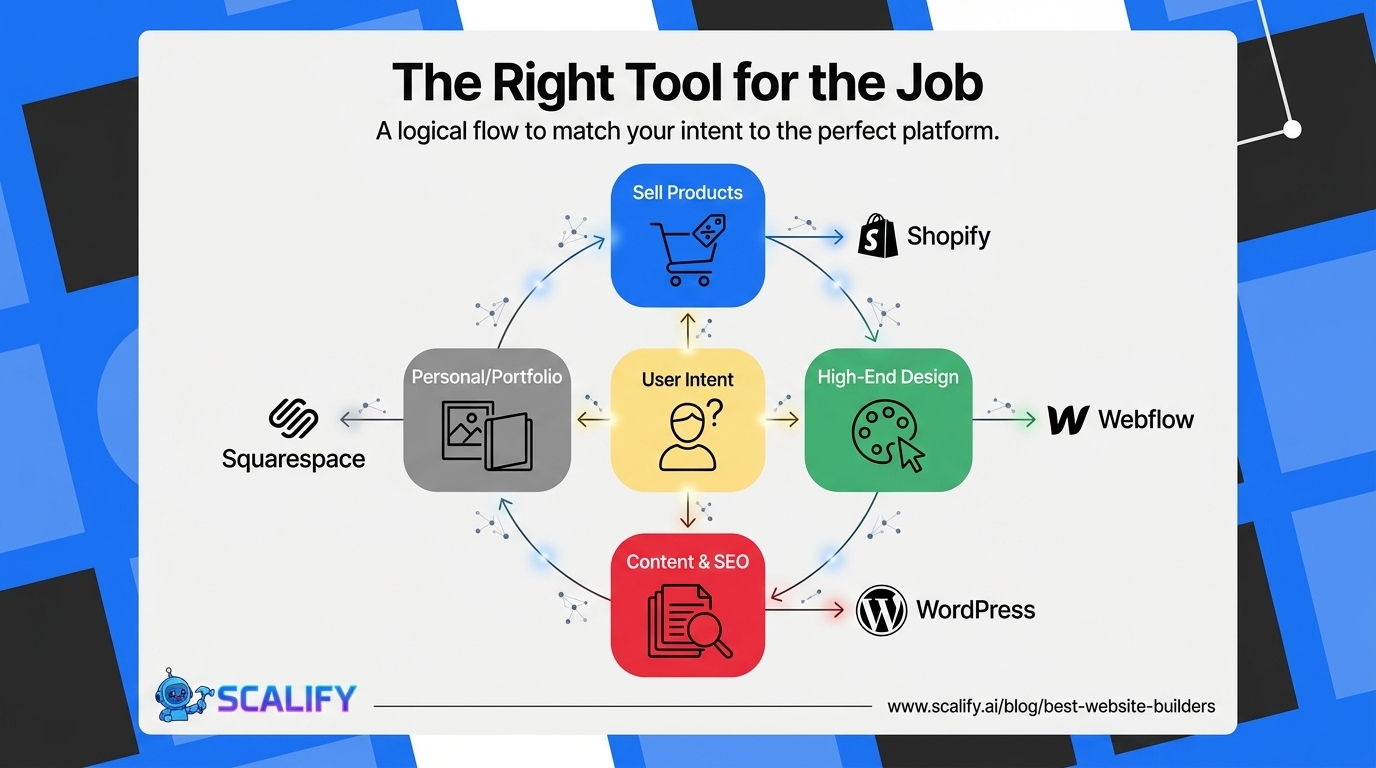
For e-commerce: Shopify wins over all three (but among these, WooCommerce/WordPress)
For performance: Webflow > WordPress (optimized) > WordPress (default) ≈ Squarespace
For cost at small scale: WordPress (self-managed) < Squarespace ≈ Webflow
For cost at scale (including maintenance): More even — all three are comparable once professional maintenance is factored in
The Decision Framework
Ask these four questions in order:
1. Do you need complex, specific functionality? (Custom e-commerce, specific industry tools, complex membership systems, very specific integrations) If yes: WordPress, probably. If no: continue.
2. How important is design quality and customization? If extremely important and you're willing to learn a tool or hire a specialist: Webflow. If you want polished templates without high learning curve: Squarespace. If you want maximum design freedom and have developer resources: WordPress with custom development.
3. What's your technical comfort level and available maintenance bandwidth? If you want zero technical overhead: Webflow or Squarespace. If you have technical resources and want maximum control: WordPress.
4. What are your long-term growth ambitions? For a business expecting significant growth, high content volume, and evolving feature requirements over 3–5 years: WordPress or Webflow. For a stable, modest-scope site: Squarespace works well at any scale appropriate for its feature set.
The Bottom Line
WordPress is for power and extensibility with technical overhead. Webflow is for design quality and managed infrastructure with a learning investment. Squarespace is for speed, simplicity, and a polish without complexity. There is no universally correct answer — only the correct answer for your specific situation.
If you're still not sure which is right for your business, the team at Scalify can help — we assess your requirements and build on the platform that actually serves your needs best, not the one that's easiest for us to use.






.jpeg)
.jpeg)




78 SW 7th St, Miami, FL 33130